

Best Platform for Selling Online in 2026
You're standing in a Goodwill aisle with a used Patagonia fleece in one hand and a $18 price tag in the other. The eBay sold comps look promising, but Poshmark buyers may pay more, while Mercari could move it faster. The right question isn't “Where can I list this?” It's which marketplace leaves the most net profit after fees, shipping, and cost of goods?
That distinction matters across every sourcing trip. Global ecommerce reached an estimated $6.42 trillion in 2025, with marketplaces contributing roughly 83.4% of global ecommerce revenue, according to global ecommerce market data. Buyers already gather inside these ecosystems, but each platform attracts different shoppers and takes money differently.
| Platform | Best fit | Typical fee shape | Shipping reality |
|---|---|---|---|
| eBay | Mixed, used, niche, collectible inventory | Roughly 13% to 14.4% plus a fixed per-order fee | Seller-managed or platform label |
| Poshmark | Fashion, accessories, premium clothing | 20% on sales priced at $15 or more | Platform label, buyer usually pays shipping |
| Mercari | Lower-priced mixed inventory | 10% of item price plus buyer-paid shipping | Seller or platform label |
| Amazon | Media, branded retail, replenishable goods | Category-based referral fee, fulfillment adds cost | FBM or FBA |
| TikTok Shop | Social and impulse-led products | Category and transaction deductions vary | Seller or platform-supported shipping |
| Whatnot | Live auctions, cards, collectibles | Sale and payment deductions vary | Platform-arranged labels are common |
| Facebook Marketplace | Local, bulky, quick cash sales | 0% for local pickup, about 5% if shipped | Local pickup or shipped |
| ThredUp | Clothing cleanouts and consignment | Payout depends on the item and sale outcome | Platform handles fulfillment |
No platform wins every flip. The best platform for selling online is the one that produces the strongest realistic net for the specific item in front of you.
Table of Contents
- Why the Same Item Nets Different Money on Different Platforms
- The Eight Platforms Resellers Actually Sell On
- Fees and Net Profit on a Real Flip
- Matching Platforms to the Categories You Source
- Checking Sold Comps Before You Buy
- Selling on More Than One Platform at the Same Time
- Which Platform Fits Your Selling Style
- Quick Decision Checklist and Common Questions
Why the Same Item Nets Different Money on Different Platforms
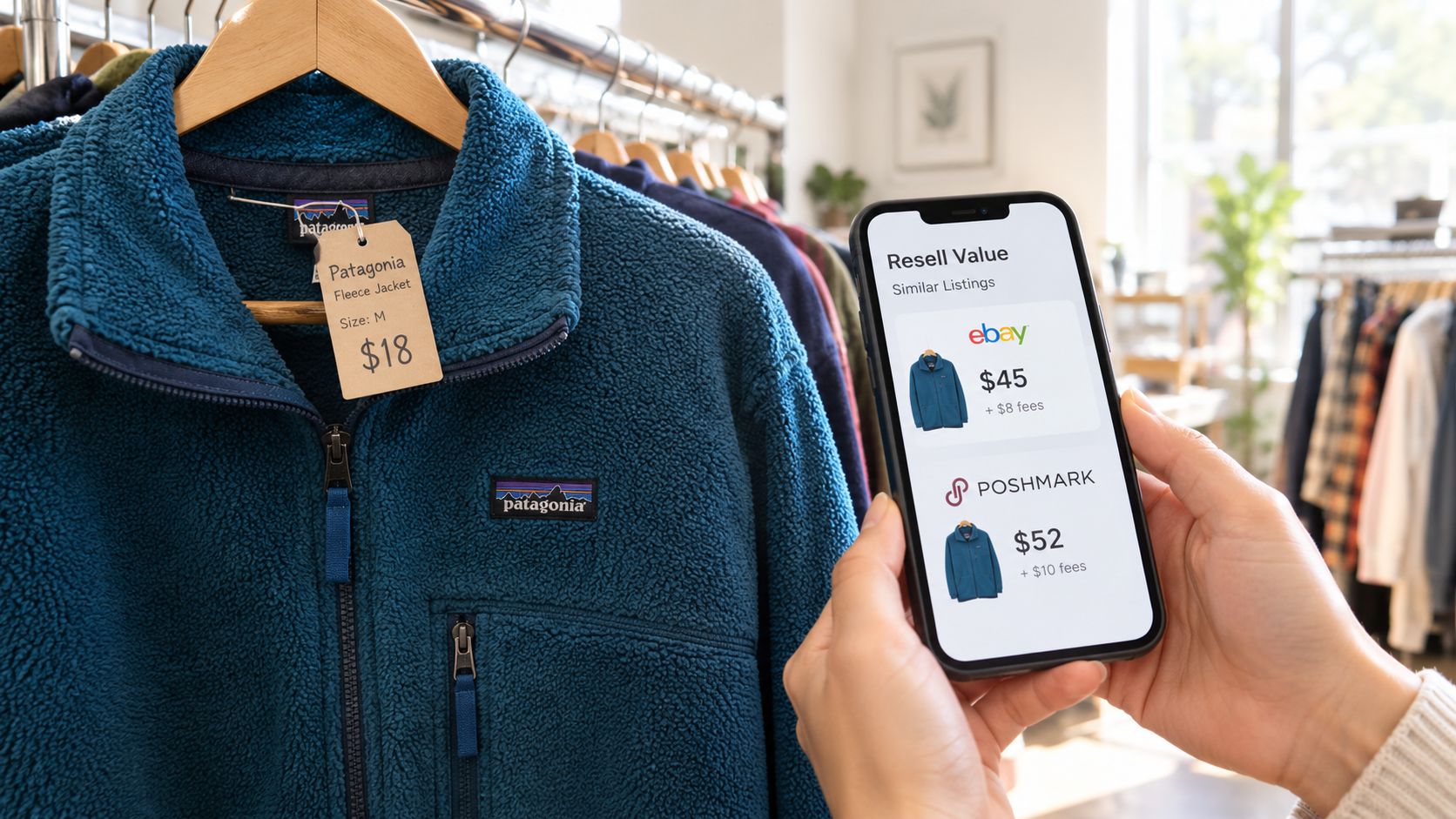
That Patagonia fleece looks like a straightforward buy. You pay $18, clean it, photograph it, and expect the sold comps to guide the list price. But the marketplace changes the math before the item ever reaches your death pile.
Suppose the fleece sells for $45 on eBay, with $8 in fees. After the purchase cost, your take-home before other expenses is $19. On Poshmark, the same piece might sell for $52, with $10 in fees, leaving $24 after the $18 cost of goods. Mercari might bring $48, with $8.50 in fees, leaving $21.50 before any additional expense.
Those aren't interchangeable outcomes. The higher gross sale price on Poshmark matters because the audience may already be looking for branded outdoor clothing, while eBay's broader buyer pool can be stronger for unusual colors, older styles, or searchable technical details.
Shelf price is only the first deduction
A thrift tag tells you what leaves your bank account. It doesn't tell you what reaches your payout balance. You still need to account for:
- Marketplace commission, which can consume a meaningful share of the sale.
- Fixed order fees, especially painful on low-dollar flips.
- Shipping exposure, including oversized packaging and seller-paid labels.
- Buyer geography, because a platform with national reach may outperform local demand for niche inventory.
- Sell-through and time, since a slightly lower net today can beat a higher theoretical net months from now.
Practical rule: Don't approve a buy because the gross comp looks good. Approve it only after you know which platform leaves enough room for your cost of goods, shipping, and time.
Platform choice is therefore a sourcing decision, not a listing decision. If an item only works on one marketplace, you need to know that while you're standing in the aisle. Otherwise, you're buying an item first and hoping the right audience appears later.
The Eight Platforms Resellers Actually Sell On
The eight platforms below cover most sourcing styles, from book scanning and retail arbitrage to live card breaks and local furniture sales. They're not identical marketplaces. Some are broad and searchable, some are tightly shaped around a category, and others depend on social discovery or live interaction.
| Platform | Primary Audience | Strongest Categories | Shipping Model | Marketplace Type |
|---|---|---|---|---|
| eBay | Broad national and international buyer base | Used goods, vintage, electronics, collectibles, parts | Seller-managed or eBay label | Open marketplace |
| Poshmark | Fashion-focused shoppers | Clothing, shoes, handbags, accessories | Poshmark label | Closed fashion marketplace |
| Mercari | Value-oriented marketplace buyers | Apparel, home goods, toys, electronics | Seller-managed or Mercari label | Open general marketplace |
| Amazon | Search-driven retail shoppers | Books, branded goods, media, replenishable products | FBM or Amazon FBA | Closed retail marketplace |
| TikTok Shop | Social and creator-led shoppers | Trend products, beauty, fashion, impulse purchases | Seller or platform-supported shipping | Closed social-commerce marketplace |
| Whatnot | Live-shopping and collector audiences | Trading cards, sneakers, collectibles, sealed products | Platform labels and live-sale workflow | Closed live-commerce marketplace |
| Facebook Marketplace | Local community buyers | Furniture, appliances, bulky home goods, general used items | Local pickup or shipped | Social local marketplace |
| ThredUp | Clothing cleanout and consignment shoppers | Clean, mainstream apparel and accessories | ThredUp handles fulfillment | Managed consignment marketplace |
Audience fit matters more than feature count
eBay is usually the broadest home for mixed inventory, especially when the item has a strong keyword trail or niche buyer base. Poshmark compresses the fashion selling process by providing a label and a buyer community that understands clothing, but its fee structure can punish low-priced items.
Amazon can work well for standardized products where condition and catalog identity are clear. It's less comfortable for one-off vintage goods or items that need a detailed condition conversation. Whatnot depends on your ability to present inventory live, while TikTok Shop relies heavily on content and social discovery.
Authentication also changes the equation. Luxury handbags, sneakers, and high-risk branded goods may benefit from a marketplace process that gives buyers more confidence, even if the platform costs more. Facebook Marketplace remains especially practical when a sofa, shelf, or exercise machine would lose its profit to shipping.
The comparison is a starting point, not a verdict. Your actual choice still depends on the item's sold comps, shipping profile, and buyer geography.
Fees and Net Profit on a Real Flip
Headline fees can mislead you because platforms don't all calculate deductions from the same base. eBay is commonly cited around 13% to 14.4% plus a fixed per-order fee, Poshmark charges 20% on items priced at $15 or more, and Mercari charges 10% on the combined item price and buyer-paid shipping, according to Mercari's current seller fee documentation. Amazon referral fees vary by category, often from 8% to 15% and as high as 45%, while fulfillment adds another cost layer, as summarized in this marketplace fee comparison.
Here's the problem with producing fake precision: shipping, category, seller status, payment method, and fulfillment choice can change the final payout. The table below uses the scenario amounts from the sourcing examples, but it doesn't pretend every marketplace can be reduced to one universal fee line.
| Platform | Lululemon Belt Bag, Sell $35 | Garmin GPS, Sell $120 | Cookbook Lot, Sell $22 | Total Fees | Net Profit |
|---|---|---|---|---|---|
| eBay | Varies by category and order fee | Varies by category and order fee | Varies by category and order fee | Must calculate per order | Depends on shipping and fee base |
| Poshmark | 20% fee applies | 20% fee applies | 20% fee applies | Category-specific total | Depends on shipping and cost of goods |
| Mercari | 10% of item plus buyer-paid shipping | 10% of item plus buyer-paid shipping | 10% of item plus buyer-paid shipping | Shipping affects fee base | Depends on shipping and cost of goods |
| Amazon | Referral fee varies by category | Referral fee varies by category | Referral fee varies by category | Fulfillment may add cost | Depends on FBM or FBA |
| Whatnot | Sale and payment deductions vary | Sale and payment deductions vary | Sale and payment deductions vary | Live-sale specific | Depends on auction outcome |
| Facebook Marketplace | About 5% if shipped, 0% local | About 5% if shipped, 0% local | About 5% if shipped, 0% local | Local pickup can avoid commission | Depends on local demand |
| TikTok Shop | Category and transaction deductions vary | Category and transaction deductions vary | Category and transaction deductions vary | Product and fulfillment specific | Depends on social demand |
| ThredUp | Consignment payout varies | Usually not the natural fit | Not the natural fit | Payout-based model | Depends on accepted item and sale outcome |
The three examples are useful because each exposes a different margin trap. A $35 vintage Lululemon belt bag sourced for $8 can tolerate some commission if fashion buyers support the price, but a low-dollar platform fee can still consume the flip. A $120 vintage Garmin GPS sourced for $25 has more room for commission, yet shipping, returns, testing, and buyer protection become central. A $22 lot of four paperback cookbooks sourced for $3 needs inexpensive shipping and efficient handling, or the labor can erase the apparent spread.
For a line-by-line worksheet, use this net profit calculation guide. The calculation should subtract cost of goods, marketplace fees, payment deductions, shipping paid by the seller, packaging, and any expected return reserve.
ThredUp is a different baseline because it's consignment. You send inventory into a managed system, and your payout depends on what the platform accepts and sells. That can suit a true closet cleanout, but it gives you less control over pricing, timing, and item-level platform selection.
The “cheapest” percentage rarely wins by itself. The platform where buyers pay a stronger sold price, with manageable shipping and acceptable turn time, often produces the highest net.
Matching Platforms to the Categories You Source
A platform should match the way buyers shop for the category. Clothing shoppers browse visually and compare brands. Book buyers search exact editions and ISBNs. Card buyers may want auction tension, while furniture buyers often want to avoid shipping altogether.
| Category | Best Primary Platform | Strong Secondary Platform | Avoid For This Category |
|---|---|---|---|
| Clothing | Poshmark for stronger fashion demand | Mercari for lower-priced pieces, eBay for vintage | ThredUp for items needing precise control |
| Books | eBay for lots and searchable used titles | Amazon for textbooks and cataloged editions | Local shipping-heavy sales |
| Trading cards | eBay auctions | Whatnot live breaks and collector sessions | Broad general listings without audience fit |
| Electronics | eBay | Amazon for standardized branded products | Local sales when national demand is stronger |
| Furniture | Facebook Marketplace local pickup | eBay only for shippable specialty pieces | Shipping-first platforms for bulky goods |
Clothing and accessories
A clean branded jacket or desirable fleece often belongs on Poshmark when the expected sale is above $40, while lower-priced clothing under $25 may fit Mercari better because Poshmark's fee structure is less forgiving on small flips. Vintage streetwear, unusual tags, and older technical garments can perform better on eBay because buyers search by exact model, era, and fabric details.
ThredUp makes more sense for a genuine cleanout than for a high-conviction BOLO. If you found a rare jacket with strong sold comps, giving up control may not be worth the convenience.
Books and cards
Books reward identification accuracy. eBay is useful for themed lots, collectible editions, and books where buyers compare condition closely. Amazon can suit textbooks and newer titles when the catalog match is clean, but FBA adds storage and fulfillment considerations.
Trading cards split by selling format. eBay auctions suit singles with an established comp trail, while Whatnot can make sense for sealed wax, graded singles, and live breaks where the host can create momentum. A card that looks profitable at a static sold price may not fit your audience or sales format.
Electronics and bulky goods
Tested electronics benefit from buyer trust and detailed condition records. eBay and Amazon can provide that national search intent, but returns and shipping damage need to be part of the buy decision.
Furniture is the easy call. If you find a solid dresser at an estate sale, Facebook Marketplace local pickup usually protects the margin because the buyer handles transportation. Shipping a bulky item turns a cheap source cost into a logistics project.
Checking Sold Comps Before You Buy
A shelf scan should answer two questions. What exactly is this item, and where does it leave the most money after fees and shipping? Gross sold prices answer only the first half of the buying decision.
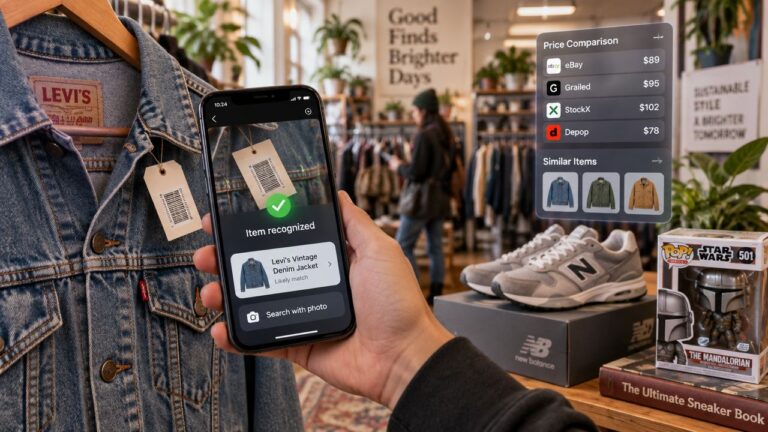
ScanFlip AI uses three scan methods that fit different sourcing situations:
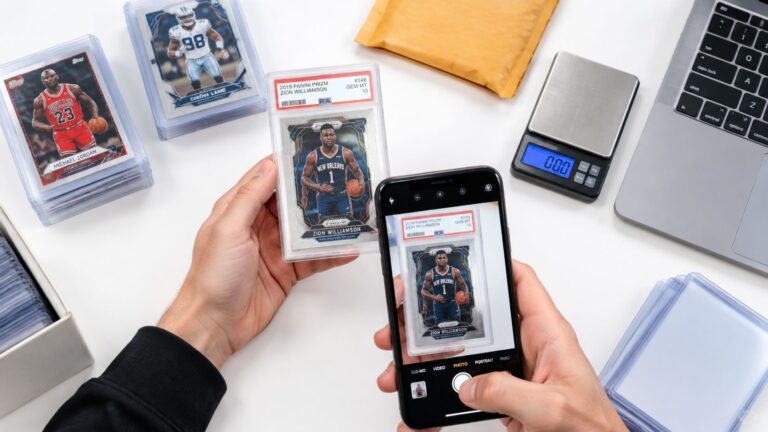
- AI photo scan: Point the camera at an untagged item, such as vintage clothing, shoes, collectibles, or electronics. No barcode is needed, which helps when the manufacturer label is missing or the item never had a UPC.
- Barcode scan: Read the UPC on books, media, games, supplements, and boxed retail. This is the fast route when the catalog identity is clear.
- Text search: Type the product name when the item can't be photographed cleanly or scanned. Search by brand, model, edition, or distinctive feature.
Photo scan for untagged inventory
Start with the full item, then capture the details that separate one model from another. On a Patagonia fleece, that might mean the style tag, size, color, and condition. On a collectible, it could be the exact release, markings, or included accessories.
The useful output isn't the highest asking price. It's the sold comps, filtered by recency, comparable condition, and brand or model match. Recent sold prices can change your decision, so use this sold price research workflow before you pay.
Barcode and text search for cataloged goods
Barcode scanning works well for a book bin because the UPC or ISBN narrows the match quickly. Compare the Amazon and Mercari results, then account for shipping weight, packaging, and the platform's fee base. A paperback lot that looks attractive as individual units may work better as an eBay bundle.
Text search handles the awkward middle. Maybe the box is missing, the barcode is damaged, or the item has several names in the market. Search until the title matches the language buyers use, because poor naming can bury an otherwise legitimate product.

The second decision is the real one
After identifying the item, compare projected net profit across eBay, Poshmark, Mercari, Depop, Amazon, Whatnot, ThredUp, Facebook Marketplace, and TikTok Shop. Then ask whether the likely turn time fits your cash cycle.
A green verdict on a slow collectible may still be a pass if your sourcing budget is tight. A smaller net on a fast-moving book bundle may be better if it turns cash back into sourcing money quickly.
Selling on More Than One Platform at the Same Time
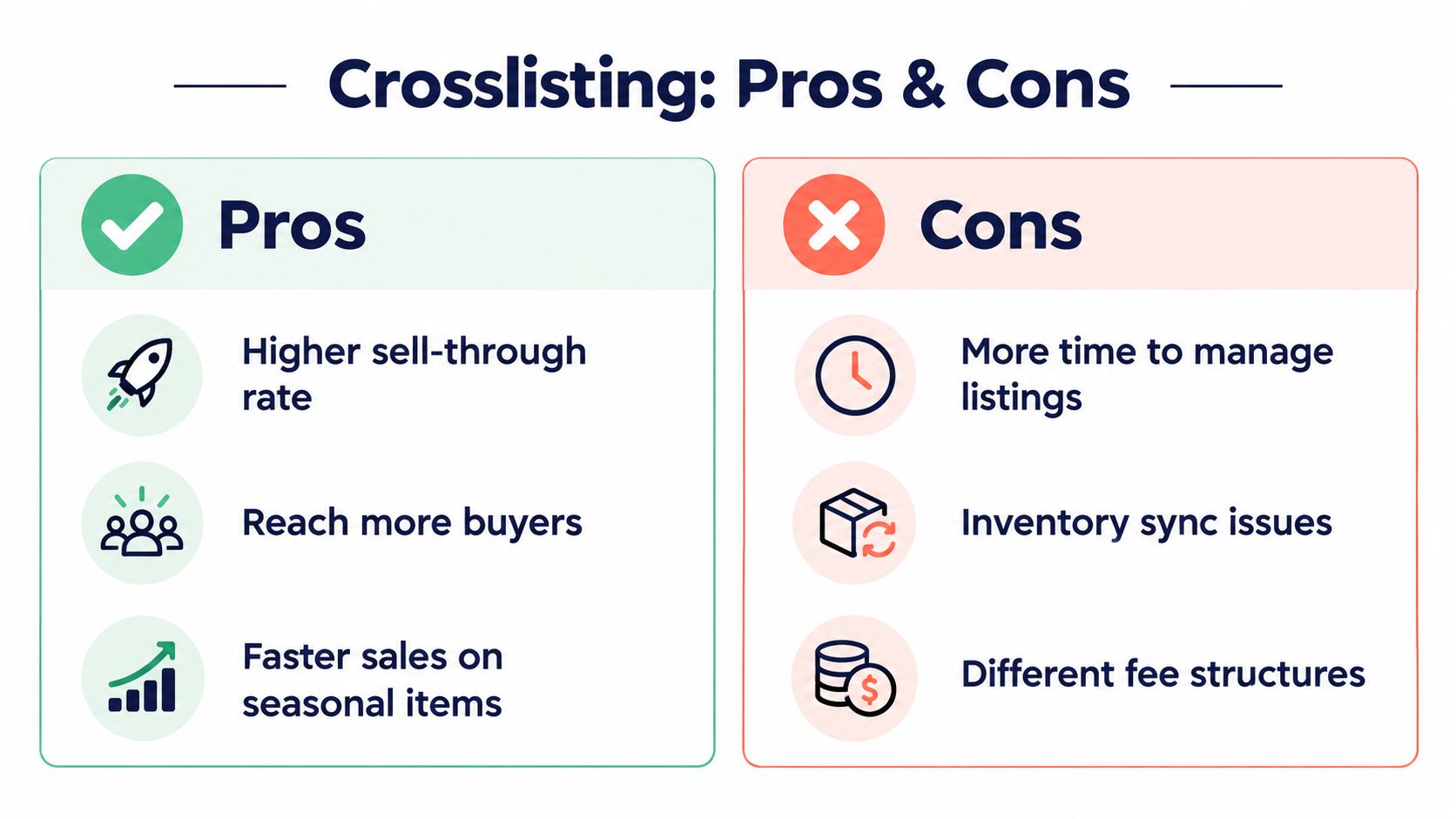
Crosslisting can make sense when buyer pools don't fully overlap. A mid-tier jacket priced between $25 and $60 may reach a fashion buyer on Poshmark, a bargain shopper on Mercari, and a collector of older styles on eBay. More exposure can improve your chances of finding the right buyer, but it also creates work that doesn't show up in the fee calculator.
Reach versus maintenance
The upside is clear:
- More buyer coverage: Each marketplace brings a different search habit and audience.
- Better seasonal exposure: A coat may find the right shopper faster when it appears in multiple relevant feeds.
- Less platform dependence: One slow marketplace doesn't control the item's entire sales path.
The downside is just as real. You'll resize photos, duplicate descriptions, answer messages in separate inboxes, update prices, and remove every other copy immediately after a sale. Double-selling is more than an inconvenience. It can create cancellations, account issues, and an unhappy buyer.
Tools such as Vendoo and List Perfectly can help resellers manage crosslisting alongside their normal workflow. ScanFlip belongs upstream, before any listing goes live, because it helps compare sold comps and projected net profit by marketplace. This guide to selling on multiple platforms is useful when deciding how much operational complexity your inventory can support.
Working rule: Crosslist when the projected net-profit spread is larger than the extra time required to create, monitor, and remove the additional listings.
That rule keeps crosslisting from becoming a reflex. A rare vintage jacket with distinct demand may justify three channels. A $12 household item probably doesn't, especially if each copy takes several minutes to create and maintain.
Which Platform Fits Your Selling Style
Your selling style should determine the default stack, not the other way around. A part-time thrifter with one garage bag a month needs a different system from a full-time reseller who sources every day and can absorb more workflow.
| Seller Type | Primary Goal | Default Platform | Add-On Platforms |
|---|---|---|---|
| Part-time clothing seller | Simple selling with manageable effort | Poshmark or Mercari | eBay for unusual pieces |
| Full-time mixed-inventory flipper | Breadth and consistent sourcing | eBay | Amazon, Whatnot, and category-specific channels |
| Speed-focused side hustler | Same-day cash and low shipping hassle | Facebook Marketplace | Mercari local or shipped |
| Vintage or luxury seller | Audience intent and premium pricing | Poshmark or Whatnot | eBay for niche search demand |
| Hobby seller testing a category | Prove demand before expanding | One focused platform | Add channels after validation |
A part-time seller clearing one bag of clothing each month shouldn't build a complicated multi-platform operation. Poshmark can keep fashion in one ecosystem, while Mercari may fit lower-priced pieces. Use eBay for anything with unusual vintage details, specialized outdoor features, or a buyer who searches by model rather than outfit.
Full-time flippers usually need eBay's breadth as the anchor. Amazon can support media and branded retail, while Whatnot may suit trading cards, sneakers, and collectibles that benefit from live presentation. This isn't about putting every item everywhere. It's about assigning each category to the audience that already understands it.
Speed and margin aren't the same target
Facebook Marketplace and local Mercari activity can suit sellers who value quick pickup over maximum price. A bulky home item that sells locally can be a good flip even when a shipped sale appears to offer a higher gross number.
Vintage and luxury sellers should spend more time on condition, authenticity, measurements, and buyer trust. A premium audience can justify the effort, but only when the sold comps support the ask.
For a new category, start with one platform and measure your own results. A practical internal threshold is a sell-through rate above 60% at your target price, then expansion once the process is repeatable. If fill rate stays below 40% after 20 listings, or platform fees consume more than 35% of the sale price, reassess the category, price, or marketplace rather than feeding the death pile. Those are operating rules, not universal market statistics.
Quick Decision Checklist and Common Questions
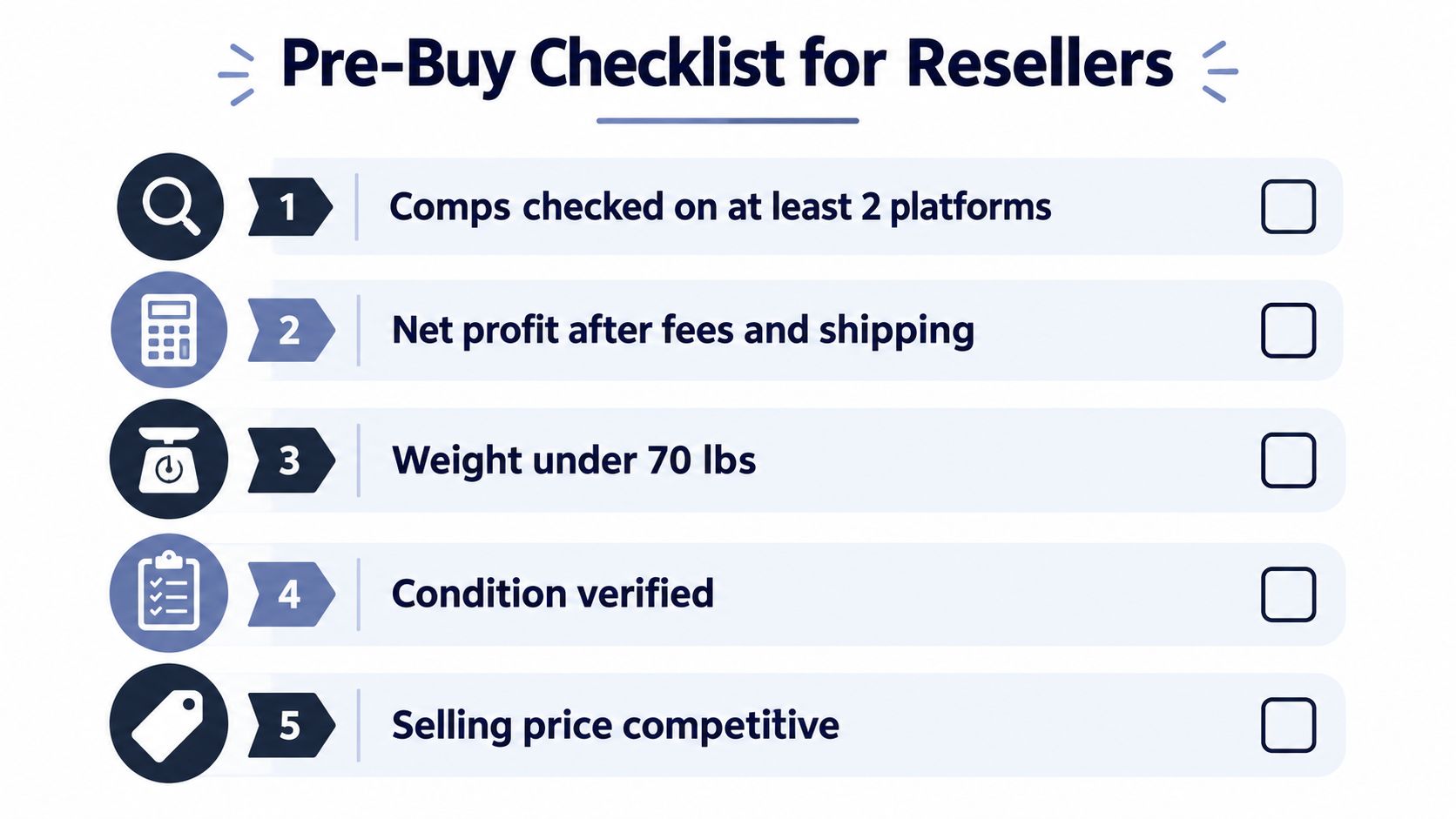
Before money leaves your hand, run the item through a short buy-or-pass routine. You're trying to protect cash, shelf space, and listing time, not chase every attractive sold comp.
The aisle checklist
- Check sold comps: Compare the item on at least two relevant platforms, using completed sales rather than asking prices.
- Calculate net profit: Subtract cost of goods, fees, shipping, packaging, and a realistic return allowance.
- Check weight: Stay under 70 pounds unless you already have a freight-friendly shipping plan.
- Verify condition: Test electronics, inspect clothing for flaws, confirm card grades, and match book editions.
- Confirm the selling price: Make sure your target price is competitive with recent sold comps, not just optimistic active listings.
- Match the cash cycle: A slow high-margin item may not fit a seller who needs quick capital rotation.
Common questions
Where should I sell used books for the highest net?
eBay often fits lots, collectible editions, and mixed bundles. Amazon can make sense for textbooks and newer cataloged titles, particularly when you can fulfill efficiently. Media Mail and accurate edition matching matter more than choosing a platform from a generic fee chart.
What's the best platform for handmade goods?
Compare Amazon Handmade with Etsy. Etsy is omitted from the main comparison because this guide focuses on the eight reseller platforms above, but handmade sellers should still evaluate buyer intent, transaction deductions, presentation, and whether they're building a repeatable branded product line.
What should I do with items under $10?
Bundle them on Mercari, create eBay lots, or move them through a Whatnot break session when the category fits. Low-value singles often lose their appeal after fixed fees, packing time, and customer messages.
How should I handle returns that eat margin?
Build a 5% return buffer into your internal net-profit calculation. That's a planning assumption, not a universal return rate, and you should adjust it based on your category and own history.
Does ScanFlip work offline?
Yes. Scans queue and sync when the connection returns, which helps in a garage, estate sale, or thrift store with poor reception.
The best platform for selling online changes from one item to the next. Check sold comps, calculate the actual payout, and choose the marketplace before you buy, not after the item becomes another box in your death pile.
ScanFlip AI identifies items through AI photo scan, barcode scan, or text search, then compares sold comps across major reseller marketplaces and estimates net profit after fees and shipping. Use ScanFlip AI on your next sourcing trip to make a clearer flip-or-pass decision before you spend.