


How to Calculate Net Profit: A Reseller’s Ultimate Guide
You're standing in a thrift aisle with an item in your hand, a price tag staring back at you, and about thirty seconds to decide. The sold comps look promising. The buy cost seems low. That's the exact moment most resellers get fooled by gross numbers.
A strong resale business isn't built on finding items that could sell high. It's built on knowing how to calculate net profit fast enough to buy with confidence and strict enough to avoid slow, low-margin inventory. That's harder than most guides admit, because resellers rarely know the final sale price in advance. You source based on comps, fee schedules shift, shipping estimates move around, and a return can erase what looked like a winner.
That's the problem. Existing content often skips the messy part. It tells you net profit is revenue minus expenses, but resellers buy first and learn the exact revenue later. A 2025 Arbitrage Insights report discussed by Harvest says 65% of resellers fail to adjust net profit calculations for sale probability and price variance, which leads to a 30% higher rate of unprofitable flips. That's why good finds still turn into bad buys.
Table of Contents
- The Difference Between a Good Find and a Profitable Flip
- Deconstructing Your Expenses: The Full Cost of a Flip
- Net Profit in Action Worked Examples for Top Marketplaces
- Beyond the Math Establishing Your Profit Rules
- Automate Your Profit Calculations with ScanFlip AI
- Conclusion From Guesswork to a Scalable Reselling Business
The Difference Between a Good Find and a Profitable Flip
A vintage leather jacket priced at $15 looks like a win. The label is solid, the condition is good, and the sold listings suggest it might sell for far more. New resellers stop there. Experienced resellers don't.
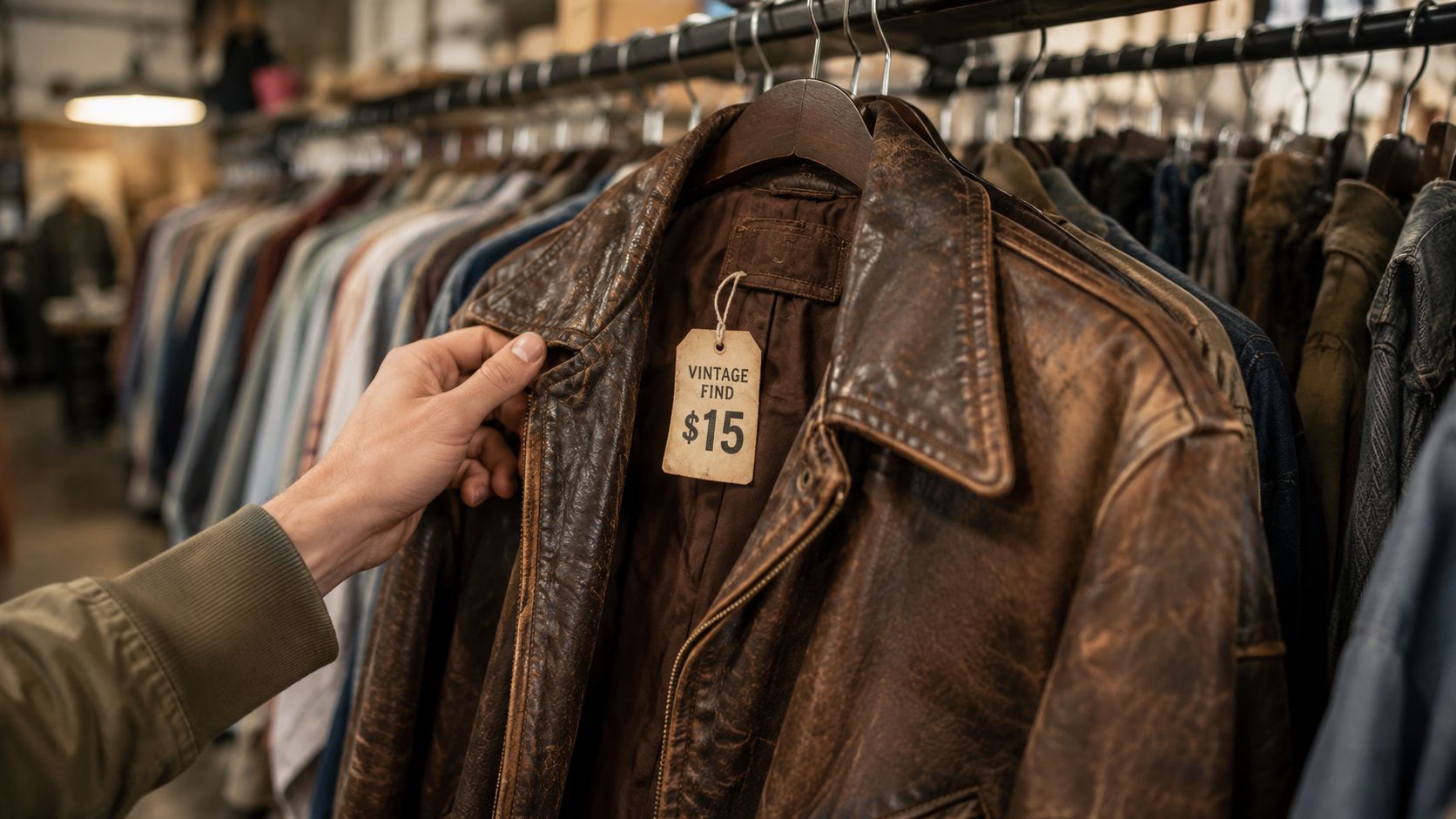
The key question isn't “What can this sell for?” It's “What will I keep after every cost, after waiting for the sale, and after accounting for the chance that it sells below the top comp?” That's the gap between a fun thrift score and a repeatable business.
A lot of sourcing mistakes start with optimistic comps. Sellers look at the highest recent sale instead of the middle of the market. They ignore slow sell-through. They assume the item will move quickly because it should move quickly. If you source like that for long, your death pile fills up with “good finds” that never became profitable flips.
Good resellers don't buy the item. They buy the expected outcome.
That's why comp selection matters as much as cost control. If sold prices vary a lot, the average can mislead you. In practice, the safer move is to source against a conservative comp, especially on categories with style, season, or condition risk. That's the missing piece in most beginner advice.
If you want a category-level view of what tends to hold margin better, this roundup of best items to resell for profit is useful as a sourcing filter. It won't replace the math, but it will help you spend more time on inventory types that behave better once the math starts.
Deconstructing Your Expenses: The Full Cost of a Flip
You're in a thrift aisle holding a pair of boots priced at $18. Recent sold comps range from $42 to $68. If you buy off the top comp, the deal looks great. If the pair sells at $46 after a markdown and the platform takes its cut, you may have bought yourself a slow, low-margin problem.
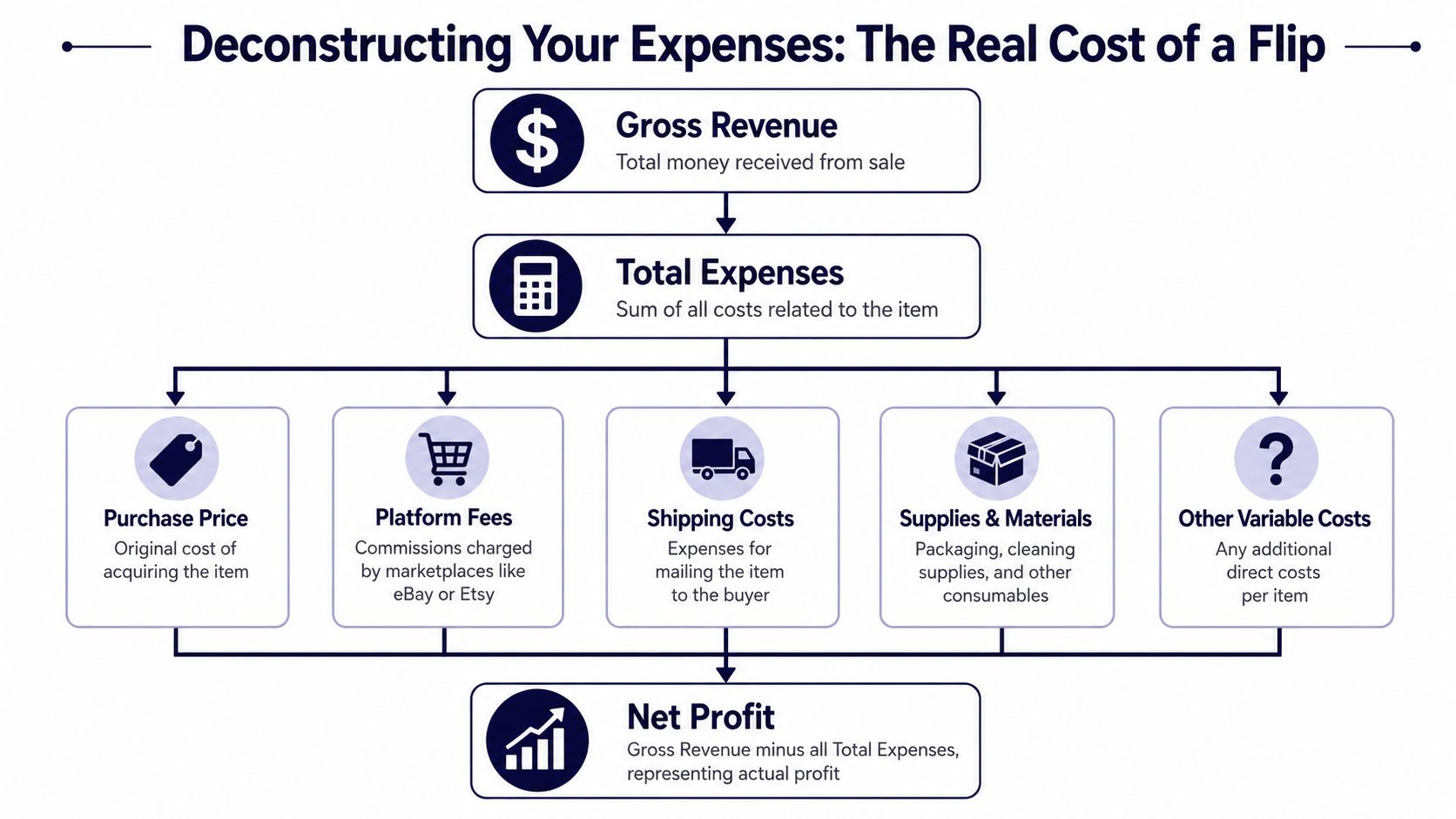
Start with the full formula
Use one formula every time:
Net Profit = Selling Price – (COGS + Platform Fees + Shipping + Prep + Returns + Overhead)
That baseline keeps sourcing decisions honest. Resellers who only track buy cost and sale price usually miss the deals that look good in the store but collapse after fees, shipping, and returns.
Paddle's explanation of the net profit formula for resellers lays out a disciplined way to calculate profit by removing direct costs, operating costs, and taxes in order. That structure matters because small leaks add up fast. A few dollars missed on shipping, supplies, or returns can wipe out the margin on a mid-priced flip.
Platform fees punish bad assumptions
Fees are rarely static, and they rarely stay simple once you sell across more than one marketplace. Amazon, eBay, Poshmark, Mercari, and StockX all take money differently. Some charge a straightforward percentage. Some layer in fulfillment, payment processing, or category-specific costs. Some make low-priced items look better than they are because the fee impact feels smaller until you stack enough volume.
The practical mistake is relying on memory.
If your spreadsheet still uses last year's fee assumptions, your sourcing math is wrong before you scan the item. That's how resellers end up buying inventory that produces sales but not cash.
Shipping, prep, and returns decide whether the margin survives
Shipping is where many “profitable” flips die. Heavy jackets, boots, breakables, and multi-item bundles can absorb far more postage than expected. Sellers who estimate shipping after listing are already late. The better move is to check the likely packed weight, dimensions, and service level before buying. This guide on how to estimate shipping costs for resale items is a useful reference if you want a repeatable method.
Prep costs are easier to ignore because they look small. A poly mailer here, a replacement insole there, a battery for testing, a lint roll, tape, labels, a box. On one item, it feels trivial. Across a hundred units, it becomes a real line item.
Returns deserve the same treatment. Apparel, shoes, and electronics all carry return risk for different reasons. Fit issues, condition disputes, missing accessories, and buyer remorse are part of the business. Build a reserve for that reality instead of acting surprised when it hits your payout.
If a deal only works at the highest comp, with perfect shipping, and no return risk, pass on it.
Overhead belongs in the model
A single flip does not carry your full monthly business expense, but every flip should carry part of it. Storage, mileage, listing tools, label printers, internet, shelving, photo gear, and workspace costs support the sale even when they never appear on the marketplace receipt.
Small operators often get stuck. They say, “I made money on paper,” while cash stays tight because the business is funding hidden costs from somewhere else.
Time matters too. A sweater that nets $12 in two weeks can be better inventory than a jacket that nets $20 after four months. Resellers need math that accounts for uncertain sale price and uncertain timing at the same time. That's what lets you make fast sourcing calls without gambling on best-case outcomes.
Use a simple checklist so every buy runs through the same filter:
- Acquisition cost: Include item cost and any tax if that's part of how you track inventory.
- Marketplace fees: Use the current fee structure for the platform where you expect to sell it.
- Shipping: Estimate outbound shipping, and include inbound shipping if inventory is headed to a warehouse.
- Prep and supplies: Count cleaning, testing, packaging, labels, and replacement parts tied to the unit.
- Returns reserve: Add a buffer for categories where returns are common.
- Overhead allocation: Assign a small share of business costs to each item.
That system does two things. It protects you from bad buys, and it speeds up good ones. Once every expense bucket is built into your process, you stop guessing in the aisle and start sourcing like someone planning to scale.
Net Profit in Action Worked Examples for Top Marketplaces
One item can be profitable on one platform and mediocre on another. That's why “What's it worth?” is the wrong question. The right one is “Where does it leave the best net after fees and shipping?”
Why the same item pays differently
Use the same core formula everywhere, but don't pretend the marketplaces behave the same. Ecom Calc Tools' retail arbitrage margins breakdown gives a clean example: a shoe bought for $20 and sold for $60 on Amazon can absorb a $9 referral fee, a $12 FBA fee, and $5 shipping, leaving $34 net profit and a 170% ROI. That example shows why fee-aware pricing matters more than headline resale price.
That same source also notes that eBay typically charges around 13% final value fees, while Poshmark charges a flat 20% on sales over $15. So even if the market price looks similar across platforms, your take-home won't be.
Here's the practical lesson. If you buy a pair of brand-name jeans for $10 and expect them to sell around the same gross price on multiple marketplaces, the platform with the lighter total cost structure usually wins. But platform fit still matters. Some items move faster on Poshmark than eBay. Some do better in FBA despite the extra fee load. Net profit has to be paired with sell-through and labor.
A platform with a lower fee doesn't help if your item sits there.
Marketplace fee comparison 2026 estimates
| Marketplace | Final Value Fee | Payment Processing | Typical Net (on $50 sale) |
|---|---|---|---|
| Amazon FBA | 15% referral fee plus variable FBA fees | Varies by structure | Depends heavily on item size, weight, and fulfillment cost |
| eBay | Around 13% | Included separately by structure and account setup | Usually stronger than gross math suggests only if shipping is controlled |
| Poshmark | 20% on sales over $15 | Built into platform structure | Simpler math, but margin can compress fast |
That table is why one-size-fits-all calculators fail. They flatten category differences, ignore shipping realities, and assume the same fee logic everywhere.
Mercari adds another layer because fee presentation and seller expectations can confuse quick sourcing decisions. If that's one of your regular channels, a Mercari fee calculator walkthrough helps when you want platform-specific math before you buy.
The core habit is simple. Run the item through the platform where you expect to sell it, not the platform with the prettiest comp.
Beyond the Math Establishing Your Profit Rules
A reseller can know the formula and still lose money.
It happens every week. You find a product at $12, comps look like $35 to $40, and the buy feels safe. Then the actual sale lands at $31 after a price drop, shipping runs higher than expected, the platform takes its cut, and your “good find” turns into $4 net for 20 minutes of work. That is not a business. That is busywork.
Experienced resellers fix this with buying rules. The goal is speed with discipline. If sale prices move, fees change by marketplace, and condition risk sits in the background, rules stop you from making a fresh emotional decision on every single item.
Use the 3X rule as a first pass
The 3X rule is a practical sourcing filter. If you pay $10, you want a believable path to roughly $30 or more in resale value. Underpriced discusses that benchmark in its guide to retail arbitrage for beginners.
That rule works because live sourcing is full of uncertainty. The comp you saw may not be the price you get. You may need to accept an offer, promote the listing, or cut price to move stale inventory. Starting with a wider spread gives the deal room to survive real selling conditions.
It is only a filter, not approval.
A $10 item that sells for $30 can still be a bad buy if fees are heavy, shipping is awkward, or return risk is high. A small media item and a bulky kitchen appliance can hit the same multiple and produce very different take-home profit.
Use this quick sequence:
- Check the resale range. Look for the actual realistic sold range, not the highest comp.
- Run the low-end scenario. If the deal only works at the best-case sale price, skip it.
- Set a minimum net floor. Many resellers use a fixed dollar target so they do not waste time on low-return flips.
- Factor in effort. Cleaning, testing, bundling, prep, and storage all count.
Build rules that match your model
Profit rules should reflect how you sell.
If you are a high-volume thrift or clearance buyer, a lower net per item may work because labor is low and listing is fast. If you sell slower, harder-to-ship products, the net target needs to be higher because each mistake ties up more cash and time. I would rather buy ten clean $12 profit flips that move fast than one $35 profit item that needs testing, oversized shipping, and three buyer questions before it sells.
Simple rules help in the aisle because they remove negotiation with yourself. A solid rule set usually includes:
- Minimum net profit: Set a floor that makes the work worth doing.
- Minimum ROI: Keep enough margin so a lower-than-expected sale price does not wipe out the deal.
- Demand check: Confirm that items sell, not just that people list them.
- Risk adjustment: Use tighter buy prices for seasonal, fashion, fragile, or return-heavy categories.
Amazon sellers often add a demand rule based on sales rank, using it alongside margin and ROI thresholds. As noted earlier, lower rank generally signals healthier movement than stagnant listings with attractive pricing.
Good sourcing rules are there to protect margin when the sale price, fees, and time-to-sell do not go your way.
The best part is consistency. Once your rules are clear, you can make faster decisions under pressure. You stop chasing “maybe” deals and start buying inventory that still works when the final sale is weaker than the comp you hoped for.
Automate Your Profit Calculations with ScanFlip AI
You are in a thrift aisle with a $14.99 coffee maker in one hand and your phone in the other. eBay sold comps range from $38 to $55. Amazon looks better, but the fees are higher and the return risk is worse. If you guess wrong by $8 on the sale price and miss one fee, the deal goes from a solid buy to dead inventory.
That is a significant problem with net profit in reselling. The formula is simple on paper. The inputs are not stable in the field.
Manual math breaks down during live sourcing
Resellers do not source under clean conditions. Sale prices move. Shipping changes by weight, distance, and packaging. Fees differ by marketplace, category, and fulfillment method. Some items can be cross-listed. Others only make sense on one platform.
That creates a speed problem.
If it takes three minutes to check comps, estimate fees, and run a conservative profit number, you will miss buys or start cutting corners. Cutting corners is where bad inventory gets into your cart. I have seen plenty of resellers buy a product with a projected $12 profit, then realize later that actual net was closer to $4 after heavier shipping, promoted listing fees, or a lower final sale price.

What automation changes
A good sourcing tool cuts the delay between spotting an item and making a buy or pass decision. It identifies the product, pulls sold comps across marketplaces, applies platform-specific fees, and shows expected net profit based on realistic sale ranges instead of one optimistic number.
That matters because uncertain sale prices are where many sourcing decisions fail. A manual calculation usually relies on a best-case comp. A useful system lets you compare outcomes at different sale prices, so you can see whether an item still works if it sells at the low end of the range. That is how experienced resellers protect margin.
ScanFlip AI is built for that workflow. Instead of juggling tabs and rough estimates, you can scan an item from a photo, review sold data, and check expected take-home profit fast enough to use it while sourcing. The value is not that it replaces judgment. The value is that it makes your judgment faster and more consistent.
Consistency is what scales.
Once the math is systematized, you can evaluate more inventory in less time without lowering your standards. You stop relying on memory for fee rates. You stop buying based on the highest comp you found first. You get a repeatable process for handling messy inputs, which is what real sourcing looks like every day.
Conclusion From Guesswork to a Scalable Reselling Business
A lot of resellers still shop on instinct and call it experience. Instinct helps with style, condition, and brand recognition. It doesn't replace the math.
The sellers who last treat every item like a tiny business decision. They count fees before they buy. They use conservative comps when sale price is uncertain. They build rules that protect capital. And they don't confuse a good-looking gross sale with a healthy flip.
That shift matters more than might be apparent. Once you learn how to calculate net profit the right way, the business gets clearer. Bad inventory becomes easier to reject. Good inventory stands out faster. You stop filling your cart with maybes and start buying on purpose.
If you want a reselling business that scales, stop asking what an item might sell for. Ask what it should return after every cost, under realistic conditions, on the platform that fits it best. That's where consistency starts.
If you want faster buy-or-pass decisions while sourcing, ScanFlip AI helps you identify items from a photo, pull sold comps across major marketplaces, and see expected net profit after fees and shipping. It's built for the exact moment when manual math is too slow and guesswork gets expensive.