
Bulk Resale Items That Actually Sell and How to Vet Them
A $200 Gaylord of books looks like an easy buy when you're standing at an estate sale. Divide the price by the number of titles, and the per-book cost feels almost free. The same pull hits when someone offers a pallet of mixed electronics, a storage-unit cleanout, or a table of untested returns for one low price.
That's where many bulk resale items turn into expensive inventory. The sticker price only tells you what the lot costs. It doesn't tell you how many units will be sellable, how long testing and cleaning will take, what shipping will cost, or whether marketplace fees will leave anything after the sale.
Table of Contents
- Introduction Why Bulk Lots Tempt and Trap Resellers
- Understanding Landed Cost and Fee Compression
- Which Bulk Categories Actually Move Right Now
- How to Read Sold Comps and Sell Through Inside a Lot
- A Fast Vet Workflow for Bulk Buys in the Aisle
- The Hidden Labor Math That Kills Pallet Profits
- Your Bulk Buy Decision Checklist and Next Steps
Introduction Why Bulk Lots Tempt and Trap Resellers
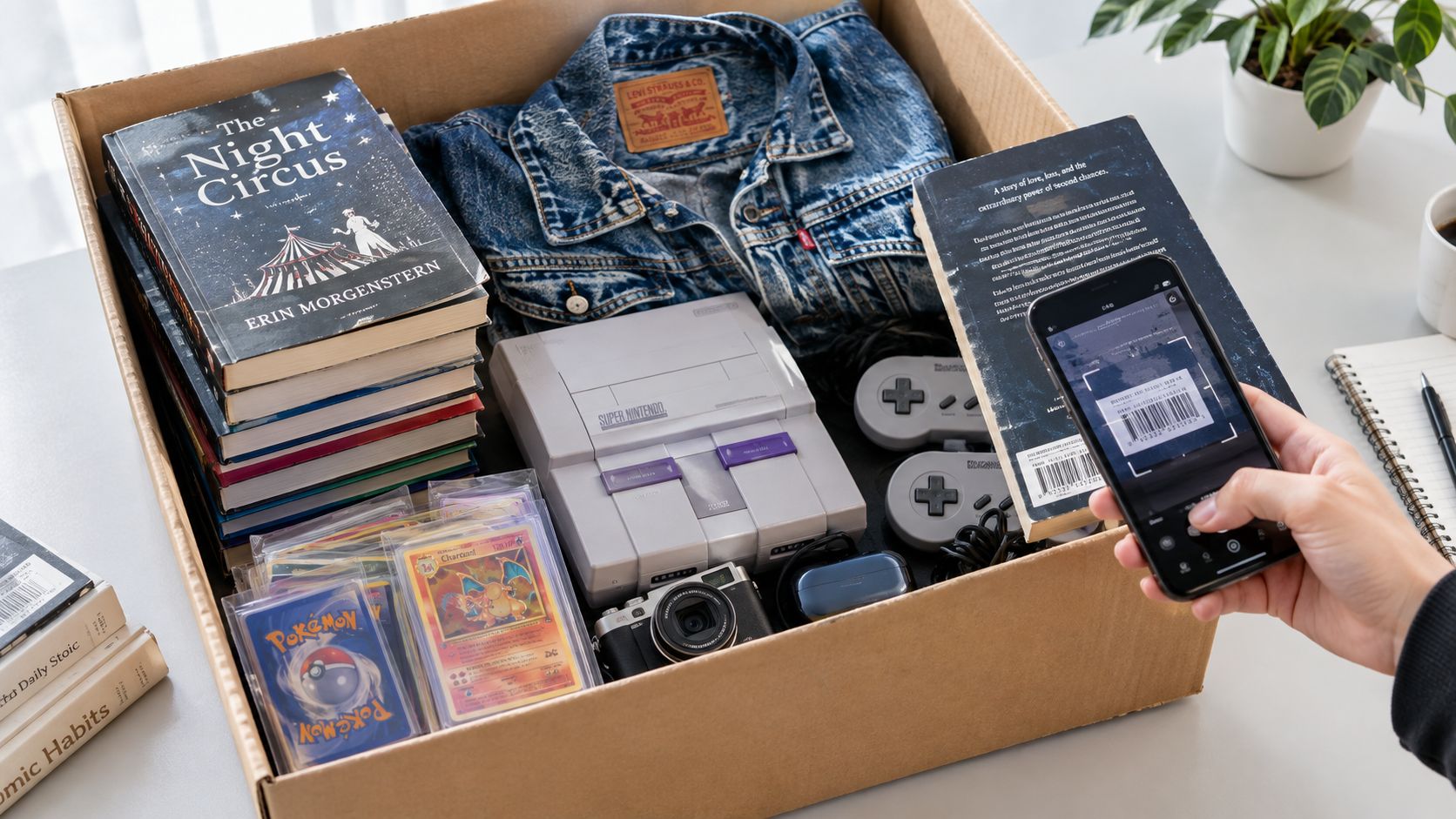
Bulk buying appeals to every kind of reseller. Book scanners see volume at library sales. Clothing pickers see a Gaylord packed with vintage pieces. Card flippers see a collection that might hide a few premium cards among common stock. Retail arbitrage sellers see a pallet that could feed several selling channels at once.
The attraction is real. The global second-hand market excluding automotive was estimated at $180 billion, with online marketplaces handling about $90 billion, or roughly half of that value, according to this analysis of the second-hand marketplace economy. Digital marketplaces give resellers faster sold-price discovery across apparel, electronics, furniture, books, collectibles, and general merchandise.
But volume multiplies mistakes. A single bad thrift purchase wastes one sourcing decision. A bad pallet ties up cash, shelf space, packing supplies, and your weekend. If half the items need testing, repair, or disposal, the low cost per unit becomes meaningless.
Practical rule: Buy the recovery rate, not the pile size.
Consider that electronics pallet. The manifest may show recognizable brands, but “customer return” can include missing chargers, locked devices, cracked screens, dead batteries, or products that fail after a short test. A book Gaylord has a different problem. The books may be cheap, but slow-moving titles create a death pile that occupies space while better inventory waits for attention.
A workable bulk purchase passes three filters:
- Category fit: You understand the condition issues, buyer demand, and best selling channels.
- Sold-comp support: Representative items have real sold prices, not optimistic asking prices.
- Net profit: The lot still works after cost of goods, freight, fees, shipping, returns, labor, storage, and disposal.
The right question isn't “How much inventory do I get?” It's “How much sellable inventory can I convert into net profit without burying myself in labor?”
Understanding Landed Cost and Fee Compression
Sticker price is only the acquisition line. Landed cost is the fully loaded cost of getting a unit ready to sell and delivering it to the buyer.
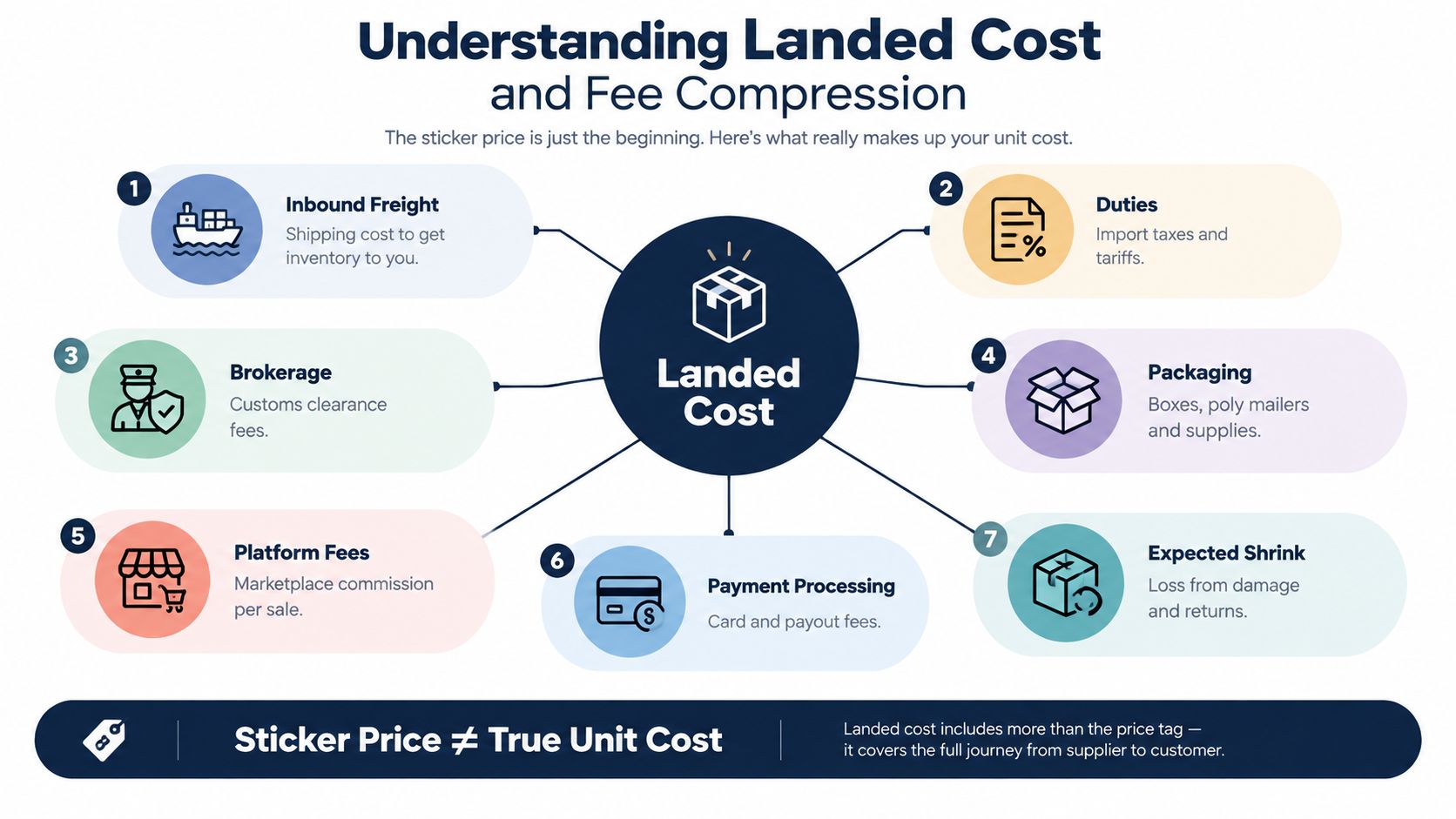
For imported or shipped lots, include inbound freight, duties, customs brokerage, insurance, labeling, packaging, and handling. Then add selling costs, including marketplace fees, payment processing, expected returns, and any loss from damaged or unsellable units. A $12 sold price can look healthy until those deductions consume the spread.
An industry guide models wholesale selling with marketplace fees around 15% on Amazon, payment processing at 2.9% plus $0.30, and returns at 3% to 8% for most categories, as shown in this bulk resale cost and margin guide. Those figures are examples from the guide's model, not a universal fee schedule, so check the current deductions for your exact channel.
Build the unit cost before buying
Use a simple lot calculation:
Fully loaded lot cost = purchase price + inbound freight + duties + brokerage + insurance + supplies + expected handling costs
Then divide by the number of units you expect to sell, not the number physically sitting in the pallet.
If a lot contains damaged, incomplete, or unmarketable goods, those units still consume space and labor. A recovery-rate estimate gives you a more honest denominator. From there, calculate expected net profit per unit by subtracting the marketplace fee, payment processing, outbound shipping, packaging, expected returns, and allocated labor from the expected sold price.
The guide to calculating net profit for reselling is useful when you're building this model around actual sales deductions instead of gross revenue.
Fixed charges hurt cheap items most
Low-ticket bulk resale items have little room for error. A fixed payment charge takes a larger share of a $10 sale than of a $100 sale. A shipping label can also erase the difference between a profitable flip and a loss, especially when the item is bulky, fragile, or difficult to bundle.
Facebook Marketplace provides a clear example. Shipped sales carry a 10% fee with a minimum of $0.80 per listing, while local pickup listings have no selling fee, according to this Facebook Marketplace fee summary. A $9 shipped sale therefore needs a different calculation from the same item sold through local pickup.
Set a margin floor before you bid. The cited industry model recommends targeting at least 45% gross margin for new sellers, with 30% considered workable only when turnover is proven and exceeds 4x per year. Use that as a planning benchmark, then adjust for your labor, storage, and risk. If a lot can't clear your threshold after all deductions, pass.
Which Bulk Categories Actually Move Right Now
The best category depends on the operation you can run. Books may tolerate a low buy cost and repeatable scanning, while electronics may offer better ticket potential but punish weak testing. Clothing can be compact and ship-friendly, yet condition grading and photography take time.
Online resale has made price discovery central to bulk sourcing. The second-hand economy is no longer a niche channel, and online marketplaces now represent about half of second-hand value in the industry analysis cited earlier. That supports faster comparison across categories, but it also means you're competing with sellers who can price from the same sold data.
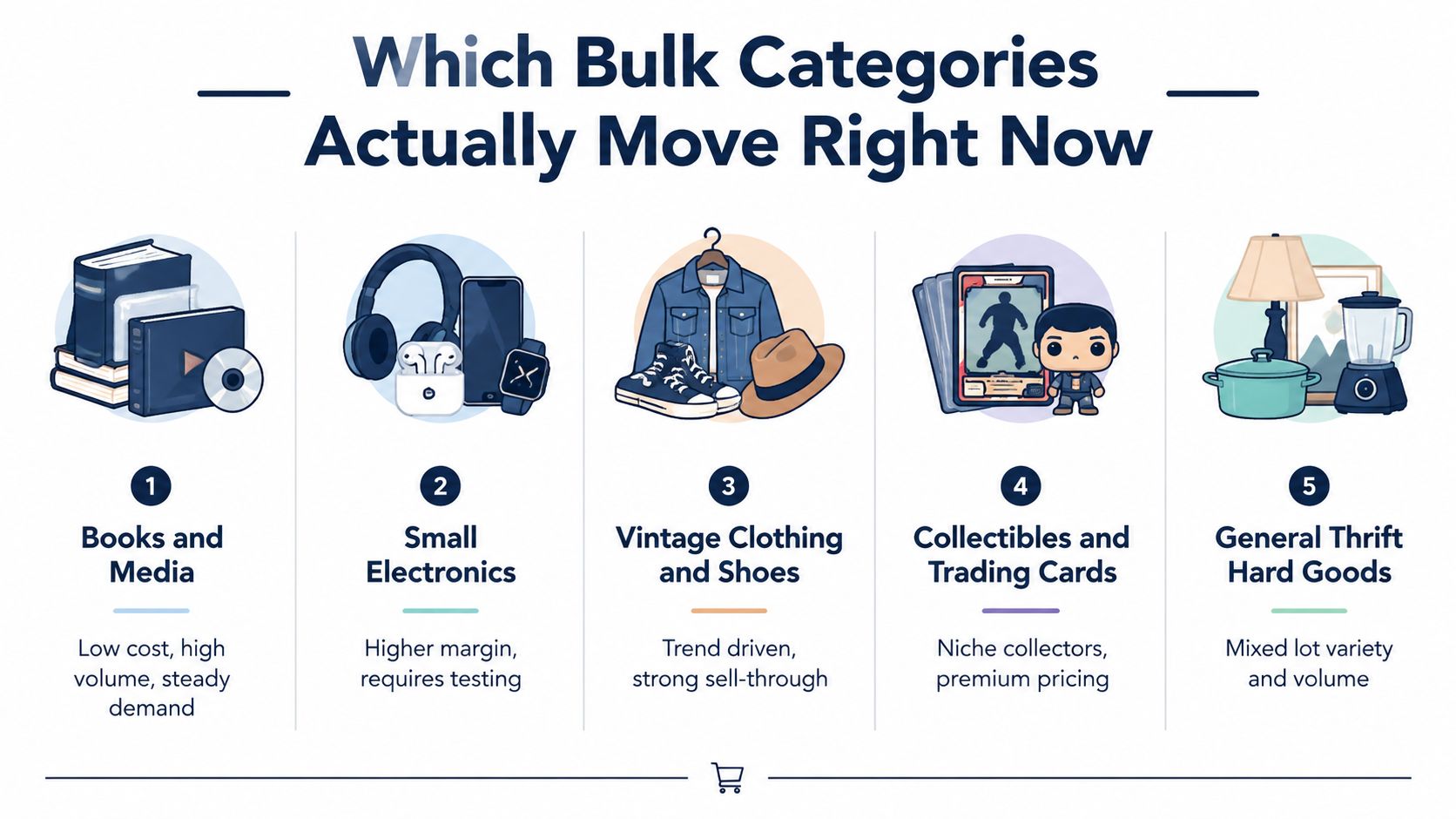
Compare the work, not just the upside
| Category | Typical Ticket | Condition Risk | Labor Intensity |
|---|---|---|---|
| Books and media | Low to moderate | Missing parts, writing, edition differences | Repetitive scanning and listing |
| Small electronics | Moderate to high | Untested, defective, incomplete | High, testing and charging required |
| Vintage clothing and shoes | Moderate | Stains, odors, flaws, sizing uncertainty | Moderate, cleaning and measurements |
| Collectibles and trading cards | Low to high | Authenticity, condition, incomplete sets | Moderate, identification and grading |
| General thrift hard goods | Low to moderate | Mixed condition and breakage | Variable, cleaning and packing |
Books and media work well when you have a barcode workflow and a clear outlet for titles that aren't worth individual listing. Library sales, thrift outlets, and estate collections can produce steady volume. The trap is accepting every title. Obscure or damaged books can occupy shelves for a long time without earning back the labor.
Small electronics can carry stronger spreads, especially when the brand and model are identifiable. They also require chargers, testing, resets, cleaning, and honest condition notes. An electronics-heavy returns pallet is only attractive if you can process defects and dispose of failures without letting them consume the profit from working units.
Vintage clothing and shoes fit sellers who know fabric, labels, era cues, measurements, and flaws. They can sell through fashion-focused channels, but trend-driven demand makes generic pieces harder to move. Shoes need careful inspection for sole separation, odors, dry rot, and hidden wear.
Collectibles and trading cards reward knowledge. A mixed collection may contain common pieces alongside a few items with strong collector demand, but authenticity and condition matter. Don't value the whole lot from one exciting find.
General hard goods are useful for local selling and bundle strategies. They're often varied enough to reduce dependence on one product, but bulky or fragile items bring storage and shipping problems. Use this guide to profitable resale items to compare individual opportunities before committing to a mixed lot.
How to Read Sold Comps and Sell Through Inside a Lot
A bulk lot rarely needs a complete item-by-item audit before you make an offer. It does need a representative sample. Pull items from the top, middle, and bottom of the lot, and include different brands, conditions, sizes, and product types.
Sample 10 to 15 representative SKUs when the lot is mixed. That count is a practical sampling method, not a market statistic. The purpose is to avoid letting one visible BOLO brand define the value of an entire Gaylord.
Use sold prices, not optimism
Listing prices show what sellers hope to receive. Sold comps show what buyers paid. Compare like with like, including model, condition, size, edition, accessories, and bundle configuration.
For each sampled item, record:
- Median sold price: Use the middle of realistic comparable sales rather than the highest result.
- Demand signal: Compare completed sales with active competition to judge sell-through.
- Condition adjustment: Discount incomplete, untested, stained, or damaged units.
- Channel fit: A collectible may perform differently on Whatnot than on eBay, while a clothing item may fit Depop or Poshmark better.
- Processing burden: Note testing, cleaning, measurements, authentication, and packing time.
The median is more useful than an outlier. One expensive sale can be a rare variation, an unusually clean example, or a bundled transaction. It shouldn't carry the whole purchase decision.
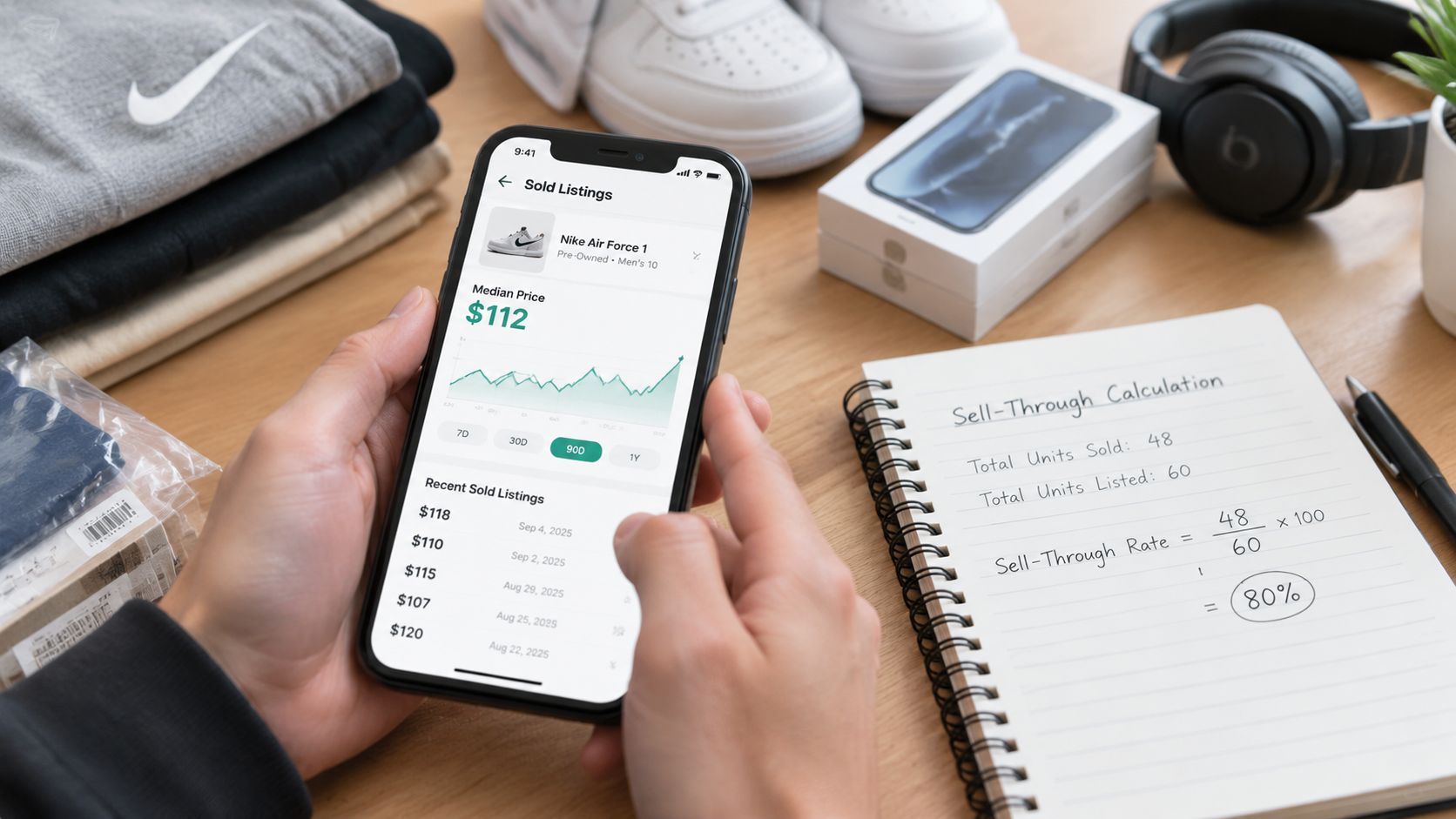
Extrapolate carefully
If the sample shows consistent demand and manageable condition risk, estimate the lot using groups rather than a single average. For example, separate premium items, ordinary sellable units, low-value bundles, and expected rejects. Assign each group its own expected sold price and labor burden.
ScanFlip AI's recent sold prices resource reflects the sourcing principle that matters here: sold comps should drive the decision. The app aggregates sold comps across eBay, Poshmark, Mercari, Depop, Amazon, Whatnot, ThredUp, Facebook Marketplace, and TikTok Shop, reducing the need to toggle between individual apps while sampling.
A lot with a few strong BOLOs can still be bad if the remaining inventory is dead stock. A lot with modest individual prices may work if the units are consistent, easy to process, and cheap to ship. The sample should tell you which situation you're looking at.
A Fast Vet Workflow for Bulk Buys in the Aisle
A pallet can look profitable from its top layer and fail once fees, shipping, rejects, and listing time enter the calculation. Use the same aisle routine for every lot: sample by category and location, identify the units, check sold comps, then calculate expected net profit before negotiating.
Start with three identification methods
Match the scan method to the inventory:
- AI photo scan: Point a phone at untagged shoes, vintage clothing, collectibles, or electronics when no barcode is available.
- Barcode scan: Move quickly through books, media, games, and boxed retail products with UPC or ISBN data.
- Text search: Use the product name, model number, brand, or variation when the item cannot be photographed or scanned clearly.
Mixed lots require a balanced sample. Pull visible winners, ordinary pieces, damaged-looking items, and products that make up a large share of the lot. Sampling only the cleanest units produces a gross-sale estimate, not a buying decision.
ScanFlip AI combines those scan methods with sold comps from major marketplaces. It also deducts buy cost, marketplace fees, and shipping to estimate net profit and provide a flip-or-pass result. Set your minimum net profit or margin before scanning, then keep that threshold fixed when an attractive item appears.
Calculate the blended lot result
Enter the total purchase cost and allocate freight and other acquisition charges across the units you expect to sell. For each sampled group, record expected net profit, likely recovery rate, and the work required to make the item sale-ready. Low-ticket units often disappear under marketplace fees and shipping, while a consistent group of easy-to-list items can still produce a workable return.
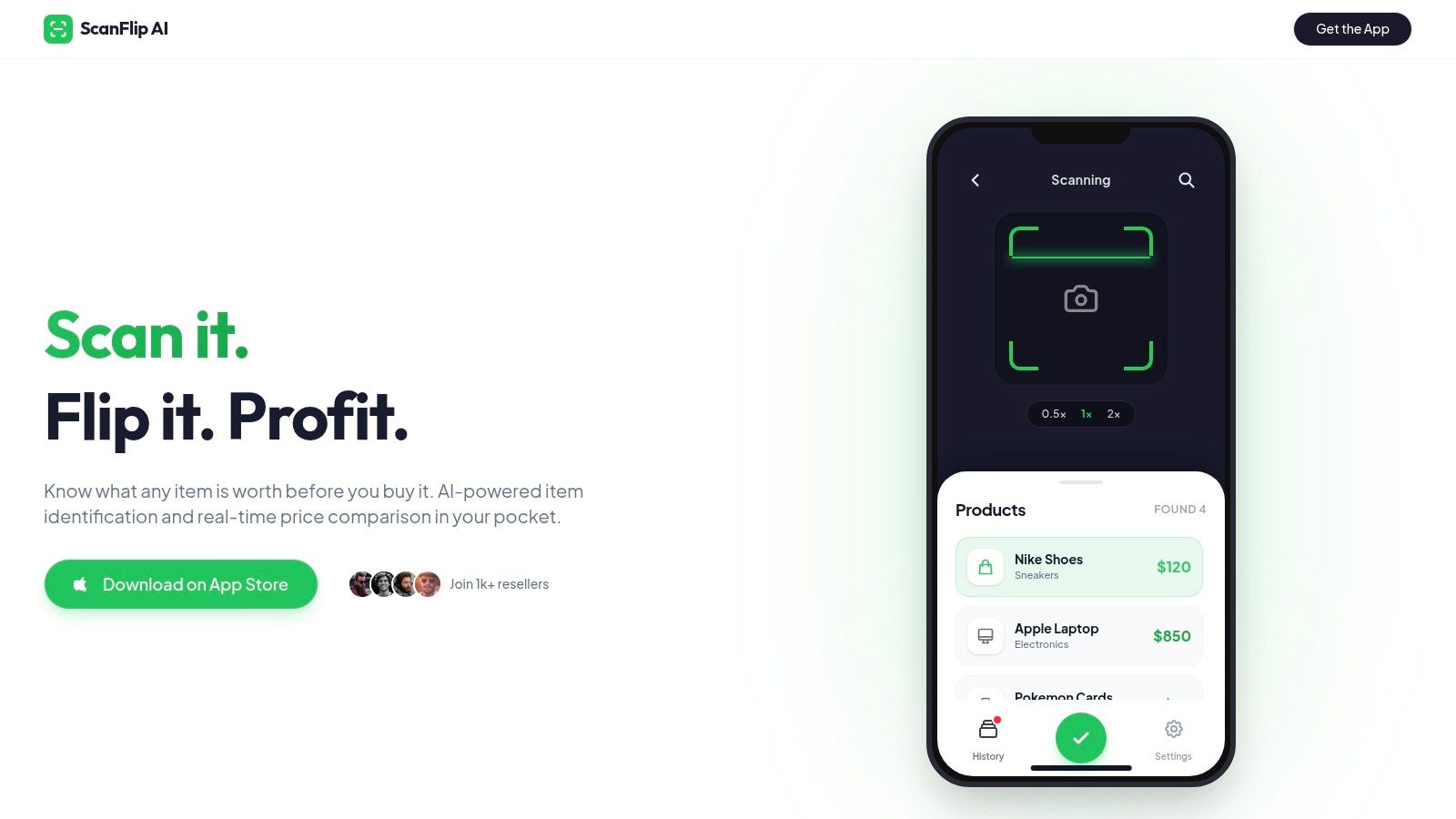
Keep the sourcing stack separate
The sourcing question is, “Should I buy this?” Crosslisting tools such as Vendoo or List Perfectly belong later, when you distribute and manage listings across channels. Publishing software can reduce listing work, but it cannot repair a purchase with weak net profit.
End the aisle check with one decision:
- Buy: The sample clears your threshold and fits your available labor.
- Negotiate: The lot works only if the all-in cost drops.
- Pass: Defects, weak sold comps, storage needs, or fees make recovery too uncertain.
The Hidden Labor Math That Kills Pallet Profits
A pallet doesn't become inventory when it arrives. Someone still has to unbox it, count it, test it, clean it, photograph it, describe it, and sort it by selling channel. Return pallets add another layer because condition can vary from new and complete to broken or incomplete within the same product group.
Independent liquidation guidance estimates labor at 2 to 4 hours per $100 of merchandise, or 4 to 8 hours per pallet for electronics-heavy loads, as described in this guide to bulk items and liquidation resale. The same guidance estimates that a 300-item pallet can require roughly 20 to 40 hours to sort, test, clean, and list.
Those benchmarks make the trade-off visible. A low purchase price doesn't compensate for a large testing queue if each unit has modest resale value. Your effective hourly return falls when you spend the afternoon diagnosing failures that never reach a buyer.
Estimate recovery before revenue
Use three separate counts:
- Sellable now: Items that can be cleaned, photographed, and listed with minimal work.
- Sellable after testing or repair: Items that need chargers, resets, parts, or extra inspection.
- Rejects: Broken, incomplete, unsafe, counterfeit, or economically unviable units.
Then estimate the labor for each group. Electronics deserve a conservative approach because testing complexity and defect rates can expand quickly. Clothing needs time for stain treatment, measurements, and flaw photography. Books need sorting, condition checks, and an exit plan for low-value titles.
Storage and disposal also belong in the calculation. A bulky lot can crowd out faster-moving inventory, while unsellable goods may require recycling, donation runs, or paid disposal. Those costs don't appear on the pallet invoice, but they reduce recovery.
Your time is part of cost of goods. If the lot can't pay for processing, it isn't cheap.
Outsourcing testing can make sense when the resale spread supports it and the process is repeatable. Otherwise, reject electronics-heavy loads with vague manifests, unclear grading, or weak per-unit value. A curated lot with a higher buy price can outperform a bargain pallet when it arrives cleaner, more complete, and faster to convert.
Your Bulk Buy Decision Checklist and Next Steps
At the aisle, estate sale table, or warehouse door, calculate the lot's net recovery before you negotiate. A low gross sale price can still work when testing is quick and fees are light. A higher-priced item can lose money once labor, returns, shipping, and defects consume the spread.
Use this filter before paying:
- Category fit: Do you understand the condition risks, buyer, and best sales channel?
- Manifest quality: Can you verify brands, models, quantities, grades, and missing components?
- Sample quality: Did you inspect items from different parts of the lot, not only the top layer?
- Sold comps: Are your estimates based on sold prices and comparable conditions?
- Recovery rate: How many units are realistically sellable after testing and cleaning?
- Fee-adjusted profit: Does the lot clear your minimum net-profit or margin threshold after freight, packaging, fees, shipping, returns, and labor?
- Storage plan: Can you process and hold the inventory without creating another death pile?
- Exit plan: Can you bundle, donate, recycle, or sell locally the units that do not justify individual listings?
Start with one category you already know. Track scanned items with photos, locations, and timestamps, then compare which stores, estate sales, or suppliers produce inventory that survives the full cost model. A small repeatable process teaches more than a mixed pallet you cannot finish.
Pennsylvania buyers should check whether a transaction triggers bulk sale requirements. The state rule applies when taxpayers transfer more than 51% of assets, including real property and asset classes such as machinery and equipment. Purchasers must secure a bulk sale clearance certificate from the seller, according to this Pennsylvania bulk sale law reference. California's former definition similarly covered a sale or series of sales outside the ordinary course involving more than half of the seller's inventory and equipment, measured by value on the agreement date, as summarized in this bulk asset sale guidance.
Use ScanFlip AI to identify untagged items with an AI photo scan, check books and media by barcode, or search products by text while sourcing. ScanFlip AI can compare sold comps across major marketplaces and show estimated net profit after buy cost, fees, and shipping before you commit.
If category, comps, recovery, labor, and net profit align, buy with a processing plan. If one fails, leave the lot.