

Amazon FBA Fee Calculator for Real Net Profit
You're standing at a Ross clearance endcap with a boxed item under your arm. The sold comps look promising, but the box is bigger than you expected, and the calculator's green profit number doesn't include what you'll spend getting it ready and shipped in. That's where a decent-looking flip becomes a purchase you should've left on the shelf.
Table of Contents
- Why a Strong Sold Comp Still Loses Money
- The Fee Layers an FBA Estimate Must Include
- Measure the Package Before You Trust the Fee
- What the Official Estimate Still Leaves Out
- Aisle Math With Cost of Goods and Shipping
- Check Net Profit Before You Buy
- Set a Flip or Pass Rule You Will Actually Use
Why a Strong Sold Comp Still Loses Money
A strong sold comp proves someone paid for the item. It doesn't prove you can buy your copy, send it to Amazon, wait for a buyer, and keep enough money to justify the work.
The usual aisle mistake is subtracting the clearance sticker from the expected sold price and treating the difference as net profit. That difference is only the money available to cover everything else. You haven't earned it yet.
A boxed kitchen item at Ross makes the problem obvious. You've matched the model and checked the condition, but the package takes up more space than the product itself. Before buying, you need to know whether that packaging changes the fulfillment estimate and whether the item sells quickly enough to justify storing it.
The sale isn't the sourcing decision
Amazon separates selling, fulfillment, and storage charges rather than charging a single all-inclusive transaction fee. Its FBA overview distinguishes fulfillment services from monthly inventory storage, so a sold comp alone can't tell you your take-home.
Your sourcing decision also includes costs outside that headline estimate. You still have cost of goods, prep materials, and the expense of getting the unit into the fulfillment network.
- Match the actual item. Check model, completeness, condition, and packaging against the sold comps.
- Check the exit. Decide whether Amazon FBA is the sensible fulfillment choice before committing.
- Price the work. Include the money you'll spend before the item becomes available to a buyer.
A BOLO isn't permission to skip those checks. Neither is a recognizable brand or a clearance sticker covering an older clearance sticker.
Don't confuse a spread with a paycheck
I wouldn't pick up an awkward boxed item just because its sold price looks impressive beside its buy cost. If the purchase only works when shipping is cheap, the package stays in the smallest plausible tier, and the next buyer arrives immediately, it's too fragile a sourcing call.
Use an Amazon FBA fee calculator to estimate what remains after the costs, not to justify something already in your cart. The useful result is net after cost of goods, with enough room for an imperfect sale.
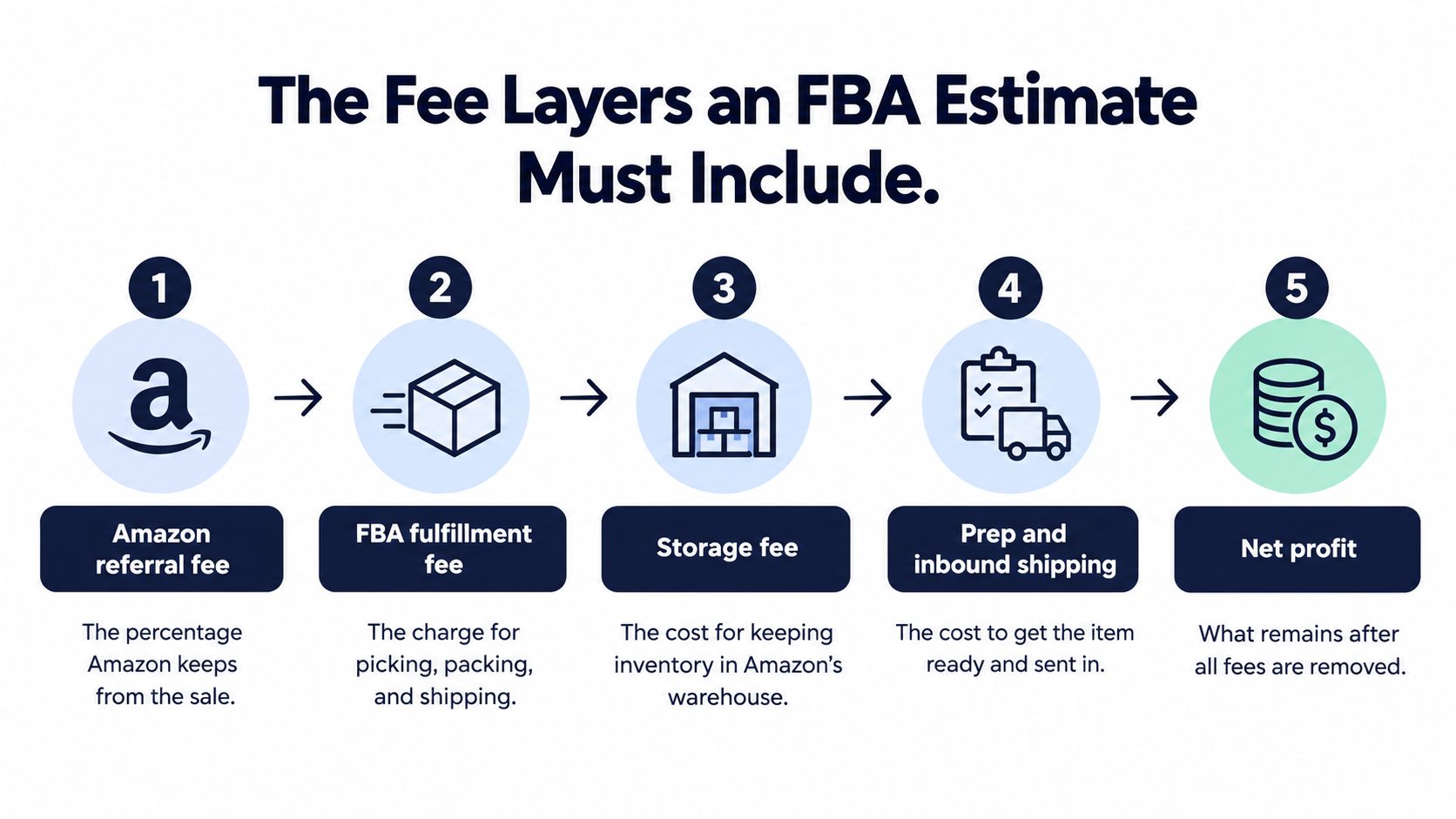
The Fee Layers an FBA Estimate Must Include
A calculator that asks only for sale price and a commission percentage hasn't finished the job. Amazon's charges come from different activities, and each needs its own input.
Separate selling from fulfillment
The referral fee belongs on the selling side of your calculation. Use the applicable category rather than a percentage you remember from another product.
The FBA fulfillment fee belongs on the logistics side. Amazon charges it per unit according to size tier and shipping weight, which means products with identical sold prices can produce different proceeds, as described in Amazon's selling and FBA fee guidance.
That distinction matters when comparing possible buys. A compact item and a bulky item aren't financially equivalent just because buyers pay the same amount.
Give storage its own line
Amazon calculates monthly inventory storage using daily average occupied volume in cubic feet. Inventory held 181 days or longer can also incur an aged-inventory surcharge based on the inventory snapshot taken on the 15th of the month, under the same fee guidance.
Storage isn't something to bury inside fulfillment. You need an expected holding period to make the allocation useful, especially when the sell-through rate is uncertain.
Capacity-related charges deserve separate attention too. Amazon identifies possible capacity-overage charges when inventory exceeds a seller's capacity limit, along with reservation fees associated with requested capacity. Check which charges apply to your account rather than spreading every possible fee across every purchase.
Sourcing rule: Estimate proceeds after the applicable selling, fulfillment, storage, and inventory-risk costs. Then subtract cost of goods and the expenses required to get the item ready and sent in.
Keep your own expenses visible
Prep and inbound shipping aren't free because Amazon handles the eventual customer order. Treat them as purchase-related expenses, even when you allocate them across a shipment instead of paying for each unit separately.
A usable cost stack should keep these inputs visible:
- Selling costs. Category-based referral fees and other applicable selling charges.
- Fulfillment inputs. Packaged dimensions, shipping weight, and the resulting fulfillment fee.
- Time costs. Expected storage duration and exposure to aging charges.
- Your landed cost. Purchase cost, prep, and inbound transportation.
Don't label the result net profit while an empty cost field still means an expense you haven't checked.
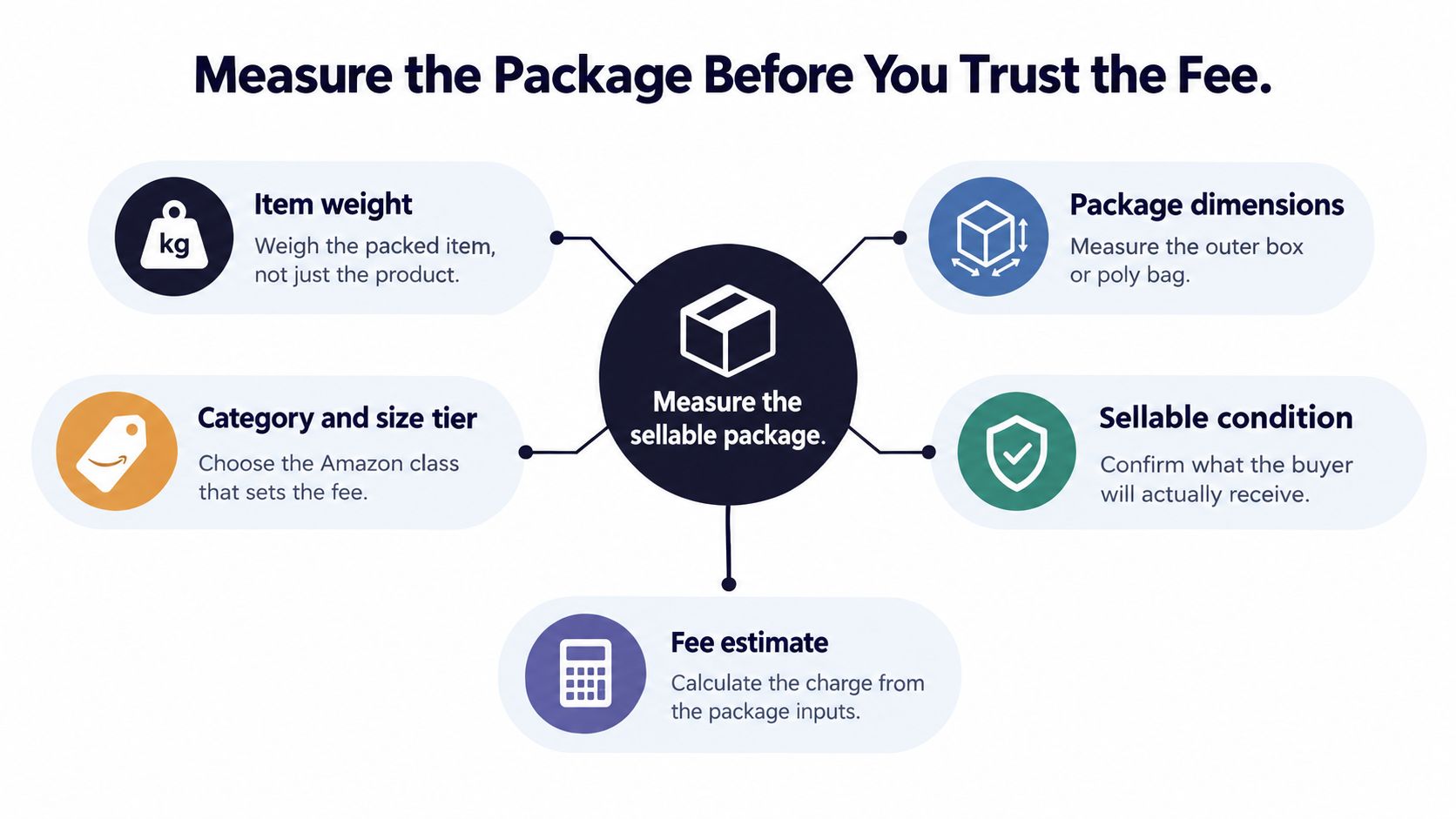
Measure the Package Before You Trust the Fee
Set the item down and measure what you'll send. The bare product from a Goodwill bin isn't necessarily the sellable package Amazon will assess.
Start with the package you can actually ship
Check the outer dimensions, packaged unit weight, category, and realistic selling price. If protective packaging is necessary, account for it before trusting the estimate.
A lightweight collectible in an oversized box is the classic trap. You can hold it comfortably in one hand and still face a fulfillment result driven by the space it occupies rather than how heavy it feels.
Under Amazon's US shipping-weight rules, large-standard, small-bulky, large-bulky, and most extra-large products use the greater of actual weight or dimensional weight. US dimensional weight is packaged length × width × height ÷ 139, with a 2-inch minimum assumed width and height for several tiers.
That isn't permission to round everything down. Apply Amazon's published tier and weight-rounding rules, and identify which input determines the charge.
- Measure the outside. Include the packaging required for the sellable unit.
- Compare the weight bases. Don't assume actual weight controls the calculation.
- Test uncertainty. If the packaging isn't settled, compare plausible package configurations before buying.
For the transportation side of the decision, use a consistent method for estimating shipping costs. Don't substitute a familiar shipping guess for the dimensions of an unfamiliar item.
Run the official comparison
Amazon's Revenue Calculator lets you search the catalog or define a product using dimensions, weight, category, price, and shipping charges. You can compare Amazon fulfillment with seller-fulfilled shipping rather than assuming FBA is the right exit.
Review the referral, fulfillment, inbound placement, and storage lines. Check special handling where relevant, including lithium-battery or oversize charges, and inspect whether long-term storage is represented in the calculation you're using.
A catalog match helps identify the product, but it shouldn't override a visible mismatch in your package. A replacement box, extra protection, or different configuration deserves a fresh check.
A precise-looking result built from uncertain measurements is still an uncertain estimate.
Label the output estimated net profit. If a small packaging change could move the item into another tier, resolve that uncertainty before spending money, not after preparing the shipment.
What the Official Estimate Still Leaves Out
A positive calculator result can still describe a bad buy. The problem isn't necessarily incorrect arithmetic. It may be an expense you never entered or a holding period you never considered.
An empty field isn't a free service
Amazon's guide to using its FBA calculator identifies common lines such as referral, fulfillment, monthly storage, and variable closing fees. It also explains that long-term storage, removal orders, and return-processing expenses may need manual entry through Miscellaneous cost.
Don't assume a storage line covers every possible storage-related charge. Review the breakdown and add only what's missing, so you neither omit an expense nor count it twice.
For a slow book buy, the important question is how long you expect to wait. A calculator's favorable result doesn't establish sell-through, and it doesn't make a removal decision disappear if the book never sells.
- Check omitted expenses. Enter an appropriate reserve for returns, removal, or other applicable exceptions.
- Match the holding period. Don't use a quick-sale assumption for inventory you expect to sit.
- Check the schedule date. A saved calculation can become stale even when the item hasn't changed.
Don't carry an old fee assumption into a new buy
Amazon announced an average $0.08 per-unit FBA fee increase for 2026, described as less than 0.5% of an average item's selling price, with changes generally effective January 15, 2026, in its 2026 fee update. The announced adjustments differed by price band and size, so applying the headline average to every product would be wrong.
Announced 2026 US FBA Fulfillment Fee Changes
| Price band | Size | Announced change |
|---|---|---|
| $10 to $50 | Small-standard | Increase of $0.25 per unit |
| $10 to $50 | Large-standard | Average increase of $0.05 per unit |
| Below $10 | Small-standard | Average increase of $0.12 per unit |
| Below $10 | Eligible low-price products | Average fee discount increased to $0.86 from $0.77 |
| Above $50 | Small-standard | Average increase of $0.51 per unit |
| Above $50 | Large-standard | Average increase of $0.31 per unit |
These are announced changes, not complete fulfillment charges. Use the applicable current rate table for the actual estimate.
An average increase can sound minor while still changing a thin-margin sourcing decision. Keep a dated fee schedule and an editable miscellaneous-cost field. Without both, you're evaluating an incomplete version of the buy.
Aisle Math With Cost of Goods and Shipping
At the Ross clearance rack, the useful math starts with what the buyer pays, not the amount you hope to keep. Keep revenue, Amazon deductions, and your purchase-related expenses separate.
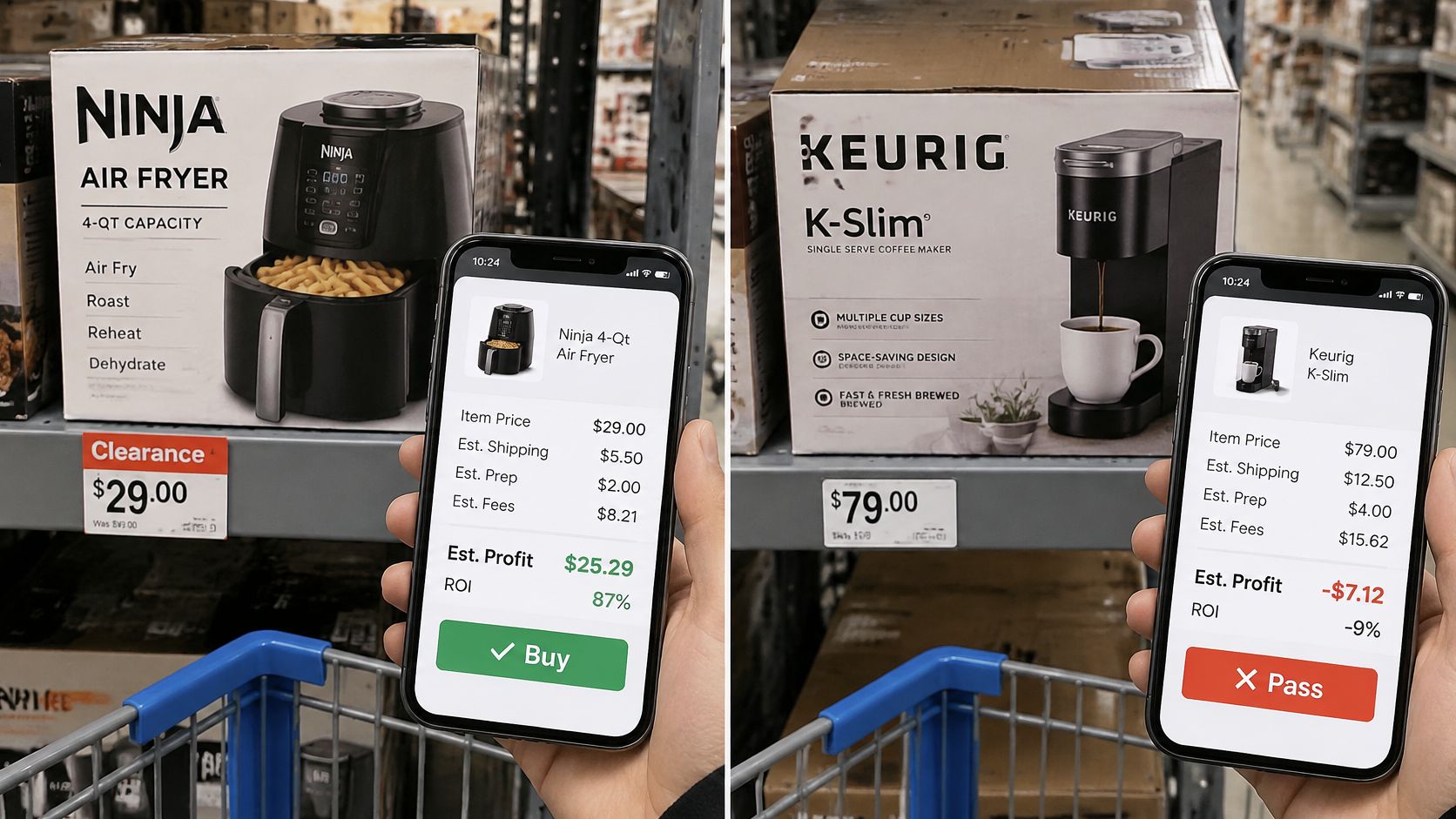
The boxed clearance item
Consider an item sold for $40, with $5 charged to the customer for delivery. The referral-fee base is $40 + $5 = $45, not the item price alone, because Amazon includes buyer-paid delivery and gift wrapping in total sales price under its referral-fee definition.
Apply the actual category rate to that total. Using only the item component understates the fee and inflates projected ROI.
The delivery charge is revenue, not automatically profit. It doesn't cancel your prep, inbound transportation, or fulfillment expenses just because the customer paid it.
Your working calculation is:
Estimated net profit = buyer-paid total − referral fee − fulfillment fee − storage allocation − cost of goods − inbound and prep − applicable reserves.
Enter the verified fulfillment result rather than borrowing a dollar charge from another boxed item. Then enter the purchase cost on the clearance sticker and your actual shipment allocation.
No honest calculation can produce a final net dollar amount without those inputs. Leaving them unknown is a reason to pause the purchase, not permission to treat them as nothing.
The slow bulky thrift buy
Now you're at Goodwill holding a bulky item with attractive sold comps but weak evidence of a quick sale. Its package may be straightforward to measure, yet the waiting time is still uncertain.
Use the size-and-weight-driven fulfillment estimate, then add the storage allocation for the time you reasonably expect it to sit. Enter a manual miscellaneous reserve if the likely outcome could involve removal, additional storage exposure, or returns.
For this item, the decision isn't whether the sold comp exceeds the thrift sticker. It's whether the proceeds still cover all committed costs under a slower-sale outcome.
- Cost of goods comes out. Money spent acquiring the item isn't profit.
- Inbound and prep come out. Getting it into sellable condition is part of the buy.
- Holding and exit costs come out. A thin remaining spread may disappear before you get paid.
Use the same definitions every time you calculate net profit. Don't compare one item's after-cost result with another item's before-cost spread.
I'd keep the boxed clearance item under consideration if its completed estimate clears my minimum. I'd pass on the slow bulky buy when it only works under an immediate-sale assumption. Strong comps don't compensate for an exit that's too expensive or too uncertain.
Check Net Profit Before You Buy
A strong sold comp means nothing until you see what the deductions leave behind. Pick the checking method that answers the question in front of you: what the item is, what it sells for, or what the fees take out.
Match the method to the decision
Checking sold listings app by app gives you direct control over comparable selection. Use it when condition, edition, completeness, or a collectible's specific variation needs close inspection. The tradeoff is your time, since you assemble every cost yourself.
Amazon's Revenue Calculator fits once you know the ASIN or have reliable package inputs. It compares fulfillment choices and exposes the Amazon-specific deductions. Demand proof still has to come from your own comps.
An aisle sourcing scan answers the earlier question: should this item leave the store with you? ScanFlip AI is an iOS option with AI photo scanning when there's no barcode, barcode scanning for books, media, games, and boxed retail, and text search by name.
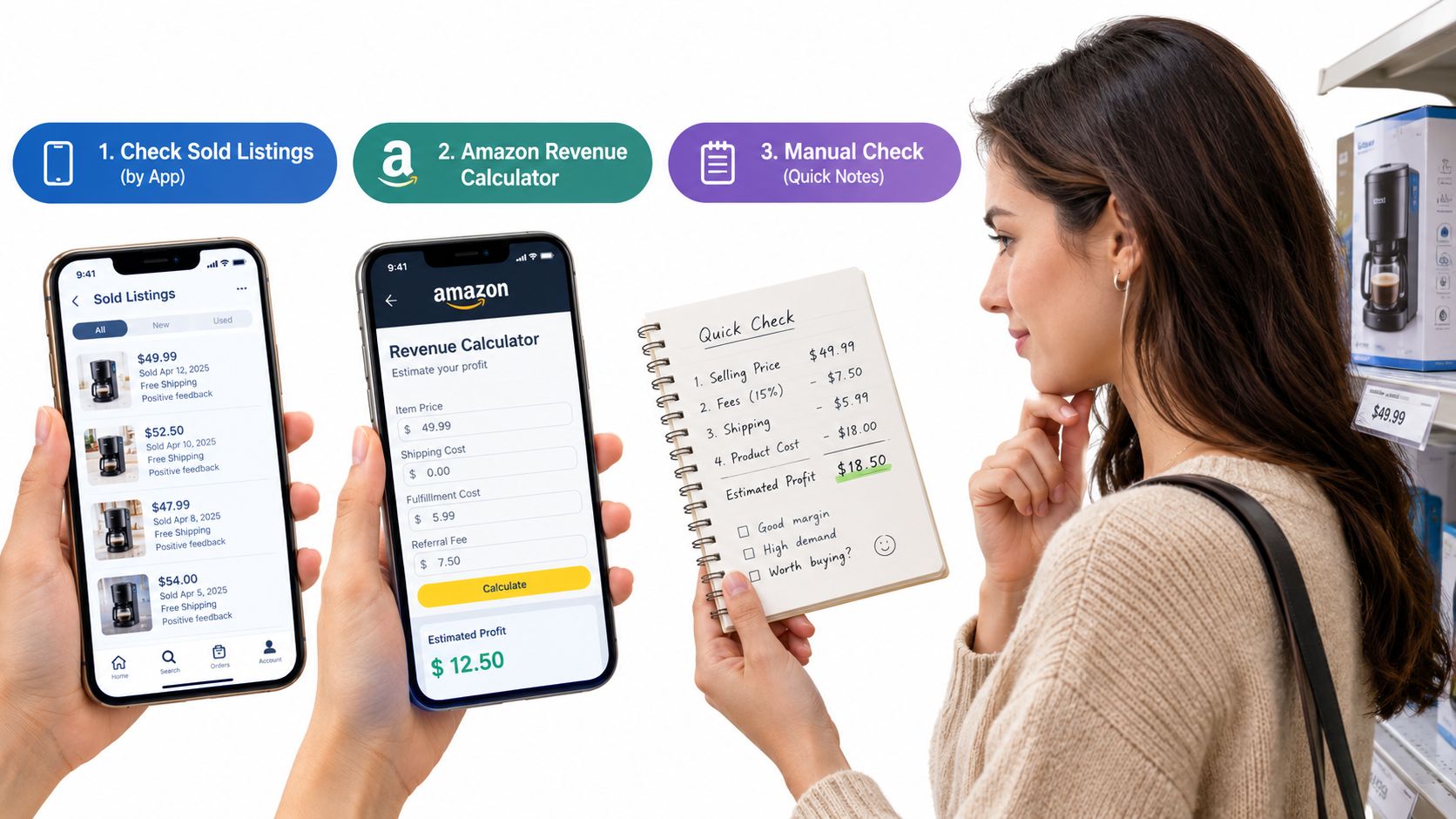
It pulls sold comps from eBay, Poshmark, Mercari, Depop, Amazon, Whatnot, ThredUp, Facebook Marketplace, and TikTok Shop. It shows expected net after current marketplace fees, shipping, and buy cost, with a red or green flip-or-pass verdict based on the minimum profit or margin you set.
Keep the estimate editable
A fee result is only as accurate as the package measurements and days in storage behind it. Keep the Amazon output labeled an estimate, then add the costs the headline number skips. Amazon's Revenue Calculator guidance explains that long-term storage, removal orders, and return-processing costs aren't automatically included in the standard estimate and belong in miscellaneous costs.
Verify the comp before you trust it. An identification match still needs a condition and configuration check, and a general profit result doesn't guarantee every FBA exception is priced in. Keep sourcing separate too. The app doesn't list, crosslist, manage inventory, or do bookkeeping.
If you use Vendoo or List Perfectly after buying, that's a separate listing step. The job in the aisle is a defensible expected-profit calculation before money leaves your pocket.
Set a Flip or Pass Rule You Will Actually Use
Your minimum has to be decided before the barcode scan. Pick a dollar floor and a margin floor, then treat both as fixed while you are standing in the aisle. A familiar brand, a clean box, or five minutes already spent checking comps does not earn the item a lower bar.
A good rule works when you are tired. It also works when the sold comp looks strong and the only problem is boring: the package is bigger than it looks, the item will sit through a slow month, or the estimate is missing costs that show up later.
Make uncertainty part of the verdict
Require a measured package and a completed cost stack before anything can go green. Cost of goods, inbound or prep, expected storage days, fulfillment on the applicable weight basis, and an exception reserve all count. If one input is unknown, the answer is pause, not assume.
Example: a boxed item has a $40 buyer-paid sold comp. Buy cost is $8, inbound and prep are $3, fulfillment at the measured size is $10, expected storage is $2, and your exception reserve is $2. Net is $15 and it exactly clears a $15 floor. If the package is one inch over the tier and fulfillment becomes $13, net drops to $12. That is still profit on paper, and it is still a pass.
- Buy only with a defensible exit. Know where it sells, which comp matches condition and configuration, and why that comp fits your item.
- Pass when ordinary friction breaks it. Slower storage, a size-tier bump, or a return reserve can erase thin net fast.
- Pause when inputs are missing. An unknown expense is not a favorable expense.
Let the threshold overrule the find
A red verdict only helps if you let it stay red. Do not edit the rule mid-aisle because the brand is good or the shelf is picked over.
Cash tied up in a near-miss cannot buy the better item two stores later. The job is keeping money available for flips that clear your floor with room left over.
If you use ScanFlip AI, respect the red or green result after you verify the package and add storage or exception costs the estimate leaves out. On the next boxed item, run the completed net before it goes in the cart. If it does not clear your minimum, put it back.