
What Is Selling Well on eBay in 2026
You're standing in a Goodwill aisle holding something that looks underpriced. Your phone shows a strong sold comp, another picker is working toward your cart, and you haven't figured out whether the thing will fit in a sensible shipping box.
Table of Contents
- Standing in the Aisle Asking What Actually Sells
- The Categories Carrying Real Demand on eBay
- How to Read Sold Comps Like a Pro
- The Real Math Behind Fees and Shipping
- A Buy or Pass Framework You Can Use in Seconds
- Seasonal Cycles and Price Trends That Matter
- Three Real Sourcing Scenarios and What to Do
- The Takeaway That Keeps You Profitable
Standing in the Aisle Asking What Actually Sells
The temptation is to buy first and research properly at home. That's how a promising find becomes another untested gadget or awkwardly sized box in the death pile.
Knowing that electronics sell doesn't tell you whether this particular device is worth buying. You still need to identify the model, check what's missing, judge the condition, and work out what you'll keep after fulfillment.
The useful question isn't just what is selling well on eBay. It's what you can source cheaply enough, identify accurately enough, and ship safely enough to make the work worthwhile.
A BOLO isn't a buying instruction
Treat every BOLO as a reason to investigate, not permission to load the cart. A collectible with an uncertain identity needs a different decision from a boxed replacement part with a readable model number.
The same applies to familiar brands. Recognition gets an item into your research queue; it doesn't establish its resale value.
- Research the actual item. Match the version in your hand, not the nicest example you can find online.
- Recognize your limits. If you can't test it, authenticate it, or estimate its packed size, you're buying uncertainty.
- Protect your working cash. Money tied up in speculative purchases isn't available when a straightforward flip appears.
Aisle rule: If the purchase only works under the most optimistic interpretation, leave it behind.
A repeatable decision method is more useful than a shopping list of fashionable categories. It lets you pass on recognizable merchandise and still spot opportunity in an ordinary household item.
That's the standard to bring into Goodwill, estate sales, and clearance aisles: not whether somebody might buy it, but whether the likely outcome justifies your cost and work.
The Categories Carrying Real Demand on eBay
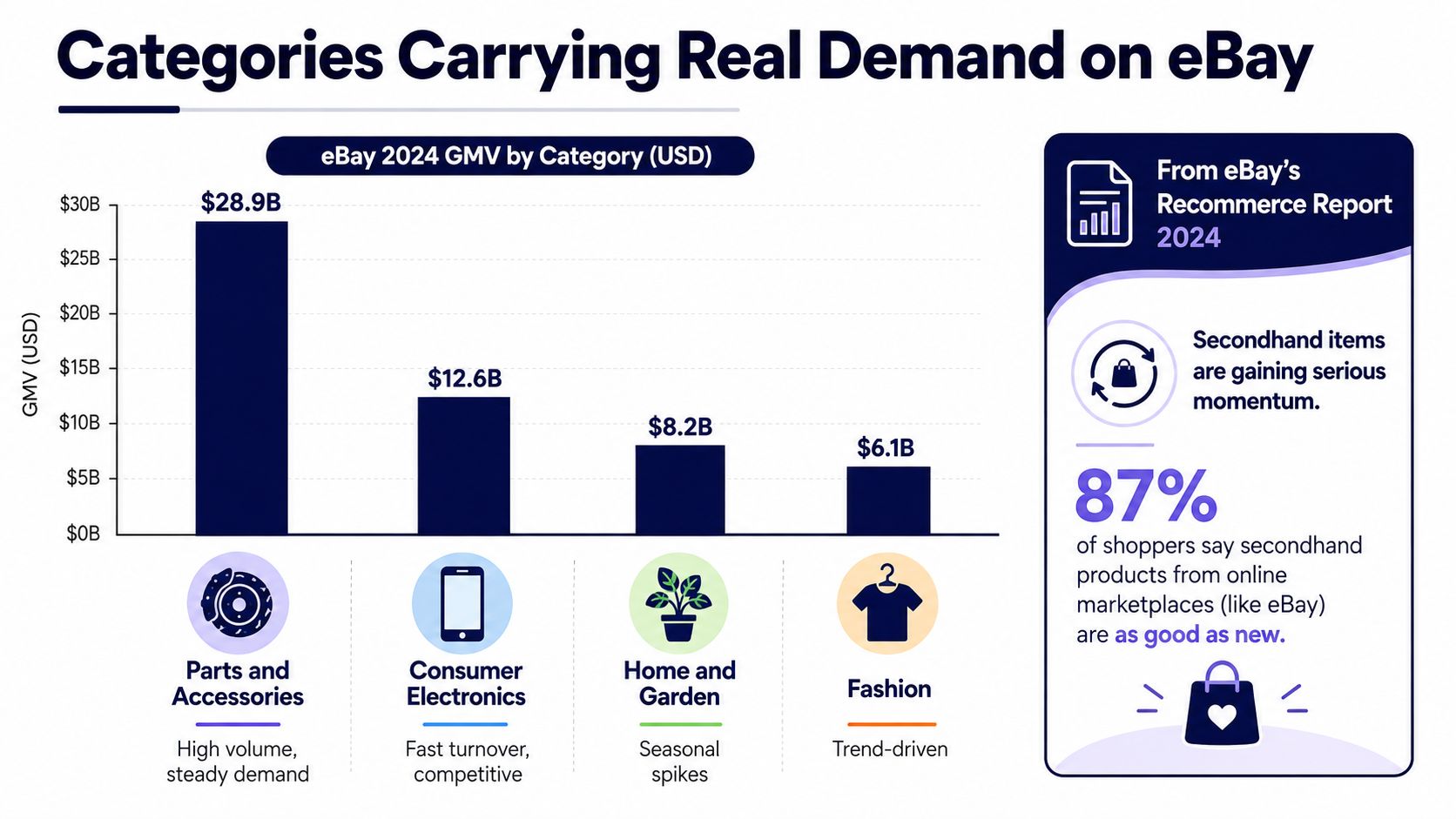
eBay reported $75 billion in global GMV for 2024, with 49% generated outside the United States. Parts and accessories, collectibles, fashion, electronics, and home and garden contributed the majority of GMV; its focus categories, including parts and accessories, refurbished goods, collectibles, and luxury, grew faster in aggregate than the rest of the marketplace, according to eBay's annual filing.
That establishes where to look, not what to pay. It also doesn't establish a numerical ranking among those individual categories, so don't treat the illustration below as a category-level revenue breakdown.
Ordinary used goods deserve attention
Pre-loved and refurbished goods represented about 40% of GMV. Clothing led reported pre-loved purchases at 48%, followed by books at 34%, shoes at 24%, home and garden at 23%, and technology and electronics at 22%; global sales of items described as “thrifted” increased more than 400% from March 2023 to March 2024, according to Retail Dive's coverage of eBay's Recommerce Report.
Those purchase percentages aren't category shares of eBay revenue. They're evidence that sourcing shouldn't stop at the electronics cabinet.
Rank opportunities by the work and money left over
For sourcing, I'd prioritize these opportunity types conditionally, rather than pretend every category has a reliable profit ranking:
| Sourcing priority | What earns attention | What makes it a pass |
|---|---|---|
| Compact, identifiable goods | Readable model numbers, verifiable completeness, manageable packing | Uncertain compatibility or missing essential pieces |
| Apparel, shoes, and books | Exact identification and condition that matches sold comps | Damage, ambiguous editions, or weak demand for the variation |
| Specialist collectibles and premium goods | Knowledge you can actually apply | Authenticity or grading assumptions |
| Bulky, fragile, or untested merchandise | Enough expected profit to justify extra work | A purchase that depends on cheap shipping or effortless repairs |
This is an editorial sourcing order, not a claim that compact goods always earn more. A specialist may reasonably reverse it because they can assess merchandise other sellers should leave alone.
The advantage is specificity. A buyer searching for a particular replacement part, edition, or garment has a more identifiable need than a seller searching broadly for something popular.
How to Read Sold Comps Like a Pro
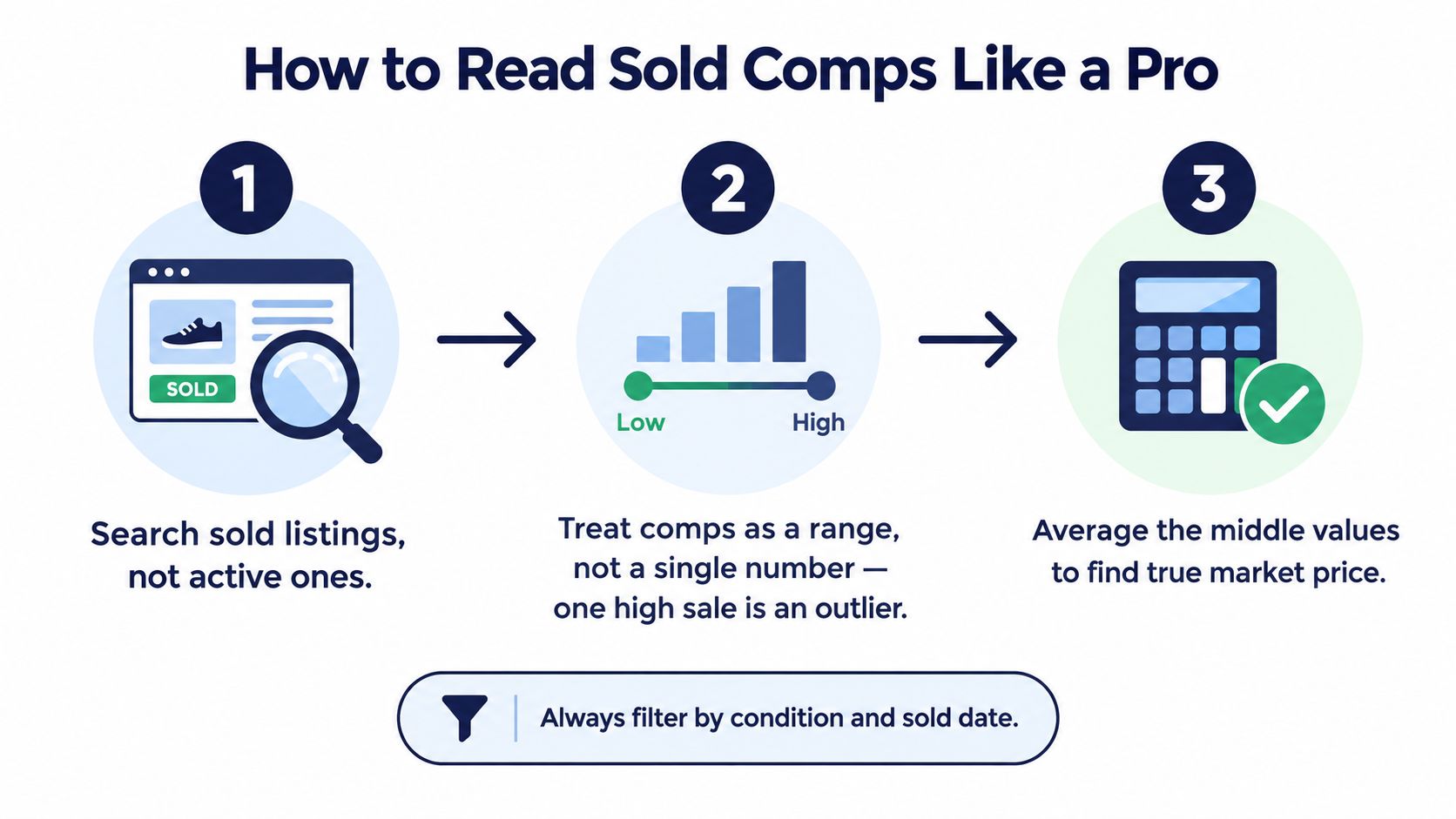
Start with identification, not price. For electronics, match the model and included accessories; for clothing, match brand, size, measurements, and condition; for books and collectibles, check the edition or variation.
A visually similar item isn't necessarily a comparable sale. If the sold example includes something yours lacks, its price needs qualification before it belongs in your estimate.
Build a range you can defend
- Match the item first. Exclude different models, bundles, grades, and conditions.
- Review recent completed sales. Look for repeated buyer behavior rather than a spectacular isolated result.
- Use the middle of the comparable range. Don't let the highest result become your default expectation.
- Compare active competition. Asking prices show what sellers hope to receive, not what buyers have demonstrated they'll pay.
eBay's Product Research tool provides up to three years of sales data for millions of items, including sales trends. That longer view helps you investigate whether a high result reflects repeatable demand or an outlier.
Check whether buyers are actually clearing inventory
Sell-through rate, or STR, is useful only when the comparison makes sense. Keep the search terms, condition filters, and observation window consistent rather than mixing broad active results with narrowly filtered sales.
Look at completed-sale velocity alongside competition. Repeated sales don't automatically make an item attractive if you'll join a crowded field of interchangeable examples.
Active listings aren't dishonest. They answer a different question, what's available, rather than what has sold. An ambitious asking price is not evidence for your purchase decision.
For the filtering workflow, use this guide to finding sold prices on eBay. Keep marketplace comparisons separate, too: a sale elsewhere can inform research without proving an identical eBay outcome.
A defensible comp is one you can explain without saying your item is “basically the same.”
If identification remains uncertain, stop researching the attractive price and resolve the identity. More search results won't fix the wrong starting assumption.
The Real Math Behind Fees and Shipping
Expected resale price minus cost of goods is gross spread, not net profit. You still have to pay for the transaction and get the item to the buyer.
eBay's seller fee guidance gives final value fee rates ranging from 2.5% to 15.3%, plus a $0.30 or $0.40 per-order charge. That's why inexpensive items under roughly $15 deserve particular caution: fixed charges and postage can consume a disproportionate share of the proceeds.
Net Profit Breakdown Example
The following is an illustrative calculation using a shipping amount equal to the $8.40 retail starting price shown on the USPS Ground Advantage service page. USPS bases pricing on package weight and zone; that starting price is not a universal quote for your parcel.
| Line Item | Amount |
|---|---|
| Expected sold price | $42.00 |
| Illustrative fee allowance | −$5.60 |
| Illustrative shipping cost | −$8.40 |
| Cost of goods | −$6.00 |
| Remainder before packing materials, taxes, and returns | $22.00 |
These are example inputs, not a promise that the fee or shipping charge applies to your item. The remainder also hasn't paid you for cleaning, testing, photographing, packing, or dealing with a problem afterward.
Quote the packed item, not the shelf item
A boxed purchase still needs an outer shipping package if the retail box requires protection. Shoes need space, fragile goods need cushioning, and a heavy book isn't cheap to fulfill merely because it's easy to identify.
Use an eBay fee calculator with the applicable category and realistic transaction inputs. Then estimate shipping from packed weight and dimensions, not what the item feels like in your hand.
- Separate revenue from expenses. Include shipping collected from the buyer when evaluating total proceeds, then subtract the actual fulfillment cost.
- Price the packaging. Don't treat a sturdy carton, padding, and tape as free.
- Allow for uncertainty. If a modest cost change would eliminate the return you need, the purchase is too tight.
ROI isn't a substitute for dollars earned. A cheap acquisition can look impressive relative to its buy cost while still leaving too little compensation for the work.
A Buy or Pass Framework You Can Use in Seconds
Set your minimum acceptable net profit before sourcing. Otherwise, you'll keep lowering the requirement to justify whatever you've already picked up.
That threshold should reflect the work involved. A clean, easily identified item doesn't deserve the same tolerance for uncertainty as something that needs repairs, specialist testing, or elaborate packing.
Make the decision in a fixed order
- Identify. Establish what the item is and whether anything essential is missing.
- Validate. Use comparable sales from the marketplace where you intend to sell.
- Cost. Enter your buy cost, applicable fees, packaging, and realistic shipping.
- Decide. Buy only when the result clears your threshold without optimistic assumptions.
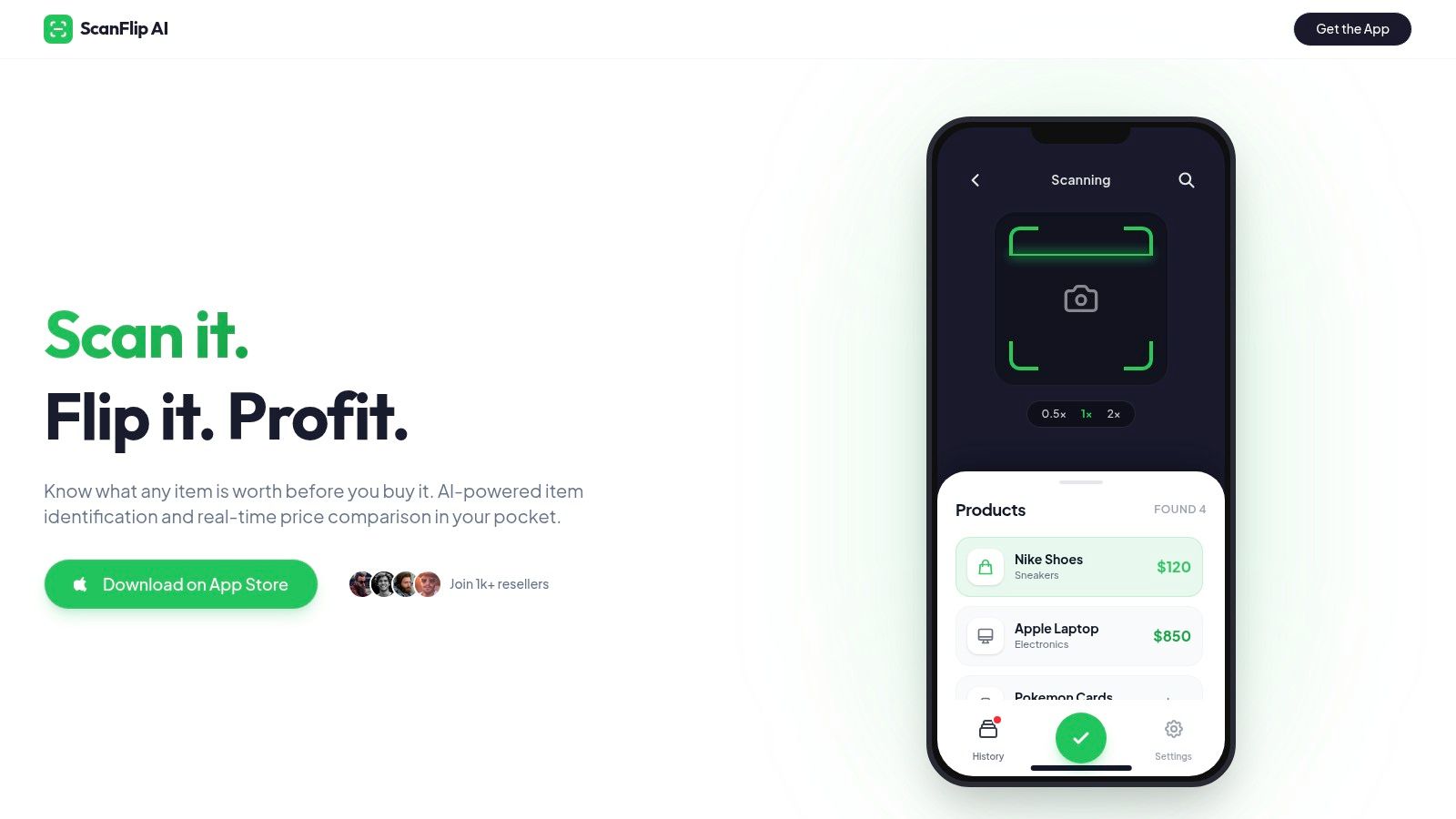
Manual eBay research is a sensible option when you need to inspect individual sales closely. For quicker pre-purchase checks, ScanFlip AI offers an AI photo scan with no barcode needed, barcode scanning, and text search.
It pulls sold comps from eBay, Poshmark, Mercari, Depop, Amazon, Whatnot, ThredUp, Facebook Marketplace, and TikTok Shop. After accounting for buy cost, platform fees, and shipping, it shows expected net profit with a red/green flip-or-pass verdict against your chosen threshold.
A verdict still needs sound inputs
A green result doesn't establish authenticity, prove that a device works, or make a loose comparison exact. You still need to inspect the physical item and challenge assumptions that could change the outcome.
Keep the destination marketplace straight. A cross-market search can help identify an unfamiliar find, but your eBay purchase decision should rest on relevant eBay evidence and eBay fulfillment costs.
There's also a difference between a fast answer and a rushed purchase. If you can't resolve a material uncertainty while standing there, the appropriate answer may be pass rather than buy now and investigate later.
That matters at estate sales and retail clearance racks, where presentation can make merchandise feel safer than it is. Original packaging, a recognized brand, or a large markdown doesn't remove your obligation to evaluate the resale transaction.
Seasonal Cycles and Price Trends That Matter
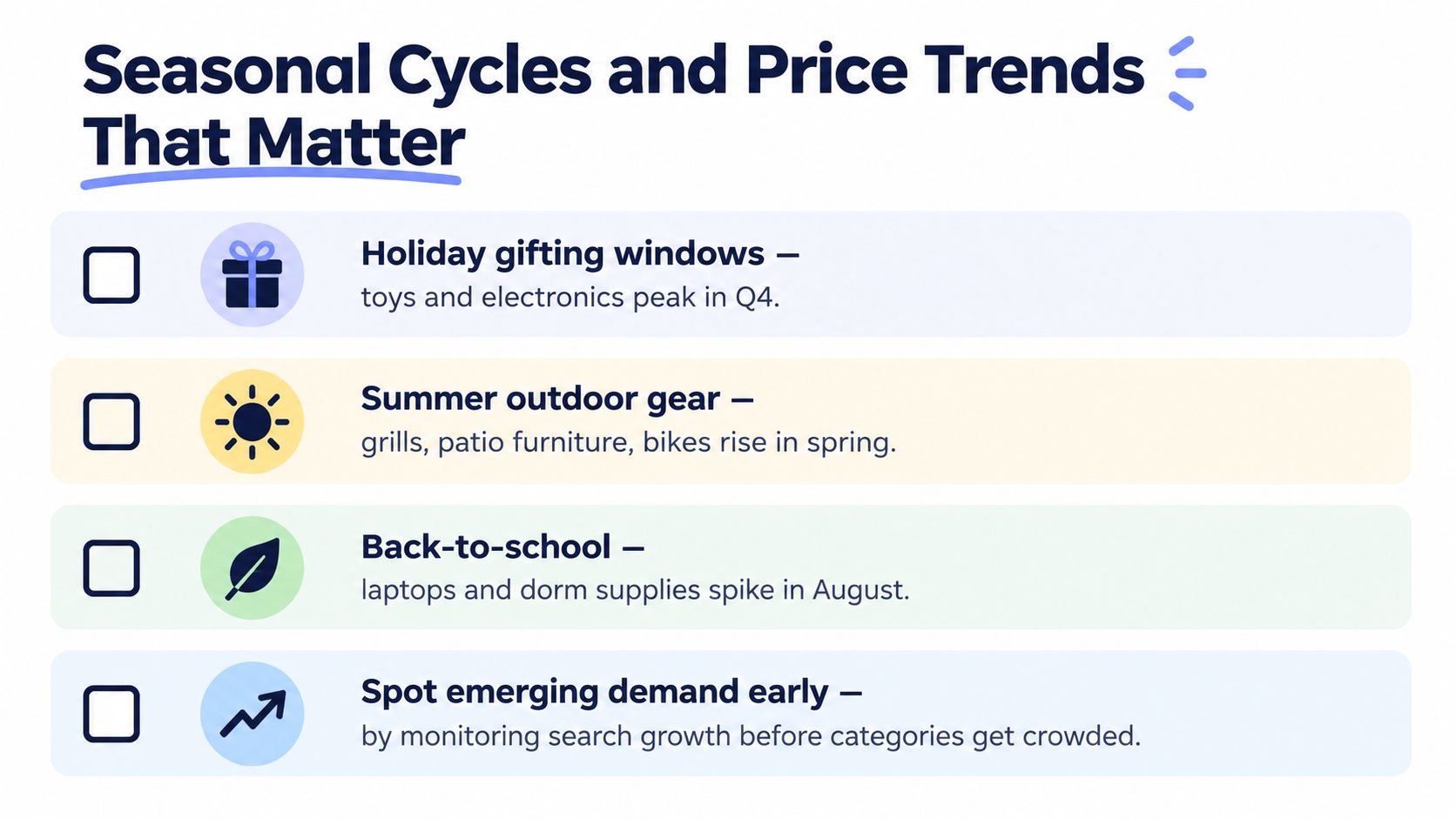
Use a sourcing calendar to schedule research, not to assume demand. Holiday gifting, back-to-school shopping, outdoor-use seasons, and vintage fashion cycles are prompts to check the relevant item's history.
The illustration below is a planning aid, not evidence that every product pictured peaks at the stated time. A general seasonal association doesn't establish demand for the model, size, or condition you're holding.
Separate category momentum from your opportunity
Trading cards experienced nine consecutive quarters of growth, according to the eBay category coverage collected by Accio. That's a reason to investigate, not evidence that an arbitrary card will sell profitably.
A card flipper still needs to distinguish the relevant variation and condition. The same discipline applies to refurbished technology and vintage clothing: category enthusiasm doesn't remove testing requirements, authenticity concerns, or fit-specific demand.
Judge “selling well” through sell-through probability, median sold price, price stability, and net profit after fulfillment. A trend can look attractive on one measure and unsuitable on another.
Keep a practical research calendar
| Research window | Question to investigate |
|---|---|
| Before gifting periods | Will the item be ready to sell and ship while buyers still want it? |
| Before school-related shopping | Does this exact model have relevant completed sales? |
| Before outdoor-use seasons | Can you sell without expensive storage or awkward fulfillment? |
| During collectible or fashion attention | Are buyers completing purchases, or are sellers merely raising expectations? |
Use this guide to seasonal price fluctuations to organize checks around your sourcing specialties. Keep notes about the item and its evidence, not just the category label.
Before buying into a trend, ask:
- Demand quality. Are sales spread across comparable examples or concentrated in exceptional ones?
- Price direction. Are recent sold prices holding, weakening, or becoming erratic?
- Supply pressure. Will your item compete with interchangeable inventory?
- Exit timing. Are you prepared to sell promptly, or are you depending on another surge?
Don't pay today for a future price increase you need but can't substantiate.
Three Real Sourcing Scenarios and What to Do
These are sourcing decision examples, not claims about completed flips. The useful part is how the decision changes when you account for the physical item.
Goodwill aisle with a compact electronic item
You find a small device with a readable model number. Its comparable sales support the worked calculation above, but the purchase still depends on whether it functions and includes the required accessories.
Inspect the battery compartment, connectors, controls, and casing. If you can't test an essential function, don't value it as tested merchandise.
The decision is buy only if its actual condition supports your comp selection. If the potential return depends on an accessory you haven't priced or a repair you haven't diagnosed, put it back.
Garage sale bin with a bulky household item
A bulky appliance looks cheap, and the seller would rather see it leave than discuss its condition. You can find sold examples, but packing it safely will take more than grabbing a spare mailer.
Your acquisition price can distract you. Before negotiating, work out whether the packed object makes sense for an eBay shipment at all.
Passing on a cheap object isn't missing a deal when you don't want the fulfillment job attached to it.
Unless the relevant sold comps leave room for the carton, protection, destination risk, and your effort, it's a pass. Don't substitute the seller's eagerness for buyer demand.
Ross clearance rack with a boxed retail item
Consider a hypothetical $12 purchase expected to sell for $55. Subtract a hypothetical $7.33 fee and $12 shipping, and the remainder is $23.67 before supplies; USPS explains the underlying destination issue in its Ground Advantage weight-and-zone guidance.
A two-pound boxed item can work differently nearby than across the country because zone and package dimensions affect the shipping assessment, as that guidance explains. Weigh and measure the packed shipment rather than assuming the retail box settles the question.
Buy only if the remaining compensation justifies preparing and fulfilling it. Clearance stickers at Ross, TJ Maxx, or Nordstrom Rack don't establish resale value, and damaged packaging may make the comp you wanted unusable.
The Takeaway That Keeps You Profitable
Before your next sourcing trip, write down the minimum net profit you'll accept for straightforward merchandise. Write a stricter requirement for items that need testing, cleaning, authentication, or complicated packing.
You don't need somebody else's universal dollar target. You need a threshold that reflects your available cash, time, storage, and willingness to handle problems.
Make passing part of the job
An oversaturated search isn't automatically a buying opportunity because the acquisition cost is low. If your example is interchangeable with the competition and you have no supported reason to expect a satisfactory outcome, leave it.
Likewise, don't keep an item in the cart because you've already spent time researching it. That time is gone whether you buy or pass; purchasing doesn't recover it.
- Choose your specialties. Research merchandise you can evaluate accurately.
- Keep uncertainty visible. Don't hide missing information inside an optimistic estimate.
- Require a credible exit. Know how you'll prepare, price, pack, and ship before paying.
- Respect your threshold. A popular category doesn't earn an exception.
Leave with decisions you can explain
For every purchase, be able to state why the item qualifies. That explanation should involve its identity, condition, supported resale value, and expected costs, not the original retail price or the excitement of finding it.
If you can't explain the purchase without relying on luck, put it back. Your job isn't to rescue every potentially valuable object from a thrift store.
On your next trip, check the evidence before committing your cash and accept a lighter cart when the opportunities don't qualify. The target is money left after the work, not merchandise brought home.
Use photo identification, barcode scanning, or text search to check unfamiliar finds before you pay. Visit ScanFlip AI to compare sold comps and see a fee-and-shipping-adjusted flip-or-pass verdict against your own profit threshold.