


Seasonal Price Fluctuations: A Reseller’s Sourcing Playbook
You're standing in a Goodwill aisle in March with a clean wool coat in your hand. The price is low, but winter demand has disappeared, so you hesitate. Three racks over, someone's passing on Christmas decorations in September because “nobody wants those yet.” Both decisions can be wrong.
Seasonal price fluctuations change more than demand. They affect sold comps, sell-through rate, holding time, and the amount of cash trapped in your death pile. A seasonal item can be cheap when demand is quiet, difficult to move when the weather is wrong, and surprisingly competitive during peak retail promotions.
The practical edge comes from timing the gap between local demand, retailer pricing, and resale supply. You're not trying to predict the entire market. You're deciding whether today's buy price gives you enough room to wait for the right calendar window.
Table of Contents
- Why Your Sourcing Calendar Matters More Than You Think
- Understanding Seasonal Price Fluctuations for Resellers
- The Real Causes Behind Seasonal Swings
- Key Categories and Their Seasonal Rhythms
- Adjusting Your Buy and Pass Thresholds
- Using Sold Comps to Time Your Sourcing Cadence
Why Your Sourcing Calendar Matters More Than You Think
A sourcing calendar changes the margin calculation before you buy. A wool coat found in March may be cheap, but its value depends on whether you can store it until winter, keep your cash tied up, and still sell near your target price. Brand, size, condition, and style affect the decision, yet timing determines how long you carry the risk.
Holiday goods create the opposite trap. A garage-sale bin of ornaments may look like an easy November flip, but buying too early means months of storage. Buy too late, and you compete with major retailers, clearance racks, and resellers who bought during liquidation.
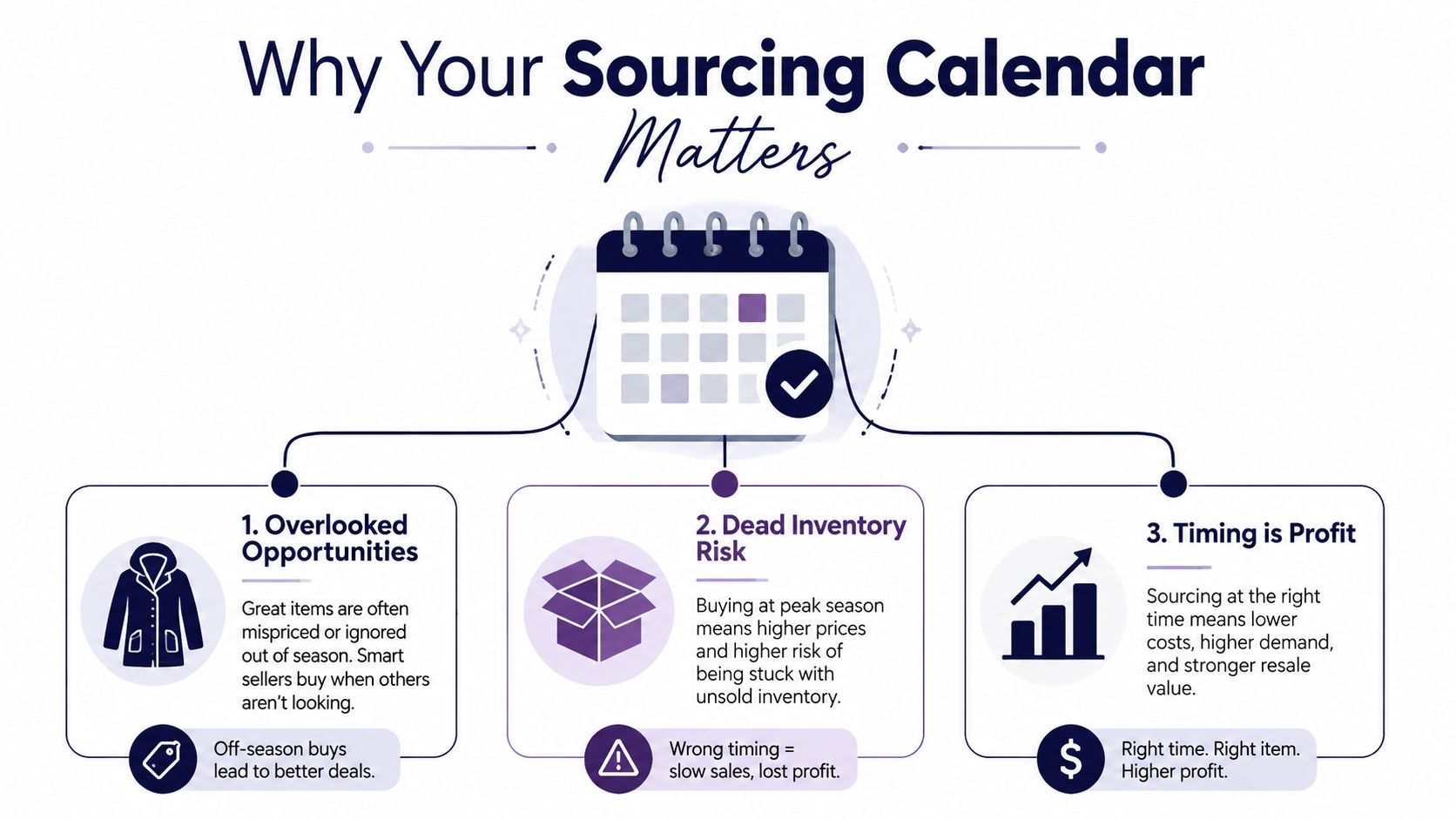
The calendar changes your risk
Every purchase has two clocks:
- The demand clock: When buyers search, purchase, and accept your target sold price.
- The cash clock: How long your money remains tied up in inventory before the item sells.
A low off-season buy price can lose its advantage when the item sits, needs a markdown, or prevents you from funding faster opportunities. A slightly higher buy price just before demand builds may produce a faster flip and a cleaner return. The right choice depends on expected sell-through, storage time, fees, and your available cash.
Seasonal patterns often follow recurring conditions such as weather, holidays, harvest cycles, and retail customs. The Bureau of Labor Statistics explanation of seasonal adjustment shows why a monthly price change can reflect normal calendar behavior rather than a lasting shift in demand. Apply that caution to sold comps. A short-term price move may reflect timing, not a permanent change in an item's value.
Practical rule: Don't ask only whether an item is worth buying. Ask whether it's worth buying this month.
Mark buying windows, not only selling seasons. Record when thrift stores clear racks, estate sales release relevant goods, retailers discount seasonal stock, and your sold comps begin to move. A market demand forecasting guide can help organize those signals around timing instead of isolated finds.
Understanding Seasonal Price Fluctuations for Resellers
A winter coat bought in spring can look like a bargain until it sits for months. The same coat sourced just before cold weather may cost more, yet sell faster at a stronger margin. For a reseller, seasonal price fluctuation means an item's realistic sold price and speed of sale change with the calendar, so the buy date affects the exit as much as the item itself.
Basic tools, neutral clothing, and common household essentials often move steadily. A heavy winter coat, Halloween decoration, patio cushion, or cooling appliance follows a sharper cycle. Interest stays limited during the wrong months, then concentrates when weather, holidays, school schedules, or events make the item useful.
Read the calendar in three layers
Start with the broad season, then narrow the buying window:
- Use case: Determine why the buyer wants the item. A ski jacket follows a different calendar from a rain shell, even though both are outerwear.
- Purchase trigger: Identify the event that creates urgency. Back-to-school shopping, winter weather, a holiday, or outdoor entertaining can change buyer behavior.
- Competition: Check whether new retail goods are discounted at the same time. Strong demand may still produce a weak used price when buyers have cheap new alternatives.
The marketplace also changes the read. eBay may provide a long history for a collectible, while Poshmark and Mercari may show different clothing behavior. Compare sold prices, not asking prices. An active listing records what a seller wants. A sold comp records what a buyer accepted, which is the figure that belongs in your margin calculation.
Separate seasonality from broad inflation
Macro inflation data can distract from the category in front of you. U.S. statistical agencies publish seasonally adjusted and unadjusted indexes because recurring calendar effects can distort month-to-month readings. Residual seasonality may remain after adjustment, and seasonality can vary sharply across product categories.
For sourcing, the takeaway is direct. Don't use “prices are rising” to justify a buy. Check the exact model, size, color, condition, and recent sales history. Toys, clothing, cooling gear, and collectibles can follow different calendars even when the wider economy appears stable. Record those differences in your buying calendar, then set a pass price that leaves room for slower sales outside the item's demand window.
The Real Causes Behind Seasonal Swings
Many resellers start with a simple assumption: demand rises, so prices rise. That logic misses what retailers do during high-volume seasons.
Retailers may cut prices when demand is strongest because they're competing for the same shoppers and trying to move time-sensitive stock. Research using retail scanner data across dozens of U.S. product categories found seasonal demand was large, around 20 log points for the median category, while the average seasonal product's price fell about 1.5 log points from demand trough to peak, with most products moving less than 2 log points overall. The retail scanner research shows why demand and shelf price shouldn't be treated as identical.
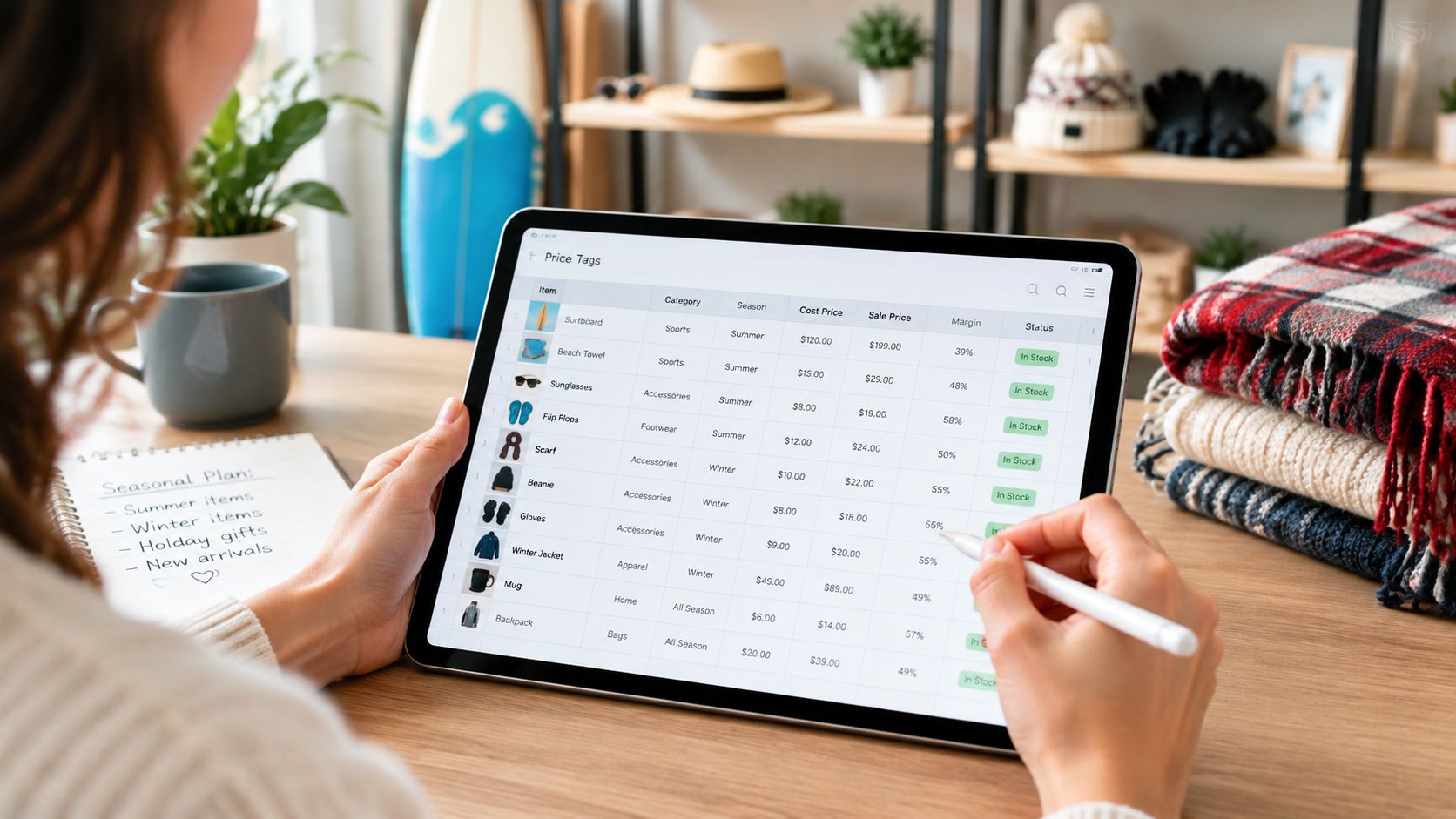
Margin compression changes the resale ceiling
Supermarket research found that peak-season price declines were driven mainly by retail margin compression, rather than wholesale cost reductions. Retailers lowered their margins to increase movement, attract shoppers, and manage seasonal inventory. The microeconomic analysis of supermarket pricing explains why a product can sell more units while carrying a lower shelf price.
That matters in the secondhand market. If a new product is heavily promoted during peak demand, your used version faces a lower ceiling. A seller with a holiday gift item may see plenty of buyer activity but still struggle to reach the expected sold price because shoppers can choose discounted new stock.
The better arbitrage window is often narrower:
- Before peak demand: Buyers are beginning to search, but retail promotions haven't fully compressed the price.
- During local demand peaks: The category is moving, but the seller still has price discipline.
- After peak clearance begins: Supply may be abundant, but the market ceiling can fall quickly.
Calendar effects can distort your read
Price changes also cluster around the calendar. Research on retail pricing found that price-change frequency is highest in the first quarter, with local peaks in January, April, July, and October. The retail pricing research makes the start of each quarter worth watching as a repricing window.
That doesn't mean every item should be bought in those months. It means you should expect more movement, re-evaluate old sold comps, and avoid treating a stale comp as a permanent market value.
Key Categories and Their Seasonal Rhythms
Category timing gets clearer when you compare actual use cases. Back-to-school clothing, holiday decorations, and outdoor furniture all respond to seasonal demand, but their sourcing windows and resale risks aren't interchangeable.
Retail research summarized by Reed College's seasonal pricing case study found that back-to-school clothing, Thanksgiving turkeys, and Christmas-season gift items were often discounted during peak demand. Store markups, rather than wholesale-cost changes, drove the price drops. That gives resellers a useful warning: peak demand can bring more shoppers without creating a higher resale ceiling.
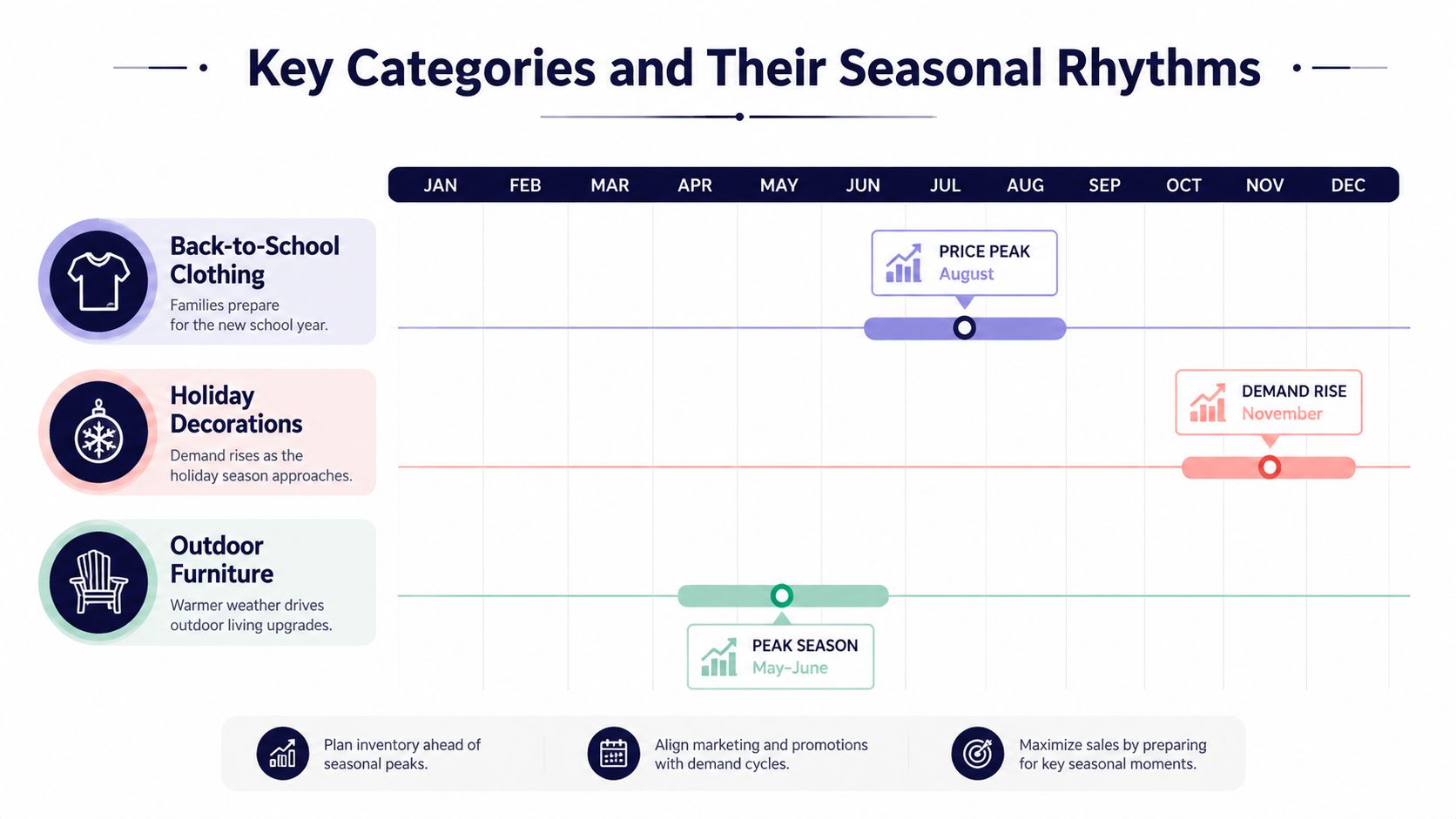
Clothing rewards the pre-peak window
Back-to-school clothing tends to become more relevant as late summer approaches. A branded jacket or quality denim piece sourced too far ahead may sit, while the same item found shortly before school shopping accelerates can have a better chance of selling quickly.
Suppose you buy a jacket for $8 and expect a $35 sold price. Your gross spread is $27 before fees, shipping, and your time. If the jacket sits through the wrong season, that spread may be less useful than a smaller profit on an item that sells immediately. The math is not just sale price minus cost of goods. It's net profit divided by the time and capital required.
Holiday decorations need disciplined buying
Holiday decor often becomes easier to sell as November approaches, but retailers also compete aggressively during that period. A box of ornaments bought for $5 might look appealing against a target sold price of $25, yet the comparison should include condition, shipping risk, storage space, and whether the exact style has recent sold comps.
Holiday periods can distort analysis because major events raise demand across many grocery products at once. A Kelley School of Business summary of holiday effects notes that weeks containing major holidays were excluded from one analysis because they affected broad product demand.
Outdoor furniture has a different burden
Outdoor furniture can attract stronger interest around spring and early summer, but bulky shipping and local-pickup limits change the profit equation. A chair found cheaply at an estate sale may be a good Facebook Marketplace flip, yet a poor eBay buy once freight, handling, and buyer expectations enter the calculation.
A seasonal resale category guide can help you compare the calendar with the item's actual resale friction. The sweet spot is usually before demand reaches its most competitive retail phase, not automatically at the demand peak.
Adjusting Your Buy and Pass Thresholds
Your buy threshold should move with sell-through confidence, not just with the season. An item that clears your normal rule in October may fail that same rule in May because the holding period is longer and the buyer pool is smaller.
Start with your normal net-profit requirement, then add a calendar adjustment. In the deep off-season, demand uncertainty deserves a stricter pass decision. Near the pre-peak window, you may accept a higher cost of goods if recent sold comps show that buyers are returning and the item can move before the retail discount cycle becomes aggressive.

Use a seasonal threshold test
At the estate sale table, ask four questions before paying:
- Demand timing: Is the item entering its useful season, already in it, or leaving it?
- Comp quality: Are the sold comps recent and close in brand, model, condition, size, and color?
- Holding cost: Can you store it without adding clutter to the death pile?
- Net outcome: Does the expected profit still work after platform fees, shipping, and buy cost?
A winter coat in May may need a larger expected profit than the same coat in October because your cash could remain tied up for months. A box of holiday decorations in early November may justify a quicker decision, but only if the sold comps support the expected price and the items are easy to ship or sell locally.
Don't confuse a discount with a green light
A low thrift price doesn't protect you from a bad flip. Seasonal goods often arrive in large batches after demand fades, which can make sourcing feel productive while building unsold inventory. The best pass is the item that would require too much patience, storage, or price cutting.
ScanFlip AI is designed for this sourcing decision. It offers AI photo identification with no barcode needed, barcode scanning, and text search, then aggregates sold comps across eBay, Poshmark, Mercari, Depop, Amazon, Whatnot, ThredUp, Facebook Marketplace, and TikTok Shop. Its calculation factors in platform fees, shipping, and buy cost, then gives a red or green flip-or-pass verdict that you can compare with your seasonal threshold.
Buy discipline: A seasonal opportunity is only useful when the calendar improves both demand and your expected net profit.
Using Sold Comps to Time Your Sourcing Cadence
Active listings are useful for seeing competition, but they aren't proof of value. For seasonal buying, sold comps are the anchor because they show what buyers accepted during a specific part of the calendar.
Build a simple rhythm around your categories. Check winter clothing before demand returns, holiday goods before peak promotions become widespread, and outdoor items before local pickup demand gets crowded. You're looking for the point where sold prices and sales frequency begin improving, while sourcing costs remain reasonable.
A practical calendar for sourcing
Use this as a working cadence, then replace assumptions with your own category data:
- Off-season: Buy only when the cost of goods is low enough to justify storage and delayed cash recovery.
- Pre-peak: Increase sourcing attention as relevant searches and recent sold comps strengthen.
- Peak demand: Watch retail discounts closely. Strong demand can coexist with lower prices because retailers compress margins.
- Post-peak: Stop buying unless the item has durable demand, unusual scarcity, or a clear local-pickup advantage.
Seasonality also differs by geography. A winter coat may move earlier in a cold region than in a warm one, while outdoor furniture can depend on local weather and storage space. Your own sales history, buyer messages, and sell-through rate should refine the broad calendar.
For a more disciplined review, compare recent sold prices with older sales, but don't treat every change as a trend. The recent sold prices guide reinforces the practical habit of checking current demand instead of relying on a category's reputation.
Make the decision at the source
Standing in a Goodwill aisle, you usually have seconds, not an afternoon. For an untagged vintage coat, AI photo scan can identify the item without a barcode. For a boxed game or book, barcode scan is faster. If the item can't be photographed or scanned cleanly, text search gives you another route to sold comps.
The goal isn't to automate judgment. It's to put the relevant evidence in front of you before cash leaves your pocket. Compare the current buy price with expected net profit, assess the holding period, and pass when the calendar doesn't support the risk.
ScanFlip AI lets you check seasonal finds with AI photo scan, barcode scan, or text search, then compare sold comps across major marketplaces and see net profit after fees and shipping. Visit ScanFlip AI before your next thrift, garage-sale, or estate-sale run, and test whether that seasonal item is a green-light flip or a pass.