
TikTok Shop Fee Calculator: Real Net Profit Math
You're standing at an estate sale holding a vintage jacket with a $50 sold comp on TikTok Shop. The platform's headline referral fee looks simple, 6%, so you do the quick math and expect about $3 to disappear. The flip appears safe until you account for shipping, a creator commission, returns, and what you paid for the jacket.
That's how a promising BOLO becomes another item in the death pile. A TikTok Shop fee calculator is useful only when it models the all-in effective take rate, not just the commission printed in the fee schedule. The question isn't “What percentage does TikTok charge?” It's “What will this order leave me after every cost that applies?”
Table of Contents
- Why the Headline Fee Lies to Resellers
- Breaking Down Every TikTok Shop Fee Layer
- The TikTok Shop Fee Formula With Worked Examples
- How TikTok Shop Fees Compare to eBay and Poshmark
- Hidden Costs That Wreck Your Margin
- Building a Sourcing Workflow Around Fee Math
- Quick Reference Checklist for TikTok Shop Flips
Why the Headline Fee Lies to Resellers
The 6% referral fee is real for most U.S. TikTok Shop categories, but it's only one layer of the sale. Independent 2026 breakdowns report that a $50 order generally produces about $3 in referral fees before shipping, returns, affiliate commissions, or other optional costs are included. The U.S. TikTok Shop fee breakdown also describes payment processing as bundled into the headline referral fee for U.S. sellers, which makes the basic calculation look cleaner than the total order economics may be.
That distinction matters in a Goodwill aisle. Suppose the jacket cost $12, shipping costs $8, and a creator helped generate the sale. The gross spread between $50 and your $12 buy cost can look healthy, but the money left after the platform, shipping, and creator payout may be much smaller. If the buyer returns it, your time, packaging, and cash flow take another hit even if the original commission looked harmless.
Practical rule: Treat the advertised referral rate as the starting input, never as your expected net margin.
Why gross revenue creates bad buys
Resellers already know the difference between a sold comp and an asking price. TikTok Shop requires the same discipline with fees. A sold price tells you what the customer paid. It doesn't tell you whether the order was creator-driven, whether you absorbed fulfillment costs, or whether a return will delay your payout.
Generic calculators usually answer one narrow question: referral fee multiplied by selling price. That can work for a rough first pass, but it fails at the sourcing decision. A reseller needs to know whether an item clears the personal profit threshold after cost of goods, shipping, creator commissions, and return friction.
Recent independent guidance notes that creator commissions of 10% to 20% and other cost layers can push the effective take rate to 20% to 35% of revenue in some order types, even when the base U.S. referral fee is 6%. Printify's TikTok Shop fee coverage highlights this gap between the headline commission and the actual cost of selling.
That's why the jacket shouldn't get a green light because “only $3” goes to TikTok. The calculator needs to show what you keep, not what the platform advertises.
Breaking Down Every TikTok Shop Fee Layer
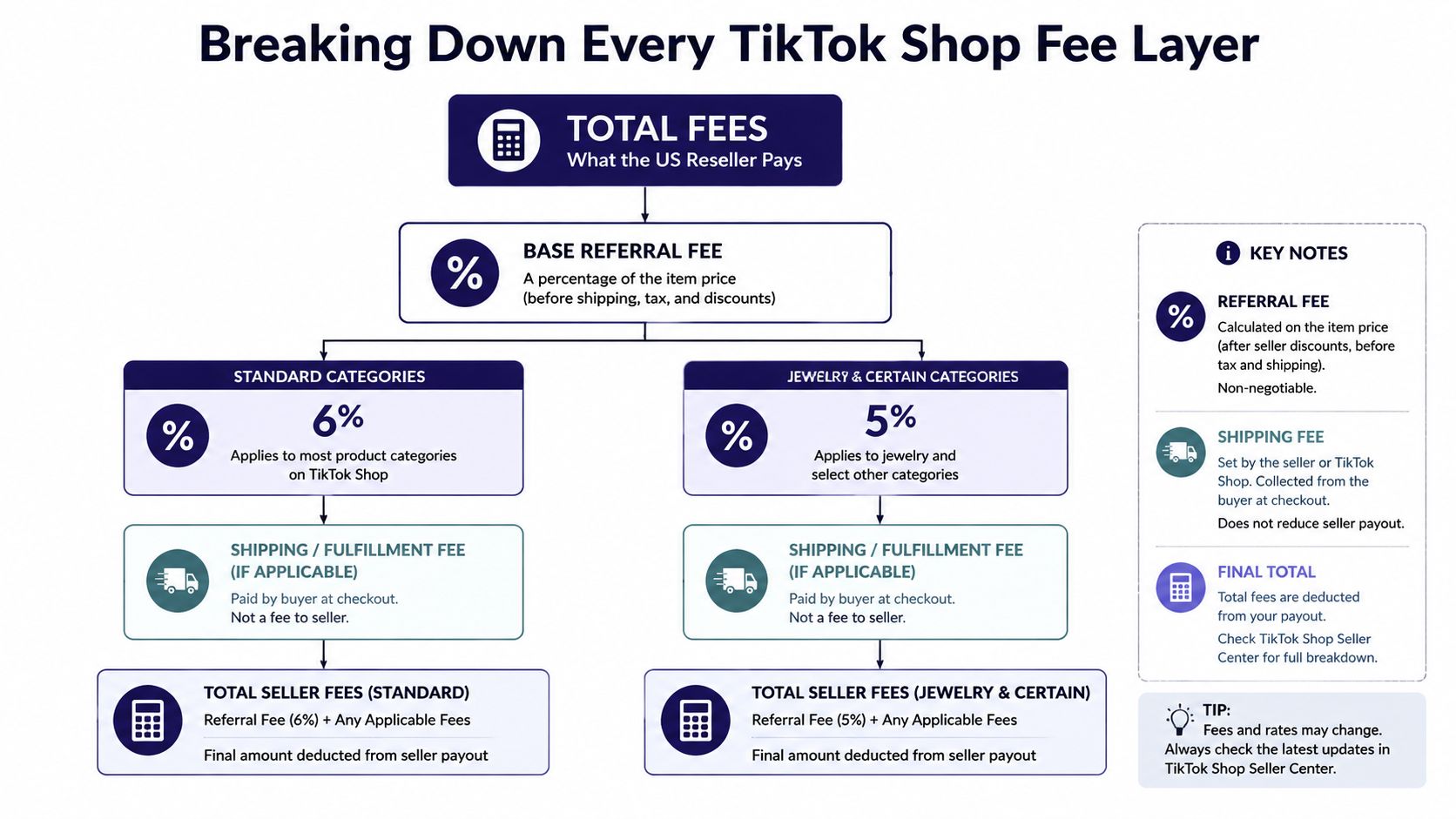
For a U.S. reseller, the first input is the category-specific referral fee. Most categories use 6%, while jewelry and certain pre-owned goods can use 5%, according to independent 2026 fee guides. On a $50 sold comp, that means $3 at 6% or $2.50 at 5%, before you subtract any other order costs. SellerGains' TikTok Shop calculator guide also reports a 3% promotional rate for new sellers during the first 30 days.
Mandatory and conditional charges
The referral fee applies to the sale under the applicable category rules. Payment processing is reported as bundled into the headline referral fee for U.S. sellers in several 2026 breakdowns, but independent coverage also reports that some U.S. markets or seller types may face a separate processing layer around 1.5% to 2.2%, or roughly 2%. Darkroom's 2026 seller cost breakdown explains why a calculator should include a separate processing field when your account terms require it.
Shipping and fulfillment aren't the same as the referral fee. If you pay to ship a $50 jacket, that expense comes out of the order economics even when the platform fee is calculated correctly. A calculator that leaves shipping blank can label a low-margin flip as profitable.
Creator or affiliate commission is optional in the sense that you don't have to attach every product to a creator campaign. It becomes a real cost when the sale is creator-driven. Independent 2026 fee coverage reports affiliate commissions ranging from 5% to 30%, depending on the campaign. On $50, a 20% creator commission would be $10, before referral fees, processing, shipping, or cost of goods.
The new-seller window
The reported 3% rate for the first 30 days can improve early-order math, but it shouldn't become the permanent assumption in your sourcing model. A $50 sale at 3% produces $1.50 in referral fees, compared with $3 at the standard 6% rate. Once the promotion ends, the same SKU may no longer clear your target unless the sold price, shipping profile, or creator strategy supports the regular rate.
Enter the promotional status as a temporary condition. If the item only works during the reduced-fee window, it's a weak long-term flip.
The TikTok Shop Fee Formula With Worked Examples
Use this basic formula:
Net profit = sold price − referral fee − applicable processing − creator commission − shipping − cost of goods
Add expected refund or return friction when the category regularly sends items back. The calculator should also separate mandatory costs from optional sales costs, because a creator-driven order and an organic order aren't economically identical.
For a quick comparison, the following examples use the stated order assumptions. Shipping is shown as an input rather than an invented rate, so the math stays honest when your actual label cost changes.
Scenario one with no creator commission
A vintage band tee sells for $40 and cost $5 at a garage sale. Assuming the standard 6% referral fee, the referral deduction is $2.40. With shipping left as an actual order input, the formula is $40 − $2.40 − shipping − $5.
If shipping is $8 on that order, the net profit is $24.60. That's a workable flip before return friction, but the $24.60 isn't a universal result. Change the shipping label or category rate and the answer changes with it.
Scenario two with a creator affiliate
A pair of sneakers sells for $60 through a creator at a 20% commission. The creator receives $12, and the standard referral fee is $3.60 at 6%. If the shoes cost $15 and shipping is $10, the math is $60 − $3.60 − $12 − $10 − $15, leaving $19.40 before any separate processing layer or return-related loss.
The important point isn't that $19.40 is automatically good. It's that the creator payout consumes more of the order than the base referral fee, so the sneaker needs enough demand and resale spread to support that channel.
Scenario three during the promotional window
A book sells for $25 during the reported 3% new-seller promotional rate. The referral fee is $0.75. If the book cost $2 and shipping is $6, the result is $25 − $0.75 − $6 − $2, or $16.25 before any other applicable expense.
Use your actual COGS, label cost, and account terms. The net profit calculation guide from ScanFlip AI is useful when you want to keep the same logic across TikTok Shop, eBay, Poshmark, and Mercari.
| Scenario | Sold Price | Referral Fee | Creator Commission | Shipping | COGS | Net Profit |
|---|---|---|---|---|---|---|
| Vintage band tee, organic order | $40 | $2.40 | $0 | $8 | $5 | $24.60 |
| Sneakers, creator-driven order | $60 | $3.60 | $12 | $10 | $15 | $19.40 |
| Book, new-seller promotion | $25 | $0.75 | $0 | $6 | $2 | $16.25 |
How TikTok Shop Fees Compare to eBay and Poshmark
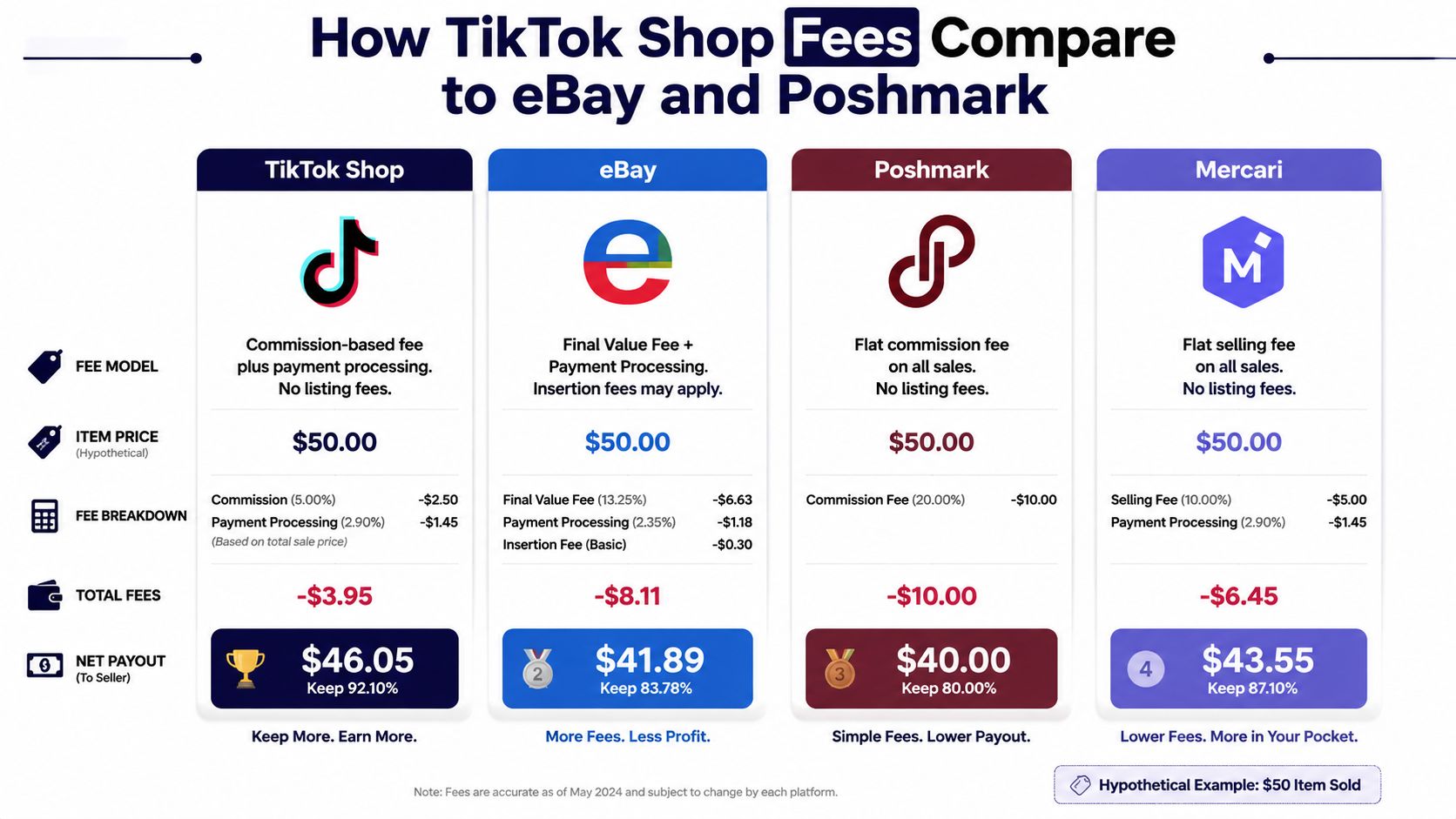
Resellers don't need the cheapest headline fee. They need the strongest net result for the specific item, buyer, and sales channel. A jacket with TikTok Shop demand may outperform a slower marketplace, while a book or collectible with established search traffic may make more sense elsewhere.
A clean comparison requires current platform terms, category rules, shipping assumptions, seller status, and creator involvement. The verified TikTok Shop inputs available here support the U.S. 6% standard referral rate, 5% rate for jewelry and certain pre-owned items, the temporary 3% new-seller rate, and optional creator commissions. They don't establish a single current fee schedule for eBay, Poshmark, or Mercari, so a responsible comparison shouldn't invent exact marketplace deductions or final payouts for those platforms.
Where TikTok Shop can win
TikTok Shop can make sense when short-form content or a creator audience creates demand that a search-first marketplace won't capture as quickly. It can also work when the product has a strong visual hook, a clear use case, or a trend that makes video discovery valuable.
The trade-off is that creator-led demand may require giving away a meaningful share of revenue. A $50 item with no creator commission has a very different margin from the same $50 item sold with a campaign attached.
Where another marketplace may be safer
Route an item elsewhere when the TikTok Shop order requires promotional support that consumes the spread. A collectible with reliable sold comps on eBay may not need a creator payout. A fashion item with strong Poshmark buyer intent may be easier to price without adding affiliate economics. A low-dollar book may fail on any platform once shipping and labor take too much of the order.
The Poshmark versus eBay fee comparison can help frame the decision, but verify each marketplace's current terms before relying on a fixed spreadsheet. The useful habit is to compare net profit by channel, not just the gross sold price.
A marketplace is a route to the buyer, not a reason to accept a weak margin.
Hidden Costs That Wreck Your Margin
The most dangerous TikTok Shop fee is often the one you didn't include. Generic calculators stop after referral commission, but a reseller's order can also involve a creator payout, shipping, refunds, and delayed settlement.
Creator commissions deserve their own line. Independent 2026 coverage reports campaigns ranging from 5% to 30%. On a $60 sold comp, a 20% creator commission is $12 before the referral fee, processing, shipping, or COGS. That's enough to change a shelf decision when you're buying with thin room between cost and sold price. ShortFormNation's 2026 seller handbook discusses this range and why creator-driven orders need separate modeling.
Returns change the effective rate
Returns don't always appear as a neat, predictable deduction on the first calculator screen. They create reverse logistics, delayed cash, repackaging work, and the possibility that an item comes back in a condition that takes longer to resell.
That's why the 20% to 35% effective take-rate range reported in independent guidance matters. It reflects the combined effect of referral fees, creator commissions, fulfillment, and refund or return friction in certain order types, not a universal TikTok Shop charge. A calculator should let you test an organic sale, a creator sale, and a returned order separately.
Settlement timing affects sourcing cash
A profitable order can still strain a reseller who needs the money for the next estate sale. One 2026 source reports that deductions occur at settlement and payouts may arrive 15 to 30 days after the return window closes. Hubfluence's TikTok Shop seller fee coverage explains why cash-flow timing belongs beside margin math.
Regional rules create another problem. The U.K. reportedly moved to a 9% seller fee in January 2026, up from 6%, while the EU structure is reported as 6% plus a 2% transaction fee. Southeast Asian markets can be higher, with Vietnam listed at 12.5% to 15.5% plus a 6% transaction fee in independent comparisons. Tiklytics' regional TikTok Shop fee data shows why one global calculator can't answer every seller's question.
Cash-flow check: If your next sourcing trip depends on this payout, model when the money arrives, not just how much the order appears to earn.
For shipping assumptions, use your own label history and category data. The reseller guide to estimating shipping costs gives you a practical way to keep that input from becoming a guess.
Building a Sourcing Workflow Around Fee Math
A fee calculator belongs in the sourcing decision, not in a month-end spreadsheet after the money is already spent. The workflow is simple: identify the item, find credible sold comps, enter the right market and category rate, add shipping and COGS, then test whether the result clears your minimum.
Set the threshold before you scan
Choose a minimum net profit that reflects your time and cash. For example, you might require $15 after fees and shipping for ordinary thrift finds, while demanding more from bulky items, fragile collectibles, or anything that requires cleaning and testing. The threshold is your rule, not a claim that every reseller should use the same number.
Then test two versions of the sale:
- Organic order: Base referral fee, shipping, COGS, and any processing input that applies.
- Creator-driven order: Add the planned affiliate commission before you decide the item is viable.
If the item passes only in the organic version, don't assume a creator campaign will improve it. Treat creator spend as a separate route to market.
Scan across marketplaces at the shelf
For a faster multi-platform check, ScanFlip AI offers three scan methods, AI photo identification with no barcode needed, barcode scanning, and text search. It aggregates sold comps across eBay, Poshmark, Mercari, Depop, Amazon, Whatnot, ThredUp, Facebook Marketplace, and TikTok Shop, then factors platform fees, shipping, and buy cost into an expected net profit with a red or green flip-or-pass verdict.
That helps when you're standing at an estate sale with an untagged jacket, a bin of books, or a collectible without a UPC. Use the result to choose the channel with the strongest realistic net, then manage your listings with the tools you already use, such as Vendoo or List Perfectly.
Keep scan history by location and category. After enough sourcing trips, you'll see which stores produce items that clear your profit bar and which ones mostly create low-margin death-pile inventory.
Quick Reference Checklist for TikTok Shop Flips
Use this before you buy:
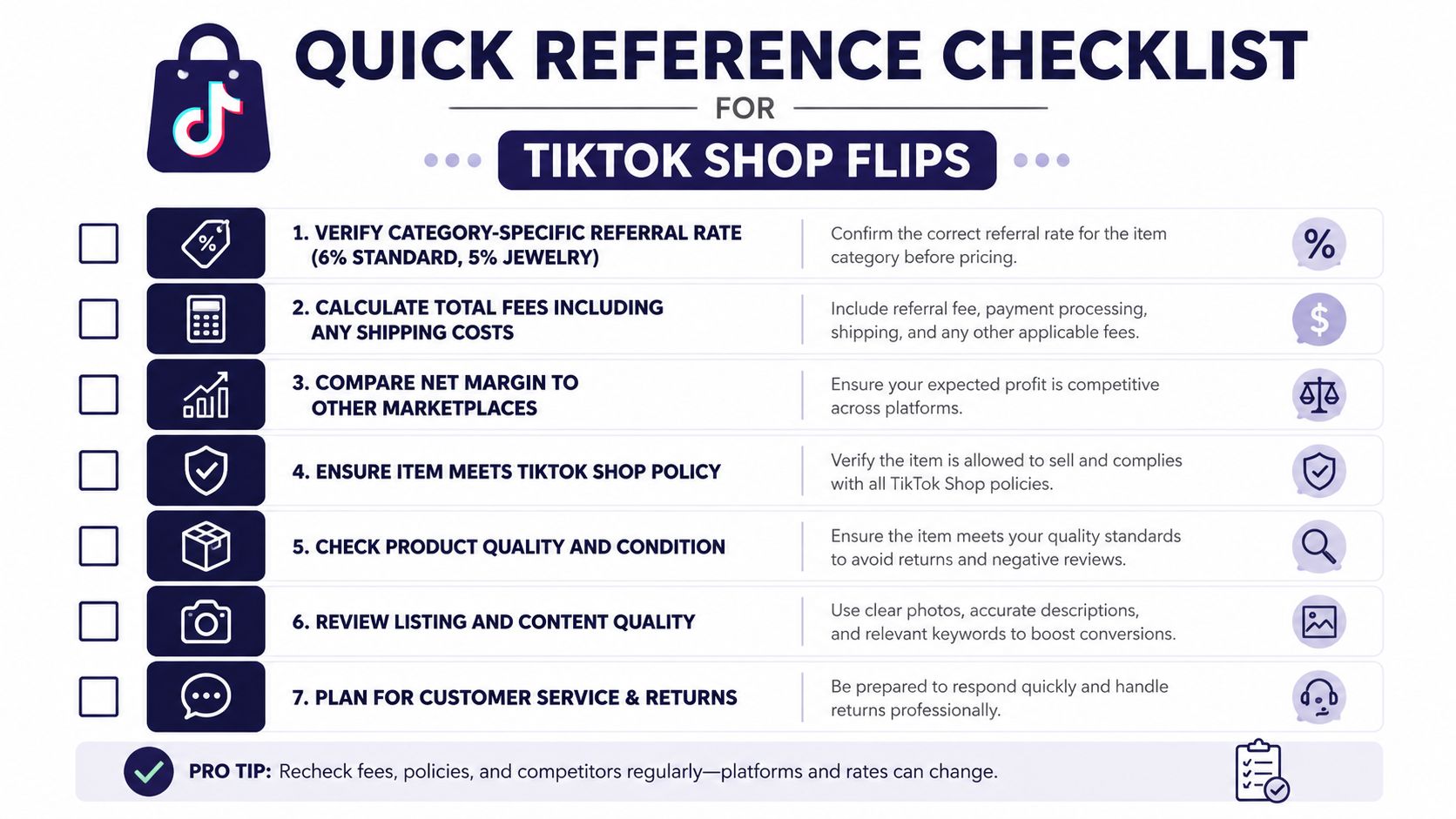
- Verify the category rate: Start with 6% for most U.S. categories, 5% for jewelry and certain pre-owned goods, or the reported 3% new-seller promotion when your account qualifies.
- Check the order type: Decide whether the sale is organic or creator-driven.
- Add every applicable fee: Include referral, separate processing when required by your terms, creator commission, shipping, and return exposure.
- Use sold comps: Don't base the decision on asking prices or optimistic listing prices.
- Subtract COGS: Enter the actual thrift, garage sale, estate sale, or retail arbitrage cost.
- Compare channels: Check whether eBay, Poshmark, Mercari, or another marketplace leaves a better net result.
- Protect cash flow: Remember that reported payouts can arrive 15 to 30 days after the return window closes.
- Confirm policy fit: A profitable-looking item still needs to meet TikTok Shop's seller and category requirements.
- Make the call: Buy only when the expected net profit clears your threshold after the realistic fee stack.
Use ScanFlip AI while you're still at the thrift store, garage sale, or estate sale to scan with a photo, barcode, or text search and compare sold comps across major marketplaces, including TikTok Shop. It calculates expected net profit after fees and shipping, then gives you a clear red or green flip-or-pass signal before you spend your money.