

Poshmark vs eBay Fees: Which Platform Keeps More Profit
You're standing in a Goodwill aisle with a $12 vintage band tee in your hand, and the sold comps look clean. It'll sell on either platform, but the fee math doesn't stay clean for long once you start matching items to Poshmark vs eBay fees. The wrong platform can turn a decent flip into a bad buy, especially when your cost of goods is low and your margin is already thin.
| Platform | Fee Structure | What It Means for Sellers |
|---|---|---|
| Poshmark | 20% commission on sales of $15 or more, $2.95 on sales under $15 | Simple to calculate, but expensive on mid and higher-priced items |
| eBay | Typically around 13.25% to 15% plus a $0.30 per-order fee, with up to 250 free listings per month before about $0.35 per listing after that | Usually lower seller charges on many categories, but shipping treatment matters |
| Shipping treatment | Commission applies to the item price only, shipping handled separately | Final value fee applies to the total sale amount including shipping |
| Low-price edge | Flat $2.95 can beat percentage fees on some sub-$15 items | Useful for cheap accessories, kids' items, and clearance flips |
| Higher-price edge | 20% scales hard against the seller | The gap grows fast on handbags, electronics, and premium vintage |
Table of Contents
- Why Fee Differences Matter More Than You Think
- Breaking Down the Fee Structures
- Real Numbers Net Profit at Different Price Points
- Which Platform Wins by Item Type and Price Band
- Tools and Strategies to Minimize Fees
- Building a Multi-Platform Strategy
Why Fee Differences Matter More Than You Think
You pull a $12 band tee off the rack, check the tag, and the sold comps tell you it can bring $45 on both platforms. Most resellers would shrug and say the fee difference is close enough to ignore, but it isn't. At that price point, the platform choice changes your net profit, and that's the number that decides whether the buy makes sense.
Thin margins turn small fee gaps into real money
A lot of sourcing trips are won or lost on items that look minor. A tee here, a hoodie there, a pair of sneakers in the cart, then a stack of “probably fine” buys at the estate sale. If each item leaks a few extra dollars in fees, the total hit across a haul gets ugly fast. The practical difference between 20% and roughly 13.25% to 15% isn't academic, it decides which flips belong in the cart and which ones stay on the rack, especially when you're trying to protect your sell-through rate and avoid dead inventory.
Practical rule: don't ask, “Will this sell?” Ask, “What do I keep after fees, shipping, and cost of goods?”
The bigger mistake is judging by gross sale price alone. A seller can have a $45 sold comp and still end up with a weak flip if the fee structure eats too much of the margin. That's why experienced flippers talk in net profit, not just sold price. It's the only way to compare items across categories without fooling yourself.
Why the gap matters on a sourcing trip
The math matters most when you're making dozens of quick decisions in a row. One platform may look almost identical on a single item, but over a cart full of books, tees, handbags, and hard goods, the fee gap becomes one more filter in your buy-or-pass process. That's especially true if you're sourcing at a Goodwill, an estate sale, or a garage sale where you don't have time to overthink every piece.
The strong habit is simple. Check the sold comps, estimate fees, and buy only when the take-home still works. Anything else is just hoping the margin survives.
Breaking Down the Fee Structures
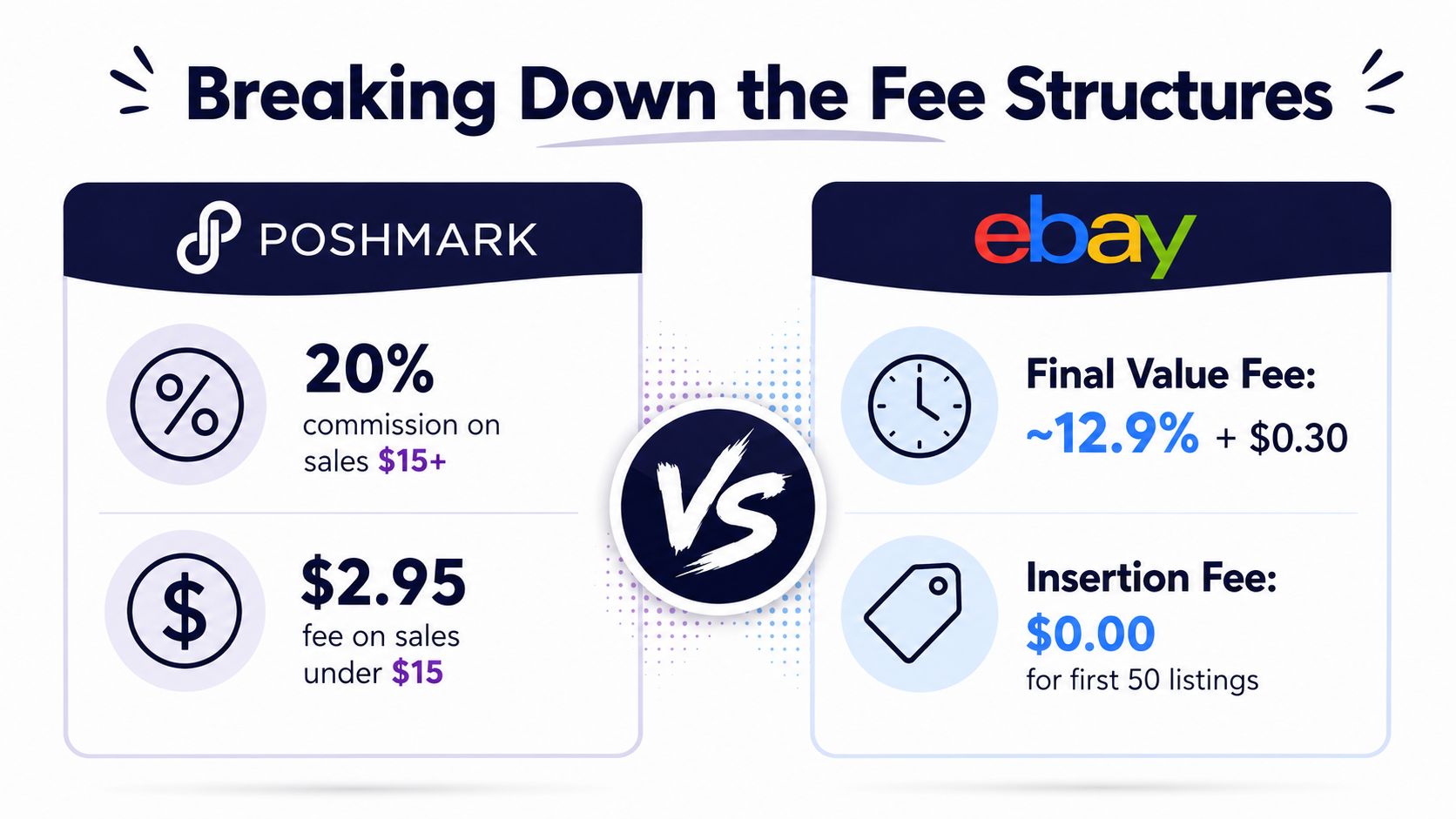
Poshmark and eBay both take a cut, but they don't take it the same way. That difference matters more than the headline rate because the fee base is different, and shipping gets treated differently too. If you only look at the percentage, you miss the part that changes your payout.
How Poshmark charges sellers
Poshmark keeps the structure simple. It takes a flat 20% commission on sales of $15 or more, and a $2.95 fee on sales under $15. That simplicity is easy to calculate in the aisle, which is why so many clothing sellers like it for fast decisions.
The downside is obvious on anything that's not cheap. Once the item price rises, that 20% bites hard. For a seller flipping higher-end fashion, the platform can feel generous on convenience and tough on payout.
If you're trying to model break-even points before you buy, the cleanest way to think about it is by price band. A small-ticket item can survive the flat fee. A mid-priced item often can't.
See the break-even approach in the ScanFlip AI break-even price calculation guide.
How eBay charges sellers
eBay's seller charges are usually lower for many categories, with final value fees commonly around 13.25% to 15% plus a $0.30 per-order fee. eBay also allows up to 250 free listings per month before charging about $0.35 per listing afterward. That structure looks more complex, but it often leaves more room in the margin.
The shipping treatment is the part most comparison pages gloss over. eBay's final value fee is applied to the total sale amount including shipping, while Poshmark's 20% commission is on the item price only and buyer-paid shipping is handled separately. That means two listings with the same gross sale can produce different net results depending on package weight, shipping charge, and how you price the item.
eBay can look cheaper on the fee line and still net less on a heavy item if shipping is handled poorly.
The practical read is this. Poshmark is easy to calculate. eBay is easier to optimize. One is simpler, the other is often better for margin.
Real Numbers Net Profit at Different Price Points
The platform debate gets real here. The fee difference doesn't matter in the abstract, it matters at the register, in the cart, and at the end of the month when you're counting what hit your payout. The same item can be a fine buy on one platform and a pass on the other.
Price bands show where each platform wins
A $50 sale is a good middle-ground example because it's common enough to matter. Poshmark usually takes about $10 in fees, while eBay is roughly $6.93 to $7.20, so Poshmark can take about 40% more in absolute fees on that transaction. That's the kind of gap that eats a sourcing budget if you keep buying items on the wrong platform assumption (Nifty AI comparison).
A $200 handbag makes the difference even starker. Poshmark triggers a $40 fee, while eBay takes roughly $26.90. On premium inventory, Poshmark's flat 20% commission scales much harder against the seller as price rises (Future Proof fee comparison).
The twist is the low end. On very cheap items under $15, Poshmark's flat $2.95 fee can beat eBay's percentage-based structure. That's the crossover point a lot of sellers miss when they dismiss Poshmark as “always more expensive.”
Use this table as a quick gut check before you buy.
| Sale Price | Poshmark Fees | Poshmark Net | eBay Fees | eBay Net | Winner |
|---|---|---|---|---|---|
| $15 | $2.95 | $12.05 | Percentage-based fee plus $0.30 order fee | Varies by category | Depends on category and shipping |
| $50 | About $10 | About $40 | About $6.93 to $7.20 | About $42.80 to $43.07 | eBay |
| $100 | $20 | $80 | Lower than Poshmark in many categories | Higher than Poshmark in many categories | eBay in most cases |
| $200 | $40 | $160 | About $26.90 | About $173.10 | eBay |
For a sourcing decision, the point isn't memorizing every row. It's recognizing that the fee curve changes with price. Once you start buying inventory in the $50 to $200 range, platform choice can matter as much as the buy cost itself.
A quick way to sanity-check the math is to plug the item into your take-home estimate before you pay. The ScanFlip AI net profit guide is useful for that kind of at-the-rack check.
Which Platform Wins by Item Type and Price Band
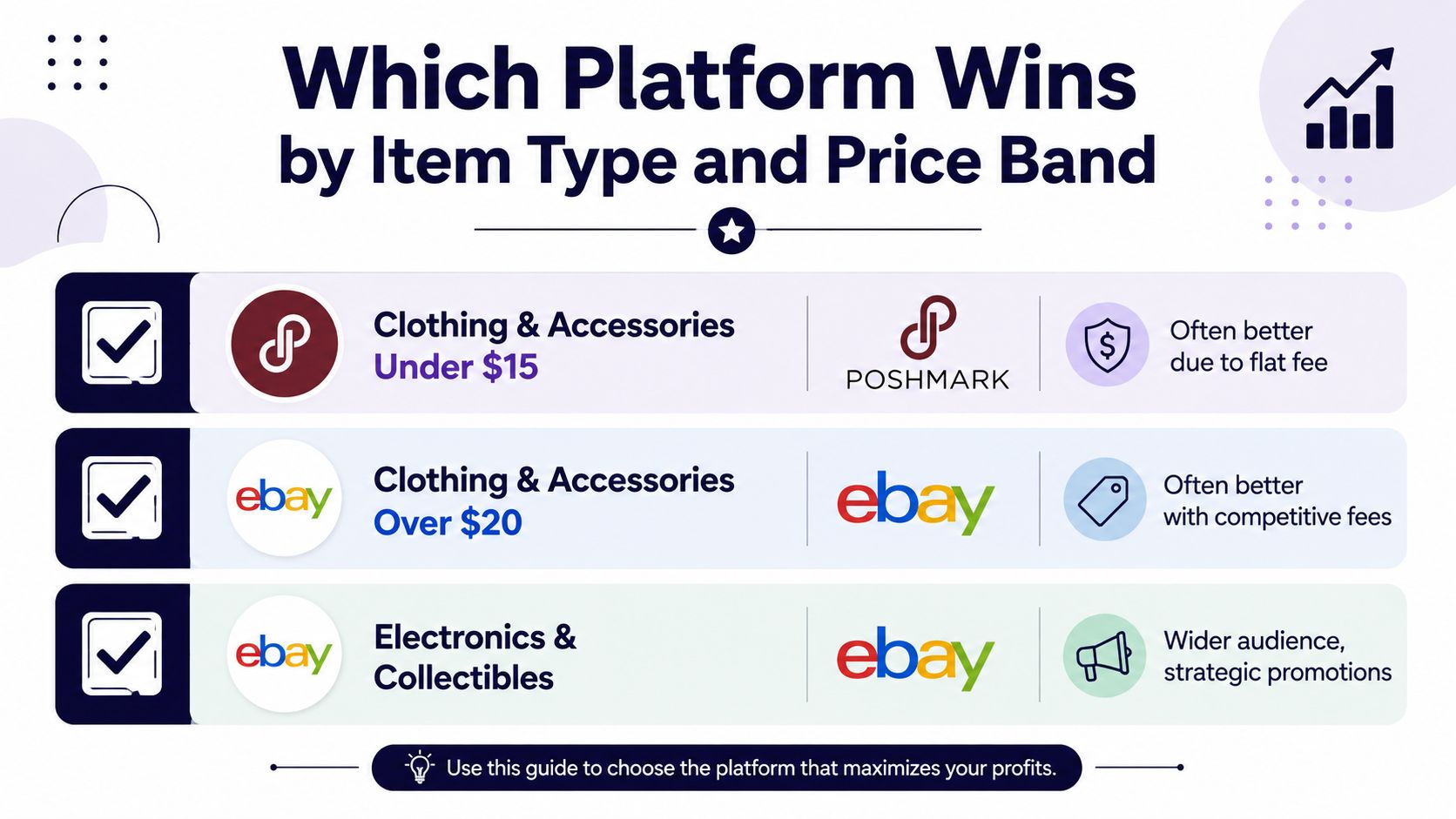
Platform choice is easier when you stop treating every item the same. Clothing, accessories, electronics, and collectibles don't behave alike, and the fee structure makes that obvious once you start separating them by price band. The right move is to match the item type to the marketplace where the net profit survives.
Cheap fashion and accessories
Clothing and accessories under $15 can work better on Poshmark because the flat $2.95 fee can be kinder than a percentage cut. That's especially true for small accessories, kids' items, and clearance flips where the dollar amount is already low and you care more about keeping a few extra dollars than about the headline percentage.
For this kind of item, Poshmark's simplicity can beat eBay's flexibility. If the comp is weak, don't force the flip. The item has to leave enough after fees to justify your time, packaging, and the shelf space it would've taken in the death pile.
Mid-range clothing and higher-ticket inventory
Clothing and accessories over $20 usually lean toward eBay. The percentage fee is commonly lower, and the savings matter more as the ticket climbs. That's why a lot of resellers move mid-range fashion, premium denim, and better shoes to eBay when they want to protect margin.
Premium handbags, electronics, and collectibles over $100 often land even harder on eBay. The fee gap widens as the sold price rises, so a platform that takes a smaller cut gives you more room to source aggressively. If you're paying real money for inventory, the platform fee can decide whether the buy is strong or weak.
Shipping weight changes the answer
Heavy items complicate the math. eBay's fee-on-shipping treatment can erase part of the percentage advantage if you're charging for shipping on a bulky item. That's why a heavier jacket, boot bundle, or awkward hard good needs a different check than a light tee.
Decision point: if the item is heavy, don't trust the headline fee rate. Run the sale price, shipping charge, and category fee together before you buy.
That's where a quick profit scan helps. ScanFlip AI uses AI photo scan with no barcode needed, barcode scan, and text search, then pulls sold comps across eBay, Poshmark, Mercari, Depop, Amazon, Whatnot, ThredUp, Facebook Marketplace, and TikTok Shop to show net profit after fees with a red or green flip-or-pass verdict. For items that might sit in multiple categories, that's a fast way to avoid bad assumptions at the shelf.
Tools and Strategies to Minimize Fees
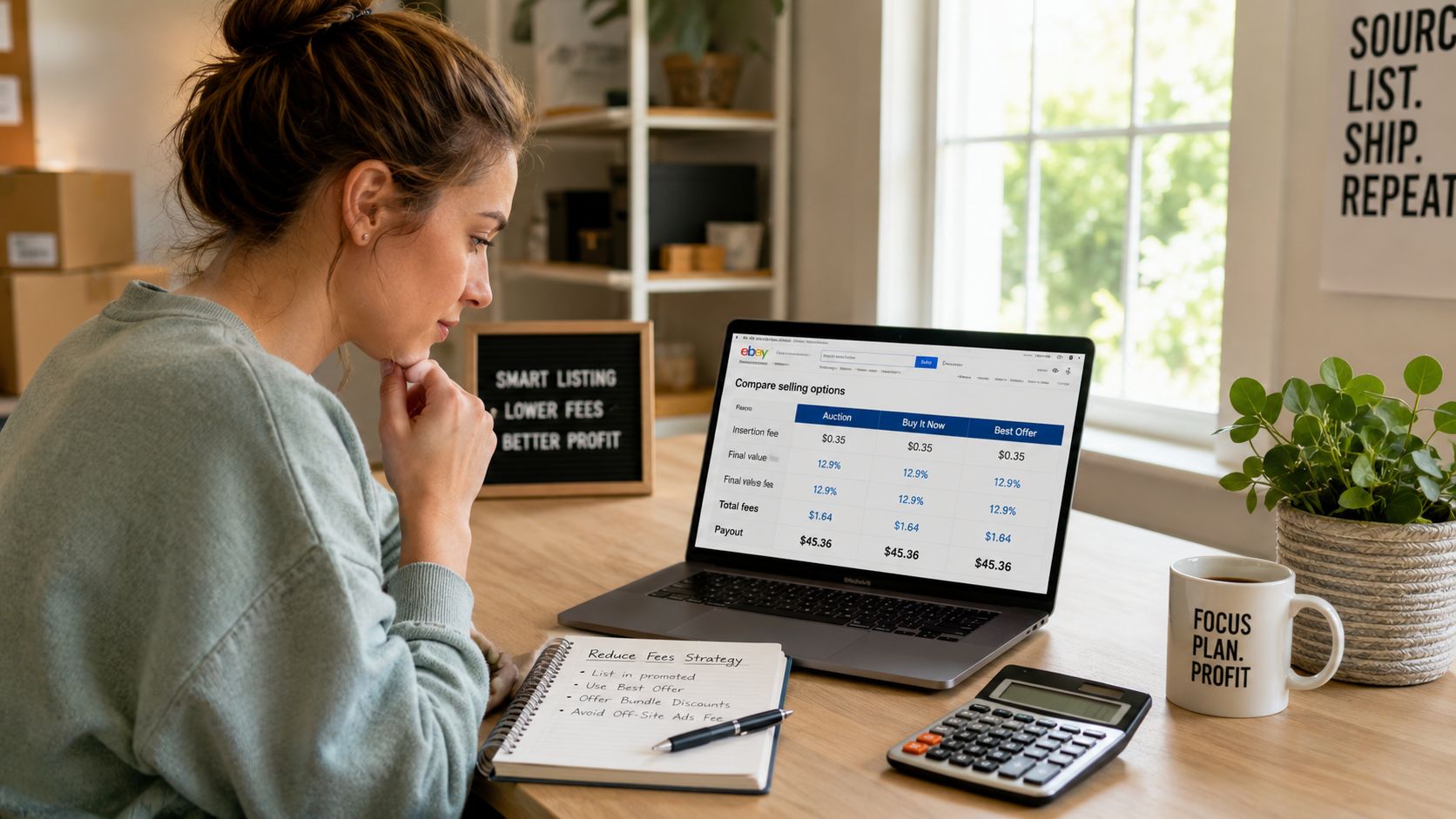
Fees don't just live on the platform, they live in how you price, ship, and decide what's worth buying in the first place. The sellers who keep more profit usually aren't magical with sourcing. They're just faster at filtering out bad margin before they commit money.
eBay tactics that protect margin
On eBay, the main job is to keep the sale profitable after every fee gets counted. That means paying attention to category-specific fee variation, not just the generic rate people quote in forums. It also means using promoted listings only when the item can support the extra spend and still leave a healthy net.
The shipping side matters too. If you're going to charge shipping, price it cleanly and don't bury it in a way that turns the fee base against you. eBay gives you flexibility, but flexibility only helps if you know where the cut is coming from.
Poshmark tactics that make the flat fee work
On Poshmark, the strategy is different. The 20% fee on items $15 or more rewards smarter price bands, so you want to know whether the item belongs in the cheap pile or the mid-ticket pile before you list it. For lower-priced inventory, the flat $2.95 fee can be a useful advantage, especially when the item is light and buyer-paid shipping keeps your side simple.
That's why a lot of clothing sellers treat Poshmark as the home for specific pieces rather than a default home for everything. The platform can still work well, but only if the sold price and cost of goods leave enough room for the fee.
Faster sourcing decisions with scan tools
When you're standing in a thrift aisle, the problem isn't finding information, it's finding it fast enough to make a buy decision. A sourcing tool like ScanFlip AI helps here by using three scan methods, showing sold comps across multiple marketplaces, and calculating net profit after fees before you spend the money. That's useful when you're comparing a tee, a pair of sneakers, and a boxed hard good in the same cart.
The point isn't to replace judgment. It's to stop guessing. If the screen shows a red verdict, leave it on the shelf.
Building a Multi-Platform Strategy
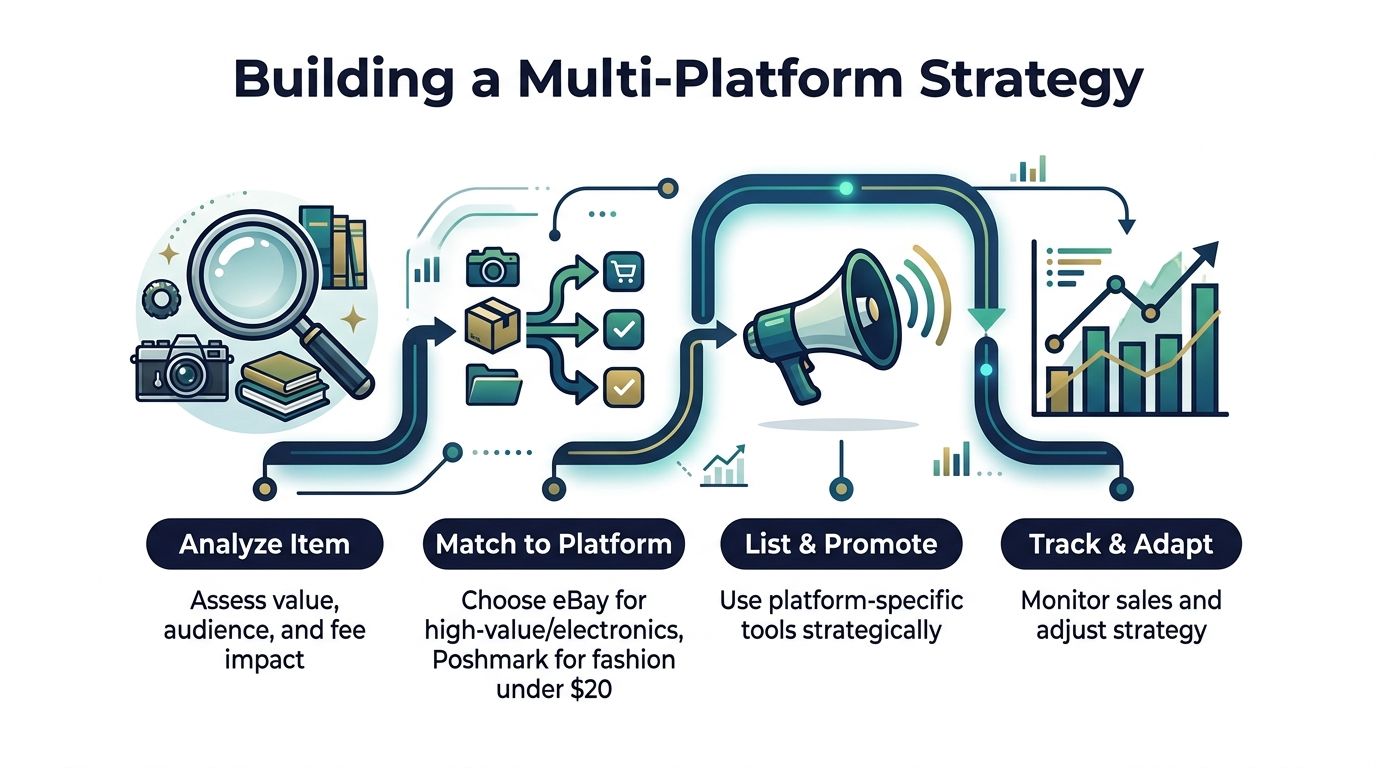
The best resellers don't marry one platform. They match each item to the place where it leaves the highest take-home after fees, shipping, and effort. That mindset matters more than loyalty, because loyalty doesn't pay the wholesale bill.
Match the item to the marketplace
High-value items usually belong where the fee drag is lower. Fashion under $20 can fit Poshmark nicely, while higher-ticket clothing, electronics, and collectibles often do better on eBay. If you keep that framework in your head during sourcing, you stop overpaying for items that only look good at gross sale price.
For mixed inventory, the safest habit is to ask one question before buying. Which platform gives me the cleanest net after the fee base and shipping are counted? That question keeps you from filling your death pile with items that only work in theory.
Track what actually performs
A multi-platform business needs a simple record of what wins where. Not everything that sells fast on one marketplace is the most profitable there, and not every item with a strong sold comp is worth your time if the fee structure is too aggressive. Keep your notes tied to categories, not just to individual items, so you can see patterns across your sourcing trips.
If you use crosslisting tools like Vendoo or List Perfectly, they can sit beside your workflow. They handle a different part of the business, while your platform decision still comes down to profit math and item fit. For a practical framework on that approach, see selling on multiple platforms.
Adapt to the trip, not the brand
Estate sales, garage sales, thrift stores, and retail clearance all hand you different kinds of inventory. A good reseller adapts the platform choice to the item in hand, not to the marketplace they happen to prefer. That's how you keep margin intact when the sourcing environment changes.
The goal isn't to be everywhere at once. The goal is to put each item where the numbers make sense.
If you want a fast way to check that before you buy, use ScanFlip AI while you're sourcing. It scans items three ways, pulls sold comps across major marketplaces, and shows net profit after fees so you can make cleaner buy decisions in the aisle.