
How to Make a Bundle That Actually Sells
You're standing in a Goodwill aisle with four candles in one hand and a mixed lot of thirty more on your phone. The seller wants one price for everything, and the deal looks cheap until you remember storage, packing material, marketplace fees, and the shipping tier that can erase the spread.
That's the question behind how to make a bundle: will combining these items produce more net profit than selling them separately? A bundle should earn its place through sold comps, sell-through potential, fee math, and shipping weight. If it only makes the listing look fuller, it's probably a bad buy.
Table of Contents
- Why Bundling Is a Margin Decision, Not a Sales Trick
- Picking SKUs That Belong in the Same Bundle
- Pricing the Bundle From the Bottom Up
- Matching the Bundle to the Right Marketplace Fees
- Shipping Weight, Dimensional Costs, and Bundle Sizing
- Listing Strategies That Move Bundles Faster
- When to Skip the Bundle and Break the Lot Apart
Why Bundling Is a Margin Decision, Not a Sales Trick
A pallet of forty mixed-brand candles can look like easy money. In practice, the first decision is whether buyers want a coordinated group, a few individual scents, or none of the lot at the price you need. A bundle made from slow-moving items doesn't create demand. It packages the problem together.
Before clicking Buy It Now on a lot, write three figures on a sticky note:
- Total cost of goods, including every item you'll keep in the bundle.
- Expected sell-through price, based on recent sold comps rather than asking prices.
- Everything between those figures, including marketplace fees, packaging, labor, and shipping weight.
The same check applies before publishing a bundle. A $60 gross sale can become a weak order after fees and postage, while a lower-priced two-item sale can be healthier if it stays light and takes less time to pack.
Practical rule: A bundle should either raise order value, improve sell-through, reduce handling, or solve a shipping problem. If it does none of those things, split the lot.
The phrase “make a bundle” has a long financial history. Dictionary.com's entry for “make a bundle” traces the expression to older uses of “bundle” for a roll or heap of banknotes, with related language recorded in the nineteenth century. That idea still fits resale: repeated small sourcing wins can become one substantial result.
Your two most expensive mistakes are predictable. First, you absorb weak items that drag down the average order value. Second, you add enough weight to push the shipment into a more expensive bracket without raising the price. I use the same margin-versus-markup distinction when checking a lot, and this resale margin versus markup guide helps keep those calculations separate.
Picking SKUs That Belong in the Same Bundle
Good bundles make sense before the buyer reads the description. I filter potential SKUs through four tests: category fit, condition parity, price tier, and audience overlap.
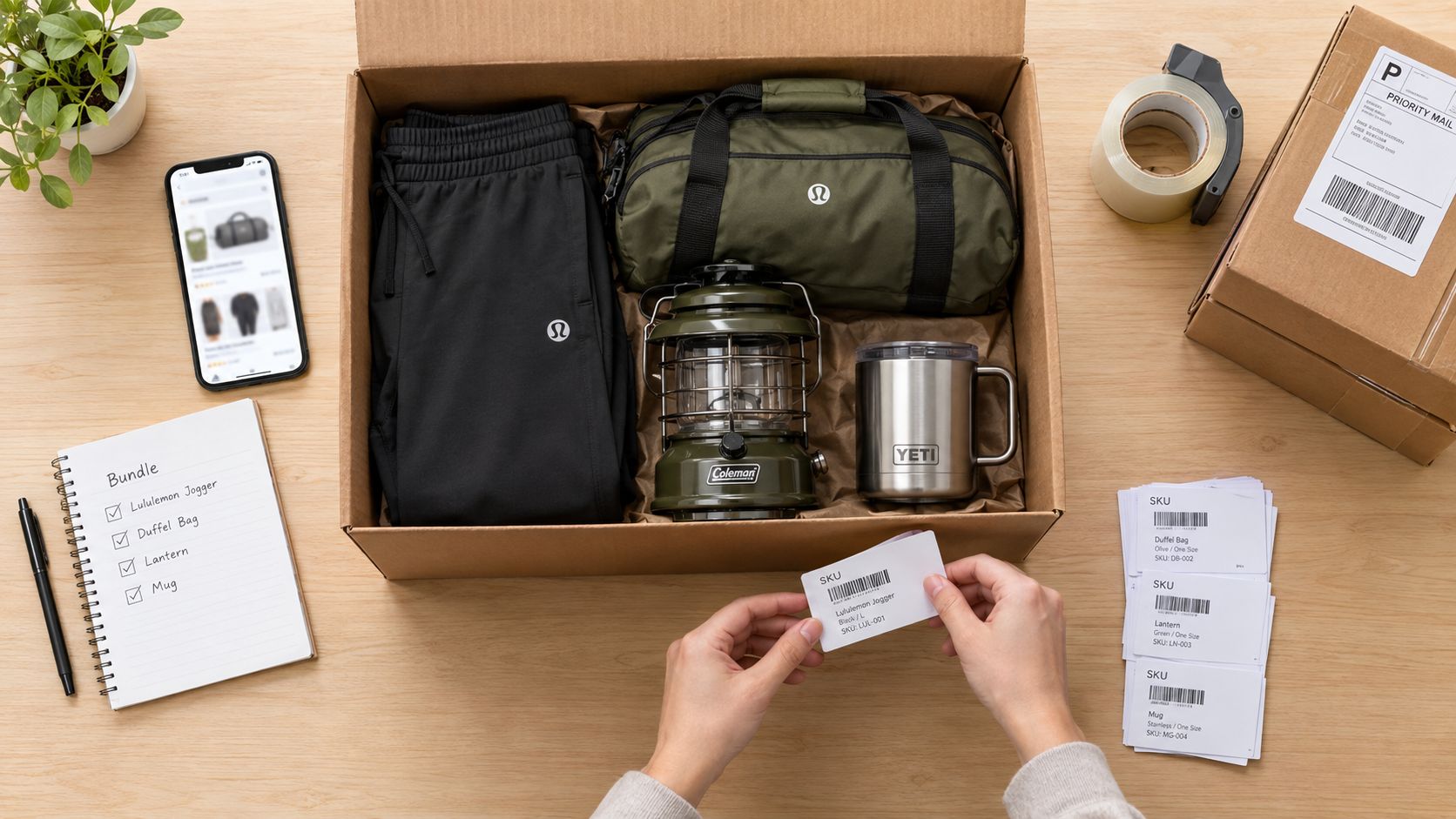
A Lululemon jogger and a Lululemon duffel can support one outfit or travel decision. A Lululemon jogger and a picture frame are merely two items sharing a shipping label. The second combination might move only if the discount is extreme, which usually means you're paying to dispose of the frame.
Condition needs the same discipline. Pair mint pieces with mint pieces, and new-with-tags items with other new-with-tags items. A clean NWT hero item beside a pilled thrift piece lowers the buyer's impression of the entire lot. The buyer doesn't average condition mathematically. They often judge the bundle by its weakest visible component.
Price tier matters too. I prefer items with a reasonably close expected value, roughly within a 1.5x spread. A premium item beside several basics can dominate the photos and make the bundle feel like an inflated price for accessories.
A mixed vintage camping lot
Suppose a mixed lot contains twenty-five camping pieces. I'd first pull the items that share a recognizable use case, such as a vintage camp cook set, matching enamel mug, period lantern, and compact utensil kit. The flashlight looks like a natural add-on, but if it's scored, has uncertain function, and attracts a different buyer, it fails condition and audience overlap.
Then I check sold comps for the remaining pieces. If buyers repeatedly purchase the cookware together but buy the flashlight only as a cheap standalone item, the flashlight belongs outside the bundle. A four-piece camping bundle can feel curated. Five items can feel careless if the fifth item exists only because it was in the box.
| Filter | Pass Example | Fail Example |
|---|---|---|
| Category fit | Lululemon jogger with matching duffel | Jogger with picture frame |
| Condition parity | Clean vintage camping pieces together | NWT item paired with pilled clothing |
| Price tier | Items with comparable sold values | One premium hero item beside basics |
| Audience overlap | Camp cookware bought by the same vintage camping audience | Scored flashlight with unrelated buyer intent |
Check the buyer's decision, not your storage situation. A bundle is stronger when every item helps the buyer complete an activity, collection, outfit, repair, or gift.
Pricing the Bundle From the Bottom Up
Start with acquisition cost. Reseller lot guidance commonly places acquisition cost per item at roughly 10% to 20% of expected resale price, leaving room for fees, shipping, and profit. Lot-splitting guidance from Stokd uses that benchmark alongside sold-comps validation and testing different lot sizes.
Here's a workable example. Four vintage camping pieces cost $4, $6, $3, and $7, for a total cost of $20. Their individual prices are $45, $55, $40, and $50, producing a separate-buy total of $190. A $160 bundle price gives the buyer roughly a 16% discount against purchasing separately.
That discount is reasonable only if the bundle still survives the rest of the worksheet. Don't start with “I'll take 20% off.” Start with the costs, then see what discount the order can support.
The bottom-up worksheet
Add the direct costs first. Labor can be a modest internal charge for cleaning, measuring, photographing, and packing. Materials include boxes, tape, labels, tissue, and protective wrapping. Fees must reflect the marketplace and the full fee base. Then add the profit you require.
| Step | Calculation | Amount |
|---|---|---|
| Cost of goods | $4 + $6 + $3 + $7 | $20 |
| Labor | Cleaning, measuring, photographing, packing | Set your internal amount |
| Materials | Packaging used for the order | Set from actual use |
| Marketplace fees | Platform-specific fee calculation | Calculate before purchase |
| Target profit | Required return after direct costs | Set your threshold |
| Bundle price | Costs plus profit, rounded to a buyer-friendly point | Example target, $160 |
A 30% net margin target after marketplace fees can work as a planning benchmark for this example, but it isn't a substitute for platform-specific math. If your total cost stack is $20 in goods, $10 in labor and materials, and $32 in fees and shipping, a $160 sale leaves $98 before any other overhead. That clears the target in this example. If shipping rises by $12 because the packed lot crosses a weight break, the same sale becomes materially weaker.
Use recent sold comps for each item and for comparable lots. This resale pricing guide is useful when you're separating sold prices from optimistic asking prices and building the bundle from actual market evidence.
The bundle fails when the price must rise beyond what buyers pay, or when the discount needed to create a sale consumes your margin. At that point, sell the strongest camping piece separately and lot the lower-value items only if the reduced package stays profitable.
Matching the Bundle to the Right Marketplace Fees
The marketplace changes the result before the buyer ever sees the bundle. eBay says its final value fee is calculated on the total sale amount, and its per-order fee is $0.30 for orders of $10.00 or less and $0.40 for orders over $10.00. The eBay selling-fees page also explains why shipping belongs in your calculation.
Poshmark has a sharp breakpoint. Sales under $15 incur a flat $2.95 fee, while sales of $15 and above incur a 20% commission, according to this Poshmark fee calculation guide. That makes cheap bundles particularly vulnerable. A $12 sale loses nearly a quarter of its revenue to the platform fee before cost of goods or shipping.
Mercari is simpler to forecast. Independent 2026 fee guidance describes a flat 10% selling fee calculated on the item price rather than shipping, as outlined in this Mercari fee guide. You still need to include shipping and payout costs, but the fee calculation is easier to model.
| Marketplace | Sale Price | Fees | Net to Seller | Best For |
|---|---|---|---|---|
| eBay | $40 | Final value fee plus $0.40 order fee, calculated on the full sale amount | Depends on the applicable final value rate and shipping | Lots with strong sold comps and fee advantages |
| Poshmark | $40 | 20%, or $8 | About $32 before cost of goods and other costs | Fashion bundles priced above the low-fee breakpoint |
| Mercari | $40 | 10%, or $4 | About $36 before shipping and other costs | Straightforward mid-priced bundles |
A $40 Poshmark bundle keeps roughly $30 after fees, while the same lot on Mercari clears about $34, based on the fee assumptions above and rounded for practical comparison. A $14 bundle deserves extra scrutiny on Poshmark because the flat fee consumes a large share of the sale.
My quick rule is to favor Mercari for very low-priced items, compare eBay carefully for mid-range bundles, and use Poshmark when the fashion lot has enough value and low enough shipping weight to justify its commission. Don't assume the same physical bundle earns the same net profit everywhere.
Shipping Weight, Dimensional Costs, and Bundle Sizing
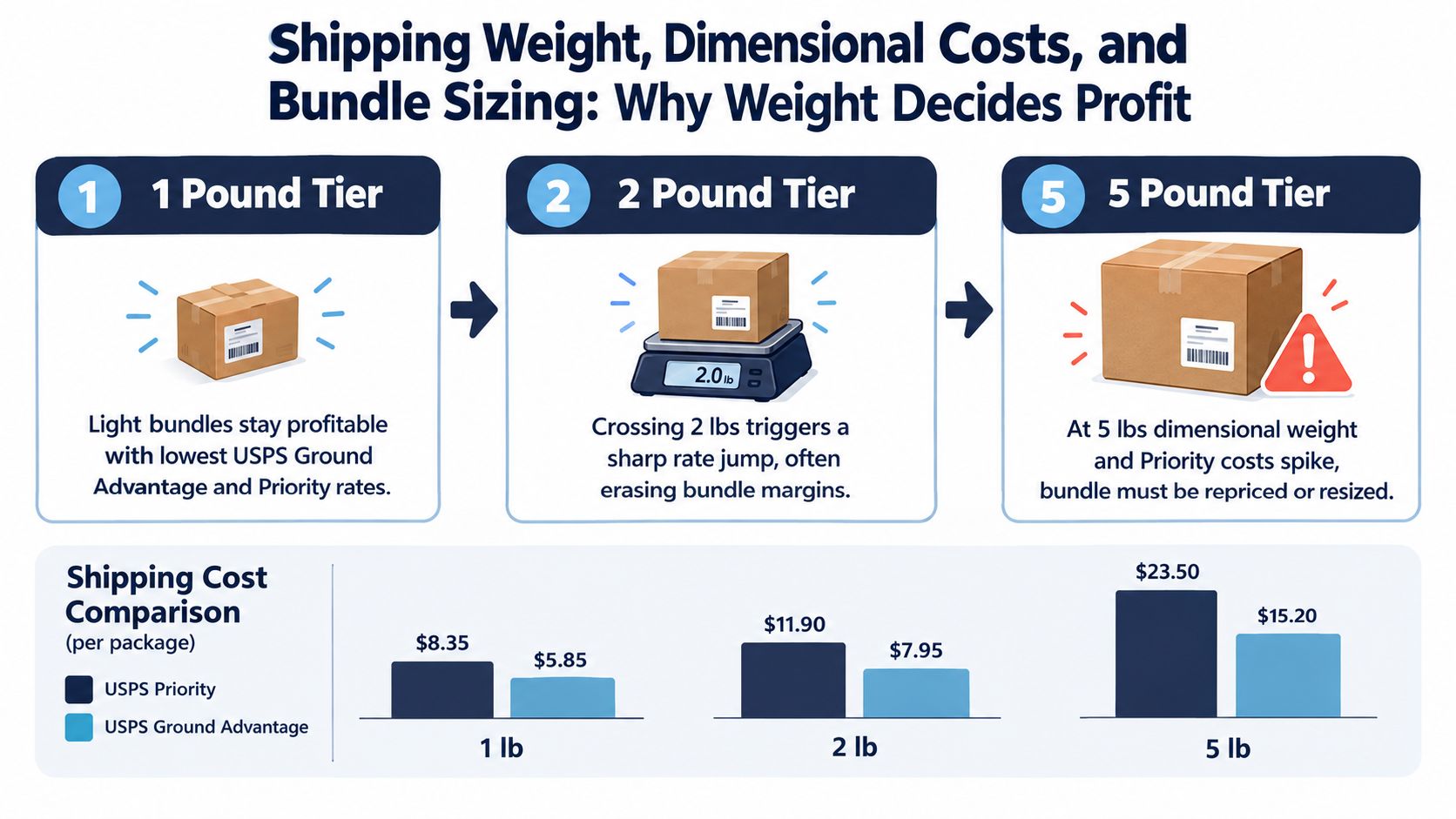
Shipping weight determines whether a bundle works. A parcel at 15.9 ounces can be manageable, while a packed parcel at 1 pound and 0.1 ounce enters a different tier. That small change can add several dollars to postage, depending on service, distance, packaging, and platform rates.
The same issue appears at 2 pounds and 5 pounds. Two items shipped together often cost less than two separate shipments, but only if the combined package stays within a favorable tier. If the second item pushes the package over a break, the savings can disappear.
Pack before you price
Soft goods can often fit in a compact polymailer. The same clothing lot in a rigid box may trigger dimensional pricing, especially when the package becomes long, wide, or tall. Bulky coats, shoes, home goods, and boxed toys need an actual packed test, not a guess made from the items sitting on the floor.
Keep the total bundle under 1 pound when practical. Treat 5 pounds as a serious pricing checkpoint, not a casual upper limit. A heavier bundle needs enough sale value to support the shipping service and the extra packing time.
Record actual weights in a simple packing log:
- Item group: Name the exact bundle.
- Packed weight: Include box, mailer, tissue, and protection.
- Package dimensions: Record the outer measurements.
- Quoted postage: Save the rate shown at purchase.
- Final net: Compare the estimate with the payout.
Shipping guidance for resellers notes that weight thresholds and platform rules are changing, and some 2026 USPS Ground Advantage rates for 10 to 20 pound packages reportedly dropped by up to 26% for some shippers. This 2026 shipping overview is worth checking before building a strategy around heavy lots. For lighter bundles, use this shipping-estimate guide and verify the final packed weight before publishing.
Listing Strategies That Move Bundles Faster
A Patagonia fleece paired with a Smartwool beanie is easier to understand than a lot of three unrelated fleeces. One bundle sold in four days for $65, while the three-fleece lot stalled for six weeks. The difference was practical: the photo showed the pieces layered as an outfit, and the title described the use case rather than announcing a random pile.
A three-piece Roomba accessory lot had the opposite result. It sat for 45 days with a flat-lay photo and no cleaning context. After relisting with a kitchen photo and a title phrased around the buyer's search question, it sold in a week. The lesson isn't that every staged photo creates a fast sale. It's that the buyer needs to understand what the items do together.
Build the listing around the use case
Use a title structure such as:
- Brand plus use case plus item count plus condition
- Compatible model plus accessory type plus included pieces
- Activity or occasion plus matching items plus size
Keep the main image clean. Show every item together, then add individual detail photos for labels, flaws, measurements, compatibility marks, and material. Don't hide the weak piece. A buyer who discovers it after delivery will turn a small margin into a return problem.
Price just below a round number when the sold comps support it. The point isn't a fake bargain. It's giving the buyer a clear comparison against purchasing the items separately.
Use a controlled markdown cadence
Share the bundle when the platform supports sharing, watch the quality of offers, and record the response. If there's no traction, drop the bundle price 10% every 14 days, as a deliberate test rather than random discounting. Compare the new price with recent sold comps each time.
The Patagonia bundle returned 2.4x cost, while the unstaged accessory lot lost money after fees. Those outcomes show why composition and presentation have to be judged together. A bundle can contain useful inventory and still fail if the buyer can't see the reason to purchase it as one order.
When to Skip the Bundle and Break the Lot Apart
Bundling is the wrong move when one item carries the entire lot. If a hero SKU outsells the rest by 3:1 on 90-day comps, selling it beside weak pieces can suppress its value. Buyers who want the hero item may not want the extras, and buyers interested in the extras may not pay enough to support the hero.
Four signals should make you pause:
- Hero imbalance: One item clearly dominates recent sold comps.
- Shipping jump: The combined parcel crosses the next USPS or UPS tier.
- Cost exposure: Total landed cost exceeds 20% of projected bundle price.
- Search mismatch: Sold comps show no meaningful keyword or buyer overlap.
The inventory-age response should be mechanical. At day 14 with no offers or only weak lowballs, test a 10% price reduction. At day 30, split the lot if watchers aren't converting. At day 45, stop defending the original bundle because you already photographed it.
| Day | Trigger Signal | Action | Capital Impact |
|---|---|---|---|
| 14 | No offers or repeated lowballs | Reduce bundle price by 10% and review sold comps | Tests demand without rebuilding the lot |
| 30 | Watchers but no conversion | Split hero items from the remainder | Releases value from the strongest SKU |
| 45 | Continued stagnation | Reprice, lot only complementary leftovers, or sell individually | Limits further capital lockup |
| 60 | Aged bundle still unsold | Clear the remaining pieces using the strongest viable format | Stops storage from becoming the hidden cost |
A sixty-day bundle ties up cash that could fund new sourcing. Splitting the lot can free working capital faster than waiting for one buyer who wants every piece. My rule is simple: bundle only what would otherwise sit past two markdown cycles as a single unit. Don't bundle a desirable item just to make an awkward lot look complete.
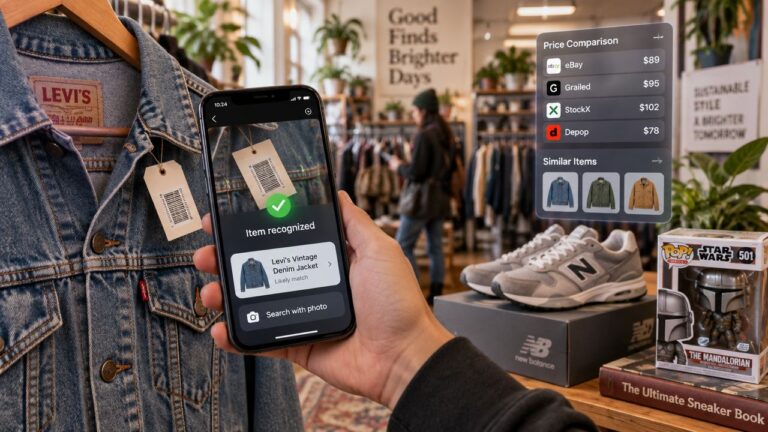
ScanFlip AI can identify items through an AI photo scan with no barcode, a barcode scan, or text search, then aggregate sold comps from eBay, Poshmark, Mercari, Depop, Amazon, Whatnot, ThredUp, Facebook Marketplace, and TikTok Shop. Before you buy a lot, visit ScanFlip AI to check net profit after fees and shipping and get a red or green flip-or-pass verdict.