
eBay Profit Calculator: How to Find Your Real Net Profit
You're standing in a Goodwill aisle with a $6 find and recent eBay sold comps around $42. That looks worth grabbing, until you remember the shipping box, the fees, and the possibility that the buyer sends it back.
An eBay profit calculator should help you decide whether to buy before you reach the register. The useful number isn't what the buyer pays. It's what you expect to keep after the costs you're responsible for, with enough room for something to go wrong.
Table of Contents
- The Net Profit Formula With a Real Example
- Fee Inputs Your Calculator Needs
- How to Run the Numbers Before You Buy
- Shipping Costs That Change the Verdict
- Returns, Disputes and Taxes That Eat Margin
- Set Your Pass Threshold Before You Buy
The Net Profit Formula With a Real Example
Say that Goodwill find is a compact item you've shipped before. For this hypothetical flip, assume a $42 sold price, free shipping to the buyer, $5.60 in total eBay fees, and $4.50 for postage and packaging.
Those are example inputs, not a claim that every item qualifies for that fee or shipping cost. Your category, account, package, and destination determine the actual deductions.
The basic calculation is:
Net profit = sold price + buyer-paid shipping − eBay fees − postage and packaging − buy cost − other seller-paid costs.
Worked example with a $6 buy and $42 sale
| Line item | Notes |
|---|---|
| Sold price | $42.00, hypothetical sold-comp estimate, with free shipping |
| eBay fees (final value plus per-order) | $5.60, assumed combined fee for this example, not a universal rate |
| Postage and packaging | $4.50, assumed actual label and packaging cost for the packed box |
| Buy cost | $6.00, hypothetical Goodwill purchase |
| Net profit | $25.90, calculated as $42.00 − $5.60 − $4.50 − $6.00 |
The buyer pays $42, but you don't earn $42. You recover your original purchase money, pay the platform and fulfillment costs, and keep the remainder.
Don't subtract cost of goods twice. If your calculator already deducts the purchase cost, the resulting profit is after you've recovered that investment.
Margin and ROI answer different questions
In this example, profit margin is about 62%, calculated by dividing $25.90 by $42. That tells you how much of the sale remains after the modeled costs.
Return on buy cost is about 4.3 times, calculated by dividing $25.90 by $6. That's profit relative to your inventory investment, not total cash returned.
Change only the purchase cost to $30, and the same hypothetical sale leaves $1.90. The item didn't become less desirable to buyers. You paid too much to make the flip worthwhile.
Buying rule: A worthwhile item and a worthwhile buy aren't the same thing.
I'd keep the $6 find if condition and demand check out. I'd leave the $30 version behind because that tiny remainder still needs to justify my time, sourcing travel, and exposure to a return.
Also distinguish item-level profit from what your whole reselling operation earns. For allocating recurring costs rather than pretending they disappear, Smart Receipts' guide to calculating OpEx is a useful companion to your sourcing calculator.
Fee Inputs Your Calculator Needs
| Fee | Amount | What it means for your calculator |
|---|---|---|
| Final value fee | 2.5% to 15.3%, set by category | Applied to the transaction fee base, including item price and buyer-paid shipping |
| Per-order fee | $0.30 for orders of $10 or less; $0.40 above $10 | Charged once per order |
| Insertion fee | $0.35 per listing after 250 monthly listings, under the standard allowance described below | Include it when your listing activity exceeds your applicable allowance |
| Promoted listings | Optional percentage you set for the applicable promotion | Add the applicable advertising expense when you run promotions |
| Buyer-paid shipping | The shipping charge you enter for the buyer | Include the charge in the fee base, separately from your actual postage expense |
For the standard eBay.com structure cited as of February 2025, eBay's selling-fee FAQ describes the 2.5% to 15.3% category range, the $0.30/$0.40 per-order charges, and the $0.35 insertion fee after 250 monthly listings. Treat that dated schedule as a reference, not a substitute for checking your current account.
Use your category and account settings
A single universal percentage won't give dependable answers for both a sweater and a set of vintage tools. Select the actual category before trusting the output, especially when an item could plausibly fit more than one.
Store status can change the rates you pay. Optional services can add costs, so a calculator configured for another seller's account may overstate or understate your take-home.
Before each sourcing session, look up the applicable rate through Seller Hub and the linked fee information. Record the rate beside the find so you can compare opportunities using consistent assumptions.
A weekend flipper shouldn't automatically deduct an insertion fee from every item if their listings fall within their available allowance. A high-volume seller shouldn't ignore that expense merely because each individual charge looks small.
Keep shipping income separate from postage
Buyer-paid shipping and your label expense belong in different fields. The buyer might pay an amount that doesn't exactly match what you spend after packaging and service selection.
Promoted-listing expenses need their own field, too. Don't assume organic sales while planning to advertise the item to get it moving.
The rule that matters most is simple: the fee base includes buyer-paid shipping, not only the item's sold price. Charging the buyer for delivery doesn't make that money exempt from selling fees.
How to Run the Numbers Before You Buy
Build the calculation once, then reuse it at Goodwill, an estate sale, or a Ross clearance rack. eBay's seller-fee guidance explains that final value fees use the transaction amount, including buyer-paid shipping and other applicable buyer charges, plus the per-order fee.
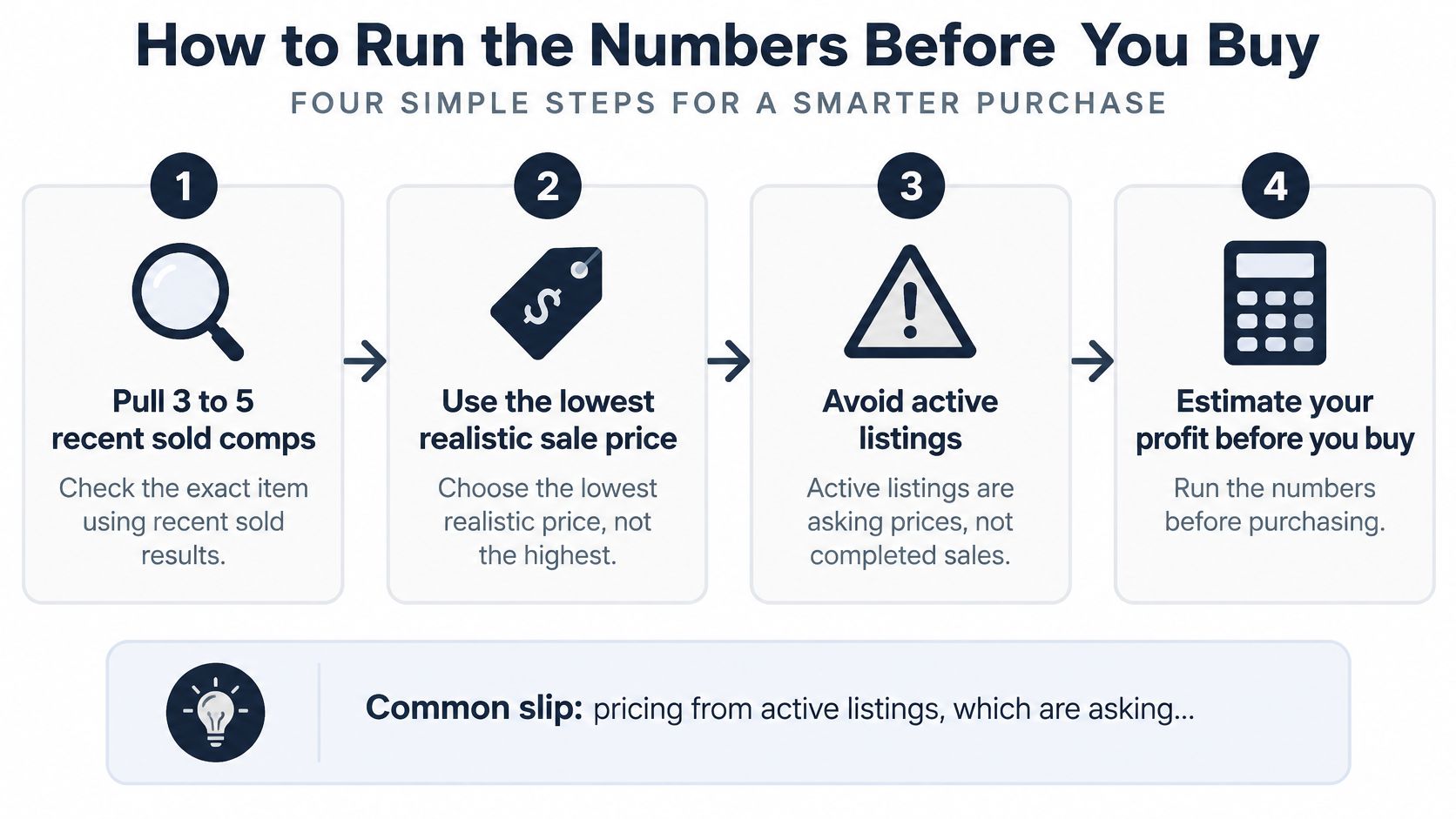
Follow the same sequence for every find
Pull three to five recent sold comps. Match the exact model, size, condition, and included accessories, then use the lowest realistic sold price rather than the standout sale. Common slip: relying on active listings, which show asking prices; use an eBay sold-listings search to check completed transactions.
Add the buyer's shipping charge. Combine that with your estimated sold price to establish the working fee base. Common slip: deducting the label later but forgetting shipping income when calculating fees.
Apply the correct category rate. Use the rate you confirmed for your account, not a percentage remembered from another category. Common slip: treating every BOLO as though it has identical selling costs.
Add the applicable per-order charge. Keep it separate from the percentage calculation so your spreadsheet doesn't omit or duplicate it. Common slip: entering only the percentage and calling the result total fees.
Subtract packed shipping and packaging. Weigh the box with the item, padding, and any protective inserts inside. Common slip: weighing bare shoes and forgetting their outer shipping carton.
Subtract acquisition and other seller-paid costs. Include cost of goods, planned promotion expense, preparation supplies, and a consistent allocation of fuel for a multi-store sourcing run. Common slip: remembering the garage-sale purchase but ignoring the trip needed to acquire it.
Calculate ROI and margin. Divide net profit by buy cost for ROI, and by sold price for the item-level margin used here. Common slip: letting an impressive percentage distract you from too few dollars or weak sell-through rate.
Build a spreadsheet that includes shipping income
Put sold price in A, buyer-paid shipping in B, category fee rate in C, per-order fee in D, and postage plus packaging in E. Add separate columns for buy cost and optional expenses.
Use this working formula:
Net profit = A + B − ((A + B) × C + D) − E − buy cost − optional costs.
For free shipping, B is zero, so this becomes A − ((A + B) × C + D) − E − buy cost − optional costs. Don't use that shortened version when the buyer pays shipping, because you'd omit shipping revenue while still charging fees against it.
A negative result is a pass before checkout. A positive result earns further consideration, not automatic permission to buy.
Shipping Costs That Change the Verdict
Postage is a variable cost, not a standard deduction you can copy across every find. A soft garment, boxed shoes, and a framed print need different assumptions even when their sold comps look similar.
USPS's shipping-services guidance lists Ground Advantage starting at $8.40 at Post Office rates, with ounce-based tiers up to 15.999 ounces, heavier parcels rounded up by pound, and pricing affected by zone; commercial rates can be lower. Get a live quote before committing to an unfamiliar package.
Test the package you'll actually send
Weigh and measure the packed box. A framed print needs corner protection and cushioning, while electronics may need enough padding to prevent movement inside the carton.
Dimensions matter alongside weight. A bulky shoe box can require a more expensive shipping assumption than a compact item that feels heavier in your hand.
The hypothetical comparison below holds the $42 sale, $6 buy cost, and $5.60 fee assumption constant. These are sensitivity-test inputs, not published carrier quotes; in particular, the retail scenario isn't a claimed current USPS counter rate.
| Shipping case | Shipping cost | When to use it |
|---|---|---|
| Commercial label rate | $4.50, leaving $25.90 net | Light, compact item you ship often, with a verified label quote |
| Conservative retail rate | $6.50, leaving $23.90 net | Hypothetical higher-cost test for counter purchases or a first-time shipment; replace with the actual quote |
| Overweight or dimensional contingency | $9.00, leaving $21.40 net | Hypothetical stress test for bulky, dense, or framed items; increase it if the quote requires |
Make the contingency credible
Use the commercial case when you already know the packaging and can reproduce the quoted service. Familiarity is useful only if you're shipping the same kind of parcel to a comparable destination.
For an unfamiliar estate-sale find, use a conservative quote and then test what happens if your first estimate is wrong. A sensible contingency reflects the item's actual failure point: extra weight, a larger carton, or protective packing.
Don't approve a bulky flip using a shipping price that only works for a compact parcel.
Use a shipping-cost estimate before buying, then judge the item against the contingency result. If it only meets your minimum with the cheapest possible label, leave it for someone whose shipping setup makes the numbers work.
Returns, Disputes and Taxes That Eat Margin
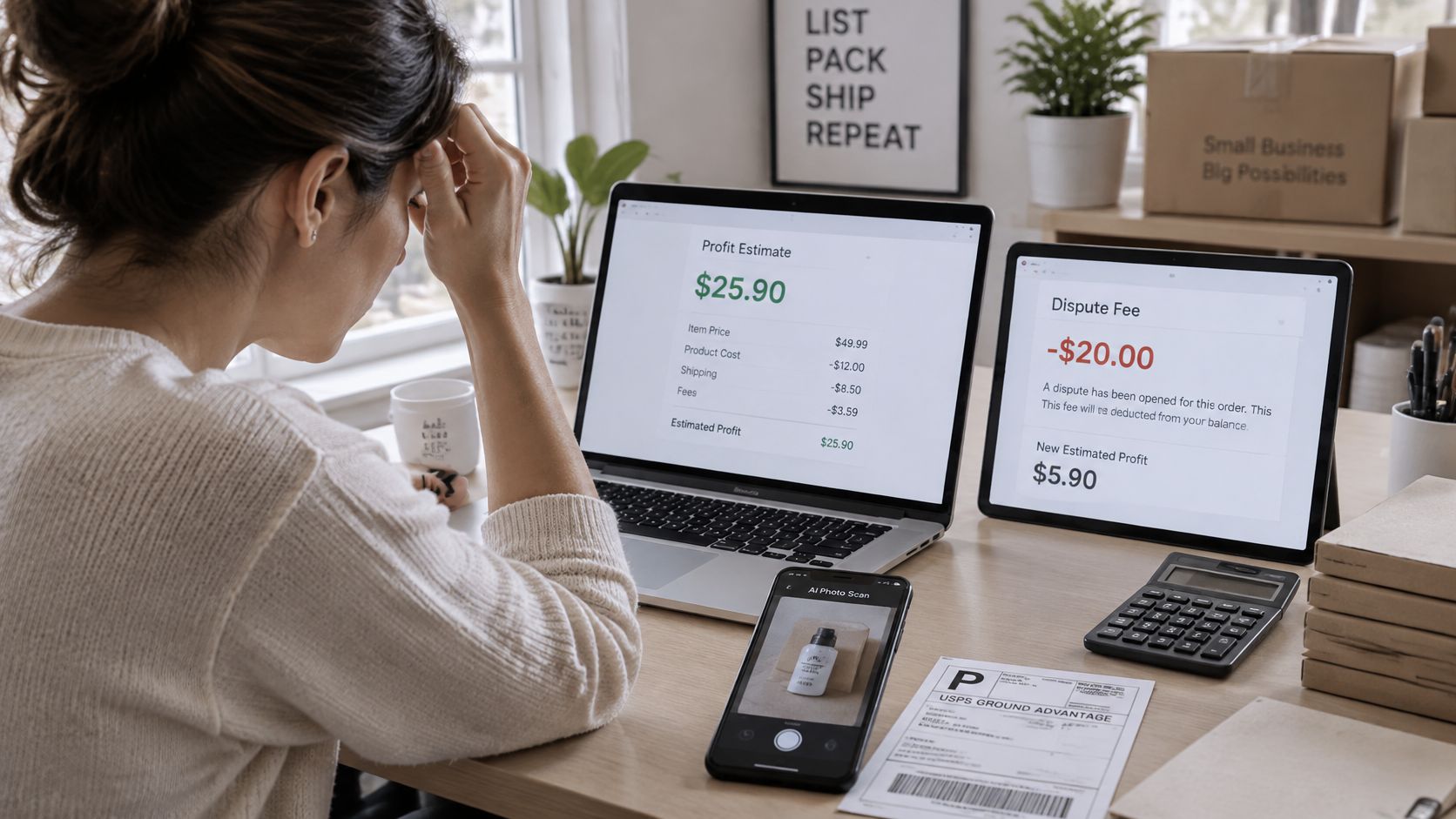
A projected $25.90 keeper can become $5.90 after a dispute fee alone. eBay's managed-payments selling-fee guidance states that sellers may face a $20 dispute fee when responsible for a chargeback or disputed amount, and explains that transaction taxes and international treatment depend on the applicable market and transaction.
That subtraction is only a hypothetical fee adjustment, not a complete chargeback calculation. Losing the sale proceeds or paying other unrecovered costs could make the outcome worse.
Separate your money from collected taxes
Sales tax, GST, or VAT collected for remittance isn't your profit. Keep those amounts separate from seller revenue, while checking the actual transaction's fee treatment rather than assuming every tax-related amount is excluded from every fee calculation.
Refunds, seller-paid return postage, damaged inventory, and unrecovered chargebacks are different. Those can be your losses, so they belong in the risk calculation.
International sales need a separate tax and transaction-cost check. Don't assume the economics of a domestic sale transfer unchanged to another market.
Model outcomes instead of trusting one number
For a hypothetical clothing or electronics flip, consider:
- Best case: It sells quickly, ships at your verified cheapest rate, and stays sold.
- Base case: A condition complaint requires a partial refund or another seller-paid concession.
- Downside case: A full return requires return postage, and a related dispute could add further costs if applicable. Don't assume every return creates a dispute fee.
I'd use the base case for the buy decision and the downside case as a sanity check. Use your own realized return and loss history to build allowances rather than borrowing an unsupported category average.
Apparel, shoes, electronics, and collectibles deserve particular scrutiny for condition risk. Measurements, sole deterioration, intermittent faults, missing accessories, and grading disagreements can turn an apparently straightforward sale into unpaid work.
A calculator's output is an estimate until the sale is complete and your actual costs are known.
Set Your Pass Threshold Before You Buy
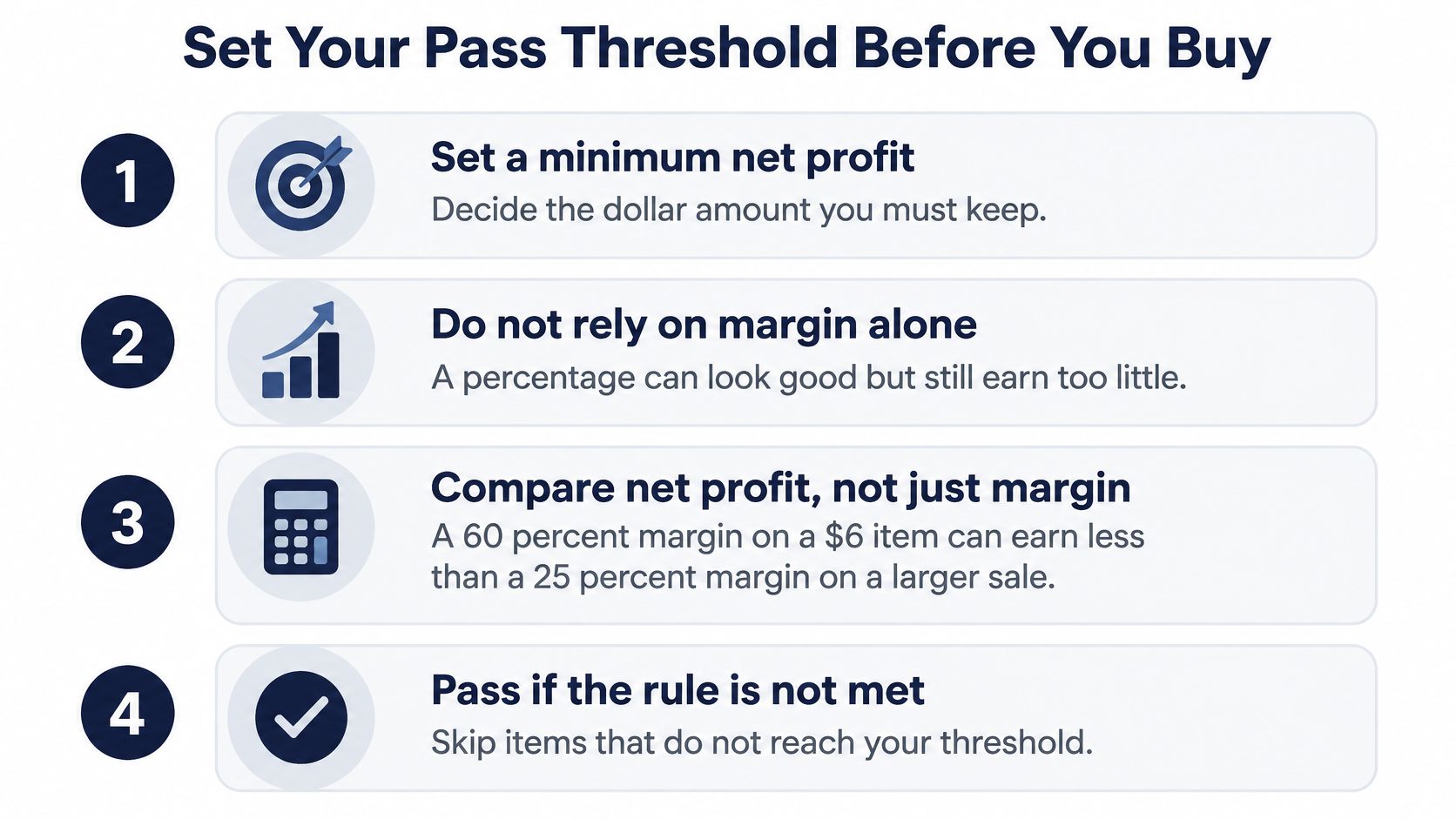
Set your rule before you start sourcing, before a cart full of maybes starts lobbying for exceptions. At a TJ Maxx or Nordstrom Rack clearance rack, a discount sticker tells you nothing about whether the remaining resale spread pays for the work.
Minimum net dollars come first. In a hypothetical comparison, a 60% margin on a $6 sale produces $3.60, while a 25% margin on a $60 sale produces $15. The higher percentage loses to the bigger paycheck.
Choose a rule you can enforce
As a starting rule, I'd require at least $10 net under contingency shipping and profit of at least twice the buy cost. Treat that as a personal buy rule, sized to your time and risk tolerance, rather than a market benchmark every seller should copy.
Adjust upward for testing, cleaning, fragile packing, uncertain authenticity, or slow sell-through. A high projected ROI means little when the item sits in your death pile for months.
Your break-even price calculation establishes the floor. Your buy threshold should sit far enough above that floor to pay for the work and absorb the occasional return, partial refund, or dispute cost that follows a bad sale.
Before paying, check:
- Sold comps: Exact-item comparisons support your estimate.
- Fees: Your category and account rate are confirmed.
- Package: Packed weight and dimensions are credible.
- Contingency: Net dollars and ROI still clear your rule at the pricier shipping option.
- Risk: One plausible complaint won't erase the reason you bought it.
Use the result without outsourcing your judgment
For the aisle version, the ScanFlip AI app supports AI photo scan with no barcode needed, barcode scan, and text search, and compares real-time sold comps across six major reselling platforms: eBay, Poshmark, Mercari, Depop, Amazon, and Whatnot.
Its automatic profit calculator computes fees and shipping against your buy cost to show take-home profit for the entered assumptions. The Flip or Pass Verdict gives an instant red/green signal based on your set minimum profit margin. Treat the verdict as your first filter: condition flaws, authenticity doubts, and a fragile pack job can still push a green item below your line.
Write your dollar threshold and ROI requirement in your phone tonight. On your next sourcing trip, treat anything below that rule as a pass, even if you'd enjoy owning it.
Check the next find before you pay for it with ScanFlip AI. Use photo scan, barcode scan, or text search to compare sold comps and calculate profit after fees and shipping, then measure the red/green verdict against your own buying threshold.