

Break Even Price Calculation for Resellers in 2026
You're standing in a thrift aisle with a jacket in one hand and your phone in the other. The tag says one price. Your brain says another. eBay solds look decent, Poshmark looks softer, and there's always that sinking feeling that the item can sell and still lose money.
That's where most resellers get burned. They don't lose because they picked a bad-looking item. They lose because they guessed on the math. A solid break even price calculation tells you the exact line between a workable flip and a guaranteed mistake. For resellers, that line matters more than any hype about gross sales, average comps, or what someone claims they “could get” for an item.
Corporate finance guides usually stop at the standard formula for pricing a product. Resellers have a different problem. We often know the likely future sale price first, then have to decide the maximum buy price that still leaves room for fees, shipping, and actual profit. That reverse calculation is what matters when you're sourcing fast.
Table of Contents
- The Reseller's Dilemma Why Gut Feeling Isn't Enough
- The Core Break-Even Formula for Resellers
- Calculating Your True Costs Beyond the Price Tag
- Putting It All Together with Real-World Examples
- Handling Advanced Scenarios and Edge Cases
- Stop Guessing and Start Scanning with ScanFlip AI
The Reseller's Dilemma Why Gut Feeling Isn't Enough
A lot of sourcing mistakes happen in under a minute. You see a vintage jacket, a pair of boots, or an older video game accessory. It looks profitable at first glance. The tag feels low enough, so you buy it and assume you'll sort out the details later.
That's how inventory piles up. Not because the item had no resale value, but because the buy decision was based on gross sale price instead of net reality. A jacket that “should sell” is not the same thing as a jacket that clears fees, shipping, supplies, and your overhead.
In practice, gut feeling tends to make resellers commit two common errors:
- They anchor on the highest comp. One strong sold listing gets treated like the normal outcome.
- They subtract only the thrift tag. The rest of the transaction gets ignored until after the sale.
- They confuse movement with margin. Fast sales feel productive, even when the take-home is weak.
- They underprice to force a sale. The item moves, but the numbers were bad from the start.
If you can't identify your break-even line before you buy, you're not sourcing. You're gambling.
The useful way to think about break-even isn't as accounting jargon. It's your floor. It's the minimum number that keeps you from paying to do work. Once you know that floor, you can make tighter buy decisions, set firmer listing prices, and stop carrying items that looked good only because the math was sloppy.
For resellers, this number has to work at the item level. Not the business-in-theory level. Not “I'll make it up on volume.” One item, one expected sale, one real answer.
The Core Break-Even Formula for Resellers
The standard definition is straightforward. The U.S. Small Business Administration defines break-even price as (Fixed Costs ÷ Expected Units Sold) + Variable Cost per Unit in its guide to calculating your break-even point. That formula matters because it forces you to cover both direct selling costs and your share of overhead.
The standard formula and the reseller version
For a reseller flipping one item at a time, the same idea gets translated into simpler field math.
Break-even sell price = buy cost + platform fees + shipping + other direct costs + allocated overhead
That's the practical version most flippers need in a thrift store or garage sale.
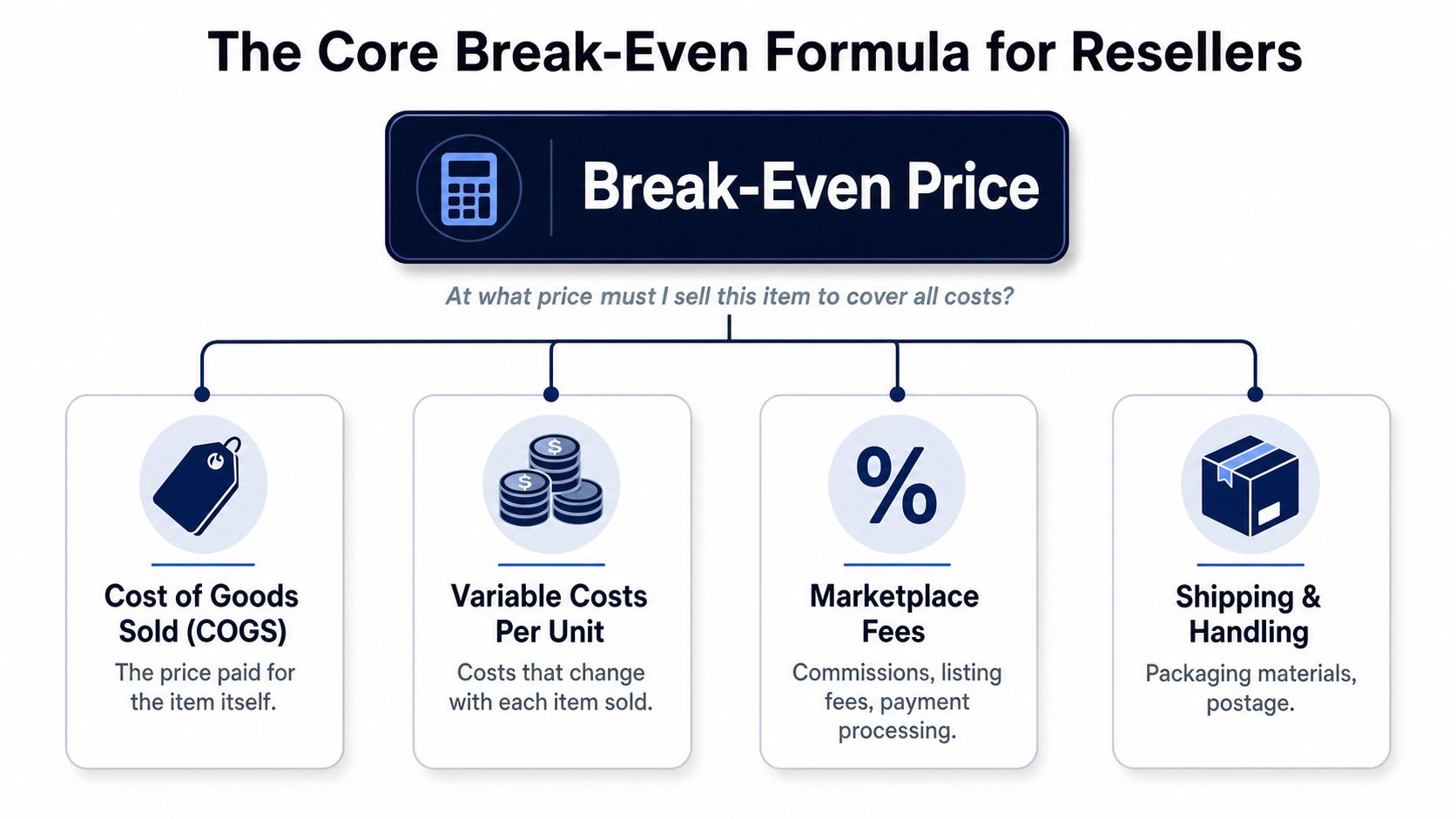
Each part means something specific:
| Cost part | What it means for a reseller |
|---|---|
| Buy cost | What you paid at the thrift store, estate sale, flea market, or garage sale |
| Platform fees | Selling fees, payment processing, promoted listing costs, and similar transaction deductions |
| Shipping | Postage, label cost, and any shipping charge you absorb |
| Other direct costs | Packaging, cleaning, replacement parts, prep work, and sales tax where relevant |
| Allocated overhead | Your share of recurring business costs such as software or storage |
Many people drift off course. They treat overhead as “business stuff” and keep it separate from item-level decisions. That usually works until margins get thin. Then the stuff you ignored becomes the reason your bank balance doesn't match your sold total.
If you want a deeper look at resale pricing after break-even, this guide on how to price items for resale complements the math.
Why contribution margin matters in plain English
Contribution margin sounds like textbook language, but the idea is simple. It's the amount left from a sale after variable costs are removed. That leftover amount is what covers fixed costs first, then turns into profit.
The contribution logic sits underneath every clean break even price calculation. If the gap between sale price and variable cost is too small, the item can sell and still fail to carry its share of the business.
A basic example from Stripe's break-even explanation shows how quickly this shifts. When an item sells for $20 and variable costs are $10, the contribution margin is $10 with a 50% ratio. That requires $10,000 in revenue to cover $5,000 in fixed costs. If variable costs rise to $12, the contribution margin drops to $8 with a 40% ratio, and break-even revenue jumps to $12,500.
That's the lesson resellers need. Fees don't just trim profit. They move the whole break-even line.
Calculating Your True Costs Beyond the Price Tag
The fastest way to lose money in reselling is to treat the thrift tag as the whole cost. It isn't. The tag is just the opening number. Everything after that decides whether the flip was smart or pointless.
Marketplace fees are part of the item cost
Every platform takes a cut differently, but the practical rule is the same. If the platform touches the transaction, its fee belongs in your item math before you buy.
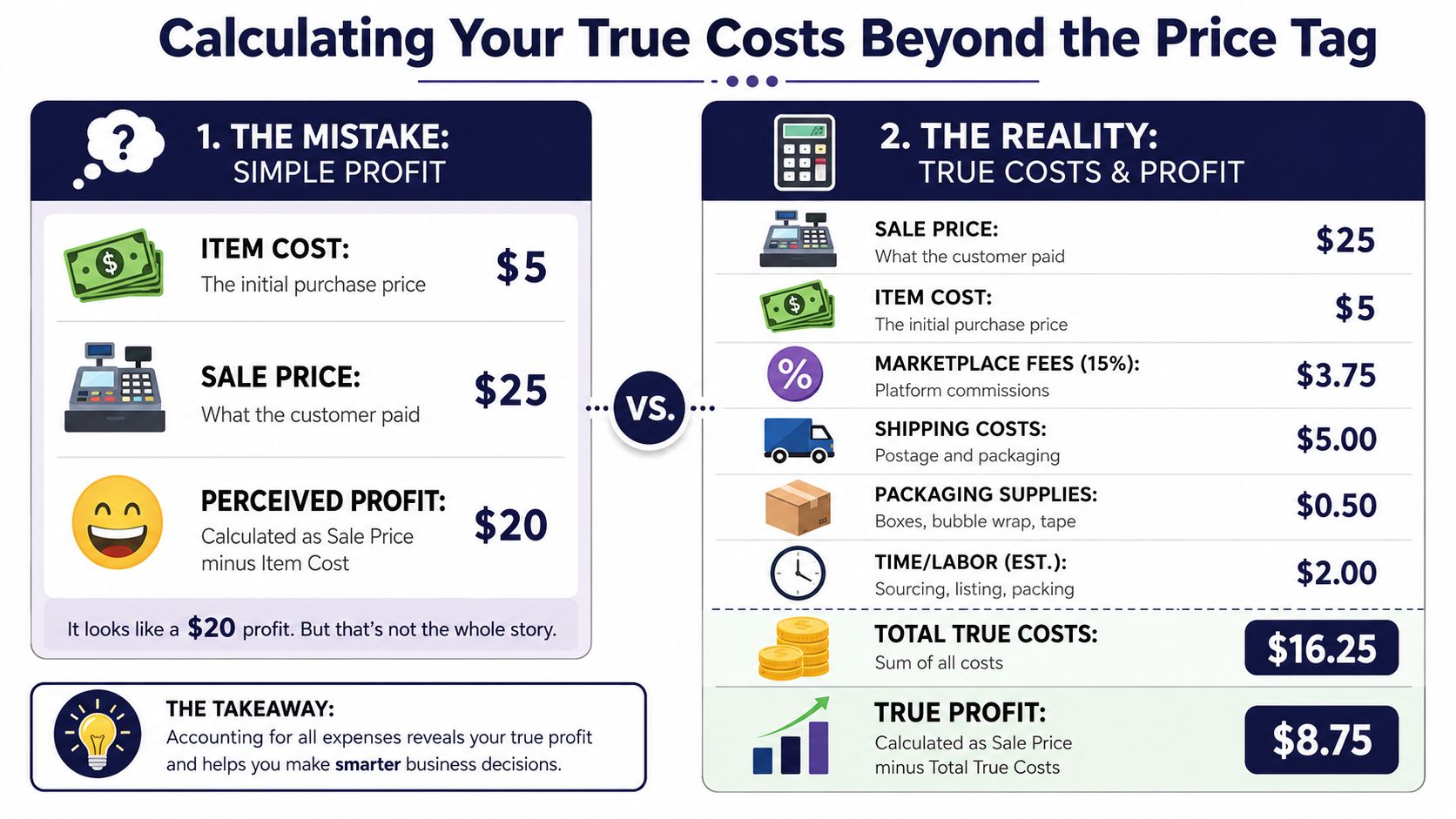
Newer resellers often do this:
- Find a sold comp
- Subtract the purchase price
- Call the difference profit
That shortcut breaks down fast. Platform fees, payment processing, optional ad spend, and shipping deductions all hit the margin before you ever see your payout.
A better way to think about it is this:
The item cost starts at the thrift tag, but the real cost finishes only after every selling deduction is accounted for.
That's why fee-sensitive categories can fool you. An item with a strong gross sold price can still be weak if the platform, shipping profile, or return risk eats too much of the spread.
Shipping packing and the costs people skip
Shipping is where casual math gets exposed. Sellers love saying “buyer pays shipping,” but that doesn't automatically mean shipping disappears from your break-even calculation. It still affects buyer behavior, listing competitiveness, and in some cases the fees tied to the total transaction.
For one-off flips, the cleanest method is to gather the full transaction costs, standardize them by marketplace, then run the item through a single formula. A reseller-focused guide from Longbridge on break-even pricing describes a six-step approach that includes defining the time frame, gathering fees and taxes, standardizing marketplace assumptions, applying the formula, testing sensitivity, and then setting minimum price thresholds. It also notes that many novice resellers omit opportunity cost and borrowing costs, which can understate the true break-even point by 5% to 15%.
That matters because hidden costs don't arrive dramatically. They leak out in small pieces:
- Packaging supplies matter on low-dollar flips.
- Storage matters when bulky items sit.
- Cleaning and prep matter when you buy fixable inventory.
- Mileage and pickup time matter when sourcing gets scattered.
- Capital tied up in dead stock matters more than most beginners admit.
A practical shipping workflow helps. This guide on how to estimate shipping costs is useful because it pushes you to calculate shipping before the buy, not after the sale.
Here's the no-nonsense version of true cost tracking:
- Start with the buy price. No adjustment, no rounding down.
- Add every direct sale expense. Fees, labels, packaging, cleaning, prep.
- Add overhead allocation. Even a rough per-item share is better than pretending overhead doesn't exist.
- Add risk where appropriate. Slow inventory and fragile categories deserve more caution.
- Use the result as your floor. If the market price sits too close to that floor, pass.
Most bad buys aren't dramatic. They're items where the gross spread looked wide enough, but the true spread never existed.
Putting It All Together with Real-World Examples
Theory is nice. A buy decision still happens one item at a time. The way to make break-even useful is to run the same sequence every time: expected sale price first, all selling costs second, maximum buy price last.
Example one a thrifted shirt
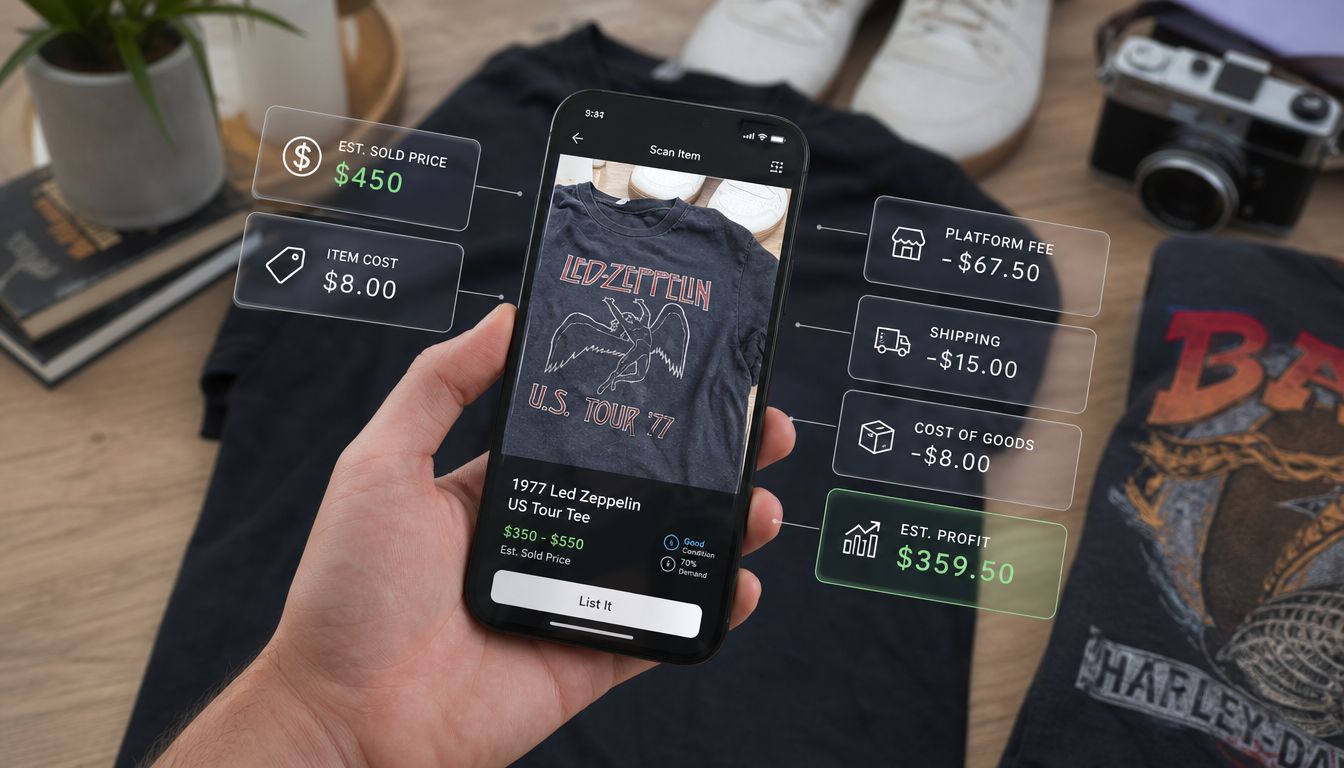
Say you find a vintage band T-shirt in a thrift store. Comps across resale marketplaces suggest there's real demand, but sold prices vary based on size, graphic, flaws, and how quickly you want it gone.
The clean way to work it is:
- Choose the realistic sale target. Not the best comp. The one you'd list at based on condition.
- Subtract expected platform fees.
- Subtract shipping and packing.
- Subtract any direct prep costs.
- Subtract your minimum required profit.
- What's left is your maximum buy price.
That's the reseller's reverse break-even formula in plain English. Instead of asking, “What do I need to sell this for?” you ask, “Given the likely sold price, what's the most I can pay and still like the deal?”
If the shirt has a narrow spread between expected sold price and all-in cost, the smart move is usually to leave it. Apparel gets overbought because it's easy to ship and easy to list. That doesn't mean it has enough margin.
A good-looking flip with no cushion is not a good flip.
Experienced sellers separate clean inventory from clutter. They don't buy because the item is cool. They buy because the downside is controlled.
Example two a heavier electronics flip
Now take a garage sale electronics item, like an older game console. The comp checking process is the same, but the cost profile changes. Weight, fragility, testing time, accessories, and return risk all become more important.
A heavier electronics flip should trigger stricter questions:
| Question | Why it matters |
|---|---|
| Does it power on and complete basic testing? | Untested items can sell, but they change the risk and likely sale price |
| Are cords, controllers, or adapters missing? | Missing parts often reduce value and create extra prep cost |
| Will shipping size push the label cost up? | Bulkier boxes can erase a decent spread |
| Is the comp based on complete sets or bare units? | Many sellers compare the wrong version of the item |
| Could returns be painful? | Electronics often carry more dispute risk than simple apparel |
For this type of flip, a weak reverse break-even result usually means pass, even if the gross solds look attractive. Electronics tempt people because the dollar amounts are bigger. Bigger numbers don't guarantee better margins.
A disciplined reseller will also adjust for listing quality and speed to sale. If the comp assumes a clean, tested, complete setup and your item needs work, your expected sale price should come down before you even touch the buy number.
That's what a real break even price calculation does. It removes optimism from the sourcing decision.
Handling Advanced Scenarios and Edge Cases
Simple flips are easy to model. Real inventory isn't always simple. Bundles, partial lots, returns, and long-tail items all force you to tighten your assumptions.
Bundles and mixed cost lots
When you buy a lot with multiple items, don't spread the cost evenly just because it feels neat. Equal allocation often hides where the profit is really coming from.
Use one of these approaches instead:
- Assign cost by expected resale value when one item clearly carries most of the lot.
- Assign cost by replacement logic when one part would be expensive to source on its own.
- Keep one item at near-zero cost only if the rest of the lot already covers the purchase cleanly.
That last point matters. Resellers love saying they got an item “for free” because another piece of the lot paid for everything. Sometimes that's true. Often it's just loose bookkeeping.
Slow movers and probabilistic break-even
Static break-even works best when the item is liquid and the market is active. Secondhand marketplaces don't always behave that way. Wikipedia's overview of break-even analysis notes that 30% to 40% of listed items on platforms like Poshmark or Depop never sell without significant price adjustments.
That's a big warning for long-tail inventory.
If a large share of listings need discounts to move, your original break-even number might be technically correct and still useless in practice. The item may need markdowns, more time, and more storage than you assumed. In reseller terms, that means your real break-even threshold is higher than the static calculation suggests.
A practical way to handle this is to add a safety layer:
- For highly seasonal items, require more cushion before buying.
- For bulky inventory, count storage and handling friction more seriously.
- For slow niches, assume you may need price cuts to create liquidity.
- For fragile or return-prone categories, protect the downside with a larger margin target.
Static math tells you where loss starts on paper. Practical math tells you whether the item is worth tying up cash in the first place.
That's the difference between accounting break-even and sourcing break-even. One tells you the threshold. The other helps you survive real marketplace behavior.
Stop Guessing and Start Scanning with ScanFlip AI
Manual break-even math works. It just doesn't work fast enough when you're in an aisle, at an estate sale table, or trying to make decisions before someone else grabs the item.
That's the gap most tools leave open. As noted in this video discussion of the reseller reverse break-even problem, most guides teach the corporate version of break-even but don't help sellers calculate the maximum acquisition price when future sold price and platform fees are the moving parts. That's the part resellers need in the field.

This is exactly why purpose-built reseller tools matter. Instead of bouncing between marketplace apps, sold comps, fee calculators, and shipping estimates, you can use a single workflow built around the buy decision. That's what makes reverse break-even practical instead of theoretical.
If you already know your margins matter more than gross sales, a dedicated margin calculator app for resellers is the logical next step. The value isn't just speed. It's consistency. You stop making exceptions for “maybe” items and start making repeatable sourcing decisions.
When the process gets simpler, you buy better. And buying better fixes a lot of problems before they ever reach your listings.
If you want a faster way to handle break-even math while sourcing, ScanFlip AI is built for exactly that job. It helps resellers identify items, pull sold comps across major marketplaces, factor in fees and shipping, and see expected net profit before they buy. That makes the reverse break-even decision much easier when time is short and the wrong buy gets expensive fast.