
Margin Calculator App: The Reseller’s Guide to True Profit
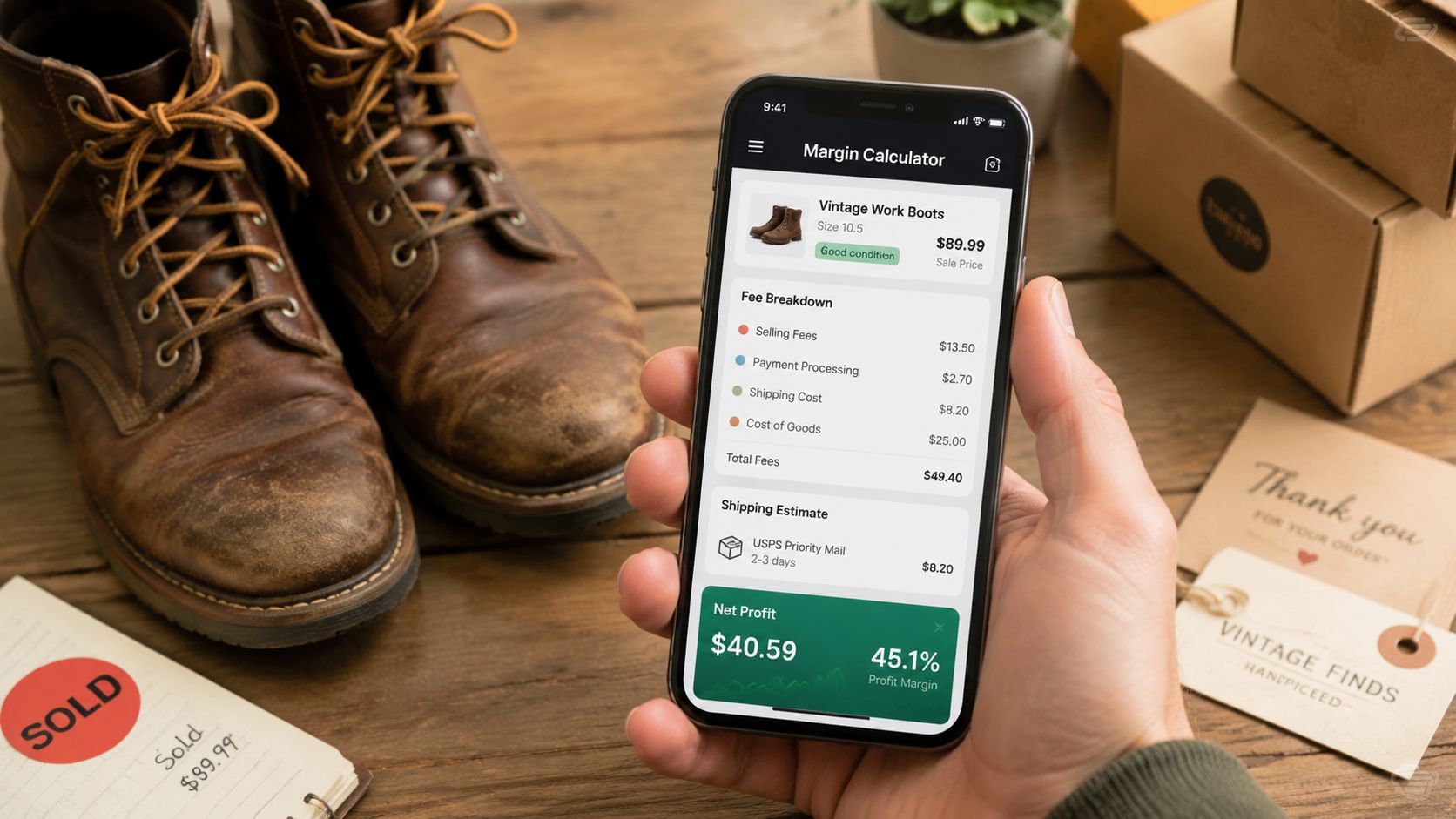
You're standing in a thrift aisle with a pair of boots in your hand, a price tag that looks cheap enough, and a quick hunch that they might flip well. The problem isn't spotting potential. The problem is knowing whether that potential survives fees, shipping, and the reality of the platform you'll list on.
That's where most resellers get burned. They look at the buy cost, estimate a sale price, and call the spread “profit.” It isn't. Net profit is what matters, and if your tool can't calculate that cleanly in real time, it's not helping you source. It's helping you make faster mistakes.
Table of Contents
- The Reseller's Dilemma in Aisle Four
- Why Your Phone's Calculator Is Costing You Money
- The 5 Pillars of a Powerful Margin Calculator App
- Sourcing in Action A Scan-to-Decision Workflow
- Common Sourcing Pitfalls and How to Avoid Them
- How ScanFlip AI Delivers True Profit Insight
The Reseller's Dilemma in Aisle Four
You are in aisle four with a pair of boots in one hand and your phone in the other. The comps look decent at a glance. The price tag is low enough to tempt a quick buy. What you need in that moment is not optimism. You need a fast read on take-home profit.
That is where a lot of new resellers slip. They see a gap between buy cost and likely sale price and treat that spread like profit. It is only a starting point. Net profit is what survives referral fees, payment processing, promoted listing costs, shipping, returns, and the category rules that change from one flip to the next.
A deal can look strong on the shelf and weak at checkout. I have seen plenty of items with solid comps turn into low-pay work once the full cost stack shows up. Boots are a good example. They may sell well, but weight and box size can wreck the margin if your estimate is lazy. Small appliances do the same thing, especially when missing parts or an odd package size pushes shipping higher than expected.
The blind spot that kills good-looking deals
Spotting potential is the easy part. Knowing whether that potential survives fees, shipping, and platform rules is what keeps your cash flow healthy.
Field rule: If you don't know your take-home before checkout, you don't know the deal.
This matters even more when you source fast. At thrift stores, estate sales, bin spots, and clearance aisles, there is pressure to decide before someone else grabs the item. In retail arbitrage, that pressure gets even sharper because speed wins buys and bad math creates inventory you should have left behind.
The better question is simple.
Can this item still clear enough net profit after fees and shipping to justify the buy, the time to list it, and the risk of it sitting?
A strong margin calculator app answers that with current fee logic and a realistic shipping estimate. A weak one only confirms the number you wanted to see.
Why Your Phone's Calculator Is Costing You Money
You are in aisle four. The comps look good, the buy cost is low, and someone else is already eyeing the same shelf. You punch sale price minus cost into your phone, see enough spread to feel good, and toss the item in your cart.
That shortcut is where a lot of profit leaks out.

A basic calculator gives you gross spread. Sourcing decisions need net profit. Those are not the same number, and the gap gets expensive fast once fees, shipping, returns, and paid visibility enter the picture.
A significant problem is that resale costs do not stay fixed. Fee schedules change. Categories behave differently. Shipping can swing hard based on weight, dimensions, and packaging. An item that looks like a clean flip at $12 cost and $35 resale can turn into a weak buy after marketplace fees, promoted listings, and a shipping estimate that was off by a couple of pounds or a few inches.
What a basic calculator leaves out
Phone math usually misses the costs that decide whether a flip is worth your cash:
- Marketplace fee logic: Each platform takes its cut differently, and some categories carry different rules than others.
- Shipping reality: The difference between a rough guess and a calculated estimate is often the difference between a buy and a pass.
- Variable selling costs: Promoted listings, payment processing, return risk, and supplies all eat into take-home.
- Category-specific friction: Shoes, electronics, media, small appliances, and bulky items each have their own margin traps.
- Actual pricing discipline: A target sale price only matters if it lines up with comps and your take-home goals. That is why smart sourcing ties directly to pricing resale items for profit.
New resellers get burned here all the time. They see a healthy gap between cost and expected sale price and call it margin. It is not margin if the fee structure is wrong and shipping is guessed.
I have passed on plenty of items with solid comps because the net came out thin once the full cost stack was added. That is the trade-off serious sellers make. A flip can be popular and still not be worth buying.
Why bad math hurts more than no math
The risk is not being off by a dollar. The risk is building a buying habit around incomplete numbers.
If your calculator ignores platform rules, you start approving deals that only work in theory. Then your cash gets tied up in inventory that sells slowly, pays less than expected, or requires discounts to move. The item may still sell, but the flip was weak from the start.
That is why purpose-built margin calculator apps matter. They do more than speed up the math. They help you make field decisions with current fee logic and realistic shipping inputs, which is what protects net profit.
A quick comparison
| Method | What it tells you | What it misses |
|---|---|---|
| Phone calculator | Simple spread between cost and expected sale | Fees, shipping, category rules, variable selling costs |
| Spreadsheet in the field | More detail if you maintain it well | Slow input, stale assumptions, weak fit for fast sourcing |
| Margin calculator app | Net-profit decision support at buy time | Still only as good as its fee logic and shipping estimates |
Fast sourcing rewards clear decisions. Clear decisions come from net profit math, not shelf-level optimism.
The 5 Pillars of a Powerful Margin Calculator App
A margin calculator app earns its spot on your phone when it helps you avoid bad buys in real time. The test is simple. Can it get you to a realistic net profit number fast enough to make a good call while the item is still in your hand?
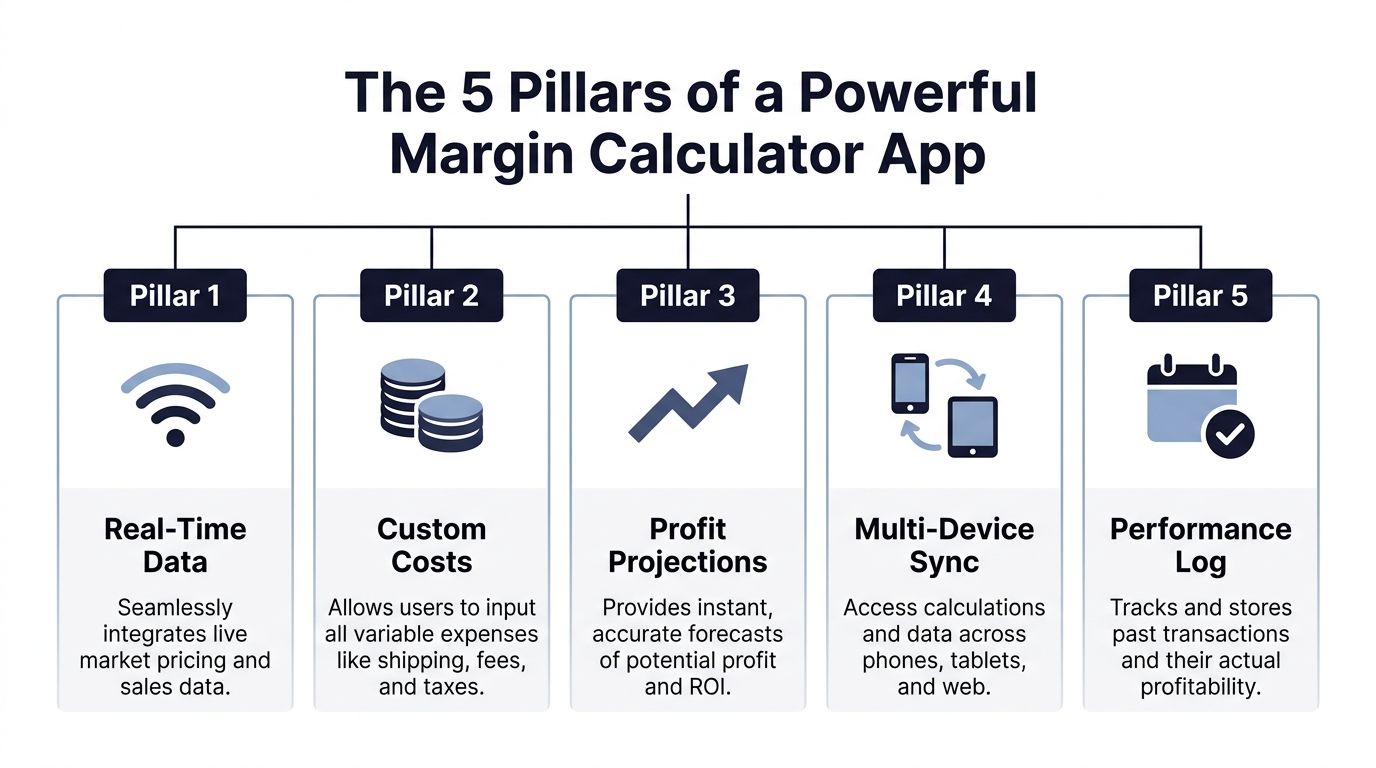
Ignore the feature list for a minute. Look at the parts that change buy decisions in the field.
Fee logic has to stay current
Marketplace fees change. Categories behave differently. Payment processing, promoted listings, store tiers, and marketplace rules can all change what you keep.
A calculator that relies on old fee tables gives clean-looking numbers and bad guidance. That is the dangerous part. New resellers often trust the output because the math looks precise, even when the assumptions are stale.
Required check: the app should calculate fees by marketplace and category, not with one flat percentage pasted across every item.
Shipping can't be a guess
Shipping is where thin flips die.
A pair of shoes, a bread maker, and a vintage jacket can all sell for similar prices and still leave very different net profit after packing size, carrier rates, dimensional weight, and buyer location are accounted for. If the app uses a placeholder shipping number, it can turn a pass into a buy for the wrong reason.
Look for tools that let you estimate shipping from real item details, not a default value. If you source books often, a tool with book scouting features built around live profit checks is a better fit than a generic calculator that treats every item the same.
Comps need context, not just a high sold
Bad buying starts with bad comps. The common mistake is anchoring to the best sold listing and building the whole decision around an outlier.
A useful calculator helps you work from realistic sale price assumptions. That means recent solds, enough comp volume to trust the range, and visibility across more than one marketplace when the category calls for it. Some items are stronger on eBay. Others move better on Amazon, Poshmark, or niche platforms.
Required check: your margin result is only as good as the comp price you feed into it.
Identification matters when barcodes fail
A lot of profitable secondhand inventory has no barcode advantage. Vintage clothing, estate sale electronics, replacement parts, and collectible media often need photo recognition, label lookup, or manual identification before you can even start comping.
That affects speed and accuracy. If your process requires bouncing between image search, sold listings, fee math, and shipping guesses, you lose time and make weaker calls. A strong app shortens that chain.
Tools built only for retail arbitrage miss this problem completely.
Your app should make the decision easier
Good sourcing tools do more than calculate margin. They help you decide whether the flip clears your rules.
Look for features like:
- Custom margin targets: Different categories justify different return thresholds.
- Minimum dollar profit rules: A 30 percent margin on a low-dollar item can still be a poor use of cash and time.
- Clear buy or pass signals: You should not have to interpret five fields of math while someone else is reaching for the same item.
- Saved history: Reviewing past scans helps tighten your sourcing standards and spot where your assumptions were off.
Here is the practical standard I use. If the app leaves you staring at the result and still unsure whether the item hits your net target, it is missing the point.
Sourcing in Action A Scan-to-Decision Workflow
You are in a crowded estate sale. Someone is already reaching for the same shelf. You spot an untagged vintage leather jacket with a worn label, no barcode, and just enough upside to tempt a bad buy if you rush the math.
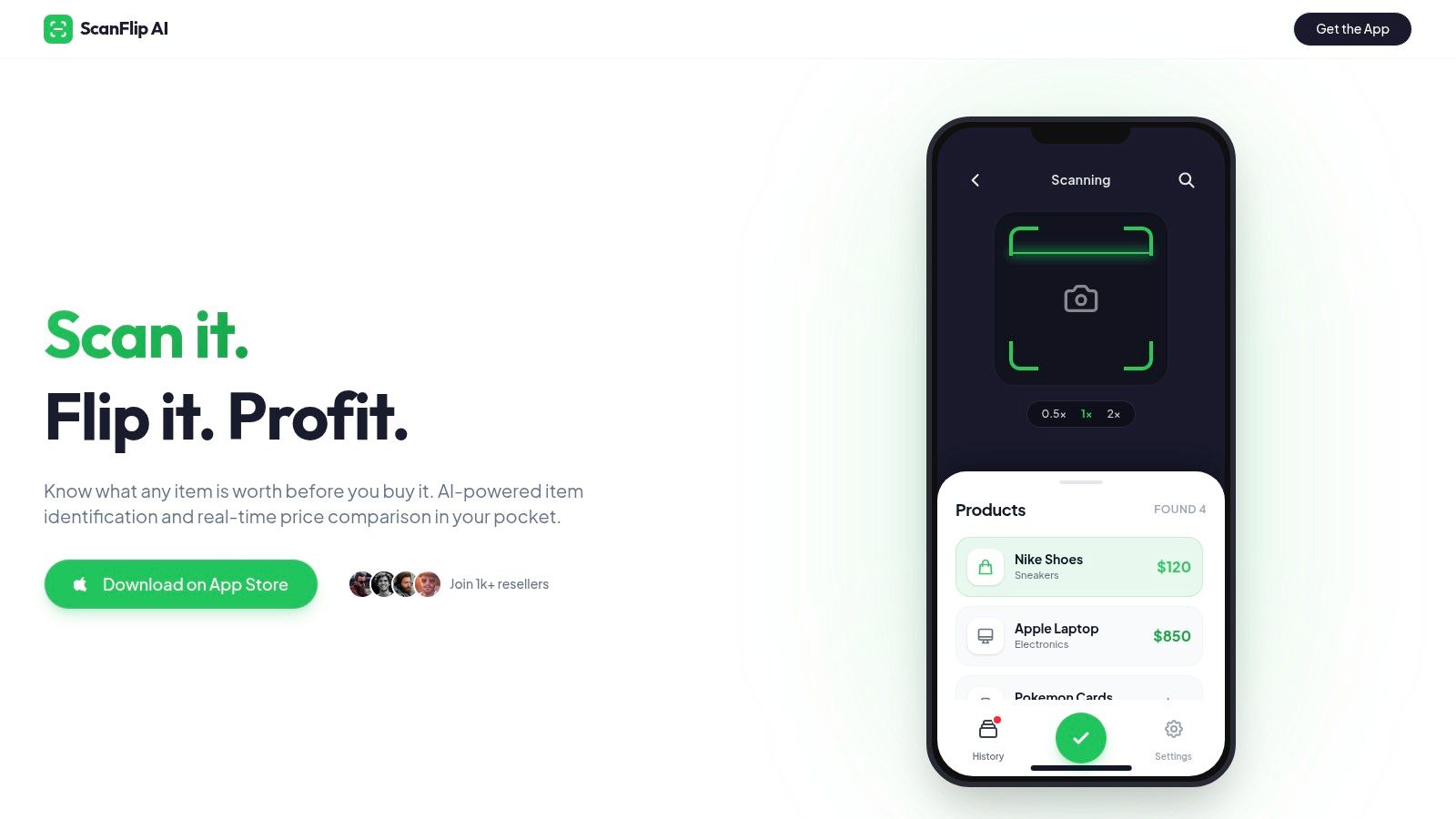
That is where a real workflow earns its keep. The goal is not to get a margin number. The goal is to get to a pass or buy decision based on net profit before emotion takes over.
A real sourcing flow
A practical scan-to-decision workflow looks like this:
- Identify the item fast: Use photo search or label recognition to pin down the brand, model, or style.
- Check sold comps: Pull recent solds from the marketplaces that handle that category.
- Set a realistic sale price: Use the middle of the comp range, not the highest sale.
- Enter your buy cost: Here, the sourcing decision gets real.
- Account for platform fees and shipping: The app should estimate both based on the category and likely package, so you see take-home profit instead of inflated gross margin.
- Compare against your rules: If it clears your minimum dollar profit and margin target, buy it. If not, leave it.
That order matters. New resellers often start with the sticker price and work backward emotionally. Experienced sellers start with likely net, then decide whether the asking price leaves enough room.
Why reverse calculation matters
The feature I use most in the field is the reverse calculator. Instead of asking, “What happens if I pay this much?” it asks, “What is the most I can pay and still hit my target?”
The math is straightforward: Max Buy Cost = (Selling Price * (1 – Target Margin %)) – (Fees + Shipping)
That sounds basic, but it changes how you source. You stop negotiating against hope and start buying against a ceiling. If the item is priced above that number, the flip does not fit your model.
This matters even more in categories with variable fees or awkward shipping. A jacket, stereo component, or boxed media lot can look fine on gross margin and still miss your net target once actual costs show up. That is why dynamic fee schedules and shipping estimators are required. Flat assumptions produce bad buys.
A good app also cuts decision time because it removes the extra steps. You are not bouncing between sold listings, a calculator, fee charts, and shipping guesses while someone else shops the same aisle.
If you source fast-turn categories, that workflow gets even tighter. Sellers working books and media often adopt tools built for high-volume comping first, then apply the same discipline elsewhere. That is the logic behind using a dedicated book scouting app for resellers and carrying that scan-first process into broader secondhand sourcing.
What good workflow feels like
Good sourcing software feels quiet. Scan. Verify the comp. Check net. Make the call.
That is the standard. If the app still leaves you translating fee math in your head, it is slowing you down and hiding the number that matters most. Net profit.
Common Sourcing Pitfalls and How to Avoid Them
Even with a strong margin calculator app, sellers still make the same few mistakes. The tool helps, but it won't fix bad judgment by itself.
Bad comps create bad buys
The easiest mistake is trusting a single strong comp because it supports the outcome you already want.
Do this instead:
- Check multiple solds: One high sale can be an outlier.
- Compare platforms: Some items perform differently depending on where they're listed.
- Ignore hopeful actives: Unsold listings tell you what sellers want, not what buyers paid.
- Use the middle of the market: A realistic comp range beats a cherry-picked result.
If your expected sale price is inflated, every margin number after that is fiction.
A clean calculator can't rescue a dirty comp.
Condition and sell-through still matter
Two identical model names can produce very different outcomes if one item has wear, missing parts, odor, damage, or replacement components. New resellers often scan an item, see a good comp, and stop there.
A better habit is to adjust the expected sale price before you judge the flip.
Ask yourself:
- Does this item match the condition of the sold comp?
- Will I need extra cleaning, testing, or repair time?
- Are key accessories missing?
- Would I still buy it if I had to list it lower than the cleanest comp?
That small pause protects your margin better than any flashy feature.
Your history should teach you something
Most sellers have patterns they don't notice in real time. They may overbuy a category they enjoy, hold inventory too long because it feels “special,” or repeatedly accept low-dollar flips that eat time.
A useful app history helps you audit yourself. Not just what you scanned, but what you chose, what you paid, and whether those buys fit your actual business.
Use your history to review:
| Review question | What it reveals |
|---|---|
| Which categories do I pass on too often? | Missed opportunities or lack of confidence |
| Which categories do I overbuy? | Emotional sourcing or weak sell-through |
| Which finds looked good but sold weakly? | Comp mistakes or condition blind spots |
| Where do I make my cleanest decisions? | Categories worth doubling down on |
The best resellers don't just source faster. They keep tightening their standards.
How ScanFlip AI Delivers True Profit Insight
ScanFlip AI is built around the exact problem that trips up most resellers. Gross margin looks good in the aisle. Net profit decides whether the buy was smart.

Its approach fits the way secondhand sellers work. Visual identification helps with untagged and barcode-free items. Cross-platform sold comps reduce the need to bounce between marketplaces. Built-in fee schedules and shipping-aware profit logic push the output toward take-home instead of rough spread math.
That matters more as sourcing gets faster and more competitive. The market data on reseller-focused margin apps and AI visual recognition shows the category has become substantial. The secondhand economy generated $177 billion in global revenue in 2023, and top-tier apps with AI-driven visual recognition reduced sourcing time by an average of 60% for professional resellers.
The main advantage isn't just speed. It's speed with fewer blind spots.
If your current process still starts with “I think I can make money on this,” a tool like this changes the workflow to “I know what this should net, and I know whether it clears my rule.” That's the difference between casual guessing and disciplined sourcing.
If you want a sourcing workflow built around visual item ID, cross-platform sold comps, and net-profit decisions instead of gross-margin guesses, take a look at ScanFlip AI. It's designed for thrift flippers, estate sale hunters, and resale sellers who need a fast buy-or-pass answer before the item goes back on the shelf.