
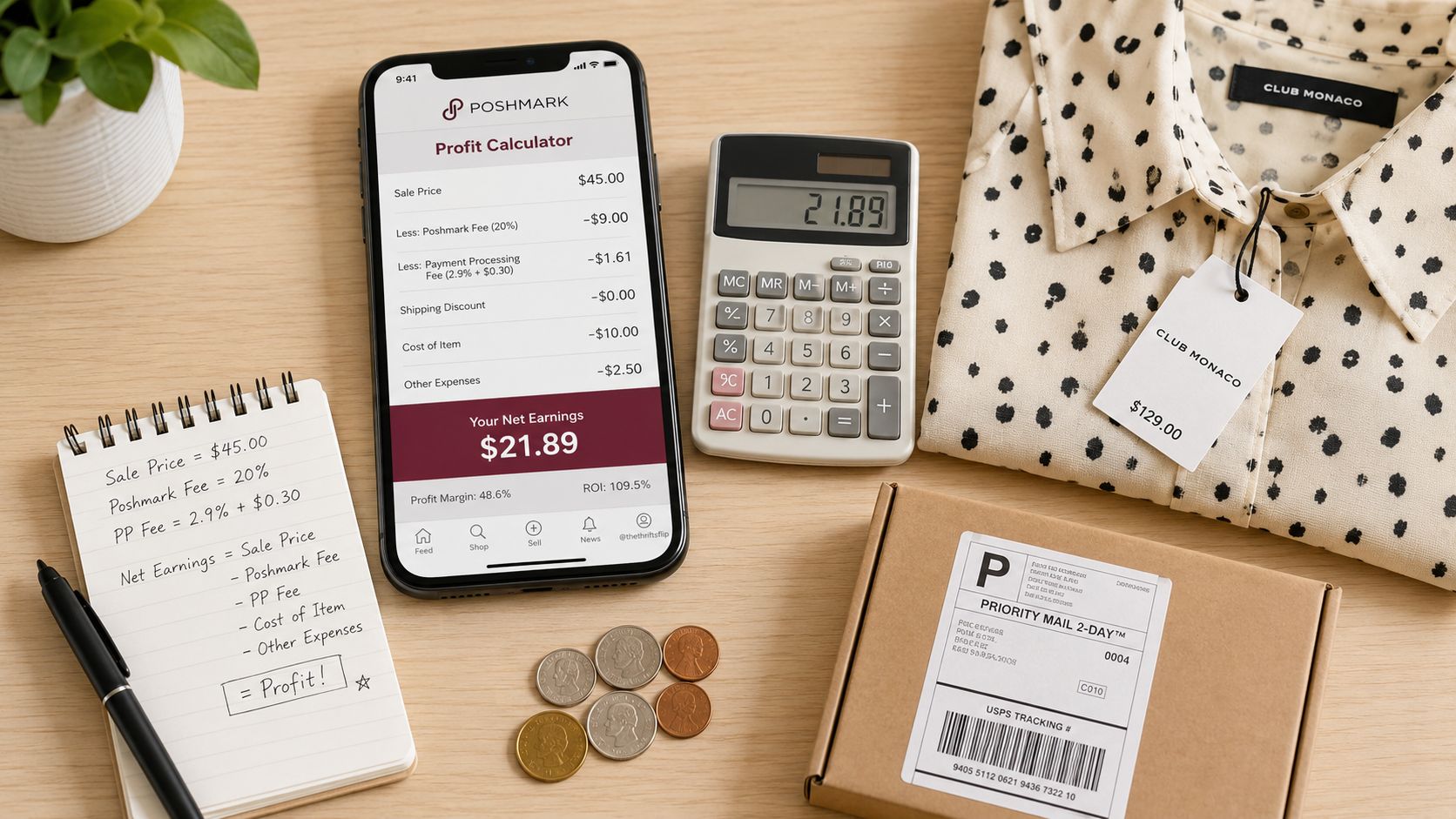

Poshmark Profit Calculator: A Guide to Your Net Earnings
You're standing in a thrift aisle with an item in your hand, doing fast mental math. The tag price looks great. The sold comps look even better. So you buy it, list it, sell it, and then the payout lands lower than expected.
That gap is where a lot of reseller profit disappears.
On Poshmark, the sale price isn't your profit. Your actual take-home depends on platform fees, your buy cost, and one expense that gets ignored far too often: seller-funded shipping discounts. If you don't account for all three before you source, you'll keep buying items that look good on paper and underperform in your payouts.
A solid Poshmark profit calculator fixes that. It tells you what you'll keep, not what you hope you'll keep. That's the number that matters when you're deciding whether a find is worth your cash, your time, and your storage space.
Table of Contents
- The Real Profit Behind Your Poshmark Finds
- Deconstructing Poshmark's Fee Structure
- The Manual Poshmark Profit Calculation Formula
- Worked Examples Calculating Profit in the Wild
- Factoring in Hidden Costs and Shipping Discounts
- Manual Calculation vs Automated Tools like ScanFlip AI
- Setting Profit Goals and Sourcing Smarter
The Real Profit Behind Your Poshmark Finds
A reseller sees a clean piece on the rack, checks recent sold listings, and gets excited. That part is easy. The harder part is knowing whether the item still works after fees, shipping concessions, and your buy cost come out.
That's why a Poshmark profit calculator matters so much in real sourcing. It closes the distance between sale price and net earnings. Without it, people rely on rough guesses, and rough guesses usually favor optimism.
I've seen the same pattern over and over. Sellers focus on what the item can sell for, not what they'll keep after the transaction is finished. The result is a closet full of listings that move, but don't produce enough real cash.
Practical rule: If you can't estimate your take-home before you buy, you're sourcing blind.
The best flippers don't treat profit as something they discover later. They decide it upfront. They look at the likely sale price, subtract the correct fee structure, subtract the item cost, factor in any discount they may need to offer, and then make the buy or pass call.
That shift changes how you source.
Instead of chasing every item with strong comps, you start chasing items with enough room. Room for platform fees. Room for negotiation. Room for shipping discounts. Room for mistakes. That's how a side hustle gets more stable, and how a serious reseller avoids the slow leak that comes from underpriced, under-margined inventory.
Deconstructing Poshmark's Fee Structure
A lot of margin leaks start here.
Poshmark does not use one flat fee on every sale. If the final sale price is under $15, the seller fee is $2.95. At $15 and up, Poshmark takes 20% of the order price, as outlined in Investomatica's breakdown of Poshmark calculator logic.
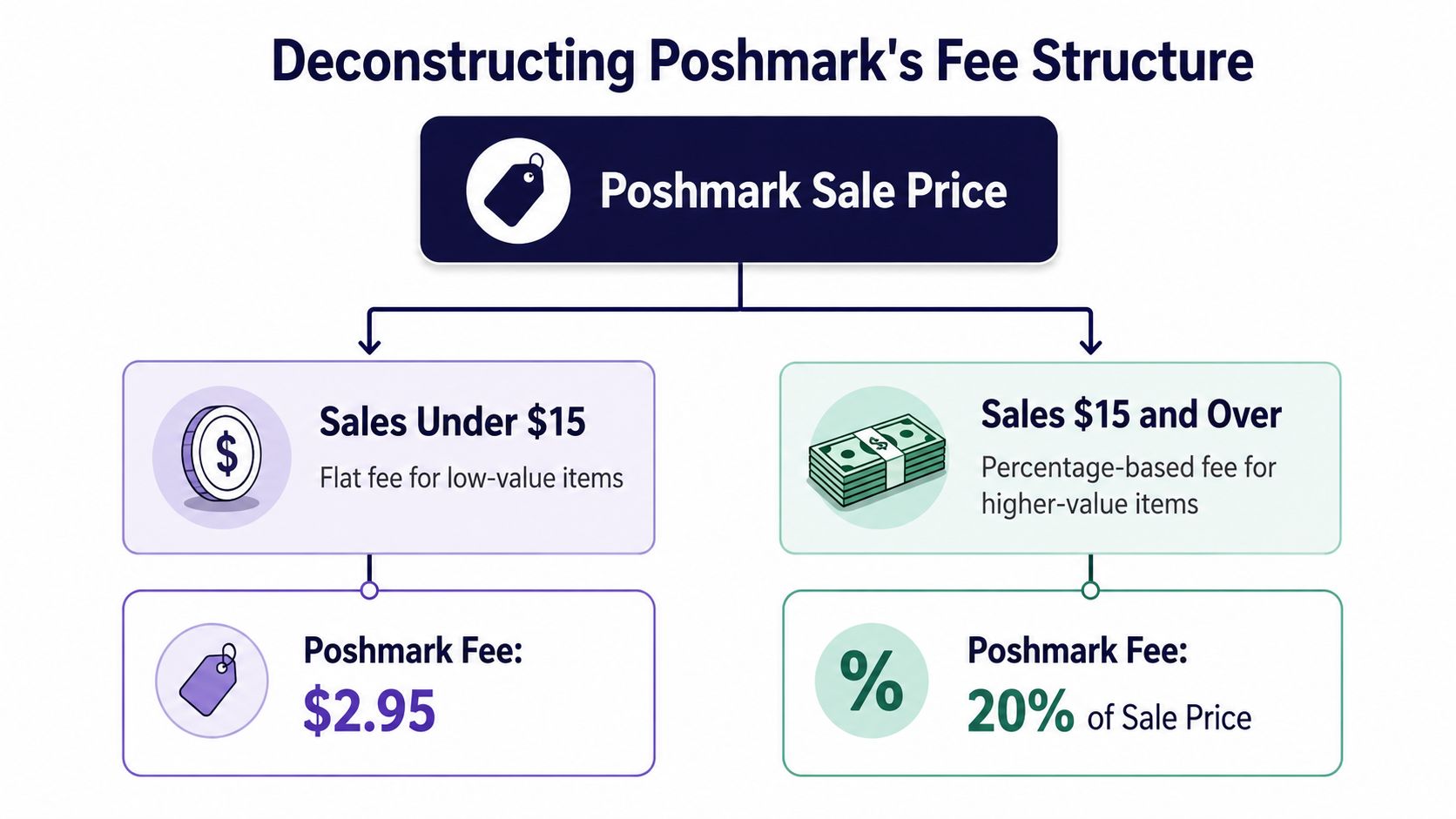
That cutoff matters more than new sellers expect. It changes how small pricing moves affect payout, especially on lower-priced items where a dollar or two can decide whether the sale was worth listing in the first place.
Sellers who list on multiple platforms run into this mistake all the time. They carry over fee assumptions from another marketplace and price badly. If you want to compare how another platform handles seller charges, this Mercari fee calculator guide shows how different the math can be.
The pricing trap at $15
The sharp edge in Poshmark's fee structure sits at $15.00.
Here's the part many guides skip. A $14.99 sale leaves the seller with $12.04 after the $2.95 fee. A $15.00 sale leaves the seller with $12.00 after the 20% fee. One extra cent in price can reduce your payout by $0.04.
That sounds minor until it shows up across dozens of low-ticket sales. It also matters during offer strategy. If an item is hovering around that threshold, a seller needs to know whether dropping just under $15 protects more take-home pay, or whether pushing the price higher still makes sense after the percentage fee and any shipping concession.
Here's the simple fee view:
| Final Sale Price | Poshmark Fee |
|---|---|
| Under $15.00 | $2.95 |
| $15.00 and over | 20% of total order price |
Experienced resellers check payout, not just list price. Around $15, that habit prevents a lot of bad pricing decisions.
The Manual Poshmark Profit Calculation Formula
The formula that matters
A manual Poshmark profit calculator doesn't need to be complicated. It needs to be complete.
Use this formula:
(Sale Price – Poshmark Fee) – Your Costs = Net Profit
That's the core math. The reason sellers get bad answers isn't because the formula is hard. It's because they leave out costs, or they use the wrong fee rule.
The first part is Sale Price. That's the amount the transaction is based on. The second part is the platform fee. As covered above, you can't estimate that casually because Poshmark doesn't treat every sale price the same.
Then comes the part that decides whether your estimate is useful or fantasy: Your Costs.
What belongs in your costs
Your buy cost is the obvious one. If you paid up for the item, your margin tightens immediately. But that's only the start.
A practical cost list usually includes:
- Cost of goods sold: What you paid to acquire the item.
- Seller-funded shipping discount: Any amount you absorb to close the sale.
- Packing materials: Mailers, tissue, tape, labels, and other supplies if you track them.
- Operational overhead: Whatever you consistently choose to assign to sourcing or handling.
If you want better buying decisions, use the same cost rules every time. Don't count packaging on one item and ignore it on the next. Don't include shipping discounts only after a bad sale reminds you they exist.
The calculator only works if your inputs are honest.
A lot of sellers improve fast when they stop asking, “Can I sell this?” and start asking, “What does this item leave me after everything comes out?” That's the difference between gross thinking and net thinking.
When you're trying to price an item for listing, broad resale pricing strategy matters too. This guide on how to price items for resale is useful because it pushes you to think about margin before you publish a listing, not after an offer comes in.
Use a repeatable sequence when you calculate manually:
- Estimate the realistic sale price. Don't anchor to the highest comp you can find.
- Apply the correct Poshmark fee tier. Here, many quick estimates fail.
- Subtract every cost you expect to carry. Not just the purchase price.
- Check the leftover amount. If that number doesn't justify the effort, pass.
This process is simple enough to run in a thrift store note app or calculator. The main challenge is discipline. Sellers often get lazy on low-cost finds because the buy-in feels harmless. But cheap inventory can still produce weak profit if the payout gets squeezed.
A manual calculator is also useful because it teaches instinct. After enough reps, you'll spot weak margins faster. You'll know when a small item has no room under the flat fee, when a mid-tier item can absorb an offer, and when a buyer's request for cheaper shipping turns a decent flip into a bad one.
Worked Examples Calculating Profit in the Wild
Theory sticks better when you can see it on actual sourcing situations. The numbers below use the same formula each time, but the decision quality changes based on the item, the fee tier, and whether you absorb any extra cost.
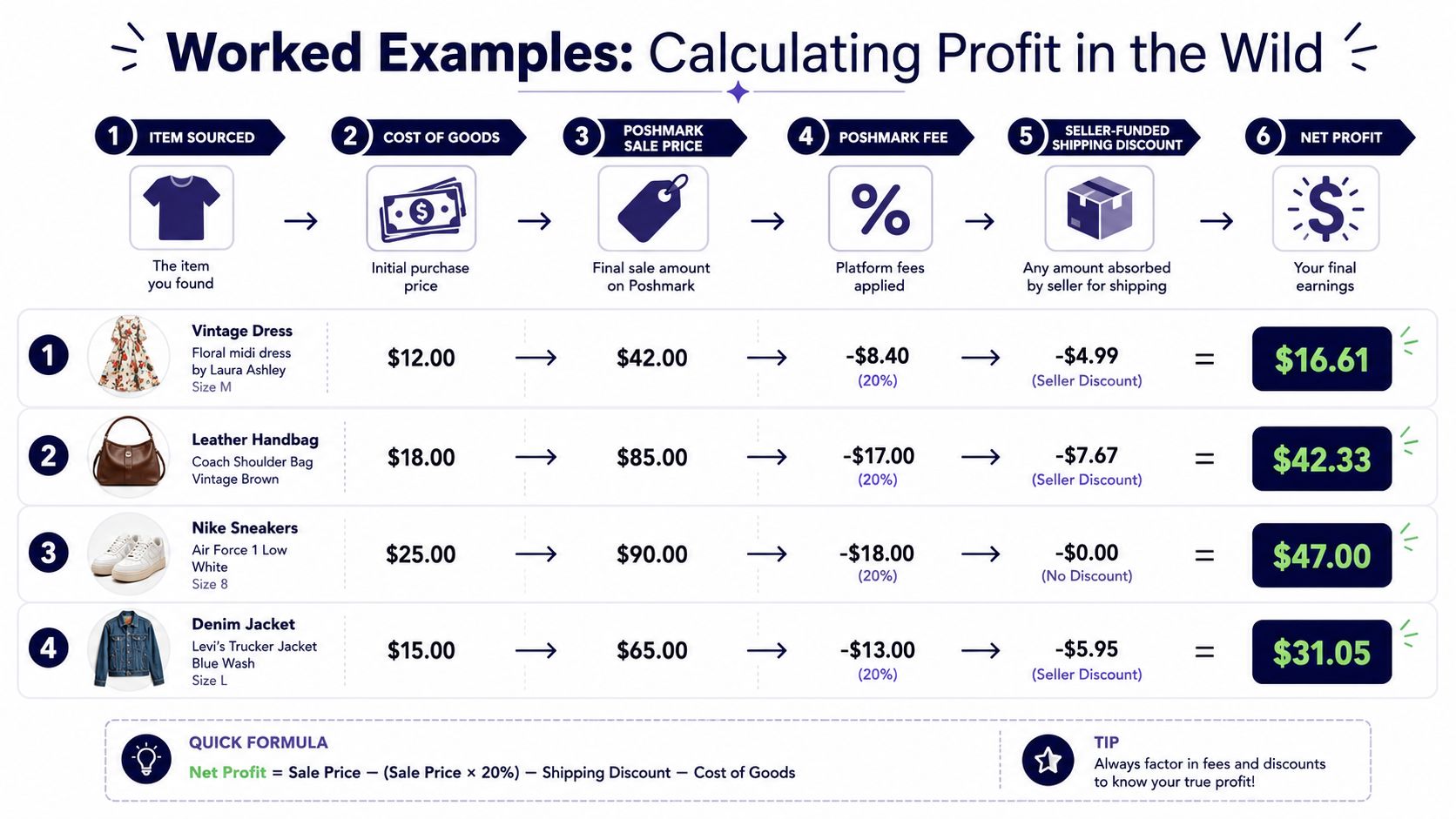
Example one and example two
Example one: a lower-priced accessory
You source a small accessory and expect it to sell for $12. Because the sale is under the threshold covered earlier, the flat fee applies. You subtract that fee, then subtract your item cost and any supplies you track.
This kind of item teaches an important lesson. Low sale prices don't leave much room for mistakes. If your buy cost is too high, a seemingly easy flip can end up barely worth packing.
Example two: a standard apparel sale
You source a solid brand-name piece and it sells for $40. This falls into the higher fee tier, so the percentage-based commission applies. From there, you subtract your buy cost and any other expenses attached to that sale.
Mid-range sales are where many sellers feel more comfortable. Mid-range sales usually give you more room to negotiate and still keep a workable payout, assuming you bought well in the first place.
Good flips don't just survive fees. They survive offers too.
Example three and example four
Example three: a sale with a shipping discount
You sell an item for $50, but you offer a shipping discount to get the buyer over the line. The sale still looks fine at a glance. The problem is that the discount comes out of your side, so your true net drops after the standard fee and your item cost are already accounted for.
This is the sale type that exposes weak calculators. If the calculator ignores the shipping concession, it gives you a payout number that feels safe but isn't real.
Example four: a higher-ticket item
You move a premium piece where the price point is well above everyday thrift finds. At that level, the same fee structure still applies, but your decision changes. The item may leave enough profit to justify slower sell-through, stronger packaging, or more patient pricing.
A useful way to think about the four examples is by risk profile:
| Scenario | What usually matters most |
|---|---|
| Lower-priced item | Whether the flat fee leaves enough room |
| Mid-range sale | Whether your buy cost was disciplined |
| Sale with discount | Whether the concession erased too much profit |
| Higher-ticket piece | Whether margin justifies longer holding time |
The lesson isn't that one category is always better. It's that each one fails in a different way. Small items fail when sellers underestimate the fee burden. Mid-range flips fail when sourcing gets sloppy. Discounted sales fail when the seller treats shipping like a minor detail. Premium pieces fail when money gets tied up in inventory that looks impressive but moves too slowly for your business style.
Factoring in Hidden Costs and Shipping Discounts

Why shipping discounts distort margin
A sale can look healthy until the shipping discount comes out of your side.
That mistake shows up all the time on lower and mid-priced items. A seller accepts an offer, sends a shipping discount to help close it, and reads the sale price as if that discount were a small marketing cost. It is a direct hit to take-home pay. If your calculator skips that field, your projected profit is inflated before you even subtract cost of goods.
ResellBot's Poshmark fee calculator analysis points out the same problem. Seller-funded shipping needs to be treated as a negative line item, not buried inside a rough estimate. On a cheap item, that difference can wipe out the margin you thought you had.
The practical rule is simple. Every time you offer discounted shipping, subtract it in full from your expected net. Do not round it away. Do not treat it as a minor concession. On Poshmark, it is real money leaving your payout.
If your calculator doesn't include seller-funded shipping, it isn't showing profit. It's showing a draft.
Other costs serious sellers track
Shipping discounts are the cost sellers miss first. They are not the only cost that matters.
Packaging is a small leak that turns into a real expense over volume. Mailers, tape, thank-you cards, tissue, label paper, and replacement supplies can be ignored on one sale and still hurt the month. Sellers who move steady volume usually assign a fixed packaging cost per order so the math stays honest.
Buy cost is still the biggest profit lever. Overpay by a few dollars at the thrift, estate sale, or buyout, and the listing has to work harder before it even goes live. I would rather pass on a maybe item than force a sale later with a price cut and a shipping discount. That combination is how decent gross profit turns into weak net profit.
Taxes matter too. Payout is not the same as spendable cash. Sellers who want a clear picture of profit track what needs to be set aside instead of counting every deposit as available money.
The cleanest method is to build your calculator around true take-home pay:
Sale price – Poshmark fee – seller-funded shipping discount – cost of goods – packaging – tax reserve = real profit
That is the number worth making decisions on.
Manual Calculation vs Automated Tools like ScanFlip AI
A good reseller should be able to run the math on a paper receipt. That skill matters because bad inputs create bad buying decisions, and Poshmark leaves enough room for fee mistakes, offer mistakes, and shipping discount mistakes to turn a decent find into a weak sale.
Manual calculation works best when the decision is slow and the item is unusual. A vintage jacket with inconsistent comps, a bundle offer, or an old listing you plan to relist often needs judgment before it needs software. Hand-checking the numbers also exposes sloppy assumptions. If the expected profit only works when the buyer pays full price and no shipping discount is offered, the item was probably too expensive to buy.
Three situations still favor manual math:
- Testing one item carefully: Useful when comps are messy or the category is new to you.
- Training your sourcing instinct: Repetition helps you recognize margin fast.
- Auditing a tool's output: A quick hand check catches wrong buy cost, missing discounts, or bad sale-price inputs.
Speed changes the equation.
At a thrift, estate sale, or rack pull, manual math gets slow fast. You are checking sell-through, likely sale price, your cost, and actual take-home while someone else may already be reaching for the same item. In that setting, automation earns its keep because it reduces repeat work and cuts the kind of mistakes that happen when you do fee math in your head.
As noted earlier, seller-funded shipping is a common blind spot in many calculators. That omission matters because a tool can show a healthy payout while your real net is much thinner once the discount is applied. Serious sellers need a calculator that reflects what leaves the payout, not just the platform fee.
The better reseller tools do more than subtract fees. They identify the item, pull sold comps, estimate a realistic resale range, and combine that with buy cost and platform math in one workflow. That matters in the field because sourcing is rarely a one-number decision. The primary question is whether the item still clears your minimum profit after offers, fees, and any shipping help you expect to give.
For sellers comparing options, a margin calculator app for resellers is useful because it keeps attention on margin instead of vanity revenue. A $40 sale with thin net profit is less interesting than a $28 sale with cleaner take-home and faster turnover.
Manual math builds judgment. Automated tools save time and help you make more buy-or-pass decisions before the inventory is gone. The best approach uses both. Know the formula well enough to catch bad assumptions, then use software to move faster without guessing.
Setting Profit Goals and Sourcing Smarter
A Poshmark profit calculator becomes powerful when you stop using it as a post-sale curiosity and start using it as a sourcing filter.
Set a minimum standard before you shop. Maybe the item needs enough profit to justify cleaning, photographing, storing, listing, sharing, and shipping. Maybe you want more room if the category moves slowly. The exact target is personal. The discipline isn't.
This changes how you buy. You stop chasing “nice brands” and start chasing profitable buys. You pass on items that need perfect pricing to work. You favor inventory that can survive offers, discounts, and ordinary selling friction without collapsing your margin.
That's how smarter sourcing looks in practice:
- Know your floor: Decide what minimum payout makes an item worth your time.
- Leave room for negotiation: Buyers often want offers or shipping help.
- Treat net profit as the true score: Gross sales can flatter weak sourcing.
The sellers who stay profitable over time aren't guessing better. They're filtering better.
If you want faster buy-or-pass decisions while sourcing, ScanFlip AI helps you identify items, check sold comps across marketplaces, and estimate take-home profit in one workflow so you can make cleaner resale decisions before you buy.