

Online Arbitrage Tool: A Complete Guide for Resellers
You're probably in one of two places right now. Either you're staring at a product in a thrift aisle, tabs open everywhere, trying to decide if it's worth buying before someone else grabs it. Or you're doing online arbitrage from your laptop, bouncing between retailer sites, Amazon, eBay sold comps, and a fee calculator, trying to figure out whether the spread is real or fake.
That's the pain point an online arbitrage tool fixes. Not by giving you one more data point, but by changing the whole sourcing workflow. Its true upgrade isn't “faster scanning.” It's moving from guesswork to a repeatable buy-or-pass system that works under pressure.
Table of Contents
- The End of Sourcing Guesswork
- What Is an Online Arbitrage Tool
- Core Features That Maximize Reseller Profits
- How Smart Tools Beat Simple Price Lookups
- Your New In-Aisle Sourcing Workflow
- A Practical Checklist for Choosing Your Tool
- Common Questions and Tool Limitations
The End of Sourcing Guesswork
A reseller spots a promising item. Maybe it's a pair of branded boots without a box, or a small kitchen appliance that looks expensive but doesn't have an obvious model number. The old workflow kicks in fast. Search eBay. Check active listings. Open another app for sold comps. Estimate shipping in your head. Guess fees. Hope the margin survives reality.
That workflow burns time and creates bad buys.
The worst part isn't just missing a deal. It's the uncertainty. You pass because you can't verify demand fast enough, or you buy because the top-line sale price looks good, then discover later that fees, shipping, or weak comps killed the flip.
What manual sourcing usually gets wrong
Most manual sourcing breaks down in the same places:
- Comps get misread: Active listings look like market value, but they're often just wishful pricing.
- Fees get ignored: Gross sale price feels exciting until platform fees and shipping eat the spread.
- Decision speed collapses: By the time you've checked enough apps, the buying window is gone.
- Category knowledge gets stretched: Even experienced flippers get shaky outside their core lanes.
That's why a serious online arbitrage tool matters. It doesn't just help you “look things up.” It turns sourcing into a system built around evidence.
Practical rule: If you can't confirm demand, likely net, and your exit path in one workflow, you don't have a sourcing edge. You have a gamble.
For focused sellers using modern tools, the break-even point, where revenue covers initial investment and operating costs, typically occurs within 2 to 3 months, and many resellers set strict buy rules such as at least $3 profit or a 30% ROI according to GoAura's online arbitrage guide.
The workflow shift that changes everything
The shift is simple. Instead of asking, “Can I maybe flip this?” you ask:
| Old question | Better question |
|---|---|
| What's it listed for? | What has it actually sold for? |
| Could this work? | Does it clear my threshold? |
| Is this item popular? | Is there enough demand in the comps? |
| Can I make money? | What's my likely net after costs? |
That's the core value of an online arbitrage tool. It gives you a repeatable sourcing process you can trust when the clock is running.
What Is an Online Arbitrage Tool
You're staring at a shelf full of maybe-profitable inventory, phone in hand, and the old workflow starts dragging. One app for sold comps. Another for fees. A browser tab to check restrictions. By the time the math is done, the good buy is gone. An online arbitrage tool fixes that by pulling the decision into one place.
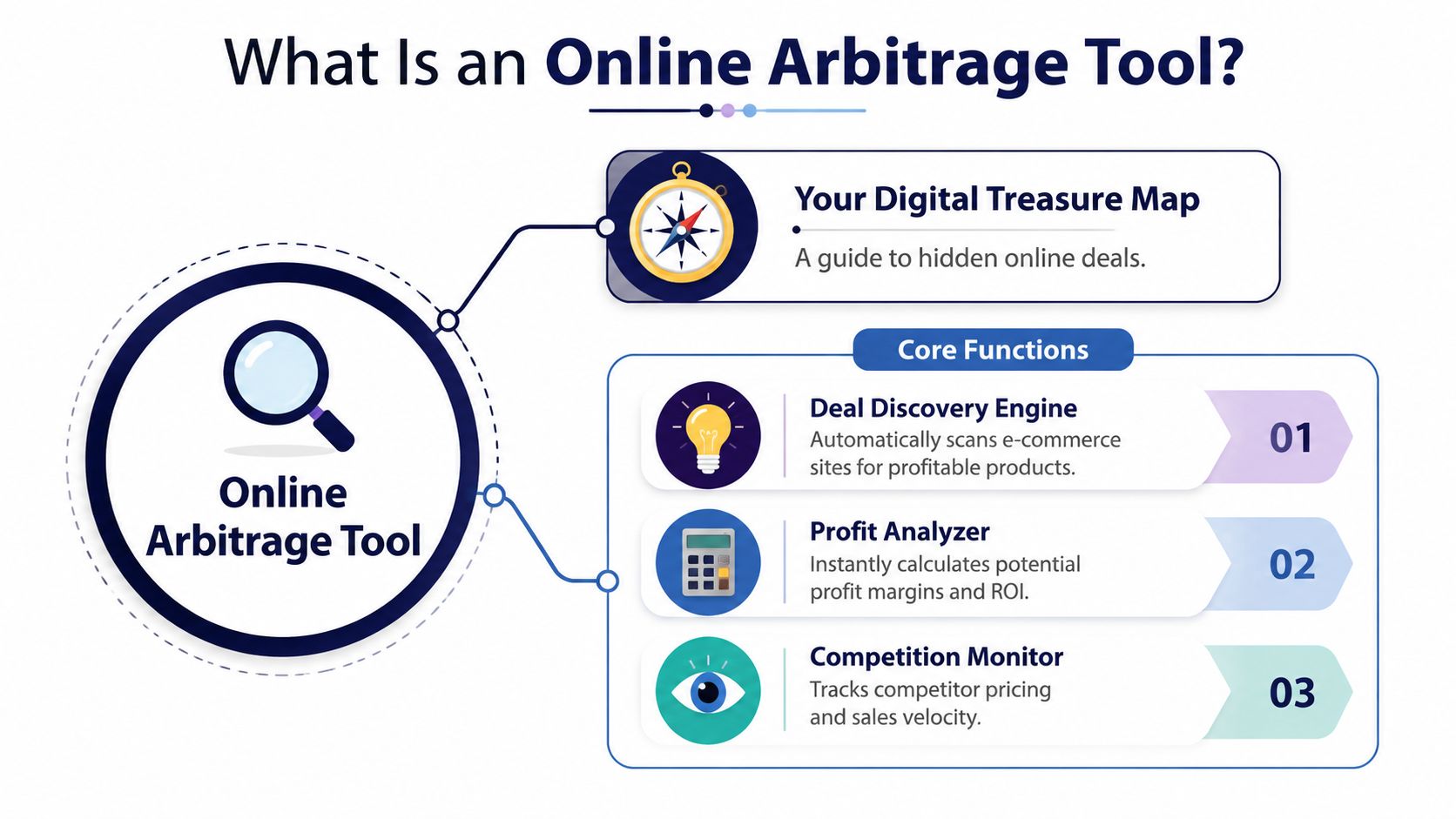
An online arbitrage tool is sourcing software that helps resellers identify an item, check sell-through, estimate costs, and make a flip-or-pass call fast. It works like a live market scanner for physical goods. Instead of guessing whether a product has room, you're checking whether the spread still holds after fees, shipping, and platform friction.
A basic price-check app gives you one data point. A real arbitrage tool supports the full buying decision. It answers the questions that matter in the aisle or during an online sourcing run: What is this exactly? What do the comps look like? What will fees do to the margin? Can I even sell it? What is my likely net?
Built for faster decisions, not just more data
Manual sourcing breaks down when volume goes up. Serious sellers need a tool that can cut search time, compare multiple signals at once, and surface opportunities before they disappear.
That changes the job. The work stops being “search every listing by hand” and becomes “review qualified leads, verify edge cases, buy with rules.” Sellers who source this way spend less time stitching together screenshots and more time judging whether a lead fits their model.
What these tools do in a real workflow
A capable online arbitrage tool usually handles four jobs:
Identification
It helps match the item to the correct product or listing, even when titles are messy or product details are incomplete.Comp checking
It pulls sold history, current offer data, or marketplace pricing so you can compare against real demand instead of hopeful list prices.Profit math
It estimates fees, shipping, taxes, and expected net. A good setup pairs well with a margin calculator app for reseller profit checks when you want to sanity-check borderline buys.Risk screening
It flags issues that can kill a deal, like restrictions, weak sell-through, poor listing quality, or a margin that disappears the second shipping runs high.
That mix is why these tools change reseller behavior. They replace scattered lookups with a single sourcing workflow you can repeat all day.
A good online arbitrage tool does not make the buy decision for you. It shortens the gap between spotting an item and knowing whether it clears your rules.
Why the definition matters
Calling it a “product research tool” undersells it. The better definition is operational. An online arbitrage tool is the system that turns sourcing from manual guesswork into a data-backed process. You stop chasing random deals and start running inventory through the same filter every time.
That is the main upgrade. Better decisions, made faster, with fewer dead-end buys.
Core Features That Maximize Reseller Profits
Profit comes from reducing bad calls fast. The best online arbitrage tool improves the whole sourcing workflow so you can identify the item, verify comps, run the math, and screen risk before momentum or bad assumptions push you into a weak buy.
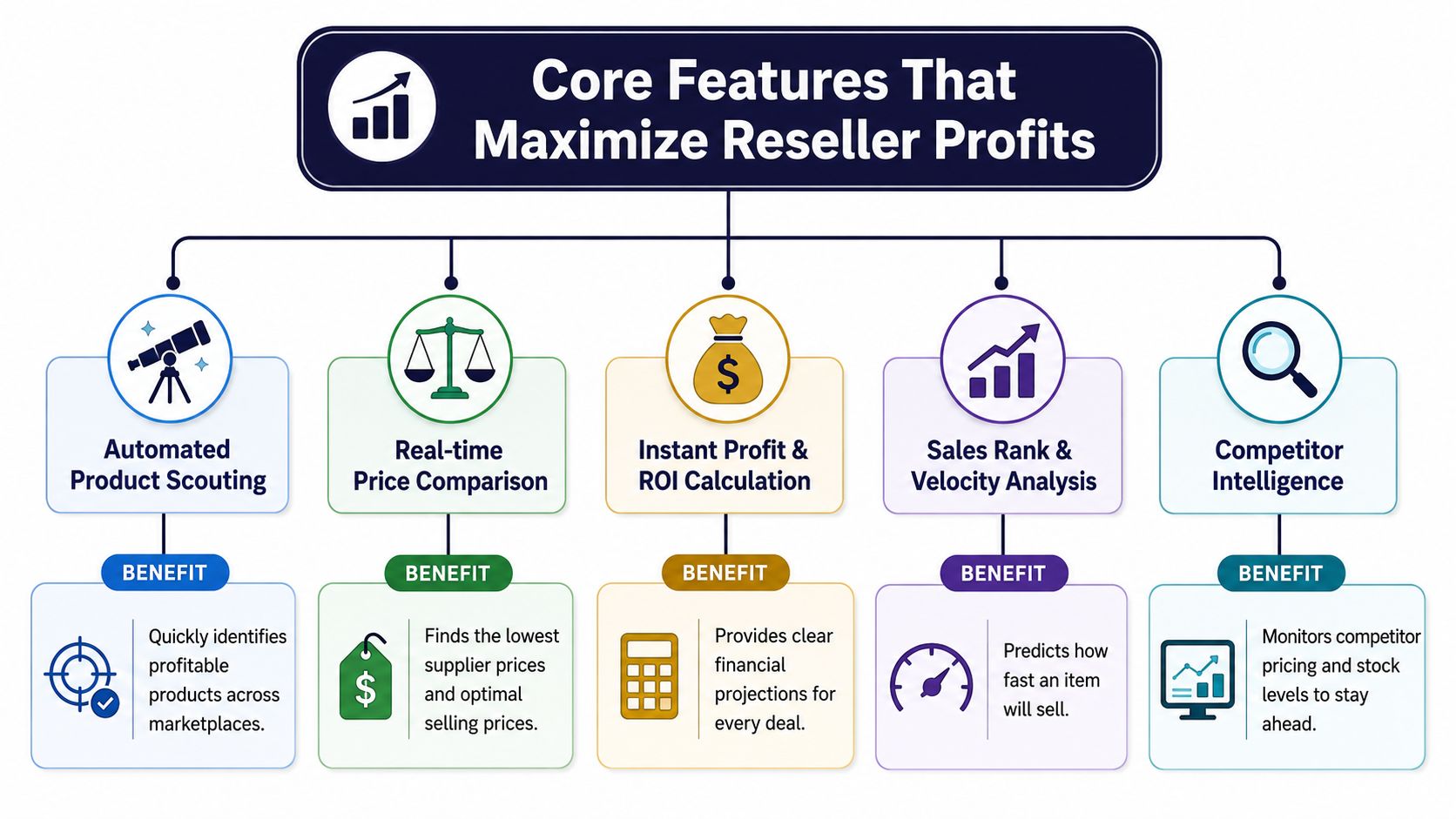
Product identification without a barcode
A lot of profitable inventory starts as a messy listing, a missing tag, or an item with no usable UPC at all. If your tool only works when the barcode is clean, you miss too many flips before the research even starts.
Strong identification tools close that gap. Photo search, title matching, and attribute-based matching help pin down the exact product faster, which means you spend less time guessing and more time checking real comps. For thrift, estate, and closeout sourcing, that speed matters because hesitation usually costs you the item.
Cross-platform sold comps in one view
Resellers lose margin when comping gets fragmented. One app shows an active eBay listing. Another shows a stale Mercari price. Poshmark tells a different story once condition and bundle behavior enter the picture.
A better tool pulls sold data into one screen so you can judge demand with context instead of hopping between tabs. That changes the workflow in a practical way. You stop doing scattered price checks and start making flip-or-pass calls from a single view. If you want a cleaner way to sanity-check edge cases, use a reseller margin calculator for net profit checks before you buy.
Profit calculators that use net, not fantasy
Gross resale price is how sellers talk themselves into dead inventory. Net is what matters.
A useful calculator accounts for marketplace fees, shipping, taxes where relevant, and target ROI before the item hits your cart. Good tools also save presets by platform or category, which matters more than people think. The fee profile on shoes is different from media. The shipping risk on small electronics is different from jackets. If the tool cannot reflect those differences quickly, you end up back in spreadsheet mode, and the workflow slows down again.
Field note: If net profit takes too long to verify, bad buys start looking acceptable.
Demand validation through history, not hype
One high comp is not a market. It is often just noise.
The better tools show enough history to answer the question resellers care about most: does this item move at a price that still leaves room after costs? Pricing history helps separate a temporary spike from a normal range. Recent sold patterns show whether buyers are active right now. On Amazon-heavy workflows, rank and offer trends can help estimate whether the product is likely to sit or turn.
That history changes behavior. Instead of chasing the best screenshot, you start buying items with repeatable demand.
Restriction and eligibility checks
A strong buy can still fail if you cannot list it where you planned to sell it. Amazon sellers know this pain well, but the same principle applies anywhere listing rules, condition standards, or category limits can block the sale.
The right tool checks those issues early. That saves time, protects cash, and keeps your cart clean. In practice, this feature does more than prevent obvious mistakes. It also keeps the workflow honest by filtering out deals that only look profitable on paper.
How Smart Tools Beat Simple Price Lookups
A basic lookup gives you a number. A smart online arbitrage tool helps you make a flip-or-pass call while the item is still in your hand.
That sounds like a small upgrade until you source outside clean barcode categories. In shoes, apparel, collectibles, accessories, and oddball electronics, one lazy comp can turn a decent-looking buy into dead stock. The primary difference is workflow. Simple lookups make you stop, cross-check, and fill gaps yourself. Smart tools pull the decision pieces into one place so you can move with confidence instead of guessing.
Before and after the upgrade
Here's the practical difference:
| Simple lookup | Smart sourcing tool |
|---|---|
| Shows an active listing | Shows sold comps |
| Checks one marketplace | Aggregates multiple marketplaces |
| Focuses on sale price | Focuses on expected net |
| Requires manual fee math | Calculates platform costs in workflow |
| Often depends on barcode | Can support barcode-free identification |
| Gives data | Supports a decision |
The table matters because sourcing mistakes rarely come from one bad number. They come from missing context. A seller sees a high active listing, skips fee math, ignores condition spread, and talks themselves into a buy that never should have made it into the cart.
Why active prices fool resellers
Beginners get burned here all the time. They open eBay, spot a high asking price, and treat it like a comp. That only shows what another seller hopes to get.
Sold data is what matters. Historical pricing matters too. On Amazon-heavy workflows, stronger research tools also factor in rank movement and pricing patterns so you can tell the difference between steady demand and a short-lived spike. That shift alone changes sourcing behavior. You stop buying screenshots and start buying repeatable sell-through.
If eBay is still part of your comp stack, learn how to check sold prices on eBay without getting fooled by bad comps. A single outlier can still wreck the decision if you read it wrong.
What “smart” means on the sales floor
Smart does not mean packed with features you never use. It means fewer blind spots at the exact moment you need to decide.
A useful tool should answer these fast:
- Is this the exact item or a close variant?
- Do sold comps support the buy price?
- What does net look like after fees and shipping?
- Is demand steady enough to justify the hold time?
- Does it clear my buy threshold?
That is a key upgrade. You are no longer running five separate checks in your head and hoping nothing got missed. The tool turns scattered research into a repeatable in-aisle workflow.
The biggest jump in sourcing skill comes from rejecting weak comps faster.
What simple tools still do well
Simple lookups still earn their spot for quick checks. They work fine when you know the category cold, the item has stable demand, and you only need a fast sanity check.
But once you branch into unfamiliar inventory, they start costing you time and margin. Not because every result is wrong. Because too much of the decision still depends on your own patchwork process. That is where smart tools pull ahead. They replace manual guesswork with a system you can trust under pressure.
Your New In-Aisle Sourcing Workflow
A good sourcing trip changes once you stop treating every find like a fresh research project. You grab an item, run the same checks in the same order, and get to a flip-or-pass call before the aisle gets crowded.

Step one starts before you scan
You find a pair of branded shoes at the thrift. No box. No barcode. The shape looks right, but brand alone will burn you.
The old workflow starts with vague search terms and too much guessing. A camera-first tool cuts that out. You shoot the item, get likely matches, and move straight into actual research. If you have not used a barcode-free item identifier app for secondhand sourcing, that is usually the first big shift in speed.
Then the tool narrows the match
Now the search is tied to the item in your hand, not a pile of loose keywords. That matters more than resellers admit.
Bad matches kill margin. The wrong model year, width, material variation, or sub-line can make clean-looking comps useless. A smart workflow reduces that error before you even look at price.
Next comes comp context
Once the item is identified, the tool should pull sold comps from the marketplaces you sell on. The goal is not to find one exciting sale. The goal is to see whether there is a real lane for that item at the price you need.
At this point, the workflow starts paying you back in time and discipline:
- Thin comps: usually pass, unless you know the category well enough to spot hidden value
- Decent demand but weak spread: pass
- Healthy sold comps with room after costs: keep going
That is a different process from manual sourcing. You are no longer trying to remember fees, compare tabs, and sanity-check demand in your head while someone else reaches for the same shelf.
Add buy cost and let the math do its job
This is the step that saves a lot of bad buys.
At sourcing speed, sellers round numbers. They underestimate shipping, miss marketplace fees, forget promoted listing costs, or assume the item will sell at the highest comp instead of the median. That is how a “profitable” pickup turns into dead inventory or a tiny payout that was never worth the time.
A strong arbitrage tool handles the net calculation on the spot. You plug in buy cost, see expected fees and shipping, and judge the spread based on take-home profit, not hope.
Do not ask whether it sells. Ask whether it clears your margin after every predictable cost.
End with a threshold-based verdict
The last upgrade is simple, but it changes behavior fast. Set your buy rules in advance, then let the tool score the item against those rules.
That gives you a cleaner flip-or-pass decision in the aisle. No second-guessing because the brand is hot. No emotional buy because the comp screenshot looked strong for two seconds. The verdict only matters because it is tied to your numbers.
That is the workflow transformation. Manual sourcing feels like improvising. A smart tool turns it into a repeatable system you can trust under pressure.
A Practical Checklist for Choosing Your Tool
Most resellers don't need the “best” online arbitrage tool in the abstract. They need the one that fits their sourcing style. A thrift-heavy secondhand seller has different needs than an Amazon-focused laptop sourcer scanning retailer catalogs all day.
This checklist cuts through the fluff.
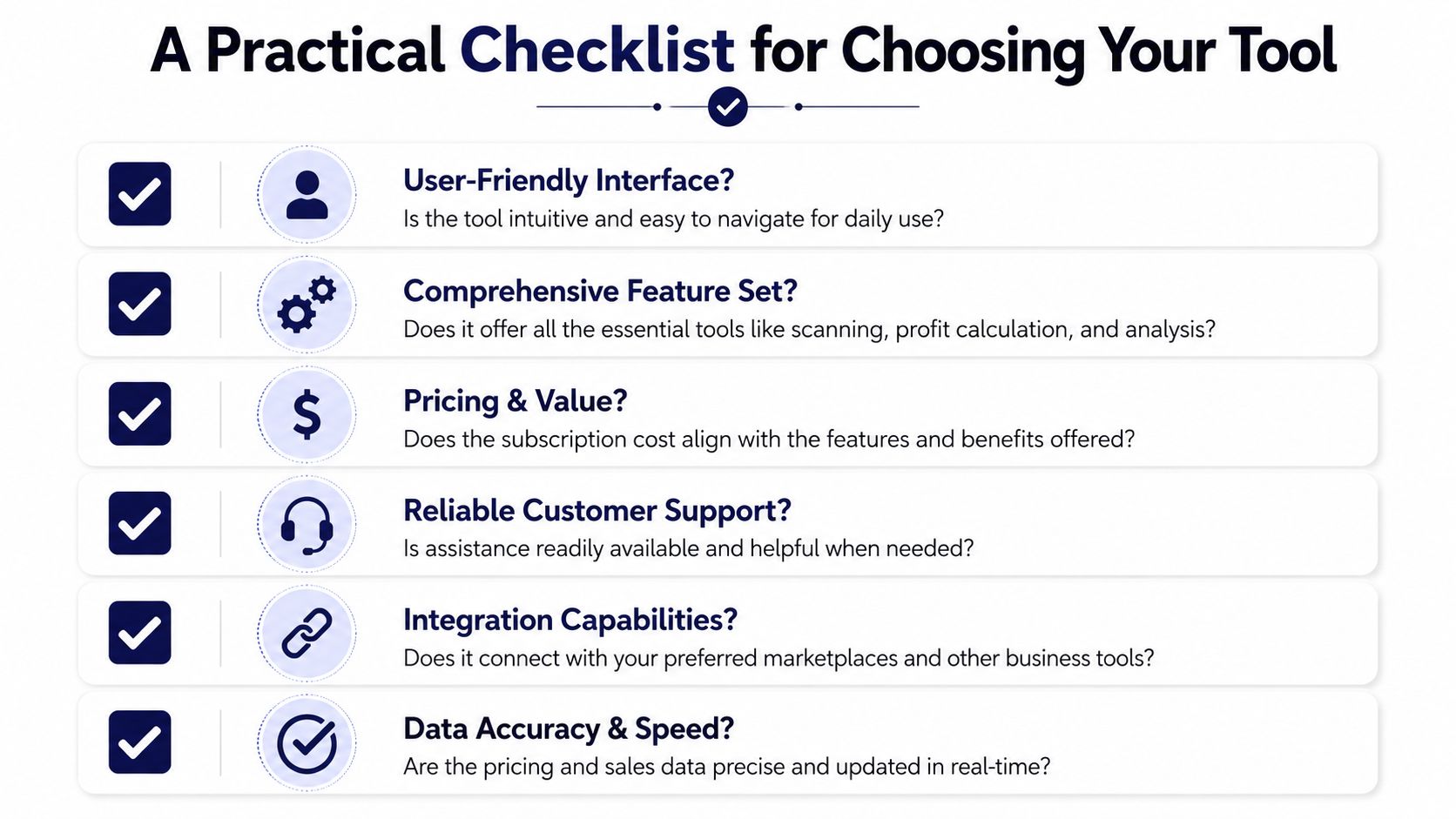
Match the tool to your actual workflow
Use these questions before you subscribe:
- Does it cover your marketplaces: If you sell across eBay, Poshmark, Mercari, Amazon, or other channels, the tool should reflect where you flip.
- Does it show sold comps or just asking prices: Sold data is decision data. Active listings are only partial context.
- Does it calculate net profit: You want take-home estimates, not just resale price.
- Can it identify items without barcodes: This matters a lot for thrift, vintage, estate sale, and apparel sourcing.
- Does it work on mobile: If you source in the field, desktop-only software creates friction.
- Can you set your own thresholds: Your buy rules should drive the verdict.
Check the hidden friction points
Tools can look great in a demo and still fail in daily use. Pay attention to the stuff that affects repetition.
| Evaluation point | Why it matters |
|---|---|
| Speed of scan-to-result | Slow tools break aisle momentum |
| Accuracy of match | Bad item IDs create bad comps |
| Fee maintenance | Outdated fee logic poisons profit math |
| History and saved scans | Useful for reviewing mistakes and patterns |
| Interface clarity | Busy screens lead to rushed errors |
Buying filter: If a tool makes you export data, open other apps, or manually clean the math before every decision, it isn't simplifying your workflow enough.
Choose for the next stage too
A tool should fit where you are now, but it also shouldn't box you in. If you're starting with shoes and electronics, but plan to widen into collectibles or apparel, make sure the workflow supports those categories cleanly.
Good tools don't just help you source faster. They help you stay consistent when your inventory mix gets messier.
Common Questions and Tool Limitations
Good tools tighten your sourcing workflow. They do not remove judgment.
That distinction matters in real buying conditions, especially when you are making fast calls on thin margins. Software can surface sold comps, estimate fees, and flag weak listings. It cannot inspect a cracked battery door, spot a missing remote, or tell you whether a niche collectible has enough buyer depth to move this month.
Can an online arbitrage tool guarantee profit
No. It improves decision quality and speed, but your margin still depends on buy cost, condition, sell-through, competition, return risk, and how clean the item match is.
Experienced resellers still sanity-check the weird stuff. If the comps look too high, the rank is erratic, or the match is fuzzy, it is a manual review. The tool should cut guesswork, not replace basic buying discipline.
Is there a learning curve
Yes.
The fastest way to get value is to build around three actions first: identify the item, check sold comps, and read net profit. Ignore the extra tabs until that flip-or-pass routine feels automatic. Sellers who try every filter on day one usually slow themselves down and second-guess good buys.
Advanced tools also create a trade-off. More context helps, but too much screen clutter can kill aisle speed. The right setup is the one you can trust under pressure.
Do these tools work for every category
No category gets equal coverage.
Tools are strongest when products have clean identifiers and enough marketplace history to produce usable comps. New-in-box electronics, branded shoes, common media, and many household goods usually fit that pattern. Hyper-rare items, handmade goods, heavy customization, and condition-sensitive vintage pieces are harder because tiny differences can swing value hard.
That is where category knowledge still pays.
Where tools still struggle most
Multi-platform profit math is still the biggest trouble spot. Fee tables change. Shipping costs shift by size, weight, and destination. Some marketplaces add category-specific charges or promotional deductions that are easy to miss if the calculator is not current.
Treat any profit estimate as a working number, not final take-home. Good sellers spot-check edge cases before they buy deep, especially on items with awkward shipping or marketplaces known for changing fee rules. One bad assumption can turn a clean-looking score into a bad buy.
What the best users do differently
They use the tool as a filter inside a repeatable workflow.
They still:
- Check condition against the comps
- Stay inside their margin rules
- Watch sell-through, not just top-end sale prices
- Review bad buys to tighten future scans
- Pass fast when the match or math looks shaky
That is a significant upgrade. The tool handles the repetitive research, and you spend your attention on the calls that require reseller judgment.
If you want a mobile-first sourcing workflow built for secondhand resellers, ScanFlip AI is worth a look. It helps identify items from photos, pulls sold comps across major marketplaces, calculates expected net profit after fees and shipping, and gives a clear flip-or-pass verdict while you're still in the aisle. That kind of workflow change turns scattered sourcing into repeatable decisions.