
Item Identifier App: A Reseller’s Guide for 2026
You're in a thrift aisle holding a pair of untagged boots, a vintage camera bag, or a random kitchen appliance that looks expensive. Someone else is already moving down the same shelf. You've got a few seconds to decide whether it's a flip, a maybe, or dead stock.
That's where most resellers still lose money. Not on obvious junk. On items that look profitable at a glance, then turn into weak buys once marketplace fees, shipping, and actual sold comps show up. A fast gross-price lookup helps, but it doesn't protect your margin.
The better item identifier app doesn't just tell you what something is. It tells you whether buying it makes sense right now.
Table of Contents
- What Is an Item Identifier App
- How These Apps See and Think
- Core Features Every Reseller Needs
- Real-World Sourcing Scenarios
- Common Limitations and How to Work Around Them
- Your In-Aisle Workflow for Faster Sourcing
- Making Smarter Faster Flips
What Is an Item Identifier App
An item identifier app is a sourcing tool that helps resellers identify products from a photo or scan, pull relevant market data, and make a buy-or-pass decision without bouncing between apps. In practice, it replaces the old routine of opening eBay, then Poshmark, then Google Lens, then a notes app, then a fee calculator, then second-guessing yourself.
The simple definition is “an app that identifies stuff.” The reseller definition is better. It's a tool for making fast decisions with less guesswork when you don't have a barcode, a brand tag, or enough time to research manually.
That matters because the biggest sourcing mistake usually isn't misidentifying the item. It's misreading the money.
A 2025 Vendoo study of 1,200 resellers found that 68% of failed thrift flips resulted from misjudging hidden platform fees and shipping costs, yet only 12% of popular scanning apps offer built-in fee-adjusted profit calculators (Vendoo findings cited by Underpriced AI). That gap is the net profit blind spot. Plenty of apps can show a resale number. Far fewer tell you what you'll keep.
Gross value is not the decision
If an app shows that a pair of shoes sells for a solid gross price, that's useful. But gross doesn't pay for shipping labels, marketplace fees, returns, packing materials, or the cost of buying the item in the first place.
That's why experienced resellers stop asking one question and start asking three:
- What is it
- What does it really sell for
- What's left after costs
If your tool only answers the first two, you're still doing the risky part in your head.
Practical rule: Never let a gross sold price make the buy decision by itself.
Why this category matters now
Modern AI tools have moved well beyond novelty. The broader market behind visual recognition, price aggregation, and conversational assistance keeps expanding, with AI projected to reach $407 billion by 2027, up from $86.9 billion in 2022, according to Forbes Advisor's AI statistics roundup. For resellers, that shows up as better recognition, quicker comps, and less manual math at the shelf.
If you want a bigger-picture look at field tools resellers use during sourcing, this breakdown of a retail arbitrage app is worth reading alongside this topic.
How These Apps See and Think
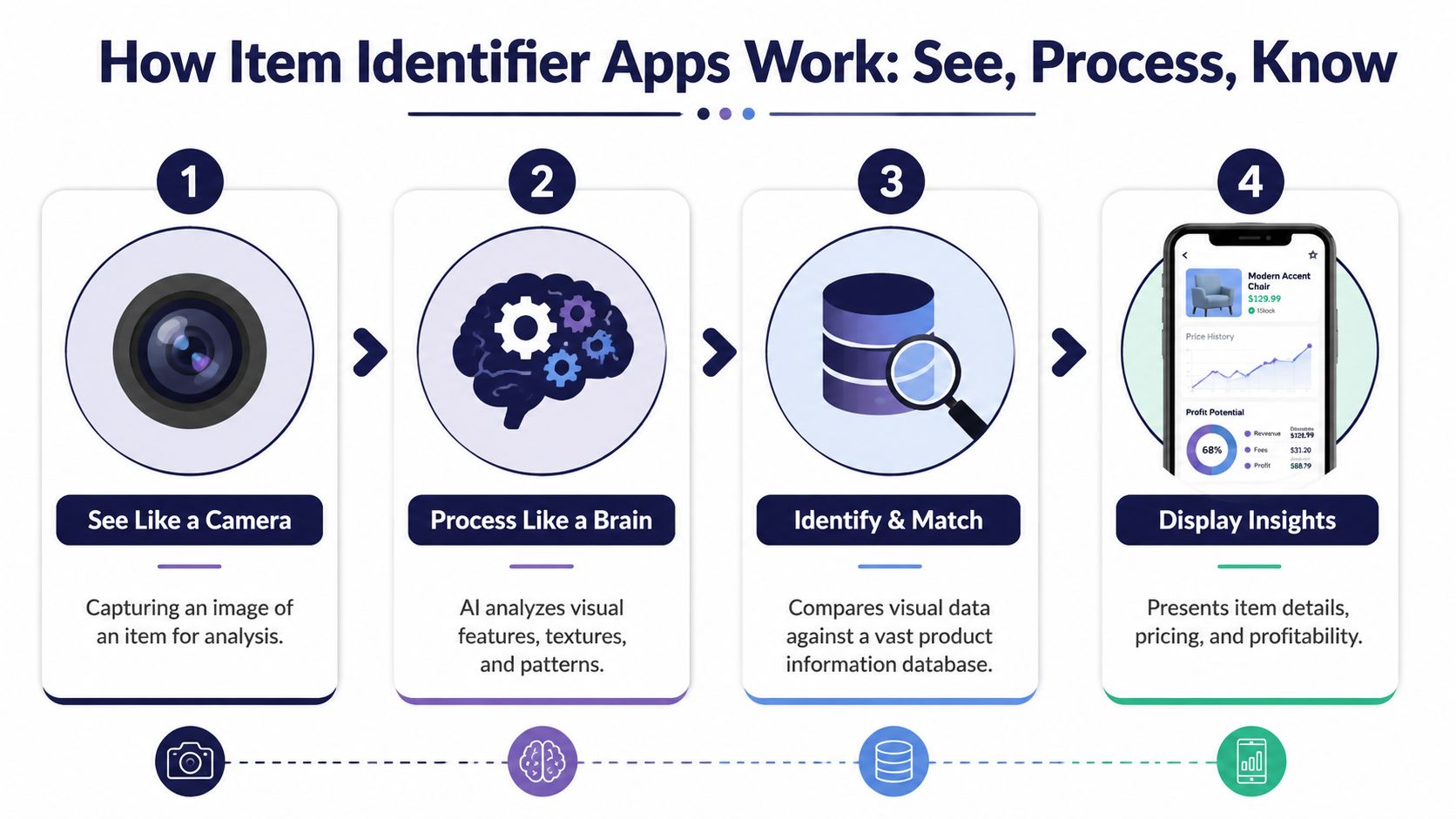
The easiest way to understand an item identifier app is to think of it as Shazam for physical products. You point your camera at an item, the app looks at visible features, and it tries to match what it sees against product data and marketplace information.
That's why these apps are much more useful than old-school barcode scanners when you're handling secondhand inventory. Thrift stores are full of items with worn labels, missing tags, damaged boxes, or no barcode at all.
What the app looks for
When you scan an item, the app isn't “thinking” like a human picker. It's analyzing visual clues such as shape, logo placement, materials, stitching patterns, color blocking, hardware, packaging, and category-specific details.
For example:
- Shoes often get identified by silhouette, outsole pattern, tongue label area, and logo shape
- Collectibles depend more on packaging art, character art, edition markers, and design cues
- Electronics often need model-shape matching, button layout, ports, and brand styling
- Apparel can be trickier, especially if the garment is basic and the tag is missing
The better your photo, the better your result. Clean angle, clear lighting, and one item at a time usually beat a rushed shot taken from too far away.
Why barcode-free recognition matters
Secondhand sourcing breaks traditional scanning tools because too many items can't be scanned the normal way. Over 30% of secondhand inventory in thrift stores has no scannable barcode, and barcode-free visual identification can cut sourcing time by 40–60% compared with manual search methods, according to Jordi Ordóñez's retail arbitrage app review.
That changes the math in the aisle. Instead of passing on untagged shoes, loose accessories, or older hardgoods, you can still evaluate them quickly.
Untagged inventory used to force a manual search. Visual recognition turns that dead time into a workable decision.
The second half is matching and context
Identification alone isn't enough. Once the app gets close to the item, it needs to connect that match to market context. That usually means sold listings, category data, marketplace comparisons, and fee logic.
Weak apps commonly begin to falter. They may identify the category correctly but return broad or noisy results. A decent app tells you “women's leather ankle boots.” A better one gets you close enough to the brand, model family, and resale context that you can act.
A practical reseller treats app output as decision support, not a blind verdict. If the item is common and the app result is clean, trust it. If it's niche, modified, incomplete, or highly collectible, slow down and verify the details that really move price.
Core Features Every Reseller Needs
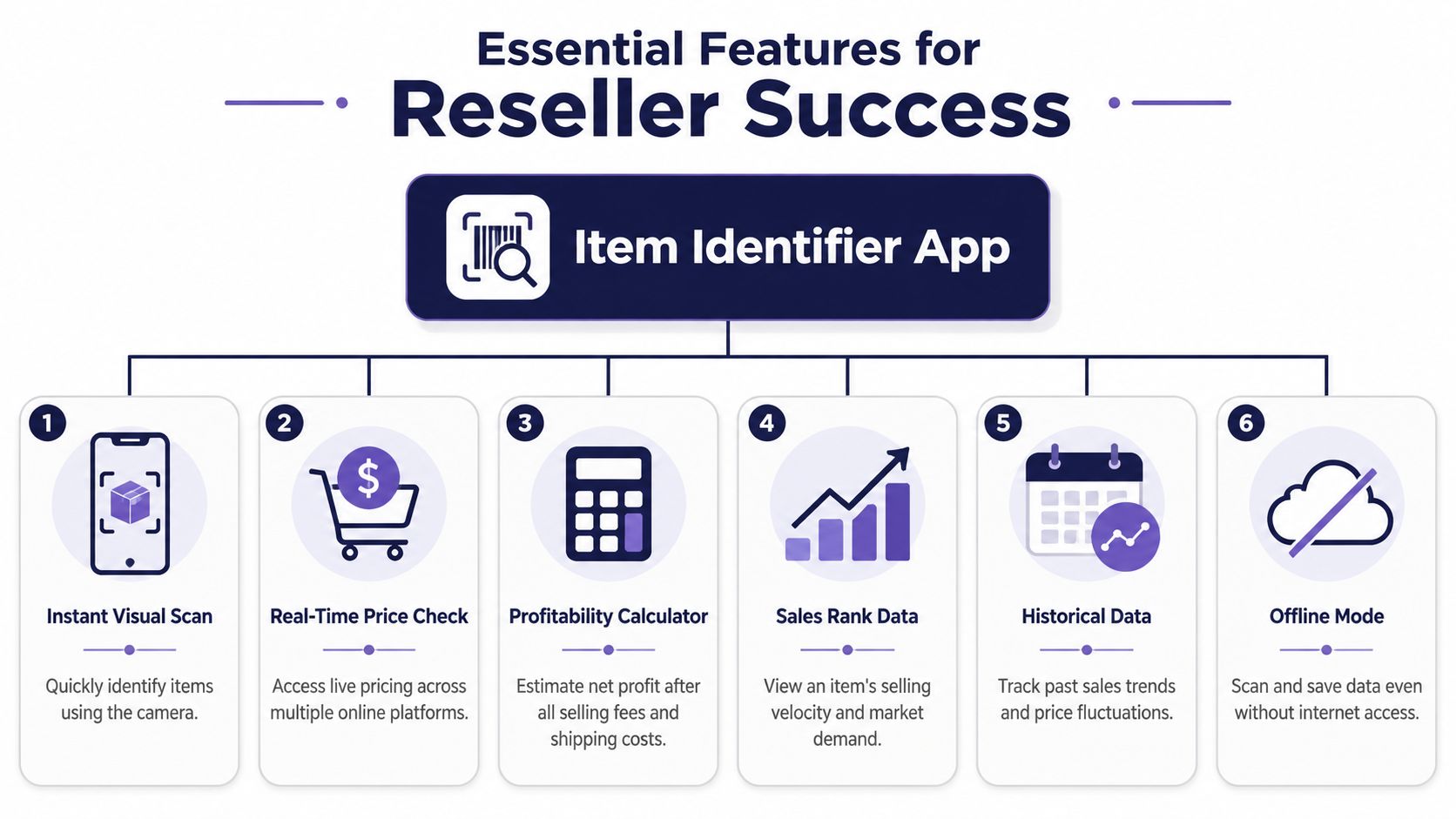
Most reseller app roundups lump every scanner into the same bucket. That's a mistake. A useful item identifier app needs a specific mix of features, and one matters more than the rest if you care about actual take-home profit.
Start with identification that works off the shelf
If the app can't identify untagged, worn, or barcode-free items, it's too limited for real secondhand sourcing. You need camera-based recognition that handles shoes, apparel, collectibles, accessories, and electronics without demanding retail-perfect packaging.
This is the feature that gets you into deals other buyers skip. At garage sales and thrift stores, the best finds are often the least organized.
Sold comps need to be cross-marketplace
One marketplace view is rarely enough. eBay may have the most searchable sold history for some categories, while Poshmark, Mercari, Depop, Amazon, or Whatnot may better reflect what buyers pay in others.
A strong app pulls sold comparables across multiple marketplaces and puts them in one view. That matters because the resale market isn't one market. Sneakers behave differently from vintage jackets. Toys don't move like electronics. Media can be misleading if you only check one platform.
Here's a quick way to think about the difference:
| App behavior | What it means in practice |
|---|---|
| Single marketplace lookup | Faster at first, but easier to misread actual demand |
| Cross-platform sold comps | Better read on price range and where the item really moves |
| Active listings only | Often inflates expectations |
| Recent solds plus fee logic | Closer to what you can actually pocket |
Net profit calculation is the non-negotiable
This is the feature most guides underplay. It's also the one that saves the most bad buys.
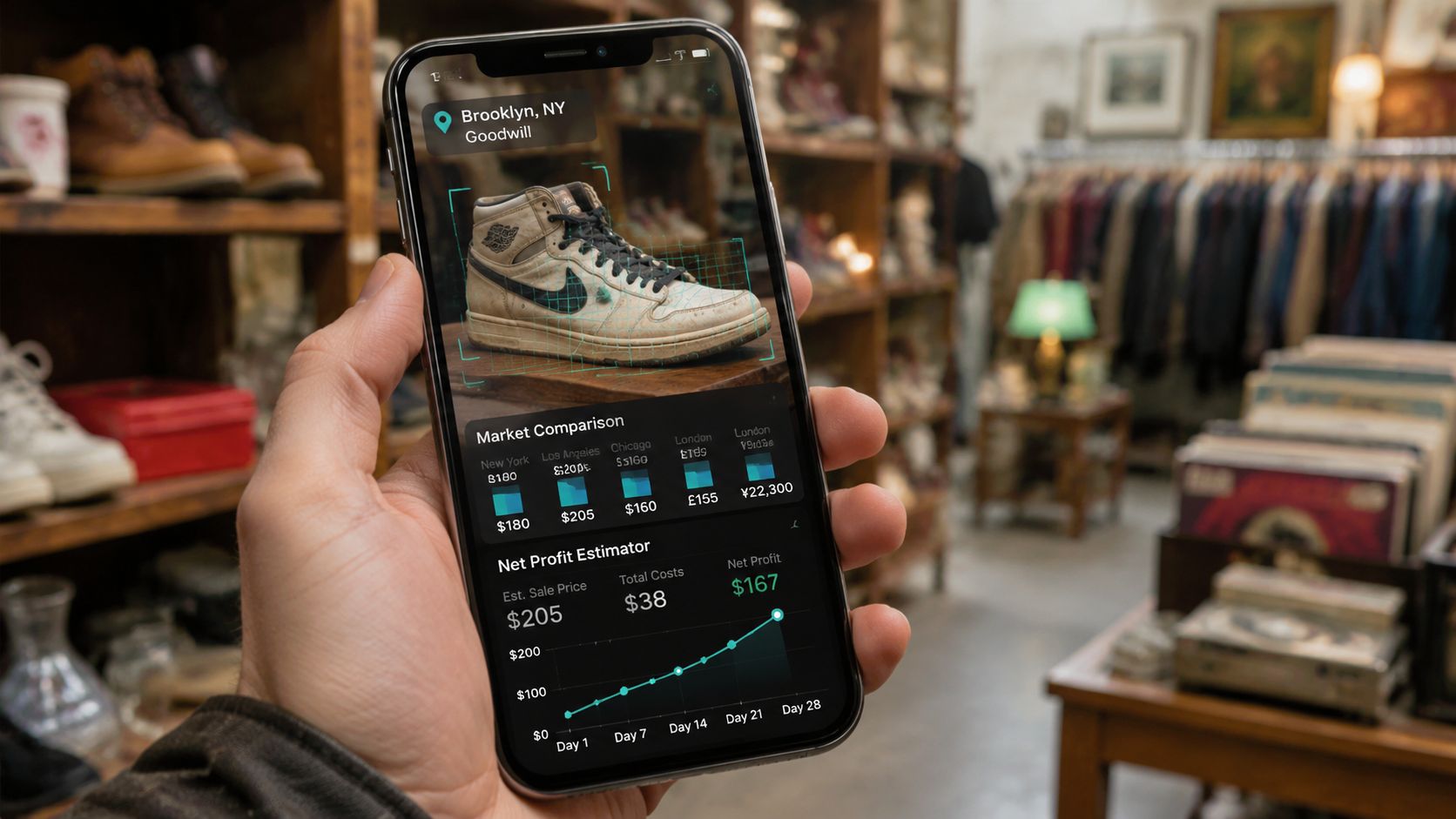
Aggregating real-time sold comparables with automated fee and shipping adjustments allows resellers to calculate net profit with <5% margin of error, reducing manual spreadsheet work by 70–80% and enabling a scan-to-decision workflow under 15 seconds, according to Threecolts' guide to retail arbitrage.
That's the key upgrade. Not “instant prices.” Instant usable math.
A good app should account for:
- Platform fees: Different marketplaces take different cuts
- Shipping estimates: A lightweight shirt and bulky boots don't behave the same
- Buy cost input: Without cost, profit is fiction
- Expected payout: What lands in your pocket after deductions
If you still need a separate calculator, your workflow is slower than it should be.
For a wider comparison of tools resellers use in the field, this guide to best reseller apps gives useful context.
Saved scans are more valuable than people think
Scan history sounds secondary until you start sourcing seriously. Then it becomes one of the most useful features in the app.
Saved photos, comps, timestamps, and location context help with:
- Reviewing maybes later
- Training your eye on recurring brands and categories
- Checking whether your instincts match real outcomes
- Avoiding duplicate research on items you keep seeing
Field habit: If you're unsure and the app lets you save the scan, save it. Today's pass can become next month's easy buy once you know the category better.
Real-World Sourcing Scenarios
The value of an item identifier app shows up when the environment gets messy. Clean demos don't matter much. Flea markets, church sales, estate sales, and packed thrift aisles do.
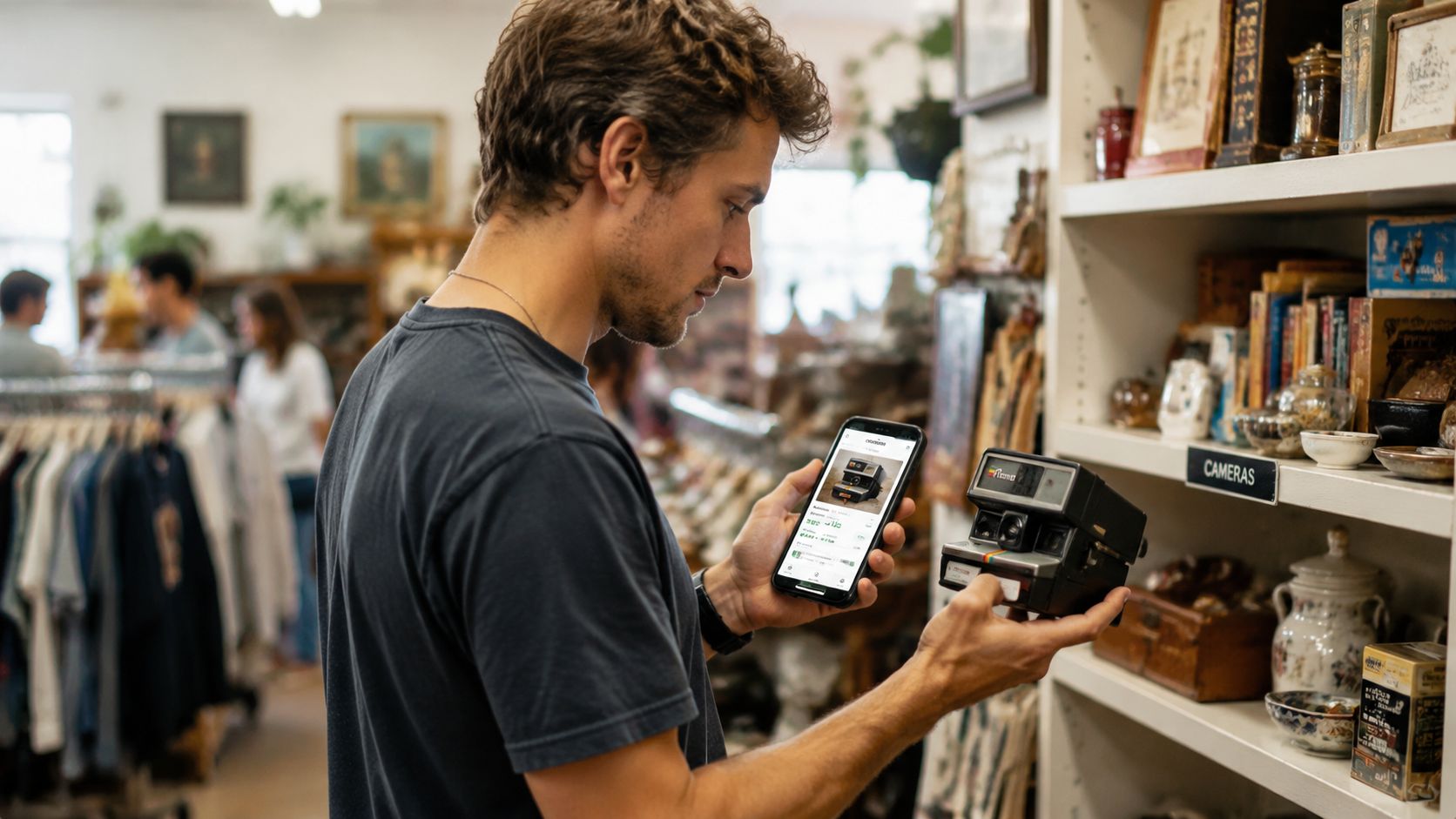
The garage sale table with mixed junk
You walk up to a folding table covered in hats, cables, old remotes, shoes, a camera case, and random housewares. There's no organization and no seller who knows much about the items.
In that setting, speed beats deep research. You're not trying to become an expert in every object on the table. You're trying to eliminate obvious losers, catch underpriced winners, and move on.
An item identifier app helps by narrowing unknowns fast. You scan the odd-looking shoes, the older hardgood, and the accessory with no packaging. If the result is clear enough and the margin looks healthy, you buy. If it's murky, you skip and keep moving.
The picked-over thrift store
It is a common scenario for many newer resellers to get frustrated. The easy flips are gone, and what's left looks average. That's usually where visual recognition earns its keep.
A worn pair of branded sneakers without a box, a jacket with a faded interior tag, or an electronic accessory with no barcode might still be viable. You're looking for hidden identity, not obvious retail presentation.
The app doesn't make every leftover item profitable. It just helps you filter faster so your time goes into plausible buys instead of endless manual searching.
The estate sale where hesitation costs money
Estate sales punish indecision. If you need too long to verify a buy, someone else takes it.
That's why the productivity side matters, not just the identification side. Early adopters of agentic AI report over 50% reductions in time and effort, which aligns with the kind of in-aisle decision speed resellers need, according to Vention's AI adoption statistics.
In practical terms, that means fewer moments where you're standing there opening five separate apps while another buyer loads the item into their basket.
If the item is common enough for the app to identify cleanly, speed creates profit. If the item is rare enough to need deeper verification, discipline creates profit.
Those are different situations. Good resellers treat them differently.
Common Limitations and How to Work Around Them
No item identifier app is perfect. Treating one like a magic sourcing machine is how people make sloppy buys. These tools are strongest when you use them inside their limits.
Weak signal and bad store Wi-Fi
Some stores have terrible reception. Some estate sales are in older homes where your connection drops the second you walk inside. If the app depends on pulling marketplace data live, that slowdown matters.
The workaround is simple. Prioritize obvious winners first, save uncertain scans for review outside, and avoid building your entire buying process around a perfect connection. If your app stores scan history, use it as a holding area for borderline items.
Rare, weird, or heavily altered items
Visual recognition is strongest on categories with clear patterns and enough comparable data. It can struggle with handmade pieces, one-off vintage items, incomplete sets, custom-painted goods, and niche collectibles.
When that happens, don't force certainty. Switch to manual verification. Check labels, model numbers, material tags, edition markings, and included parts. The app should speed up standard decisions, not replace reseller judgment on unusual inventory.
These are sourcing tools, not full business systems
A lot of people expect one app to do everything. That's not realistic. The best item identifier app helps at the point of sourcing. It doesn't automatically replace your listing workflow, inventory management, bookkeeping, or customer service systems.
That's not a flaw. It's focus.
Here's the clean way to use it:
- Use the app for sourcing decisions
- Use marketplace tools for listing execution
- Use your records for business tracking
- Use manual review for edge cases
Don't ask a sourcing app to run your whole resale business. Ask it to help you avoid bad buys and find better ones faster.
Your In-Aisle Workflow for Faster Sourcing
Most sourcing mistakes come from one of two problems. Either you spend too long researching low-potential items, or you move too fast and buy on gross price alone. A repeatable workflow fixes both.
The first look
Before you scan anything, do a quick physical filter. Condition still matters. A strong identifier app can tell you what an item probably is, but it can't make cracked leather, missing pieces, heavy odor, or bad damage disappear.
I use a short first-pass screen:
- Brand signal: Is there any visible clue that suggests demand
- Condition reality: Is damage cosmetic, repairable, or value-killing
- Shipability: Will this be simple or annoying to pack and send
- Category fit: Do I already know this category well enough to trust a quick decision
If the item fails hard on condition, I usually don't scan it unless the brand or category is exceptional.
The scan and margin check
Once the item passes the first look, scan it and focus on decision-grade data, not just curiosity. You want enough information to answer one question. Does this item deserve money and bag space?
What I look for on the result screen:
- The likely match
- Recent sold context
- Expected fees and shipping impact
- Clear net profit, not just resale value
If you still calculate margin on the side, you're slowing yourself down. A dedicated margin calculator app gives a good reference point for what your sourcing math should feel like in practice.
The flip or pass verdict
The final step is where discipline pays. Don't buy because the item is interesting. Don't buy because the gross sold price looks decent. Buy because the expected net is worth the effort and risk.
A simple decision framework works well:
- Buy now if the match is strong, the margin is healthy, and the item is easy to list and ship.
- Save for later if the item looks promising but needs a second review.
- Pass immediately if profit is thin, comps are noisy, or condition creates too much drag.
A good in-aisle workflow feels boring after a while. That's a good sign. Boring systems make money because they cut impulsive buys.
Making Smarter Faster Flips
The resale game has changed. A few years ago, getting any fast price lookup felt like an advantage. Now that's baseline. The primary edge comes from making faster decisions with better math.
That's why the best item identifier app isn't just a recognition tool. It's a filter for profitable action. It shortens the path from “What is this?” to “Should I spend money on this?” and that gap is where a lot of bad buys happen.
The big blind spot in reseller content is still net profit. Gross sold prices look exciting. Net payout keeps your business alive. If your tool doesn't account for fees and shipping, you're still doing the hardest part manually, and manual math breaks down when the aisle is crowded and time is short.
The resellers who improve fastest usually do three things well. They move quickly on common inventory, they slow down on weird inventory, and they use tools that reduce avoidable mistakes. That's a practical approach, not a flashy one.
If you want to source more seriously in 2026, don't just look for an app that identifies items. Look for one that helps you protect margin, cut hesitation, and make cleaner buy-or-pass decisions every single trip.
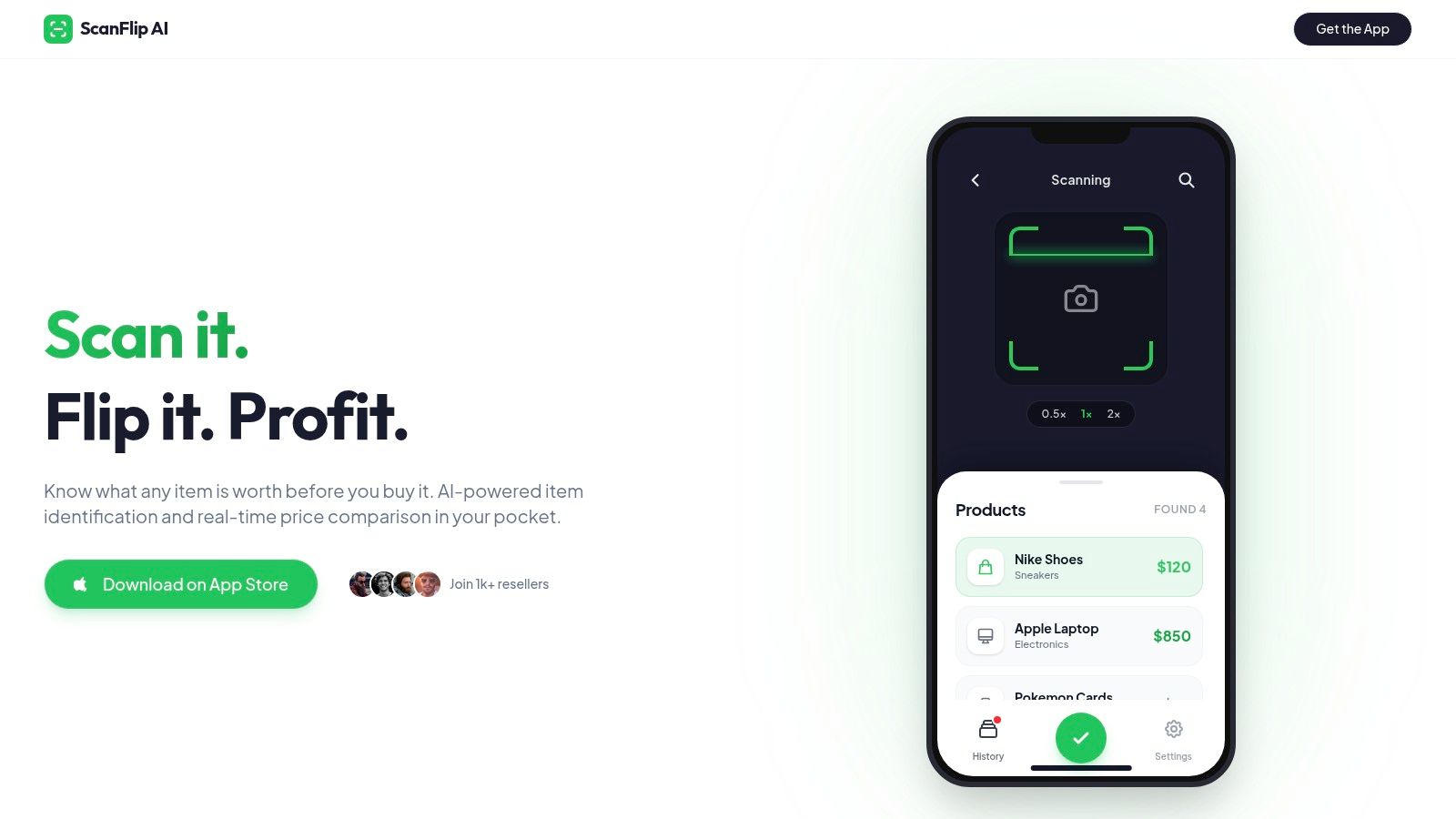
If you want a sourcing tool built around what resellers need in the field, ScanFlip AI is worth a look. It identifies items from photos, pulls cross-platform sold comps, and calculates expected net profit after fees and shipping so you can make faster buy-or-pass decisions where they matter most.