
What New with Tags Means for Resellers and How to Price It
You're standing at a Ross clearance rack with a tagged top in your hand and a promising sold comp on your phone. The retail tag makes it feel like the hard part is done. It isn't. Before that piece goes in the cart, you need to know whether the buyer's payment will leave enough after fees, shipping, cost of goods, and the possibility of a return.
Table of Contents
- Why a Tag in Your Hand Is Not the Same as Profit in the Bank
- How Marketplaces Define New With Tags
- Why a Tag Pushes the Sold Price Up
- When a Tag Is Actually a Warning Sign
- Pricing NWT With Sold Comps and Real Fee Math
- The Pre-Buy Checklist for NWT Finds
- How ScanFlip AI Fits Into the NWT Sourcing Flow
- The Return Problem That Quietly Eats NWT Margin
Why a Tag in Your Hand Is Not the Same as Profit in the Bank
A blouse comes out of a Goodwill bin with its original hangtag still attached. You check the neckline, turn it over, and start mentally moving it into your next sourcing haul. That's exactly when to slow down.
New with tags, usually shortened to NWT, describes a garment presented as new with its original identifiers attached. The marketplace's actual condition rules still control whether that description fits.
The useful question isn't whether the tag looks impressive. It's whether buyers are purchasing that exact garment, in comparable condition, at a sold price that supports your buy cost.
Separate the find from the deal
A tag can help establish condition. It can't make an unpopular cut desirable, fix an expensive shipping problem, or produce buyers for a brand nobody's searching for.
That distinction matters whether you're sourcing at TJ Maxx, Nordstrom Rack, an estate sale, or a garage-sale clothing bin. You're buying the opportunity to complete a profitable transaction, not buying the discount printed on a clearance sticker.
Rack rule: Don't let the original retail price become your resale forecast.
There's also a difference between potential ROI and worthwhile work. An inexpensive garment can look attractive relative to its cost while leaving too little cash to justify inspection, photographs, packing, and buyer messages.
Before committing, separate these questions:
- Condition: Does the item qualify for the marketplace's new-with-tags field?
- Demand: Do relevant sold comps support the price you expect?
- Take-home: Does the transaction still work after deductions and return exposure?
Those are sourcing questions. Settle the condition definition, run the fee math behind the comp, and account for what could come back before paying at the register.
How Marketplaces Define New With Tags
NWT is a condition field, not a mood. A garment looking fresh on a hanger doesn't establish that it belongs in that field.
For eBay, the distinction is explicit. Its item-condition definitions describe new with tags as brand-new, unused, and unworn, with original tags attached and/or original packaging. eBay also distinguishes new without tags from new with defects, and the available condition values depend on category.
That matters when a tagged garment has a manufacturing flaw or an incorrect size identifier. Don't squeeze it into the cleanest condition field just because the hangtag survived.
Match the field to the item
Treat Poshmark and Mercari as separate condition decisions rather than copying an eBay description automatically. Check the current condition selector and category guidance on the platform where you intend to sell.
The comparison below deliberately keeps eBay's published definitions separate from fields that require a platform check. Don't assume similarly named options have identical requirements.
NWT condition fields across eBay, Poshmark, and Mercari
| Marketplace | NWT-style condition | What it requires | What it excludes |
|---|---|---|---|
| eBay | New with tags | New, unused, unworn condition with original tags and/or packaging, subject to category rules | Worn merchandise and defects incompatible with the selected condition |
| Poshmark | Check the current new-with-tags selection | Verify the platform's current requirements and the garment's actual condition | Don't assume an attached tag overrides wear or damage |
| Mercari | Check the current new-condition selection | Verify the category's current condition description before buying | Don't import another marketplace's definition without checking |
Record tag presence, packaging, and flaws separately during inspection. A single mental note saying “new” won't help when you later discover a snag underneath the paper tag.
Condition selection can affect buyer expectations and marketplace filtering. Buying an item that only works financially under an inaccurate condition description isn't a sourcing strategy worth keeping.
Why a Tag Pushes the Sold Price Up
Buyers can't handle your garment before purchasing it. An attached original tag gives them another piece of evidence when deciding whether the item matches its description.
That's the practical value: less uncertainty about prior wear, plus a clearer connection to the original retail product. The eBay apparel buying guide is a useful condition-checking reference, but a tag should remain one part of the buyer's evaluation rather than the entire case for value.
Buyers still have to want the garment
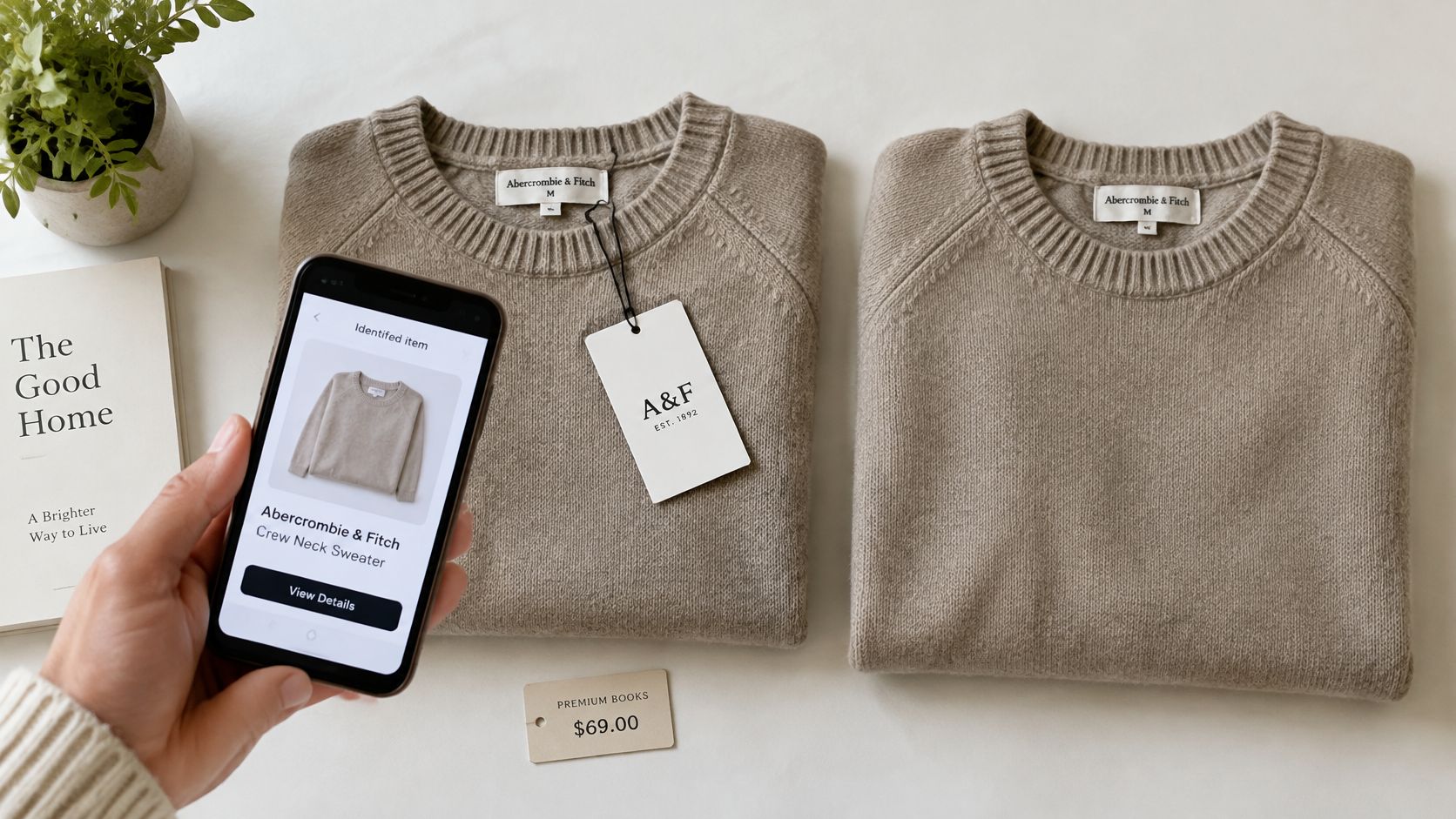
Think about otherwise comparable sweaters. The tagged example gives a buyer a reason to distinguish it from a worn one, but fabric, design, size, and brand desirability still matter.
The wrong sourcing move is treating that distinction as a fixed premium. Don't take a used comp, add an arbitrary amount for the tag, and call the result market value.
Instead, compare like with like:
- Match the product: Use the style identifier where available, not just the brand and garment type.
- Match the condition: Separate genuinely comparable NWT sales from used examples.
- Match the buyer's choice: Consider size, color, fabric, and season before accepting a comp.
A weak brand doesn't automatically make an item worthless. A strong brand doesn't automatically turn every tagged piece into a BOLO, either.
The tag can support a higher sold price. It can't supply the missing sale.
When the only appealing evidence is the original retail sticker, you haven't established resale value. A tagged garment with no relevant recent sales is a speculative purchase, and your buy cost should reflect that uncertainty.
When a Tag Is Actually a Warning Sign
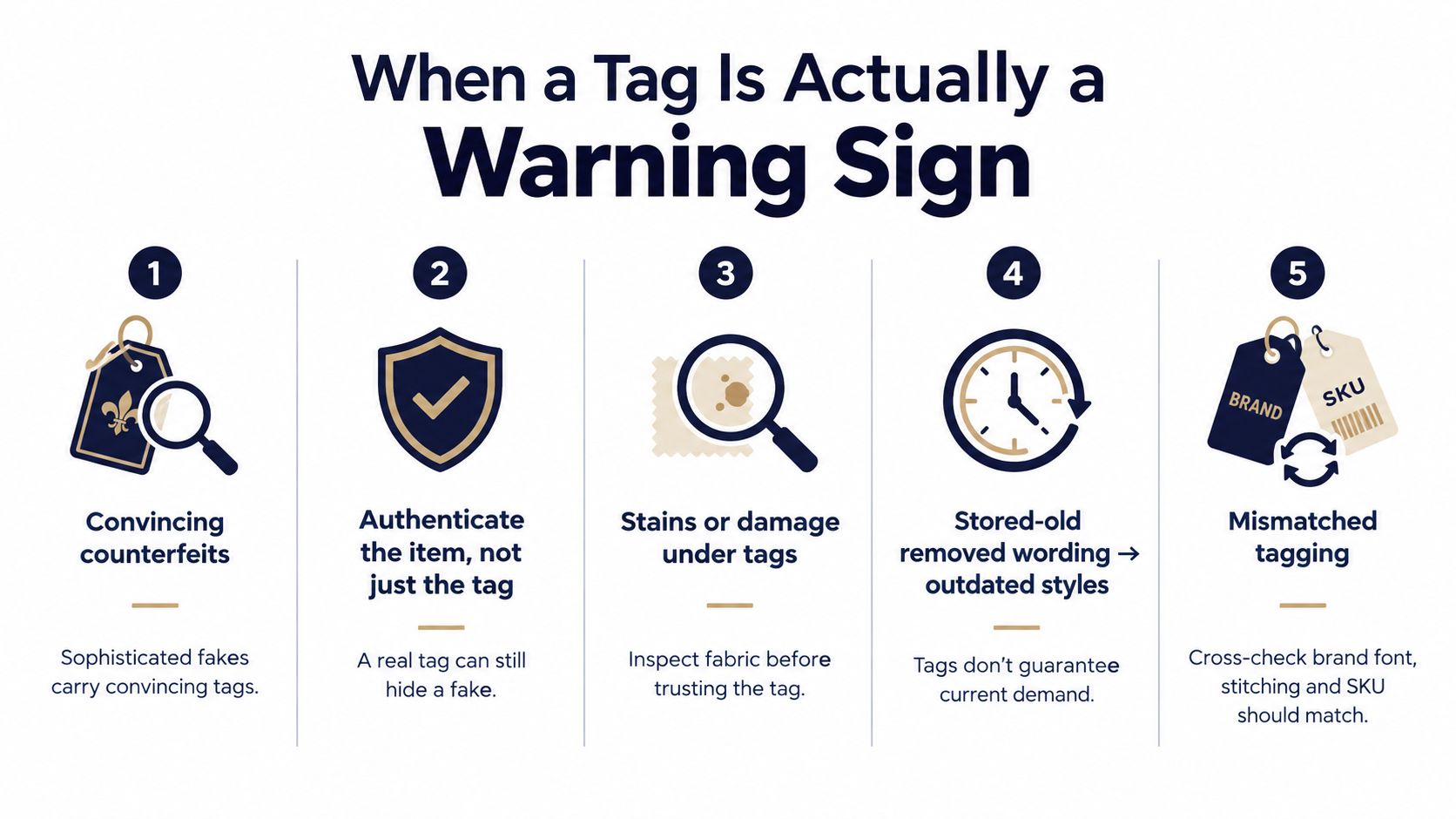
A convincing tag is not authentication. For branded and luxury merchandise, treating those as equivalent can turn an exciting find into an expensive mistake.
The authentication stakes are substantial. CNBC's reporting on secondhand luxury described a global resale market estimated at $210 billion, projected to reach as much as $360 billion by 2030, with luxury resale growing about 10% annually, roughly three times the firsthand market's growth rate. The reporting also describes elaborate counterfeits, including instances in which brands failed to identify fakes during repairs.
Ask why the tag is still there
A retail return, closeout garment, outlet purchase, and altered piece can all reach you with tags attached. They don't carry identical sourcing risks, and none should be presumed eligible for NWT without inspection.
A return deserves a careful wear check. Deadstock deserves scrutiny for storage damage and outdated styling. Outlet merchandise needs comps for the actual item, not a vaguely similar piece associated with a higher retail tier.
Alterations require special attention because the garment may no longer match its tagged measurements. Use a consistent approach to describing item condition rather than letting the clean hangtag excuse a meaningful discrepancy.
Before buying, capture the evidence you'll need to investigate:
- Identifiers: Photograph the hangtag, style number, brand label, and care label.
- Construction: Capture hardware, stitching, and any inconsistent details.
- Purchase context: Record packaging and where the item was found, where photography is permitted.
A style number that returns a matching product is useful identification evidence. It isn't proof that the garment in your hand is authentic.
For higher-risk goods, professional authentication is a separate expense and decision. Photo identification and sold comps don't replace it.
Pricing NWT With Sold Comps and Real Fee Math
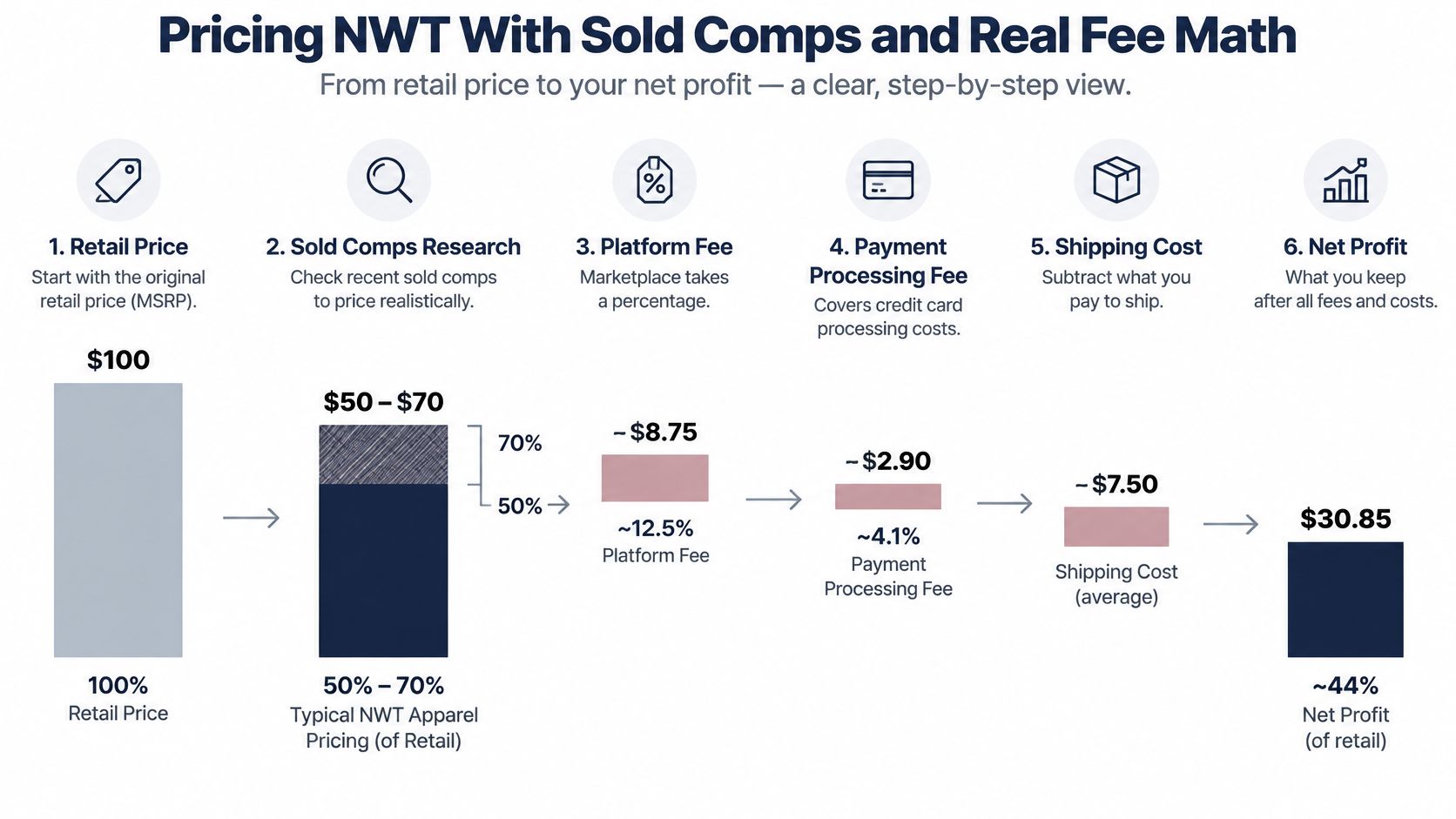
Independent pricing guidance puts mainstream NWT apparel at roughly 50%–70% of retail, with sought-after designer items sometimes supporting more, according to Climb the Ladder's clothing-pricing guidance. Treat that range as a starting reference, not a floor or a guaranteed ceiling.
A weak-demand garment can sell below that range. Your better starting point is recent sold prices for the actual item, not active asking prices from sellers who haven't found a buyer.
Run the transaction, not just the comp
These are worked sourcing scenarios, not claimed seller results. The point is to calculate what remains using the applicable fee base.
- Ross top sold on eBay: Using a $42 total sale amount, an assumed 13.25% category fee rounds to $5.57; subtracting $4.50 shipping and $6 cost of goods leaves $25.93 before the per-order fee, or $25.53 after the additional $0.40 fee applicable to orders over $10, under eBay's published fee mechanics. This assumes the stated sale amount is the entire applicable fee base; buyer-paid shipping or other applicable amounts can change the calculation.
- Garage-sale collectible sold on Mercari: A $36 item price plus $7 buyer-paid shipping creates a $43 fee base; the 10% selling fee is $4.30, leaving $23.70 after $8 cost of goods when the shipping collected covers the shipping expense, under Mercari's seller-fee structure. That structure applies to listings created or updated on or after January 6, 2025, without an additional payment-processing fee.
- Thrift-store piece sold on Poshmark: A $28 sale incurs a 20% commission of $5.60, leaving $22.40 before the $4 cost of goods and $18.40 afterward; Poshmark's fee policy instead applies a flat $2.95 commission to sales below $15.
Keep the excluded costs visible
Those estimates aren't final business profit. Packaging, shipping discounts, promoted-listing charges where applicable, returns, and taxes can require further deductions.
Don't subtract a generic processing charge just because a calculator has a box for it. Use the platform's actual fee structure, then verify package weight and shipping assumptions.
The comp establishes what a buyer paid. The net determines whether you should buy.
The Pre-Buy Checklist for NWT Finds
Consistency matters more than enthusiasm when you're crouched over a garage-sale bin. Run the same checks on a promising tagged jacket that you'd run on an unfamiliar untagged piece.
The original sticker shouldn't buy the garment an exemption. A repeatable sourcing routine keeps the decision tied to evidence instead of how satisfying the find feels.
Make every check count
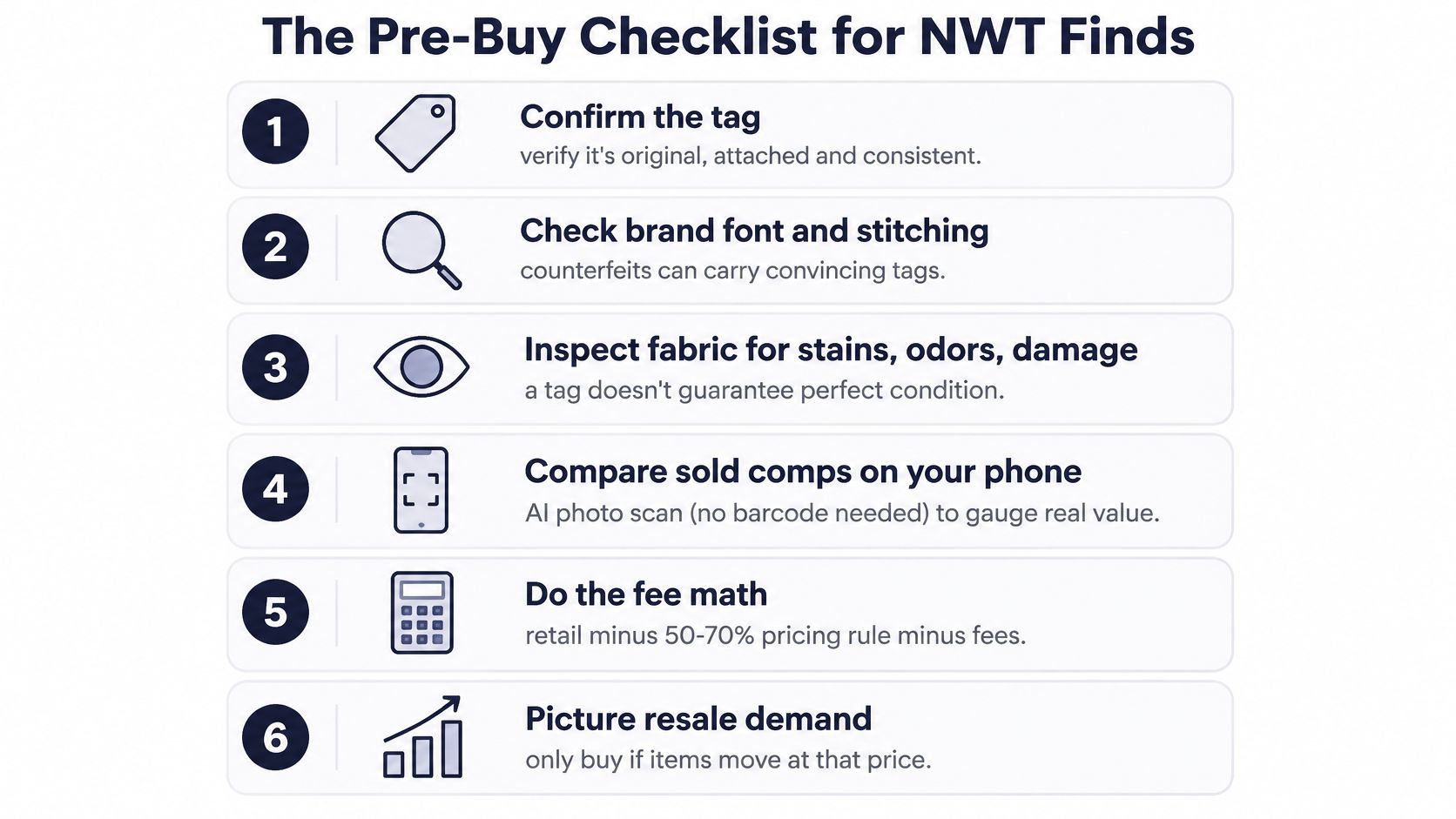
- Confirm the match: Verify that the original attached tag, garment identity, size, and style number agree. Inspect fabric, seams, odors, and hidden damage at the same time.
- Capture the evidence: Photograph the tag and care label before leaving, where permitted. Include anything you'll need to verify construction or condition later.
- Check recent sales: Favor current, closely matched sold comps. An old sale shouldn't carry the same weight as evidence of present demand.
- Calculate the net: Enter the correct marketplace fee, shipping expense, and cost of goods. Include additional deductions that apply to your transaction.
- Set your threshold first: Decide the minimum cash profit or margin you require before scanning. Don't lower it because you already want the item.
- Pass unresolved failures: If condition, identity, demand, or net profit remains uncertain, leave it unless you deliberately budget for speculative buys.
A jacket can clear your profit threshold on paper and still fail because the supporting sale is stale. That isn't being overly cautious. It's recognizing that a correct calculation can still rest on a weak assumption.
Buying discipline: A passed item costs you no storage space, packing time, or return shipping.
This routine isn't about making sourcing slow. It's about keeping close calls out of the death pile while leaving room for purchases you can defend.
How ScanFlip AI Fits Into the NWT Sourcing Flow
Manually checking marketplace apps can interrupt the buy decision. You identify a garment, search for matches, investigate condition, and then still need to calculate what you'd keep.
The useful role for a sourcing tool is to put identification, sold comps, and estimated net profit into the same decision process. It shouldn't replace your inspection or turn an uncertain match into a confident purchase.
Choose the search method that fits
The app offers different ways to start:
- AI photo scan: Identify unfamiliar apparel, shoes, vintage, or collectibles without needing a barcode. A missing UPC doesn't prevent an initial search.
- Barcode scan: Check UPC-tagged retail goods, books, media, games, and boxed merchandise.
- Text search: Search by name or identifier when you can't photograph or scan the item.
Its sold-comps search covers eBay, Poshmark, Mercari, Depop, Amazon, Whatnot, ThredUp, Facebook Marketplace, and TikTok Shop. The net-profit calculator accounts for marketplace fees, shipping, and buy cost, with a red/green flip-or-pass verdict based on your chosen minimum profit or margin threshold.
Verify the inputs before trusting the verdict
A green result is only useful if the match and assumptions are sound. Check whether the displayed comps correspond to the correct style, condition, and size, then enter a realistic shipping expense rather than the cheapest imaginable outcome.
Use marketplace-specific evidence when judging sell-through rate, or STR. A sold comp establishes a transaction, but it doesn't by itself tell you how quickly your particular item will move.
Keep authentication and return exposure as separate checks. No identification result should override suspicious construction, an inaccurate tag, or a fragile margin.
This belongs in the sourcing phase, alongside whatever tools you already use afterward, such as Vendoo, List Perfectly, or Crosslist. Its job in this workflow is answering whether the item deserves your money before you leave the aisle.
The Return Problem That Quietly Eats NWT Margin
The sale notification isn't the end of the transaction. A buyer can dispute fit or color, remove the tag, or send back a garment that no longer qualifies for the condition you originally sold.
The broader return figures justify taking that risk seriously, without treating them as a forecast for your own closet. First Analysis's e-commerce research discusses an average online return rate of 30%, compared with 9% for physical stores, and a separate 2025 estimate of 19.3% for online sales, $849.9 billion in total retail returns, and processing costs ranging from 20%–65% of item cost. Those estimates use different scopes and shouldn't be blended into a single assumed return rate.
Model what happens after the sale
Use scenarios rather than pretending every tagged piece will stay sold. Your own return history and platform policies should inform the assumptions.
| Scenario | What to include in the sourcing decision |
|---|---|
| Best case | The expected sale closes with ordinary fees, fulfillment costs, and no return |
| Normal case | Allow for realistic offers, packaging, shipping adjustments, and a return reserve |
| Downside case | Consider return shipping, inspection time, damaged tags, and a lower-condition resale |
Keep the reserve separate from money you've already committed to the next sourcing trip. If a return would leave you unable to cover fulfillment or force you to sell at a loss, the purchase needs more room.
Treat condition loss as a real downside
Fragile tags, seasonal styles, and high-fit-risk garments deserve more conservative buying decisions. The problem isn't merely refunding the buyer. It's receiving an item that can't be resold on the original assumptions.
A generous-looking gross comp can disappear quickly once you pay to handle the same garment again. NWT can improve buyer confidence and still be a poor flip when the remaining spread won't absorb a problem.
Before your next checkout, choose the downside you're willing to fund. If the conservative net doesn't clear your threshold, put the item back with its tag still attached.
Use photo identification, barcode scanning, or text search to check the item before you buy, then compare sold comps against the net you'd really keep. Visit ScanFlip AI to run that sourcing check while you're still at the rack, and leave the tagged duds behind.