
10 Sourcing Best Practices for Resellers
You're standing in a Goodwill aisle with an unfamiliar item priced at $3.99. Other buyers are moving quickly, and the temptation is to toss it into your cart before someone else notices it. That's exactly how a death pile starts.
The best flip isn't the item you grab fastest. It's the item you check before your money leaves your pocket. You need to identify what you're holding, inspect its condition, check sold comps, account for marketplace fees and shipping, and decide whether the expected net profit clears your personal threshold.
That workflow applies whether you're digging through an estate-sale closet, scanning books at a library sale, checking sports cards at a garage sale, or working a retail clearance shelf. The strongest sourcing best practices don't focus on buying more inventory. They focus on making fewer bad buys.
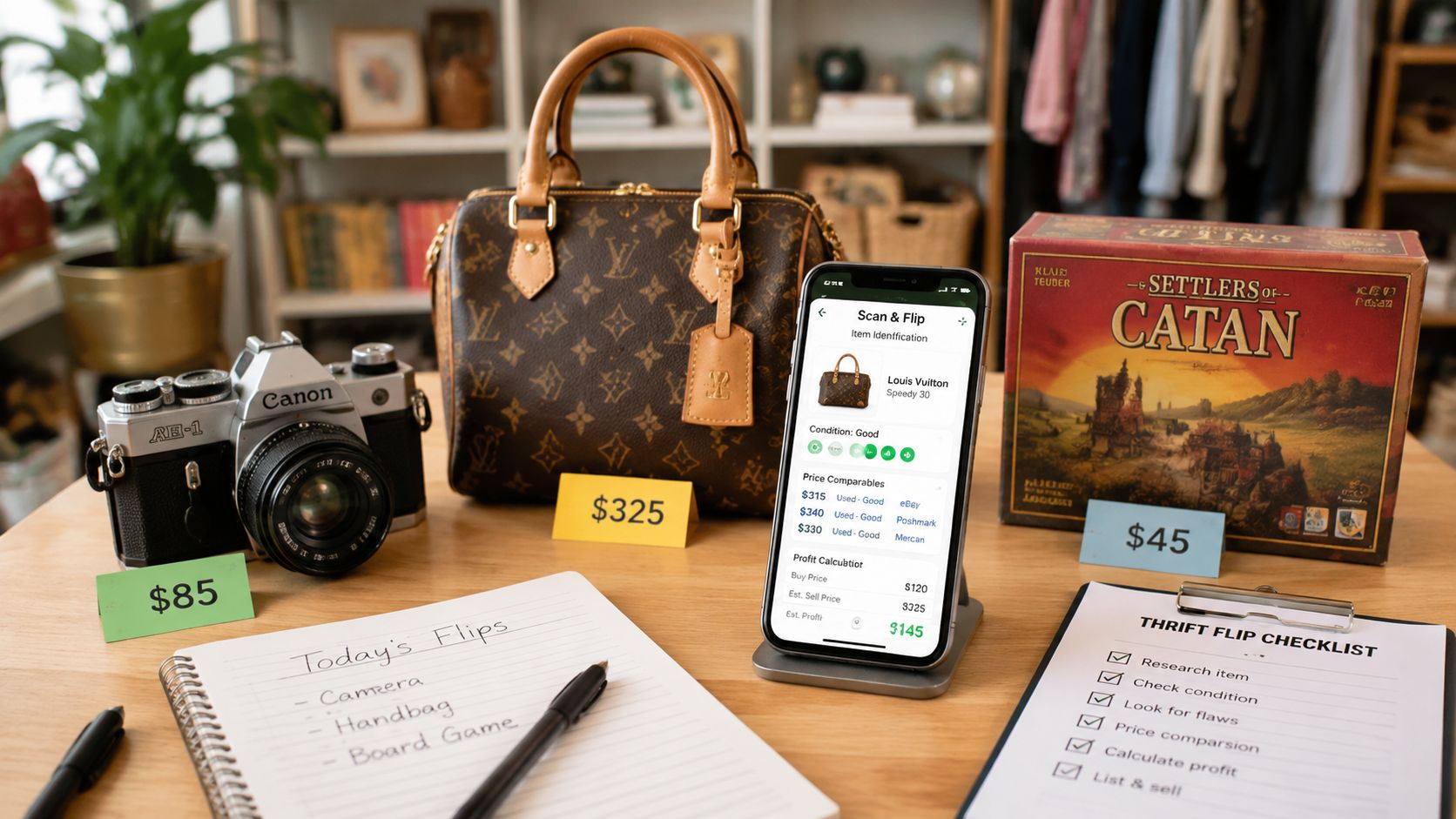
A sourcing-phase tool such as ScanFlip AI can support that decision without replacing your existing listing or crosslisting setup. It offers an AI photo scan with no barcode needed, barcode scanning, and text search, then combines sold prices across major marketplaces and shows estimated net profit with a red or green flip-or-pass verdict.
Table of Contents
- 1. Know Your Sold Comps, Not Listing Prices
- 2. Build a BOLO List by Category and Margin
- 3. Calculate True Net Profit
- 4. Diversify Sourcing Venues to Reduce Inventory Risk
- 5. Scan Everything First, Buy Second
- 6. Build Relationships With Pickers, Estate Agents, and Staff
- 7. Master Your Primary Category Before Expanding
- 8. Track Sourcing Data to Find Profitable Patterns
- 9. Inspect Condition Before Trusting the Comp
- 10. Set a Flip-or-Pass Threshold and Respect It
- 8-Point Sourcing Best Practices
- Turn Every Sourcing Trip Into a Repeatable System
1. Know Your Sold Comps, Not Listing Prices
An active listing tells you what a seller hopes to receive. A sold comp tells you what a buyer paid. Those are different markets, and confusing them is one of the fastest ways to overpay.
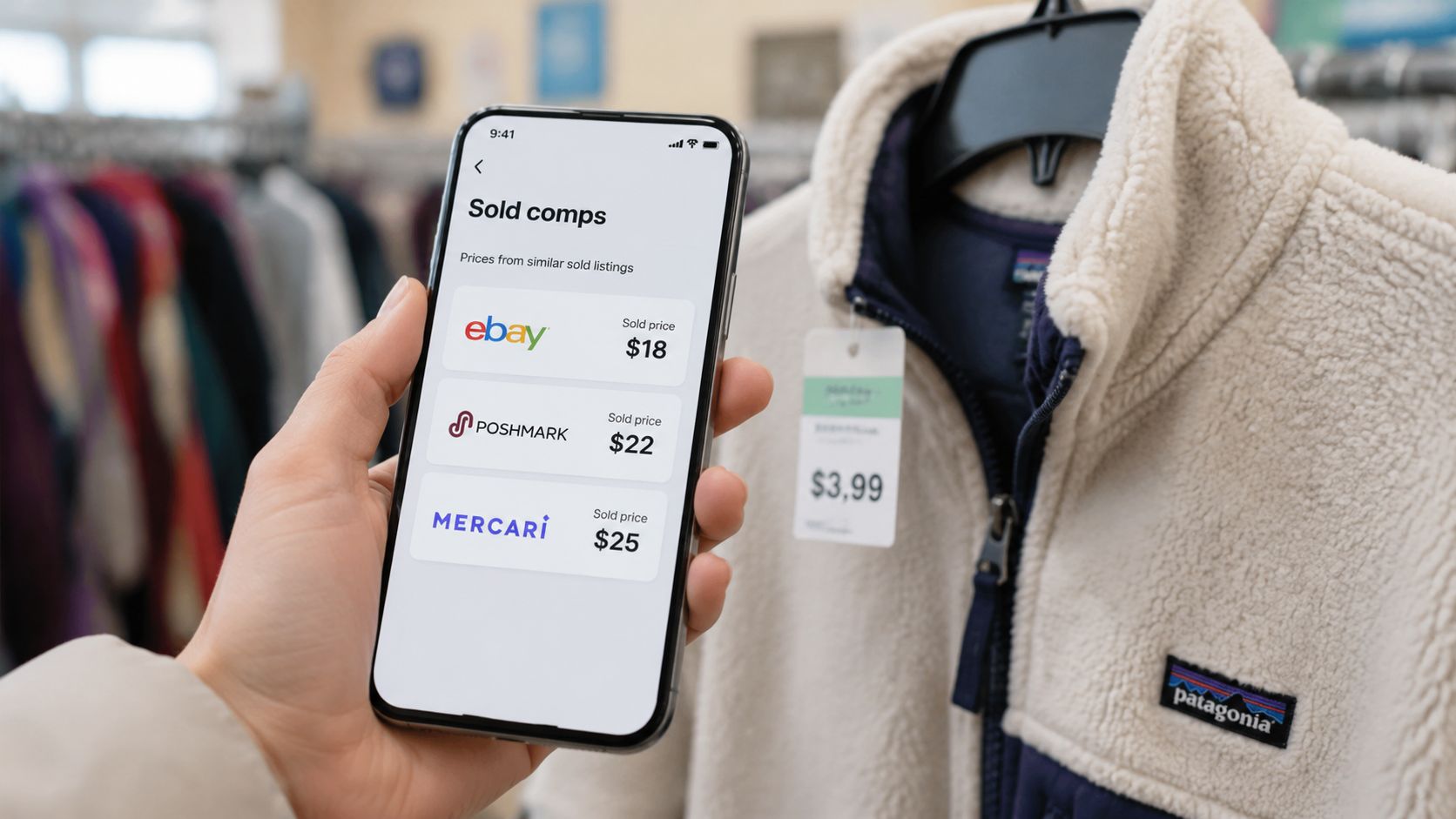
A jacket may sit at $50 on an active marketplace for months while recent sold comps landed at $18, $22, and $25. If you buy based on the $50 number, your expected margin exists only in your imagination. That item can become a death-pile resident before you realize demand is weak.
Check completed sales for the same model, brand, size, color, edition, and condition. For a category that moves across several venues, compare sold prices on eBay, Poshmark, Mercari, Depop, Amazon, Whatnot, ThredUp, Facebook Marketplace, and TikTok Shop. The right platform depends on the item. Vintage clothing may move differently from books or collectibles, and the fastest venue isn't always the one with the highest gross sold price.
Compare like with like
At an estate sale, a vintage Levi's 501 priced at $8 deserves a closer look if comparable Poshmark and eBay sales support a $32 to $45 range after fees. A PSA 8 sports card priced at $60 is easier to evaluate when comparable eBay sales cluster around $120 to $150. On the other hand, a branded T-shirt priced at $2.99 can still be a pass if it has no recent sales on Mercari or Poshmark.
Practical rule: Don't buy from an active listing price. Buy from a realistic sold-price range after condition and fees are accounted for.
For a category-specific decision, cross-check sold comps on at least two platforms. For a higher-value item, use more marketplace evidence before committing. Recent sold prices are the foundation of a disciplined buy decision, and ScanFlip AI can aggregate sold comps in one scan instead of making you jump between apps.
2. Build a BOLO List by Category and Margin
A BOLO, or Be On the Look Out list, turns a crowded thrift store into a more manageable search. It records the brands, item types, keywords, and conditions that repeatedly work for your business.
A useful BOLO isn't just a list of brand names. It includes the details that affect the buy: size, era, condition, expected venue, and minimum net profit. A clothing flipper might watch for pre-2000s Levi's 501s, Carhartt jackets, and vintage Band-Ts without holes or stains. A collectibles seller might focus on PSA 7 or better graded sports cards and CGC 6.5 or better comic books. A book scanner may prioritize first editions, signed copies, textbooks, and specific science-fiction or fantasy genres.
The point isn't to buy every item on the list. It's to recognize promising inventory quickly, then verify each one with current sold comps.
Let your own sales edit the list
Start with a small set of item types you understand. Test them, record the results, and remove the ones that consistently sit or produce weak net profit. A BOLO that looked strong last season may no longer fit your market, while an overlooked category can become useful after you learn its identifiers.
Track sell-through rate, hold time, condition issues, and net profit by item type. A brand that sells quickly at a modest profit may be better for your cash flow than a higher-priced item that sits. Margin matters, but so does how long your money stays tied up.
Useful BOLO entries might include:
- Vintage clothing: Levi's 501s, Carhartt jackets, and clean vintage Band-Ts with a target of $15 to $35 net profit.
- Collectibles: PSA 7 or better sports cards and CGC 6.5 or better comics, with a target margin of 30% to 50%.
- Retail arbitrage: Nike clearance items priced under $15, Lululemon dupes, and designer handbags in outlet bins, with potential flip ranges from $25 to $80.
- Books: First editions, signed copies, textbooks, and selected science-fiction or fantasy titles, with an expected $8 to $40 per book.
These figures are decision targets, not promises. Condition, demand, fees, and venue still decide whether an individual item is a buy.
3. Calculate True Net Profit
Gross sold price is not your profit. Your sourcing math needs to subtract cost of goods, marketplace fees, shipping, packaging, and any other expense you'll absorb.
Suppose a vintage handbag has sold comps around $45 and costs $4 at Goodwill. If the marketplace keeps 20% and you pay $4 shipping, the calculation is $45 multiplied by 0.80, or $36, minus $4 shipping, leaving $32 before cost of goods. Subtract the $4 purchase price, and the estimated net profit is $28.
That's a solid result, but only because the fee and shipping assumptions were visible before buying. Repeat the same process on a marginal item and the decision can change quickly. eBay's fee structure includes an insertion fee and a final value fee, with a per-order fee of $0.30 for orders of $10.00 or less and $0.40 for orders over $10.00, according to eBay fee guidance summarized by FlowLister. A $25 sale can look attractive in the aisle and still leave little after the fee stack.
Run the aisle math
For most eBay categories in the United States, FlowLister reports a final value fee of 13.6% up to $7,500, plus 2.35% above that amount, along with the applicable per-order fee, as detailed in its 2026 eBay fee breakdown. Treat current platform fees as variables to verify, not rules of thumb.
Here are practical examples:
- Athletic shorts: Buy for $3, sold comp of $22 on Poshmark, 20% fee and $3 shipping. Estimated net profit is $11.60.
- Glass vase: Buy for $8, sold comp of $35 on eBay, 12.9% fee assumption and $5 shipping. Estimated net profit is about $17.48.
- Nintendo game: Buy for $5, sold comp of $18 on eBay, 12.9% fee assumption and $2.50 shipping. Estimated net profit is about $8.17.
- Vintage Levi's 501 jeans: Buy for $5, sold comp of $40 on Poshmark, 20% fee and $4 shipping. Estimated net profit is $23.
These examples show why calculating net profit before purchase matters. ScanFlip AI can factor platform fees, shipping, and buy cost into a red or green verdict while you're still holding the item.
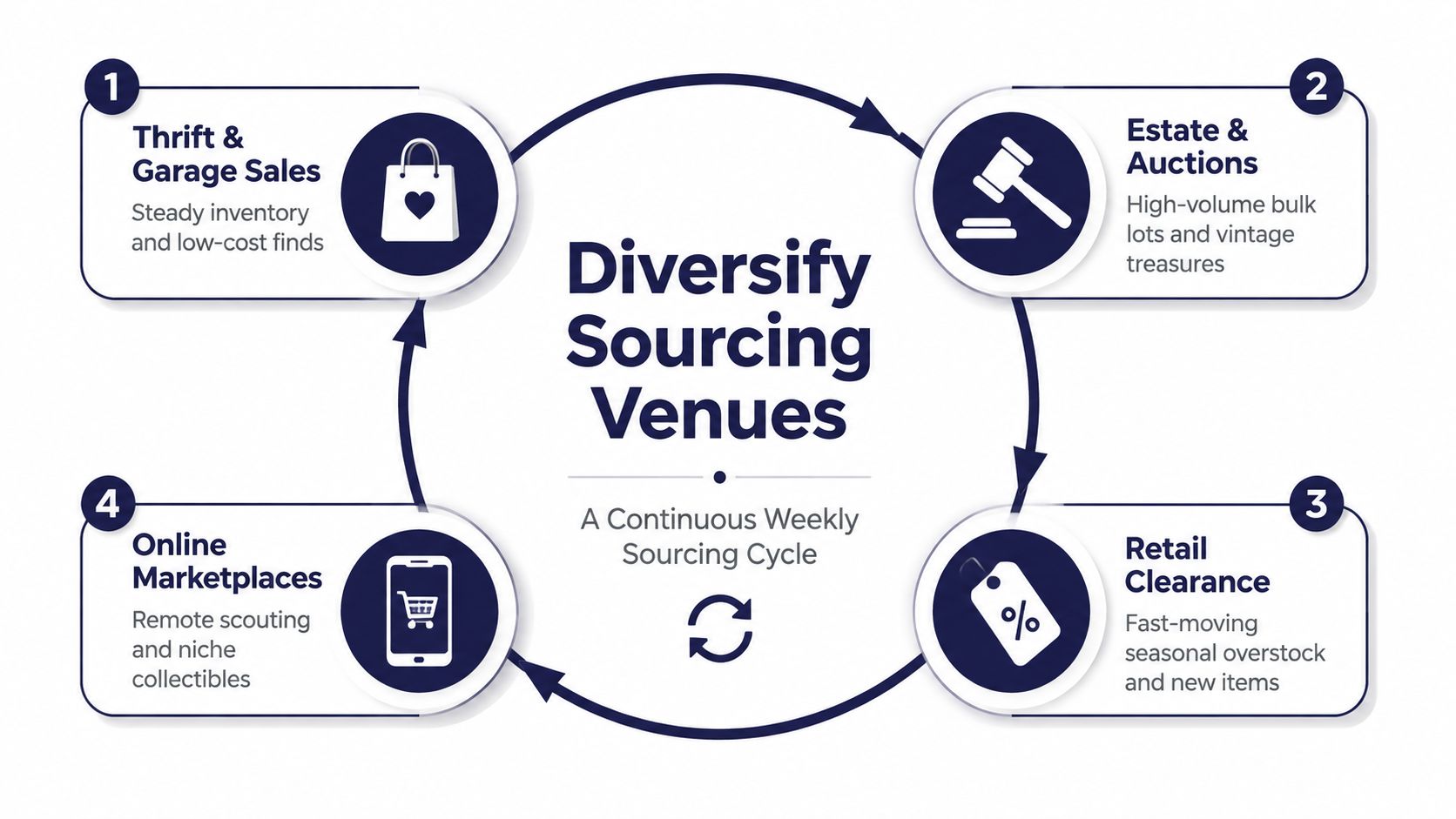
4. Diversify Sourcing Venues to Reduce Inventory Risk
One Goodwill location can be picked over. One estate-sale company can price aggressively. One retail chain can change its markdown process. If your entire sourcing routine depends on a single venue, a small change can leave you with less inventory and fewer viable buys.
Different channels produce different trade-offs. Thrift stores offer repeatable access but may have heavy competition. Garage sales can deliver low buy costs but require more driving and schedule management. Estate sales may offer concentrated collections, including books, jewelry, decor, and collectibles, but prices and access vary. Retail arbitrage can be efficient when clearance inventory is available, yet it requires frequent scouting.
Online channels such as Facebook Marketplace and Craigslist can expose bulk lots and local deals. Library sales, church sales, pallet liquidators, storage-unit auctions, and online auctions can add volume, but each requires its own inspection and risk controls.
Build a route, not a random loop
Start with three primary venues and two secondary venues. Assign them to a sourcing calendar so you know where you're going and why. A weekly route might include early thrift runs, a midweek garage-sale search, an estate-sale appointment, a retail clearance visit, and a weekend library or church sale.
Don't add a venue because another reseller mentioned it. Scout first, scan enough inventory to understand the pricing, and compare the results with your current channels. Gas, time, parking, and carrying costs belong in the decision.
International sourcing and channel diversification are also shifting across the wider market. A Source Fashion sourcing report reports that 74% of respondents were sourcing internationally, while separate industry reporting described offshoring increasing by 16% and nearshoring at 10%. For a small reseller, the lesson isn't to chase every channel. It's to test several sources, measure write-offs, and keep the channels that produce dependable inventory.
5. Scan Everything First, Buy Second
Buying first and researching later reverses the entire sourcing process. Once the money is spent, a weak comp becomes a problem you own.
At a garage sale with a box of books, scan the first few ISBNs before buying the lot. Two may have no useful sales history while another has weak $2.50 comps. Buying the whole box because one title looks promising is how cheap inventory becomes expensive storage.
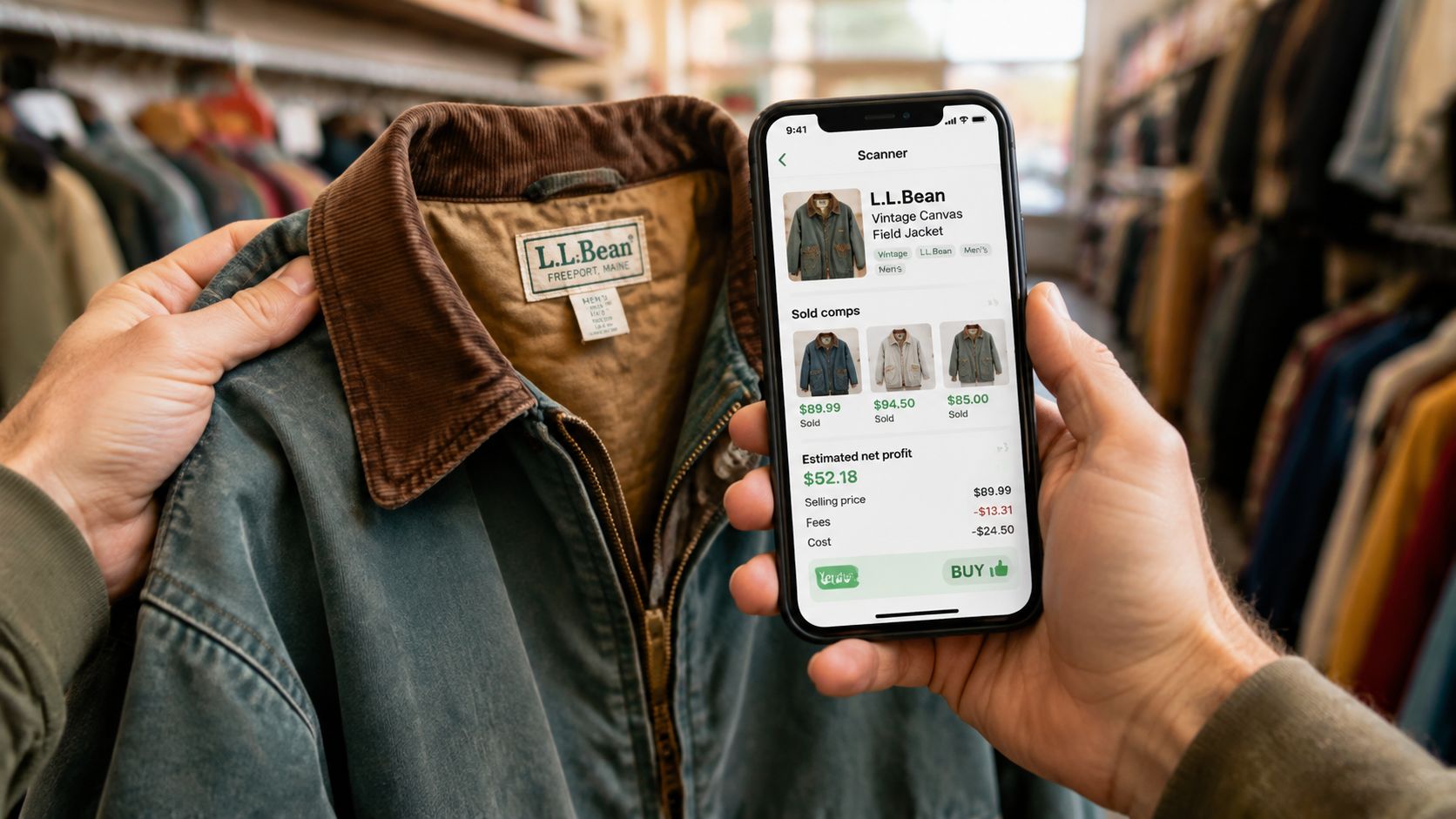
The same habit works in a Goodwill aisle. Pick up the branded hoodie, scan it, check sold comps, subtract fees and shipping, then compare the result with your $3.99 cost. If the estimated net profit is $14, it may earn a green verdict. If the same hoodie has weak demand or condition problems, put it back.
Use the right scan method
ScanFlip AI supports three ways to identify an item:
- AI photo scan: Use it for untagged vintage clothing, shoes, collectibles, decor, and electronics. It doesn't require a barcode.
- Barcode scan: Use it for books, media, games, and boxed retail products with UPC or ISBN information.
- Text search: Use it when you know the item name but can't photograph or scan it cleanly.
A vintage lamp with no recent sales history is a pass, even if it looks attractive. A retail clearance shoe priced at $15 may work if sold comps support $32 to $45 and the fee-adjusted net leaves enough room. Scan the entire group instead of assuming every color or size will perform the same way.
Review scan history later. Photos, locations, and timestamps can show which stores produce winners and which ones mostly produce tempting passes.
6. Build Relationships With Pickers, Estate Agents, and Staff
Some of the best sourcing opportunities never reach the public floor. Estate-sale companies know regular pickers. Thrift-store staff see donations before shoppers do. Local resellers notice Facebook Marketplace lots quickly because they already know which keywords and sellers to watch.
Relationships won't replace research, and they shouldn't become an excuse to buy blindly. They give you earlier access, better local information, and a chance to hear about inventory that fits your category before the crowd arrives.
Start by becoming dependable. Visit the same store consistently, be polite, buy when the item makes sense, and don't create extra work for staff. Tell an estate-sale manager that you source vintage clothing, books, jewelry, or collectibles. Give them a phone number or email and ask whether they maintain a picker notification list.
Be useful to other sourcers
A small local network can improve coverage without turning every deal into a competition. One reseller can cover a neighborhood garage sale, another can check an estate sale, and both can share photos of items that fit each person's BOLO.
Good relationships are reciprocal. Share a useful lead, send a comp when someone asks, and be honest about what you're looking for. A coffee or small gift may be appropriate for a helpful staff member or event organizer, but respect the venue's policies and never pressure anyone to set aside merchandise improperly.
Show up consistently enough that people remember your category, your standards, and your word.
A retail-arbitrage seller who regularly checks Target clearance may learn when markdowns arrive. A vintage clothing flipper may hear about a fresh donation. Those advantages improve speed, but the item still needs a condition check and a profitable flip-or-pass decision.
7. Master Your Primary Category Before Expanding
A reseller who flips clothing, books, electronics, decor, and collectibles may have more variety but less useful expertise. A focused seller learns the details that make a fast aisle decision possible.
A vintage Levi's specialist can recognize fit codes, eras, shrink-to-fit details, fabric wear, and common condition problems. A book scanner focused on first editions and signed science-fiction titles knows which reprints are usually weak. A sports-card flipper who understands graded vintage basketball cards can evaluate centering, surface, grading, and recent comps more confidently than a generalist.
Specialization also improves your buying speed. After repeated scans and sales, you start noticing which items deserve attention and which ones can stay on the rack. You won't need to research every category from scratch.
Choose a category that fits your market
Your primary category should match three things: existing knowledge, local availability, and reliable buyer demand. A category can look profitable online and still be a poor fit if your local stores rarely receive it or if shipping creates too much risk.
Track every flip by buy cost, sold price, fees, net profit, condition, and hold time. After enough sales, your own records become more useful than generic BOLO lists because they reflect the venues and buyers you serve.
Good primary categories include vintage clothing, graded cards, books, designer handbags, or retail-arbitrage products. Each has different risks. Clothing has measurements and condition variables. Cards require careful grading and authenticity awareness. Books can be cheap to source but may have low net profit per unit. Handbags require authentication discipline.
Use ScanFlip AI's photo, barcode, and text searches to build a repeatable comp reference for your category. Expand only after your primary category is producing consistent decisions, and keep most of your sourcing attention on the area that pays for the experiments.
8. Track Sourcing Data to Find Profitable Patterns
Instinct may spot a promising item, but records show which sourcing decisions deserve more time. Track the source, location, buy cost, sold price, fees, net profit, condition, and hold time for every completed flip. Review this guide to sourcing performance metrics for a practical way to turn those numbers into route and buying adjustments.
Use a simple comparison after each batch of sales:
| Source | What to compare |
|---|---|
| Thrift stores | Net profit, sale speed, and travel time |
| Estate sales | Larger profits against longer holds and driving |
| Garage sales | Faster sales against lower margins |
| Retail clearance | Store-check time, mileage, and repeatability |
A venue earns more of your attention when its profit survives the full time cost. A $25 net profit from an estate sale may require long travel and a slow sale. A smaller profit from a nearby thrift store may win if the item sells faster and takes less effort.
Turn records into route decisions
Suppose Goodwill A regularly produces $6 to $10 net profit per flip while Goodwill B produces $12 to $15. Reduce trips to A and give B more attention, provided the pattern remains after accounting for travel and inventory volume.
Hold time changes the decision. Estate-sale finds may produce stronger net profit but sit for 45 days. Garage-sale items may sell in 3 days at lower profit. That difference affects cash flow, storage, and how quickly you can reinvest.
Your records should preserve the item, location, condition, comp, purchase decision, and final result. ScanFlip AI can support that workflow by keeping a consistent scan history instead of scattered notes. Inventory teams still commonly rely on spreadsheets. A 2026 inventory-operations survey found that spreadsheets remain the primary inventory tool for many operations professionals. For resellers, a consistent log matters more than a complicated system. Review it before planning the next sourcing trip.
9. Inspect Condition Before Trusting the Comp
A sold comp is only comparable if the item you're holding matches the condition and completeness of the item that sold. A clean vintage jacket and one with stains, missing buttons, smoke odor, or a damaged zipper don't belong in the same buy decision.
Inspection needs to happen before the profit calculation, not after. Check seams, soles, zippers, tags, screens, hinges, pages, signatures, serial numbers, accessories, and signs of repair. For electronics, confirm that the item powers on when possible. For books, look for writing, moisture damage, missing pages, and ex-library markings. For cards and collectibles, inspect corners, surfaces, authenticity indicators, and protective packaging.
Let condition change the threshold
A low-cost item can still be a bad buy if it needs cleaning, repair, authentication, or extensive testing. Those tasks consume time and can create additional costs. A handbag with strong sold comps may become a pass if its authenticity is uncertain. A collectible with a desirable brand may be worthless to your workflow if key parts are missing.
Take photos of damage before leaving the venue. Those photos help you remember what you saw and prevent an optimistic memory from replacing the actual condition. ScanFlip AI's photo identification can help identify an unfamiliar item, but identification doesn't replace your inspection.
A comp is evidence, not permission to ignore defects.
Write down the exact flaw when the item is unusual or high value. If you can't describe the condition accurately, you don't yet know whether the comp applies. Passing on a questionable item is usually cheaper than discovering the problem after it becomes a return, an unhappy buyer, or long-term dead stock.
10. Set a Flip-or-Pass Threshold and Respect It
A sourcing system needs a personal minimum. Without one, excitement and scarcity will push you into marginal buys, especially when another picker is reaching for the same item.
Your threshold can combine minimum net profit, margin, sell-through, condition, and hold time. A lightweight item with a predictable buyer may justify a lower dollar profit than a fragile vase requiring careful packing. A $4 item that nets $1.20 may technically be profitable, but it may not justify photographing, listing, packing, customer messages, and shipping. A $20 item that nets $6 may also be too weak if it sits for months.
Set separate rules for different categories. A book scanner may accept a small net profit when scanning is fast and fulfillment is simple. A glassware seller may require more profit because breakage and packaging take time. A card flipper may need stronger evidence because condition and authenticity affect the result.
Make close calls deliberate
If the math is close, negotiate rather than rationalize. At an estate sale, ask whether the seller can reduce an $8 item when the estimated profit only works at a lower cost. At a garage sale, bundle several proven winners instead of taking a box of unknowns. In retail arbitrage, buy a small test quantity before committing to every unit on the shelf.
ScanFlip AI lets you set a minimum profit or margin threshold and returns a red or green flip-or-pass signal based on sold comps, fees, shipping, and buy cost. Seller-experience research on B2B marketplaces also links information quality with satisfaction, perceived value, and continued usage in this 2025 marketplace study. The reseller version of that lesson is simple: clearer information supports better repeat decisions.
A red verdict isn't a failure. If condition, demand, sell-through, or net profit doesn't support the purchase, passing is a successful sourcing decision.
8-Point Sourcing Best Practices
| Strategy | Implementation complexity | Resource requirements | Expected outcomes | Ideal use cases | Key advantages |
|---|---|---|---|---|---|
| Know Your Sold Comps, Not Listing Prices | Moderate, requires systematic checks | Access to multiple marketplaces or an aggregation tool; time for research | Accurate pricing, fewer deadstock, faster buy-or-pass decisions | Thrift/estate sourcing where pricing varies by platform | Prevents overpaying; market-driven buy decisions |
| Build a BOLO (Be On the Look Out) List by Category and Margin | Low–Moderate, testing and refinement needed | Initial test inventory, tracking of ~20–50 flips | Faster targeted sourcing, higher hit rate, reduced decision fatigue | Regular sourcing routes and high-volume pickers | Focuses effort on proven winners; speeds buying decisions |
| Calculate True Net Profit (Cost + Fees + Shipping) | Moderate, per-item math or app integration | Knowledge of platform fees, shipping estimates or a calculator/app | Realistic margin expectations; fewer loss-making purchases | High-ticket items and sellers on fee-heavy platforms | Prevents margin erosion; enforces disciplined buys |
| Diversify Sourcing Venues to Reduce Risk & Spot Trends | Moderate–High, logistics and scouting complexity | Time, transport, venue research, schedule planning | Increased deal flow, reduced dependence on one source, earlier trend signals | Sellers in competitive or variable supply markets | Spreads risk; uncovers arbitrage and emerging trends |
| Scan Everything First, Buy Second | Low, habit change plus a scanning app | Smartphone, scanning app, battery/connection | Fewer impulse buys, quicker flip-or-pass decisions, less dead inventory | High-traffic thrifting, garage sales, retail clearance | Rapid, data-backed decisions; reduces regret buys |
| Build Relationships with Pickers, Estate Agents & Staff | Medium, requires ongoing effort and networking | Time, consistency, communication (calls/texts, tips) | Pre-sale access, bulk deals, reduced competition | Estate sale pickers, local resellers, frequent store visitors | First access to inventory; exclusive opportunities |
| Master Your Primary Category Before Expanding | High initially, steep learning curve | Focused sourcing time, research, community resources | Faster sourcing, higher sell-through, expert reputation | Sellers aiming for sustainable margins and repeat buyers | Deep expertise yields faster, more profitable decisions |
| Track Sourcing Data to Identify Profitable Venues & Patterns | Moderate, needs consistent data entry | Tracking tool or app, discipline for logging buys/sales | Data-driven route optimization, proven ROI, seasonal insights | Sellers scaling operations or optimizing time/mileage | Reveals which venues/time produce the best profits |
Turn Every Sourcing Trip Into a Repeatable System
The most useful sourcing best practices form a short field workflow. Start with a category or BOLO, then inspect the item before you get attached to the idea of the flip. Check brand, model, size, edition, completeness, defects, and authenticity indicators.
Identify the item with the method that fits the situation. Use an AI photo scan for untagged vintage clothing, shoes, decor, and collectibles. Use a barcode scan for books, media, games, and boxed retail items. Use text search when the item can't be photographed or scanned clearly but you know its name.
Next, verify sold comps, not asking prices. Compare the item with recent sales that match condition and variation. If the evidence is thin, lower your confidence or pass. A high active price doesn't compensate for missing sales history.
Then calculate expected net profit after marketplace fees, shipping, packaging, and cost of goods. Compare that result with your personal minimum threshold. If the math is close, negotiate, bundle only with proven items, or leave the item behind. Don't turn uncertainty into an automatic buy because another picker is nearby.
Record the result. Save the item photo, venue, location, timestamp, buy decision, and eventual outcome. ScanFlip AI's scan history can preserve photos, locations, and timestamps, giving you a way to review which stores, neighborhoods, estate-sale companies, and sale types produce winners.
Review that data regularly. Remove stale BOLO entries, add patterns from completed flips, and adjust your route when one venue consistently creates weak results. Keep your sourcing tool separate from your listing workflow. ScanFlip AI helps answer whether you should buy. After that decision, use your existing listing and crosslisting tools, such as Vendoo or List Perfectly, for the work those platforms handle.
The system doesn't need to be complicated. It needs to be followed while you're still standing in the aisle, at the sale table, or beside the clearance shelf. A pass is a successful sourcing decision when the condition, sold comps, sell-through, or net profit doesn't support the buy.
ScanFlip AI gives resellers three ways to check an item before buying, AI photo identification without a barcode, barcode scanning, and text search. It aggregates sold comps across major marketplaces, subtracts fees and shipping, and returns a red or green flip-or-pass verdict, so visit ScanFlip AI and use it on your next thrift, estate-sale, garage-sale, or clearance run.