
Does Goodwill Wash Clothes Before Selling Them
Goodwill does not wash donated clothing before putting it on the sales floor. The store's model is donor-prepared, as-is resale, so the first proper wash usually happens after you buy the garment.
You're standing in a Goodwill aisle with a promising label in one hand and a faint thrift-store smell in the other. The price is low, the sold comps look workable, and the only question is whether that odor is a normal laundry problem or a sign the piece belongs back on the rack. For resellers, the answer matters because cleaning is production labor, while permanent stains, damaged fabric, and bad odors can erase your net profit.
The practical distinction is simple: Goodwill doesn't launder every donation, but it also doesn't put every donation on the rack. The garment you see has already passed through sorting and inspection. Your job is to decide whether the remaining flaws are washable, repairable, or fatal to the flip.
Table of Contents
- The Short Answer on Goodwill and Clothing Hygiene
- Why Goodwill Cannot Wash What It Sells
- What Actually Happens to a Donation After Drop-Off
- The Cull Most Resellers Do Not See Coming
- Sourcing Unwashed Clothing Without Getting Burned
- Cleaning and Prepping Thrift Finds for Resale
- How to Price and Decide Before You Buy
- A Reseller's Quick Rules for Goodwill Clothing
The Short Answer on Goodwill and Clothing Hygiene
Goodwill does not wash donated clothing before putting it on the sales floor. Goodwill locations describe the process directly, including a Goodwill Northwest North Carolina FAQ stating that donated clothing isn't washed, while other Goodwill guidance expects donors to provide clean, dry, sellable garments. The store receives, sorts, prices, and displays the item, but it doesn't run that garment through a standard wash, dry-cleaning cycle, or sanitizing process.
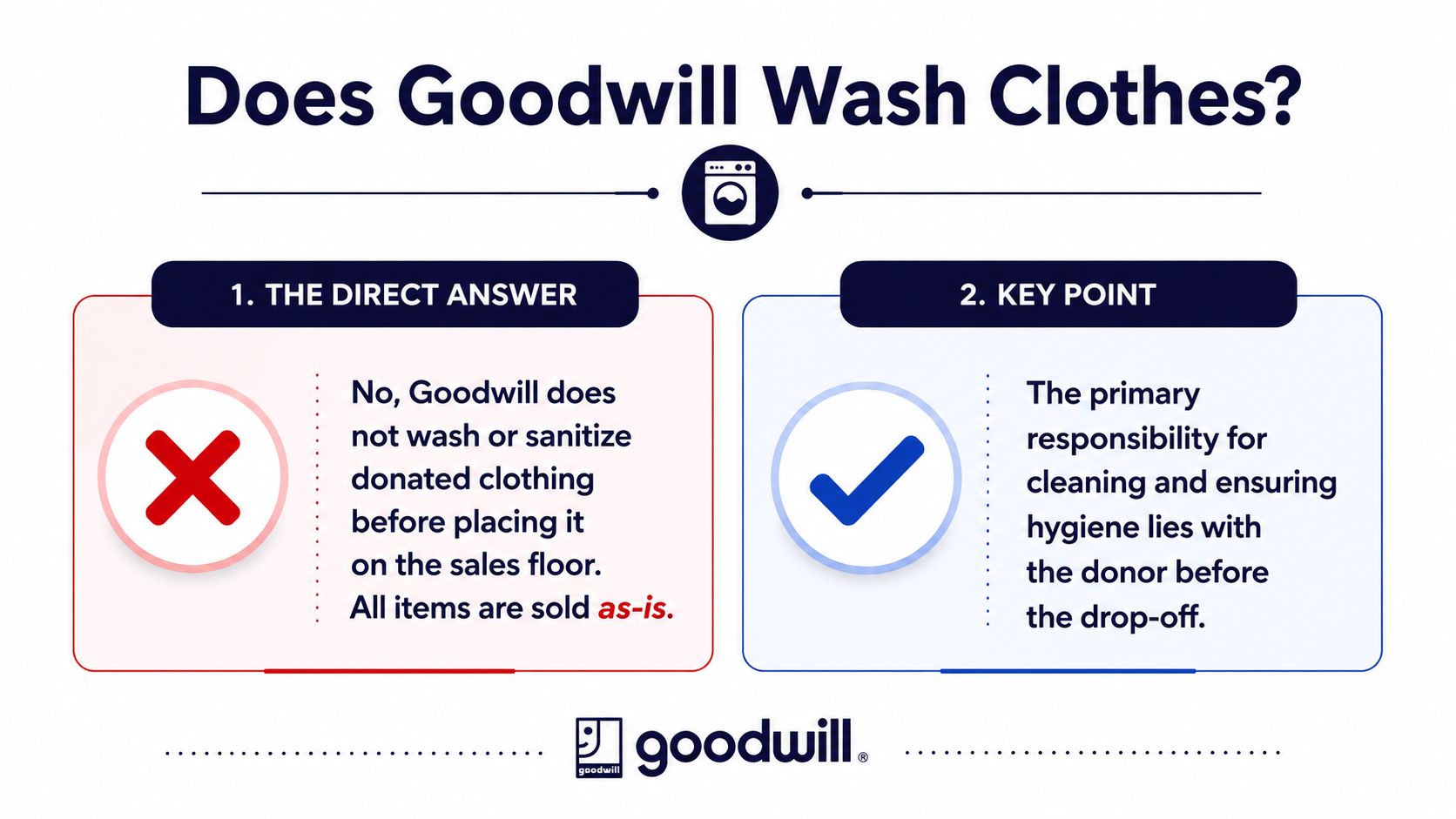
“As-is” doesn't mean every piece arrives filthy and goes straight to a rack. It means the cleaning burden stays with the donor and buyer, rather than becoming a store-side service. Goodwill's public guidance focuses on donor-prepared cleanliness, while visibly wet, stained, torn, or strongly odorous items may be removed from sale instead of being laundered, as described in this Goodwill clothing hygiene overview.
Most rack clothing is therefore a sourcing judgment, not a hygiene emergency. A cotton shirt with a mild storage smell may be perfectly workable after washing. A silk blouse with an oil mark, a pair of trousers with permanent waistband damage, or a coat carrying deep must can turn into a death-pile project.
Practical rule: Treat “unwashed” as a condition to evaluate, not an automatic pass or automatic buy.
For a flipper, this is useful information. You can price the wash, drying, steaming, and inspection into your cost of goods before the garment enters the cart. The store hasn't failed to clean the item. It has followed an as-is resale model that keeps the rack moving and leaves the final preparation decision to you.
Why Goodwill Cannot Wash What It Sells
Goodwill's operating model is built around sorting and resale, not commercial laundering. Independent coverage describes Goodwill handling millions of pounds of goods each year and stores processing thousands of items daily, a scale that makes washing every garment a major logistics problem, as outlined in this reseller-focused explanation of Goodwill processing.
A wash-everything model would need intake separation, stain treatment, industrial machines, drying capacity, folding space, water handling, labor, and a second transportation loop. It would also create a new quality-control problem because different fabrics need different temperatures, cycles, detergents, and drying methods. One careless cycle could shrink wool, distort rayon, or damage embellishment before the item ever reached a buyer.
| Metric | Current Goodwill Model | Hypothetical Wash-Everything Model |
|---|---|---|
| Intake handling | Receive, sort, inspect, tag, and price | Receive, sort, inspect, wash, dry, fold, tag, and price |
| Cleaning responsibility | Donor and buyer | Goodwill-operated laundry system |
| Equipment | Sorting lines, racks, scales, balers, and tagging stations | Industrial washers, dryers, water systems, treatment stations, and folding areas |
| Garment condition | Sold as-is after visual triage | Condition affected by wash compatibility and processing errors |
| Unit economics | Low-cost handling supports low retail prices | Laundry labor and utilities would add a separate cost layer |
| Reseller effect | Buyers can source inexpensive raw inventory | Added processing costs would likely pressure retail prices upward |
That's why the absence of a laundry room isn't surprising. Goodwill's public-facing instructions emphasize sending in clothing that's clean, dry, and suitable for sale, while the organization sorts out items that don't meet that standard. The CBS News report on Goodwill donation sorting describes inspection before items reach the store and notes that Goodwill doesn't launder them.
For resellers, the trade-off works in your favor when you buy selectively. The as-is model keeps the initial price low enough for a brand, fabric, or unusual style to leave room for cleaning and fees. Washing everything would add a processing burden that the thrift model was never designed to absorb.
What Actually Happens to a Donation After Drop-Off
The donation path is more selective than shoppers usually realize. A garment can pass through several human and mechanical touchpoints before it reaches a retail rack, yet washing isn't one of them.
From donation bin to processing line
The process generally looks like this:
- Drop-off and receipt: The donor hands over bags or places them in a donation bin, then receives a receipt where offered.
- Transport: Loads move by truck to a regional processing center or another handling location.
- Intake and weighing: Staff weigh incoming material and separate broad categories. Scales and baling equipment handle parts of the volume mechanically.
- Human inspection: Sorters examine garments for stains, odors, tears, wetness, missing components, and general saleability. This is the first quality filter that matters to a reseller.
- Tagging and retail placement: Pieces that survive inspection are tagged, priced, hung, and sent to a store for rack placement.
The human decisions happen at sorting, tagging, hanging, and store-level pricing. Mechanical handling supports weighing, transport, baling, and movement through the facility, but machines don't determine whether a questionable blazer has enough resale value to justify a place on the rack.
The two points resellers should watch
The sorter's pull determines what never reaches you. A stained collar, torn underarm, strong odor, or damp garment may be diverted or discarded rather than cleaned. If the item survives, the store-level pricing decision determines whether the buy margin still works.
That sticker is not proof of cleanliness. It's proof that the piece passed a visual and operational gate. The buyer's home laundry remains the garment's first real wash, and your resale workflow should treat that step as mandatory before photography or shipping.
The Cull Most Resellers Do Not See Coming
The unwashed garment on the rack is only the visible part of the donation stream. Goodwill doesn't sell everything it receives. Sorters remove pieces that are too stained, torn, wet, odorous, worn, or commercially weak before shoppers ever get a chance to inspect them.
Some rejected textiles may move into salvage or recycling channels rather than retail. The exact split varies by affiliate and location, so don't assume a fixed percentage for your local store. The important point is that the rack is already a curated remainder, not a random sample of every donated garment.
That changes how you read “unwashed.” It doesn't mean every item arrives with severe contamination, and it doesn't mean Goodwill has ignored obvious defects. It means the store uses visual and sensory triage instead of laundering. A piece priced at $4.99 may still need washing, but it has already survived a first decision about whether it's worth retail space.
The real risk isn't universal dirt. It's the permanent flaw that looks fixable until you've paid for the garment and carried it home.
Inexperienced sourcing often leads resellers astray. They spot a recognizable label, assume the stain will come out, and skip the close inspection. The correct question isn't “Does Goodwill wash clothes before selling them?” You already know the answer. Ask whether your cleaning process can rescue this exact fabric and defect.
Spend less time judging whether the garment smells like detergent and more time checking the label, construction, care instructions, and sold comps. A washable cotton overshirt with a mild odor can be a solid buy. A premium piece with thinning fabric, set-in oil, or damaged lining may be a pass even when the rack price looks attractive.
Sourcing Unwashed Clothing Without Getting Burned
I've stood in the aisle with two garments in my hands, one priced at $5 and another at $12. The $5 piece had a mild storage odor but a strong label and washable cotton. The $12 piece looked cleaner, yet its sold comps were weak. The cheaper garment was the better buy because the cleaning problem was small and the resale demand was real.
That decision starts with inspection, not optimism. Check the underarms, collar, cuffs, waistband, hem, seams, zipper, lining, and pockets. Denim can hold musty storage smells around the hem, while vintage trousers often reveal permanent sweat rings at the waistband. A phone flashlight helps expose thin fabric, residue, and marks that fluorescent store lighting hides.
Separate washable problems from permanent problems
Cotton and common synthetic blends usually tolerate a normal care-label wash. Silk, rayon, wool, structured pieces, and heavily embellished garments require more caution. If the label says dry clean only, the cleaning cost and turnaround belong in the buy decision before the item enters your cart.
A practical aisle filter looks like this:
- Buy with room: Mild odor, surface lint, ordinary dust, and wrinkles on a desirable washable garment.
- Slow down: Collar discoloration, deodorant marks, loose buttons, damaged zippers, or stains near delicate trim.
- Pass quickly: Mildew odor, wetness, fabric thinning, deep oil, irreversible discoloration, or damage that remains obvious after cleaning.
- Check the price: A low-cost piece can support a volume flip, while a higher-priced garment needs sold comps before you commit.
Price stickers are anchors, not proof of value. A $3 item can sometimes survive a modest cleaning failure because the cost of goods is low. A $10-plus piece needs a stronger brand, better condition, or clear demand to justify the additional risk.
For sourcing ideas beyond standard thrift racks, this guide to thrift store suppliers can help you compare different inventory sources. The same rule applies everywhere: buy the garment the wash cycle can rescue, not the project that needs a salvage operation.
Cleaning and Prepping Thrift Finds for Resale
Treat cleaning as production, not a household favor you'll get around to later. The garment isn't ready for photography, storage, or shipment until you've inspected it again after cleaning and confirmed that the odor, stain, and shape are acceptable.
A practical home setup can be simple. A 30-pound front-loader, a $4 jug of fragrance-free detergent, and a drying rack are enough for many machine-washable pieces. For heavily soiled workwear, a five-gallon bucket and oxygen cleaner can create a pre-soak that costs roughly $0.15 per garment, based on the workflow described in the supplied cleaning guidance.
| Fabric or item | Cleaning method | Cost per garment | Time per garment |
|---|---|---|---|
| Cotton shirts and synthetic blends | Care-label machine wash and complete dry | Detergent share, usually low | Part of a batch cycle |
| Heavy workwear | Oxygen-cleaner pre-soak, then appropriate wash | About $0.15 for the pre-soak | Extra inspection and soak handling |
| Delicate knits | Hand wash or careful spot treatment | Detergent share, usually low | Longer handling per piece |
| Tailored or dry-clean-only pieces | Professional or coin-laundry dry-cleaning service | About $8 to $12 per batch | Batch-dependent |
| Finished garments | Dry completely, steam or press, remove lint, tag | Small supply cost | Include in labor budget |
Plan around 15 minutes per load for wash, dry, fold, and tag when you're batching efficiently, then set a labor ceiling before buying. That time estimate comes from the requested reseller workflow, not a universal rule. Your actual handling time will rise for stains, delicates, repairs, and pieces that need repeated odor treatment.
Protect the resale presentation
Read the care label before choosing heat or agitation. Skip fabric softener because residue and heavy fragrance can create a poor buyer experience. Photograph the garment before steaming so you document its original state, then finish with lint removal and flat pressing, which often improve perceived condition more than aggressive cleaning does.
For vintage labels, unusual fabrics, and construction details, this guide to identifying vintage clothing is useful before you choose a cleaning method. A garment's age and fabric can be worth more than the original odor problem, but only if you avoid shrinking or distorting it.
How to Price and Decide Before You Buy
The buy decision belongs in the aisle, before money leaves your pocket. Open sold listings and match the garment's brand, size, style, material, and actual condition. Don't use asking prices as your ceiling. Sold comps show what buyers have paid.
Your basic math is:
Expected sold price minus marketplace fees, shipping, supplies, cleaning cost, and cost of goods equals estimated net profit.
Add your handling time when the garment needs stain treatment, steaming, repairs, or dry cleaning. A $12 purchase with a likely $25 sold price may be a pass after fees, shipping, and cleaning. A $5 purchase with a realistic $30 sold price may work, but only if the condition supports that outcome.
Inspect the failure points before checking out
Some defects damage grade even after the garment is clean:
- Stained collars that remain visible after treatment
- Deodorant damage in the underarm area
- Missing buttons or broken closures
- Fabric thinning, pilling, or weakened elastic
- Persistent smoke, mildew, or chemical odor
- Care requirements that consume too much time for the expected sold price
Use a minimum margin rule that fits your operation. If your floor is a 2x retail margin, calculate it against the complete cost, not just the sticker. Cleaning, packaging, and platform fees belong in the same decision as the brand and sold comps.
For a faster aisle workflow, this thrift store pricing guide lays out the same principle from the resale side. ScanFlip AI can scan a label with an AI photo scan that needs no barcode, use a barcode scan for tagged items, or run a text search when the item is difficult to photograph. It aggregates sold comps across eBay, Poshmark, Mercari, Depop, Amazon, Whatnot, ThredUp, Facebook Marketplace, and TikTok Shop, then shows net profit after fees with a red or green flip-or-pass verdict.
Batch scanning helps when you're holding several pieces from the same rack. Scan the strongest candidates first, remove obvious condition failures, and only spend deeper research time on items whose cleaning burden still leaves room for profit.
A Reseller's Quick Rules for Goodwill Clothing
The answer to does Goodwill wash clothes before selling them is only useful if it changes your workflow. Use the rack for inspection, your laundry setup for production, and your sold comps for the final buy decision.
At the rack
- Smell first: Check for mildew, smoke, heavy fragrance, and sour storage odor before you get attached to the brand.
- Inspect failure zones: Look closely at collars, underarms, cuffs, waistbands, hems, and pocket openings.
- Test the construction: Pull gently at seams, operate zippers, inspect buttons, and check elastic for weakness.
- Use the light: A phone flashlight can reveal oil, thinning, residue, and transparent stains that store lighting misses.
- Read the fabric label: Cotton and synthetics may be straightforward; silk, rayon, wool, and embellished pieces need a more conservative plan.
- Check sold comps: Confirm the brand, size, style, and condition before paying a premium rack price.
- Pass on permanent damage: Cleaning can remove odor and surface dirt, but it can't restore missing fabric or reverse severe thinning.
After purchase
- Separate immediately: Keep thrift finds out of your clean clothing area until they've been inspected and processed.
- Wash or dry-clean before listing: Follow the care label, use an appropriate cycle, and dry the piece completely.
- Treat selectively: Pre-soak sturdy garments when needed, but don't attack delicate fabric with a method it can't tolerate.
- Steam and press carefully: Remove wrinkles and lint only after confirming that heat is safe for the material.
- Reinspect after cleaning: Check collars, hems, seams, closures, and odor once the garment is dry.
- Create a repair pile: Don't let missing buttons or loose threads disappear into your death pile without a decision.
Before shipping
- Photograph in natural light: Show color, texture, labels, measurements, and any remaining flaw clearly.
- Grade accurately: Never describe a persistent issue as cleaned up if it's still visible or noticeable.
- Include care information: Buyers need to know whether the piece should be hand washed, air dried, or dry cleaned.
- Don't ship what you wouldn't wear: If the garment still smells bad, feels contaminated, or looks damaged, cancel the flip.
- Track local patterns: Learn which drop-off days produce the best rack refreshes and which categories your store culls aggressively.
- Build a brand shortlist: Know which labels justify paying full rack price when the condition and sold comps support it.
Hygiene is a solvable production problem. Margin lives in accurate grading, disciplined sourcing, and fast turnaround.
ScanFlip AI helps you make the buy decision while you're still standing in the Goodwill aisle, using AI photo scan, barcode scan, or text search to identify items and pull sold comps across major marketplaces. Visit ScanFlip AI to check net profit after fees and get a clear flip-or-pass verdict before an unwashed garment becomes another project in your death pile.