
Top 10 Thrift Store Suppliers for Resellers in 2026
You clear a thrift rack in twenty minutes, fill a cart with maybes, drive to the next store, and still get home with inventory that is hard to list in any consistent way. That sourcing style can work for side money. It breaks down fast when you need steady sell-through, repeatable margins, and enough volume to treat reselling like a real operation.
Thrift store suppliers solve a different problem than local thrifting. They give you access to pipeline, not just product. The broader U.S. used merchandise and resale market reached $56 billion in 2025, according to GrabOn's resale market roundup. Analysts at IBISWorld's thrift store industry report project the U.S. thrift store industry will reach $13.7 billion in 2026 with 4,530 businesses. Behind that retail footprint are sorting centers, auction platforms, liquidators, rag houses, and wholesale vintage suppliers that feed inventory into the market.
That does not mean every supplier is good for every seller.
Online auctions reward patience, fast research, and strict bid discipline. Mystery boxes are useful for testing categories, but they push more risk onto your grading process. Bulk wholesale and raghouse buying can lower your unit cost, though they also punish weak prep systems, poor space management, and loose cash flow. Sellers who understand how retail arbitrage differs from wholesale sourcing usually make this transition faster because they stop buying item by item and start buying around process.
The goal is not to find one magic source. The goal is to build a sourcing stack that fits your stage. This guide breaks suppliers into the channels that matter, then shows how to vet them, where to negotiate, and what needs to happen after delivery so bulk buys turn into listed inventory instead of dead stock.
Table of Contents
- 1. The Goodwill Box
- 2. ShopGoodwill.com
- 3. ShopTheSalvationArmy.com
- 4. America's Thrift Supply
- 5. thredUP Rescue Boxes
- 6. LA Vintage Wholesale
- 7. Bulk Vintage Clothing
- 8. Raghouse
- 9. Bank & Vogue
- 10. A&E Clothing Corporation
- Top 10 Thrift Store Suppliers Comparison
- Your Playbook for Profitable Wholesale Sourcing
1. The Goodwill Box
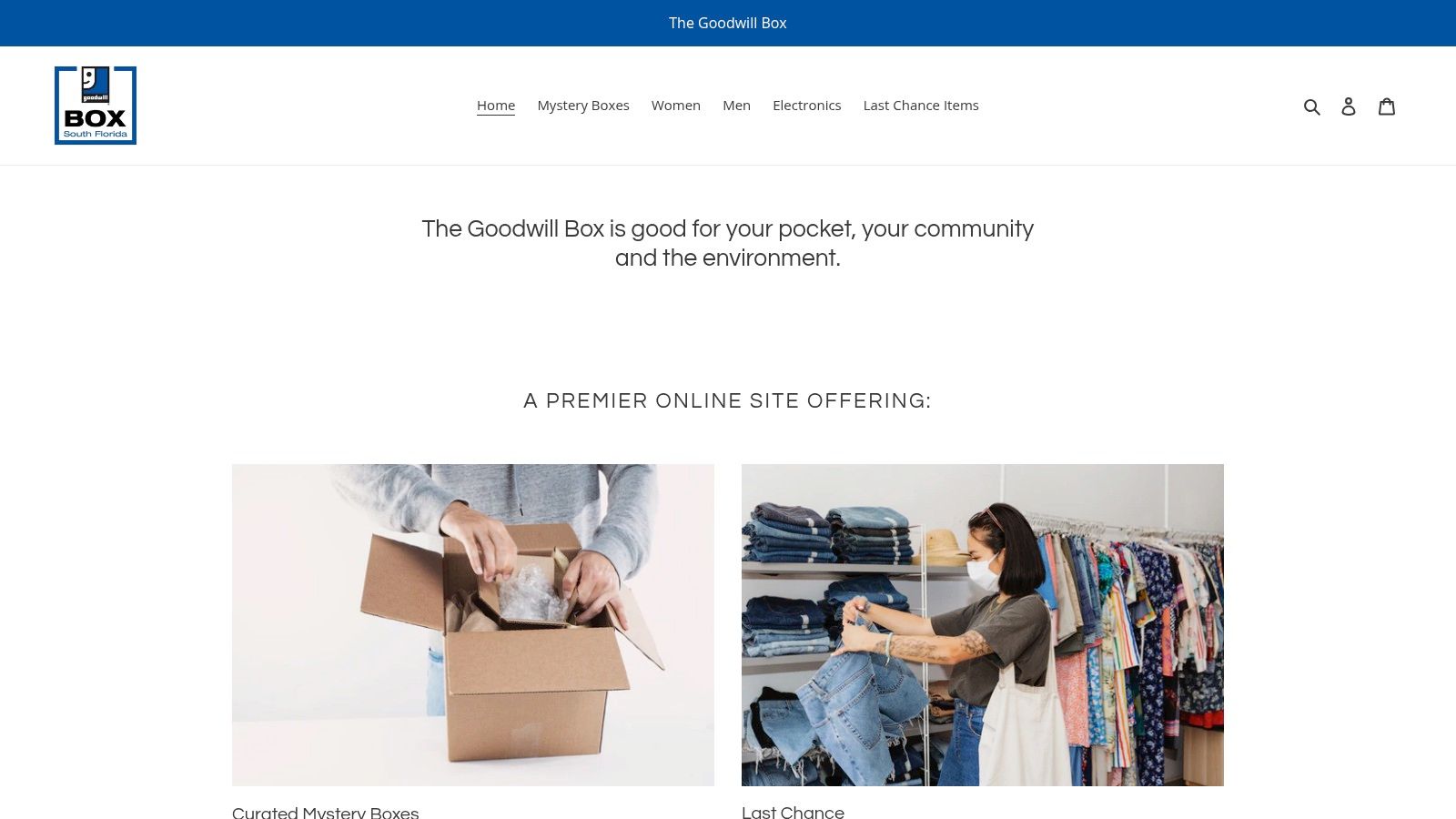
The Goodwill Box is one of the easiest entry points for resellers who want thrift store suppliers without jumping straight into auctions or pallets. The format is simple. You buy fixed-price boxes, usually grouped by category, size, or theme, and wait for the mix to arrive.
That fixed-price model matters more than people think. You're not fighting auction fever, and you can model downside before you buy. If you know your average sell-through in women's denim, graphic tees, or mall-brand basics, you can decide quickly whether a box format fits your store.
Why it works
The biggest advantage is speed. Checkout is simple, restocks are frequent, and you can test categories without committing to bale-level volume. For a reseller moving up from local sourcing, that's a cleaner transition than diving into broker-led wholesale.
A second benefit is consistency of process. Even if the contents vary, the buying workflow doesn't. That makes it useful for building intake habits, especially if you're moving from pure in-store sourcing into more structured buying. If you're still learning the difference between casual flips and a repeatable retail arbitrage workflow, this type of supplier is a manageable step up.
Practical rule: Buy mystery boxes for category testing, not for guaranteed home runs.
A few trade-offs are obvious. Mystery means mystery. Some boxes will carry the load. Others will be built on bread-and-butter pieces, and a few units may be low excitement inventory that only sells with patient listing. The best drops also sell out quickly, so you need to know your target categories before the restock goes live.
Use this supplier when you want a lower-friction way to source apparel and build batch processing discipline. Skip it if your business depends on cherry-picking every item before purchase.
2. ShopGoodwill.com
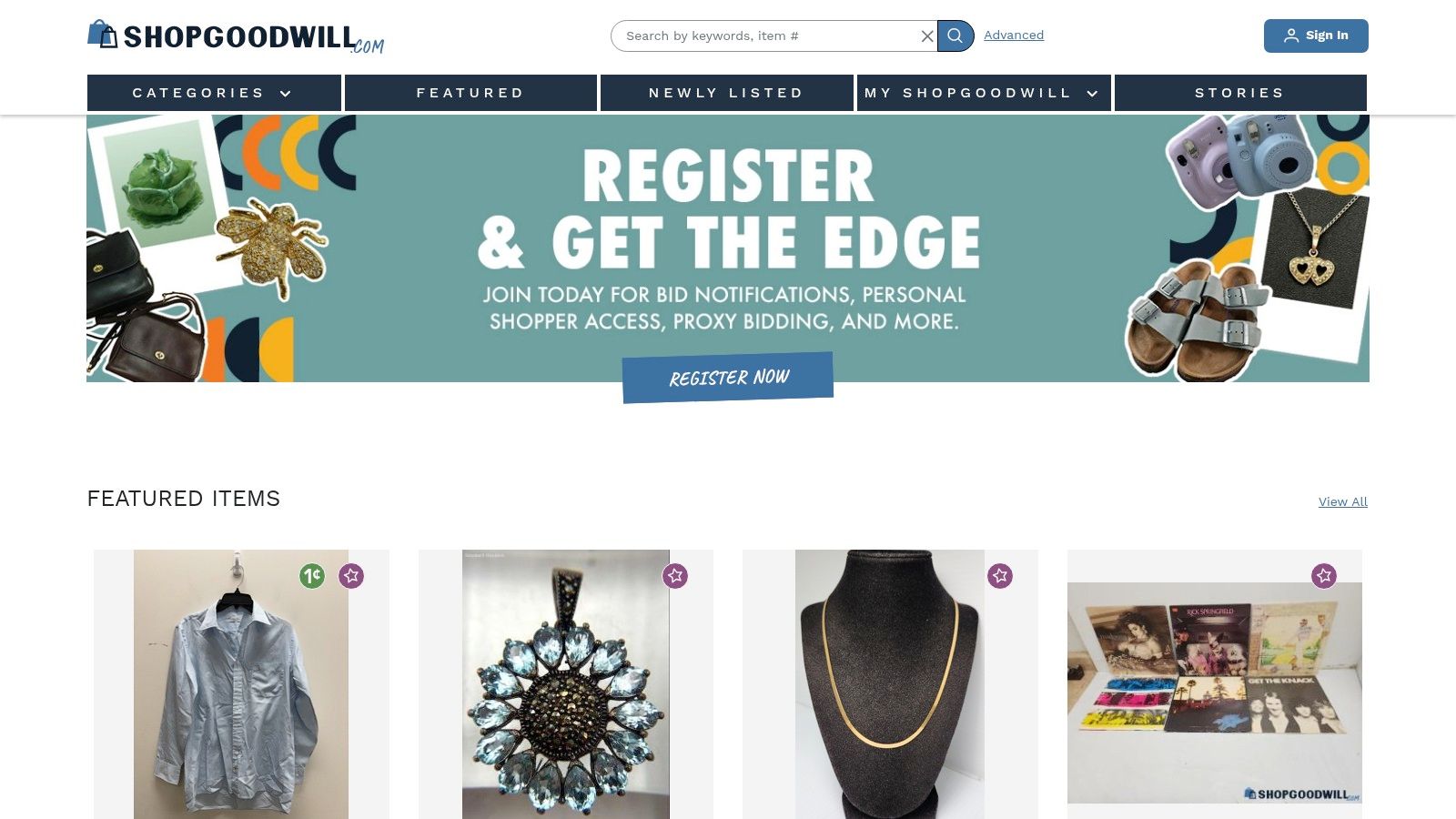
You find a listing that looks underpriced, place a bid, and feel good until checkout adds shipping, handling, and a condition surprise you missed in the photos. That is the ShopGoodwill lesson. Profit usually comes from process, not from the thrill of winning.
ShopGoodwill.com is one of the better online auction channels for resellers who can evaluate inventory fast and stay strict on margins. Because listings come from many Goodwill regions, quality is uneven. That inconsistency creates opportunity, but only for buyers who know how to read weak titles, sparse descriptions, and incomplete testing notes.
How to buy without killing your margin
Start with categories where you already know the resale spread. On this platform, broad searches invite bad buys. Narrow searches produce better results. Use model numbers, obscure subcategories, material terms, replacement-part language, and misspellings that casual bidders skip. Small electronics, media lots, hobby kits, and niche housewares often beat the obvious branded items because fewer buyers have solid comps.
Electronics can be worth the work. Analysts have projected strong growth for secondhand electronics in 2026, which helps explain why tested units and useful accessories still attract steady demand. That does not make every receiver, camera, or game peripheral profitable. It means condition grading, functionality, and shipping cost matter more than hype.
Set your maximum bid before the auction gets busy, then stop. If you raise it in the last hour, treat that as a warning sign, not a strategy.
Local pickup is where some of the best deals happen. Bulky, fragile, or awkward items get less competition when shipping is expensive or unavailable. I like those listings only when the photos are clear and the branch gives enough detail to confirm what is included. A cheap stereo without a remote, cords, or proof of testing can turn into dead inventory fast.
This supplier fits the online auction part of a serious sourcing plan. Use it when you want selective buys with upside, not boxed inventory with predictable workflow. The trade-off is time. You spend more effort vetting listings, but that extra work can produce better margins than easier sourcing channels.
3. ShopTheSalvationArmy.com
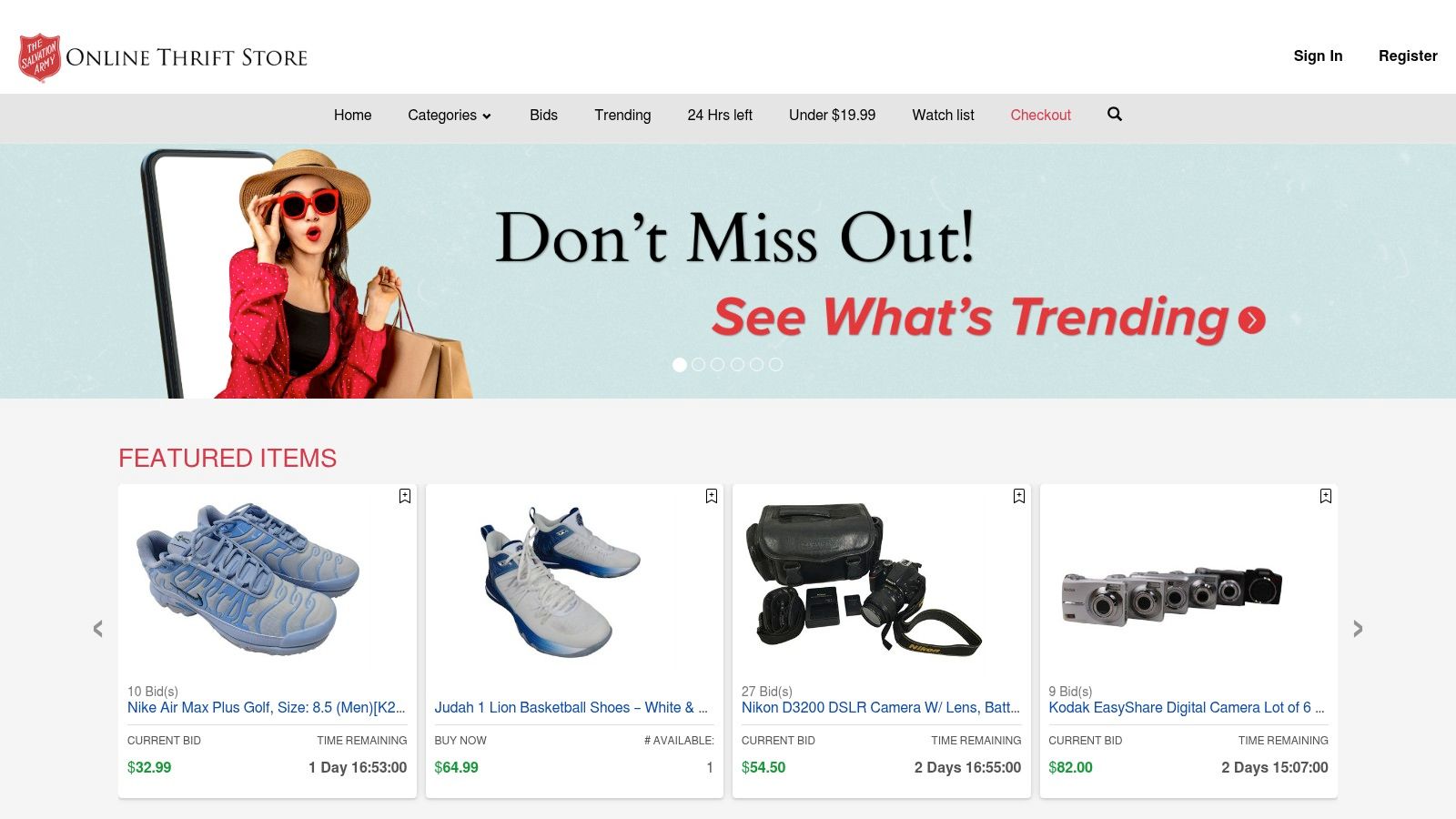
ShopTheSalvationArmy.com sits in a useful middle ground. It's an auction platform, but it often feels less crowded than the more famous alternatives. For resellers who are tired of bidding wars on obvious items, that matters.
The product mix is broad enough to reward specialization. Apparel, jewelry, instruments, and small electronics all show up, but the edge usually comes from buying in categories you already understand. Generalists can browse all day and still miss the profit because the descriptions and photos require interpretation.
Best use case
This platform is strongest when you use it as a focused lane, not a treasure hunt. Pick two or three categories, save your searches, and review listings with the same standards every time. That keeps you from drifting into “maybe” buys just because the opening bid looks cheap.
The other reason this site deserves a spot on the list is competitive density. Existing content about thrift store suppliers often confuses B2B supply with consumer thrift advice. One source notes that much of the search intent around the term leans toward reseller-style sourcing rather than owner-level supplier procurement, creating a mismatch in what buyers need from a guide like this, as discussed in OreateAI's article on thrift store suppliers. In practice, that means many smaller sourcing channels stay underused by flippers who only look at the biggest marketplace.
A few cautions apply. Shipping policies can differ by local Salvation Army unit, and testing depth isn't uniform. Some listings are clear and businesslike. Others require more guesswork than they should.
Use this one when you want nonprofit-auction inventory without the same level of crowding you'll often see elsewhere.
4. America's Thrift Supply
America's Thrift Supply is built for resellers who want recurring box drops with more structure than a blind grab bag. The appeal isn't just that they sell mystery boxes and micro-bales. It's that the assortments are usually framed in ways that help you choose a lane before you spend.
That matters if you're trying to run sourcing on a calendar instead of on impulse. A scheduled restock rhythm helps you plan cash flow, labor, and listing capacity. You know when to be ready, and you can decide in advance which categories deserve your budget.
What to watch before checkout
Themed boxes are the draw. They don't eliminate variance, but they reduce the chaos compared with totally blind lots. If you sell shoes, jewelry, toys, or a specific apparel niche, category labeling lets you keep your intake closer to what your store can process.
Here's the trade-off. Predictability at the category level doesn't mean predictability at the item level. You still need a sorting system, a defect workflow, and clear exit paths for low-fit inventory. Buyers who expect every box to align perfectly with their aesthetic usually get frustrated.
A simple way to approach this supplier:
- Use it for replenishment: Reorder only in categories where you already know your average turnaround.
- Track dud rates: Note how many units need cleaning, repair, bundling, or donation back out.
- Protect margins early: Include shipping and any optional protections in your real cost basis before you buy.
This supplier makes sense for batch-oriented resellers who want fixed-box simplicity with a bit more category control. It's less useful for people who only make money by hand-picking every single piece.
5. thredUP Rescue Boxes
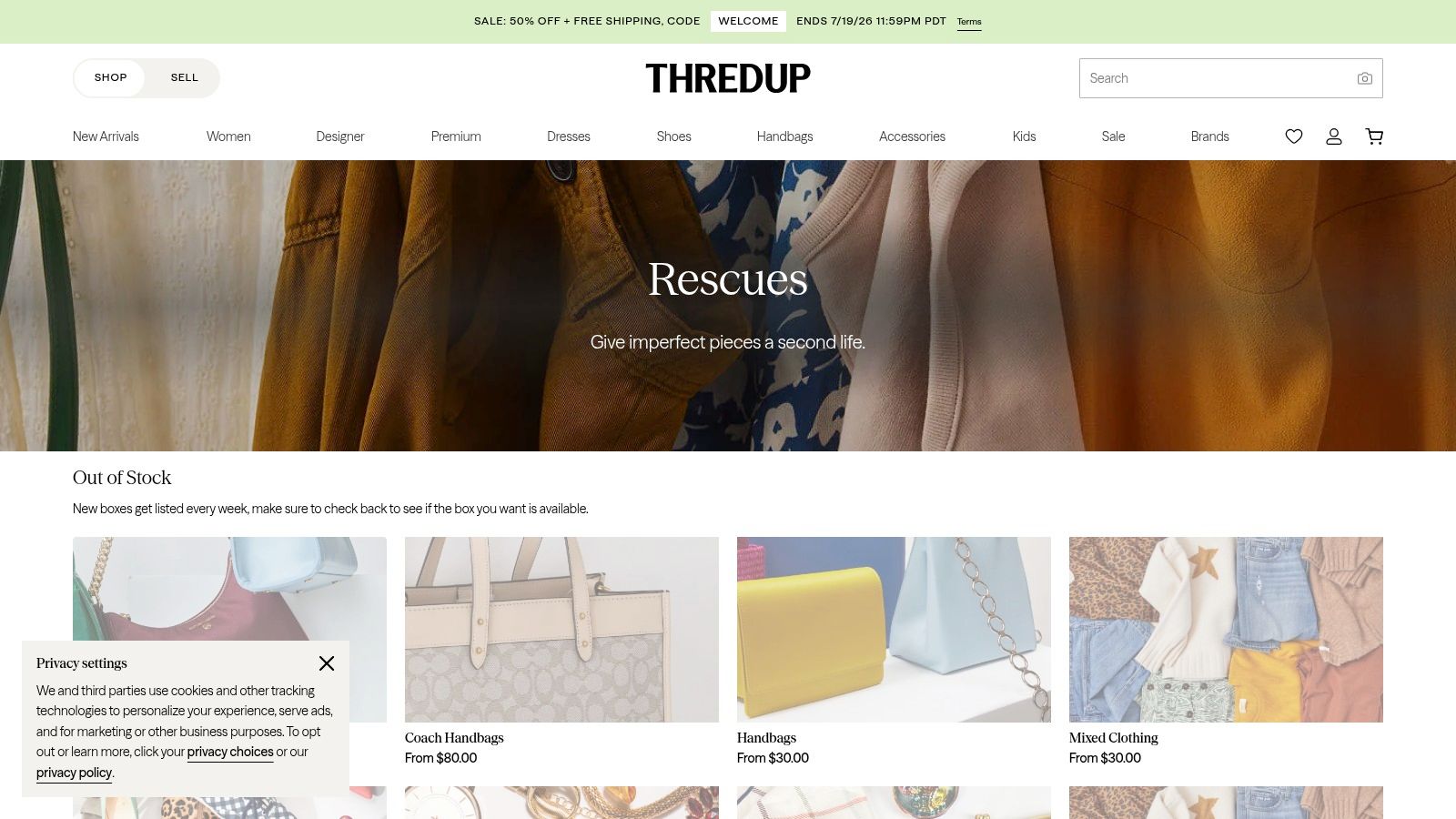
thredUP Rescue Boxes are one of the more familiar sourcing options for apparel-focused resellers, and for good reason. The box types are easy to understand. Denim, tees, handbags, mixed apparel, and DIY formats give you a rough intake profile before the package lands.
That predictability is what makes them workable at scale. You're not buying individual winners. You're buying a processing job. If your sorting, grading, and listing systems are decent, rescue boxes can keep inventory moving without requiring daily sourcing trips.
Where the profit is made
Profit usually doesn't come from one dramatic score. It comes from clean triage. Separate obvious keepers, obvious bundle pieces, stain or repair candidates, and dead stock fast. Don't let a rescue box sit half-open for days while you “get around to it.” Box sourcing punishes indecision.
This category is especially relevant because unbarcoded resale keeps growing. One data point from the background material notes that 65% of top-selling thrift categories such as shoes, collectibles, and vintage apparel are unbarcoded, discussed in this reseller workflow video reference. That's exactly why a box full of mixed apparel or accessories can slow down even experienced sellers if they rely on manual lookups.
A cleaner system is to price each item against actual demand, not guesswork. When you're working through blind apparel lots, a fast resale pricing workflow helps separate profitable singles from pieces better suited for bundles or quick liquidation.
Rescue boxes reward operators, not gamblers.
The downside is obvious. You can't cherry-pick, and shipping adds pressure to the cost basis. Still, if you already know how to process clothing quickly, thredUP Rescue Boxes remain one of the more practical thrift store suppliers for apparel-heavy resale.
6. LA Vintage Wholesale
A reseller books a warehouse appointment, walks in chasing “vintage,” and leaves with pieces that look interesting but do not fit one customer, one price band, or one listing workflow. That mistake gets expensive fast. LA Vintage Wholesale works best when you already know your lane.
This supplier suits stores built around specific eras and categories such as Y2K, denim, workwear, sportswear, and older vintage. The advantage is range. You can order online, shop virtually, or buy in person. That flexibility helps established sellers scale past local thrift runs, but it also exposes a common weakness. Buyers without a clear assortment plan tend to overbuy broad categories and tie up cash in slow movers.
Who should buy here
Buy here if your shop has a defined aesthetic and a repeatable sell-through pattern. Era-based drops, fabric-led curation, and category specialists usually get the best results because they can buy with tighter filters. A seller who knows their customer wants faded carpenter denim in a certain size spread will make better decisions here than a seller who just wants “cool vintage.”
The trade-off is quality control versus access. Online and virtual buying save time, but you give up some inspection. In-person buying gives you more control, but travel, minimums, and picking time raise your real cost per usable item. Wholesale vintage rewards operators who know their acceptable flaw rate, target margins, and repair threshold before they place the order.
Vintage also creates more identification work than standard apparel. Tags, eras, and fabric cues often matter as much as condition. If your intake team handles obscure labels or untagged pieces, a clear process for identifying vintage clothing will keep receiving from turning into a bottleneck.
The resale tailwind is real, as noted earlier in the article, but demand alone does not fix sloppy buying. Treat LA Vintage Wholesale as a category supplier, not a discovery tool. Use it after you know what sells, what flaws your buyers tolerate, and how quickly your team can sort, grade, and list each shipment.
7. Bulk Vintage Clothing
Bulk Vintage Clothing gives East Coast buyers a practical alternative to West Coast rag-house sourcing. The appeal is straightforward. Categories are clearly framed around era, style, and material, and the business supports both online orders and in-person warehouse picking by appointment.
That combination matters because vintage resellers don't all buy the same way. Some want bundles shipped to them. Others need to feel fabrics, inspect wear, and chase specific style stories in person. This supplier gives room for both approaches.
How to approach vintage bundles
The best way to buy here is with a narrow filter. Don't order “vintage” as a broad concept. Order categories that match your listing strength. Wool knits, leather, Y2K tops, made-in-USA tees, or workwear are operationally different businesses even if they all sit under the vintage umbrella.
Visual identification also becomes more important here than it is with barcode-heavy inventory. Vintage sellers spend too much time guessing labels, eras, and style-specific comps. If you handle untagged or obscure pieces often, a fast tool for identifying vintage clothing can keep intake moving without constant app switching.
The more specific your niche, the more useful this kind of supplier becomes.
The trade-off is that category labeling still won't guarantee every unit fits your shop. Vintage always carries aesthetic drift. Some pieces will be strong. Some will be just fine. Some belong in lower-tier live sales, bundles, or wholesale back out.
Bulk Vintage Clothing is best for sellers who already understand how to merchandise vintage in subcategories, not just as a vague trend.
8. Raghouse
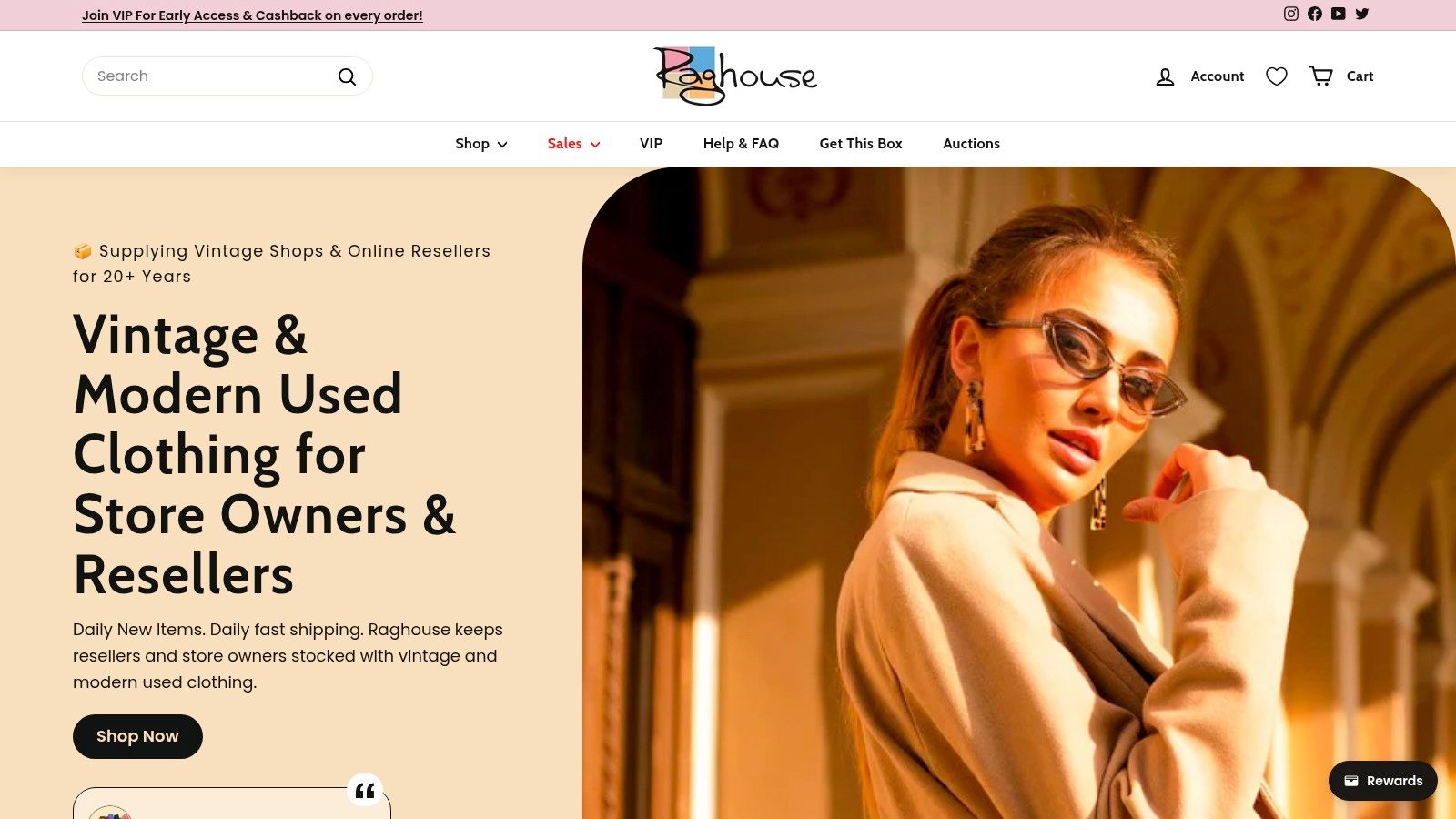
Raghouse fits sellers who already know their sell-through and need inventory on a schedule, not whenever local thrifts happen to be good. This supplier belongs in the bulk wholesale lane of your sourcing strategy. The appeal is consistency, category access, and ordering by weight instead of chasing one-off finds.
That shift matters once a resale business has real throughput. If your listers, photographers, or live sale team need fresh units every week, random sourcing creates gaps. A raghouse model gives you a steadier intake rhythm, which makes staffing, cash planning, and listing targets easier to manage.
The upside is simple. You can place orders online, stay inside your category, and reorder if the mix works for your business. That is a very different job from negotiating lot by lot through brokers or trying to piece together inventory from auctions, mystery boxes, and store visits.
The trade-off shows up after delivery. Bulk used clothing only works if your back end is tight. You need space to stage goods, a clear grading standard for your own team, and a fast process for defects, odors, laundering, steaming, measuring, and routing lower-value pieces to the right channel. Without that, cheap inventory turns into expensive backlog.
I'd treat Raghouse as a supplier to test with discipline. Start with one or two categories you already move well. Track cost per pound, usable yield, average sell-through time, and how much labor each order creates. If those numbers hold over a few buys, then increase volume.
Raghouse is a strong option for sellers solving a supply problem. It is a poor choice for sellers still trying to figure out what their customer wants.
9. Bank & Vogue

Bank & Vogue plays at a different level from box sellers and casual wholesale sites. This is a large-scale secondhand wholesaler and broker with logistics capabilities that matter if you buy in serious volume.
What stands out is scope. The inventory isn't limited to apparel. Shoes, belts, purses, and accessories can all be part of the load, which is useful if your resale business crosses categories or if you're supplying multiple sales channels.
How to contact them like a real buyer
A supplier like this responds better when you sound like an operator, not a browser. Don't open with “What do you have?” Open with quantity, grade, category, and frequency. If you don't know those yet, you're probably not ready for this tier.
A practical outreach message includes:
- Your category: Women's denim, mixed shoes, handbags, or sorted accessories.
- Your volume: Monthly weight, pallet count, or container interest.
- Your grade tolerance: Whether you want cleaner resale-ready inventory or can absorb lower grades.
- Your destination: Where inventory is shipping and whether repeat routes matter.
This supplier makes sense for buyers who want repeatable logistics, customizable loads, and fewer surprises in fulfillment. It doesn't make sense if you're still testing whether you can move bulk product at all.
Bank & Vogue is one of the stronger thrift store suppliers for established operations. Beginners can still reach out, but they should expect quote-based conversations and minimums that may be above their comfort zone.
10. A&E Clothing Corporation
A&E Clothing Corporation suits the reseller who is ready to stop buying one mystery box at a time and start sourcing by bale, grade, and category. A shipment lands, you cut it open, and your margin depends less on luck than on how well you specified the order and how fast your team can process it.
A&E is a long-running used clothing grader and wholesaler in New Jersey. The buying process reflects that background. You contact them, explain what you need, and get quotes based on business variables such as product type, grade, and volume. There is no polished retail storefront guiding the decision for you, which is often a good thing for serious buyers.
That format forces discipline. You have to know whether you need credential-style product, sorted used clothing, lower grades for bundle sales, or rag and salvage output for secondary channels. If you cannot describe your buyer, your sell-through speed, and your tolerance for defects, bale sourcing will expose that quickly.
Where it fits in a sourcing stack
A&E makes the most sense for resellers who want a step up from consumer-facing thrift store suppliers but are not ready for full container buying. It is also a practical option for Northeast and Mid-Atlantic operators who care about freight distance and want a supplier built around wholesale conversations instead of cart-based checkout.
A key advantage is control. Online auctions are good for cherry-picking. Mystery boxes are useful for testing categories. Bulk wholesalers like A&E are where you start building repeatable inventory flow. That matters if you run Whatnot shows, refill flea market booths, supply a vintage rack, or move volume through local reseller networks.
There is a trade-off. Bale buying creates labor. You need space, a sorting system, and clear rules for what gets listed, bundled, donated, recycled, or sold by the pound. Returns are limited in this part of the business, so the vetting work happens before you place the order and again the moment freight arrives.
My rule with suppliers like this is simple. Ask for grade definitions, expected category mix, minimum order sizes, and photos or video of current lots if available. Then place a test order that is large enough to reveal the actual average quality, but small enough that one weak shipment does not tie up your cash.
A&E works best for buyers who want to professionalize sourcing. If local thrift runs are getting inconsistent and mystery boxes no longer give you enough volume, this is the kind of supplier that helps you build a real intake process instead of chasing one-off finds.
Top 10 Thrift Store Suppliers Comparison
| Supplier | Inventory type & format | Target reseller / use case | Key benefits (USP) | Order model & price notes |
|---|---|---|---|---|
| The Goodwill Box (Goodwill South Florida) | Fixed‑price mystery apparel boxes (commonly 10 pcs); occasional hard goods | Upcyclers & resellers who want ready‑to‑ship mixes | Fixed pricing, frequent restocks, supports nonprofit mission | Fixed‑price boxes; variable value mix; fast sell‑outs |
| ShopGoodwill.com | Timed auctions across broad categories (luxury, electronics, collectibles, apparel) | Resellers targeting higher‑value finds nationwide | Large, daily supply; auction history & saved searches for comps | Auction bids; shipping varies by seller; margins can compress |
| ShopTheSalvationArmy.com | Auction‑based donated goods with category browsing | Buyers seeking less‑competitive auctions and mission‑driven sourcing | Often lower competition; nonprofit provenance | Timed auctions; local pickup/shipping policies vary |
| America's Thrift Supply | Themed micro‑bales and 5–10 lb mystery boxes; scheduled restocks | Resellers needing predictable cadence and themed assortments | Scheduled drops, themed boxes reduce blind‑buy risk | Scheduled restocks; nationwide shipping; purchase protection limited |
| thredUP Rescue Boxes | Category‑specific rescue boxes (Denim, Tees, Handbags, etc.) | Scalability‑focused sellers wanting frequent large drops | Predictable categories, national brand mix, sustainability angle | Fixed bundles; frequent availability; shipping increases cost basis |
| LA Vintage Wholesale | Curated vintage mixes, era/style lots; warehouse appointments | Vintage specialists and high‑volume buyers (Y2K/earlier eras) | Rag‑house access, era‑specific stock, container fulfilment | Online ordering + in‑person appointments; wholesale minimums |
| Bulk Vintage Clothing | Bundles/weight by era/style; in‑person picking or online orders | East‑coast vintage buyers targeting niche eras/styles | Clear category labeling; in‑person picking option | Online or appointment purchases; U.S. shipping; variable condition |
| Raghouse | Bulk lots sold by weight with reseller‑focused assortments | Sellers needing predictable, ongoing replenishment | Predictable supply, business‑friendly assortments, fast shipping | Bulk purchases by weight; requires storage and capital |
| Bank & Vogue | High‑volume wholesaler/broker; customizable loads & logistics | Professional resellers, graders, circular brands with scale needs | End‑to‑end logistics, customizable loads, reliable delivery windows | Quote‑based pricing; pallet/container minima; account setup |
| A&E Clothing Corporation | Bulk bales by grade (mixed rags → premium); distribution & export | Regional buyers, exporters, beginners to large buyers | Long industry track record; regional sourcing consistency | Quote/order by bale/grade; upfront QC needed; limited returns |
Your Playbook for Profitable Wholesale Sourcing
Finding a supplier is only the first move. The actual profit comes later, when you control what you buy, how you process it, and how fast you turn it into cash. Resellers lose money with thrift store suppliers in three common ways. They buy categories they haven't validated, they underestimate labor, or they let shipping and defects distort their cost basis.
The strongest suppliers in this list serve different stages. Fixed-price boxes help you test categories with lower operational drag. Auctions reward research-heavy buyers who can comp quickly and stay disciplined. Rag houses and bale wholesalers make the most sense once you have storage, labor, and a repeatable sell-through pattern. If you pick the wrong model for your current stage, even a good supplier turns into expensive clutter.
Vetting Your Next Supplier
Before you place a first order, do basic due diligence. Check reseller forums and seller communities for pattern-level feedback, not one-off rants. Look for comments about packaging, description accuracy, communication speed, and how the supplier handles damaged or clearly unsellable goods.
Then get specific. Ask about shipping timelines, whether local pickup exists, how grades are defined, and whether photos are representative or purely illustrative. If the supplier sells mystery boxes, assume variety. If they sell sorted wholesale, ask what “sorted” means in practice.
A simple rule helps here. Don't make a large first order to “save time.” Make a small first order to buy information. The first transaction tells you how they pack, how they communicate, and whether the inventory style matches your business.
Buy the test order to learn the supplier, not to hit a home run.
Triage Bulk Buys with ScanFlip AI
Once inventory lands, speed matters. Many professional resellers don't lose money because the supplier was terrible. They lose money because the intake pile sits too long, mixed grades don't get separated fast enough, and research drags across too many apps.
That's where ScanFlip AI fits. It uses camera-based identification for shoes, apparel, collectibles, electronics, and accessories, so you're not stuck when a piece has no barcode or missing tags. That matters because barcode-free and vintage-heavy categories are a real part of modern resale, and manual lookup burns time fast.
ScanFlip AI also aggregates sold comps across marketplaces including eBay, Poshmark, Mercari, Depop, Amazon, and Whatnot, with Marketplace and TikTok Shop coverage noted on site. More important, it doesn't stop at gross comps. The app calculates expected net profit after fees, shipping estimates, and your buy cost, then gives you a clear buy-or-pass signal based on your minimum profit or margin threshold.
That changes how you process bulk. You can sort faster, identify strong singles sooner, and push weak items into bundle, live sale, repair, or donate-back piles before they clog your workflow. Saved scan history with photos, locations, and comps also helps you review sourcing decisions later and spot patterns in what you sell well.
Contacting Wholesalers A Template
When you reach out to a quote-based wholesaler like Bank & Vogue or A&E Clothing Corporation, keep the email short and businesslike. Subject line: “Wholesale Inquiry | Your Store Name.” Then tell them exactly what you buy.
A strong message looks like this: “I'm looking to purchase women's vintage denim on a recurring basis. Please share current availability, grade options, minimum order requirements, and shipping terms to my location.” If you buy by weight or pallet, say so. If you need specific categories only, say that too.
Weak outreach gets weak replies. “What do you have available?” tells a wholesaler you're browsing. A clear request tells them you understand inventory, and that usually gets you better information faster.
The goal with thrift store suppliers isn't to find one magic source and stop. It's to build a sourcing stack. Maybe that means auctions for hard goods, rescue boxes for apparel, and one bale supplier for steady replenishment. Maybe it means local thrifting still fills gaps while wholesale handles core inventory. The right mix is the one that matches your margin targets, storage limits, and listing speed.
If you want faster buy-or-pass decisions while sourcing or sorting bulk inventory, try ScanFlip AI. It helps resellers identify items from photos, pull real-time sold comps across major marketplaces, and calculate expected net profit after fees and shipping so you can move from guesswork to cleaner sourcing decisions.