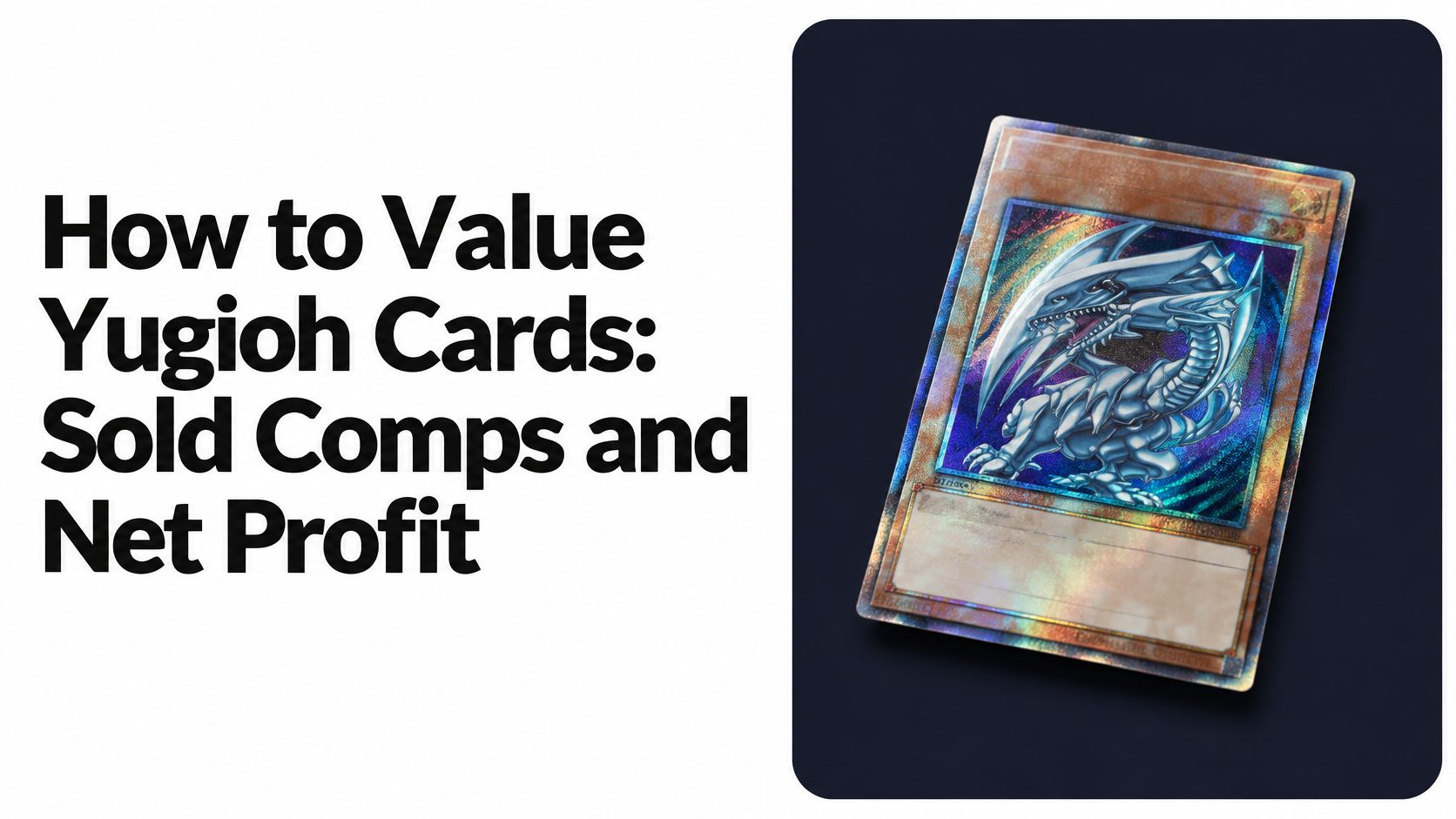

How to Value Yugioh Cards: Sold Comps and Net Profit
You're at the Goodwill counter with a stack of Yu-Gi-Oh! cards, and the shiny one on top looks like it could pay for the whole pile. Your phone shows a strong sold comp, but the tiny set code doesn't match. That's where a cheap buy becomes expensive inventory.
Learning how to value Yu-Gi-Oh! cards means answering a sourcing question, not just finding a market number: what will this exact copy realistically put in your pocket after the sale?
Table of Contents
- Identify the Exact Printing Before You Price It
- Score the Condition Before You Trust a Comp
- How to Pull Sold Comps You Can Trust
- When Grading Pays and When It Doesn't
- Work Out Net Profit After Fees and Shipping
- Make the Buy or Pass Call Before You Pay
Identify the Exact Printing Before You Price It
Two copies of the same card name can land in completely different price brackets, and the only thing separating them is a set code and a foil pattern. That gap is where sourcing decisions get made.
Take Linguriboh. Konami's official card database lists RA05-EN056 from Rarity Collection 5 in Super Rare, Ultra Rare, Secret Rare, Ultimate Rare, Platinum Secret Rare, and Collector's Rare versions. Searching only the name blends six distinct printings into one comp pool, and the average that comes back matches none of them.
A recognizable card name is the start of identification, not the finished match.
Match the release and the treatment
Find the set code near the lower-right area of the artwork, then verify it against the database. Check the language code, edition text, and foil treatment rather than trusting the seller's handwritten label.
Rarity is printed on the card face, so read it there first, then confirm that printed rarity and the foil treatment against the set-code record in Konami's database before you settle on a comp group. The confirmation step matters because the same rarity name doesn't always look the same across releases. Tilt the card under light and check whether the name, artwork, background, or surface carries the foil or texture, since a straight-on photograph hides that distinction.
The stakes can run high. The Yu-Gi-Oh! Card List price guide valued Blue-Eyes White Dragon, Dark Duel Stories, DDS-001, Prismatic Secret Rare, at approximately $1,450.56, while other Blue-Eyes printings were worth substantially less.
That's a guide reference, not a promise for the copy in your hand. Rarity alone doesn't settle value either: an older, scarcer printing with a modest rarity can outperform a newer premium treatment.
What to record on every card before pricing it
| Field | Where to Find It | Why It Changes the Price |
|---|---|---|
| Set code | Lower-right area of the artwork, for example RA05-EN056 | Separates the exact release from reprints and other sets |
| Rarity | Printed on the card face; confirm the printed rarity and foil treatment against the set-code record | Ultra Rare, Secret Rare, and Collector's Rare versions belong in different comp groups |
| Edition | Edition text on the card; record 1st Edition, Unlimited, or Limited status | First-edition prints can carry a premium over later runs |
| Language | Language identifier within the set code and the card's text | Different language prints have different demand and sale histories |
| Finish | Foil, holo, or texture on the card face | A finish change can put the card in a different comp group |
| Condition or grade | Raw condition, or the label of a graded slab | Raw and graded sales can't be mixed into one valuation |
At an estate sale, photograph the front and a readable close-up of the set code before separating cards into buy and pass piles. Confirm the printing in Konami's database, then pull comps. Two minutes on the database is cheap next to the alternative: paying premium-version money for a copy that belongs in the bulk box. If you can't identify the finish confidently, don't pay the premium-version price.
Score the Condition Before You Trust a Comp
A shiny card can look clean inside a cloudy sleeve and turn into a played copy once you inspect it under bright light. Edge whitening, foil scratches, and a crease across the back aren't listing details to worry about later. They change your buy price now.
For an illustrative sourcing calculation, suppose you pay $8 against a $45 Near Mint comp. Using hypothetical fees of 14% and $4.50 shipping, you'd expect $26.20 net after the buy. If your played copy realistically sells for $22, the same calculation becomes $22 − $3.08 − $4.50 − $8 = $6.42, before supplies.
That gap is why you shouldn't grade condition through optimism. A supposedly Near Mint card may belong closer to Lightly Played after honest inspection.
Inspect outside the sleeve
With permission, remove the sleeve and photograph the front, back, corners, and foil surface. Tilt the card so reflected light reveals scratches, indentations, and bends that disappear in a flat photograph.
TCGplayer's Yu-Gi-Oh! trend methodology can restrict analysis to Near Mint copies with at least ten sales during a defined window, so its reported values shouldn't automatically transfer to a worn copy. Volume filters also matter: a price supported by repeat transactions is more useful than an isolated result.
The same condition-first discipline applies when checking baseball card values: match the physical copy, not the most flattering comparable.
Condition rule: When the strong comp is Near Mint and your card is visibly played, treat that number as upside, not your expected sale.
Condition tiers and the comp to use for each
Use this as a sorting guide, then apply the marketplace's condition standards. Creases, water damage, and other structural defects may require a damaged designation rather than a played tier.
| Condition | What You See | Comp to Use |
|---|---|---|
| Near Mint | Sharp corners, clean edges, no visible surface wear | Near Mint sold comps only |
| Lightly Played | Minor edge whitening or light scratches under bright light | Lightly Played sold comps, or a defensible discount from Near Mint |
| Moderately Played | Visible scratches, whitening, or a light crease requiring closer classification | Moderately Played sold comps; if none, treat Near Mint as upside only |
| Heavily Played | Creases, bends, heavy scratching, or stains | Heavily Played or damaged sold comps; often bulk value |
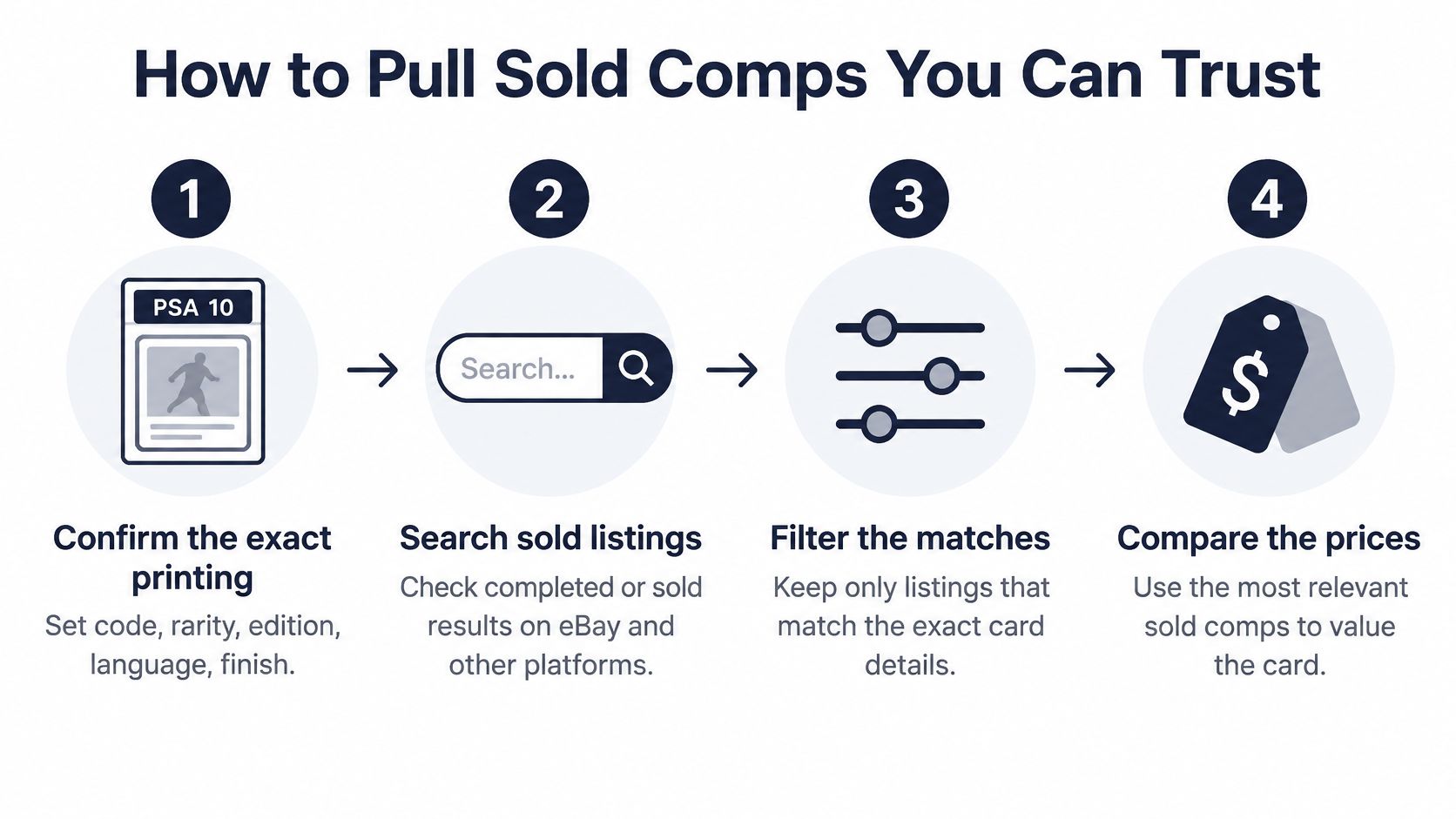
How to Pull Sold Comps You Can Trust
A useful comp is a completed transaction for something you could sell as equivalent. Active asking prices show what sellers hope to get, not what your buyer will pay.
The Hobby Card Index sold-comps guide recommends evaluating individual transactions when there are one to five comparable sales, and averaging only with roughly twenty or more comparable sales in the relevant ninety-day period. That's a practical sourcing rule, not permission to average mismatched copies.
Run a repeatable search
Confirm the exact printing. Include the set code, rarity, edition, language, finish, and artwork in your match. A correct name with the wrong release is still the wrong product.
Search completed or sold results. Use eBay and the platforms where you intend to sell, because marketplace context affects the exit you can reasonably expect. An eBay sold-listings search is useful only after you've narrowed the product.
Filter condition and sale format. Separate fixed-price transactions from auctions, and raw cards from graded copies. Keep grading companies and grades distinct rather than treating every slab as equivalent.
Remove demonstrably bad matches. Exclude misidentified printings, bundles, and transactions with materially different condition. Investigate unusually high or low results instead of deleting them just because they don't support your preferred price.
Count the relevant sales. With a thin sample, inspect seller context and give more weight to recent private-seller transactions. For the intermediate band, use the median and record the spread rather than letting an extreme result dominate.
Record the supported range and dates. Save enough detail to explain your valuation later, including whether shipping was included. A Best Offer result may hide the accepted amount, so don't assume the visible crossed-out figure was the actual sold price.
The compact workflow looks like this:
Choose a number the evidence supports
| Comparable sales in the review window | How to use them |
|---|---|
| One to five | Read each transaction individually; prioritize relevance and recency |
| Six to nineteen | Use the median and note the lowest-to-highest spread |
| Roughly twenty or more | Average comparable results after checking outliers |
A broad market number is a cross-check, not a replacement for this work. Market aggregates can combine information that doesn't match your copy closely enough for a buy decision.
Don't mix an auction with poor photographs into fixed-price results without considering why it sold differently. Likewise, a premium seller's result may not be immediately repeatable from your account.
If you can't identify the exact printing behind a comp, it doesn't count. At a garage sale, uncertainty should reduce your offer, not increase your willingness to gamble.
When Grading Pays and When It Doesn't
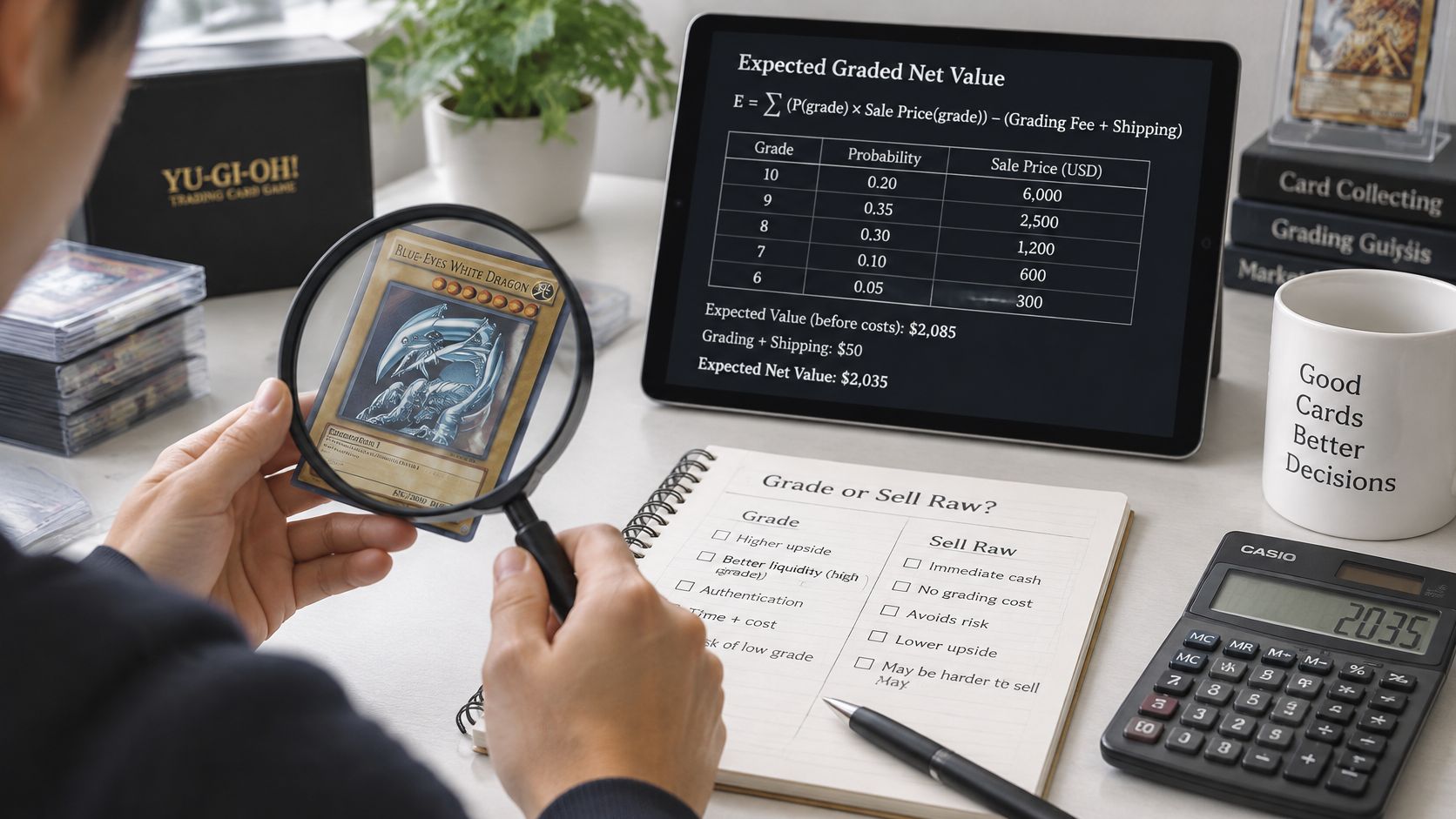
The myth is that a strong PSA 10 sold price makes grading worthwhile. It doesn't if your card is more likely to receive a lower grade, or if submission costs consume the premium.
Consider this hypothetical example: the most probable outcome is a PSA 9 selling for $40, while the headline PSA 10 sold comp is $90. If grading costs $25 and round-trip shipping and insurance add $10, the likely graded path leaves $5 before selling fees and cost of goods. A $30 raw Near Mint sale leaves more before those shared deductions.
Evaluate the copy before paying for the possibility of a better label.
Calculate the likely outcome
Misprint's Yu-Gi-Oh! grading guide treats submission as an expected-value decision: sum each grade's probability multiplied by its grade-specific sold price, then subtract grading, shipping, insurance, selling fees, and a return or liquidity allowance.
Compare that result with the raw-sale alternative on the same basis. Subtract acquisition cost from both paths when calculating profit, and account for the additional time your cash will be tied up.
Inspect centering, surface, edges, and corners conservatively. Don't make a submission budget around the best grade the card could possibly receive.
A grading premium only helps when you're likely to receive it and can keep enough of it after costs.
Use population reports as a cross-check
A low population isn't proof that collectors can't find the card. Owners may have little reason to submit it, while a large graded population can limit the scarcity premium.
Check authenticity before doing grading math. Compare font, positioning, and apparent card stock against authentic references using high-resolution photographs; unresolved concerns belong in the pass pile.
Set the required margin before buying. Grading should improve a defensible deal, not rescue one that only works at the headline grade.
Work Out Net Profit After Fees and Shipping
A $30 card that cost $3 at a garage sale looks profitable until you run the full exit. At a 14% marketplace and payment fee, the fee takes $4.20. Add $5 for shipping and supplies, and the card nets $17.80. TCGplayer's Market Price explanation describes its market measure as transaction-based and designed to avoid distortion from outliers, but the gross number is not your take-home.
For the three price points below, fees are modeled at 14%, not presented as a universal platform rate. Check the current fee schedule for your category and account, then enter your actual shipping method rather than a convenient guess.
Net profit at the same fee and shipping assumptions
| Card | Sold price | Fees at 14% | Shipping and supplies | Buy cost | Net profit |
|---|---|---|---|---|---|
| $30 card | $30.00 | $4.20 | $5.00 | $3.00 | $17.80 |
| $75 card | $75.00 | $10.50 | $5.00 | $10.00 | $49.50 |
| $18 card | $18.00 | $2.52 | $5.00 | $2.00 | $8.48 |
The $5 shipping figure is a planning number, not a quote for every order. Packaging, tracking, insurance, and order value can change the method you choose. The fixed $5 hurts the $18 card most: shipping and supplies consume about 28% of the sale before fees.
Price the exit, not just the card
A $75 card returning $49.50 looks stronger than an $18 card returning $8.48. That gap only matters if the expensive card sells. When buyers rarely transact, the cheaper card can be the better inventory buy because it returns cash sooner. I would rather take a lower net per card on repeatable sales than park money in one slow listing.
Sell-through rate, or STR, is the share of listed units sold within a set window, such as a 30-day review period. Keep the product definition and window consistent; mixing bulk lots, raw singles, and slabs makes the comparison useless.
For a low-STR card, cut the price you underwrite or demand a cheaper acquisition cost. Leave room for a negotiated Best Offer instead of assuming you collect the full visible comp.
Cash-flow check: Compare expected net dollars per week of capital tied up, not just net per card.
A broader resale-pricing workflow helps keep fees, cost of goods, and shipping separate. ROI matters, but a striking ROI on inventory you can't move won't fund the next sourcing trip.
Make the Buy or Pass Call Before You Pay
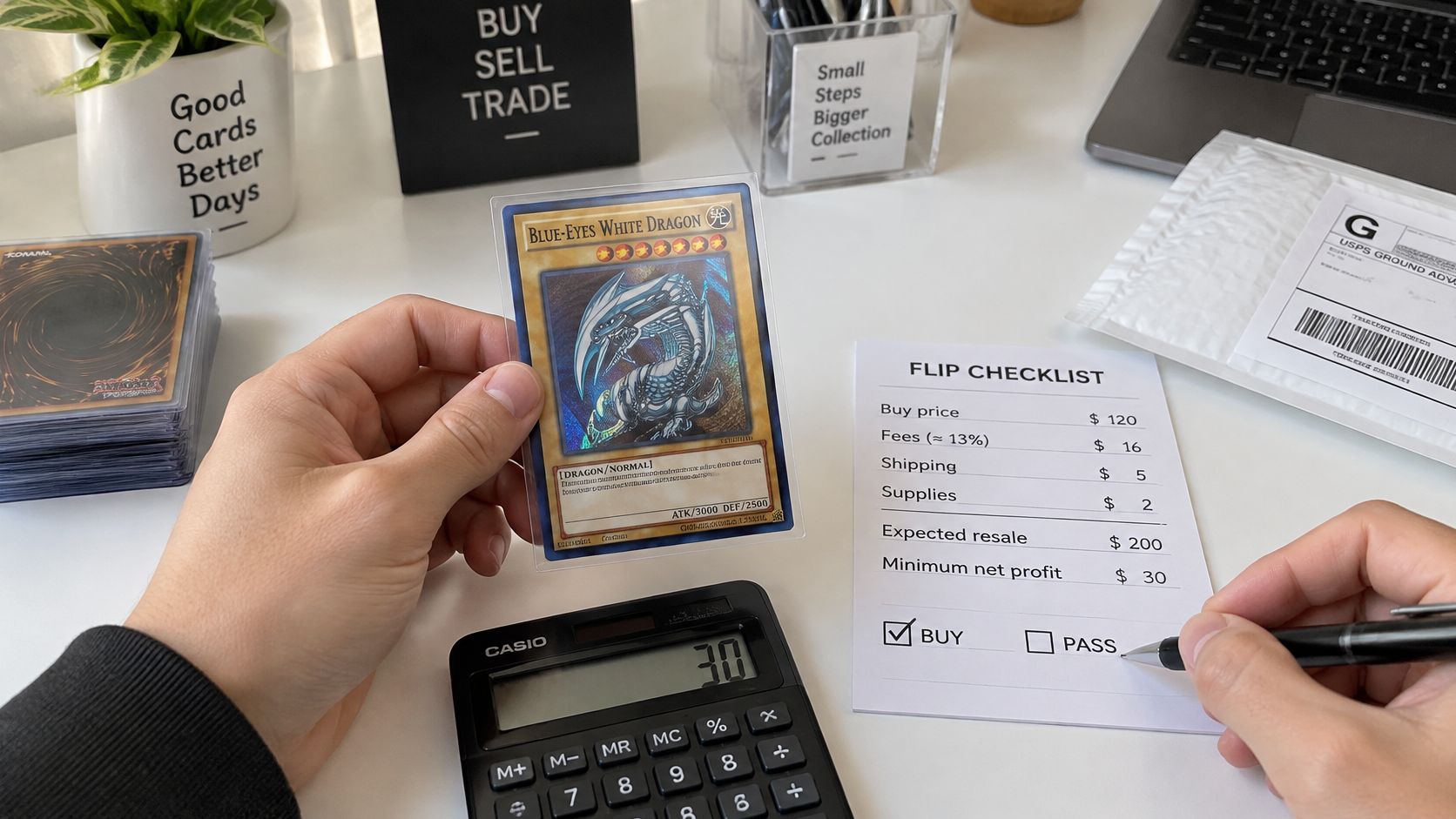
Set a minimum before you start sourcing. For an illustrative threshold of $5 net per card, a deal either clears that amount after expected costs or it doesn't. Don't lower the standard because you've already spent time digging through the bin.
Bulk deserves particular skepticism. The TCGrate Yu-Gi-Oh! index reports that 71% of 58,436 priced printings sell for under $1. That describes its tracked printings, not every thrift-store box, but it's a useful warning against paying collectible prices for a pile of recognizable names.
Ask yes-or-no questions
- Printing confirmed? You can identify the actual release and treatment.
- Condition supported? Your photographs justify the tier you're using.
- Sales evidence usable? The transactions support a realistic range.
- Minimum cleared? Expected net exceeds your preset threshold.
- Exit available? Recent buyer activity supports taking on the inventory.
A batch isn't a buy merely because a promising card is somewhere inside it. The valuable copies need to justify the batch cost and sorting time without assigning imaginary profit to the leftovers.
Use a physical check before committing your sourcing money.
Finish the decision at the counter
At the counter, ScanFlip AI offers AI photo scanning without a barcode, barcode scanning, and text search, with sold comps across eBay, Poshmark, Mercari, Depop, Amazon, Whatnot, ThredUp, Facebook Marketplace, and TikTok Shop. Its net-profit calculation accounts for fees, shipping, and buy cost, while the red/green Flip or Pass Verdict applies your minimum profit setting; verify the exact card match before relying on the result.
Use that for the sourcing decision. Resellers can use tools such as Vendoo or List Perfectly alongside it for their selling workflow.
A card is worth buying when its expected net, based on the exact printing and matched condition, clears the minimum you set before walking in.
Before paying for the next stack, photograph the strongest candidate and check its exact printing, sold comps, and expected net. Visit ScanFlip AI to use photo, barcode, or text search and a profit-based flip-or-pass verdict while the decision is still yours to make.