


Mercari Profit Calculator: How to Work Out Real Net Profit
You're standing in a Goodwill aisle with a jacket in your cart. The tag says $8, sold comps look solid, and your brain's already spending the profit.
That's exactly where a good buy turns into death pile math. Mercari doesn't just take a cut of the item price. Who pays shipping, what the packed box weighs, and whether the buyer opens a claim can change what you end up keeping. Run the Mercari profit calculator math before you pay, not after the payout hits.
Table of Contents
- The Mercari Net Profit Formula at a Glance
- Which Mercari Fee Applies to Your Listing
- Shipping Weight and Label Risk to Build In
- Shipping Payer Scenarios From Thrift and Clearance Finds
- Returns and Tax Records That Shrink Real Margin
- Confirm the Net Before You Pay at the Register
The Mercari Net Profit Formula at a Glance
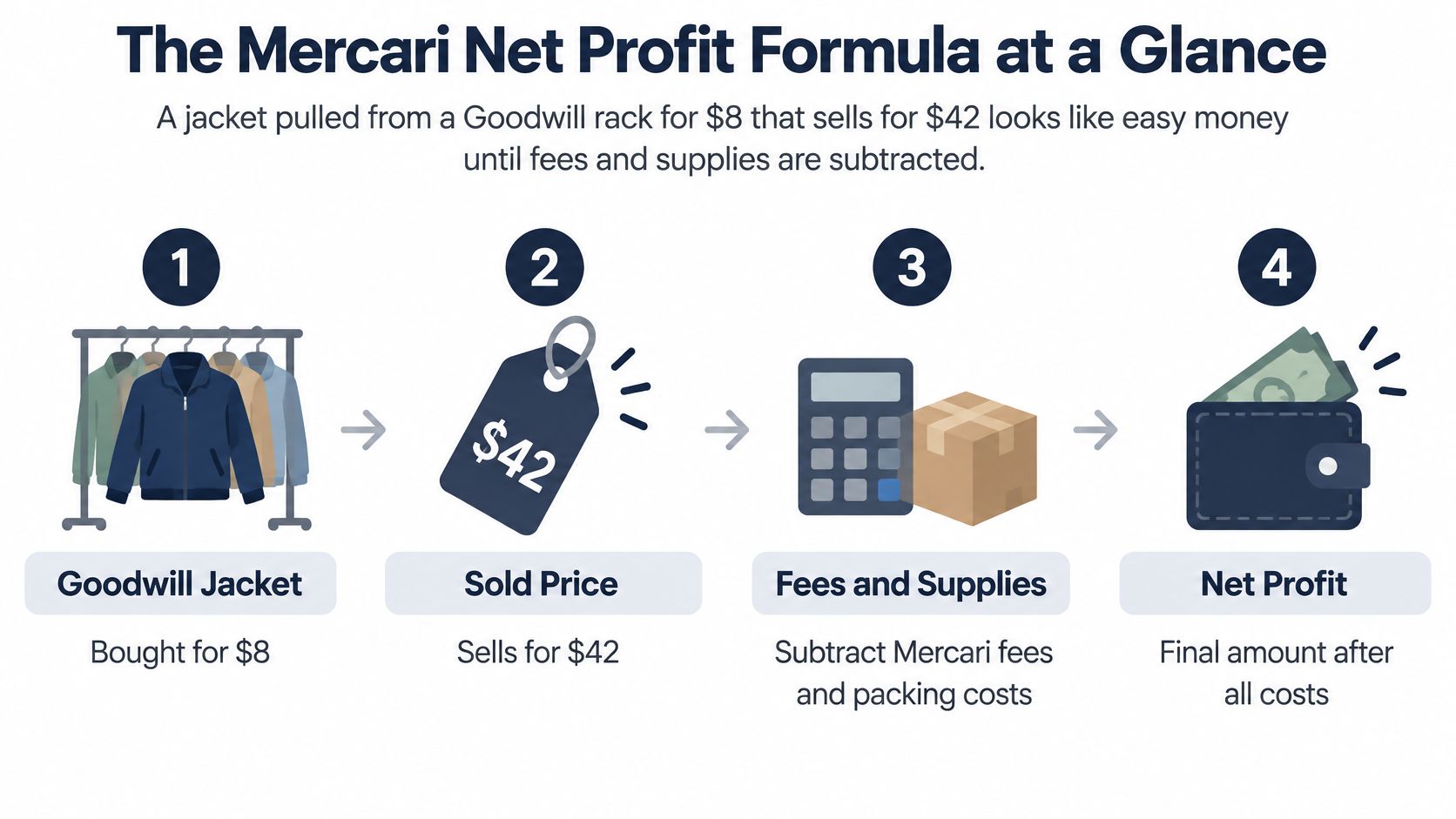
Say you pull that jacket for $8 and it sells for $42. On paper that's a $34 spread. In real life, Mercari's fee and your supplies come out first.
The sold price you should use is the final completed price, not what you originally listed it for. If you list high and accept an offer, the offer is the number that matters. Use recent sold comps for that input, never another seller's hopeful asking price.
The Formula You Can Copy Into Your Phone
Net profit = sold price − Mercari fee − seller-paid shipping − cost of goods − supplies
Buyer-paid shipping is the line that trips people up. It's a pass-through to the carrier, so you don't subtract it like a label you paid for. But it still sits in the fee base, so it makes the Mercari fee a little bigger.
| Line item | How to calculate it | Example value |
|---|---|---|
| Sold price | Final completed item price, not the original list price | $42.00 |
| Buyer-paid shipping | Added to the fee base and passed through to the carrier | $6.00 |
| Mercari selling fee | 10% of (sold price + buyer-paid shipping) | $4.80 |
| Seller-paid shipping | Deducted only when you offered free shipping | $0.00 |
| Cost of goods | What you paid at the store, bin or sale | $8.00 |
| Supplies | Box, tape, mailer and packing material | $1.00 |
| Net profit | Sold price minus fee, minus seller-paid shipping, minus cost, minus supplies | $28.20 |
Run it longhand: $42 − $4.80 − $0 − $8 − $1 = $28.20. That's your net profit on this flip, before time, gas, returns, or taxes.
If you want the broader accounting picture behind gross versus net, Allied Tax Advisors explains net income in plain terms. For sourcing, you don't need the whole textbook. You need those six lines, every time.
Practical rule: If you can't fill in all six lines at the shelf, you don't have a profit number yet. You have a guess.
Keep this formula in your phone notes. It takes twenty seconds at the rack and it stops the most common bad buy, the item that looked like $34 and cleared $11.
Which Mercari Fee Applies to Your Listing
The first thing any Mercari profit calculator needs is a date. When was the listing created or last updated?
Mercari's U.S. fee structure changed on January 6, 2025, and for new or updated listings sellers pay a flat 10% selling fee calculated on the completed item price plus any shipping amount paid by the buyer, according to Mercari's seller fee help page. The newer structure also removes additional payment-processing fees for buyers and sellers.
Why the Fee Base Matters More Than the Rate
Take a $50 item with $8 buyer-paid shipping. The fee base isn't $50, it's $58. The 10% fee is $5.80, leaving $52.20 before your cost of goods, seller-paid shipping, packaging, and other expenses.
Run it on the item price alone and you'll understate the fee by $0.80. That's small on one sale. On forty sales a month, it's real money and it's why your payout never matches your spreadsheet.
Buyers also pay a separate Buyer Protection fee on the completed item price and buyer-paid shipping. It raises their checkout total, which matters when you're reading sold comps and pricing against other platforms, but it doesn't reduce your net the way the selling fee does. Treat it as a comp-shopping variable, not a line in your own math. If you're deciding where an item belongs, this Mercari versus eBay fee comparison is worth running side by side.
| Listing situation | Seller fee | Buyer Protection fee | Fee base |
|---|---|---|---|
| New or updated listing after January 6, 2025 | 10% | Paid by buyer; added to their checkout total, not taken from your payout | Item price plus buyer-paid shipping |
| Seller-paid shipping on any listing | Not a selling fee; deducted from proceeds | Not applicable | Not included in fee base |
Listings created before January 6, 2025 may still run on the older structure until you update them, and that older structure includes payment-processing fees. Check Mercari's current fee pages for the listing you're selling from rather than trusting an old screenshot from a reseller group.
Before you calculate, do three quick checks:
- Note the listing date: New, updated, or sitting untouched since before the change.
- Confirm the fee base: Item price only, or item price plus buyer-paid shipping.
- Apply that regime's rate: Don't blend two structures into one generic percentage.
Shipping Weight and Label Risk to Build In
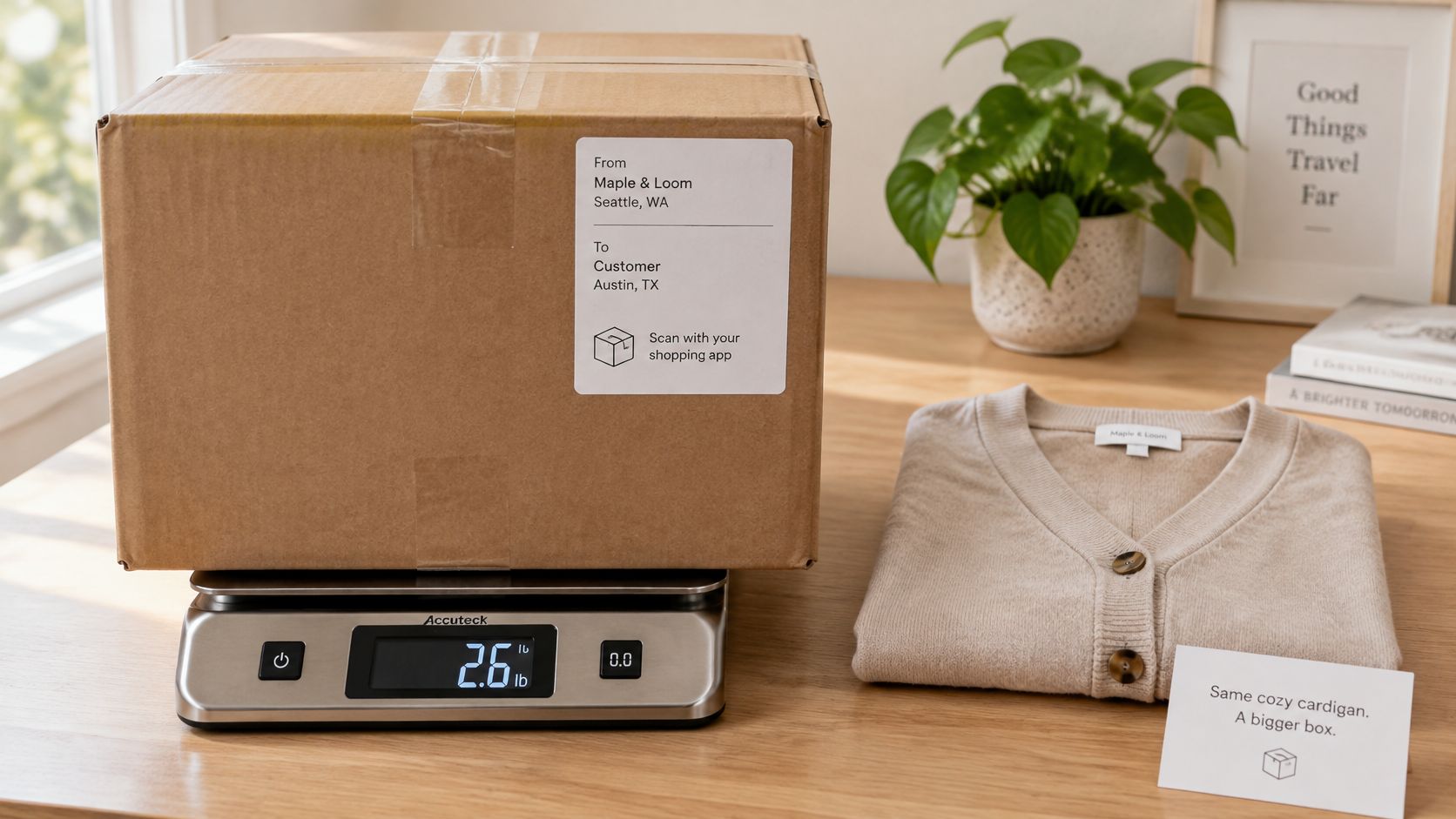
A lightweight cardigan shouldn't cost much to ship. Then you pack it in the only box you have, a big one, and the label costs more than the scale ever suggested.
That's dimensional weight doing its job. Mercari states that prepaid-label charges use the higher of actual weight or dimensional weight, and sellers may owe additional fees when the selected label category or weight is inaccurate, per Mercari's prepaid label guide. Pick the wrong tier and the adjustment comes after you've already shipped.
A Four Step Packing Table Routine
Use the same routine every time, before you list, not after it sells.
- Weigh it packed: Item, box or mailer, padding, tape, everything. A bare item weight is a fiction.
- Measure the packed box: Length, width, and height in inches, after it's taped shut.
- Pick the conservative tier: Use whichever is larger, actual weight or dimensional weight, and round up when you're on a border.
- Add an overage buffer: Pick a fixed dollar amount you can defend and test it on your first ten shipments. Adjust it from what happens.
If you need the fuller walkthrough on tiers and buffers, this guide to estimating shipping costs before you buy covers the measurement side in detail.
Two Ways This Kills a Flip
A light, cheap item can lose its whole margin to packaging and label cost. The sold comp looked fine, the fee looked fine, and then a padded mailer, tape, and a label tier you didn't expect ate the spread.
An oversized item is worse. Dimensional weight alone can collapse the margin even when the item itself weighs almost nothing. Think lampshades, big plush, bulky home goods from a garage sale. They photograph great and ship terribly.
Mercari also limits standard prepaid-label eligibility to packages up to 50 pounds and specifies size restrictions in that same guide. Past those limits, model seller-arranged shipping at a real quoted rate. Don't assume the platform label price applies to a heavy bin find.
A number from a bare-item scale is the number that overstates your profit.
Your calculator should ask for packed weight and dimensions on every item. If it doesn't, it's not pricing shipping. It's hoping.
Shipping Payer Scenarios From Thrift and Clearance Finds
Who pays for the label changes your net. It's one listing setting, and it's where most quick mental math at the shelf goes wrong.
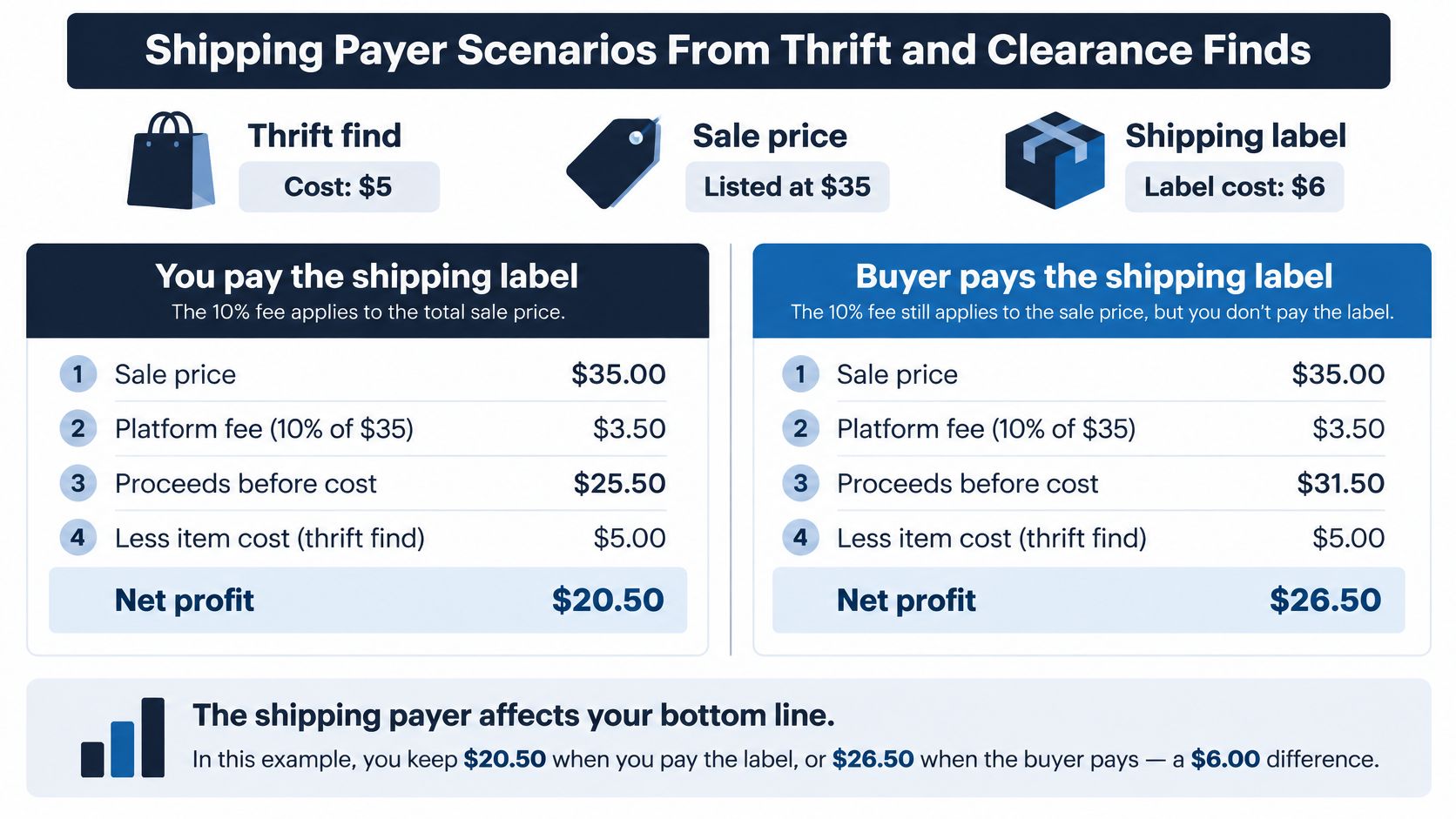
Start with a $35 thrift find that cost you $5 and needs a $6 label. Mercari lets you use a prepaid label and either have the buyer pay it or offer free shipping, and when the seller offers free shipping, the label cost is deducted from sales profit, according to Mercari's shipping for sellers guide.
The $35 Find, Both Ways
If you pay the $6 label, the 10% fee applies to the $35 item price. That's a $3.50 fee. Proceeds before cost of goods are $25.50, and after your $5 purchase the net is $20.50.
If the buyer pays the $6 shipping instead, the fee applies to the $41 total. The fee rises to $4.10, but proceeds before cost are $30.90 and the net after cost is $25.90. That's $5.40 better for you on the same item, same buyer, same box.
Buyer-paid shipping still costs you a little, because the label money sits in the fee base. You pay 10% on funds that pass straight through to the carrier. Annoying, but it's $0.60 here, not $6.
| Shipping setup | Mercari fee | Proceeds before cost | Net after $5 cost |
|---|---|---|---|
| Seller pays $6 label | $3.50 | $25.50 | $20.50 |
| Buyer pays $6 label | $4.10 | $30.90 | $25.90 |
Buyer-paid doesn't always win in practice. Free shipping can move a stale listing or win a crowded category. Just price it in. If you're absorbing the label, your list price has to carry it, or your net does.
The Goodwill Jacket and the Ross Cardigan
Now the jacket from the outlet bins. You paid $8, listed at $60, and accepted a $48 offer. A Mercari profit calculator should use the final completed item price, not your original list price. With buyer-paid shipping of $9, apply the 10% rule to the combined charge: the fee base is $48 + $9 = $57, the fee is $5.70, and your rough net before supplies is $34.30.
Flip it to a seller-paid $9 label and the picture changes. The fee drops to $4.80 on the $48 item price alone, but you subtract the full label: $48 − $4.80 − $9 − $8 = $26.20 before supplies. Same jacket, same offer, roughly eight dollars apart on one listing setting.
Then the small stuff. A $4 cardigan off a Ross clearance rack sells for $22 with $6 buyer-paid shipping. The fee base is $28, the fee is $2.80, and once the buyer's $6 covers the label your net is $22 − $2.80 − $4 = $15.20 before supplies. Decent quick flip if sell-through holds up. Offer free shipping at the same price and the fee drops to $2.20, but the $6 label comes out of your side, leaving $9.80. That one checkbox hands back over a third of the margin, and none of these nets account for a label that prices heavier once the box is packed.
Combining sold price, both shipping lines, and cost into one generic fees number hides the exact decision that determines whether the flip is worth buying.
The payer choice doesn't change what the label itself covers. Prepaid labels include tracking and shipping protection on eligible shipments. Buy postage on your own and that protection goes away, so a package lost or damaged in transit becomes a loss you carry yourself. On a $15 cardigan, maybe you accept that risk. On a $150 electronic, I wouldn't.
Whichever setup you run, keep the shipping line separate in your records. The fee is charged on a combined figure, but item price, label cost, and cost of goods are three different numbers when you reconcile the books at tax time.
Use sold comps for the sold price in every one of these scenarios, then run both payer setups. The better number is usually obvious in about ten seconds. The mistake is only running one.
Returns and Tax Records That Shrink Real Margin
It's sold, it's delivered, and three days later it's coming back. A clean net on paper assumed the sale was final. On Mercari, it isn't always.
Buyers get 72 hours after confirmed delivery to report that an item is not as described, and approved claims can result in a free return label, according to Mercari's return policy help page. Payment is automatically released only when no claim is made within that period, and for approved returns buyers must ship the item back within three days.
Where the Risk Actually Lives
This bites hardest on certain categories:
- Untested electronics: Powers on at the estate sale doesn't mean it works.
- Authenticity-sensitive luxury goods: One questioned detail and you're relisting.
- Shoes with hidden wear: Soles and insoles you didn't photograph closely.
- Collectibles and vintage: Condition is the whole value, and it's hard to verify while sourcing.
For those, run a risk-adjusted number instead of the optimistic one. Take your expected net and subtract a probability-weighted cost of return shipping, repackaging, relisting time, and possible damage. If an untested item only clears your threshold when everything goes perfectly, it doesn't clear your threshold. Pass, or buy it cheaper.
Photograph flaws at the shelf and again at listing. Sealed, tested, untested, and vintage shouldn't share the same flip-or-pass bar.
The Gross Number Is Not Your Profit
Records are the quieter margin killer. Mercari's reported gross sales can include the item price, buyer-paid shipping, buyer-paid merchant fees, and applicable sales tax, without automatically subtracting refunds, cancellations, discounts, or other deductions, per Mercari's tax reporting help page. For the 2025 tax year, Mercari states federal Form 1099-K reporting generally applies when a seller exceeds both $20,000 in gross payments and 200 transactions, while some states use different thresholds.
So a deal can be positive in cash and still need clean records to reconcile what Mercari reports against your actual taxable profit. Keep your cost of goods, fees, and shipping receipts per item. If you also sell through other payment channels, PayPal tax guidance for self-employed professionals from Blue Sage Tax & Accounting Inc. is a useful reference for how platform reporting gets tangled.
This is a record-keeping check, not tax advice. Talk to a tax professional about your own situation, especially if you're high volume or selling across borders.
Profit isn't one number. Cash net, platform-reported gross, and taxable profit are three different figures, and a good calculator keeps them separate.
Confirm the Net Before You Pay at the Register
All of this has to happen in about thirty seconds, with someone else eyeing the same rack. So make it a routine, not a research project.
The Five Step Shelf Check
- Confirm the sold price: Recent sold comps only. Not asking prices, not one outlier sale from eight months ago.
- Choose the fee regime: Based on when you'll create or update the listing.
- Pick the shipping payer: Enter the label cost on the correct line, using packed weight.
- Enter your real costs: The price on the tag in front of you, plus supplies.
- Compare to a threshold you set in advance: A minimum dollar profit that covers your time and the return risk for that category.
Pricing is step one for a reason, and this breakdown of how to price items for resale digs into reading comps and STR properly. A net that clears your threshold on paper still needs a condition check. Flip the shoes over. Power the thing on if you can. Smell the jacket.
I use ScanFlip AI at the shelf instead of doing six lines of math in my head. You can run an AI photo scan with no barcode needed, a barcode scan, or a text search. It pulls sold comps from eBay, Poshmark, Mercari, Depop, Amazon, Whatnot, ThredUp, Facebook Marketplace, and TikTok Shop, deducts fees and shipping, and gives a red/green flip-or-pass verdict against the minimum profit you set. It's a sourcing decision tool, so use your existing stack for everything after the buy.
Set your threshold by category, not by mood. Tested and sealed can run a lower bar. Untested electronics and vintage with condition questions need a higher one, because the downside is a return, not just a slow sale.
Write your minimum profit number on the back of your phone case, or in the notes app you open, before you walk into the next sale. Decide at home what a buy looks like. At the register, you're just checking whether this item matches it.
Next time you're at Goodwill, the bins, or a Ross clearance rack, run the item through ScanFlip AI before it goes in the cart. Scan it by photo, barcode, or text, check real sold comps across the major marketplaces, and see your net profit after Mercari fees and shipping with a clear flip-or-pass verdict. Buy the ones that clear your number and leave the rest for somebody else's death pile.