

Mercari vs eBay Fees: A Reseller’s Side-by-Side Breakdown
You're standing in an estate sale with two identical mid-century lamps in the same bin. One could go on Mercari, the other on eBay. You paid $50 for each, expect a $120 sale price, and the photos, condition, shipping setup, and buyer terms are identical. The only variable is the marketplace cut.
That comparison gets useful quickly. A lower fee doesn't automatically win if the item sells slowly, attracts weaker buyers, or requires a promotion to get seen. On the other hand, extra eBay fees can erase the advantage of a broader buyer pool on a common, low-priced flip.
This guide runs the same resale math across both platforms, then applies it to thrift books, vintage clothing, collectibles, and used electronics. The answer changes with sale price, category, shipping weight, sourcing cost, and demand, so the right platform is a buy decision, not a habit.
Table of Contents
- Two Listings, Same Item, Different Take-Home
- What Mercari Actually Charges in 2026
- What eBay Charges in 2026
- Mercari vs eBay Fees Side by Side
- Real Net Profit on Four Common Flips
- How to Pick the Right Platform Before You Buy
- The Honest Recommendation for Different Seller Types
Two Listings, Same Item, Different Take-Home
For the two lamps, the gross economics are straightforward. Each has a $50 cost of goods and a target sale price of $120. Before packaging, shipping, returns, or any advertising, Mercari's standard seller fee takes less than eBay's common fee stack.
Mercari's current U.S. seller structure centers on a flat 10% selling fee for new or updated listings. The platform stopped charging sellers a separate payment-processing fee on January 6, 2025, while buyers may pay a 3.6% Buyer Protection fee at checkout, as explained in Mercari's current seller fee guidance. On a $120 sale, that marketplace fee starts at $12.
eBay's cost is more layered. Sellers may have insertion fees after their free monthly allowance, then a category-based final value fee and a fixed per-order fee. For many common categories, the final value fee is around 12.55% on the total amount of the sale up to $750 per item, while independent comparisons commonly place the overall seller cost around 13.25% to 13.6% plus a fixed order charge, depending on the item and order total. The Mercari and eBay fee comparison from Easyship outlines that structural difference.
| Marketplace | Core seller charge | $120 sale before shipping and COGS |
|---|---|---|
| Mercari | 10% selling fee | $12 |
| eBay | Around 13.25% plus fixed order fee in many common categories | Around $16.30 |
| Difference | Mercari's starting fee is lower | Roughly $4.30 before optional promotion |
That gap matters, but it isn't the whole decision. A lamp with stronger eBay sold comps may justify the higher deduction if eBay brings the buyer who pays your target price. A generic lamp with limited demand may be better on Mercari if the simpler fee lets you accept an offer without turning the flip into a charity project.
Practical rule: Compare the expected payout at a realistic sold price, not the number you hope to get from an optimistic listing.
The $50 sourcing cost also changes the emotional calculation. At $120, a seller has $70 gross spread before marketplace fees and fulfillment. After Mercari's basic fee, that becomes $58 before shipping and supplies. After a common eBay percentage and fixed fee, the remaining spread is lower. The final winner still depends on the actual shipping bill and whether the item sells without paid promotion.
What Mercari Actually Charges in 2026
Mercari became simpler for sellers after its January 2025 change. For new or updated listings, the platform stopped charging a separate seller payment-processing fee and now centers seller economics on a 10% selling fee, while buyers may be charged a 3.6% Buyer Protection fee at checkout. That seller-side structure is documented in Mercari's help center.
The practical takeaway is blunt. A $100 item creates a $10 Mercari marketplace fee, leaving $90 before shipping and cost of goods. The buyer's protection charge doesn't come out of that $90, although any added checkout cost can influence what buyers are willing to pay.
Mercari's seller model also avoids the eBay-style insertion fee and fixed per-order surcharge in the standard comparison. That makes low-volume selling easier to price because you aren't tracking a separate listing charge for every item or a transaction fee that becomes disproportionately painful on cheap inventory.
Mercari 2026 Fee Schedule at a Glance
| Fee Type | Amount | Notes |
|---|---|---|
| Selling fee | 10% | Applies to the seller-side transaction under the current structure |
| Seller payment processing | No separate fee on new or updated listings | Mercari shifted the buyer-side protection charge to checkout |
| Buyer Protection fee | 3.6% | Paid by the buyer at checkout, not deducted from the seller's standard fee |
| Insertion fee | None in the standard comparison | Useful for casual and lower-volume sellers |
| Per-order surcharge | None in the standard comparison | Keeps small transactions easier to model |
| Optional promotion | Varies | Treat any paid visibility option as an additional cost only when selected |
For a quick pre-buy calculation, a Mercari fee calculator for resellers can help separate the marketplace deduction from shipping and cost of goods. That distinction matters because a $90 payout isn't a $90 profit.
Authentication can change the math in eligible categories. Sneakers, watches, luxury goods, and trading cards may carry an additional verification fee, so a seller needs to check the item-specific terms before assuming the flat fee is the entire cost. A high-dollar authenticated item can absorb that extra charge more easily than a low-margin thrift find, but it still belongs in the purchase decision.
Tax paperwork is separate from platform profitability. Sellers should track gross sales, fees, shipping, supplies, and cost of goods, then review current 1099-K threshold rules with the platform and a qualified tax professional. Don't confuse a marketplace payout with taxable profit, and don't assume a fee comparison answers your reporting obligations.
What eBay Charges in 2026
A $100 item from an estate-sale bin can produce very different payouts on eBay depending on its category, store setup, and promotion choice. eBay's fee structure has more variables than a flat percentage, so price the item only after checking those settings. The platform provides up to 250 free listings per month, then charges $0.35 for each additional listing under the stated setup, according to LitCommerce's Mercari and eBay comparison. Free listings reduce the cost of testing inventory, but they do not remove the fee charged when an item sells.
eBay also applies a category-dependent final value fee. Many common categories sit around 13.25% of the total sale amount, followed by a fixed per-order fee of $0.30 for orders of $10 or less or $0.40 for orders over $10, as explained on eBay's seller fee help page. Because the percentage may apply to the total sale amount, confirm how shipping and category rules enter the calculation before listing.
eBay 2026 Fee Schedule at a Glance
| Fee Type | Amount | Notes |
|---|---|---|
| Free monthly listings | Up to 250 | Applies before insertion fees begin under the stated allowance |
| Additional insertion fee | $0.35 | Charged per listing after the free allowance in the applicable setup |
| Final value fee | Around 13.25% in many common categories | Category-dependent and based on the total sale structure |
| Fixed per-order fee | $0.30 or $0.40 | $0.30 for orders of $10 or less, $0.40 for orders over $10 |
| Store or category variation | Varies | A store subscription or category-specific rule can change the percentage |
| Promoted Listings | Optional | Any selected ad rate adds to the platform cost |
Run the math on the same $100 sale. At 13.25%, the final value fee is $13.25. Since the order exceeds $10, the fixed fee is $0.40, producing a basic platform deduction of $13.65 before promotion. A 5% promoted listing rate adds $5, bringing platform deductions to roughly $18.65, before shipping, supplies, and cost of goods.
Category, store status, and promotion choice can all change the result. Books, media, and selected categories may use capped or distinct fee rules, so a rare book or electronics part should not be priced from a general consumer-goods assumption.
When the free allowance helps
The free-listing allowance helps most when inventory volume is high and each item needs its own listing. A reseller creating 250 listings in a month can avoid the stated insertion charge on those listings. Listings beyond that allowance add $0.35 each, while sold items still incur final value and order fees.
For a thrift-aisle item with a thin margin, the extra setup work and category research may outweigh eBay's reach. For a retail-arbitrage item with repeatable demand, free listing capacity can make testing more practical. The buying decision should include listing volume, expected sell-through, and the fee rate for that specific item, not just the headline percentage.
Mercari vs eBay Fees Side by Side
The cleanest comparison uses the same item price and ignores shipping, supplies, cost of goods, and optional advertising. Mercari takes 10%, while eBay uses an illustrative 13.25% final value fee plus the applicable fixed order fee. eBay's actual category rate can differ, so use this table as a baseline rather than a universal invoice.
| Sale Price | Mercari Fee | eBay Fee, no store | Net to Mercari Seller | Net to eBay Seller | Gap |
|---|---|---|---|---|---|
| $20 | $2.00 | $3.05 | $18.00 | $16.95 | $1.05 |
| $50 | $5.00 | $7.03 | $45.00 | $42.97 | $2.03 |
| $100 | $10.00 | $13.65 | $90.00 | $86.35 | $3.65 |
| $250 | $25.00 | $33.53 | $225.00 | $216.47 | $8.53 |
| $500 | $50.00 | $66.65 | $450.00 | $433.35 | $16.65 |
The gap grows with price because the percentage difference compounds, while eBay's fixed order fee remains small on higher-ticket items. At a $20 sale, the difference is only a little over a dollar in this simplified model. At a $500 sale, the percentage spread becomes much harder to ignore.
Mercari's advantage is predictability. You can usually look at the item price, apply the seller fee, and then subtract fulfillment and cost of goods. eBay's advantage is flexibility and reach, but you need the correct category rate, order fee, store status, and advertising decision before you know your actual payout.
There isn't a useful universal breakeven point based on fees alone here. Under the stated baseline, Mercari's percentage is lower at every listed price point. The breakeven is operational, meaning the eBay buyer pays enough more, or buys quickly enough, to compensate for the higher deduction.
The fee gap is measurable. The sales advantage has to be proven with sold comps and sell-through, not assumed from platform reputation.
A store subscription can reduce eBay's final value fee in some categories, which may shift the comparison for a high-volume seller. That benefit only counts if your volume and category mix justify the subscription cost. Don't add a store plan to rescue weak inventory.
Real Net Profit on Four Common Flips
Fee math becomes useful only after shipping and supplies enter the spreadsheet. The following examples use explicit working assumptions for illustration, including the stated sale prices and sourcing costs. Shipping and supplies are scenario inputs, not marketplace facts, so replace them with your actual label and packaging costs before buying.
| Item Scenario | Sourcing Cost | Sale Price | Mercari Net Profit | eBay Net Profit | Winner |
|---|---|---|---|---|---|
| Thrift book lot | $12 | $25 | $1.50 | $0.63 | Mercari by $0.87 |
| Vintage jacket | $18 | $60 | $28.00 | $25.65 | Mercari by $2.35 |
| Graded collectible | $65 | $150 | $62.00 | $59.13 | eBay if buyer reach creates the sale |
| Used electronics | $150 | $400 | $175.00 | $168.60 | eBay if demand and buyer fit support the price |
The $25 thrift book lot
Assume $12 sourcing cost, $6 shipping, and $2 supplies, with a $25 sold price. Mercari's 10% seller fee is $2.50, producing $14.50 after the marketplace fee, shipping, and supplies, then $1.50 net profit after COGS.
Using the common eBay baseline, the final value fee is $3.31 and the fixed order fee is $0.40. After the same $6 shipping, $2 supplies, and $12 COGS, the result is $0.63 net profit.
Verdict: Mercari wins by $0.87, but this is still a weak flip. A damaged cover, return, extra packing time, or slower sale can erase the spread. The net profit calculation guide for resellers reinforces the right habit, calculate the whole transaction before you buy.
The $60 vintage jacket
Assume $18 COGS, $9 shipping, and $3 supplies. Mercari's $6 seller fee leaves $42 after shipping and supplies, then $24 net profit after the purchase cost.
On eBay, the illustrative final value fee is $7.95, plus the $0.40 order fee. After the same fulfillment costs and COGS, net profit is $21.65.
Verdict: Mercari leads by $2.35 when both platforms produce the same $60 sale and no promotion is used. For a jacket found in a Goodwill rack, that simpler payout can make an offer acceptable without cutting below your buy cost.
The $150 graded collectible
Assume $65 COGS, $8 shipping, and $2 supplies. Mercari's $15 seller fee leaves $60 net profit after all listed costs.
eBay's common baseline produces an $19.88 final value fee and a $0.40 order fee. The resulting profit is $54.72.
Verdict: Mercari wins the pure fee math by $5.28, but eBay may be the better business decision if its buyer pool supports the $150 sold price while Mercari requires a discount or waits in stale inventory. Don't call eBay cheaper here. Call it potentially more productive for the right collectible.
The $400 used electronics flip
Assume $150 COGS, $18 shipping, and $7 supplies. Mercari's $40 seller fee produces $185 net profit after those costs.
On eBay, the 13.25% final value fee is $53, plus the $0.40 order fee. The same assumptions produce $171.60 net profit.
Verdict: Mercari wins this identical-sale model by $13.40, but eBay is often the stronger test for used electronics when buyers need exact parts, accessories, compatibility, or international availability. The extra reach only matters if it produces a sale at the modeled price, not if it encourages you to spend more on promotion.
How to Pick the Right Platform Before You Buy
Choose the marketplace while you're standing in the thrift aisle. Once you've paid for a questionable item, the platform decision can't fix weak sold comps, poor sell-through, or an inflated purchase price.
Start with the same scan-then-list routine every time:
- Identify the exact item. Confirm model, size, edition, condition, accessories, and defects. A generic “vintage jacket” search is weaker than the brand, style name, and measured details.
- Check sold comps on both platforms. Use completed sales rather than asking prices. A high listing price proves only that another seller wants that amount.
- Compare the likely net. Subtract the platform fee, shipping, supplies, and COGS. Then account for any authentication or optional promotion that applies.
- Check sell-through qualitatively. Recent sold activity, repeated buyers, and a reasonable number of active listings matter more than one exciting outlier.
- Set a pass price. If the source asks more than your conservative model supports, leave the item behind.
Match the item to the buyer behavior
Lightweight items under $40 often fit Mercari's simpler seller economics, particularly for a casual seller without a store plan. That doesn't make every cheap item worth buying. Low-value books, common Funko figures, and basic mall-brand clothing can still become death-pile inventory when shipping and handling consume the spread.
Branded apparel, sneakers, and trading cards often deserve an eBay check first because buyers search by exact model, size, grading, set, and condition. Authentication or category rules can change the fee calculation, so verify those details rather than applying a flat assumption.
Mid-value electronics and vintage gear can be tested on Mercari first when speed and simple pricing matter. If the item has a narrow buyer profile, uncommon accessories, or strong international interest, eBay may justify its higher fee structure. Bulky furniture is usually a poor mail-order flip on either platform unless local pickup and a realistic buyer are already part of the plan.
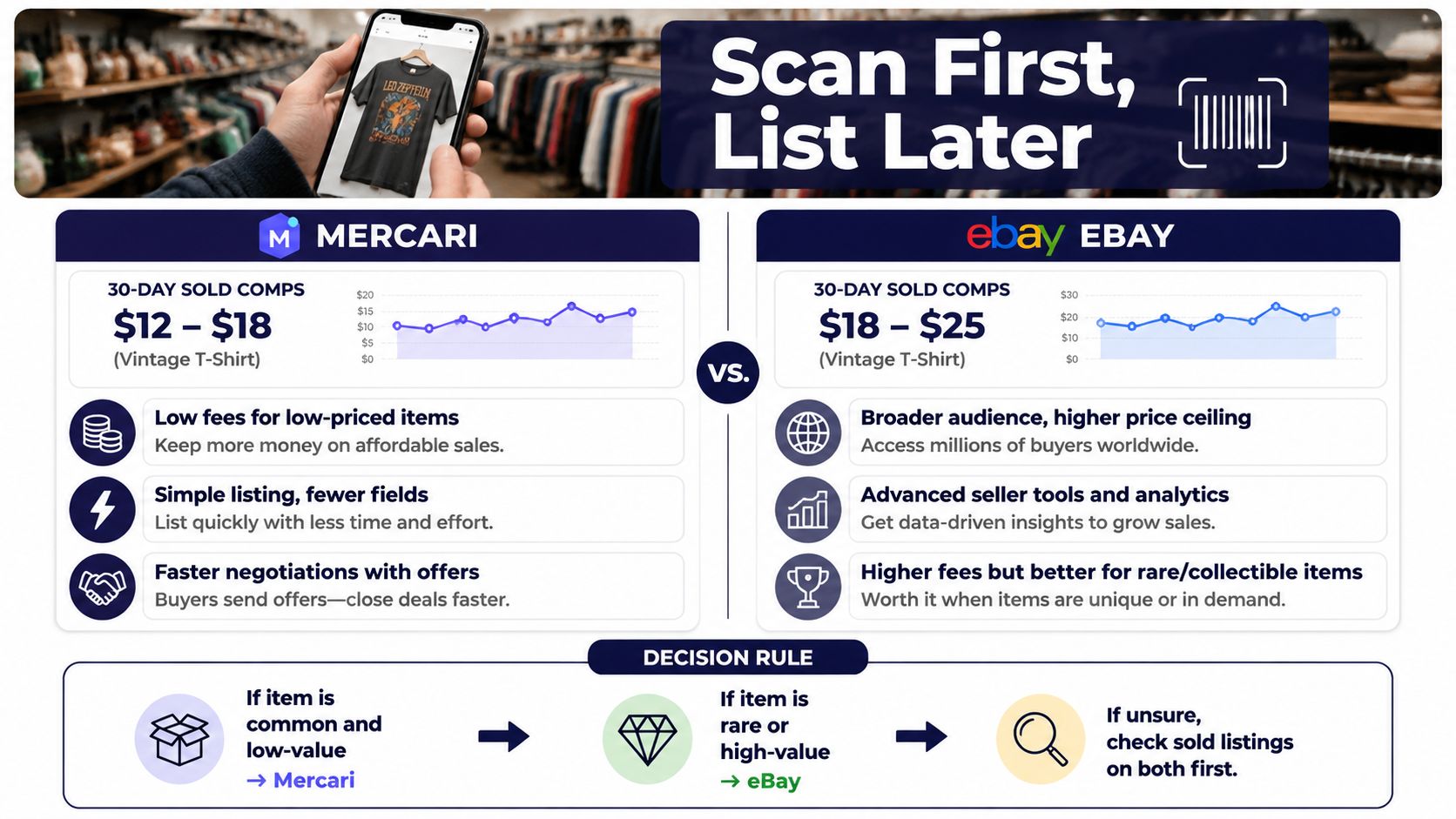
A sourcing app can speed up the comparison. ScanFlip AI supports AI photo scanning without a barcode, barcode scanning, and text search, then aggregates sold comps across eBay, Poshmark, Mercari, Depop, Amazon, Whatnot, ThredUp, Facebook Marketplace, and TikTok Shop. It also estimates net profit after fees and returns a red or green flip-or-pass verdict, which fits the aisle decision better than checking gross asking prices one marketplace at a time. Crosslisting tools such as Vendoo and List Perfectly solve a different problem after the buy decision, so don't confuse them with a sourcing calculator. You can also review this workflow in guidance on selling across multiple platforms.
The Honest Recommendation for Different Seller Types
The right answer depends less on loyalty and more on what your inventory does after you buy it. A part-time thrifter clearing a Saturday haul has different constraints from a full-time reseller processing shoes, electronics, and trading cards every week.
| Seller Type | Best Platform | Why | Watch Out For |
|---|---|---|---|
| Part-time thrifter | Mercari | Simple 10% seller math and no standard insertion or per-order surcharge | Low-value items can still fail after shipping and supplies |
| Full-time volume reseller | eBay | Free monthly listing allowance, broad category coverage, and optional promotion | Category rates, fixed fees, and ads make payout harder to predict |
| Shoe and trading card seller | eBay | Exact-item searches and deeper category demand can support higher realized prices | Authentication or category-specific charges need checking |
| High-dollar vintage or luxury seller | eBay | Authentication centers and broader visibility can fit rare inventory | Returns, disputes, and promotion can cut into large gross sales |
| Fragile or counterfeit-risk seller | Neither | A weak risk-adjusted return makes the fee comparison irrelevant | One dispute or chargeback can erase the expected profit |
Mercari is the practical choice for small, simple flips
If you're clearing a few low-priced items from a garage sale or thrift run, Mercari usually gives you the cleaner calculation. The absence of a standard insertion fee and separate seller processing charge reduces the number of deductions to track. That helps when you don't have a store subscription and don't want a $0.40 fixed fee to take a noticeable bite from a cheap order.
The platform isn't a free pass for bad sourcing. A $12 common book, a basic mall-brand shirt, or a bulky item with expensive postage can remain a pass even with the lower seller fee. Your sold comps and net profit matter more than the logo at the top of the app.
eBay earns its cut when demand is specialized
Full-time sellers often accept eBay's layered structure because exact-item demand can matter more than a few dollars of fee difference. Shoes, electronics, parts, accessories, graded cards, and rare vintage pieces can attract buyers who know precisely what they're looking for. Auction formats may also help move stale inventory, although an auction isn't a substitute for strong sourcing or accurate condition notes.
Promoted Listings Standard remains optional, so don't automatically add an ad rate to every item. If a common item needs paid visibility just to compete, lower the buy price, improve the photos, or pass on the next one.
Some inventory deserves a hard no
Items with COGS above realistic sold comps aren't worth buying on either platform. Fragile goods with high return or breakage risk can turn a healthy-looking spreadsheet into a loss. Counterfeit-risk brands are worse, especially when authenticity is uncertain and a dispute could consume the profit from several ordinary sales.
The lamp example makes the decision clear. If the $50 buy produces a genuine $120 sale, Mercari preserves more of the modeled spread. If eBay's buyer depth is the only realistic path to that sale, the higher fee can be rational. If neither platform supports the price after shipping, supplies, and risk, leave both lamps in the estate sale bin.
ScanFlip AI lets you compare AI photo scans, barcodes, and text searches against sold comps across major marketplaces, then see net profit after fees and shipping before you buy. Use ScanFlip AI in the thrift aisle or at the next estate sale to make a red or green flip-or-pass decision before another picker takes the item.