


Expected Profit Calculation for Resellers (2026)
You're standing in a Goodwill aisle with three things in your hand, all of them look like easy flips. The tag says one price, the sold comps look strong enough, and your brain already wants to call it a win. Then you get home, add platform fees, shipping, a return buffer, and the fact that one of those items might sit for weeks, and the “$60 flip” starts looking like a weak net profit or a pass.
That's the core problem with expected profit calculation for resellers. The simple version, sale price minus buy cost, misses the part that matters in the aisle, which is whether the deal still works after fees, shipping, and uncertainty. The useful version treats profit as a decision tool, not a single nice-looking number, because a flip can have a decent average outcome and still be a bad buy if the downside is ugly or the inputs move even a little.
Table of Contents
- The 3 Goodwill Items That Almost Cost You $40
- The Expected Profit Formula and What Each Variable Means
- Worked Example on a $6 Thrift Find
- Margin vs Absolute Profit and When Each Matters
- Three Sensitivity Checks Before You Buy
- Common Calculation Mistakes That Eat Into Net Profit
- How ScanFlip AI Runs the Whole Calculation at the Aisle
The 3 Goodwill Items That Almost Cost You $40
A few weeks ago, the rack had three items that all looked fine on the surface. A branded jacket, a pair of boots, and a niche graphic hoodie. Each one had a sold comp that made your head nod, but the math changed once you treated the buy as a real resale decision instead of a quick subtraction game.
The jacket was the trap. It looked like a clean $60 sold comp, but after shipping, fees, and a conservative return buffer, the take-home was nowhere near that number. The boots had a better spread, but only if they moved fast enough to justify the time. The hoodie was the sneaky one, because it looked “safe” until you remembered how long similar items can sit in the death pile before the right buyer shows up.
That's why expected profit matters more than headline comp hunting. A single sold price doesn't tell you how sensitive the flip is to a softer demand week, a lower accepted offer, or a shipping overage. A good sourcing decision needs to answer a harder question, how much money do I expect to keep after the whole process, and how fragile is that result if one assumption changes? For a practical walkthrough on pricing before you ever get to the checkout line, this thrift store pricing guide is a useful companion.
Practical rule: if you can't explain the downside in one sentence, you probably don't know the deal well enough to buy it.
The issue is uncertainty. Finance and operations sources on expected value emphasize scenario-based analysis, probability-weighted outcomes, and sensitivity checks, while the newsvendor logic behind inventory decisions says the right choice depends on the balance between underage and overage costs, not just an average outcome (EMS PSU). That's exactly how resellers should think at the rack.
The Expected Profit Formula and What Each Variable Means
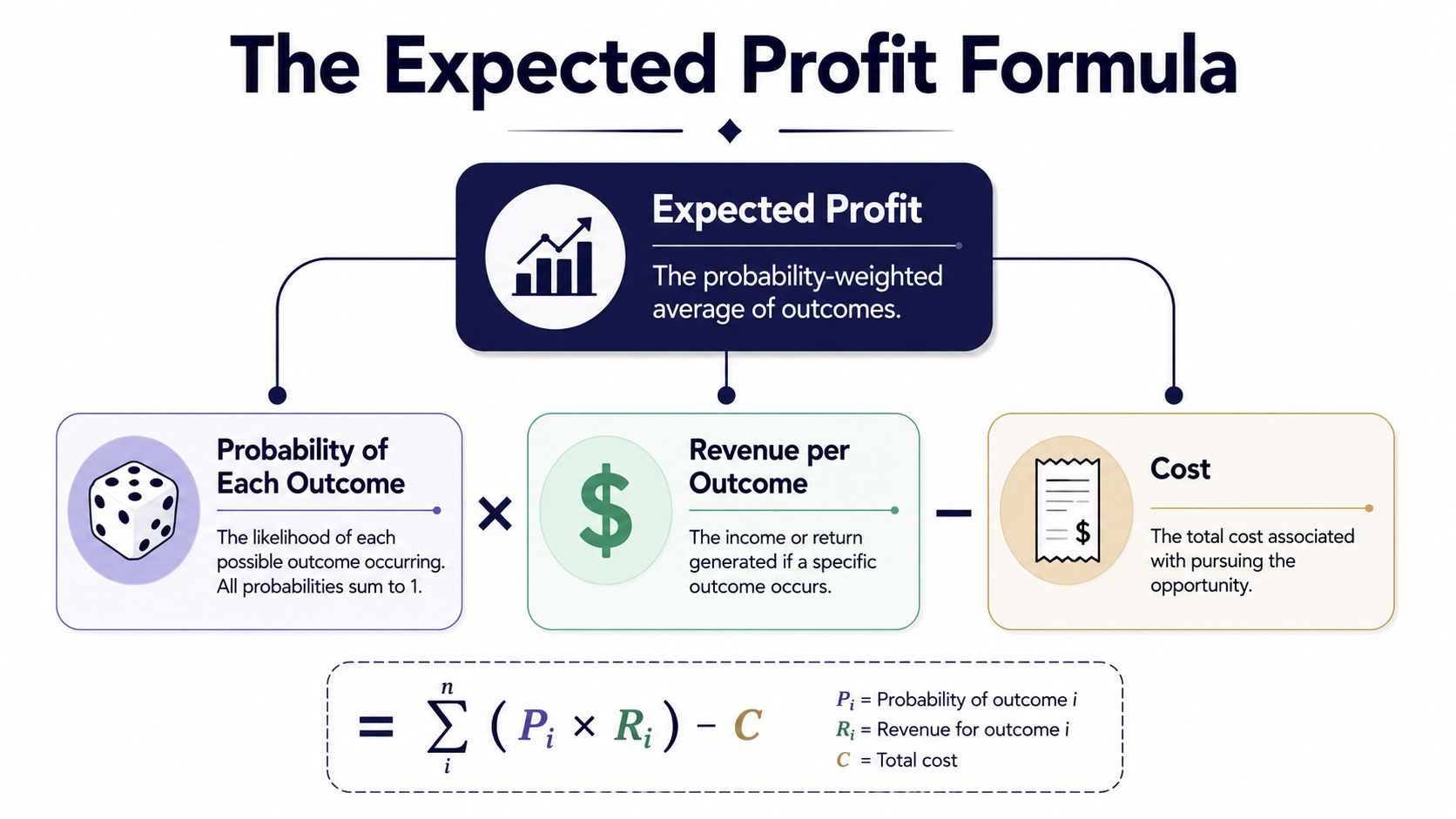
A rack score can look solid and still be a bad buy. A jacket that sells quickly at one price, slowly at another, and gets hit with different fees each time does not have one true profit number. Expected profit calculation forces you to price the whole set of outcomes, then decide whether the spread still works for your cash, space, and patience. Business planning sources treat expected value as a probability-weighted result, and profit forecasts only make sense once costs are part of the picture, not just revenue (Agicap).
Expected profit = the average of scenario outcomes after true costs, not the highest comp minus buy cost.
The aisle version is simple. A higher comp is only useful if it is likely enough to matter, and if the fees, shipping, and returns do not drag the take-home below your floor. That is why resellers who only chase the top sold price end up overbuying slow items.
The variables that matter in the aisle
- Buy cost, what leaves your pocket at the store, estate sale, or garage sale.
- Sell price scenarios, usually a fast sale, a middle outcome, and a slow sale at the high end.
- Probability of each outcome, your best estimate of how often each scenario happens.
- Platform fees, the take rate the marketplace keeps.
- Shipping cost, what you'll really pay to get it to the buyer.
- Return risk, the chance the item comes back, or you lose time and fees on a problem order.
- Time to sell, not a fee line item, but absolutely part of the decision if your cash gets trapped in the death pile.
Each variable changes the decision in a different way. A cheap buy cost can still be a weak flip if the likely sell prices are clustered low, the platform takes a big cut, or shipping eats the margin on the middle scenario. A slower item can look fine on paper and still be the wrong buy because it ties up capital you could turn into faster profit elsewhere.
The point of the formula is straightforward. You ask what the weighted take-home looks like across realistic outcomes after every cost that hits your margin. That is the logic behind a solid net profit calculation, and it is the version that matters when you are buying inventory with limited cash and limited space.
Worked Example on a $6 Thrift Find
A new flipper sees a NWT branded jacket at Goodwill for $6 and knows it can sell on Poshmark. The sold comps show a range, but the key is not the top comp. The key is how often the jacket clears at each level, and what's left after fees and shipping.
Step 1, set the sell scenarios
Use three realistic outcomes.
| Scenario | Sell Price | Probability | Fees + Shipping | Net Profit | Weighted Profit |
|---|---|---|---|---|---|
| Fast sell | $24 | 0.40 | $5.79 | $12.21 | $4.88 |
| Mid sell | $32 | 0.35 | $7.39 | $18.61 | $6.51 |
| Slow sell | $40 | 0.25 | $8.99 | $24.01 | $6.00 |
For this example, the fees and shipping assume Poshmark's 20% commission plus the $0.99 listing fee, USPS Priority shipping, a poly mailer, and a small return buffer. The exact fee and shipping mix is what turns a nice-looking comp into real take-home, and it is the area where many new sourcers overestimate profit.
Step 2, read the weighted result
Add the weighted profits, and the expected profit comes out to $17.39 before tax and before your own labor. That's not bad on a $6 thrift buy, but it's also not automatic. If the item doesn't hit those probabilities, the number moves fast.
Step 3, ask the buy question
A jacket like this can still be worth a cart if your standard is modest and your cash turns quickly. But if the same rack has easier items with cleaner sell-through and less fee pressure, this one might not deserve the spot. The better question isn't “is $17.39 good?” It's “is this still worth a cart after I account for time, risk, and what else I could buy instead?”
Margin vs Absolute Profit and When Each Matters
A lot of resellers mix up absolute profit and margin. They're related, but they answer different questions. Absolute profit asks how many dollars you'll keep. Margin asks how hard the buy cost works for you.
When each threshold matters
If you're doing a high-volume thrift run, absolute profit usually matters more. You're scanning lots of items, making fast decisions, and every dud eats time. In that lane, a flip that only nets a couple of dollars can be worse than a pass, even if the percentage return looks fine.
If you're at an estate sale, dealing with higher-cost items, or flipping pallet or vintage pieces, margin matters more. A 2x return on a $200 buy can be a clean buy even if the dollar gain isn't flashy, because the capital at work is larger and the category supports it.
| Category | Better Threshold to Watch | Why It Usually Fits |
|---|---|---|
| Books | Absolute profit | Low buy cost, fast scanning, thin room for mistakes |
| Apparel | Absolute profit | Fees and returns can eat small spreads |
| Shoes | Margin | Higher volatility, but decent room if comps are strong |
| Electronics | Margin | Higher buy cost and higher downside if tested poorly |
| Vintage collectibles | Margin | Slower sales, stronger upside if the comp range is stable |
A lot of sellers try to apply one rigid rule everywhere, and that's how they pass on good buys or buy dead inventory. A cleaner way is to pick the rule that matches your actual sourcing style, then stick to it. If you want a quick way to sanity-check those thresholds on the fly, this margin calculator app is a useful reference point.
Use one yardstick per category. Mixing absolute profit and margin in the same aisle decision usually leads to bad buys.
Three Sensitivity Checks Before You Buy
A positive expected profit is not a green light by itself. It only says the average looks acceptable under the assumptions you used. The core buy decision is about how much that average changes when demand slips, the sale price lands lower than hoped, or fees and shipping come in heavier than planned.
1. Sell-through probability drops
Start with the sale speed. If the item does not move as fast as your best-case guess, your cash stays tied up longer and the return on that buy gets weaker even if the listed profit number still looks decent. A flip that depends on a quick sale is more fragile than it looks, because slower turn changes the math and the opportunity cost at the same time.
2. Sold price lands at the low end
Comp ranges can make a buy look safer than it is. If the item closes near the bottom of the range instead of the middle, you lose sale price first, then you lose cushion for marketplace fees, shipping, and any return risk. That is why a deal that looks fine at the midpoint can turn thin fast once you price for a buyer who wants the low number, not the optimistic one.
3. Shipping runs high or the item comes back
This is where a lot of small flips break. A label that costs more than expected, a heavier box, or a return that sends money back out can wipe out most of the margin on a cheap item. P&L forecasting is useful for this reason, because the result is never just sale price minus cost, it also includes the extra adjustments that hit the real take-home.
A practical aisle rule is better than wishful thinking. Cut the best-case demand a little, then cut the sale price a little too. If the item still works after both adjustments, it is worth a closer look. If it only works when everything breaks your way, walk past it.
Common Calculation Mistakes That Eat Into Net Profit
The easiest way to get burned is to use the wrong numbers. Sellers do it all the time, especially when they're moving fast and the rack is full.
- Using listing prices instead of sold comps, because active listings can sit forever and don't tell you what buyers paid. The fix is simple, base your math on sold prices.
- Forgetting platform-specific fee tiers, because each marketplace changes the take-home. Poshmark's 20% over $15 is not the same as other platforms, and fee structure matters a lot on thinner flips.
- Underestimating shipping, because the box, tape, poly mailer, and service choice all hit profit. The fix is to build shipping into the expected profit calculation before you buy.
- Ignoring money trapped in the death pile, because unsold inventory ties up cash and space. Even if the flip looks fine on paper, slow turn can make it a bad use of capital.
- Forgetting returns, because a returned item can mean fees, time, and relisting work all over again.
Some categories just don't work. Low-end fast fashion under $15 often gets crushed by fees, shipping, and low buyer willingness to pay, so even “good comps” can't rescue the math. That's not a category problem, it's a profit problem.
If the item only works on the prettiest comp, it usually doesn't work.
The fix across all of this is consistency. Use sold comps, use real shipping, and use the actual fee structure for the marketplace you're selling on. A calculator is only useful if the inputs match what really happens after the buy.
How ScanFlip AI Runs the Whole Calculation at the Aisle

The cleanest sourcing workflow is the one that gives you the answer before the item leaves your hand. ScanFlip AI is built for that aisle decision, with AI photo scan for untagged apparel and vintage, barcode scan for books and media, and text search for items that are hard to photograph. It pulls sold comps from eBay, Poshmark, Mercari, Depop, Amazon, Whatnot, ThredUp, Facebook Marketplace, and TikTok Shop, then shows net profit after fees and shipping with a red or green flip-or-pass verdict.
That matters because the question at the rack isn't “what could this sell for someday.” It's “what will I keep after fees, shipping, and buy cost?” The app's value here is speed and realism, not guessing off a single number. It's a fit for the sourcing phase, while tools like Vendoo or List Perfectly still handle the later listing and inventory side of the workflow.
If you're standing in a thrift aisle, the decision checklist stays the same whether you use an app or a notebook:
- Confirm sold comps, not just active listings.
- Estimate total fees, not just one marketplace cut.
- Count shipping, including packaging.
- Set a minimum profit or margin threshold, then walk away if the item misses it.
- Stress-test the downside, because a good average can still hide a bad buy.
If you want to run that process faster, visit ScanFlip AI and try it on your next sourcing trip. It's built for the buy decision, so you can check sold comps, fees, and net profit before you spend.