
Poshmark Fee Calculator: What You Actually Keep
You're standing at a Ross clearance rack with a $6 jacket in one hand and your phone in the other. The sold comp says $42 on Poshmark, and for a second that looks like an easy pickup.
It's not a $42 decision. It's a decision about what survives after Poshmark takes its cut, after you subtract what you paid, and after any shipping discount you offer to get the sale. Run that math before you buy, not after the payout hits and you're wondering where the money went.
Table of Contents
- Why a $42 Sale Is Not a $42 Paycheck
- How Poshmark Fees Shift at the $15 Line
- Checking the Fee Schedule Before You Trust It
- Building a Net Profit Calculation From Start to Finish
- Worked Examples for Common Sale Prices
- Returns and Condition Risk Your Math Misses
- Setting a Buy Rule and Choosing Your Tool
Why a $42 Sale Is Not a $42 Paycheck
That $42 sold comp is gross revenue. It's the price the buyer paid for the item, not the amount that lands in your balance, and it definitely isn't your net profit.
Newer sellers make the same mistake at Goodwill, the bins, and estate sales. They see a sold price, subtract cost of goods, and call the difference profit. Then the payout shows up smaller and they assume something went wrong. Nothing went wrong. They just skipped the fee, the shipping discount, the supplies, and the offer they accepted to move it.
The Three Numbers You Actually Need
A usable Poshmark fee calculator has to give you more than a payout guess. At the rack, you need three separate answers before money leaves your pocket.
- Seller proceeds: What Poshmark pays you after its fee and any seller-funded shipping discount, before your buy cost.
- Estimated net profit: What's left after buy cost, supplies, and the expenses you track on that item.
- Minimum sale price: The lowest accepted offer that still clears your target, so you know when to counter or walk away.
Those numbers answer different questions. Seller proceeds tell you what the platform hands over. Net profit tells you whether the flip was worth your time and cash. The minimum sale price is the one that protects you during sourcing, because it turns a vague feeling about a jacket into a buy or pass call.
If you can't name your minimum acceptable sale price before you buy, you're not sourcing. You're hoping.
I keep that same $6 jacket in mind because it's the kind of find that piles up fast. One jacket is no big deal. Twenty jackets bought on gross sold prices instead of net profit is a death pile with money tied up in it.
You already know how to list, share, and ship. The point here isn't how Poshmark works. It's the math that decides whether an item deserves space in your car, your storage bin, and your closet in the first place. No calculator can promise a sale or a fixed profit, but it can stop you from paying retail clearance prices for thrift store margins.
How Poshmark Fees Shift at the $15 Line
Poshmark doesn't charge one flat percentage on every sale. That's the whole reason a generic fee guess falls apart on cheap items.
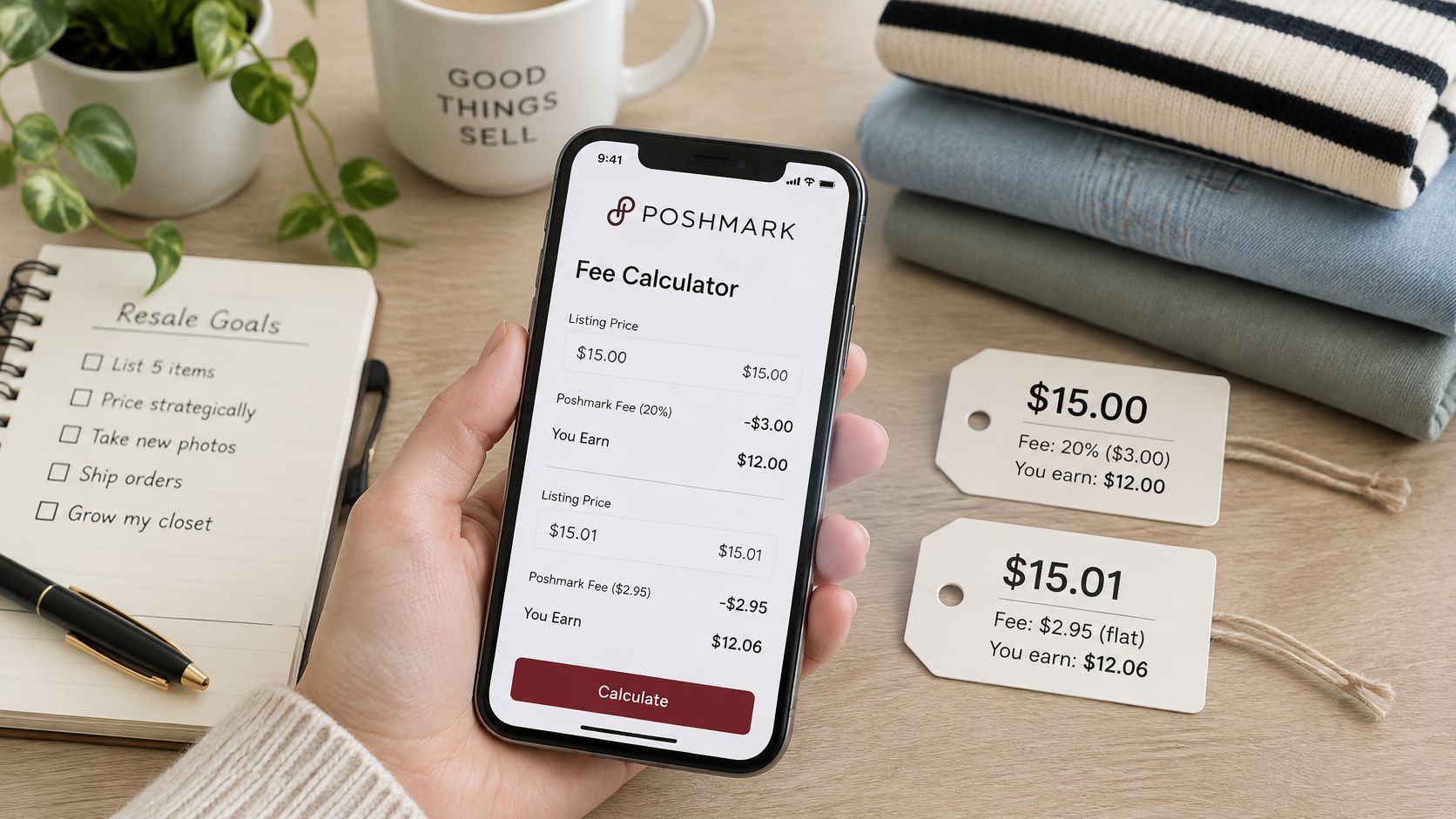
Under the current U.S. seller fee guidance from Poshmark, sales below $15 pay a flat $2.95, while sales of $15 or more pay 20% of the item price. Listing is free and there's no monthly subscription, which sounds simple until you look at what that flat fee does to a low sale price.
What the Flat Fee Does to Cheap Items
There are two rules, like a toll booth. Below the line, everyone pays the same flat fare no matter how small the trip is. Above the line, you pay a percentage, so the fare rises with the price.
On a $5 sale, the $2.95 fee equals 59% of gross proceeds. You keep $2.05 before cost, which means almost anything you paid money for loses money on that sale. On a $10 sale, that same $2.95 is 29.5%, leaving $7.05 before cost. Better, but still punishing if you paid $6 at the thrift and then throw in tape, a mailer, and your time.
Cross the line and the math changes shape. At exactly $15, the fee is $3 and you keep $12. At $20, the fee is $4 and you keep $16. The percentage stays steady from there, so your main job becomes protecting margin instead of fighting a flat fee that's eating small sales alive.
The $14 Trap
The awkward spot sits right below the threshold. A $14 sale loses $2.95 and leaves $11.05 before costs. A $15 sale loses $3.00 and leaves $12.00.
That extra dollar on the sale price adds $0.95 to your proceeds, not just a few cents. It's why pricing just under $15 to look cheaper can backfire, and why bundling small items into one sale often beats selling them one by one and paying that flat fee over and over.
Practical rule: Don't price at $14 because it looks friendly. If the item can honestly sell at $15, take the cleaner percentage math.
A threshold-aware Poshmark fee calculator has to switch formulas at that line automatically. If a tool applies 20% to everything, it'll overstate what you keep on every sale below $15, and those are exactly the sales where a few dimes decide whether you made money or donated your labor.
Checking the Fee Schedule Before You Trust It
Resellers tend to treat the fee they learned on day one as permanent. Poshmark has already proven that assumption wrong once, and an outdated calculator will keep giving you confident, wrong answers.
On October 24, 2024, Poshmark's published U.S. fee policy reverted to the original structure, with a 20% seller fee for sales of $15 or more and a flat $2.95 fee for sales under $15. That change also removed the Buyer Protection Fee. If your spreadsheet or favorite web widget was built during the temporary structure, its seller net estimate may not match your current payout.
A Small Error That Repeats
Take a $12 sale, the kind of quick flip that shows up in every closet cleanout and bin haul. The correct flat $2.95 deduction leaves $9.05. Apply 20% by mistake and you'd expect $9.60.
That's a $0.55 difference on one item. It won't ruin your week by itself. Run it across a closet full of low priced tees, kids clothes, and garage sale odds and ends, and you've been sourcing against profit that was never really there. Small errors repeated at a clearance table turn into real money spent on inventory you should've passed on.
This matters before you ever list the item. Your buy decision is where the wrong fee does its damage, because you're deciding whether $9.05 or $9.60 justifies what you paid. Guess wrong by half a dollar on every low priced buy and the losses pile up.
What a Trustworthy Calculator Shows
Before you build a buy rule around any tool, check whether it makes its assumptions visible enough to audit.
- Effective date rule: The formula should match the policy in force for the sale date you're estimating, not just the latest headline you remember.
- Country and currency selection: Marketplace thresholds can differ by country, so a U.S. assumption shouldn't automatically apply to a sale in another currency.
- Last updated date: If the tool can't tell you when its fee schedule was checked, treat the output as a rough guess.
- Visible breakdown: Gross price, platform fee, shipping adjustments, cost of goods, and estimated profit should show as separate lines.
Check the schedule yourself on Poshmark's own fee pages, then run two test prices, one below $15 and one at or above it. If the tool doesn't switch from the flat fee to the percentage at the threshold, don't use it for sourcing decisions. A calculator that's wrong at the line where cheap inventory lives isn't saving you time. It's costing you money in smaller, harder to notice pieces.
Building a Net Profit Calculation From Start to Finish
You don't need a complicated spreadsheet at a garage sale table. You need the same short sequence every time, run the same way, so a $6 find in a bin gets judged by the same standard as a clearance rack jacket.
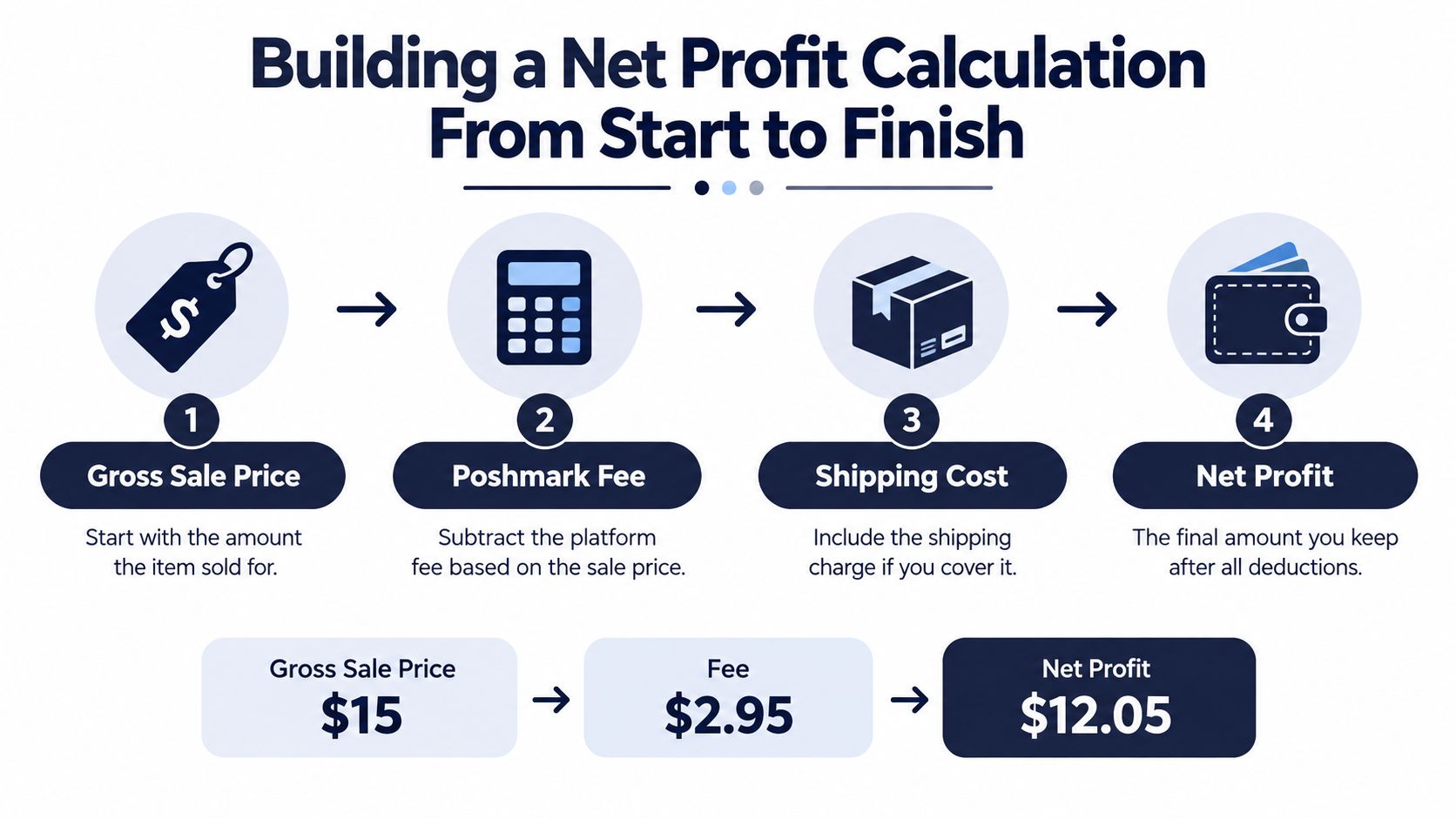
Start with the plain formula. Net profit equals the sale price, minus the Poshmark fee, minus any shipping discount you fund, minus your buy cost, minus supplies and any tax amount you track for the item. The sale price starts the math. It never finishes it.
Run It in This Order
Keep this in a phone note if you're doing it by hand. The order matters because each step answers a different question.
- Gross sale price: Use the realistic sold comp or accepted offer you expect, not the highest sold price you can find to justify the buy.
- Poshmark fee: Apply the threshold rule, flat $2.95 below $15 or 20% at $15 or more.
- Shipping discount: Subtract only the discount you choose to fund. Don't subtract the whole standard postage amount from every sale by default.
- Buy cost: Subtract what you paid, including the price you'd pay standing there today, not what you wish it cost.
- Supplies and tracked taxes: Add the mailer, tape, thank you cards if you use them, and any per item tax reserve you keep.
- Estimated net profit: Whatever remains is the number you compare against your minimum.
Poshmark's standard workflow uses a prepaid label generated after the sale, and the buyer generally pays the flat shipping charge unless you offer a discount. That's why shipping belongs in your Poshmark fee calculator as an adjustable seller cost, not as a generic percentage buried inside the fee. Two sellers can get different net profit from the same sold comp if one subsidizes shipping to close the deal and the other doesn't.
Work Backward From Your Minimum
The faster check runs in reverse. Pick your minimum net profit first, then ask what sale price gets you there after the fee, shipping discount, and buy cost. If that required price sits well above recent sold prices, pass and keep walking.
That habit pairs well with a clear method for pricing items for resale, because your list price should leave room for offers without dropping below the floor you set at sourcing.
Your list price is a negotiation starting point. Your minimum sale price is the line you set before emotion and closet pressure get involved.
Do the fast version in the aisle and the full version at home before listing. If both versions clear your target, you've got a buy. If the aisle version only works at the highest comp with no offer and no shipping discount, it's not a flip. It's an item you're talking yourself into.
Worked Examples for Common Sale Prices
Formulas get abstract fast, so hold one thing steady. The table below uses a $6 buy cost across common sale prices, following the threshold rule covered above, so you can compare the fee, the proceeds before cost, and the net after cost without changing the sourcing price every row.
Net Profit at a $6 Buy Cost Across Common Sale Prices
| Sale price | Poshmark fee | Proceeds before cost | Net after $6 buy cost |
|---|---|---|---|
| $5 | $2.95 | $2.05 | -$3.95 |
| $10 | $2.95 | $7.05 | $1.05 |
| $14 | $2.95 | $11.05 | $5.05 |
| $15 | $3.00 | $12.00 | $6.00 |
| $20 | $4.00 | $16.00 | $10.00 |
| $42 | $8.40 | $33.60 | $27.60 |
| $50 | $10.00 | $40.00 | $34.00 |
| $100 | $20.00 | $80.00 | $74.00 |
Read the $5 row first. At a $6 buy cost, it loses money before supplies, and no amount of wishful thinking about sell-through rate fixes that. Don't pick it up for Poshmark unless it's part of a bundle that changes the sale price.
The $10 row is almost as honest. You net $1.05 before supplies and taxes, which means a mailer and your packing time can wipe it out. That's the kind of item that feels productive because it sold, while your bank account barely notices.
The $14 and $15 rows show the threshold in real dollars. You make $5.05 at $14 and $6.00 at $15 on the same $6 cost. By $20, you've got $10.00 after cost, which might clear your minimum or might not, depending on how fast it sells and how much work it needs.
The $42 row matches that Ross jacket before any shipping discount, with $27.60 after the $6 cost. The $50 row keeps $40.00 before cost, and the $100 row keeps $80.00 before cost. Higher prices don't remove the percentage fee. They just give you more room to absorb it.
The Same $42 Sale With a Shipping Discount
Now change one variable. On a $42 sale with a $4.99 seller-funded shipping discount, the $8.40 commission plus that discount leaves $28.61 before cost of goods. With the $6 buy cost, net profit is $22.61 before supplies and taxes.
Compare that with $27.60 on the same sale with no discount. Same jacket, same sold comp, same buy cost, but almost five dollars less profit because you paid to help the buyer on shipping. Sometimes that discount is worth it to improve sell-through rate. Sometimes it's just giving away the margin you sourced for.
This is also where platform choice gets practical. Comparing Poshmark fees against eBay fees on the same item can show you whether Poshmark's buyer pool is worth its cut for that category, or whether the item belongs somewhere else.
Use the table as a floor check, not a promise. If a row doesn't clear your minimum before supplies and condition risk, a prettier photo won't save the math.
Returns and Condition Risk Your Math Misses
A clean net number on your phone can still be wrong, because a sale isn't finished when you drop the package off. It's finished when the buyer keeps the item and the money releases.
Under Posh Protect buyer rules, a buyer has 72 hours after delivery to open a return case for undisclosed damage, an incorrect or missing item, an item not as described, or suspected inauthenticity. If no case is opened within three days of delivery, payment is automatically released to you. When Poshmark verifies a claim, it can provide a return label and refund the buyer.
The $10 Shoes From the Estate Sale Bin
Say you dig a pair of shoes out of an estate sale bin for $10 and find a $55 sold comp. The clean math looks great. The sale is $55, minus $11 in commission, minus $10 in cost, which equals $34 before other expenses.
Then condition gets a vote. Heavy sole wear you didn't photograph, a missing accessory you didn't notice in the bin, or a buyer who doubts authenticity can turn that projected payout into a return, a round trip through the mail, and handling time you don't get back. You might relist and sell them later, but the original profit estimate was never real money.
Shoes, designer goods, electronics, and collectibles carry this risk more than a basic sweatshirt does. So do bin finds where you can't inspect zippers, test buttons, check for odors, or confirm every part is present before you pay.
Use a Buffer Instead of Pretending Precision
No Poshmark fee calculator can price return risk precisely for a specific pair of shoes. What you can do is require a bigger cushion on categories where condition is hard to verify, and walk away when the projected profit only works if everything goes perfectly.
- Inspect wear points: Soles, collars, underarms, corners of bags, and battery compartments tell you more than the front view does.
- Disclose flaws in photos: A clear flaw photo lowers return risk more than a clever caption does.
- Raise your minimum on risky finds: If a return would erase the profit, the item needs a higher target before you buy it.
Good guidance on describing item condition accurately helps here, because accurate condition language protects the same margin your calculator is trying to measure.
A high sold comp is not guaranteed net profit. It's a forecast that assumes the buyer agrees with your description.
Build that humility into sourcing. If the numbers only work at the top comp with perfect condition and no return, you're not looking at a flip. You're looking at a gamble with a shipping label.
Setting a Buy Rule and Choosing Your Tool
All of this math only helps if it turns into a decision you can make in about a minute at a shelf. A buy rule does that work for you, because it starts where you're standing: the clearance rack, the price tag in your hand, and the minimum profit you refuse to go below. The payout percentage is the last input, not the first.
Three Ways to Run the Numbers
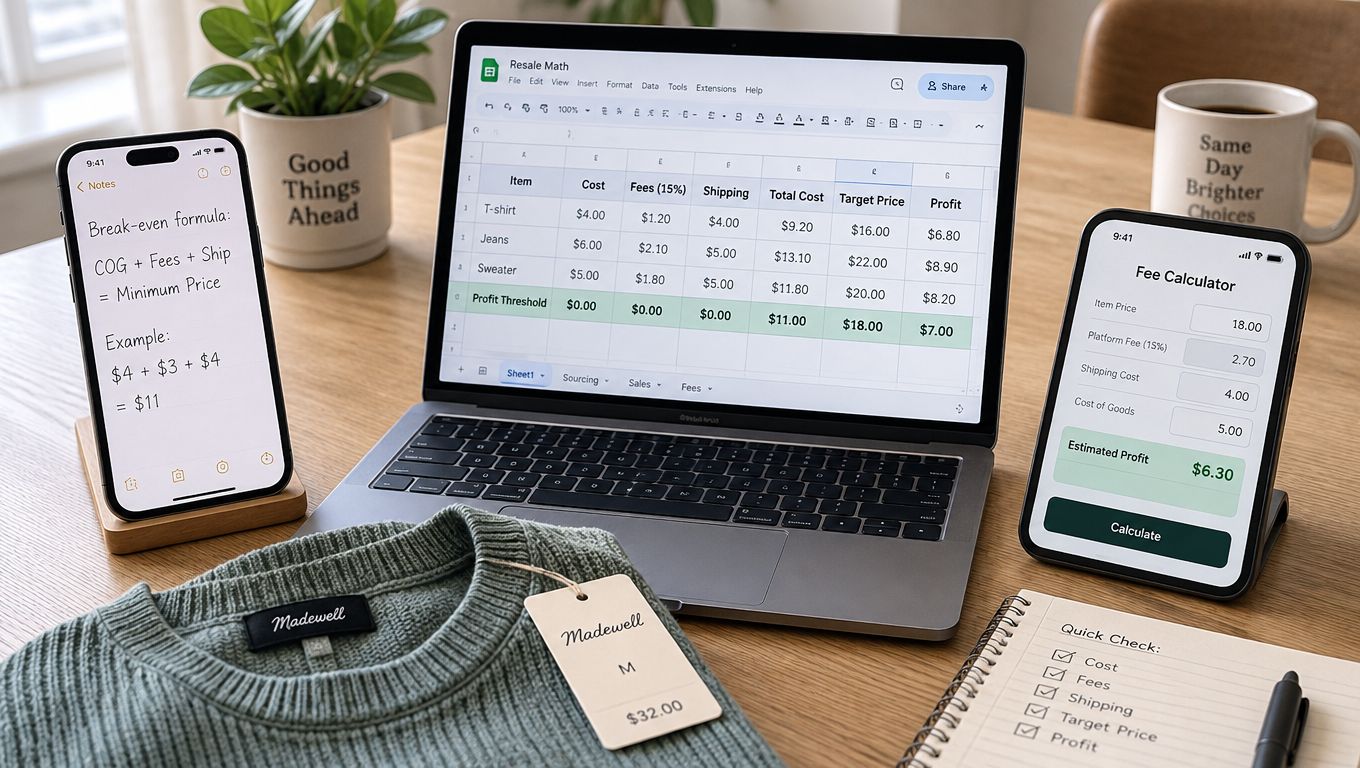
A notes app or paper formula works if you keep it consistent. It's free, it's transparent, and it drills the $15 line into you until the switch from flat fee to percentage becomes automatic. The downside is speed. At a crowded estate sale, slow math hands good items to the picker next to you.
A spreadsheet with the threshold built in suits home review and batch sourcing from thrift hauls. Columns for buy cost, shipping discount, supplies, and your minimum net let you sort out the losers before listing day. The risk is stale assumptions sitting in an old tab nobody checks.
A sourcing app is the third option, built for the moment you're still holding the item. ScanFlip AI scans any item with your camera, compares real-time sold comps across eBay, Poshmark, Mercari, Depop, Amazon, and Whatnot, and its automatic profit calculator computes fees and shipping to show your take-home profit. Its flip-or-pass verdict gives a red or green signal based on the minimum profit margin you set, which is your buy rule made instant. Keep the manual method as a fallback for the days you want to audit the number yourself.
Add the Shipping Deadline to the Rule
Profit on paper still has to survive your schedule. Sellers must ship within seven days of purchase, verified by an active carrier scan, under Poshmark's shipping policy terms. Miss that window and the buyer can cancel, which wipes out the expected profit and the work you already put in.
That matters for death pile buys. A $6 jacket with a $42 expected sale only helps if you can photograph it, list it, store it where you can find it, and ship it inside that window. If it sits unlisted for weeks, the calculator didn't fail. Your fulfillment capacity did.
Set one concrete rule this week. Choose a category you source often, set your minimum net profit for it, and run your next five finds through the fee, shipping discount, buy cost, condition buffer, and ship-by question before you pay. Buy only the ones that clear every part. That habit will do more for your ROI than one more BOLO that looks good at the gross price and falls apart after fees.
Before your next Ross, Goodwill, or estate sale run, set your minimum profit and work backward from it: sold comps, real Poshmark fees, shipping discounts, and buy cost all feed the same decision. ScanFlip AI lets you scan any item with your camera, see net profit after fees and shipping, and get a clear flip or pass verdict while you're still holding it.