
Comparable Sales Database: How Resellers Price Smarter
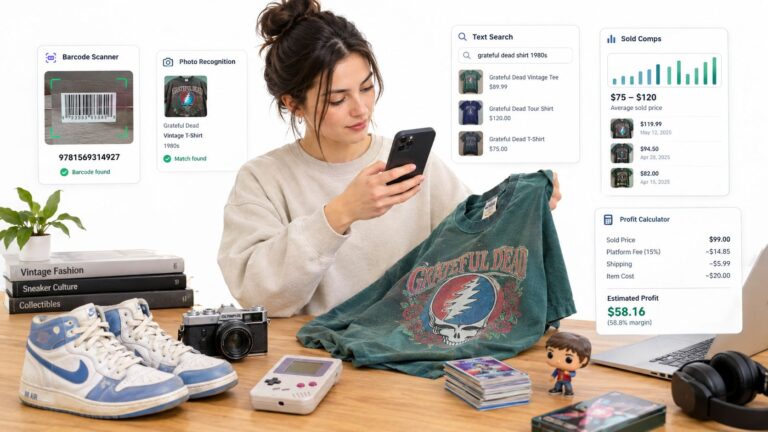
You're standing in a Goodwill aisle with a vintage Nike windbreaker in your hand, the rack's crowded, and somebody else is already hovering two feet away. You've got maybe 30 seconds to decide if $8 is a steal or a mistake, and the usual app-hopping routine, eBay, Poshmark, Mercari, burns that window fast. That's where a comparable sales database matters, because it turns a scattered sold-comps hunt into one fast pricing check before the item disappears back on the rack.
Table of Contents
- The Sourcing Problem That Costs Resellers Money
- What a Comparable Sales Database Is
- Key Metrics Every Reseller Should Check in Sold Comps
- Common Pitfalls and Biases in Comparable Sales Data
- How to Set Buy Prices and Profit Thresholds Using Sold Comps
- Building a Fast In-Aisle Sourcing Workflow with ScanFlip AI
- What to Look for in a Good Comparable Sales Tool
- Stop Guessing and Start Sourcing with Real Data
The Sourcing Problem That Costs Resellers Money
You know the drill at an estate sale. A pair of Allen Edmonds shoes looks clean, the size seems good, and the tag's sitting at $15. You open one app, then another, then another, and by the time you've checked sold comps, the person behind you has already picked up the same style in a different size.
That's the problem. Fragmented sold data slows down buy decisions, and slow decisions cost money. In the aisle, speed matters as much as accuracy, because a decent flip gone by is still a missed flip.
Practical rule: if you're toggling between apps to assemble a comp picture, you're already losing time to the picker who's using one clean dataset.
A comparable sales database solves that by putting recently sold items in one place, so you're not building a valuation from scratch every time you spot a BOLO. Instead of bouncing between marketplaces, you pull one search and look at the sold prices, the recency, and whether the item is close enough to your find to matter. That's the same basic logic real estate appraisers use, only adapted to reselling, where fees, condition, and platform bias can change the answer fast.
For resellers, the point isn't abstract valuation theory. It's whether a jacket, shoe, game, or hardgood clears your buy threshold after fees and shipping. If it doesn't, walk away.
If you want a sourcing-first view of how this fits into real picking decisions, the retail arbitrage angle is worth reading in the retail arbitrage sourcing guide.
What a Comparable Sales Database Is
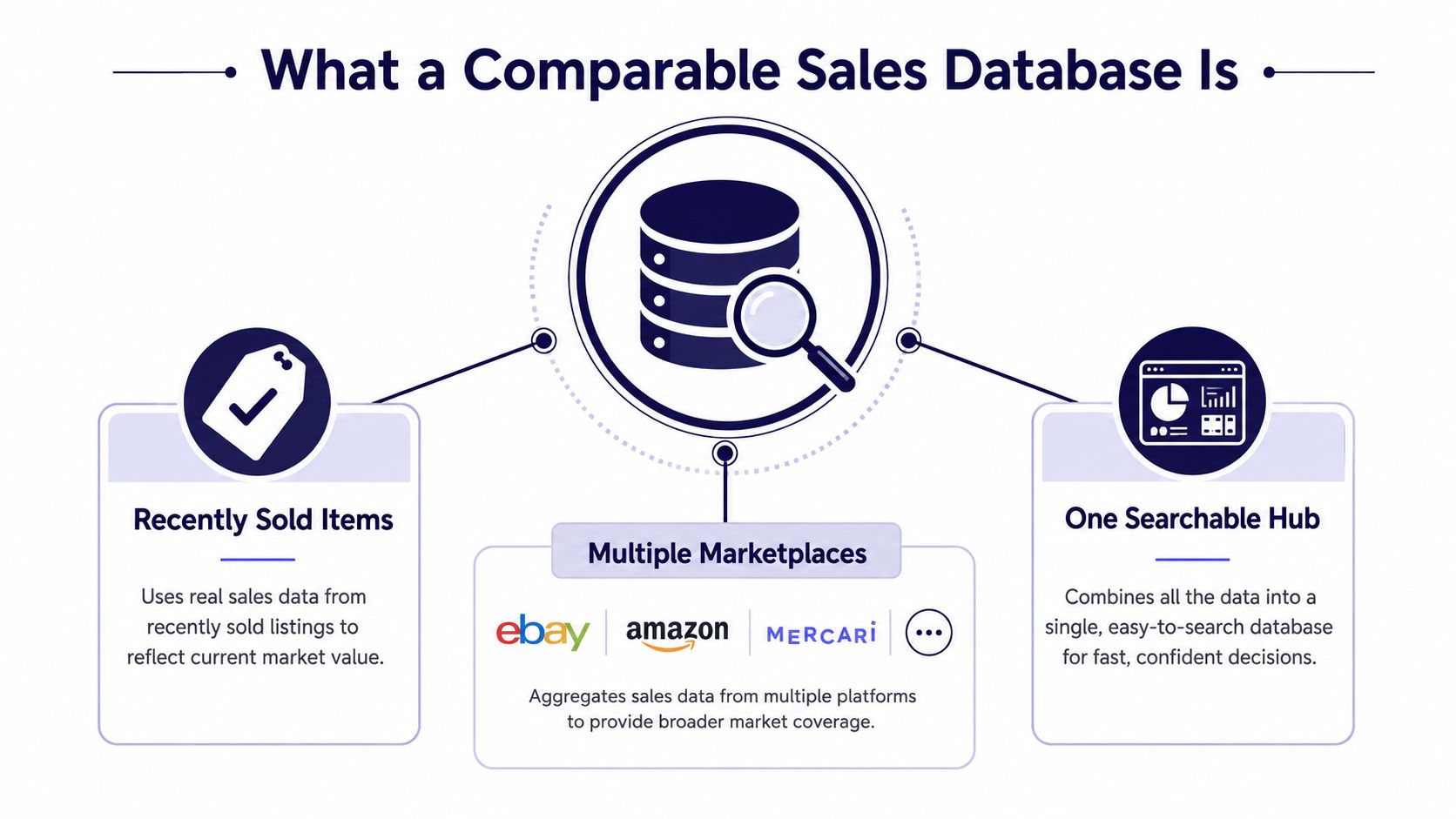
A comparable sales database is a tool that collects sold prices, not active listing prices, and organizes them into one searchable system. That matters because a listing is just somebody's ask, while a sold comp is what a buyer paid. If you're trying to price a vintage jacket or a collectible, the sold price is the number that tells the truth.
Real estate uses the same logic. According to Zillow's real estate comps guidance, you should look at at least 3 similar homes, ideally sold within the past 3 to 6 months, and often within about 0.25 to 0.5 mile in many cases. According to Fannie Mae's comparable sales guidance, closed comps within the last 12 months should be used in appraisal work, and the best comps are not always the newest ones. That same idea carries over to reselling. Recent, similar, closed sales beat pretty screenshots of active listings every time.
If you want a closer look at how recent sold prices work in practice, the recent sold prices guide breaks down why timing matters so much.
Why aggregation matters
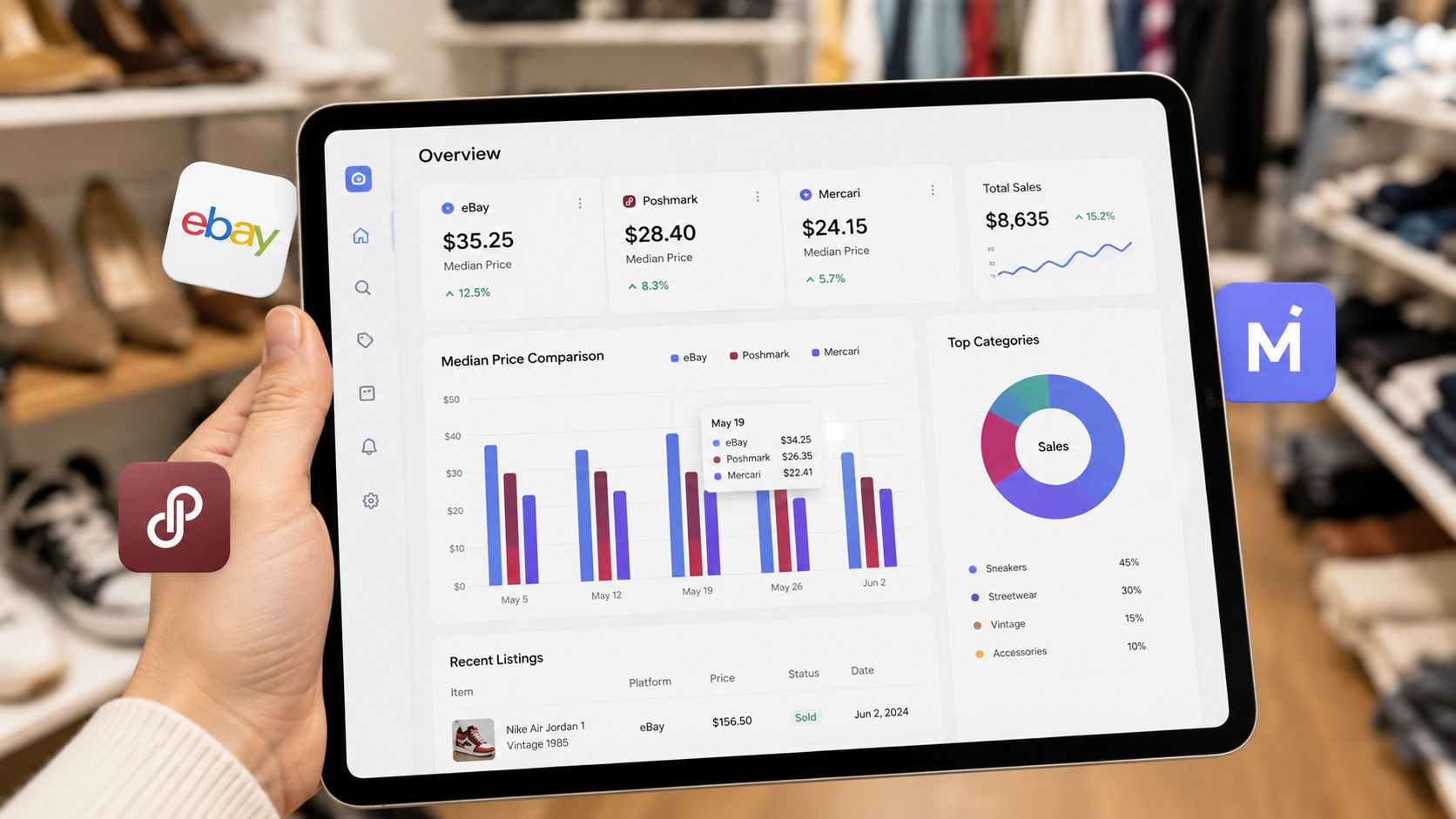
Good databases do more than stack one marketplace on top of another. They normalize messy records from places like eBay, Poshmark, Mercari, Depop, Amazon, Whatnot, ThredUp, Facebook Marketplace, and TikTok Shop, then make the records comparable. That part matters, because a sold jacket on one platform does not mean much until the tool strips away the noise and lines up the details that matter.
On the valuation side, that is exactly why structured comp databases store sale date, location, size, condition, and features rather than just a headline price. In commercial and land systems, RealStack's comparables overview describes ValuSource's Market Comps database as including fields such as Price/Sales, Price/EBT, SIC, NAICS, Location, Annual Gross, Annual Earnings, Owner's Comp, Sales Price, Business Description, sale date, and geographic area, plus 15 asset fields for one year and 16 income statement fields for three years. That kind of structure is what lets users compare apples to apples instead of eyeballing random sold records.
For resellers, the point is plain. If the tool only shows a number without context, it is not doing enough. If it gives you sold prices plus the attributes you need to judge fit, it starts to act like a real comp database.
Key Metrics Every Reseller Should Check in Sold Comps
A sold comp with a nice-looking price can still be trash data if the sample is thin, stale, or wildly different from the item in your hand. I've seen people get seduced by one strong sold price and miss the fact that the rest of the comps were weaker, older, or from a different marketplace. That's how you overpay in a thrift aisle and then spend a week trying to justify the buy later.
Start with the middle, not the highlight reel
The median sold price usually matters more than the average because it ignores the weird outliers that skew the math. If a pair of Nike Dunks has a median sold price of $120, that number is usually more useful than one random high sale that looks great but doesn't reflect the bulk of demand.
The middle sold price is the number you can trust when the data gets messy.
Then check the volume and the age
A vintage Carhartt jacket with 15 recent sales tells you a lot more than one with 2. Thin volume means you're guessing, even if the top sold price looks tempting. Recency matters too, because old comps can drift away from what buyers are paying now, especially in fast-moving categories like sneakers and trend-driven vintage.
Adjust for condition before you buy
A comp only helps if it's comparable. If the sold example was new-in-box and yours has wear, stains, missing accessories, or a rough size tag, mentally subtract value before you get excited. That's the reseller version of appraisal adjustment, and it keeps you from treating a beat-up item like mint stock.
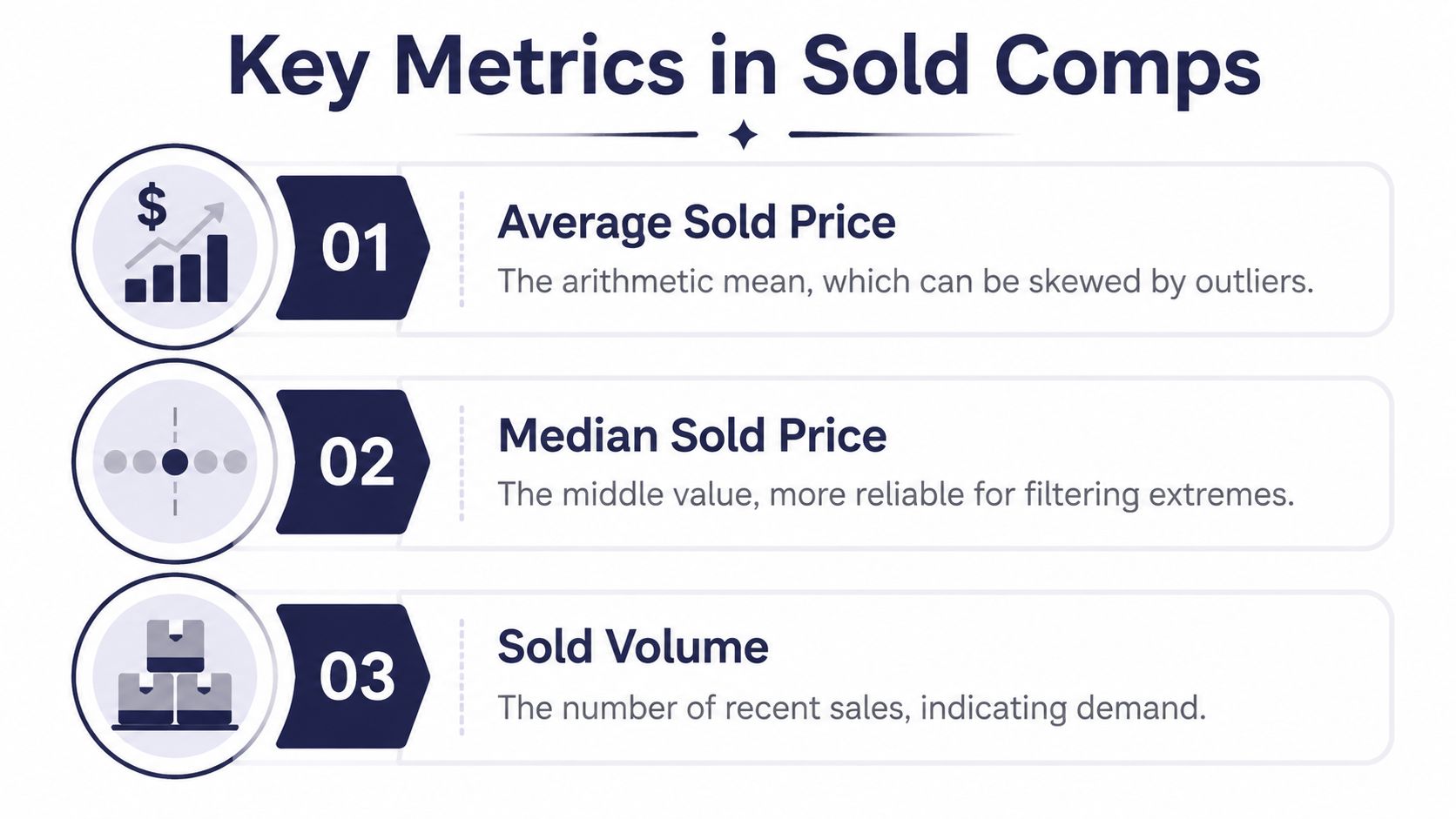
Here's the quick checklist I use in the aisle:
- Median sold price: the best anchor when one weird sale shouldn't control the decision.
- Recent sold volume: enough activity to prove demand, not just a one-off fluke.
- Condition gap: always compare your item to the actual state of the sold comp, not the label alone.
If a tool doesn't make those three things easy to see, it's not helping much. It's just making you feel informed while you're still doing the work in your head.
Common Pitfalls and Biases in Comparable Sales Data
The biggest trap in comp data is treating one sold price as the market. It isn't. A single comp at $200 does not mean the item is worth $200 if the rest of the sales cluster much lower. That is how resellers end up buying into a number that looks clean on the screen and ugly in the cart.
Marketplace bias changes the number
Different marketplaces price the same item differently. Fashion on Poshmark often sits in a different range than eBay, while Facebook Marketplace can run lower because local pickup changes buyer behavior and weakens urgency. If your database does not show the marketplace clearly, you can end up treating separate buyer pools as if they were the same market.
Stale data is a quiet problem
Comps from six months ago may miss what buyers are paying now, especially in seasonal categories and trend-heavy items. A tool that mixes old and fresh solds without distinction can make a decent item look safer than it is. Real estate guidance makes the same point, since the value of a comp depends on recency, similarity, and transaction context, not just proximity or a neat sold record, as described in the Fannie Mae sales comparison approach.
Thin markets force judgment
When there are only 2 or 3 sold comps total, you are not looking at a strong market signal. You are looking at a guess with paperwork. That is the point where appraisers and resellers both have to slow down and treat the number as a starting point, not a verdict.
Fannie Mae also says the source for each comparable sale has to be reported and verified, and the source has to be specific and reliable for the local market, not just a vague label like “public records” or another broad category.
The other quiet failure is listing price contamination, where a tool mixes active listings into sold data. That makes a comp set look healthier than it is, because asking prices are often aspirational and do not tell you what cleared. If the database cannot separate solds cleanly, I do not trust the output enough to buy from it.
How to Set Buy Prices and Profit Thresholds Using Sold Comps
A comp only matters if it turns into a number you can pay. That means starting with the median sold price, then backing out fees, shipping, and your target profit before you touch your wallet. If you skip that part, you're not pricing. You're hoping.
A simple buy-price formula
Take a vintage band tee with a $45 median sold price on eBay. If fees come out to $6.75, shipping is $5, and you want $15 in profit, your max buy price is $18.25. Anything above that and your margin starts getting thin fast.
That's the whole game in a thrift aisle. The item can be cool, the brand can be strong, and the sold comps can look healthy, but if the math doesn't leave room for profit, it's a pass.
Different categories need different thresholds
Fast-flipping books and media can sometimes work with smaller margins because they move quickly and don't take much room. Furniture, shoes, jackets, and niche collectibles usually need more breathing room. The slower the turn, the more disciplined the buy price has to be, because your money is sitting there longer.
| Marketplace | Fee Percentage | Fee Amount | Est. Shipping | Net Before Buy Cost |
|---|---|---|---|---|
| eBay | about 13 to 15% | varies by sale | varies by item | sold price minus fees and shipping |
| Poshmark | 20% | varies by sale | varies by item | sold price minus fees and shipping |
| Mercari | 10% plus payment processing | varies by sale | varies by item | sold price minus fees and shipping |
The cleanest way to use the table is not to memorize the exact fee for every tiny scenario. It's to force yourself to think in net profit, not gross sale price. If your target is a minimum net and the item can't get there, leave it behind.
For a more detailed break-even framework, the break-even price calculation guide is the right way to pressure-test your numbers before you buy.
Building a Fast In-Aisle Sourcing Workflow with ScanFlip AI
The best sourcing workflow is boring in the best way. Pick up the item, scan it, get a read on sold comps, check net profit, and decide before your attention drifts. In a crowded estate sale or thrift aisle, that speed is worth more than a prettier dashboard.
Use the scan method that fits the item
ScanFlip AI fits that aisle workflow because it gives you three ways to check an item. Use the AI photo scan for stuff without a barcode, like vintage clothing, shoes, or collectibles. Use the barcode scan for books, media, and boxed retail. Use text search when the item can't be photographed cleanly or you already know the name.
That matters because a barcode-only app misses a lot of reseller inventory. Most of the stuff worth flipping in a Goodwill bin, a church sale, or an estate sale table isn't neatly UPC-tagged.
A quick shoe buy decision
I've seen the decision become simple when the numbers are clear. Say you're at an estate sale and find a pair of Allen Edmonds shoes with no visible barcode. You use the AI photo scan, see a $85 median sold price across sold comps, estimate $52 net after fees and shipping, and your $20 minimum profit threshold gives you a green light to buy at $15. That's the kind of move that keeps sourcing clean, because the app is doing the math while you're still in front of the table.
Practical rule: if the tool can't show net profit after fees, you still don't know if the buy is good.
ScanFlip AI is a sourcing-phase tool, not a listing tool. Resellers often use it alongside crosslisting tools like Vendoo or List Perfectly, but the job here is simple, decide whether to buy before the money leaves your pocket. It pulls sold prices from eBay, Poshmark, Mercari, Depop, Amazon, Whatnot, ThredUp, Facebook Marketplace, and TikTok Shop, then returns a red or green flip-or-pass result based on your threshold.
What to Look for in a Good Comparable Sales Tool
A decent pricing app can show a number. A good comparable sales tool helps you make a purchase decision. That difference matters when you're standing in a store with a cart full of maybe-buys and limited time.
The features that actually matter
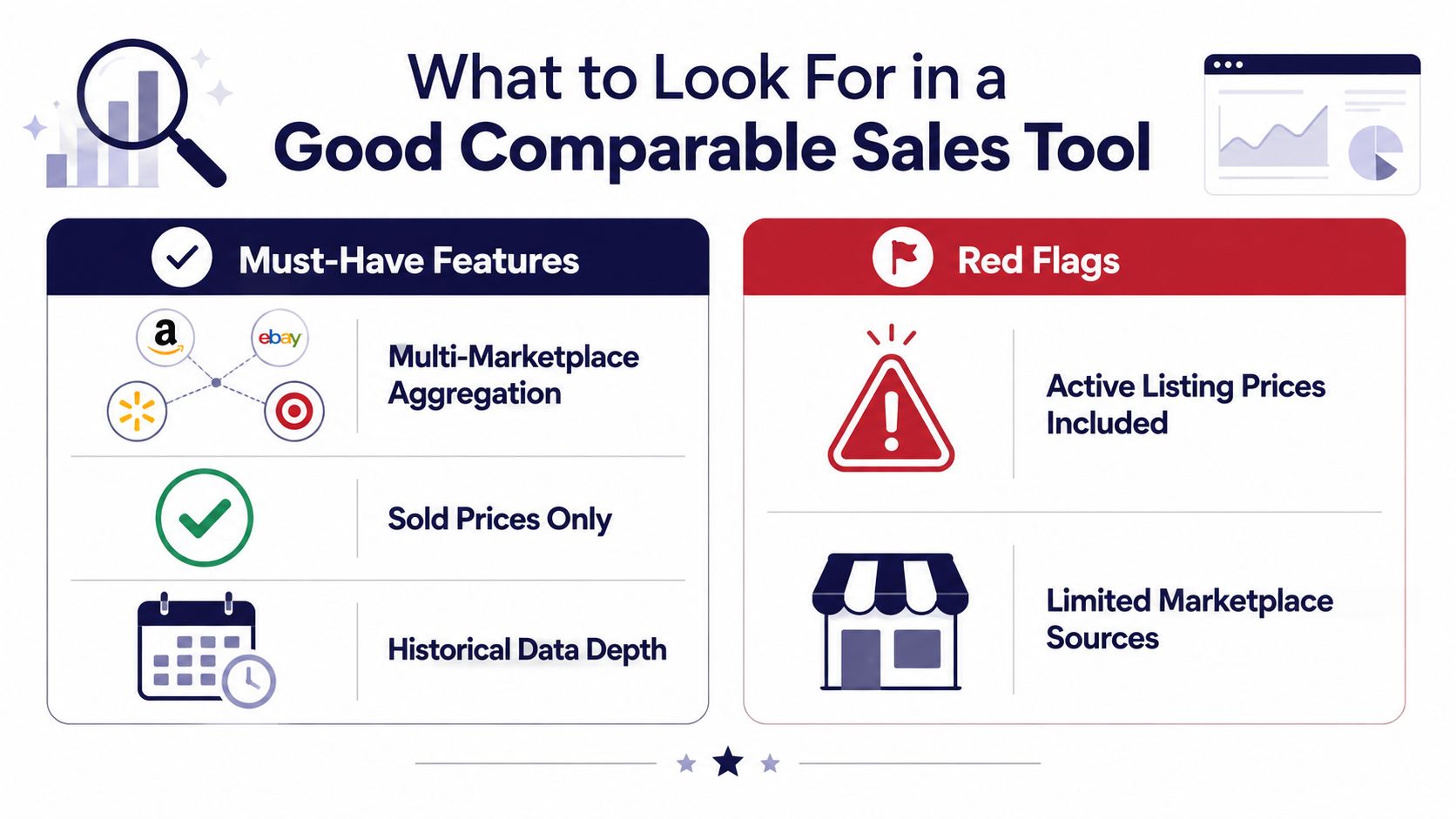
The essentials are pretty clear:
- Multi-marketplace aggregation: you need sold comps from more than one platform, not just a single marketplace view.
- Sold prices only: active listings should not get mixed into the comp set.
- Historical depth: you need recency filters so you can widen or tighten the window based on the category.
Red flags that waste time
If a tool shows active listing prices, that's a warning sign. If it only covers one marketplace, it can miss the overall market. If it works only for barcode scans, it's weak for vintage apparel, shoes, and collectibles, which is where a lot of good flips hide.
A few nice-to-haves help too. Scan history with photos and timestamps is useful when you want to remember what you saw. Location tracking helps you figure out which stores produce. Condition adjustment tools save time because they force you to account for wear instead of pretending every comp is equal.
The main point is simple. A reseller tool should help you buy smarter in the aisle, not just look smarter after the fact. If it can't separate sold data cleanly, calculate net profit, and work on the kinds of items you source, it's not built for real flipping work.
Stop Guessing and Start Sourcing with Real Data
Sold comps beat listing prices every time because sold prices show what buyers paid. Median matters more than average when outliers creep in. Recency, volume, and condition decide whether a comp is useful or just noise.
The cleaner your workflow, the fewer bad buys you drag home. Scan fast, check the median, back out fees, and make a flip-or-pass call before you leave the aisle. That discipline saves time and keeps the death pile from getting bigger than your profit.
Not every item is worth flipping. A solid comparable sales database helps you walk away from weak buys just as confidently as it helps you spot the good ones. That's the part most beginners miss, the data doesn't just tell you what to buy, it tells you what to leave behind.
If you want a faster way to check sold comps while you're still in the aisle, visit ScanFlip AI. It pulls sold prices from multiple marketplaces, calculates net profit after fees, and gives you a clear flip-or-pass read before you buy.