


How Fast Do Items Sell on Poshmark? Real Timelines
There's no single Poshmark timeline: well-priced items commonly sell within about 18-25 days, while overpriced items often sit 90 days or longer. Your actual sell window depends on the item, its condition, buyer demand, and whether your price matches recent sold comps.
You're standing in a Goodwill aisle holding a jacket that looks like easy money. The question isn't just what somebody might pay for it. It's whether that purchase will turn back into usable cash before your next sourcing trip, or join the death pile while you keep buying around it.
Table of Contents
- Typical Poshmark Sell Times at a Glance
- What Makes Some Items Sell in Days and Others in Months
- How to Read Sold Comps for a Realistic Timeline
- Check Net Profit and Timing Before You Buy
- Pricing for Speed Without Giving Up Margin
- Fixing a Listing That Has Stopped Moving
- Shipping Fast So the Sale Sticks
Typical Poshmark Sell Times at a Glance
A jacket that nets $25 in two weeks can beat one that nets $60 in five months. The bigger number looks better on paper, but while it sits your capital is locked on a hanger and fresher listings keep pushing yours down. Sell speed is a cash-flow question before it is a profit question.
Poshmark doesn't publish a universal average time-to-sale. The figures available describe particular seller inventories and reseller benchmarks, so treat them as planning ranges for your own buying decisions.
Reported Poshmark sell times by scenario
| Pricing or listing scenario | Reported timing | Source type |
|---|---|---|
| Priced at or below recent sold comps | The fastest-moving group, often selling within the first few weeks | Reseller benchmark |
| Priced at full retail or above market | A large share still sitting unsold months later | Reseller benchmark |
| Items sold within first two weeks | About 48% of items | Seller-reported analysis |
| Average time to sale, extreme outliers removed | 39.5 days | Seller-reported analysis |
| Average time to first sale | 14 days | 2025 Clothing Digest comparison |
The first two rows capture the split that matters when you're deciding whether to buy: inventory priced where buyers are paying tends to move, and inventory priced at wishful numbers tends to stall. The bottom three rows come from identifiable reports you can weigh for yourself.
A seller-generated analysis summarized in an Alibaba product-insights article reported that nearly 48% of items sold within their first two weeks, with an average of 39.5 days after removing approximately 2% of extreme outliers that took more than a year to sell. Those numbers describe one seller's inventory, not the marketplace as a whole.
A 2025 Clothing Digest comparison reported an average of 14 days to make a first sale for Poshmark listings. How quickly a fresh closet starts converting is a different yardstick from average holding time across established inventory.
Why the average can mislead you
Stale items pull an average upward even when most of a seller's good inventory moves promptly. Sold-only averages also skip the listings that never sold at all, so the true cost of a bad buy stays invisible in the numbers.
Practical rule: Plan around the inventory you're buying, not somebody else's entire closet.
Track three things together: your median holding time, how much sells in the first two weeks, and what is still sitting. Before buying into a new category, write down its expected sell window and the comp evidence behind it. Given similar effort, I'd take the fast $25 over the slow $60 nearly every time.
What Makes Some Items Sell in Days and Others in Months
Think of your closet as a shelf: a sold item matched a buyer who was already searching, while a slow item was something buyers kept scrolling past. Better presentation helps, but it can't create demand for a style nobody wants at a price nobody will pay.
A recognizable label is a starting point, not a buy signal. A worn, dated piece from a BOLO brand can be a worse purchase than a clean, current item with less name recognition.

Check the item, not just the label
- Brand demand: Lululemon, Free People, and Vineyard Vines are recognizable names to investigate, not automatic fast flips. Check the exact product rather than treating every piece from a label equally.
- Category and season: An in-season dress or bag may fit an immediate need. A heavy coat in July requires a buyer shopping ahead, which changes your holding-time expectations.
- Size and fit: Common sizes can attract a broader buyer pool, but competition matters too. Less common sizes may wait longer for the right buyer, so inspect matched comps rather than assuming.
- Condition and photos: Pilling, heel wear, missing hardware, and hidden stains change what buyers will pay. Show flaws clearly and photograph fabric texture, labels, and fit details.
- Style currency: A recognizable trend that peaked last year can still be dead stock. Don't mistake an old retail price for current demand.
Seasonality also changes when to source versus when to list. Sweaters in September and swimwear in March are useful merchandising cues, not guarantees that every piece will move.
Make your BOLO list specific
Use a guide to what sells best on Poshmark to build search targets, then narrow those targets by style, condition, and sold comps. A useful BOLO describes a product you can recognize and verify, not just a brand you hope will sell.
Digging through a garage-sale bin, it's easy to buy something because it looks expensive. That's where discipline matters most: the purchase is cheap, but cleaning, photographing, storing, and answering questions still take time.
My sourcing test is simple: name three recent sold listings of the same brand, size, and style. If you can't, treat the item as a slow-sale risk, regardless of how good it looks in the bin.
How to Read Sold Comps for a Realistic Timeline
Sold comps help answer what buyers paid. Estimating speed takes another layer of checking, because a sold result doesn't always reveal when the item was first listed.
A seller's multi-year Poshmark analysis illustrates how strongly early sales and long-held inventory can differ within the same closet. Use that as a reason to inspect comparable items closely, not as a forecast for an unrelated find.
Follow a repeatable comp check
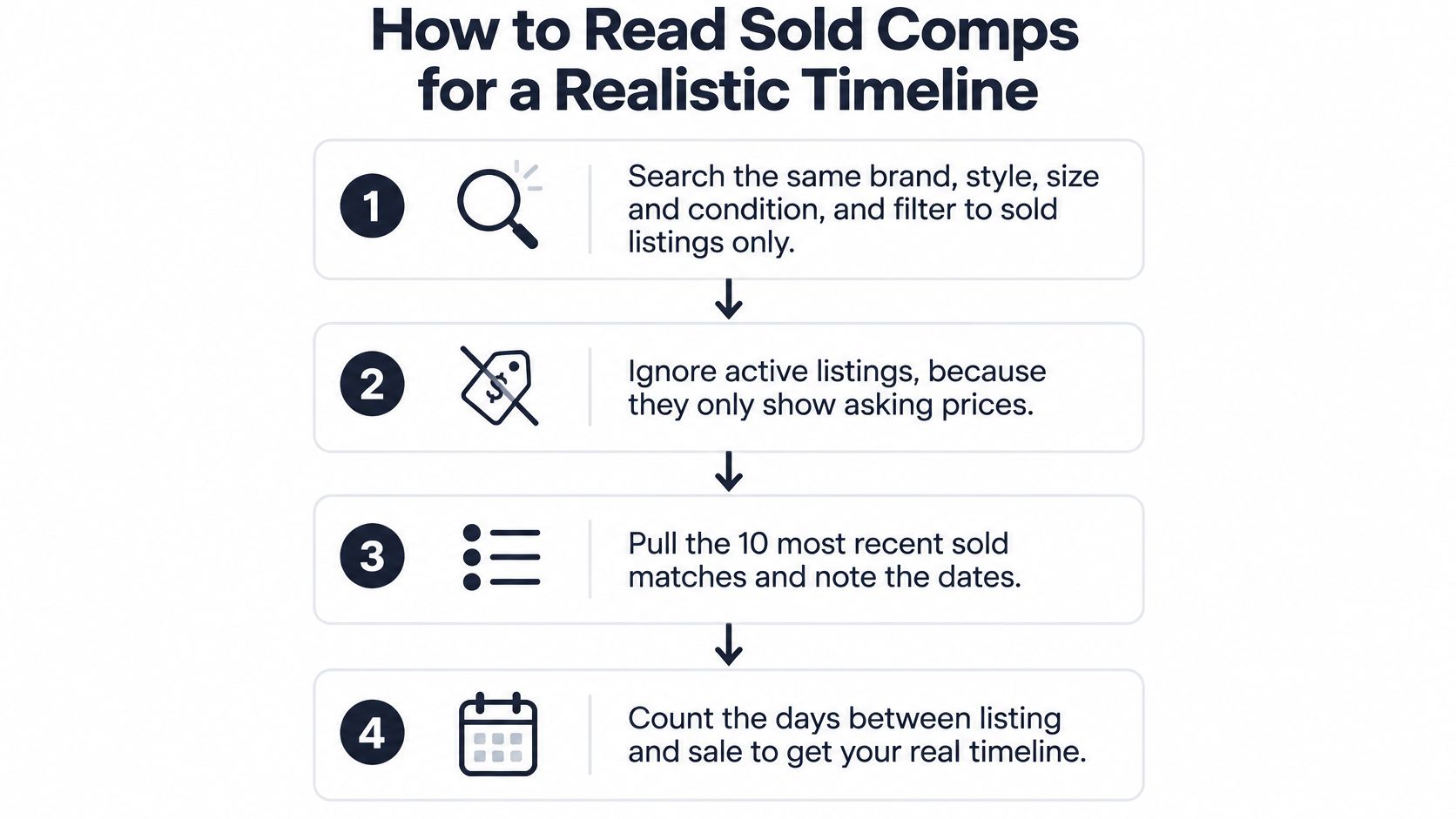
Match the actual item. Search the same brand, style, size, and condition, then filter to sold listings. Active listings show asking prices, not proof that a buyer paid them.
Pull the 10 most recent useful matches. Record each sold price. Exclude results that aren't comparable, such as a new-with-tags item when yours has visible wear.
Check listing duration where it's visible. Note the original listing date and sale date only when you can verify both. Don't assume an update date is the original listing date, and don't invent missing timing.
Use the median sold price. Arrange your matched sold prices from lowest to highest and use the middle as your working target. The highest sale might reflect exceptional condition, an unusual size, or a buyer you can't count on finding again.
Classify the likely holding period. For this sourcing exercise, check how many matched sales happened within 30 days. If several took 60 to 90 days, budget for a slower hold rather than calling the item a quick flip.
Make the buy-or-pass decision. Buy when the price and observed timing both fit your requirements. Pass when the matches are sparse, stale, or only attractive before you account for discounts and costs.
Our guide to recent sold prices is useful when you need to separate a relevant comp from a superficially similar result.
Read the sample honestly
Say you find 7 of 10 matched sold items sold within 30 days. In this hypothetical example, that supports a fast-flip estimate if your item is equally competitive and the net profit works.
Now say only 3 of 10 sold within 30 days. I'd pass if the purchase depends on quick turnover, even if the highest sold comp looks attractive.
Neither result is a true sell-through rate, or STR, because you sampled sold items and excluded unsold listings. To estimate STR, you need a defined inventory cohort, a time window, and the share that sold.
Missing timing is uncertainty, not evidence of a fast sale.
Finish with a written estimate such as: Expected sell window: within a month, provided condition and price match the strongest comps. If you can't support a window, mark the purchase as speculative before deciding whether it deserves your cash.
Check Net Profit and Timing Before You Buy
A $25 net-profit item selling in 10 days can be a better purchase than a $60 net-profit item taking 90 days, a comparison discussed in this seller turnover discussion. The slower item earns more per transaction, but it keeps your sourcing money unavailable longer.
Using those hypothetical outcomes, the fast item produces $2.50 net profit per holding day, compared with about $0.67 for the slow item. That isn't a guaranteed reinvestment return: you still need replacement inventory, time to process it, and buyers.
Calculate profit before committing cash
Use this calculation:
Expected sold price − platform fees − seller-paid shipping − cost of goods = expected net profit.
Then divide expected net profit by expected days to sale. Keep ROI alongside that figure, because profit per holding day alone doesn't tell you how much capital you had to invest.
The jacket calculation in the pricing example puts actual fees and shipping into that decision. For your own purchases, use a Poshmark profit calculator rather than mentally treating gross proceeds as take-home.
At the shelf, ScanFlip AI offers AI photo scanning with no barcode needed, barcode scanning, and text search. Its core real-time comparison covers six major platforms, eBay, Poshmark, Mercari, Depop, Amazon, and Whatnot, with sold-comp coverage also including ThredUp, Facebook Marketplace, and TikTok Shop; it calculates net profit after fees, shipping, and buy cost, then gives a red/green flip-or-pass verdict based on your threshold.
Budget for space as well as money
A Ross clearance find isn't automatically worth buying because the markdown is deep. If your profit depends on holding it through another season, include storage and handling in the decision.
For practical guidance on organizing stock and keeping purchasing decisions connected to available space, the Container Self Store inventory guide is a useful companion.
Before paying, write down expected net profit and expected sell window. Buy only when both fit your cash-flow needs, not merely because the ROI looks impressive.
Pricing for Speed Without Giving Up Margin
Say a $6 thrifted jacket sells for $42, and you cover $4.50 in shipping. Those are scenario inputs, not a standard shipping charge.
For the fee assumption, a Poshmark selling guide from Closo describes a 20% commission on sales above $15. Under that structure, the jacket calculation looks like this:
| Hypothetical jacket calculation | Amount |
|---|---|
| Sold price | $42.00 |
| Platform fee | −$8.40 |
| Proceeds after fee | $33.60 |
| Shipping you cover | −$4.50 |
| Cost of goods | −$6.00 |
| Net profit | $23.10 |
That transaction works if the sale price sits inside the relevant sold-comp cluster. It doesn't require you to post the highest number on the page and wait for somebody to negotiate it down.
Leave offer room without leaving the market
The reseller benchmark comparing clothing resale platforms reports roughly 18-25 days to sale for priced-to-sell listings, while about 40% priced at full retail or above market remained unsold after 90 days. Treat that as directional evidence for competitive pricing, not a prediction for a particular jacket.
List a little above your target when the comp range supports it. Don't add so much negotiation room that buyers dismiss the item before making an offer.
A bundle or small price drop can make sense when inventory is aging. But calculate the combined net first, including any shipping deduction or heavier-package cost, rather than assuming a larger order is automatically better.
Set the floor before offers arrive
Your floor price is the lowest sale amount that clears your net target after fees, shipping, and cost of goods. Calculate it before listing, while you're thinking clearly rather than reacting to an offer notification.
Margin rule: If the price you need is above what comparable items actually sell for, the sourcing decision is wrong.
Write that floor on the item tag or in your item notes. Don't accept below it casually; if you later choose liquidation, make that a separate, deliberate decision to recover cash and space.
Fixing a Listing That Has Stopped Moving
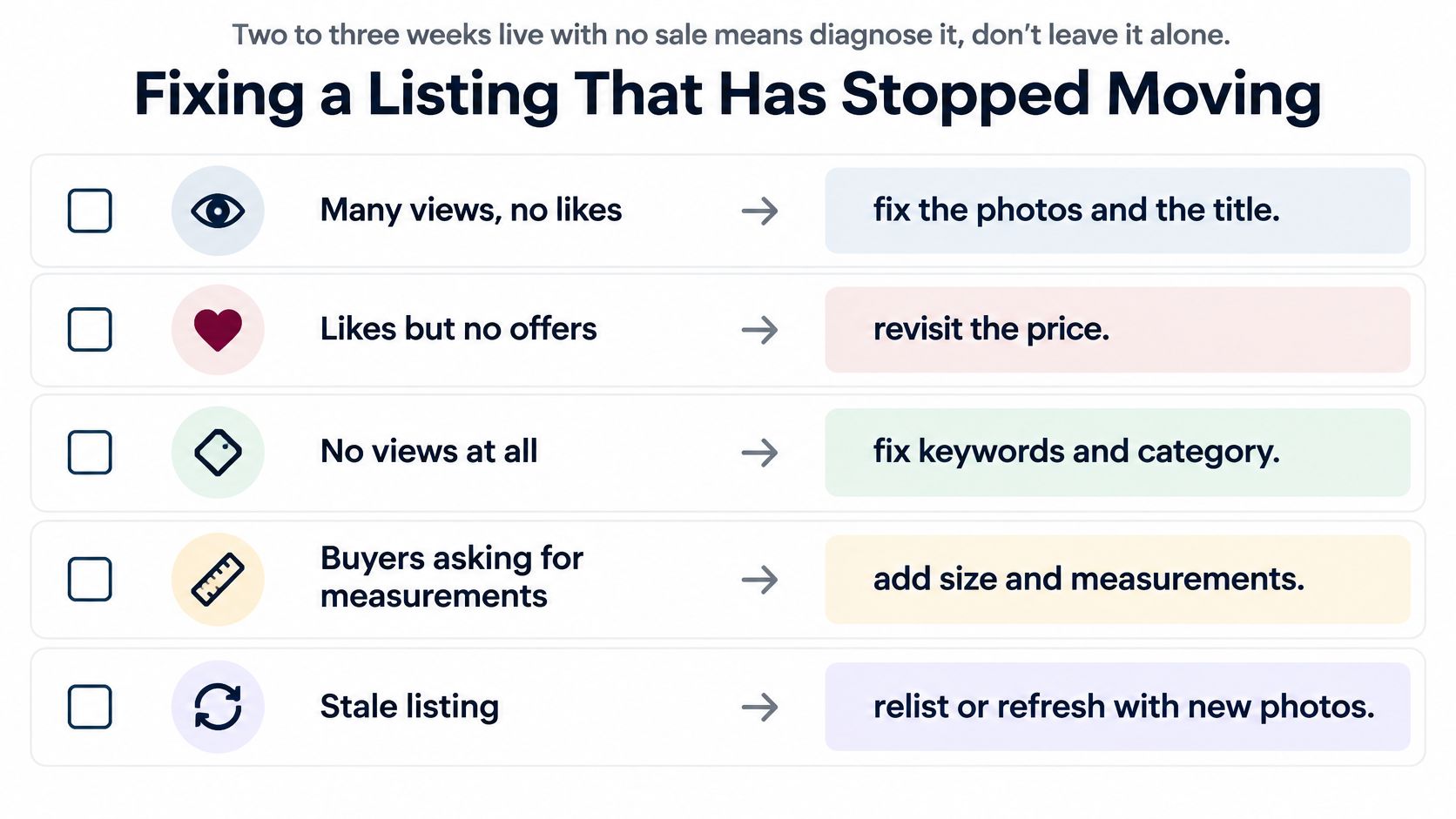
Use a 30-day check as an operating habit, not a marketplace rule. If an item has been live for two to three weeks without selling, start diagnosing it rather than waiting indefinitely.
Buyer activity gives you clues, not a definitive explanation. A weak photo, a poor title, and an uncompetitive price can overlap, so change the clearest problem first and record what you changed.
Stalled Poshmark listings symptoms, causes and fixes
| Symptom | Likely cause | Fix |
|---|---|---|
| Many views, few likes | Weak first photo or price above sold comps | Reshoot the first photo and move the price to the comp median |
| Likes but no offers | Price or shipping looks high next to sold listings | Check net with shipping, then lower the price or offer a bundle |
| Views drop after two weeks | Stale listing with weak title keywords | Rewrite the title with brand, style, size and condition, then relist |
| Offers only at deep discounts | Priced well above the market | Cut to the sold-comp median and accept a shorter sell window |
| No sold matches for the style | Item has lost demand | Stop investing time, bundle it or write it off as a pass |
Treat these as diagnostic hypotheses, especially when the activity count is small. No sold matches can also mean your search is too narrow or the item is uncommon, so verify the identification before declaring it dead stock.
Change what the buyer actually sees
For views without likes, inspect the cover photo on a phone screen. Remove distracting backgrounds, show the full item, and make sure the color looks accurate.
Likes without offers call for a total-cost check. Compare the item's price and shipping arrangement with genuine alternatives, rather than treating likes as proof that a sale is close.
When visibility fades, rewrite the title with brand, style, size, and condition where relevant. Correct the category, add requested measurements, and refresh photos before relisting through the platform's permitted process; copying a weak listing doesn't repair it.
Deep-discount offers deserve attention when they cluster around the actual comp range. They may be telling you that your target is unrealistic, not that every buyer is unreasonable.
Know when to stop fixing
Share on a steady schedule that fits your workflow instead of spending an entire evening repeatedly pushing the same stale item. Sharing is an exposure task, not a substitute for correcting the product, photos, or price.
Set an exit rule before another round of edits. If the item remains unsold after your second planned price adjustment brings it to the comp median, move it into a suitable bundle or liquidate it and mark that style as a future pass.
The original cost is already spent. Don't keep spending sourcing and listing time trying to prove the purchase was right.
Shipping Fast So the Sale Sticks
Selling time and cash-return time aren't identical. A purchase notification still leaves you with fulfillment work, and an unshipped order can disappear before it becomes usable sourcing capital.
According to Poshmark's FAQ, most sellers ship within two days, sellers have seven days from purchase to ship, buyers can cancel an unshipped order beginning on the eighth day, and Poshmark reserves the right to automatically cancel an order still unshipped on the fourteenth day. Those are fulfillment limits, not sensible handling targets.
Build a routine you can repeat
The thrifted jacket only becomes a completed transaction if you follow through. Same-day or next-day handling reduces avoidable delay, although delivery and transaction completion still take time.
- Check orders every morning. Print the label when the sale comes in, verify the item, and keep paid orders separate from unsold stock.
- Pack at a fixed daily time. Batch the work into a dependable packing session and arrange a carrier handoff that doesn't leave weekend orders forgotten.
- Keep supplies ready. Stock tape, labels, protective materials, and suitable mailers before you run out. Use Material Handling USA's poly mailer sizing chart to choose packaging that fits without forcing garments into an undersized bag.
Printing a label isn't the same as shipping. Confirm the parcel reaches the carrier, and monitor tracking when an acceptance scan is missing.
Set up a small packing station this week, clear a place for sold orders, and put the daily order check on your calendar. That's a more useful speed improvement than sourcing another bag of inventory while paid orders sit by the door.
Before your next sourcing trip, use ScanFlip AI to identify a find, compare real sold comps, and calculate net profit after fees and shipping. Pair that result with an evidence-based sell window, then buy only when both the return and the wait make sense for your cash.