
Magic the Gathering Card Value Lookup: Sold Comps
Four dollars buys a shoebox of Magic cards at Goodwill. You flip through, spot an old frame and a set symbol you half recognize, type the name into your phone, and the first number that comes back is $180. That number is almost certainly for a different printing, a different finish, or a grade your card doesn't have.
A Magic: The Gathering card value lookup isn't a price check. It's an identification job, then a condition job, then a price job, in that order. Skip the first two and the third one lies to you.
Table of Contents
- Why a Generic Price Search Gets Resellers Burned
- How to Identify the Exact Printing Before You Search
- Reading Sold Comps Without Getting Fooled
- What Condition Does to the Sale Price
- Working Out Net Profit Before You Pay
- Set Your Buy Line Before You Walk the Aisle
Why a Generic Price Search Gets Resellers Burned
A card name is not a lookup key
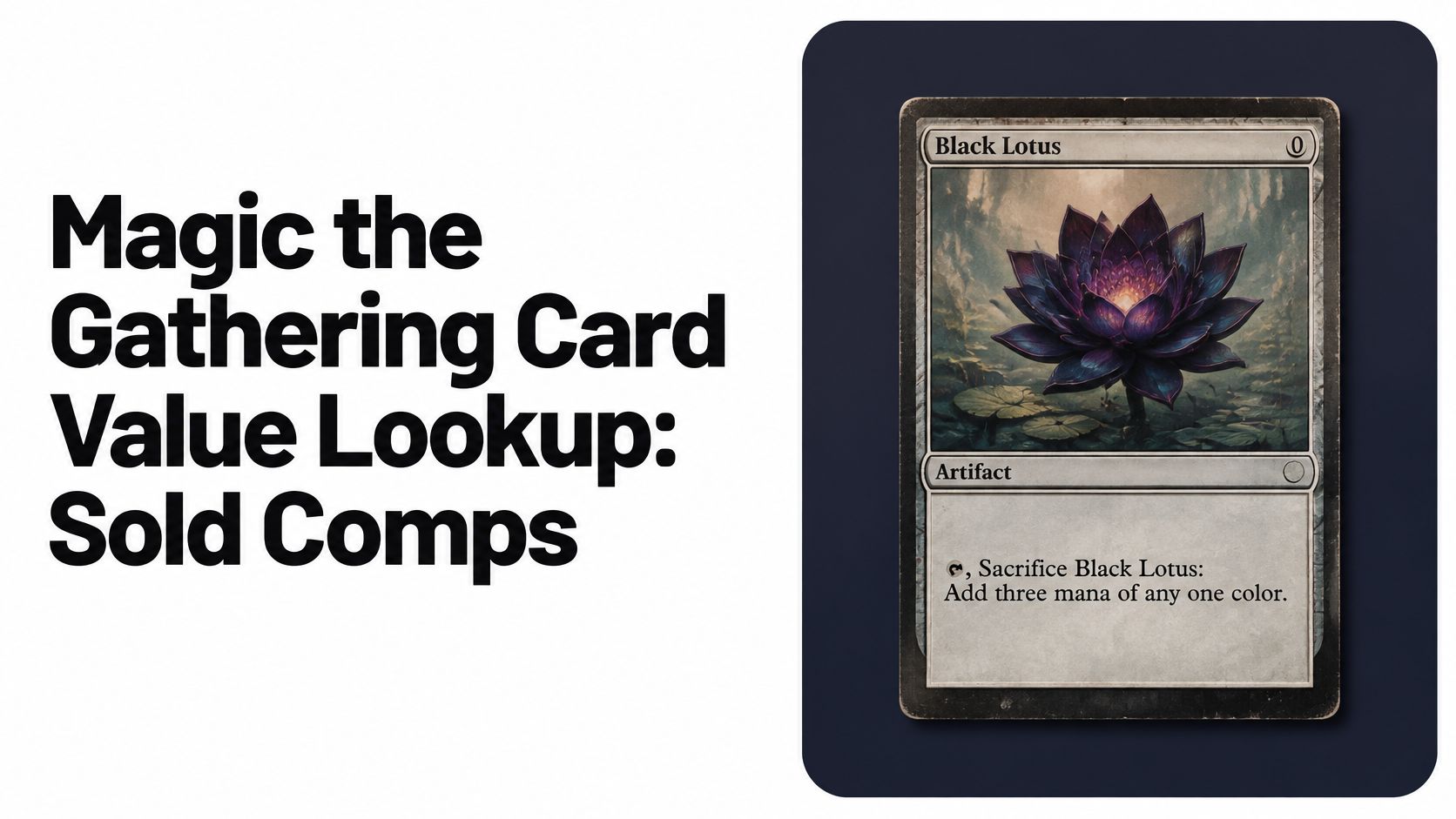
Every printing of a card shares its name, and the name is the least useful field on the card. Alpha Black Lotus was released in 1993 in a print run of roughly 1,100 copies, and the price history of that single card shows how hard edition moves the number. In June 1994, the first issue of Scrye magazine listed Beta Black Lotus at a median price of $15, with some copies available at $9.75 and high-end examples around $22.50, as TCGplayer's Black Lotus price history records. Within six months that listed price had more than quadrupled, then more than doubled again over the following three months, and by the end of 1995 Beta copies were commonly listed at $200 to $300.
The spread doesn't flatten out in modern sales, either. A 2021 signed copy sold for $511,100, and a 2023 high-grade example reached $540,000. Same name, same art, several orders of magnitude between the cheapest and the most expensive example of it.
The base rate is the other trap
Most cards are worthless, and that fact should shape every buy you make. In one 2026 dataset, 73% of more than 93,000 tracked cards were valued below $1, while only 1.1% exceeded $100, according to TCG Vault's breakdown of card values. A generic search hands you the outlier and hides the base rate. That's how a $4 shoebox feels like a lock and turns into another bag in the death pile.
Know which number you're looking at
Four price types appear on a card page and they answer four different questions. Mixing them up is the most reliable way to overpay.
| Price type | What it measures | Use it for |
|---|---|---|
| TCGplayer Market Price | Completed sales over a recent window, with outliers damped | Baseline estimate for the exact printing |
| Most Recent Sale | The latest completed sale, filterable by condition and card version | Spot-checking a recent trade |
| Listed median | Active listings only, so it reflects seller expectations | Gauging asking pressure, not what cards clear for |
| Buylist price | What a store pays for the card | Floor for a fast cash sale |
The listed median is the one that burns people. It's built from active listings, so it measures what sellers are hoping for, not what buyers paid. A card showing a $40 listed median with three completed sales at $22 is a $22 card.
The rule for the rest of this article: sold comps for the exact printing and grade decide the buy. Everything else on your screen is context.
How to Identify the Exact Printing Before You Search
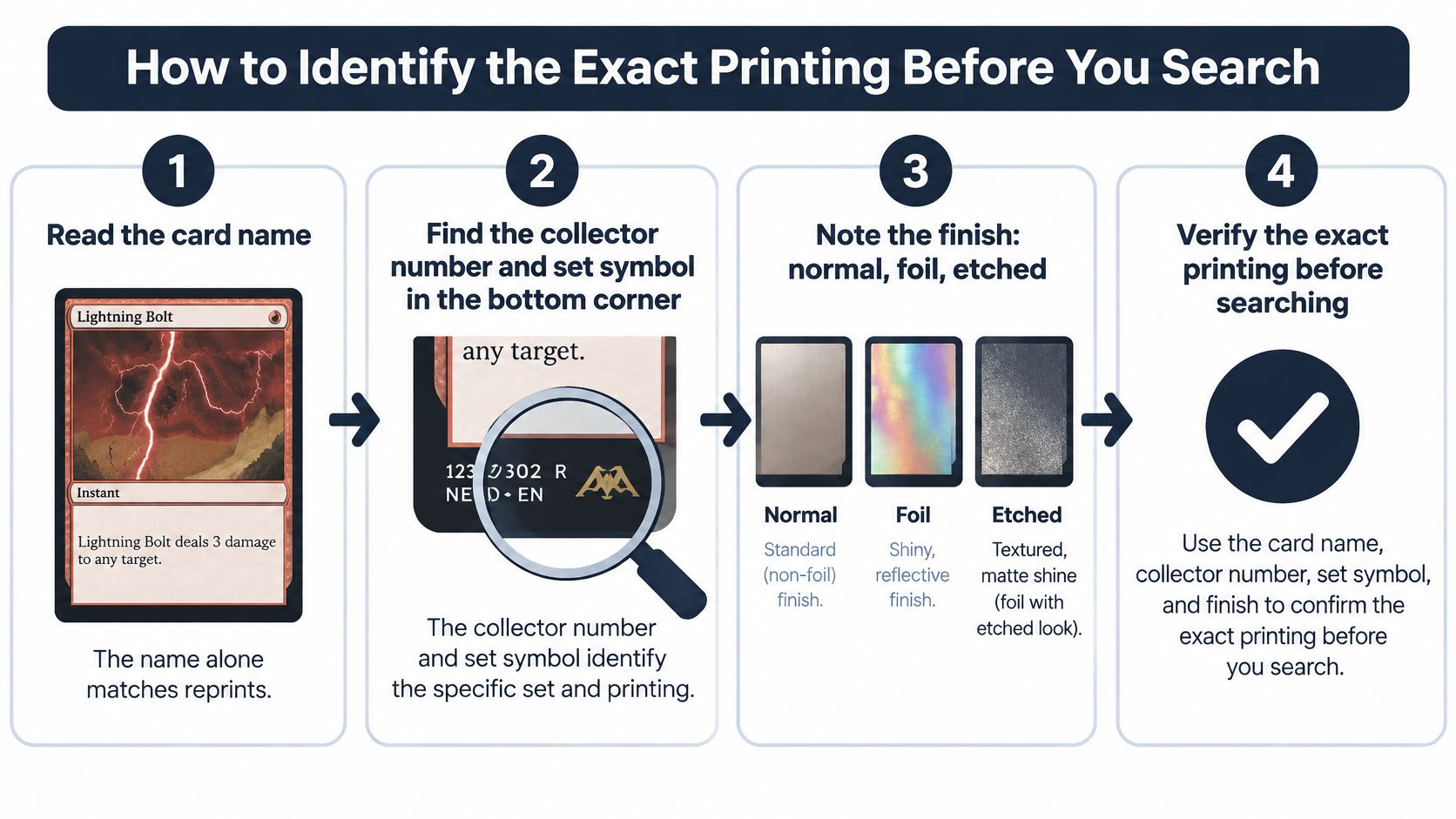
Identification is a fixed sequence, not a judgment call. TCGplayer's guidance on its Market Price lays out the order: match the card name and collector number or set symbol, distinguish normal from foil and etched foil and promo and alternate art, verify language and edition, assess condition, and only then compare recent completed sales. Run it in that order every time and most bad buys die before you open a pricing app.
The whole pass compresses into four moves you can run in about fifteen seconds per card.
The five-step identification pass
- Read the name, then stop trusting it. Flip to the bottom corner and read the collector number and set symbol. Reprints share names across dozens of sets, and the corner is the only part of the card that tells you which one you're holding. If the symbol is unfamiliar, that's when you look it up, not after you've already priced it.
- Name the finish. Normal, foil, etched foil, promo and alternate art are separate products with separate markets. Price a foil as a non-foil and you leave money on the table; price a non-foil as a foil and you eat a return when the buyer opens the envelope.
- Confirm language and edition from the card itself. Frame style, border color and language all narrow the edition. A non-English copy of a card is often worth less than the English one, and the gap is big enough to turn a marginal buy into a pass.
- Grade condition under angled light. Tilt the card so the light rakes across the surface, then look for whitening, edge wear, scratches and bends. A camera can identify a card. It can't confirm the card is Near Mint, so never let confidence in the identity bleed into confidence about condition.
- Write the fields down. Set, collector number, finish, language, condition. Keep them as fields instead of a name and a number in your head, because you'll compare them against comps for six different cards before you reach the register.
What a wrong printing costs at the counter
Edition is a pricing mechanic, not a detail you clean up later. TCGplayer keeps separate price guides and the numbers inside them move independently: the Revised Edition price guide lists Revised Badlands at $512.02 and Revised Bayou at $441.98 alongside Benalish Hero at $0.15 and Atog at $0.24. Fifth Edition shows separate values for its own reprints, including Animate Dead at $9.05 and Armageddon at $12.84.
That's the argument on one page. A $5 buy on a reprint that turns out to be a $1 card is a $4 lesson and a wasted trip. The same $5 on a correctly identified older printing is a decent morning. If the identity isn't certain, treat the card as unidentified and price it as bulk, because that's what the market will do to you anyway.
Reading Sold Comps Without Getting Fooled
An active listing is an offer. A sold comp is a fact. That distinction does more work than any pricing tool you can install, and it's the reason to ignore the headline number on a card page until the sales behind it are visible.
How the number is actually built
The mechanics matter because they have a quirk that changes how you read a thin market. TCGplayer's guide to its price points explains that volatility is based on 30-day sales volume and standard deviations, and that observations are counted per order rather than per individual copy. A single bulk order containing four copies counts as one pricing data point. So a card showing four data points might represent four transactions or sixteen cards, and there's no way to tell from the page.
Two safeguards follow. Require a minimum transaction count before you believe a narrow estimate, and widen the range when sales are sparse or spread wide. Also keep buylist value separate from marketplace value. A buylist price is what a store pays you, so it isn't interchangeable with what a customer pays.
When a set of sales is too thin to trust
Liquidity is the part most resellers skip. One tracked List reprint ranged from $1.94 to $6.26 during 2026, a 222% increase from its low, per TCG Rate's weekly market report. In that same reporting, 1,070 of 2,074 frequently traded cards declined in a single week while the median card moved only -0.1%. Individual cards swing hard even when the market looks flat, which is why a $50 quote with two sales in sixty days is a worse signal than a $12 card turning over steadily.
Say a card shows three sales in the last thirty days: $8, $19 and $30. That isn't a $30 card. That's a card with no established price, and buying at $30 because the top sale says so is how a flip becomes a hold. The same discipline that works here applies to valuing Yu-Gi-Oh cards, where reprint waves shred headline prices the same way.
Four sales at $18 to $21 tell you more about your exit than one sale at $60 from eight months ago. Date range beats peak.
A comp checklist I run on every card worth more than $10:
- Minimum sales count: at least three completed sales in the same printing and condition before I trust a range.
- Date range: sales inside the last 30 to 60 days, and I check whether anything changed in between, like a reprint or a ban.
- High-low spread: if the top sale is more than double the bottom one, the market is unsettled and I price toward the bottom.
- Matched condition filter: every comp filtered to the grade I think the card is, not the grade I hope it is.
- Buylist floor: the store price tells me what a fast, no-hassle exit is worth if the comps disappoint.
What Condition Does to the Sale Price
Condition is where an otherwise fine flip dies. TCGplayer's own worked examples put real numbers on the ladder, and the gap between the top and bottom rung is usually larger than the entire profit margin you were counting on.
| Condition | Example sold price |
|---|---|
| Near Mint | $39.91 |
| Lightly Played | $32.40 |
| Moderately Played | $28.90 |
| Heavily Played | $25.50 |
| Damaged | $22.00 |
That's the gentle version. A second example from the same TCGplayer guide to card condition runs from $450 Near Mint down to $96 Damaged. Two cards, same name, same set, same art, and one is worth less than a quarter of the other because of how it was stored.
Inspect like you're pricing it, not admiring it
Do the inspection before you assign any grade, and do it in good light. Check corners, edges, surface scratches, whitening, creases, bends, ink marks, water damage and any sign of cleaning. At an estate sale, a card that looks clean inside a sleeve can show edge wear or a pressure crease the moment you tilt it toward a window. Sleeves hide a lot and they cost about a nickel.
Then apply the condition adjustment as its own line in your math. Start from a Near Mint baseline, subtract for every flaw, and label the result. Don't blend condition into a single fuzzy number, because that's how a played card ends up listed at a Near Mint price and comes back as a return.
Grade down, not up. The buyer who receives a card in slightly better condition than described leaves five stars. The one who receives a card in worse condition opens a case.
The math on a played copy
Here's the version that shows up in the aisle. The Near Mint sold comp is $100. The card in your hand is Moderately Played, which comps at about $55. You can buy it for $35.
Sell at $55, subtract a 10% fee ($5.50) and $1.25 for packing and postage, and you net about $48.25, or $13.25 profit on the $35 outlay. That's a real flip. Now run the same buy against a genuine $100 Near Mint comp, which is what the first search result probably showed you, and the projected profit looks like roughly $53.75. Same card, same $35, and a $40 difference between the number in your head and the number in your bank account.
Condition grading is the same discipline across collectibles. These collector tips on valuing cinema posters make the point that folds, tears and fading drive the price far more than the title on the paper does, which is exactly how a pressure crease changes a Magic card. If you cross into sports, the grading conventions behind baseball card values follow the same ladder, just with a different name on the slab.
Working Out Net Profit Before You Pay
Gross sale price is a fantasy number. Net after fees, shipping and cost of goods is the only figure that decides whether a card is worth picking up, and it's the step most resellers skip when they're excited.
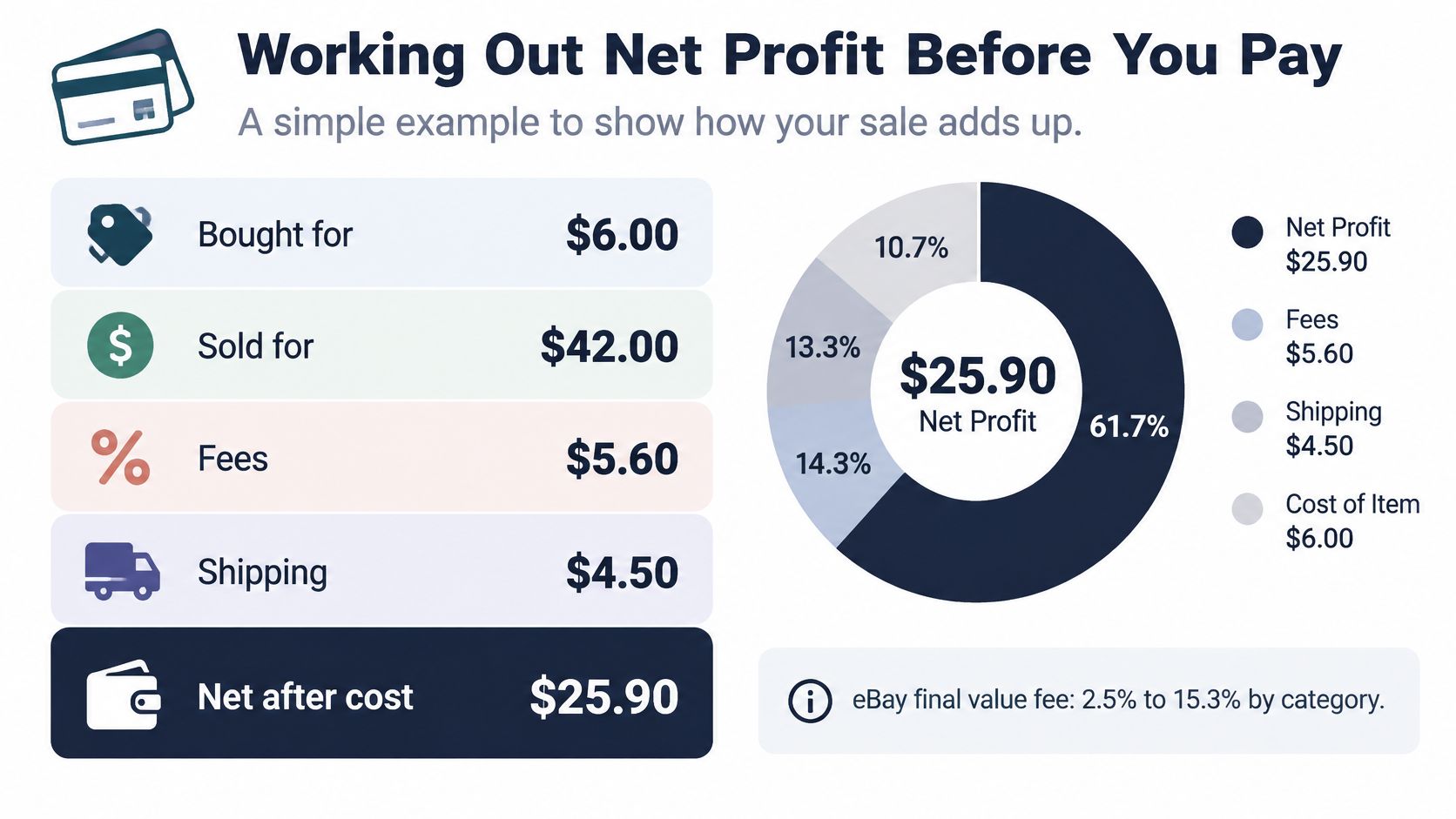
Start with a clean one. You buy a card for $6, sell it for $42, pay $5.60 in fees and $4.50 in shipping. That leaves $25.90 after cost. Nobody needs a spreadsheet for that, but notice the shipping and fees together took $10.10 out of a $42 sale, which is 24% of the price gone before you touched the cost of goods.
The fee structure you're actually paying
eBay's seller fee schedule puts the final value fee at 2.5% to 15.3% by category, plus a per-order charge of $0.30 for orders of $10 or less and $0.40 for orders above $10. That per-order charge is what kills cheap singles. On a $3 card it's a 13% add-on before the percentage fee even applies.
TCGplayer gives sellers several ways to price, including TCG Lowest Listing, TCG Last Sold Listing and TCG Market Price. All three still leave the seller to account for fees, supplies, shipping and cost of goods. The price you list at is not the money you keep.
Why cheap singles are the hardest math
Take a $12 single bought for $1 out of a garage-sale lot. At about 13%, fees run $1.56, the per-order charge is $0.40, and you're at $10.04 before packing and postage. A $1.00 mailer and $1.00 postage leave $8.04, and after the $1 cost of goods you're working with $7.04. Change the shipping method and the numbers get ugly fast.
| Scenario | Shipping and packing |
|---|---|
| Bought $6, sold $42 | $4.50, net $25.90 |
| Bought $1, sold $12, $1 mailer, $1 postage | $2.00 combined, net $7.04 |
| Bought $1, sold $12, $1 mailer, $4.50 postage | $5.50 combined, net $3.54 |
That last row is the whole lesson. Same card, same sale price, and choosing the wrong shipping service cuts the profit roughly in half. On a batch of ten such cards, that's a $35 swing for nothing more than getting the mailer weight right.
My aisle rule: run net profit on the exact platform and the exact shipping method before money leaves your pocket. A $0.50 common is a pass unless it's already sorted into a high-value lot or bundles cheaply with something else.
Set Your Buy Line Before You Walk the Aisle
You don't decide what a card is worth while a guy with a shoebox is watching you. You decide the rule beforehand and then apply it five times per card, in order.
- Confirm the printing. Set, collector number, finish and language all match, or the card goes to the bulk pile. No exceptions for gut feeling.
- Confirm the comp. Enough recent sold sales in the same condition, with a spread that holds together. Thin or wildly dispersed sales mean no price, which means no buy.
- Subtract everything. Fees, shipping, mailer, and what you paid, including your allocation of the lot price if you bought a box rather than a single.
- Compare to your profit floor. Set a minimum net per card before you walk in. If your floor is $8 and the math lands at $5, walk, even if the card is cool.
- Pass on single-sale pricing. If the deal only clears on one outlier sale or a high-low range that spans 3x, it isn't a deal. It's a hope.
The scanning part of that sequence is where most of the time goes, and it's the part worth automating. ScanFlip AI is built for exactly this decision: AI-powered item identification and real-time price comparison in your pocket, with three ways to scan (AI photo scan for cards with no barcode, barcode scan, and text search), sold comps pulled from eBay, Poshmark, Mercari, Depop, Amazon, Whatnot, ThredUp, Facebook Marketplace and TikTok Shop, fees and shipping deducted, and a red or green flip-or-pass verdict on the screen. It answers the buy question. It doesn't list, crosslist, or track inventory, so you still pair it with something like Vendoo or List Perfectly once the card is yours.
The rest of the discipline sits with you. Run the break-even math on fees and shipping before you commit, because a card that looks like a $40 flip at the counter is often a $9 flip after the platform takes its cut.
A card that looks valuable in a sleeve is worth buying only when its printing, its condition and its net figure all check out in that order. Everything else is a $4 shoebox with a story attached.
The fastest way to stop guessing in the aisle is to make the app do the three checks you keep skipping: identify the exact printing, pull real sold comps instead of asking prices, and subtract fees and shipping before you commit. ScanFlip AI runs all three from an AI photo scan, a barcode, or a text search, across eBay, Poshmark, Mercari, Depop, Amazon, Whatnot, ThredUp, Facebook Marketplace and TikTok Shop, then hands you a red or green verdict. Next time a shoebox shows up at Goodwill, scan the card before you reach for your wallet at ScanFlip AI.