
Thrift Store Flipping Without the Guesswork
Thrift store flipping is a buy-or-pass call you make before the money leaves your wallet. Last Saturday I stood in a Goodwill aisle holding a $6 jacket. It had a clean label, and I had a strong hunch it would sell for $40. That hunch was not cash.
Table of Contents
- Why Most Thrift Store Finds Lose Money
- Fees, Shipping, and Shelf Time
- Buying Well Is Its Own Skill
- The Fast Pass Before You Lift It
- Looks Expensive Versus Proven Demand
- Run the Same Numbers Every Time
- Keep the Breakdown Visible
- Time, Returns, and a Floor You Set First
- The Aisle Workflow Falls Apart
- How to Read Comps Honestly
- Why Sell-Through Beats the Best Sale
- Match the Platform to the Need
- What the Log Shows You
- Four Mistakes the Numbers Keep Catching
- How Much Should I Expect to Pay for Inventory?
- Is Thrift Store Flipping Still Worth It With So Many People Doing It?
- Which Categories Are Best for Beginners?
- How Do I Avoid Buying Items That Will Not Sell?
Why Most Thrift Store Finds Lose Money
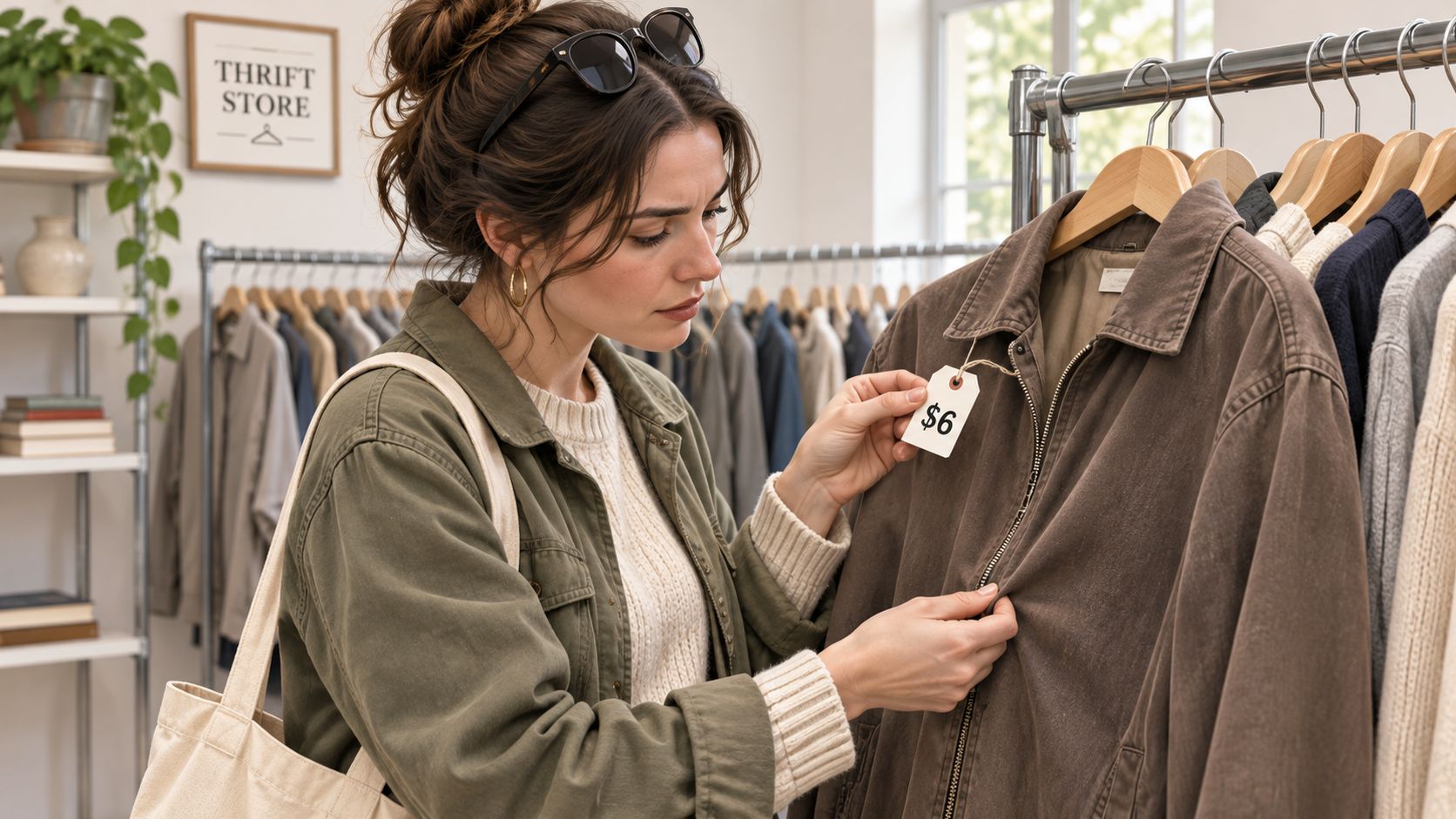
The jacket looked like an easy win. Good brand, no stains, and a size that tends to move. I nearly tossed it in the cart because the gap between $6 and $40 seemed wide enough to cover everything else.
It wasn't. Take away only the buy-in, and you're left with $34. A $40 price tag is not $34 in your pocket, and it isn't even $40 until someone actually pays it.
Fees, Shipping, and Shelf Time
Money comes out of a sale in a predictable order. Think of it like a toll road with several booths:
- Platform fees come out first.
- Shipping and mailers come next.
- Whatever is left is your net profit, and you only get to count it once the item sells.
Then the clock starts ticking. If a style takes weeks to move, your $6 ends up in a death pile. That's cash you can't spend on the next rack, space you keep walking past, and a listing you keep refreshing instead of replacing.
Asking prices are the wish; sold comps are the receipt.
I've priced items off what other sellers were hoping to get, then watched them sit. Sold comps show what buyers actually paid, and that's the only number that belongs in a buy decision. Asking prices are just the wishful thinking you talk yourself into under fluorescent lights.
Buying Well Is Its Own Skill
Good sourcing beats a lucky label. A recognizable brand is a clue, not a green light. You can photograph an item beautifully and still lose money if the buy left no room for fees, shipping, and a slow sell-through rate.
Buying well and listing well are separate skills. Listing only begins after you've already spent the $6. A sharp photo, a tight title, or a price drop won't recover that money if the comps were thin and the item was never going to move at a price that covers your cost of goods.
The rest of this guide is a buy-or-pass process, not a hunt for lucky finds. You'll learn to spot real candidates, run the net profit math before you pay, read sold prices honestly, pick the platform where an item will actually move, and keep a record of what happened. The jacket can stay in your hand until the math says yes.
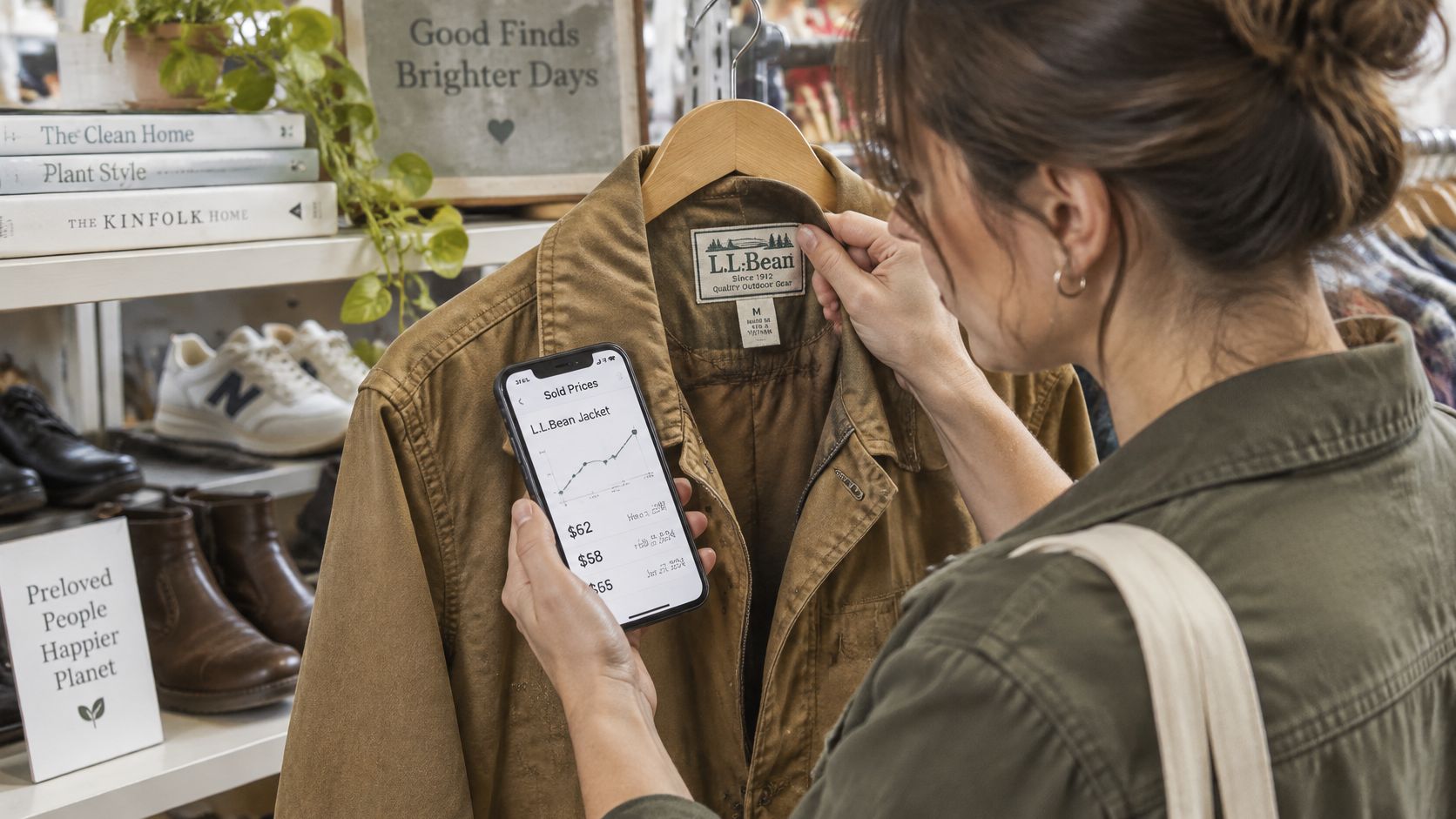
I choose a category before I ever step up to the bin. If today's sourcing run is about shoes, I walk right past the book wall and the kitchen glassware. Trying to evaluate everything is how an entire Saturday slips away.
Thrift store flipping gets easier once your eyes have a job. At a clothing rack, I run through five quick checks before my hand leaves the hanger: brand tag, material, construction, style, and condition.
The Fast Pass Before You Lift It
A heavy wool coat with a clean label and tight seams is worth more than a flashy logo stitched onto thin polyester. I check for stains, missing buttons, and stretched cuffs under the store lights, not out in the parking lot where everything looks fine.
Picture the rack as a conveyor belt. Only the items that clear a quick filter get pulled off:
- A readable tag or maker's mark you already recognize
- Fabric or construction that matches what buyers pay for in that category
- No holes, odor, or broken hardware
- A style that's already on your current BOLO list, not a "maybe"
Clothing is only one lane. The same Goodwill also carries books, shoes, games, kitchen gear, collectibles, and electronics, and each of those sells on its own clock.
A complete board game with every piece can move much faster than a pretty casserole dish with a hairline crack. A tested controller will often beat a dusty receiver you can't even plug in. Sell-through matters far more than the pretty photo on the shelf.
Looks Expensive Versus Proven Demand
A gold-tone watch can look valuable and still sit unsold for months. Proven demand looks dull by comparison. What I want is a clean label, recent sold comps for the exact item, a category I already understand, and no missing parts.
If I have to learn the category in the aisle, I am already late.
I leave unfamiliar brands for someone who lives in that niche. My job is to source what I can price without turning it into a research project.
That habit is really the whole scan. You're filtering, not shopping.
If you want a broader map of lanes that actually move, take a look at our guide on what to buy at thrift stores.
Pick one category before you get in the car, and jot it on a sticky note if your attention tends to wander. Then scan only that category. You'll pass on more items, and the ones you do pull will have a real reason behind them.
That jacket becomes a flip only after the math has its say. Thrift store flipping pays on net profit, and a $42 sold price is the first number in the problem.
Treat each find like a small resale bet before you buy. Estimate what is left after every cost, and if you want the same idea in plain business terms, track actual profit beyond cash balance instead of staring at the cash you hope to collect.
Run the Same Numbers Every Time
Here is the find I actually bought. Cost of goods was $6, recent sold comps clustered around $42, marketplace fees came to $5.60, and postage plus the mailer came to $4.50.
The arithmetic is short enough to do while you are still holding the hanger:
- Start with the sold price, $42.00.
- Subtract the buy cost: 42.00 minus 6.00 equals $36.00.
- Subtract marketplace fees: 36.00 minus 5.60 equals $30.40.
- Subtract shipping and packing: 30.40 minus 4.50 equals $25.90.
That $25.90 is net profit. Swap in your own fee rate and your own shipping quote, and the same four lines still work on a Ross clearance rack or a garage-sale bin.
Gross sale price is the misleading number. $42 looks like a win because it ignores three real costs, and cost of goods is only the first of them. Fees leave before you see the payout, and shipping leaves the moment you print the label.
This infographic shows how a thrift flipper walks a $42 sale down to $25.90 before deciding to buy.
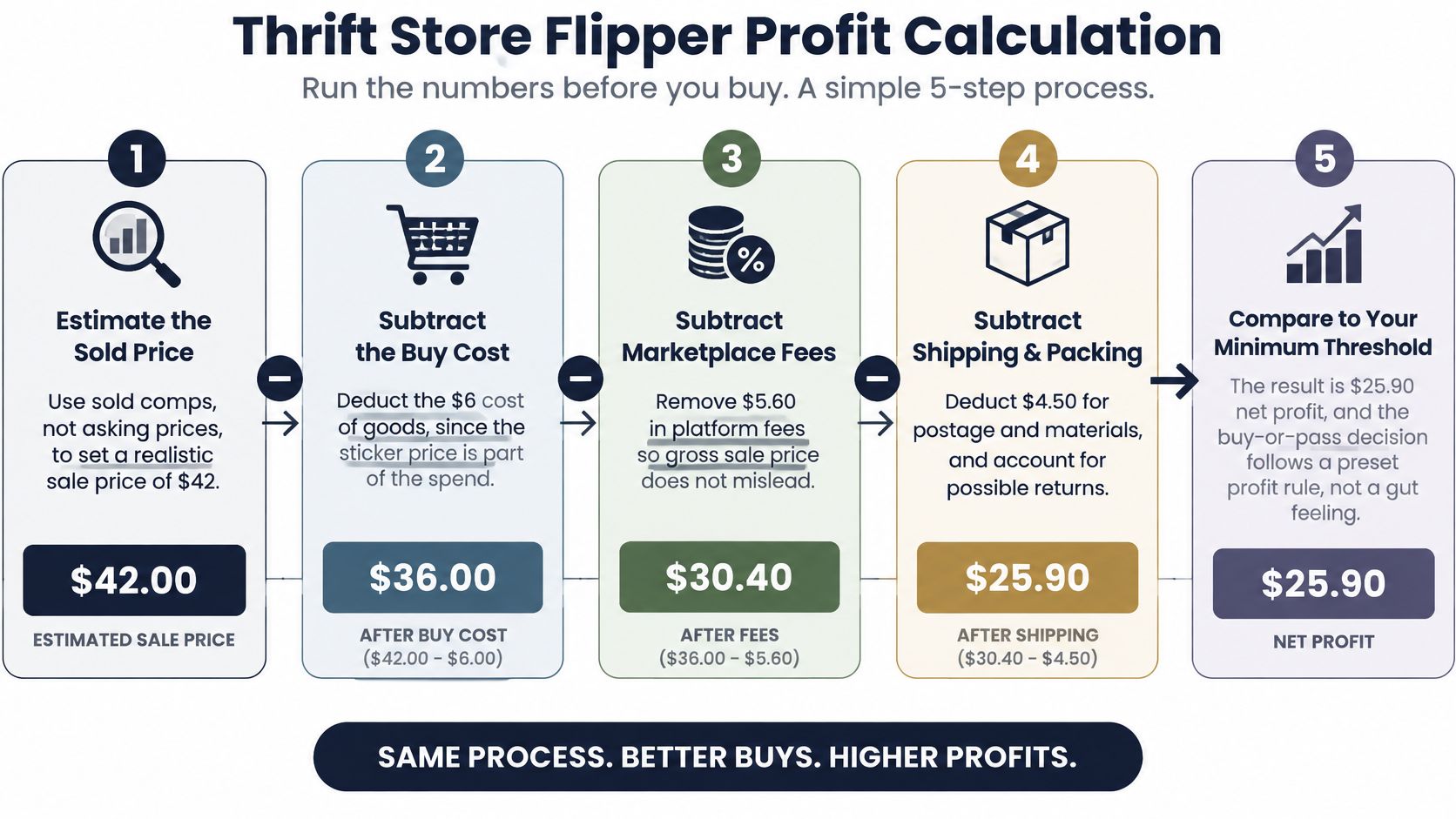
The drop is the point. Most of the gap between the sticker and the sold price disappears before you ever count a profit, which is why a pretty sale price is no buy signal by itself.
Keep the Breakdown Visible
Write the same receipt-style math down before money changes hands, so the decision is on the table while the item is still in your cart.
Net Profit Breakdown for a Single Thrift Find
| Line Item | Amount | Running Total |
|---|---|---|
| Sold price | $42.00 | $42.00 |
| Cost of goods | minus $6.00 | $36.00 |
| Marketplace fees | minus $5.60 | $30.40 |
| Shipping and packing | minus $4.50 | $25.90 |
Read the bottom line as the buy decision. When it lands under your floor, the find stays on the rack.
If the number after fees and shipping is below your floor, put the item back.
Time, Returns, and a Floor You Set First
$25.90 is only worth the effort if the item sells inside a window you can live with. A piece that sits for months still ties up the $6 and the shelf space, even when the math looked clean on day one.
Returns change that same number without changing the comps. A return can send the item back, require another label, and leave you holding inventory you already counted as sold. Packing cost is already inside that $4.50, so a second mailer is a second hit, with no free do-over.
I set a minimum net profit before I walk into the store. For this kind of clothing flip, $25.90 clears my floor, so I buy. If the same four lines land near $8, I pass, even when the brand feels exciting under the store lights.
Write your floor in your phone and treat it as a rule, never a mood. The aisle gets noisy, other shoppers move fast, and a hunch will talk you into a slow seller. The rule will not.
Asking prices are what a seller hopes to get. Sold comps are what a buyer actually paid, and that's the only figure that belongs in a buy decision. I learned that the hard way, standing in a Goodwill aisle with a jacket in one hand and my phone in the other.
The tag is a wish. The sold feed is the scoreboard.
A seller can ask $65 all day long. When the last two comparable sales closed at $38 and $42, the comp lands a lot closer to $40 than to $65. That gap is the line between a flip and a donation.
The Aisle Workflow Falls Apart
I used to start on eBay, filter for sold listings, then hop over to Poshmark, then Mercari, then Depop. Meanwhile someone was waiting behind me, and I was piecing together an estimate under pressure. That estimate was almost always too generous, because I wanted the item to work out.
The worst part was the space between apps. A jacket might show one solid eBay sale from eight months back and nothing recent anywhere else. By the third app I was basically guessing, and the shopper behind me was sighing.
ScanFlip AI (scanflip.ai) fixes that exact moment. It pulls sold comps from eBay, Poshmark, Mercari, Depop, Amazon, Whatnot, ThredUp, Facebook Marketplace, and TikTok Shop in a single search. You can scan by AI photo identification, barcode, or plain text search, and it hands back net profit after fees along with a red or green flip-or-pass verdict. The call is still yours.
One clean sold comp beats five hopeful asking prices.
How to Read Comps Honestly
One sale isn't a market. I want to know how many sales happened, how recent they are, and whether the item genuinely matches. Ten sales inside the last 90 days tells a completely different story than a single sale from last year.
A thin sold history is a pass, not a puzzle to crack.
Check the exact model, size, condition, and what parts come with it. A clean jacket with tags isn't the same comp as a faded one missing a button. If the closest match is a different colorway, treat that number as a ceiling rather than a promise.
For more on reading recent sales without fooling yourself, check our guide to recent sold prices. Then put the phone down, look at the item one more time, and decide. Your floor matters more than the label. Stay boring. Every time.
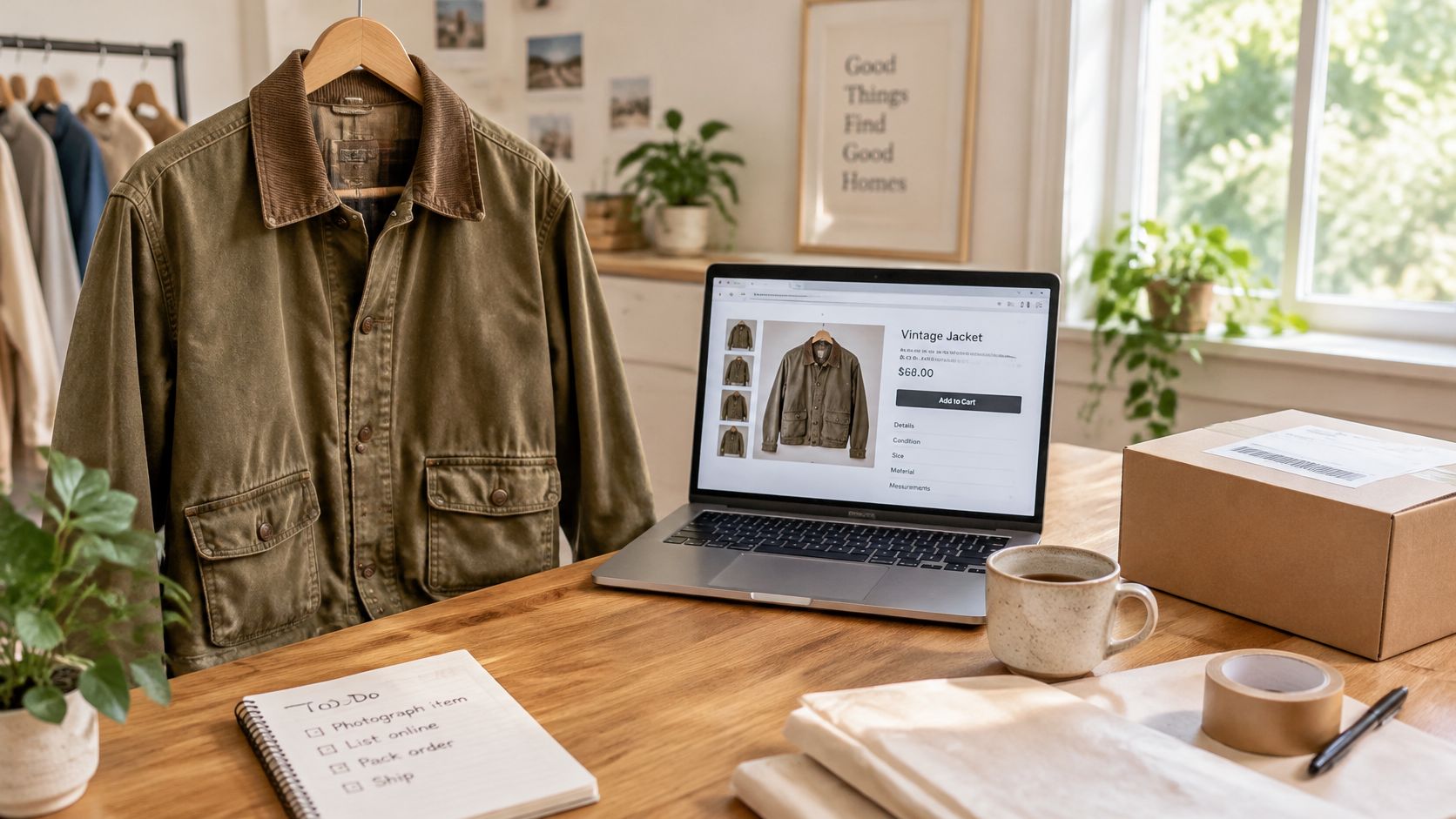
That same $6 jacket might sell for $42 on one marketplace and sit at $28 on another for weeks. Thrift store flipping only works when your item ends up where buyers are already hunting for that kind of thing.
Why Sell-Through Beats the Best Sale
A $55 sold comp looks exciting until you dig in and realize only two out of twenty listings actually sold in 90 days. That's a weak sell-through rate, and it means your cash stays tied up a lot longer than that headline number suggests.
Honestly, I'll take $38 with a fast STR over chasing one lucky sale every single time.
The best price that never sells is still zero.
Think about who's actually on each platform. Poshmark shoppers browse style photos and brands they already wear. eBay collectors search by model, year, and exact measurements. Mercari bargain hunters sort by lowest price and wait for an offer.
Same jacket, three totally different buyers. Trendy clothing tends to move faster where outfit photos do the talking. Odd sizes, vintage details, and parts people search by name usually find their collector on eBay.
And when I need the money back this week, I price for the bargain shopper and accept the smaller net.
Match the Platform to the Need
Fees change the $25.90 I ran earlier. A higher-fee site only makes sense when sold comps and speed cover the cut.
How fast I need cash decides everything else. Waiting on a slow collector sale is fine when my shelf is empty and the margin is fat. It's a bad plan when the death pile is already overflowing.
Once a buy is settled, I crosslist the keepers with Vendoo or List Perfectly. Those tools push your listing out everywhere, but they can't tell you which buyer will actually pay.
Before anything takes up shelf space, I run through this check:
- Recent sold comps exist on the platform I plan to use, not just one fluke sale
- The sell-through rate is strong enough that I'm not the only person who wants it
- Fees plus shipping still clear my net profit floor
- The buyer type fits the item: style shopper, collector, or bargain hunter
- I know how many days I'll wait before I cut the price or move it elsewhere
Fail two of those boxes and the jacket doesn't earn a hanger in my house. Listing is the last step of thrift store flipping, not a rescue plan for a weak buy.
A buy does not teach you much until it is on paper. I write down every item the same day I pay for it.
Every row gets the same six fields: cost of goods, expected net profit, actual sold price, fees, shipping, and days to sell. If your resold finds are spread across more than one platform, clean records matter once income and costs start stacking up. This guide to online seller record keeping is a solid next step when a notebook stops being enough.
What the Log Shows You
A scan history with photos, location, and timestamps turns vague memory into a pattern you can see. One local Goodwill keeps giving me denim that clears my floor. One estate sale keeps turning into a long drive for glass that never moves.
A BOLO I trusted in March can be dead by June if sold prices slide.
Once a month, I put expected net profit next to what I actually kept. When the gap is wide, I raise the minimum threshold before the next sourcing run. That monthly check is how thrift store flipping stops repeating the same bad buy.
If the log says the category underperformed, the category is wrong, even when the comps looked fine.
Four Mistakes the Numbers Keep Catching
Buying a brand name alone. A clean label with weak recent sales still sits. The fix is recent sold comps and a real sell-through rate before the cart.
Ignoring fees and shipping on heavy items. A cast-iron pan can look like a win until the label eats the margin. Weigh it in the aisle, quote shipping, and pass when net profit falls under your floor.
Chasing an oversaturated category. Sold prices can drop while asking prices stay high. If the last month of comps is lower than your model, stop buying that lane until the numbers recover.
Holding too long for a better price. Hope is not a pricing plan. Set a day count, cut the price, or move the item. A death pile cannot buy the next rack.
Some categories look clean on paper and still underperform. The log is allowed to overrule your taste.
This week, open last month's sales and mark every item that missed its expected net profit. Raise the floor on that category before you source again. For a tighter way to read those numbers, see our guide on sourcing performance metrics.
How Much Should I Expect to Pay for Inventory?
There's no shelf tag for this. I start with sold comps, then work backward to the lowest net profit I'll accept.
Say the comps bunch around $42 and fees plus shipping eat about $10. To keep $25.90, my buy price has to be $6. If that same piece is $15, the profit drops to $17, and I leave it.
That's the whole test: after fees, shipping, and the occasional return, does the price still clear your floor? The math is the same on a Ross clearance rack or during a bag day bin.
Is Thrift Store Flipping Still Worth It With So Many People Doing It?
Yes, if you go in with clear eyes. The crowded lanes are crowded for a reason: vintage tees, Carhartt, and whatever a YouTube video pushed last week. Asking prices stay stubborn while sold prices soften.
The people still doing well pick a small lane and keep score. They know the two or three categories they can judge quickly, and they know which stores keep giving them winners.
Every fresh BOLO online can pull you into a pile that never leaves the spare room.
Narrow beats wide when the work has to repeat.
Which Categories Are Best for Beginners?
Start where proof is easy: books, media, and recognizable brand clothing with steady sold data. Each one lets you check reality before cash changes hands.
A barcode scan on a book or DVD brings back a number fast. A known label with consistent comps is just as easy to sanity check.
Vintage and collectibles ask for pattern knowledge, maker's marks, and lots of reps. Begin there and it's easy to buy the wrong thing very confidently.
How Do I Avoid Buying Items That Will Not Sell?
Use one hard filter first: pass on anything under 40% sell-through rate unless the price is irresistible. That alone clears out most future shelf-sitters.
Keep your minimum profit threshold boring and firm, even when the label makes your pulse jump. Low cost plus weak demand still equals a bad buy.
Write down every result. Cost, sold price, fees, shipping, and days to sell will show which lanes deserve another trip.
Before your next sourcing run, set the floor and let ScanFlip AI pressure-test it. Scan by photo, barcode, or text, compare sold comps from nine marketplaces, and see net profit with a red or green verdict at scanflip.ai. You still make the buy call.