
Best Way to Sell Sports Cards: A Reseller Playbook
You're standing at a garage sale with a five-dollar card in your hand that looks like an eighty-dollar flip. That's where sports card profit is usually won or lost, not after the sale when you're writing the title. If you buy from an active eBay listing, ignore condition, then discover the platform fee and shipping cost later, the card can become a death pile item before it ever reaches a buyer.
The best way to sell sports cards starts with a sourcing decision. You need recent sold comps, a realistic channel choice, and net profit math that includes fees, shipping, grading, and time. Gross sale price is only the headline. Your actual decision should be based on what reaches your account after the transaction is complete.
Table of Contents
- Why Most Sports Card Sellers Leave Money on the Table
- Sourcing and Pricing Sports Cards with Real Sold Comps
- Raw Versus Graded and When Grading Math Actually Works
- Choosing Where to Sell Sports Cards for the Best Net Price
- Listings That Actually Sell for More
- Shipping, Insurance, and Authentication Without Eroding Profit
- The Pre-Buy Checklist and When to Walk Away
Why Most Sports Card Sellers Leave Money on the Table
A reseller once pulled a 2018 Prizm Luka Doncic Silver from a five-dollar garage-sale bin. An active eBay listing showed the card at eighty dollars, so the seller treated eighty as the comp, listed it, accepted a discount from a lowball buyer, and ended up clearing about forty dollars after fees and shipping.
That result wasn't caused by one bad decision. The seller skipped completed sales, treated an asking price as market value, underestimated the marketplace take rate, and used a risky plain white envelope shipment for a card valuable enough to attract a dispute. The final value fee for trading cards on eBay is reported at 13.25% of the total sale value up to $7,500, plus a small per-order fee, according to this independent trading-card fee breakdown. Managed-payment costs and shipping still have to come out of the remaining balance.
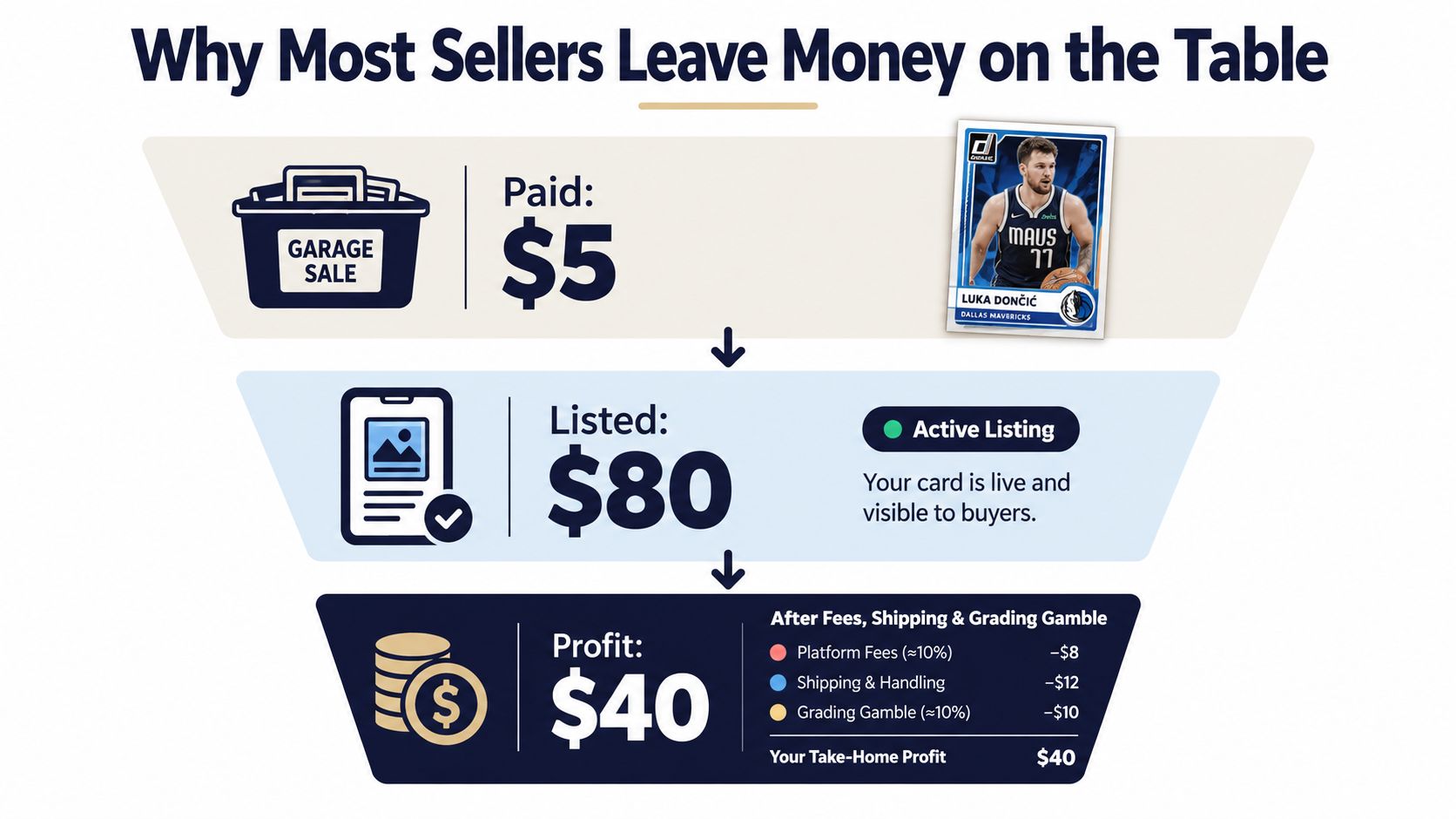
The four-dollar-and-fifty-cent shipment was another leak. A plain envelope with a stamp was too fragile for the card, but upgrading the package after the sale would have reduced the margin further. Then the seller dropped the Buy It Now price to force movement, turning a weak purchase decision into a weaker exit.
The number that matters is net profit after fees, shipping, grading, and cost of goods.
The broader market gives online sellers plenty of liquidity, but liquidity doesn't remove the need for discipline. eBay trading card singles generated $2.62 billion across more than 61 million tracked transactions in 2025, including more than $1.78 billion from sports card singles, according to World Metrics' sports card market data. That volume helps establish a useful price baseline, but only if you compare the exact card and completed transactions.
Before money leaves your pocket, ask:
- What did the exact card sell for recently?
- What will the target platform take from the gross price?
- What will safe fulfillment cost?
- Does grading improve the outcome enough to justify time and risk?
- What is left after all of that, compared with my buy cost?
That workflow keeps you from confusing a card that can sell for eighty dollars with a card that can produce eighty dollars of profit.
Sourcing and Pricing Sports Cards with Real Sold Comps
Pull comps before you buy. At a garage sale, the process needs to be fast, but fast doesn't mean casual.
Start by identifying the exact card. Confirm the year, manufacturer, set, card number, player, sport, team, parallel, insert, autograph status, and whether it's raw or graded. “Luka Prizm” isn't enough. A base card, Silver parallel, numbered version, and graded copy can occupy completely different markets.
A practical comp workflow
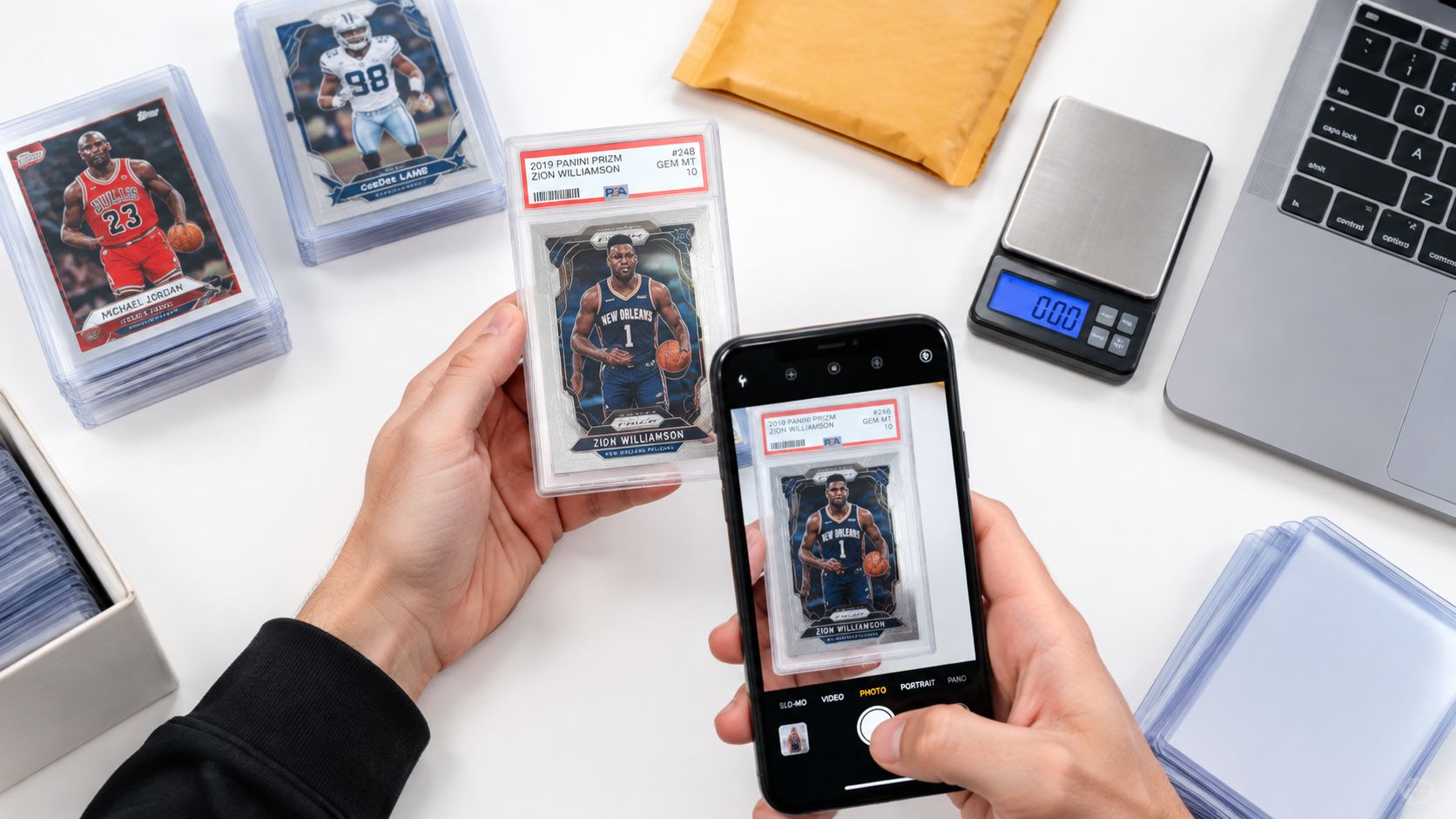
On eBay, filter for Sold Items, then narrow the search to the exact year, set, sport, player, and variation. Card number matters, especially when several parallels share similar designs. For graded cards, match the grading company and grade. A PSA 10 comp isn't a reliable basis for pricing a raw card unless you're separately modeling the grading risk.
Pull the most recent 10 to 20 completed sales when the market supports that volume. Remove obvious outliers, such as a damaged card, a combined lot, an unusually high auction, or a listing with a different parallel. Use the middle of the remaining sales as your working range rather than anchoring to the highest result.
Active listings mislead because sellers can ask for any number. A card-shop Buy It Now price may sit for months, while an aggressively priced listing may be stale, duplicated, or for a different condition. Sold comps tell you what a buyer paid.
Manual research can include 130Point's recent sales search, SportsCardPro, and PWCC records. These tools are useful when you need to inspect a difficult parallel or verify whether a sale was accepted below the visible offer price. You can also review a focused guide to recent sold prices for sports cards before building your own comp process.

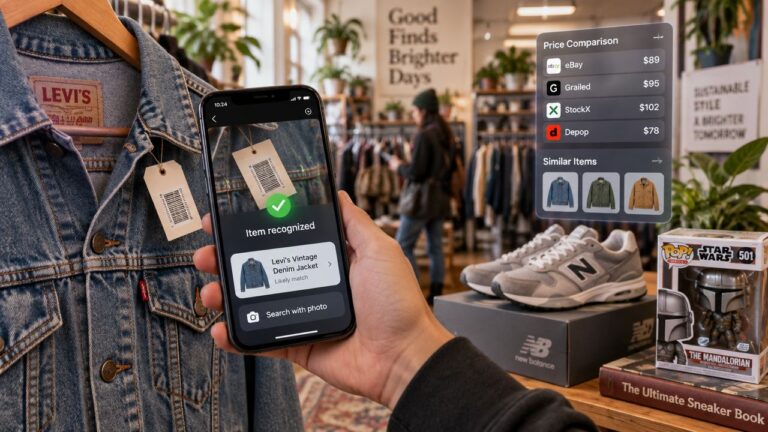
When I'm sourcing across a crowded card show, ScanFlip AI can identify a card through an AI photo scan with no barcode needed, a barcode scan, or text search. It aggregates sold comps across eBay, Poshmark, Mercari, Depop, Amazon, Whatnot, ThredUp, Facebook Marketplace, and TikTok Shop, then estimates net profit after fees and returns a red or green flip-or-pass verdict. It doesn't replace checking the exact card, but it can reduce the time spent switching between marketplace apps.
If you can't verify a recent comparable for the precise card, treat that uncertainty as a cost. A card that depends on an optimistic opinion isn't a buy. Comps beat opinions because the buyer, not the seller, establishes the clearing price.
Raw Versus Graded and When Grading Math Actually Works
Grading is a resale calculation, not a status symbol. A raw card only belongs in a grading submission when the likely graded sale leaves enough money to cover the service, postage, supplies, marketplace fees, and time tied up in the process.
The available fee tiers show why cheap cards often fail this test. A 2026 comparison lists PSA Regular at $79.99 per card with about a 65-day turnaround, while PSA Super Express is $299 per card with about a 10-day turnaround. The same comparison lists BGS Economy at $20 per card with an 80 to 100 day turnaround and BGS Standard at $35 per card with a 45 to 60 day turnaround, as shown in this 2026 grading fee comparison.
| Service Tier | Fee Per Card | Declared Value Band | Typical Turnaround |
|---|---|---|---|
| PSA Regular | $79.99 | Regular service tier | About 65 days |
| PSA Super Express | $299 | Super Express service tier | About 10 days |
| BGS Economy | $20 | Economy service tier | 80 to 100 days |
| BGS Standard | $35 | Standard service tier | 45 to 60 days |
Consider a raw 2021 Mosaic Trevor Lawrence base card that sells for eighteen dollars raw. A PSA 10 might sell for forty-five dollars, but that upside disappears if the card has soft corners, poor centering, print lines, or surface scratches. The grade isn't known when you submit it, and the market can move while the card is away.
Run the breakeven equation
Use this formula before sending anything out:
Expected graded sale minus grading fee minus submission shipping minus return shipping minus sleeves and top loaders minus selling fees.
That result must beat the raw sale by at least 30% to justify the grading risk. The 30% threshold is a working discipline rule, not a market statistic. It compensates for the possibility of a lower grade, a delayed return, and a cooler player market.
Grading usually makes more sense for modern rookies, low-population parallels, scarce inserts, and vintage stars. Commons, base cards, and cards with condition problems rarely produce enough lift. A useful baseball card value guide can help with identification, but it can't inspect the surface or predict your grade.
A raw card isn't a grading candidate because it looks expensive. It's a grading candidate when the downside still leaves a worthwhile net.
Choosing Where to Sell Sports Cards for the Best Net Price
Choose the sales channel during sourcing, not after the card is already in hand. The right venue depends on value, buyer density, speed, and the work required to store, ship, and resolve problems. Compare net profit after fees, not the headline sale price.
eBay offers the broadest buyer pool for unusual parallels, short prints, star rookies, and cards with enough completed sales to establish a baseline. Whatnot can suit visually compelling cards when live attention drives bidding. COMC reduces storage and shipping work, but slower cashout can limit a flipper's ability to recycle capital. Fanatics Collect and local buyers also have uses, depending on price tier and local demand.
| Channel | Fees on $400 sale | Payout speed | Best for |
|---|---|---|---|
| eBay | 13.25% fee plus $0.30 order fee, before shipping | Varies by transaction and account process | Odd parallels, graded cards, broad buyer demand |
| Whatnot | About 11% plus processing | Platform dependent | Live auctions and attention-heavy cards |
| COMC | Approximately 9% plus $0.25 per card, according to CardValueFinder's comparison | Slower than direct marketplace sales | Mid-range inventory with no-ship fulfillment |
| Fanatics Collect | Around 10% to 15% | Depends on sale and payout process | Higher-end collectible inventory |
| Local cash buyer | 0% marketplace fee | Immediate if terms are agreed | Lower and mid-value cards with strong local demand |
The fee figures above come from recent marketplace fee guidance and COMC and local-selling comparisons. Use them as starting inputs. Processing, shipping, promotion, and payout policies can change, so calculate the actual amount left from each sale.
For sub-$50 raw cards, a nearby cash buyer or low-handling channel can beat a large marketplace. A $40 card loses a different amount of profit when shipping and materials add $5 than it does in a local handoff. For $50 to $250 star rookies, eBay usually combines strong search demand with useful sold data. Cards above $250 require closer attention to authentication, insurance, and buyer trust.
A Poshmark versus eBay fee comparison reinforces the same sourcing rule: choose the channel that leaves the strongest net proceeds, not the one you already use. A slow-moving $200 card may justify outsourced fulfillment. A hot $60 rookie may earn more through a faster venue with less operational drag. Before buying, estimate the likely sale, subtract every fee and fulfillment cost, and walk away if the remaining profit does not justify the work.
Listings That Actually Sell for More
A strong listing can't rescue a card priced from fantasy numbers, but weak presentation can suppress a good card's result. Buyers need to identify the card quickly and judge condition without asking for basic details.
Build the title from the information collectors search for:
Year, brand, set, card number, player, parallel or color, grade or condition, then team when it adds useful search context.
For example, a title should distinguish a Prizm Silver from a Prizm base and a PSA 9 from a raw copy. Don't stuff the title with unrelated player names or claims you can't verify. Accuracy reduces returns and makes your sold data easier to interpret later.
Photos should answer condition questions
Use 4 to 8 photos minimum, as recommended in this practical eBay sports card selling guide. Raw cards need a clean front, clean back, both top corners, both bottom corners, and an angled surface shot that reveals scratches, dents, print lines, or glare. For slabs, show the front of the holder, the back label, the certification details, and any cracks or damage to the case.
A close-up is more useful than a decorative background. Buyers are deciding whether your condition description matches the card in the photos.
Match the selling format to the market
Use an auction when demand is active and you have multiple recent comps. Use Buy It Now when the market is thin, the card is unusual, or you need control over the minimum acceptable outcome. Don't choose an auction because it feels faster. A card with weak demand can finish below a reasonable fixed price.
Avoid relying on weekday timing theories or unsupported claims about exact bidding lifts. The practical test is your own sell-through record. Track the ending day, format, starting price, watchers, offers, and final sold price. That turns timing into a measurable sourcing and sales decision instead of folklore.
For a batch, schedule listings in manageable groups rather than dumping every card into the store at once. Fifteen accurately photographed cards are more useful than a larger batch with poor titles, missing backs, and condition surprises. Your listing workflow should protect the net result, not just create activity.
Shipping, Insurance, and Authentication Without Eroding Profit
Shipping is part of the sale price, not an afterthought. A card can have a strong gross margin and still become a weak flip when packaging, postage, insurance, and dispute exposure are ignored.
For lower-value cards, use a sleeve, top loader, team bag, and rigid protection appropriate to the service. For higher-value cards, use tracked shipping, insurance matched to the sale value, and signature confirmation when the exposure justifies it. Guides commonly recommend USPS Priority Mail, insurance matched to the sale price, and signature confirmation for cards above about $200, as outlined in this sports card fulfillment guide.
Pick protection by exposure
Under $25, sellers often use a plain white envelope format when the card and buyer expectations support it. That method has limited protection and limited tracking, so don't treat it as suitable for every card.
Between $25 and $250, a bubble mailer with a top loader, team bag, cardboard reinforcement, and tracking gives you a more defensible shipment. Above $250, eBay's Trading Cards Authenticity Guarantee can apply to eligible auction or Buy It Now sales. eBay says the program is free for eligible sellers and buyers, and that it covers authentication plus secure shipping from the authentication facility to the buyer, according to eBay's seller policy.
Authentication doesn't eliminate every seller responsibility. You still need accurate photos, honest condition notes, proper packing to the authentication facility, and normal marketplace fee math. For cards that aren't eligible, double-boxing, declared value, insurance, and signature confirmation may be more appropriate.
Count the materials
Your supplies have a cost even when the buyer pays shipping. Track sleeves, top loaders, team bags, mailers, tape, labels, and replacement stock. A package that arrives damaged can erase the profit from multiple successful orders, especially when the card was underpriced in the first place.
Safe shipping is a margin decision. The cheapest label isn't the cheapest outcome if it creates a damage claim.
The Pre-Buy Checklist and When to Walk Away
The most reliable card flippers make the buy decision before they own the problem. At a Goodwill counter, estate-sale table, or card-show case, run the card through the same sequence every time.
- Scan or eyeball the card. Confirm the player, year, set, parallel, card number, grade, and visible condition.
- Pull 5 to 10 recent sold comps. Use eBay sold filters, 130Point, or another source that shows completed transactions. Match the exact card instead of substituting a similar-looking version.
- Calculate grading cost. If the card is raw, use the relevant PSA or BGS tier and include outbound and return shipping.
- Estimate final value. Choose auction or Buy It Now based on demand, comp depth, and how quickly you need the cash.
- Check the population report. A low-population parallel may justify deeper research, while a heavily available modern card may not support a grading gamble.
- Run profit math. Subtract cost of goods, marketplace fees, payment costs, shipping, materials, insurance, grading, and an allowance for your time.
- Decide buy or pass. If projected margin is under 30%, walk away.
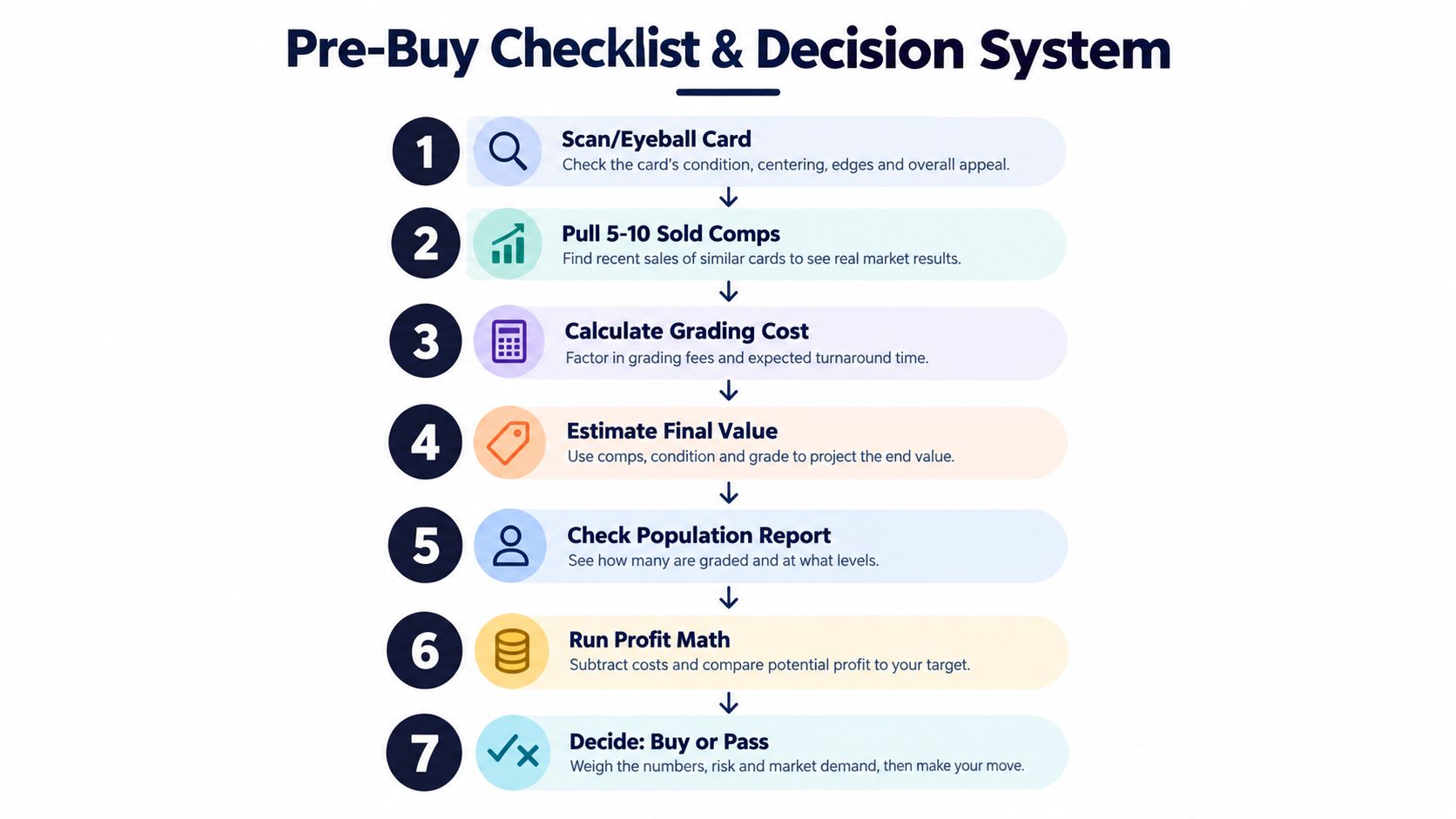
The margin cutoff is a personal operating rule. It protects you from the ordinary mistakes that don't appear in a quick gross-price calculation, including a lower grade, a return, a slow sale, a bad photo, or a market that cools before the card moves.
Walk away from weak inventory
Some cards look exciting in a box but don't deserve your cash:
- Role-player raw rookies: A rookie label doesn't create demand when the athlete has limited collector interest.
- Gloss-hidden damage: Surface scratches, dents, and roller marks can disappear under bright lighting until you angle the card.
- Questionable lots: Trimmed edges, recolored borders, altered surfaces, and inconsistent stock should end the negotiation.
- Overproduced modern parallels: A parallel printed in runs over 500 may struggle to appreciate when supply is broad, particularly without a strong player or category catalyst.
Demand can also concentrate in narrow pockets. One 2025 market summary reported that more than 26 million cards were graded, while sports cards were trending down 12% even as TCG and non-sport cards rose 95% overall, according to Sports Illustrated's grading-market coverage. That kind of divergence is why “sports cards are hot” isn't enough. You need the exact athlete, category, and recent comps.
ScanFlip AI can speed up the identification and comps step through photo, barcode, or text search, but it doesn't remove the need to inspect condition and run the final math. One skipped buy protects the profit from ten good ones. The card you pass on is often cheaper than the card you have to discount, grade, relist, store, and eventually sell at a loss.
Use ScanFlip AI before money leaves your pocket to identify sports cards, pull sold comps across major marketplaces, and estimate net profit after fees and shipping. Visit ScanFlip AI to test the photo scan, barcode scan, and text search workflow while you're sourcing.