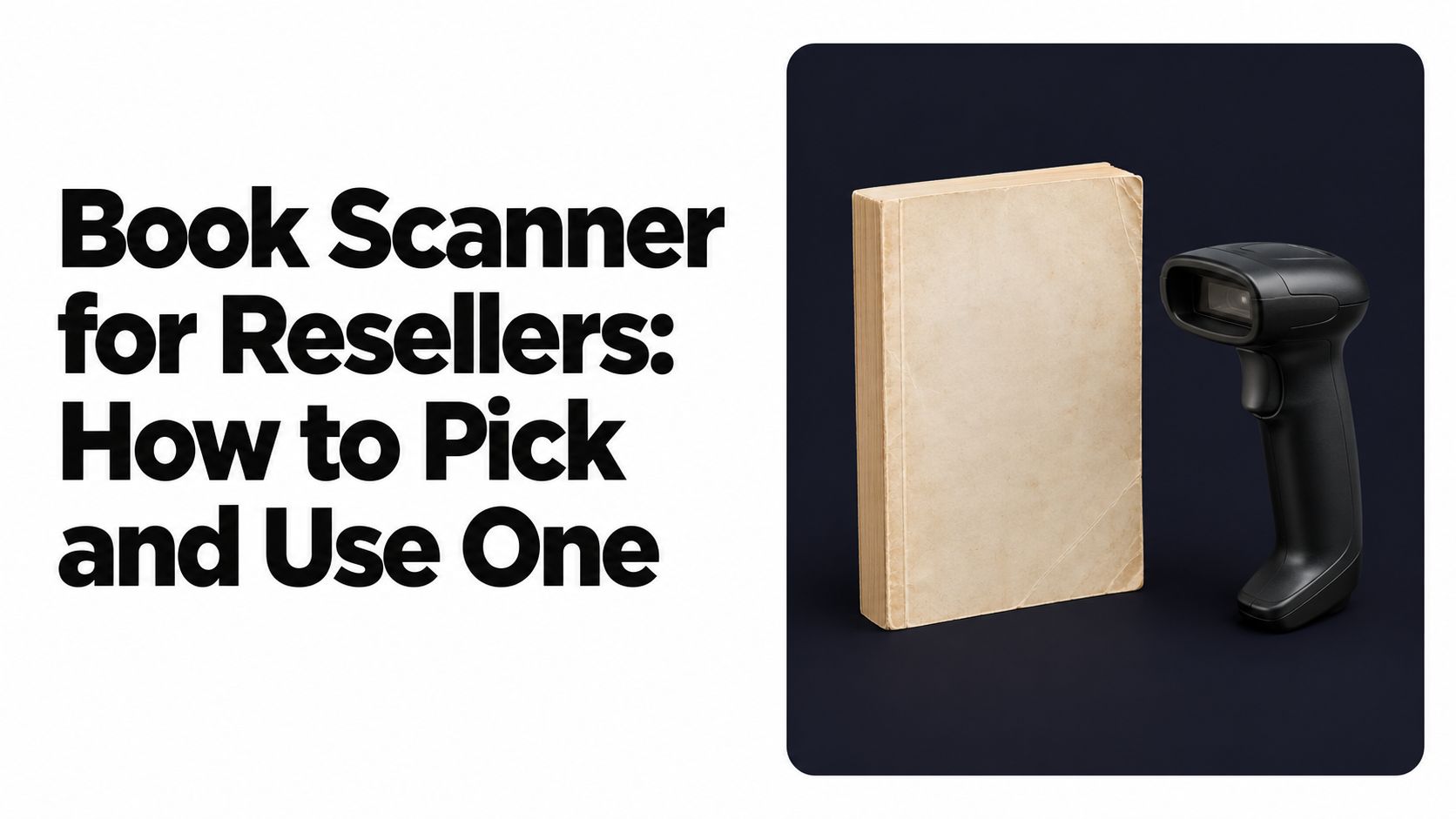

Book Scanner for Resellers: How to Pick and Use One
You're standing in a Goodwill book aisle with a full cart rolling toward the shelves and another picker already working the other end. You don't have time to type titles one by one or guess which paperback pays. A good book scanner for resellers isn't just a price checker. It's a ranking tool for scarce aisle time, and the number on the screen only matters after fees, postage, condition, and storage time come out of it.
Table of Contents
- Which Scan Method Fits Which Book
- Sold Comps Beat Active Listings Every Time
- Net Profit Math for a Book Flip
- Condition and Edition Checks Before You Buy
- How to Triage a Book Aisle Step by Step
- Set Your Flip-or-Pass Rule Before the Next Store Trip
Which Scan Method Fits Which Book
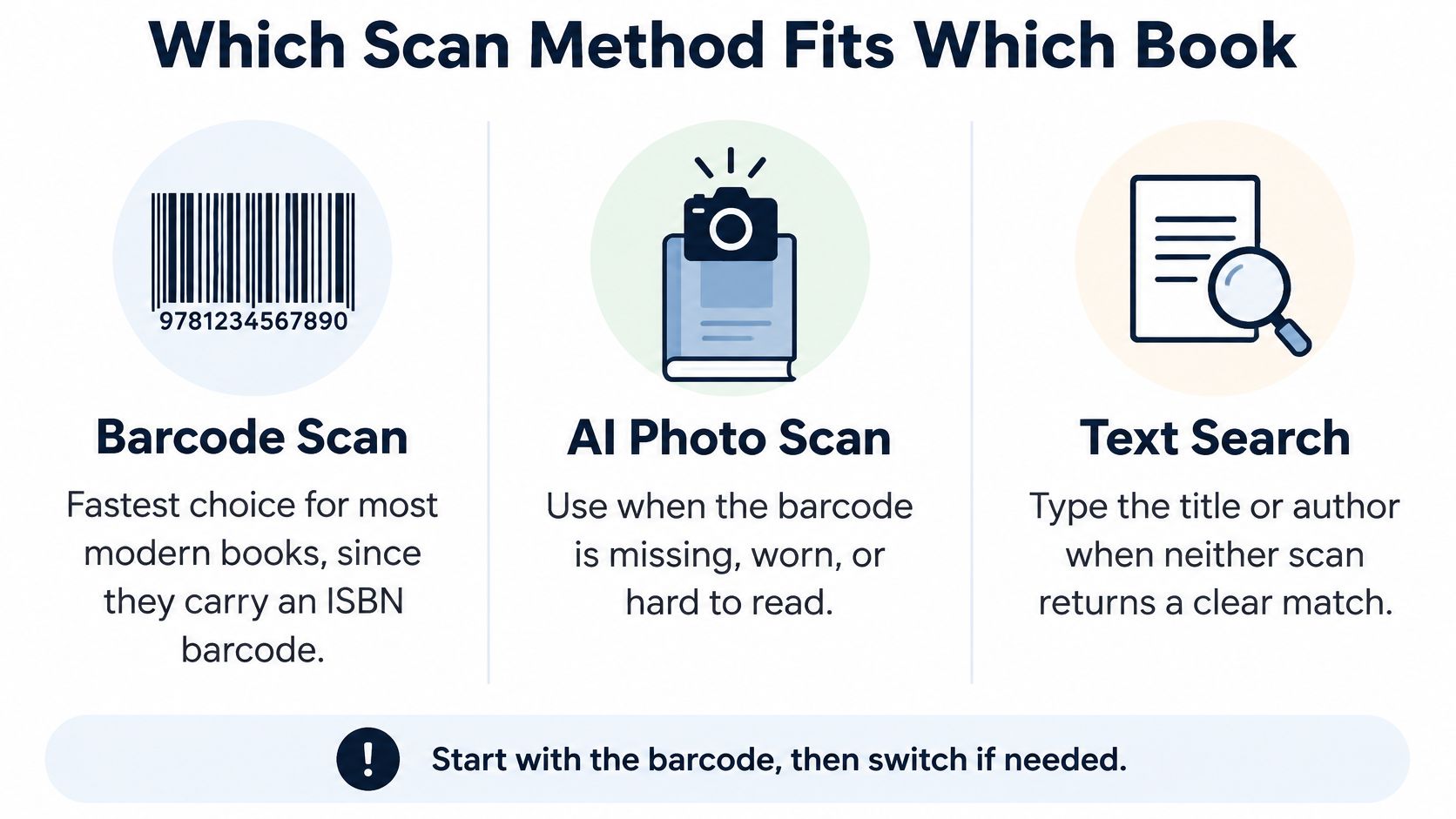
You've got a bin of paperbacks in front of you and about ten minutes before staff pulls the next cart through. Most modern books carry ISBN barcodes, so a barcode scan is the fastest first pass. It connects the copy in your hand to an existing online catalog without you typing a title, which is exactly what you want when you're working a shelf at volume.
That speed breaks down fast on the copies thrift stores really stock. Older printings may predate readable codes, foreign editions don't always map cleanly, and price stickers love to sit right over the barcode. Sometimes the code is on a dust jacket that isn't even from this printing, or it's been cut off a remaindered copy. Barcode only means you skip those books or waste minutes guessing.
Pick the Method That Matches the Copy
Scan methods compared for book sourcing
| Method | Best for | Where it falls short |
|---|---|---|
| Barcode (ISBN/UPC) scan | Trade paperbacks, newer hardcovers, textbooks with a readable code | Older printings, foreign editions, hidden or cut-off barcodes, and copies whose edition differs from the code |
| AI photo scan | Untagged books, older editions, and copies where the barcode is covered or missing | Similar editions can look alike, so confirm the copyright page before you buy |
| Text search | Books you know by title and author, or items you cannot photograph | Common titles have many editions, so the title alone rarely identifies the one you hold |
The AI photo scan covers the untagged pile. Photograph the cover and spine, get an identification, then verify it against the copyright page before you trust any comp. Covers get reused across printings, and two editions of the same textbook can look nearly identical from three feet away.
Text search is your fallback for a title you already know. Maybe it's on your BOLO list, maybe you sold one last month and spot the spine again. Type the title and author, then narrow by edition and format. It's slower than a scan, so don't make it your default for a full bin.
A scan tells you what the book is. It doesn't tell you whether it pays.
Start with the barcode because it's fastest. Switch to photo when the code is missing, damaged, or covered. Use text when you know the title and neither scan returns a clean match. Identification is step one only, and treating it as a buy signal is how death piles start.
Sold Comps Beat Active Listings Every Time
That $35 price you see on an active listing isn't money. It's a hope. eBay calls items currently for sale active listings, while sold items are completed or ended listings, and sellers can search sold-item history for the last two years through Seller Hub or My eBay, according to eBay's guide to finding sold items. Completed sales show demand. Active listings mostly show competition.
Run the Garage Sale Math
Say you're digging through a garage sale box and active copies of a paperback sit at $35. The last comparable sales cluster at $14, $16, and $18, so the $16 median is your realistic benchmark, not the ask. That's the number you buy against.
Buy the copy for $2 and the math gets honest fast. An illustrative 13.25% fee takes $2.12, Media Mail takes $4.39, and packaging takes $1, leaving roughly $6.49 net before taxes. That's a real decision. The $35 active price would've told you to grab every copy in the box.
The exact fee depends on your category and account terms, so don't treat that rate as universal. The mechanic doesn't change. Sold comps set the ceiling, fees and postage set the floor, and your buy cost has to fit between them. If you need a refresher on pulling those numbers cleanly, read up on how to find sold prices on eBay before your next run.
Match the Comp or Throw It Out
A comp only counts if it matches the book in your hand:
- Same ISBN: A different ISBN usually means a different edition, even when the cover matches.
- Same format and binding: Drop hardcover sales when you're holding a paperback, and drop bundled sales entirely.
- Same condition range: A like new sale doesn't price your highlighted copy.
- Enough matching sales: One lonely sale means unknown demand, not a sure sell.
Thin comps are a warning, not an opportunity. If you can't find comparable completed sales for that exact edition, you're guessing at sell-through rate, and guessing is expensive when you're paying for storage. Pass, or price your buy so low that being wrong doesn't hurt.
Net Profit Math for a Book Flip
The gross sold price is the most misleading number on your screen. What matters is take-home after cost of goods, fees, and shipping. Amazon's fee schedule lists a 15% referral fee for books plus a $1.80 closing fee per media item, and individual-plan sellers also pay $0.99 per item while professional sellers don't, per Amazon's official pricing and fee schedule.
Worked Example on an Individual Plan
Worked net profit for a $3 Goodwill paperback sold on Amazon, individual plan
| Line item | Amount | Running total |
|---|---|---|
| Sold price (sold comp) | $24.00 | $24.00 |
| Buy cost at Goodwill | -$3.00 | $21.00 |
| Referral fee, 15% | -$3.60 | $17.40 |
| Closing fee | -$1.80 | $15.60 |
| Per-item fee, individual plan | -$0.99 | $14.61 |
| Media Mail, one pound | -$4.39 | $10.22 |
Read that table top to bottom and you'll see the trap. The gross spread looks like $21. After the $3.60 referral fee and $1.80 closing fee, you're at $15.60 before the per-item fee, and after $4.39 Media Mail the individual plan leaves $10.22 before supplies and tax. A professional plan avoids the $0.99 charge and leaves $11.21 instead. Same book, same sale, different take-home.
Weight Changes the Answer
USPS says Media Mail is limited to eligible media such as books, normally takes 2 to 8 days, and starts at $4.39 at the Post Office, with published rates of $4.39 for one pound, $5.13 for two pounds, and $6.60 for four pounds, according to USPS Media Mail eligibility and rates. Weight isn't a footnote. It's a line item that grows while your sold price stays flat.
Take an $18 sale on a book you bought for $2. At one pound, after Amazon's $2.70 referral fee, $1.80 closing fee, cost of goods, and $4.39 postage, you're left with $7.11 before packaging. Move that same $18 sale to four pounds and postage rises to $6.60, dropping you to $4.90. A heavy textbook needs a much higher sold comp to earn the same shelf space as a light paperback.
Practical rule: Price the postage by weight in the aisle, not at the packing table. By then you've already spent the money.
Now run a $10 book. After referral and closing fees and $4.39 postage, only $2.31 remains before you subtract what you paid for the book itself. That fixed $1.80 closing fee eats cheap books alive, which is why a decent sales rank on a $10 title is usually still a pass. If you're not running this math on every scan, work through how to calculate net profit and build it into your routine.
One more Media Mail warning. Packages can be opened and inspected, so don't use it for unrelated merchandise just because a book is in the box. Cheap postage isn't cheap if the shipment gets flagged.
Condition and Edition Checks Before You Buy
A barcode match identifies an ISBN. It doesn't identify the edition you're holding, and it says nothing about condition. Amazon recommends comparing equivalent-condition prices while accounting for selling fees, shipping, and target margin, and its condition rules make clear that missing pages, unreadable text, major staining, and prohibited advance reading copies can make inventory unsellable, per Amazon's guide to selling books. Buy the wrong edition and every comp you pulled belongs to a different book.
What Each Defect Does to the Sale
Book condition checks and what each one does to the sale
| Check | What to look for | Effect on the sale |
|---|---|---|
| Edition and format | Copyright page, binding, publication date | A different edition means the comps you pulled do not apply |
| Missing pages | Page sequence against the listing | Can make the copy unsellable |
| Unreadable text or major staining | Pages, cover and spine | Can make the copy unsellable |
| Dust jacket damage | Tears, creases, missing flap | Moves the copy to a lower grade |
| Markings and spine wear | Highlighting, writing, cracked spine | Moves the copy to a lower grade |
| Remainder marks | Marks on the edge or copyright page | Check whether the comps include remaindered copies before pricing |
| Supplements and access codes | CDs, workbooks, unused codes | Missing items can make the copy unsellable or lower its grade |
| Advance reading copy | 'Not for resale' or uncorrected proof marking | Prohibited on Amazon, so do not buy it to resell there |
Inspect the cover, copyright page, page completeness, ISBN, binding, remainder marks, supplements, and access codes before the scan result counts. That sounds slow, but it's seconds once it's habit. Thumb the pages, check the spine, flip to the copyright page, look for a remainder mark on the page edge.
Textbooks deserve extra suspicion. A missing CD, a torn-out workbook section, or a used access code can gut the value even when the cover looks clean. The highest visible offer almost never applies to a copy that's missing pieces, and condition disputes turn into returns that eat the profit you thought you had. When you're grading your own copy with candor, it helps to know how to describe item condition the way buyers and marketplaces expect.
Grade your copy at the lowest defensible condition, price it there, and keep a buffer for returns and stale demand. If the book only works at the most optimistic grade, it doesn't work. Put it back and spend that money on the next bin.
How to Triage a Book Aisle Step by Step
In a crowded thrift aisle, the scarce resource is time. One reseller report describes scanning more than 3,500 books at Goodwill and keeping only about 100, a roughly 2.9% keep rate, in a Reddit discussion on barcode scanning at Goodwill. The practical goal is to rank books quickly, then spend your closer checks on the strongest candidates.
The Five Step Aisle Routine
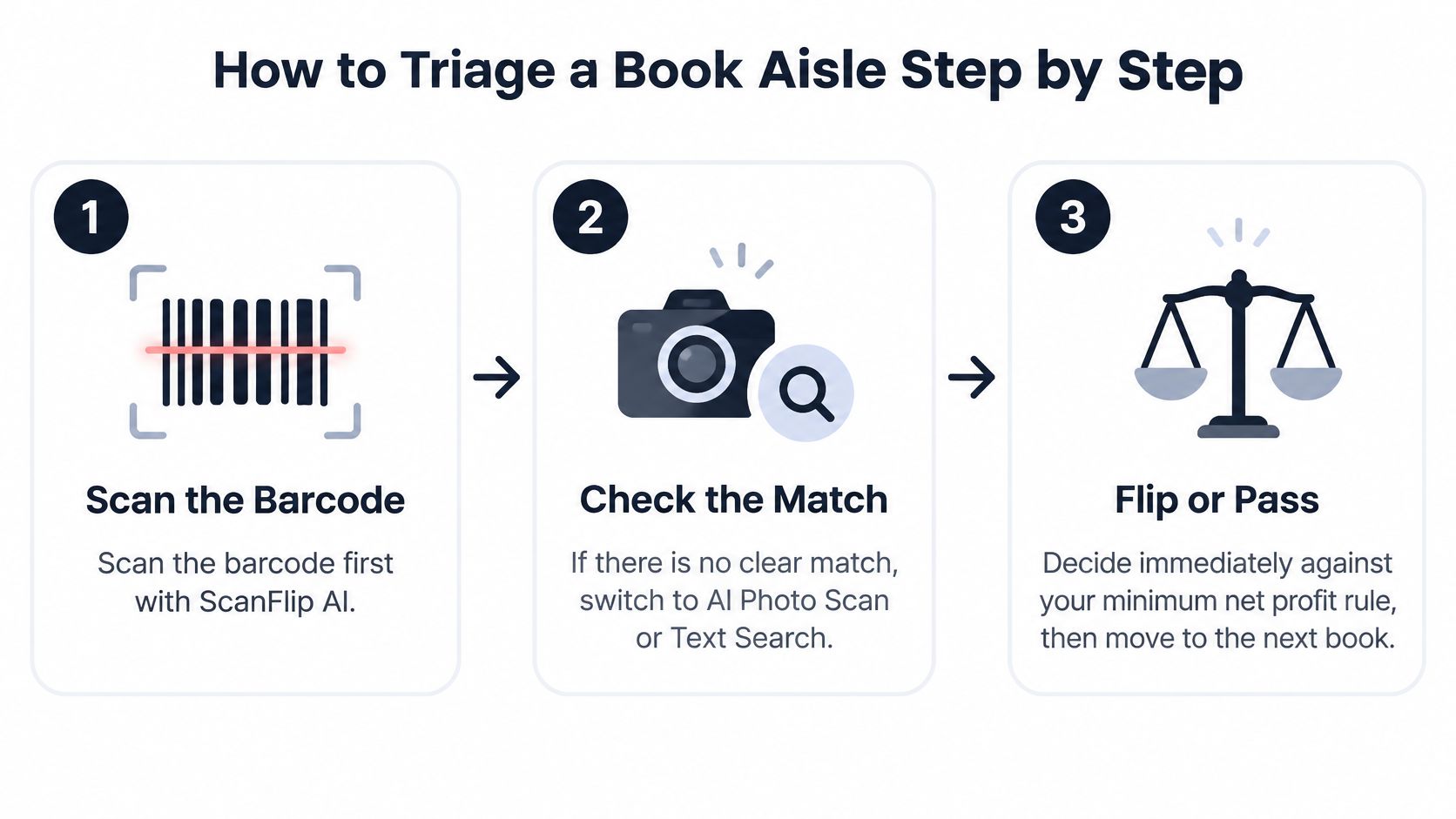
Scan to identify and rank candidates. With ScanFlip AI, use the camera to identify a book from its photo, even without a barcode. The app compares real-time sold comps across eBay, Poshmark, Mercari, Depop, Amazon, and Whatnot, calculates estimated profit after fees and shipping, and gives a red or green Flip or Pass verdict. Treat that result as a first filter, not a substitute for checking the exact edition.
Verify the edition before trusting the match. Compare the copyright-page details, binding, publication date, and format with the identified book. A similar cover can belong to a different edition, and its comps may not apply to the copy in your hands.
Judge the sold comps against your actual selling channel. Focus on completed sales for the edition you have. A promising sale on a marketplace you do not use may tell you about demand, but it does not establish what you can realistically earn.
Calculate net profit with your real costs. Use your expected purchase cost, selling fees, and shipping for the book's weight and channel. If you cannot state the likely net clearly, keep it in the candidate pile only until you can check the numbers.
Apply your minimum and move on. A book below your threshold is a pass. Keep the likely buys together, and stop revisiting marginal copies. Every extra minute on a weak candidate takes time away from the next shelf.
Think in Profit per Sourcing Minute
A $20 net-profit book that sells quickly can be a better use of your time and storage than a $60 book with uncertain demand that sits for months. The slower book ties up cash and shelf space, and its eventual sale price may fall short of the estimate. A faster seller frees both for the next sourcing run.
Rank books by profit per sourcing minute and profit per cubic foot, as well as likely profit per copy. Barcode-only routines can also miss older books, foreign editions, and textbooks without readable codes. Use photo identification when a barcode is absent, then spend your limited aisle time verifying and comparing the most promising candidates.
Set Your Flip-or-Pass Rule Before the Next Store Trip
A $2 paperback that has to net $8 after $4.39 Media Mail and Amazon fees needs a sold comp of about $19 before it's worth picking up. Work that math at home, not in the aisle. Marketplace sellers commonly report margins around 10% to 18% after fees, fulfillment, and advertising, while 47% of sellers identify rising fees as their largest challenge, according to marketplace statistics on seller margins and fees. Tight margins punish anyone buying on gut feel.
Pick a Dollar Minimum, Not a Percentage
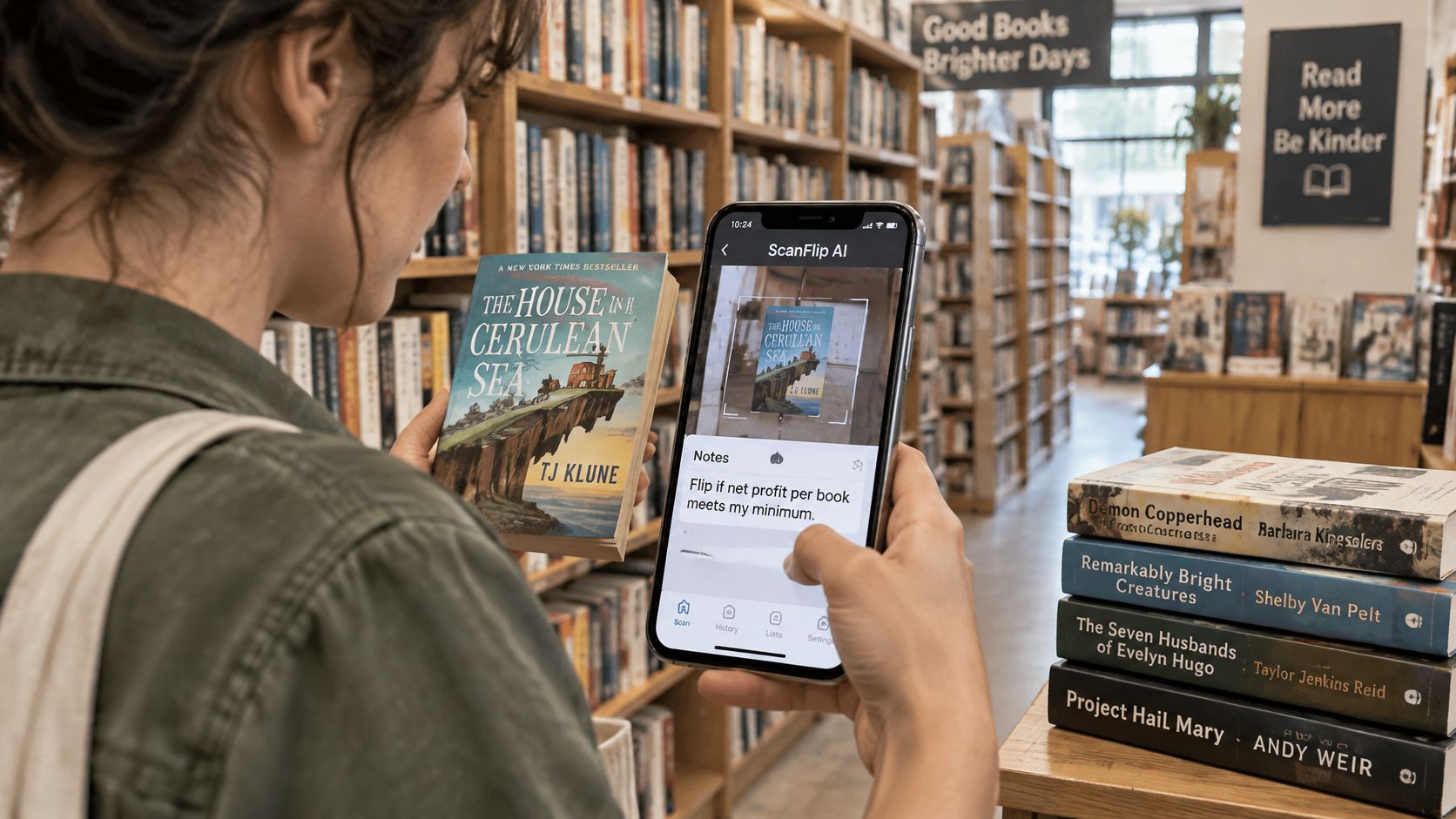
Choose a minimum net dollar amount per book and write it in your phone before you walk in. Percentages hide fixed costs. A percentage rule treats a cheap book and a pricey book the same way, but the closing fee, per-order charges, and postage don't scale down just because the sale price did. Low-priced books get eaten by fixed costs first.
Name your passes in advance too:
- Heavy books at modest prices: A four-pound book at $6.60 postage costs $2.21 more to ship than a one-pounder, so it needs a higher comp to clear the same minimum.
- The $10 trap: After the $1.80 closing fee and $4.39 postage, $2.31 remains before buy cost, so most $10 books are passes regardless of rank.
- Strong comps, slow demand: A book that takes months to move parks your money in storage while faster flips pass you by.
Apply the same minimum on every channel. The same book nets differently on Amazon, eBay, Poshmark, Mercari, and Facebook Marketplace because fee structures, buyer expectations, and shipping practices differ. A pass on one platform can be a flip on another, but only if you run the net for that channel instead of copying the first number you saw.
When the rest of the bin falls below your minimum, leave the bin. The next store has books too.
Write the minimum at the top of your note, scan against it, and don't renegotiate with yourself in the aisle because a cover looks interesting. Interesting doesn't pay postage. The sellers who last in books aren't the ones who find the occasional great comp. They're the ones who pass on mediocre books quickly, every single trip, and put their minutes and shelf space behind copies that clear the rule.
Before your next Goodwill run, put your minimum net rule into practice with ScanFlip AI, where you can scan a book by barcode, photo, or text search, compare sold comps across major reselling platforms, and get an instant red/green Flip or Pass Verdict based on your set minimum profit. New users get 10 free scans with no credit card required, so test it on a real bin and see how many of your usual pickups clear your rule.