


Estate Sale Pricing Guide: Price to Sell Profitably in 2026
You're standing in a house packed with a lifetime of possessions. The dining room has china, the garage has tools, the closets are full, and every shelf seems to hold something that might be worthless, valuable, or somewhere in between. The pressure hits fast. Price too high and the house stays full. Price too low and you hand away profit.
That's where most new resellers get stuck. They look at online listings, see ambitious asking prices, and assume those numbers belong on estate sale tags. They don't. An estate sale is a short, local liquidation event, not a months-long online listing strategy. The job isn't to prove what something could bring in perfect conditions. The job is to price it so a real buyer says yes this weekend.
A good estate sale pricing guide gives you a repeatable system. It replaces gut pricing, sentimental pricing, and stale rules of thumb with sold data, category judgment, and a markdown plan that clears the house. If you're also sharpening your sourcing eye, this breakdown pairs well with a guide to the best items to resell for profit, because strong buying starts with strong pricing.
Table of Contents
- Your First Walkthrough An Overwhelming Opportunity
- The Three Pillars of Estate Sale Valuation
- How to Research Comps and Find True Market Value
- A Practical Pricing Cheat Sheet by Category
- Implementing Your Pricing and Markdown Strategy
- Managing Negotiations Signage and Logistics
- Conclusion From Overwhelmed to Profitable
Your First Walkthrough An Overwhelming Opportunity
The first walkthrough tells you almost everything. Not exact prices yet, but the shape of the job. You can tell within minutes whether the house is heavy on daily household goods, strong furniture, old collectibles, or the kind of mixed estate that eats time because every room needs a different pricing mindset.
New resellers usually make one of two mistakes right here. They either assume everything old is valuable, or they assume most of it is junk and rush through the work. Both approaches cost money. A house full of average kitchenware still needs strategy, and one overlooked shelf can carry the best margin in the sale.
What the house is really asking you to solve
You're not solving one pricing problem. You're solving hundreds of small ones under a deadline. The pressure comes from volume, not just value.
A typical walkthrough raises questions like these:
- What deserves individual research: Signed art, sterling, designer furniture, unusual tools, vintage electronics, and boxed collectibles need more than a quick glance.
- What should be grouped: Plain glasses, common paperback books, basic office supplies, and mixed pantry containers usually sell better in practical lots.
- What hurts the sale if it stays visible: Broken, stained, incomplete, or low-quality leftovers can drag down the feel of the room.
Buyers decide quickly. If the house looks picked over before the sale starts, they become more cautious everywhere else.
The profitable mindset on day zero
A beginner thinks in terms of item-by-item maximization. A professional thinks in terms of whole-house liquidation with protected margin.
That shift matters. You don't need every tag to be perfect. You need the pricing system to be consistent enough that buyers keep moving, collectors still see value, and the house gets emptier by the hour instead of fuller with wishful pricing. That's what turns an overwhelming walkthrough into an opportunity.
The Three Pillars of Estate Sale Valuation
A reseller walks into the garage on day one, checks eBay solds on a vintage tool set, sees strong online prices, and tags it close to that number. By Saturday afternoon, it is still sitting there. The comp was real. The price was wrong for a three day estate sale.
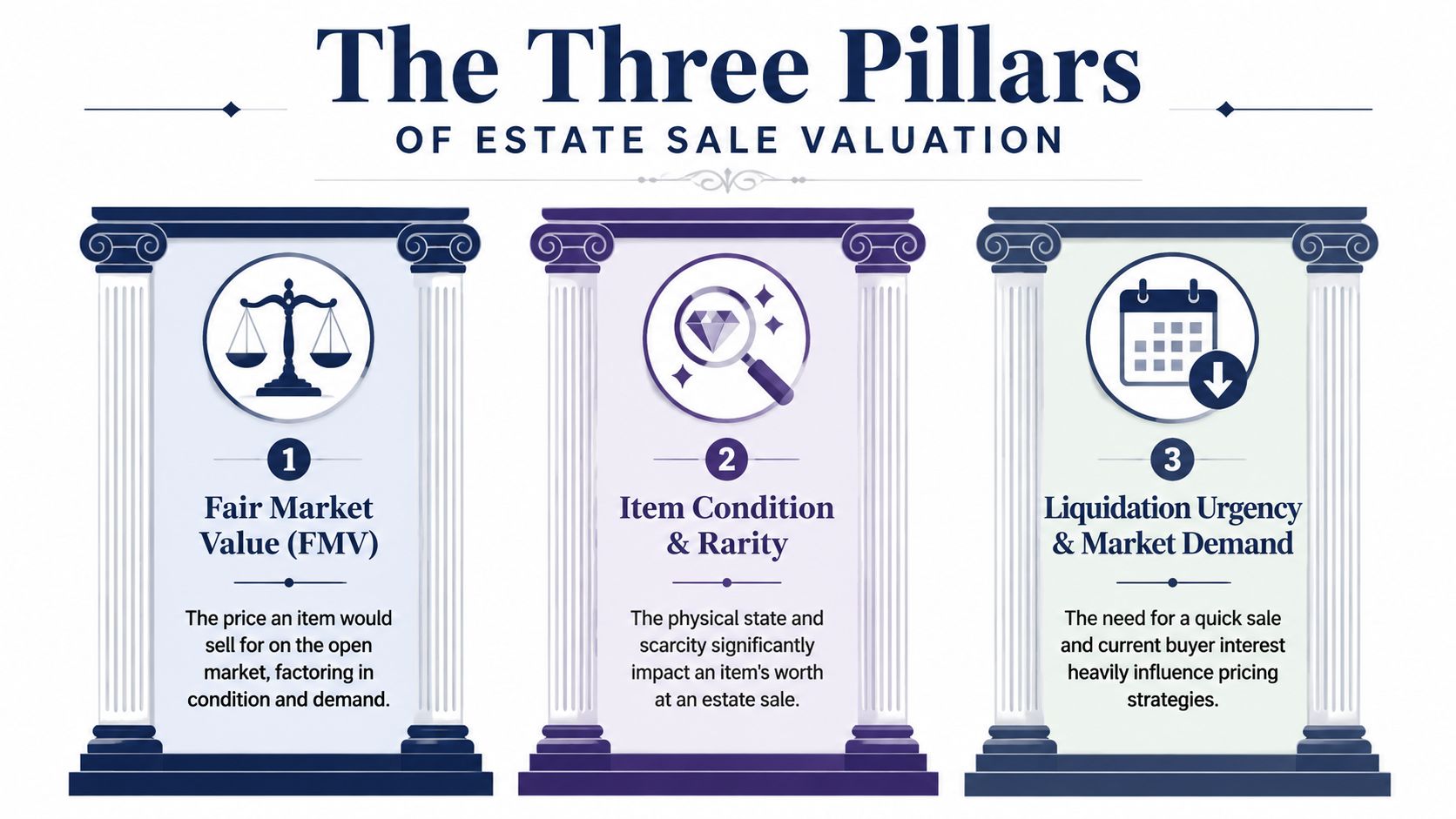
Good estate sale pricing rests on three pillars: fair market value, condition and rarity, and local liquidity discount. Leave out any one of them and you get tags that look logical on paper but stall in the house.
Fair market value gives you the ceiling
Fair market value is the first reference point, not the final tag. It tells you what a willing buyer paid in a broader market under normal selling conditions. That matters because it keeps you from guessing, but it does not account for your deadline, your local buyer pool, or the fact that everything has to move fast.
Estate sale operators who do this well use market value as a cap, then work down from there. Carat 24 Boise's estate sale pricing benchmarks lay out that spread clearly. Better antiques and desirable collectibles can hold a stronger percentage of retail than ordinary household goods, while common housewares usually need a steeper discount to move.
That difference matters more than beginners expect.
A clean mid-century lamp, a signed studio pottery piece, and a box of used coffee mugs should not be priced with the same logic just because all three came from the same house.
Condition and rarity decide how much price strength an item can carry
Condition changes buyer confidence immediately. Chips, repairs, missing parts, stains, dead batteries, warped drawers, and smoke odor all narrow your buyer pool. Clean, complete, working items do the opposite. They sell faster and they tolerate firmer tags.
Rarity buys you time, but only a little. A scarce item with proven collector demand can start higher on day one because the right buyer may show up early and pay for the chance to get it. A common item has no such protection. If five similar examples are available within a short drive or a quick online search, your tag has to compete hard.
Use that distinction room by room. I price rare and identifiable pieces with more patience at the opening. I price common goods to create motion.
If buyers are filling baskets, the house is working.
The local liquidity discount is what turns online comps into sale prices
This is the part many pricing guides gloss over. Online sold comps show what someone paid in a larger market, often after days or weeks of exposure, with search filters, nationwide demand, and shipping as an option. An estate sale has none of those advantages. You have local foot traffic, a fixed calendar, and a shrinking window every hour the doors are open.
That gap needs a number. I call it the local liquidity discount.
Here is the practical rule: once you know the online sold range, cut enough off the top to make an in person buyer feel they found the deal immediately, without having to think too hard. The exact discount depends on category, condition, and your local market depth. Dense metro areas with strong collector turnout can support tighter spreads. Rural markets, bulky furniture, and niche collectibles usually need a larger gap.
A fast way to sanity-check that gap is to run the item through a reseller margin calculator app and ask a harder question than “could this sell?” Ask “will this sell here, this weekend, at a profit after markdowns?”
Use the three pillars together like this:
- Start with fair market value from credible sold comps.
- Adjust for condition and rarity based on what the item is, not what the family hoped it was.
- Apply a local liquidity discount large enough to support a full-house liquidation in three days, not a slow trickle of selective sales.
That last step is where speed and profitability meet. Two similar items can have the same online comp and still deserve different estate sale tags because one has broad local demand and the other needs the right buyer who may never walk through the door this weekend.
How to Research Comps and Find True Market Value
Friday setup. You are staring at a dining room full of crystal, a garage with power tools, and three display cases of jewelry. If your comp process is slow, you will either price too high and carry inventory into day three, or price too low and give away margin before the doors even open.
Good comp work has one job. Get to a believable market number fast, then convert that number into a tag that will sell locally inside a 3 day estate sale.
Start with sold prices, not hopeful prices
Active listings help identify an item. They do not tell you what buyers paid. Estate sale pricing lives or dies on sold comps because sold comps show accepted value, not seller ambition.
Use a tight process:
- Identify the item correctly. Maker, model, age, material, size, pattern, and country of origin can all change the number.
- Filter to sold results. Ignore unsold listings unless you are checking how saturated the market is.
- Match condition accurately. Chips, repairs, missing hardware, staining, and replaced parts all matter.
- Check completeness. Boxes, cords, lids, remotes, manuals, and matching sets can move a price more than new sellers expect.
Misidentification is expensive. A generic “vintage lamp” tag and a correctly identified mid-century maker tag are two different outcomes.
Build a comp range you can defend
One flashy sale can distort your whole table. One bargain-bin auction can do the same in the other direction. Pull several true matches, throw out obvious outliers, and work from a realistic range.
If you only find a few strong matches, widen carefully. Match the material and form first. Then match era, brand family, and condition. If confidence is low, price with more room for the buyer. That protects your sell-through rate.
I train newer resellers to write down a quick comp conclusion in plain language: “online sold range looks like X to Y, ours is missing lid, local demand is average, tag at Z.” That note keeps you from second-guessing yourself when the room gets busy.
Use the local liquidity discount on purpose
Online sold comps are not your tag price. They are your starting point.
The missing step in many pricing guides is the local liquidity discount. You are converting an online sold number into an in-person price that has to clear in a fixed weekend window. That discount covers the difference between a national buyer pool online and whoever walks through your front door over three days.
Here is the practical trade-off. A compact, desirable, easy-to-carry item with broad demand can sit closer to online sold value. Bulky furniture, niche collectibles, incomplete sets, and anything that needs a very specific buyer should be discounted harder. The less local depth you have, the bigger the gap needs to be.
That is how you protect speed and profit at the same time.
Modern tools cut research time
The old method is too slow for real sale prep. Flipping between eBay, Facebook Marketplace, Mercari, WorthPoint, and auction archives burns time and increases mistakes. You forget which comp had damage, miss shipping costs, or anchor on the highest sale because it is the one you remember.
A better workflow is to use a tool that can identify items from photos and pull comps into one view. That matters most for unmarked housewares, vintage decor, costume jewelry, accessories, and odd collectibles without barcodes. If you want a practical breakdown of that workflow, this guide on how to price items for resale is useful.
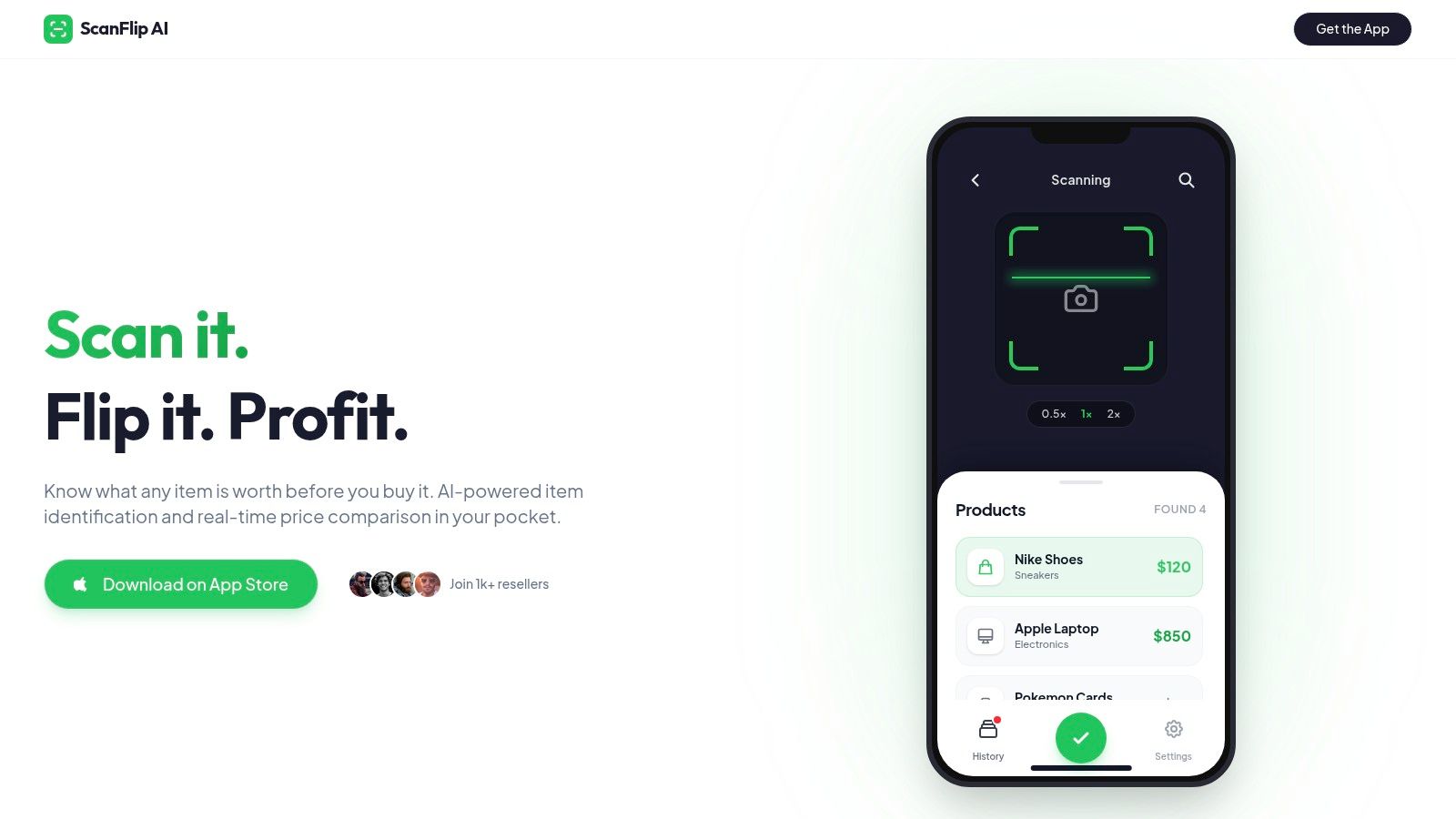
Speed matters, but accuracy matters more. A good tool helps you see net resale reality across marketplaces instead of anchoring on gross sold prices that ignore fees, shipping, and return risk. That's the logic behind any good comp workflow. Get the cleanest read on market value first, then apply your local sale discount with confidence.
A comp routine that holds up under pressure
Use this routine during setup:
- Lead with photos for identification. Many estate sale items have no barcode and weak labeling.
- Match like with like. Pattern, finish, generation, and color often separate a strong comp from a bad one.
- Ignore the top comp unless it repeats. One premium result is not the market.
- Check whether the item is practical to carry out. Buyer effort affects local sell-through.
- Write the price logic down. Fast decisions are easier to defend when your reasoning is clear.
The goal is not perfect valuation. The goal is accurate enough pricing, applied quickly, with a local discount strong enough to liquidate the house in three days instead of leaving your margin trapped in unsold inventory.
A Practical Pricing Cheat Sheet by Category
Friday at 8:00 a.m., buyers are lined up outside. You still have half a dining room to tag. That is why category pricing matters. It lets you price fast without treating a sterling flatware set, a pine hutch, and a box of everyday mugs like they belong in the same math.
Use online sold comps as the ceiling, then apply a local liquidity discount to get the item sold in person within a three day window. That discount is the gap between what an item brought online and what your local buyers will pay today, carry out themselves, and feel good about without comparison shopping all afternoon. In practice, the faster you need liquidation, the wider that gap usually gets.
Estate Sale Pricing Benchmarks by Category
| Item Category | Practical Estate Sale Starting Range | Local Liquidity Discount Notes |
|---|---|---|
| Antiques and rare collectibles | Higher end of your range when demand is proven | Narrower discount if identification is solid and local collector interest is real |
| Designer or antique furniture | Mid to upper range if style, maker, and condition are clear | Discount more for large pieces because pickup effort shrinks the buyer pool |
| Everyday household goods | Low to mid range for quick turnover | These need a steep discount because buyers compare them to thrift and discount retail |
| Basic furniture | Mid range at best unless quality stands out | Generic, bulky, or dated pieces usually need aggressive pricing to move by day three |
The table is a starting grid, not a rulebook. The main task is deciding how much local discount each item needs to convert into cash this weekend instead of sitting in the garage after the sale.
How to use the table without mispricing a room
Start with buyer effort. A small collectible that fits in one hand can sit closer to strong comp value if it is correctly identified and clean. A heavy sofa with worn fabric may need a much bigger cut even if online comps look decent, because your buyer has to like it, measure it, load it, and remove it today.
That is the part many guides skip. Local liquidity is not just value. It is value minus friction.
Use these field rules:
- Price cleaner, proven items stronger. Marked silver, signed art, complete sets, and well-styled vintage decor can open higher if the comps are real and the audience exists locally.
- Cut harder for size, damage, and uncertainty. Heavy case goods, scratched tables, missing parts, and unverified maker attributions need a wider discount.
- Lot low-dollar items early. If a buyer would not research it, do not waste setup time pricing it one by one.
- Watch the online-to-local gap by category. Small shippable goods often tolerate a smaller discount than furniture, lamps, or anything awkward to transport.
- Work from net, not gross. If you also resell online, a margin calculator for resale pricing decisions keeps you focused on take-home profit instead of inflated sold prices.
One room can show the difference. A mid-century credenza with real style might deserve a moderate local discount if your market responds to that look. A stack of basic dinner plates should be grouped and priced to disappear fast. Pressed glass that only looks old gets priced very differently from signed art glass once you know what it is.
Good category pricing protects your time. Better category pricing builds in the local liquidity discount up front, so you finish the weekend with cash instead of leftovers.
Implementing Your Pricing and Markdown Strategy
By Friday at noon, the floor tells you whether your pricing plan is real or just theory. If buyers keep asking staff for prices, arguing over mismatched tags, or skipping whole tables because the math feels hard, you lose speed. In a 3 day sale, speed is margin.
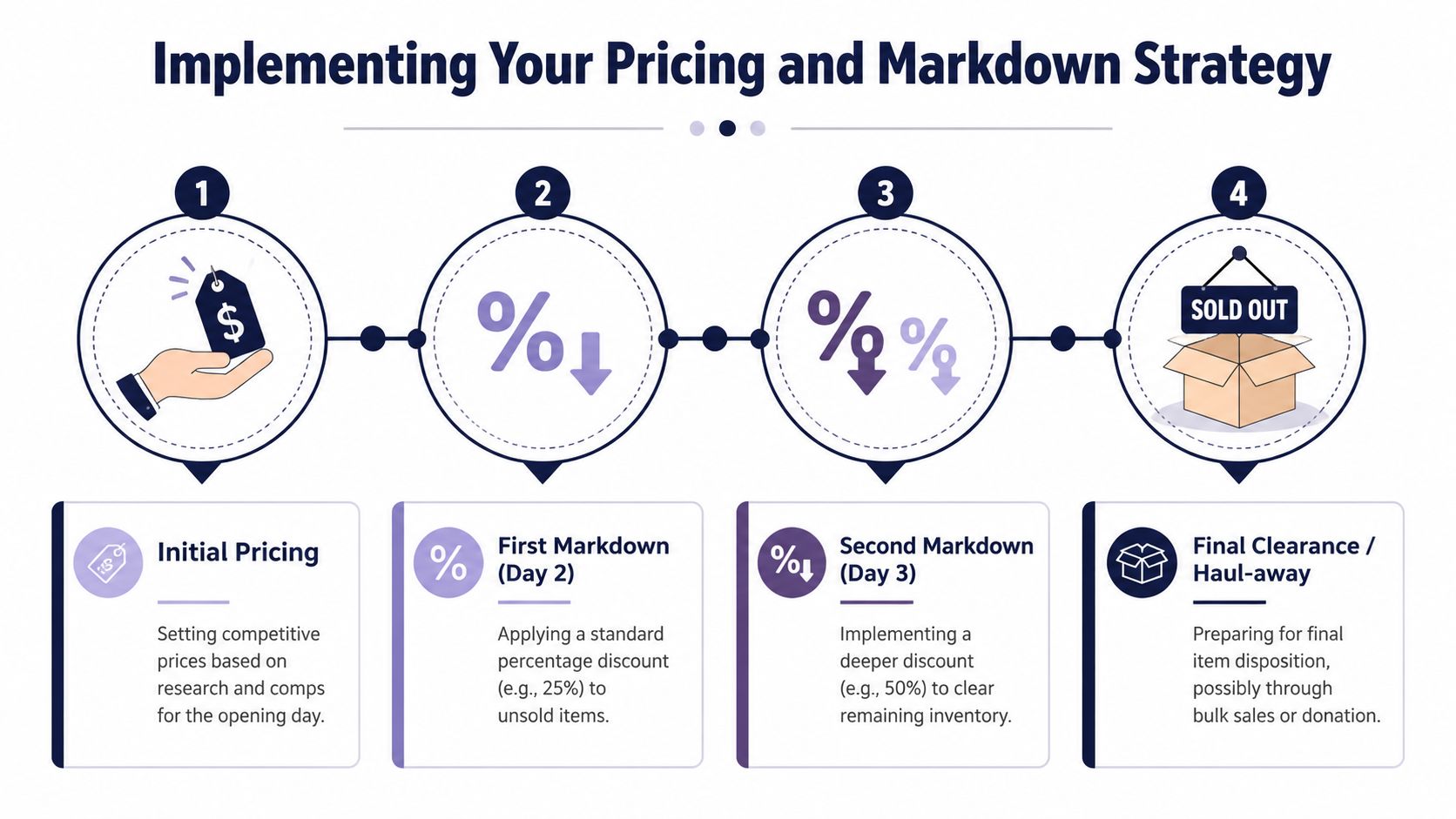
Execution matters because estate sale pricing is not retail pricing. You are not trying to hold inventory for the perfect buyer. You are converting a house full of goods into cash on a deadline. That is where the local liquidity discount has to show up in the tags and in the markdown schedule, not just in your research notes.
Tagging that helps buyers move fast
A good tag settles the question in two seconds. Price. Basic identifier if needed. Nothing else.
Use large, legible numbers. If an item needs context, add one short note such as maker, pattern, quantity, or “tested.” For paired items, mark both pieces and the set price clearly. For shelves with similar goods, use section signs so buyers do not keep pulling staff across the room.
Keep the tag out of the negotiation. Skip research notes, online comp references, and long explanations. Buyers standing in a crowded bedroom do not care what the item sold for on eBay six weeks ago. They care whether your price feels fair for an immediate, local purchase.
When to lot items instead of pricing one by one
Single-item pricing is a common time trap. If the item will only sell because it is cheap, price the group and move on.
Lot pricing works best in categories where buyers make quick bundle decisions:
- Everyday kitchen tools
- Common glassware
- Office supplies
- Craft materials
- Basic books and media
Grouped pricing also lets you build in the local liquidity discount at the container level. A basket at $10 often clears faster than ten $2 stickers scattered across a table, even if the total is lower on paper. Fast sell-through usually wins.
A three day markdown plan that actually clears inventory
A markdown schedule should be set before the first shopper walks in. Staff should not invent discounts at 2 p.m. because traffic feels slow.
For a standard 3 day liquidation, use a simple structure:
- Day 1: Full marked price for most items
- Day 2: Moderate discount on ordinary inventory
- Day 3: Aggressive discount focused on clearance and bulk movement
That rhythm works because buyer behavior changes by day. Early buyers pay for selection. Late buyers expect a better price because they are accepting less choice, more picking through, and a shorter resale window.
The mistake new sellers make is marking too close to online sold comps on Day 1, then hoping markdowns will fix it. Usually they do not. If a lamp sold online for $120 plus shipping, and your local crowd has to carry it out, test it, and fit it in a car, the estate sale tag needs a real discount from the start if you want it gone by Sunday. That gap is the local liquidity discount. Small, shippable, branded goods may only need a modest gap. Bulky furniture, decor with style risk, and anything untested usually need a wider one.
Use markdowns to finish the job, not to rescue bad opening prices.
A practical rule is simple. Open strong enough to protect quality items, but low enough that a disciplined Day 2 and Day 3 schedule still lands inside your clearance target. If too much of the house still looks “interesting” instead of sold by the end of Day 1, opening prices were probably too ambitious.
For help setting prices that reflect real buyer behavior instead of wishful thinking, this guide on how to price items for resale is a useful framework.
Good markdown strategy protects margin on the best pieces and clears the long tail before cleanup starts. That is the balance that keeps a sale profitable.
Managing Negotiations Signage and Logistics
By the time the doors open, pricing work is only half done. A buyer can agree with your numbers and still walk if the room feels confused, the register line stalls, or every staffer gives a different answer. In a 3 day liquidation, that friction costs real money because hesitation kills volume.
Set the tone before the first buyer asks
Good signage protects your pricing. It also protects your staff from answering the same question 200 times.
Post signs where buyers make decisions, at the entrance, near checkout, and in big-ticket areas like furniture, jewelry, and garage inventory. Keep the wording plain and large enough to read from a few feet away.
Use signs for:
- Pricing policy: “Prices firm today” or the exact rule you are using
- Daily discount terms: Show what applies now, not a vague future promise
- Payment methods: Cash, cards, and digital payments
- All sales final: Especially for used electronics, tools, and fragile items
- Pickup instructions: Who to see for furniture, load-out times, and hold rules
One more sign earns its place. Mark whether tested electronics are tagged as tested, untested, or for parts. That cuts down on checkout arguments and lowers the number of buyers trying to negotiate after they already committed.
Negotiate with a rule, not a mood
New operators get in trouble here. They price with a plan, then start freelancing at 9:15 a.m. because a buyer sounds confident.
Use a simple negotiation standard tied to your sale objective. If the goal is fast liquidation over one weekend, every decision should reflect the local liquidity discount already built into the tag. A chair that sold online for more money is irrelevant if your local buyer has to haul it today and you need that room cleared by Sunday. That discount is their incentive to act now. You do not need to stack another discount on top just because they asked first.
Opening morning, hold your line on clean, desirable items. On later days, allow more flexibility on bulky pieces, style-sensitive decor, and leftover mid-tier inventory where holding out hurts more than conceding. Staff should know the exact range they can approve without asking you. For example, “firm today on marked premium items,” “up to a small discretionary cut on grouped household goods,” and “manager approval required on furniture.” Consistency matters more than clever haggling.
A buyer asking for a deal in the first hour is usually testing for softness, not pointing out a pricing mistake.
Build checkout for speed
Checkout should feel fast and boring. That is a compliment.
Run one clearly marked pay station if the house is small. In a larger sale, use one main register and a separate area for wrapping, sold stickers, and furniture receipts so the line keeps moving. Keep basic supplies within arm's reach: bags, tape, wrapping paper, sold tags, markers, and a clipboard or tablet for larger pickups.
Train helpers to follow the same sequence every time:
- State the total once
- Take payment before side conversations start
- Mark items sold immediately
- Attach the buyer name to large item pickups
- Direct the customer away from the register after payment
Small operational mistakes create expensive problems. A sold dresser without a name tag gets resold. A crowded checkout table invites item switching. A vague furniture pickup promise leaves pieces behind after the sale ends.
Control the floor so buyers keep buying
Traffic flow matters. Keep aisles open, move sold furniture tags onto pieces right away, and give shoppers a place to set “hold” items that is supervised by staff, not scattered across tables. If buyers feel they have to guard their pile, they stop shopping.
Group low-dollar goods near checkout for quick add-on sales. Put measuring tape in furniture rooms. Keep extension cords and batteries handy if you are demonstrating working lamps or small appliances. These small choices reduce hesitation, and hesitation is the enemy of a fast 3 day clear-out.
The strongest sales feel organized, predictable, and easy to buy from. That is not just customer service. It is part of the pricing strategy, because a house that moves smoothly lets your local liquidity discount do its job.
Conclusion From Overwhelmed to Profitable
A house full of unpriced belongings looks chaotic at first because you're seeing volume before system. Once you apply a real estate sale pricing guide, the job gets clearer. Start with fair market value, judge the item through condition, rarity, and demand, then apply the local liquidity discount that makes an in-person weekend sale work.
That's the part many sellers miss. Online comps are only reference points. Estate sale pricing has to reflect a local buyer pool, short selling window, and the reality that emptying the house is part of the profit equation. Good pricing doesn't chase the highest imaginable number. It gets the right buyer to act while there's still time.
The rest is execution. Research sold comps, not fantasies. Use category benchmarks to move through the house efficiently. Tag clearly. Group low-value inventory where that makes sense. Then run the weekend with a markdown structure that rewards early commitment and clears remaining stock before the sale ends.
If you do those things consistently, pricing stops feeling like guesswork. It becomes a repeatable skill. And once you've built that skill, you'll walk into the next estate knowing exactly how to turn overwhelm into margin.
If you want faster buy-or-pass decisions while sourcing estate sales, ScanFlip AI helps you identify items from photos, pull sold comps across major marketplaces, and estimate expected net profit after fees and shipping. It's a practical way to replace app hopping and gut calls with cleaner resale decisions on the spot.