
How Much Does Mercari Take in 2026: Real Fees Explained
Mercari currently takes a 10% selling fee on the item price plus any shipping paid by the buyer. That became the standard fee structure for new and updated listings on January 6, 2025.
I learned to check that math the hard way. You're in a Goodwill aisle, holding an item with a $42 sold comp in your head, and the flip looks easy until you notice the buyer also paid shipping. That shipping amount increases Mercari's fee base, so “take 10% off the sold price” can leave your profit estimate short before you've even bought the item.
Table of Contents
- The 10% Headline Number Is Real but Not the Whole Story
- How Mercari Calculates the Selling Fee Step by Step
- Net Profit Math for Common Flip Categories
- Beyond the Selling Fee, What Else Mercari Deducts
- Mercari Versus eBay and Poshmark on the Same Sale
- Mercari Prepaid Labels and Shipping Protection Limits
- When Mercari Is the Wrong First Choice for a Flip
- Baking Mercari Fees Into a Sourcing Decision
- Quick Reference for Mercari Fees Before Your Next Sourcing Run
The 10% Headline Number Is Real but Not the Whole Story
Standing in the aisle, I used to do the fast version: $42 sold comp, about $4 in fees, then subtract my buy cost. But if the buyer paid $8 shipping, the fee applies to the item price plus that shipping, not just the $42. On that sale, the fee base is $50 and the fee is $5, not $4.20. That difference can decide whether an item is worth putting in the cart.
Mercari's current U.S. selling fee is 10% of the completed item price plus any shipping paid by the buyer, and it's charged only after an item sells. Mercari introduced this structure for new and updated listings beginning January 6, 2025. Mercari also said existing listings would be updated automatically within approximately one week. You can check the current Mercari selling fee policy when you're confirming how the fee applies.
The most common mistake I see is calculating 10% of the item's sold price and stopping there. That misses buyer-paid shipping and makes the projected net look better than the actual payout. Older reseller spreadsheets may also rely on an earlier fee schedule, so check whether your calculator reflects Mercari's current U.S. rule.
Aisle check: Start with the sold comp, add buyer-paid shipping to the fee base, then work out what's left after your cost of goods and shipping you'll pay.
How Mercari Calculates the Selling Fee Step by Step
Use the $42 item and $6.99 buyer-paid shipping example. Mercari's fee is calculated on $48.99 total, so the selling fee is $4.90. This is why “10% off $42” is the wrong shortcut: it leaves out shipping that the buyer paid.
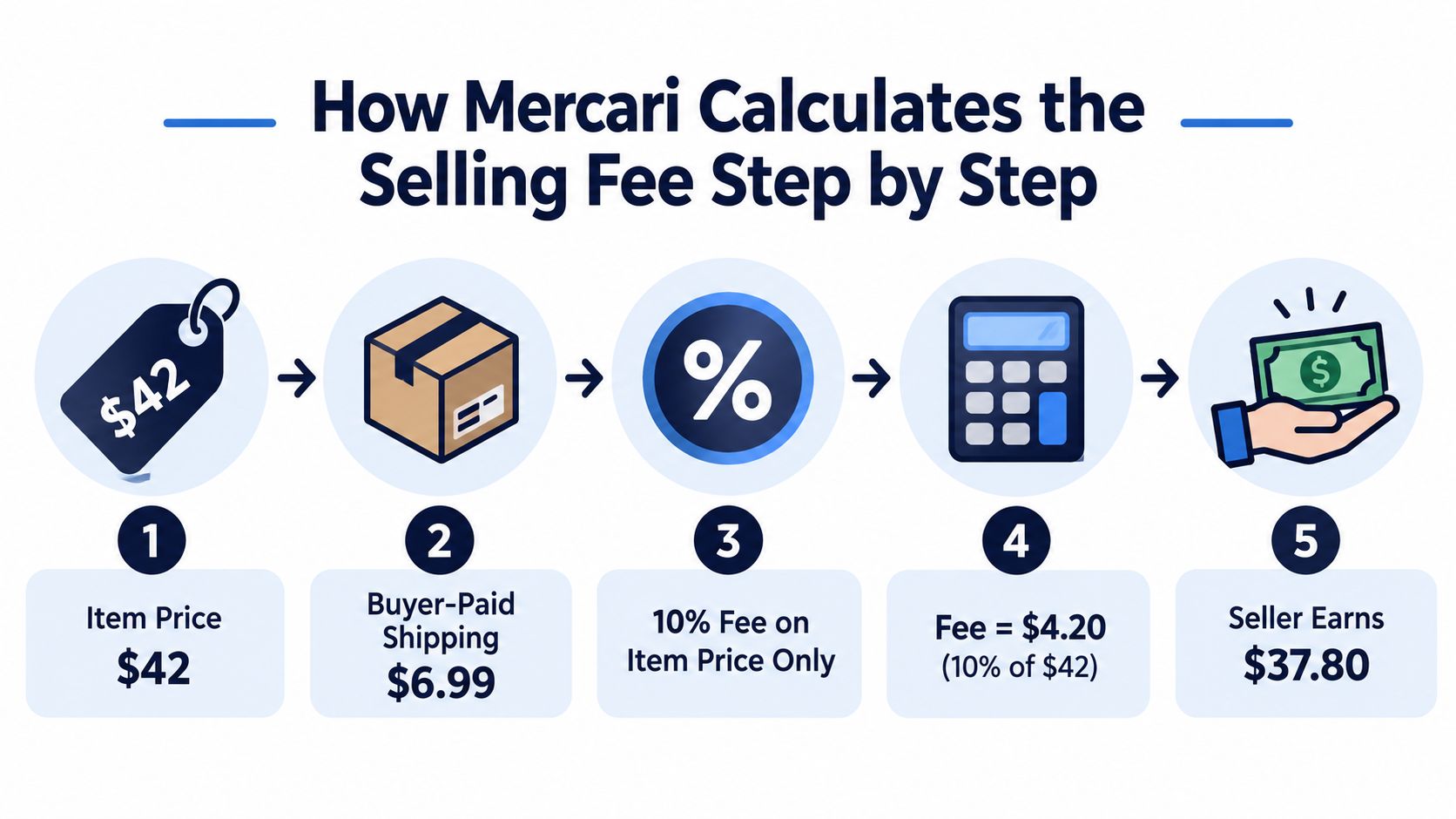
Follow the math in order:
- Start with the item price. In this example, the sold price is $42.
- Add buyer-paid shipping. The buyer pays $6.99, bringing the fee base to $48.99.
- Calculate the selling fee. Ten percent of $48.99 is $4.899, which rounds to $4.90.
- Subtract the fee from the sale amount. The seller's proceeds are $44.09 before cost of goods and any seller-paid expenses.
- Subtract your own costs. The actual net profit depends on what you paid for the item and whether you covered shipping or other costs.
The fee applies only after the item sells, so an unsold listing doesn't incur Mercari's selling commission. Buyer-paid shipping counts toward the fee base; seller-paid shipping is a separate cost that reduces what you keep. In the $42 example, if the buyer-paid shipping covers the label and the item cost $6, the net before packaging and other costs is $31.10, based on the Mercari seller-protection policy.
Quick fee-base check: include the item price and buyer-paid shipping. Don't subtract the buyer's shipping from your item price before calculating the fee, and don't treat seller-paid shipping as part of the buyer-paid shipping amount.
Net Profit Math for Common Flip Categories
Here's the part that matters at the thrift rack: not the headline sold price, but what remains after the selling fee, cost of goods, and any shipping you cover. The examples below use the $42 sold price and $6.99 buyer-paid shipping from the Mercari example above, with different buy costs by category. The fee is $4.90 in each row because the sold price and buyer-paid shipping are the same.
| Category | Buy Cost | Sold Price | Buyer Shipping | Mercari Fee | Net to Seller |
|---|---|---|---|---|---|
| Apparel | $6 | $42 | $6.99 | $4.90 | $31.10 |
| Books | $2 | $42 | $6.99 | $4.90 | $35.10 |
| Sports cards | $10 | $42 | $6.99 | $4.90 | $27.10 |
| Home goods | $12 | $42 | $6.99 | $4.90 | $25.10 |
The table assumes the buyer-paid shipping covers the label, so it doesn't deduct seller-paid shipping, packaging, refunds, cancellations, or optional services. These aren't guaranteed outcomes for each category. They're a way to plug your own sold comps and cost of goods into the fee formula before you buy.
Apparel bought cheaply can leave room for a workable net, especially when the buyer pays shipping. A heavier home-good find can look attractive based on sold prices, then turn into a pass once the label cost comes out of your proceeds. Books can be low-cost inventory, but a low buy cost alone doesn't tell you whether the item will move. Check sold comps and sell-through rate, and don't let a tempting headline comp talk you into adding another slow seller to the death pile.
Beyond the Selling Fee, What Else Mercari Deducts
A 10% selling fee is the key deduction in the current fee calculation, but it's not the same thing as profit. Your actual take-home can also be affected by shipping you pay, refunds or cancellations, and optional services. Mercari's gross-sales reporting separates buyer-paid shipping, seller-paid shipping, the selling fee, and other transaction fields, which helps when you're reconciling a payout.
Be careful with old calculators that automatically add a payment-processing charge to every Mercari sale. The current U.S. selling-fee rule described above is the direct seller fee; don't add an unverified processing charge to your estimate. For any withdrawal or optional service fee, check the current Mercari terms before treating an old guide's numbers as current.
Promoted Listings and Mercari Authenticate also need their own line in your math if you choose to use them. A promotion can add a charge under its terms, and authentication can make sense when buyer confidence matters enough to justify its cost. Don't assume either service is included in the selling fee, and don't build an exact amount into your calculator unless you've confirmed the current charge for the service.
Read the payout as separate lines
When checking a payout, look for the item amount, buyer-paid shipping, any seller-paid label, the selling fee, and any other transaction adjustment. Then compare the proceeds with your cost of goods and packaging costs. That's more reliable than subtracting a flat 10% from the sold price and calling the remainder profit.
If you sell as a side hustle, keep your own records of purchases, sales, and expenses. Tax reporting requirements depend on your situation, so don't treat a platform payout screen as a full profit-and-loss statement. It shows transaction activity, not every cost you paid while sourcing.
Mercari Versus eBay and Poshmark on the Same Sale
A useful platform comparison starts with the same sold comp, not different prices pulled from different categories. For the example below, the item sells for $42 and the buyer pays $6.99 shipping. Mercari's selling fee on that total is $4.90, leaving $44.09 before cost of goods and other seller-paid expenses.
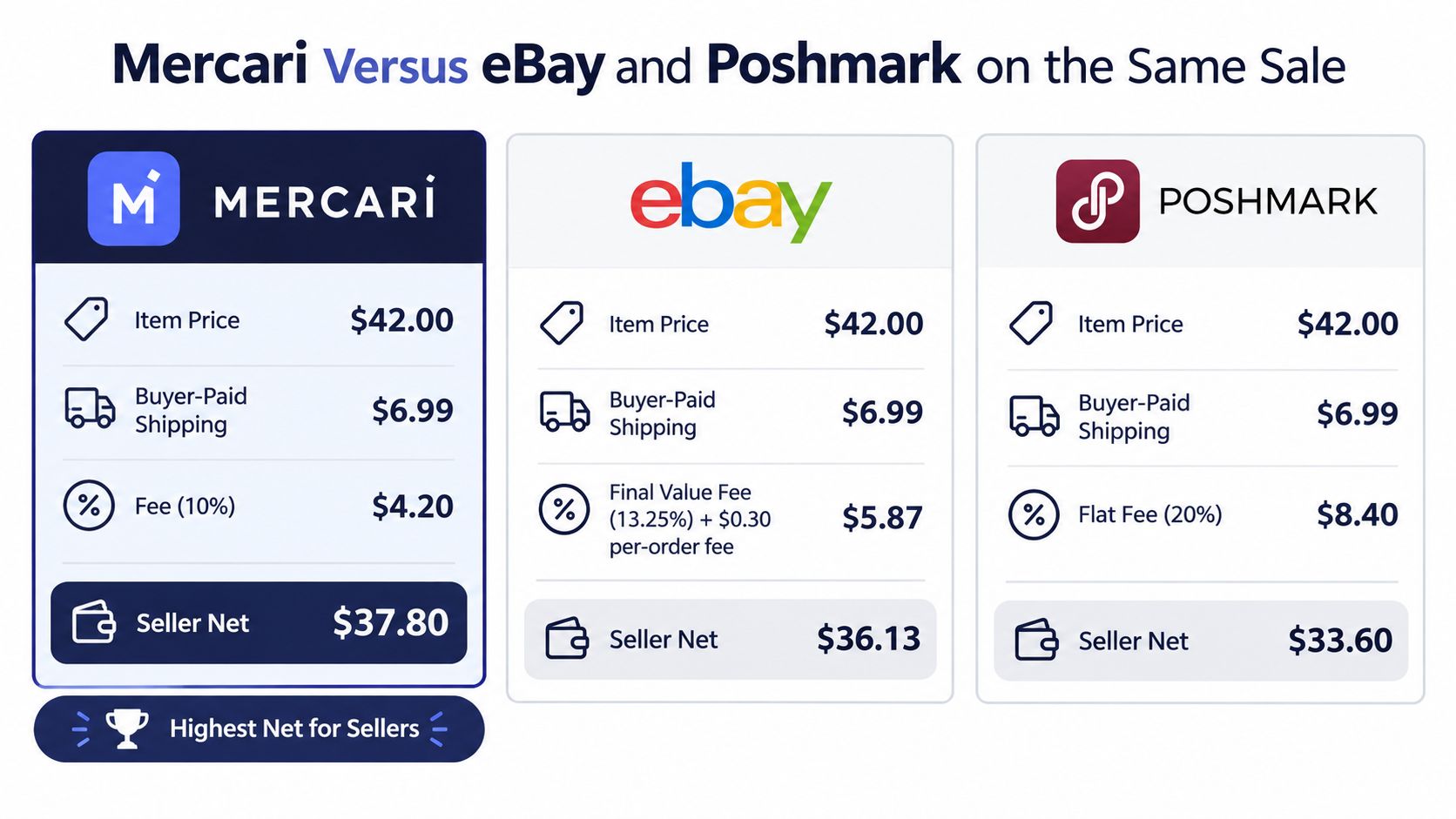
For a like-for-like illustration using the infographic's fee assumptions, the three platforms look like this:
| Platform | Example Fee Calculation | Net Before Cost of Goods |
|---|---|---|
| Mercari | $4.90 selling fee on $42 plus $6.99 buyer-paid shipping | $44.09 |
| eBay | $5.87 in fees using the infographic's assumed final value fee and per-order fee | $43.12 |
| Poshmark | $8.40 fee at the infographic's assumed flat 20% of the item price | $33.60 |
These figures compare the fee deductions shown in the examples; they aren't a complete comparison of current platform policies or shipping costs. The Mercari example uses its fee on the item price plus buyer-paid shipping, while the eBay and Poshmark rows use different fee assumptions. Check each platform's current rules before making a cross-platform decision.
Shipping can shift the result further. If a buyer-paid label covers your shipping cost, that's different from a sale where you pay for the label yourself. Poshmark's fee can look heavier, but the total cost to you depends on the shipping arrangement and any other seller expenses. eBay's per-order component can matter more on a low-priced flip than it does on a higher-priced sale.
For a broader view of how audience and selling costs affect your choice, compare the best platform for selling online. The right first platform is the one where your item's sold comps, fees, shipping, and buyer demand leave a net worth the work.
Mercari Prepaid Labels and Shipping Protection Limits
A Mercari label is a shipping decision as well as a convenience. Mercari prepaid labels provide tracking and shipping protection up to $200 for standard, economy, Local, and Media Mail shipments, and up to $20 for First-Class Envelope shipments. To qualify, the seller needs to use the Mercari prepaid label and show that the carrier received the package within three calendar days of purchase. Check the Mercari seller shipping guide for the current requirements.

That cap changes how I think about a boxed collectible or electronics flip. If the item is worth $150, a Mercari prepaid label can place its value within the listed protection ceiling, provided you meet the label and carrier-acceptance requirements. For a $275 item, $75 remains above the $200 cap, so the label doesn't erase all of the shipping risk.
Shipping independently is a different trade-off. You pay the shipping costs yourself, give up Mercari Shipping Protection, and may not receive a payout if the package is lost or damaged in transit. That can make independent shipping a poor bet when a package is valuable or difficult to replace.
Match the label to the item
Before listing, estimate the packed size and weight rather than guessing from the item alone. A boxed home-goods find can be much less attractive once you account for its package dimensions and the label you'll need. Use this guide to estimating shipping costs as a planning aid, then confirm the actual label options and protection terms in Mercari.
For a high-value item, decide whether the potential net justifies the portion of its value that falls above the protection limit. If it doesn't, the choice may be to use another shipping arrangement or pass on the flip, but don't assume shipping your own label preserves Mercari's protection.
When Mercari Is the Wrong First Choice for a Flip
Mercari shouldn't automatically be your first stop for every item. The fee calculation is simple, but shipping costs, buyer demand, and protection limits can make the platform a poor fit for a particular flip.
Very low-priced items deserve extra scrutiny. Even when the fee is a percentage rather than a large fixed charge, the label, packing time, and cost of goods can leave little net profit. A cheap item isn't a BOLO just because it has sold before. Check sold comps and STR, then decide whether the amount left is worth photographing, packing, and shipping.
Heavy items are another warning sign when Mercari's available label options don't suit the package or when you'd have to cover shipping yourself. Price the packed shipment before buying at a Ross clearance rack or estate sale. If the item's weight and size eat the margin, a strong sold price won't rescue the flip.
High-value goods need a protection check. When an item's value is above Mercari's stated shipping-protection cap, part of the value remains exposed even if you use a prepaid label. That can matter for boxed electronics, collectibles, or other items that would be expensive to replace.
Don't crosslist first and calculate later. Pick the platform after you know the net and the shipping risk.
Mercari can still be a sensible first list for mid-priced clothing when buyer-paid shipping covers the label and the sold comps support the price. It can also work for lower-priced items when a platform's other fee structure would make the alternative less attractive. But don't assume eBay's per-order fees or Poshmark's percentage automatically make Mercari better. Compare the actual costs, including shipping and the buyer demand you can see in sold comps, before choosing where to list.
Baking Mercari Fees Into a Sourcing Decision
At a Goodwill rack or garage-sale bin, work out what you'll have left after fees, shipping, and the price on the tag. Start with sold comps for the exact model, size, edition, and condition. Asking prices won't establish your likely return. A condition mismatch can turn a promising comp into a bad buy.
Run the same sold-price assumption through Mercari, eBay, and Poshmark so the comparison stays fair.
For Mercari, buyer-paid shipping belongs in the fee base even though that money covers the label. Subtract your buy cost, packaging, and any shipping you'll pay from the estimated proceeds. Check packed weight and size before committing, and account for the prepaid-label protection limit on valuable items. Use that result to set your maximum buy price.
ScanFlip AI supports photo scanning without a barcode, barcode scanning, and text search. It pulls sold comps across eBay, Poshmark, Mercari, Depop, Amazon, Whatnot, ThredUp, Facebook Marketplace, and TikTok Shop, then factors fees and shipping into an estimated net profit and red or green flip-or-pass verdict.
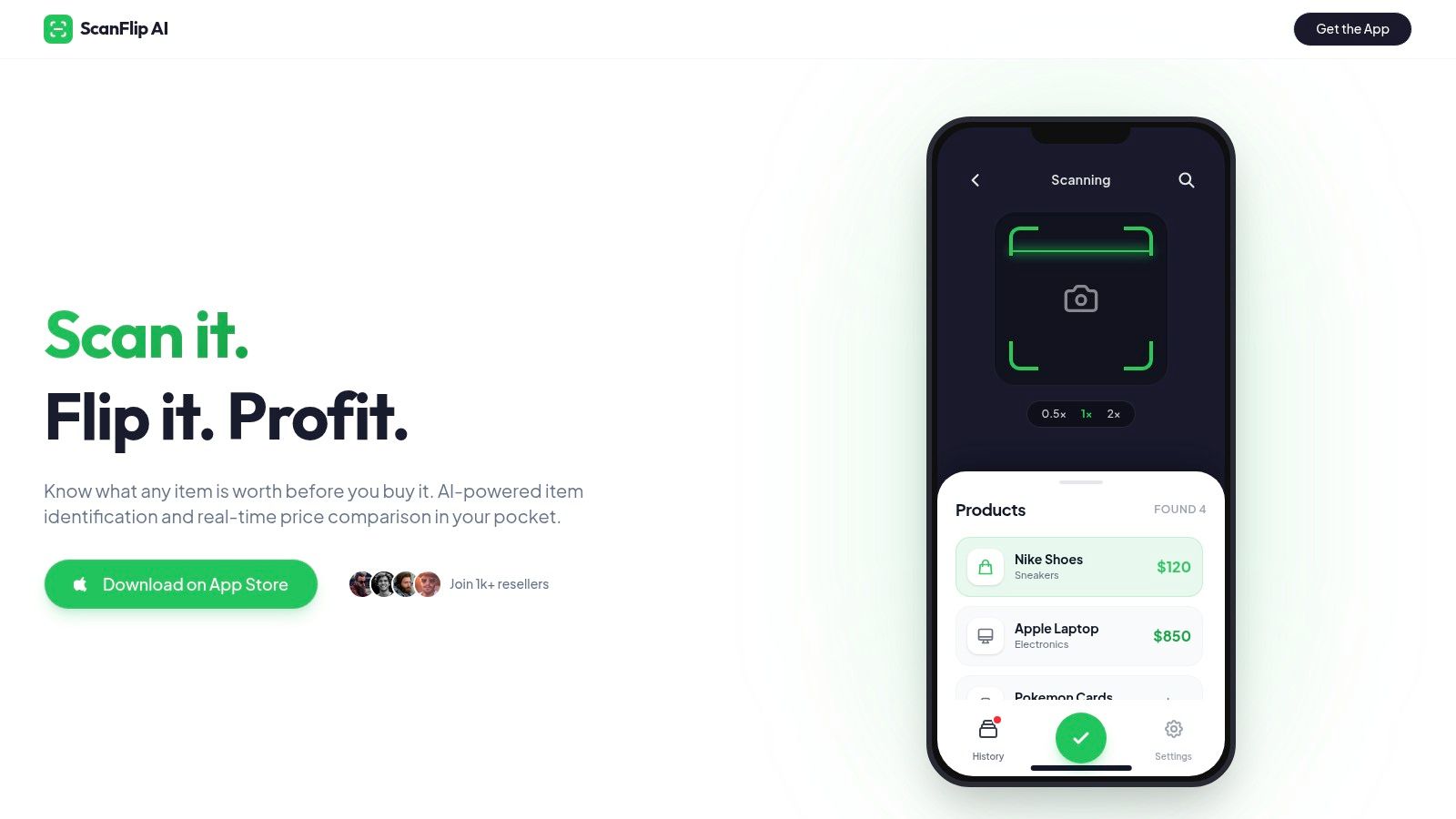
Check the comps behind that verdict. Confirm condition and package size, then adjust any input that doesn't match what you're holding. A green result still needs enough margin to justify the work. For a manual routine, use this guide to pricing items for resale alongside your own purchase and sales records.
Quick Reference for Mercari Fees Before Your Next Sourcing Run
Keep these rules handy when you're scanning a shelf or deciding whether a Ross clearance find is worth the drive home:
- Selling fee: Mercari takes 10% of the item price plus buyer-paid shipping on a completed sale.
- Unsold listings: The selling commission applies only after the item sells.
- Shipping protection: Mercari prepaid labels provide protection up to $200 for most listed shipping methods and $20 for First-Class Envelope, subject to the label and carrier-acceptance requirements.
- Optional services: Promoted Listings and authentication can affect your net, so check their current terms and include any applicable charge in your math.
- Actual profit: Subtract cost of goods and any seller-paid shipping or other expenses from the proceeds, rather than treating the payout as net profit.
Before the next sourcing run, save your fee formula where you'll use it: sold price plus buyer-paid shipping, then the selling fee, then your own costs. If those numbers don't leave enough room for the time and risk, leave the item for the next flipper.
For the next item you scan, ScanFlip AI can compare sold comps across marketplaces and estimate net profit after fees and shipping. Use its AI photo scan, barcode scan, or text search to check the math before you buy.