
Most Profitable Item to Sell on eBay: 2026 Guide
There is no single universally most profitable eBay item. The winner is whichever item leaves the highest risk-adjusted profit per hour and cubic inch after every cost, including the buy cost, fees, shipping, returns, and the time it takes to sell.
You're standing in a Goodwill electronics aisle with a boxed game console in one hand and a branded jacket in the other. The console appears to have the higher sale price, but it's heavy, difficult to test, expensive to ship, and likely to attract returns. The jacket costs less, takes minutes to photograph, and may sell faster. The right buy isn't obvious until you check the sold comps and run the net-profit math.
That's the practical answer to the question, “What is the most profitable item to sell on eBay?” It isn't always the item with the biggest gross price. It's the item that leaves enough money after costs while demanding a reasonable amount of sourcing, testing, packing, and customer service time.
Table of Contents
- The Problem With Asking “What Is the Most Profitable Item”
- How eBay Fees Actually Eat Your Margin
- Categories With the Highest Net Profit Potential
- Where To Source The Best Finds
- How To Evaluate Profitability Before You Buy
- How ScanFlip AI Speeds Up Sourcing Decisions
The Problem With Asking “What Is the Most Profitable Item”
Most category lists point sellers toward sneakers, trading cards, branded apparel, luxury accessories, or electronics. Those categories can produce excellent flips, but a category label doesn't tell you whether the item in your hand is a good buy.
eBay's own market scale does show why fashion, collectibles, sneakers, refurbished products, and parts and accessories deserve attention. In 2025, eBay generated nearly $80 billion in global GMV, with 51% produced outside the United States. Fashion alone generated more than $10 billion in annual global GMV, while U.S. fashion GMV increased by more than $500 million year over year, with most of that increase coming from consumer-to-consumer sellers, according to eBay's annual report.
Those figures show demand exists. They don't tell you whether a particular PlayStation box has working controllers, whether a vintage watch is authentic, or whether a jacket has enough recent sold comps to justify your cash and labor.

Gross price is a poor shortcut
Consider two items that each appear likely to sell for about $100. One is a compact collectible bought cheaply at an estate sale. The other is a bulky electronic item that needs testing, a large box, protective packing, and a higher-cost shipping label. If both sell for the same amount, the compact item can leave more net profit and consume less storage space.
The same problem appears with apparel. A branded coat with a high active asking price may sit for months if comparable items rarely sell. A lower-priced pair of shoes with consistent sold comps may return your cash faster and occupy less shelf space.
Risk-adjusted profit adds the costs that category lists leave out:
- Cost of goods: What you paid, including the price of a whole lot when only part of it is sellable.
- Platform fees: The percentage and per-order charges applied to the transaction.
- Shipping and packing: Postage, boxes, mailers, tape, inserts, and dimensional weight.
- Return exposure: Electronics, shoes, clothing, and fragile goods can create different levels of return risk.
- Labor and space: Testing, cleaning, measuring, photographing, researching, storing, and packing all count.
If you want a deeper way to think about valuation before buying, this guide to checking what items are worth fits the same sourcing habit. The question isn't which category sounds hottest. It's which individual item clears your minimum profit threshold without becoming another piece of death-pile inventory.
How eBay Fees Actually Eat Your Margin
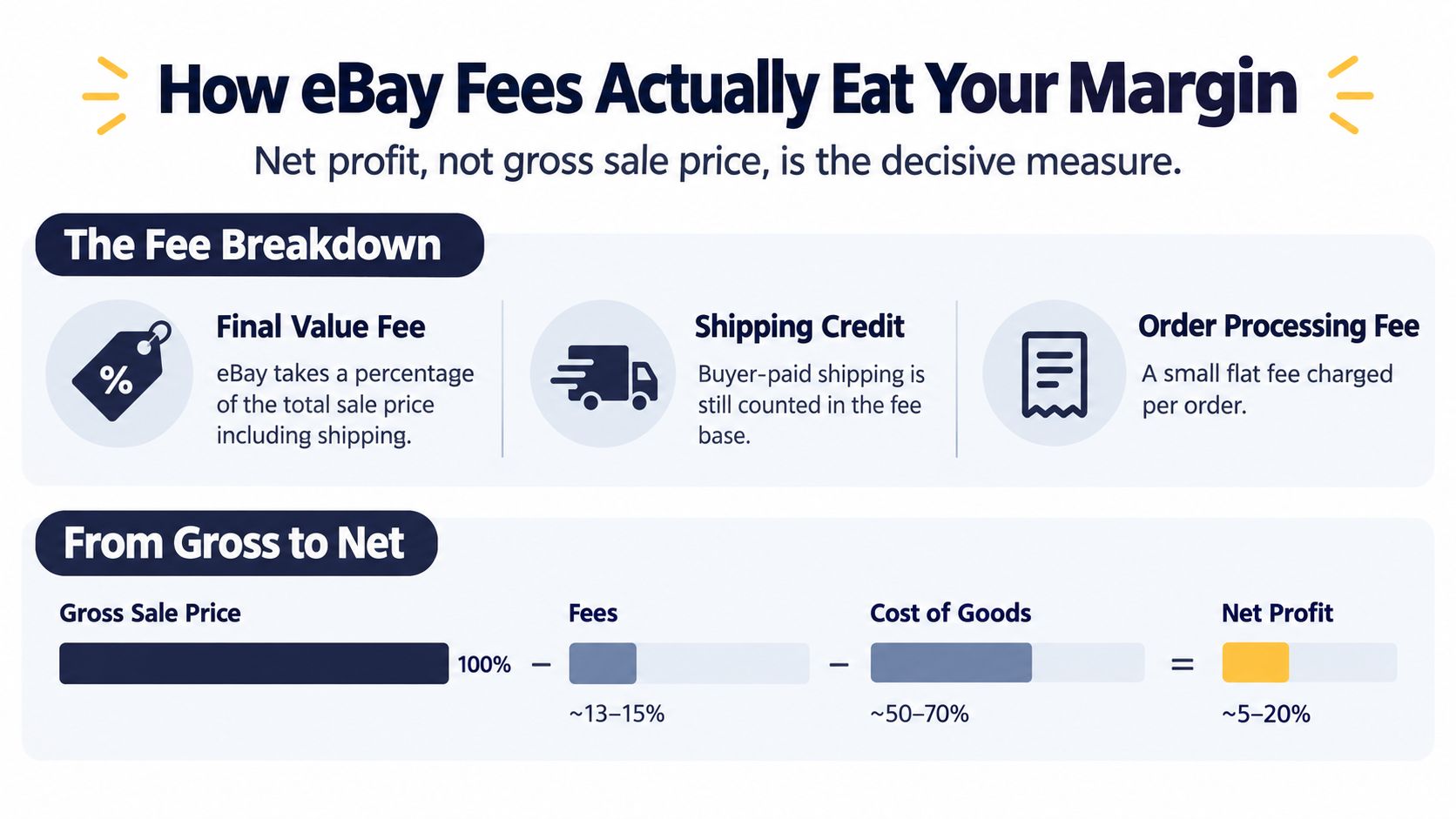
Net profit, not gross sale price, is the decisive measure. eBay calculates its final value fee as a percentage of the total sale amount plus a per-order fee. For orders over $10, the per-order charge is $0.40, while orders of $10 or less incur $0.30, according to eBay's seller fee schedule.
The percentage changes by category. The 2025 schedule lists 15.3% for Books & Magazines, Movies & TV, and most Music categories. Categories including Antiques, Art, Home & Garden, Pet Supplies, Pottery & Glass, and Sporting Goods are listed at 12.7%, while selected high-value Business & Industrial categories are listed at 3%.
The same sale can produce different take-home profit
Use a $100 sale as a clean comparison. In a 12.7% category, the estimated eBay fee is about $13.10, including the $0.40 per-order charge. In a 15.3% category, the estimated fee is about $15.70, also before shipping and other costs.
If shipping costs $12 and the item cost $20, the estimated profit is:
| Category example | Sale price | Estimated eBay fees | Shipping | Cost of goods | Estimated profit |
|---|---|---|---|---|---|
| 12.7% category | $100 | $13.10 | $12 | $20 | $54.90 |
| 15.3% category | $100 | $15.70 | $12 | $20 | $52.30 |
Those estimates are before taxes, returns, supplies, and any optional selling costs. The difference looks small on one item, but fee variation matters when you source books, media, collectibles, apparel, or other inventory repeatedly.
Remember that eBay applies the percentage to the total sale amount, including shipping collected from the buyer. A shipping charge isn't invisible to the fee calculation, so inflating buyer-paid shipping doesn't protect the margin.
Practical rule: Compare recent sold prices and calculate expected take-home profit before purchasing, especially for books, media, collectibles, and apparel.
A $100 item also isn't automatically better than a $35 item. If the $100 item costs $60 to acquire, needs oversized packing, and sits for a long time, the smaller flip may produce a better return on cash and time. Use this eBay fee calculator guide to keep the calculation consistent, then add your actual buy cost, shipping estimate, and return risk.
Categories With the Highest Net Profit Potential
The useful question isn't which category has the highest gross sale price. It's which category gives you a reliable way to identify underpriced inventory, verify condition, and ship the item without losing the margin.
Fashion and sneakers
Fashion remains a major sourcing target because eBay reported more than $10 billion in annual global fashion GMV, along with year-over-year growth in U.S. fashion driven largely by consumer-to-consumer sellers, as noted in eBay's annual report. That makes branded apparel, sneakers, streetwear, handbags, and accessories worth checking in thrift racks and estate-sale closets.
The catch is oversaturation. A recognizable brand doesn't guarantee a profitable flip. Check the exact model, size, colorway, condition, and recent sold comps. A common modern shirt with weak sell-through can be worse inventory than an obscure vintage piece with a smaller but more committed buyer pool.
Sneakers and luxury accessories also carry authenticity risk. eBay lists sneakers, handbags and other luxury accessories, watches, streetwear, jewelry, and trading cards among categories covered by Authenticity Guarantee, but eligibility and thresholds vary. Authentication can improve buyer confidence, but it doesn't rescue a bad buy or prove that your acquisition cost leaves enough margin.
Collectibles and trading cards
Collectibles reward accurate identification more than broad popularity. Edition, year, set, condition, grading status, and authenticity can change the outcome, so a seller who knows the niche can often outperform someone who buys whatever looks expensive.
Eligible trading cards can qualify for eBay authentication when they meet the applicable marketplace and price requirements. One current eBay help page specifies a $250 Buy It Now or auction threshold for qualifying cards sold on eBay.com by sellers in the continental United States or Canada to buyers in the continental United States. eBay says the seller isn't charged for the authentication service or tracked shipping from the authentication facility to the buyer under the eligible workflow, as described in eBay's Authenticity Guarantee guidance.
Trading-card fees still matter. A current promotion identifies a 13.25% final value fee for qualifying non-Store and Starter Store trading-card sales on the portion up to $7,500. Under that fee, a $250 card bought for $20 leaves $196.88 after the variable fee, before any applicable per-order fee, shipping, supplies, or returns. That is a useful illustration, not a reason to buy every expensive card you find.
Replacement parts and accessories
Replacement parts can be steadier than trend-driven inventory because buyers search for an exact solution. An OEM part number, connector type, voltage rating, compatibility list, or device model narrows the competition and creates high-intent demand.
Industry marketplace data reports average transaction values of around $99 for Motors, $135 for Electronics, and $122 for Business & Industrial in the cited sample. A $99 part with a hypothetical 13% fee, $12 shipping, and $20 buy cost produces roughly $53.73 before returns, supplies, and taxes.
That math only works if the part is identified correctly. A wrong connector or incomplete compatibility list can turn a seemingly profitable item into a return. Photograph model numbers, labels, plugs, mounting points, and any damage before you buy.
Enthusiast and niche inventory
Vintage fashion, antiques, paper collectibles, camera accessories, tools, and culturally specific items often lack a clean barcode. That makes them harder for casual sellers to research, but it can also reduce direct competition.
Use this practical guide to profitable resale categories as a starting point, not a shopping list. The strongest BOLO is usually a small, identifiable sub-niche where you understand condition and can find reliable sold comps. Hot categories attract more pickers, while specialist knowledge helps you recognize a valuable variation before the average shopper does.
Where To Source The Best Finds
The best sourcing channel depends on what you can identify quickly and what you can process efficiently. A card flipper and a book scanner shouldn't use the same sourcing routine, even if they visit the same town.
Thrift stores
Goodwill and other thrift stores provide volume and low acquisition costs, but the inventory is mixed and competition can be intense. You need to move quickly through racks of branded outerwear, electronics shelves, book sections, and shoe displays without treating every recognizable label as a BOLO.
Thrift stores work well for branded fashion, shoes, compact electronics, books, games, and kitchen accessories. They work less well when you need to spend a long time testing an item or researching an obscure variation while other pickers are waiting.
The margin profile is strongest when you already know your filters. A specific jacket construction, a model-number family, or a recognizable game variant can be worth checking. Generic fast fashion, incomplete electronics, and heavy home goods often aren't worth the cart space.
Garage sales
At a garage sale, ask to see the bins under the table. Sellers often price mixed lots for convenience, which can create opportunities in cards, tools, cables, craft supplies, games, and small collectibles.
The inventory is unpredictable, and there may be no reliable way to restock the same type of item. That unpredictability is useful for a reseller who can identify value quickly, but it makes planning difficult. A plastic tub of mixed accessories might contain one excellent replacement part and a pile of unsellable leftovers.
Negotiate around the whole lot only when you can estimate the sellable portion. A low sticker price isn't a bargain if most of what you bring home becomes storage.
Estate sales
Estate sales are often better for vintage cameras, watches, jewelry, tools, paper collectibles, branded clothing, and specialized household items. You may find unmarked boxes in closets or drawers where the value depends on model, maker, or condition rather than a visible brand.
The trade-off is time. Travel, entry lines, crowded rooms, and sorting through incomplete collections all reduce the effective profit per hour. Estate sales reward preparation and category fluency, especially when you can recognize a valuable piece without relying on packaging.

Retail arbitrage
Clearance aisles offer clean, boxed products and easy identification, but they also attract sellers using the same apps and scanning the same markdown shelves. Competition can compress sold prices before you recover your cash.
Retail arbitrage makes sense when the product has a clear model number, manageable shipping dimensions, and enough margin after marketplace fees. It makes less sense for bulky products with thin discounts or items whose demand depends on a temporary trend.
The cheapest source isn't automatically the best source. Choose the channel where your identification speed and category knowledge give you an advantage.
eBay's final value fee includes shipping collected from the buyer, and independent seller guidance estimates that final-value and payment fees together commonly consume roughly 13% of a transaction before shipping, packaging, returns, storage, or promoted listings, according to this fee analysis for eBay sellers. That is why the apparent winner can change from one sourcing channel to another.
How To Evaluate Profitability Before You Buy
A reliable aisle decision follows a short order: identify the item, check sold comps, then calculate net profit. Skipping the first step creates bad comps. Skipping the second creates false confidence. Skipping the third turns revenue into pretend profit.
Start with exact identification
Read every label, model number, edition mark, connector, size tag, and grading detail. For apparel, inspect the tag, construction, measurements, fabric, and flaws. For electronics, look for the exact model and included accessories. For cards and collectibles, separate the base version from parallels, reprints, variations, and damaged examples.
Active asking prices are not proof of demand. Sellers can ask anything. Sold prices show what buyers paid, which is the evidence you need at the point of purchase.
Use sell-through to avoid the death pile
eBay's Product Research tool provides up to three years of sales data for millions of items, including average sales prices, the number of sellers who sold the item, and sell-through rate for searches covering sales from the previous 90 days, according to eBay's Product Research documentation.
That distinction matters in a Goodwill aisle. A $6 item with a high sold price but weak recent sell-through may sit in your death pile. An item with a lower average sale price but consistent recent sales may return your cash faster.
Run the buy decision
Suppose you find a $6 item at Goodwill and recent completed listings suggest a hypothetical $45 median sold price. Using a 15.3% fee, $6 shipping, and the $6 cost of goods, the estimated profit is about $26.12 before supplies, returns, and taxes. The fee rate is drawn from eBay's published schedule, while the $45 sale price and other inputs are an illustrative sourcing scenario, not a market claim.
That profit might pass if the item is quick to identify, easy to photograph, compact to store, and supported by steady sell-through. It might fail if the item needs extensive cleaning, has condition uncertainty, or competes with a large number of unsold listings.
| Illustrative item | Buy cost | Median sold price | Estimated fee | Shipping | Estimated profit |
|---|---|---|---|---|---|
| Goodwill book or media item | $6 | $45 | $7.29 plus $0.40 | $6 | $25.31 |
| Compact collectible | $10 | $60 | $7.62 plus $0.40 | $5 | $36.98 |
| Model-specific part | $20 | $99 | $12.87 plus $0.40 | $12 | $53.73 |
The table uses illustrative sale, buy-cost, and shipping assumptions. The 15.3% fee for the first example and the 13% hypothetical fee for the third example should be replaced with the exact category rate that applies to your listing.
Set a minimum profit threshold before you shop. Track what your past flips earned after returns and supplies, then adjust the threshold for your available time and storage space. A small collectible may be a better buy than a large appliance even when the appliance has the higher gross price.
How ScanFlip AI Speeds Up Sourcing Decisions
The hardest sourcing decision usually happens before you own the item. You're holding an untagged jacket, a box of cards, or a sealed retail product while another picker reaches for the same shelf. Manually checking sold comps marketplace by marketplace can cost enough time that you either pass on a good buy or purchase without doing the math.
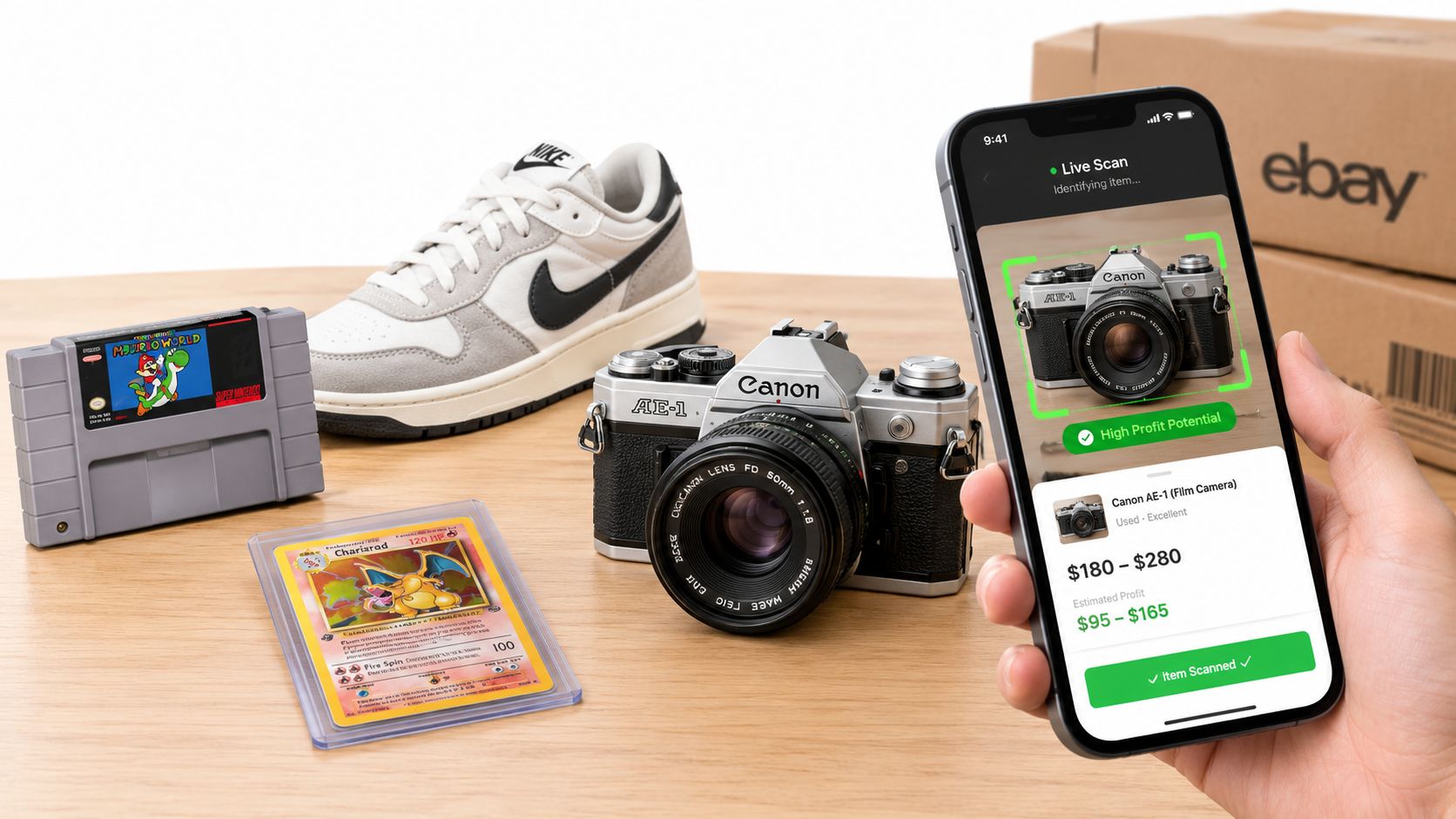
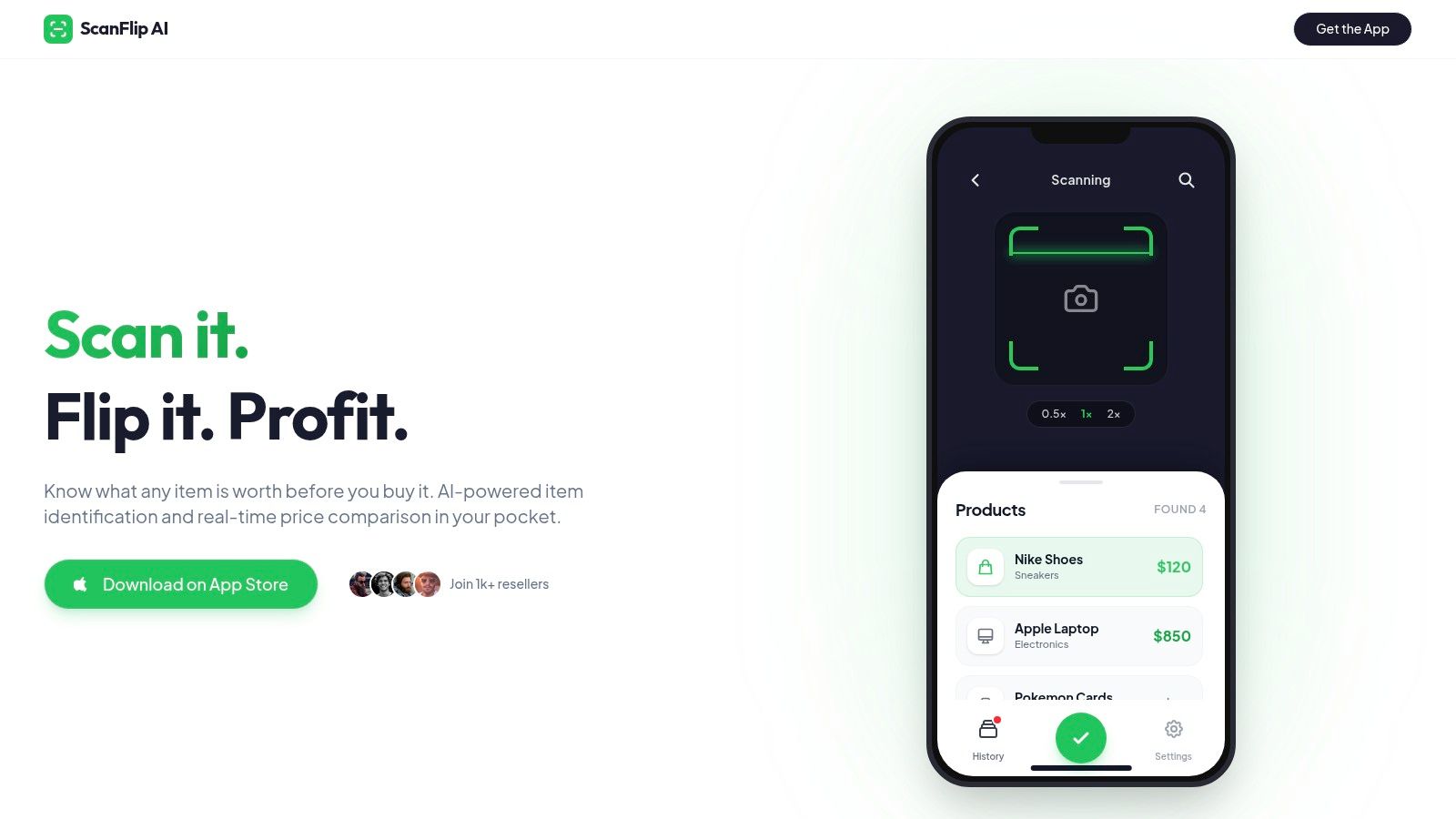
A mobile sourcing app can shorten that decision. ScanFlip AI offers three ways to check an item:
- AI photo scan: Point the camera at untagged vintage clothing, shoes, electronics, or collectibles. It works without a UPC or barcode.
- Barcode scan: Scan books, media, games, and boxed retail items when a barcode is available.
- Text search: Type the name, model, or description when the item can't be photographed or scanned easily.
The app aggregates real sold prices and sold comps across eBay, Poshmark, Mercari, Depop, Amazon, Whatnot, ThredUp, Facebook Marketplace, and TikTok Shop. It then deducts platform fees and shipping and shows expected net profit with a simple red or green flip-or-pass verdict.
Use the method that matches the inventory
Barcode scanning is efficient for standardized products, but it won't help with an untagged vintage coat or an unusual estate-sale collectible. Photo identification handles those items better, while text search is useful for a part number, watch reference, or product name you already know.
The point isn't to replace judgment. You still need to inspect authenticity, condition, completeness, compatibility, and return risk. A scan gives you a faster starting point for sold comps and net-profit math before you hand over cash.
The app is designed for thrift store flippers, garage sale and estate sale sourcers, retail arbitrage sellers, sports card and collectibles flippers, book scanners, storage-unit and pallet flippers, vintage pickers, and side-hustle resellers. It can sit alongside crosslisting and inventory tools such as Vendoo and List Perfectly, which handle different parts of a reseller's workflow.
The most profitable eBay item is rarely a universal winner. It's the item you can identify accurately, buy at the right cost, sell at a proven price, ship without destroying the margin, and process without creating a death pile. Use sold comps instead of active asking prices, calculate fees before buying, and make every sourcing decision on expected net profit rather than excitement.
If you want faster buy-or-pass decisions in thrift aisles, garage sales, and estate sales, ScanFlip AI combines photo scanning, barcode scanning, text search, sold comps across major marketplaces, and net-profit calculations after fees and shipping. Visit ScanFlip AI to check potential flips before your money leaves your pocket.