

Or Best Offer Explained: Fees, Floors and Profit Math
You listed a thrift find at $42 with or best offer turned on, and at 11 p.m. a $30 offer lands while you're half asleep. Do you take it? If you haven't run that number through fees, shipping and cost of goods, you're not making a pricing decision. You're guessing.
I treat every offer the same way. It's a net profit question, not a discount question. The list price is just a starting point. What matters is the lowest number you'd accept before sourcing, listing and shipping the item stops being worth your time.
Table of Contents
- What Or Best Offer Means on Each Marketplace
- What Each Offer Actually Nets You After Fees
- Pricing Your Listing So Offers Have Room
- Negotiation Tactics That Protect Your Profit
- When to Accept, Counter or Decline
- Fees and Profit Thresholds Behind Your Floor
- Set Your Offer Floor Before the Next Sourcing Trip
What Or Best Offer Means on Each Marketplace
A $6 jacket listed for $42 gets a $30 offer. Or Best Offer lets a buyer propose a price below your listing, then gives you the choice to accept, decline or counter. The offer is not a completed sale until you accept and the buyer pays.
Offer mechanics differ by marketplace. On eBay, buyer-initiated offers give sellers a limited time to respond, while seller-sent offers expire on their own schedule. Check eBay's current Best Offer help page for the exact timing.
How offers work on each marketplace
| Marketplace | How offers work | What to verify |
|---|---|---|
| eBay | Buyers submit offers; sellers can accept, decline or counter. Sellers can also send offers to interested buyers. | Current response windows and offer expiry |
| Poshmark | Buyers make offers; sellers can accept, decline or counter. | Current response window and expiry |
| Mercari | Buyers can make offers; sellers can accept, decline or counter. | Current response window and expiry |
| Depop | Buyers send offers; sellers can accept or decline. | Whether counteroffers are available and when offers expire |
| Whatnot | Offer behavior depends on the show and listing format. | Whether offers are available for that format |
| Facebook Marketplace | Buyers and sellers negotiate through messages. | Whether the listing type has a native offer tool |
| TikTok Shop | Check the seller dashboard for offer tools. | Whether offers are supported and the response window |
The same proposed price can call for a different response depending on the platform. On eBay, you may send a formal counteroffer. On Facebook Marketplace, negotiation happens in messages. Elsewhere, you may only be able to accept or decline. Check the current platform rules before deciding how to respond.
What Each Offer Actually Nets You After Fees
A $42 offer is only useful once you subtract marketplace fees, shipping, and what you paid for the item. With a $6 cost of goods, $4.50 in shipping you cover, and an example fee rate of about 13.3%, the full-price sale leaves $25.90.
Net proceeds at each offer level on a $42 list
| Offer (% of $42 list) | Offer amount | Fees (about 13.3%) | Net after $6 cost and $4.50 shipping |
|---|---|---|---|
| 100% | $42.00 | $5.60 | $25.90 |
| 90% | $37.80 | $5.03 | $22.27 |
| 80% | $33.60 | $4.47 | $18.63 |
| 70% | $29.40 | $3.91 | $14.99 |
| 60% | $25.20 | $3.35 | $11.35 |
| 50% | $21.00 | $2.79 | $7.71 |
A $29.40 offer looks steep against a $42 list price, but it leaves $14.99 after costs. That can be a sensible sale on a $6 thrift find. A $21 offer leaves just $7.71. For a bulky item, or one that still has a good chance of selling higher, that may not cover your time and risk. For a small item that has been sitting, taking the lower net can be the right call.
The offer amount is not your take-home amount. Run the numbers before you accept.
The eBay Best Offer guidance treats an accepted offer as a commitment to purchase. Do the math before accepting, not on the way to the post office.
This table assumes you pay the $4.50 shipping. Remove that cost if the buyer pays shipping. The fee rate is illustrative; marketplace fees vary by category and price point. Use an eBay fee calculator to estimate the net at each offer amount, then set your minimum from the dollar profit you need, not from a generic percentage off list.
Pricing Your Listing So Offers Have Room
A lot of sellers list high on purpose. They put $65 on a $42 item, expect a 40% haircut, and call that negotiation room. Real sold data doesn't back that up.
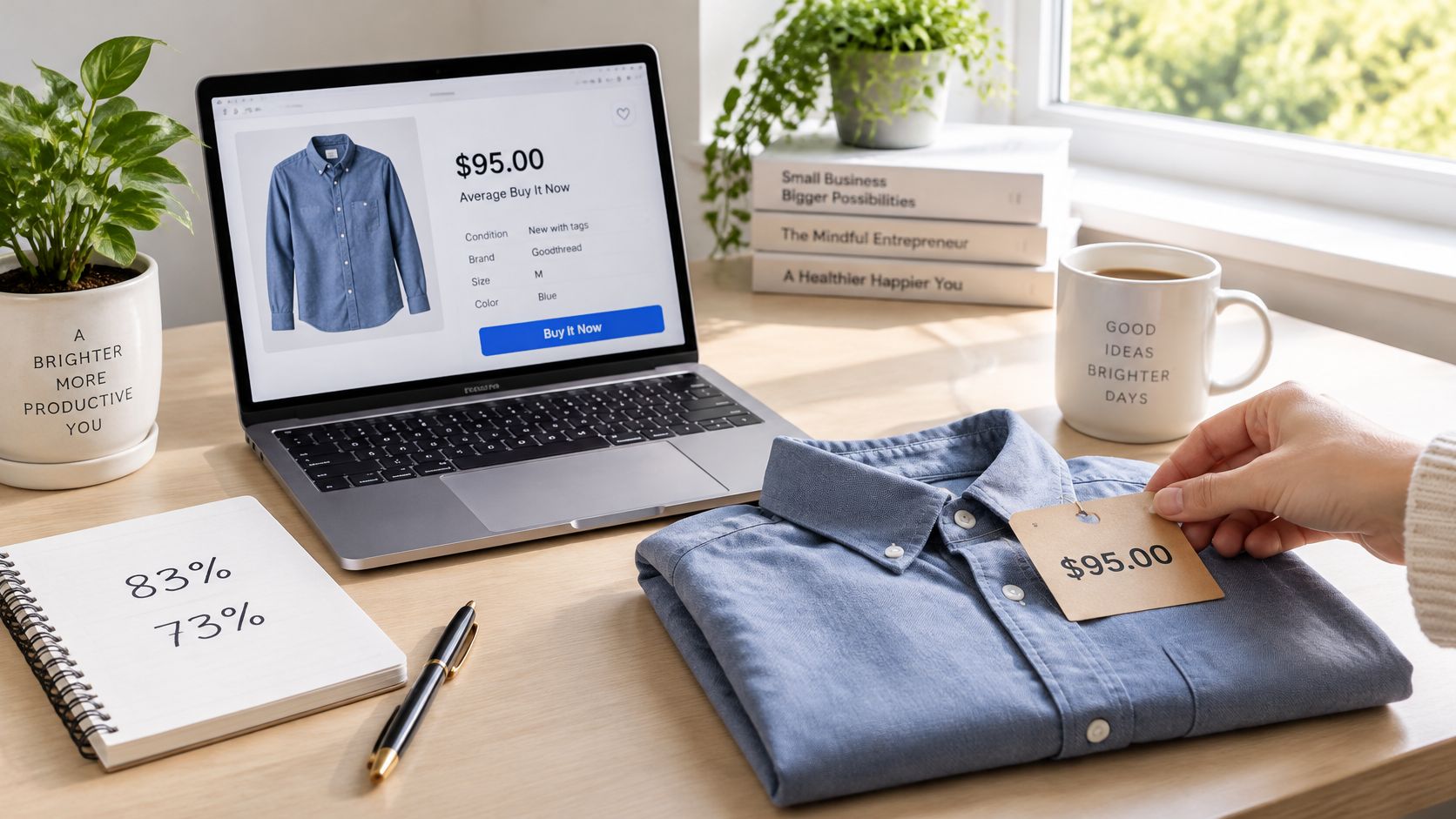
A major empirical study of eBay's Best Offer marketplace analyzed approximately 25 million listings and found the average Buy It Now listing price was $95, while the average completed sale price was 83% of that list price, or roughly $78.85. When a listing involved bargaining, the average final price fell to 73% of the list price, about $69.35 on that $95 item.
Buyers also start low. In the same study, first offers represented 61% of the listed price, bargaining succeeded in 45% of cases, and approximately 80% of listings received no offer at all.
That last number changes how you should price. If most listings never get an offer, your list price is usually your sale price. A fantasy anchor doesn't create room. It creates a dead listing that sits while correctly priced comps sell around it.
Three ways to price the same item
- High anchor plus negotiation. List a $42 median comp at $60 and hope someone offers $40. Most buyers won't offer at all, and your STR suffers while you wait.
- Firm price. List at $42 with offers off. You protect the number, but you lose the buyer who would've paid $36 today instead of scrolling past.
- Automatic offer floor. List near the comp, say $44, and set a floor near $30 that you'll accept without a long back and forth. You stay in the range buyers already pay.
I would take the third option for most thrift inventory. Listing at $44 against a $42 sold comp median gives a buyer a small win at $38 or $40 without training everyone to expect half off. A firm $42 makes sense when you have deep comps, strong sell through and no pressure to move it.
Judge all three by net proceeds, not gross sale price. A $44 sale that closes this week can beat a $55 list that sells in four months, because your $6 is free to buy the next flip. Negotiation is most common on low and mid priced items where a few dollars off feels reasonable to a buyer. Price those items close to sold comps and let small offers do the work.
Negotiation Tactics That Protect Your Profit
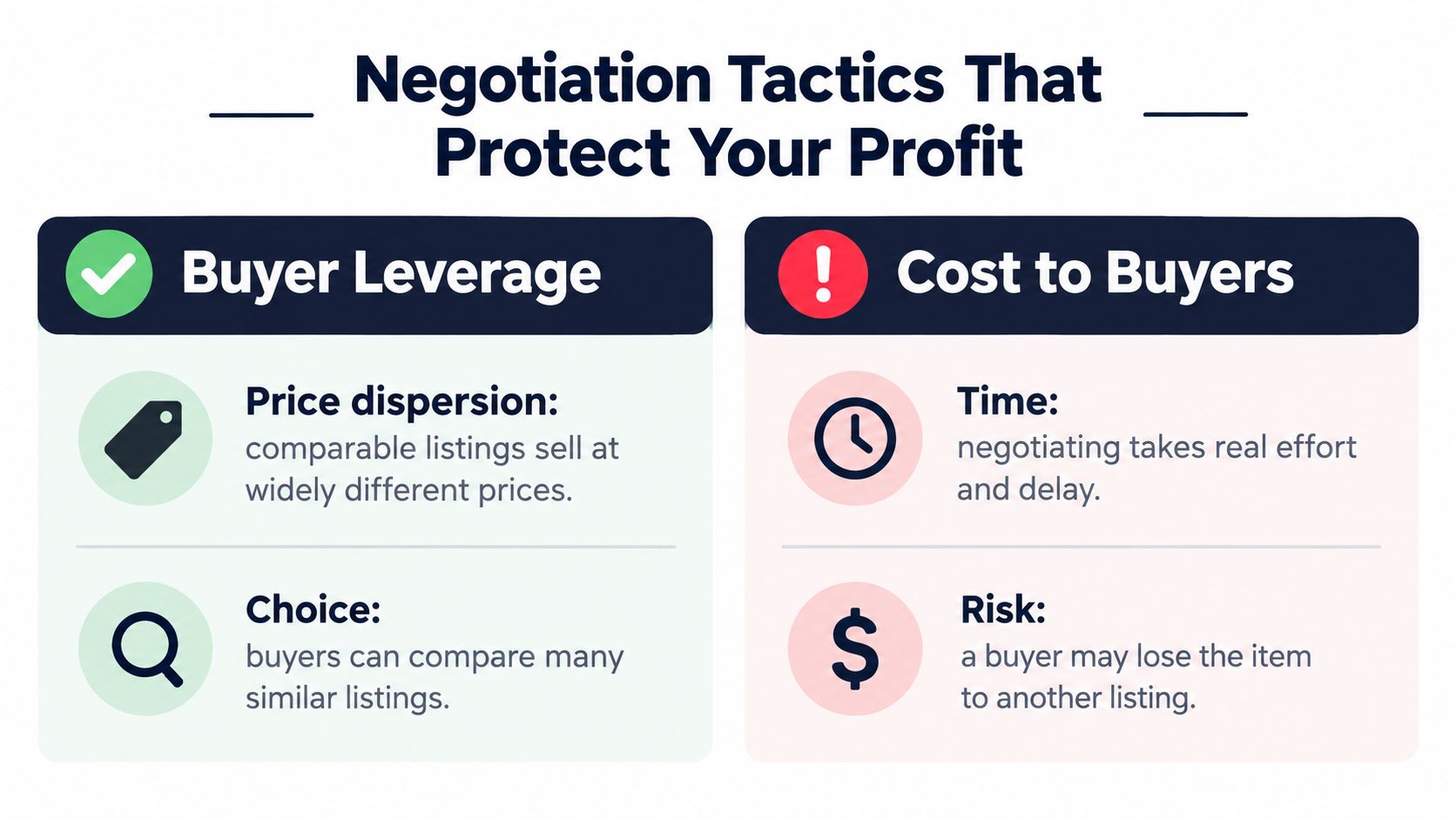
Buyers don't negotiate for free, and that works in your favor if you understand it. Research on online bargaining found that price dispersion increases consumer bargaining power, meaning buyers have more room to push back when comparable listings show widely different prices. Separate research in that source found consumers incurred an average cost of $28 to begin a negotiation and captured about 41% of the available surplus when they negotiated.
Translation for a reseller. If sold prices for your item are scattered from $25 to $60, a buyer can point at the $25 comp and push hard. If every recent sale sits between $40 and $44, your counter has legs. And because starting a negotiation costs a buyer time and effort, many won't go five rounds over $3. Your first counter needs to be one you can defend.
Tactics that keep the floor intact
- Counter once toward the middle. Split the gap if the result stays above your floor, then stop trading dollars for hours.
- Never counter below your floor. A counter is a price you'd accept. Don't send one you'd regret if they tap yes.
- Bundle instead of discounting. Offer free shipping when a buyer takes two items. You protect the item price and move a second piece out of the death pile.
- Decline fast lowballs on strong comps. If you have plenty of recent sales, a quick no saves the slot for a serious buyer.
- Use round numbers. $35 reads cleaner than $34.63 and keeps the exchange short.
If you want another seller's take on working the exchange itself, Ruit's guide to negociar precios con compradores en eBay is worth a read for the buyer psychology side. Pair that with solid competitive pricing strategies so your starting number gives your counter somewhere sensible to land.
Say a buyer offers $25 on your $42 list and your floor is $29.40. Counter at $35, not at your floor. The buyer comes back at $31. You can hold at $32 for one last exchange or accept $31, because it's still above $29.40 and the cash is real.
If a buyer says they'll walk unless you take $22, let them walk. The exception is aging inventory. A fair but low offer on a 90 day listing that's blocking a bin can be the right call even if the ROI looks ugly on paper.
When to Accept, Counter or Decline
I make the call with three inputs. Where does the offer sit against your floor, how strong are the sold comps, and how long has the item been taking up shelf or rack space?
Timing forces the decision. eBay's Making a Best Offer help page states that for a normal buyer submitted offer, the seller has 24 hours to accept, decline, or counter, and if the seller does nothing or the listing ends first, the offer expires. Don't assume an offer you saw at a garage sale comp check is still alive tomorrow.
That page also matters for your math. The offer applies only to the item price, so shipping and other checkout costs still belong in your net profit calculation.
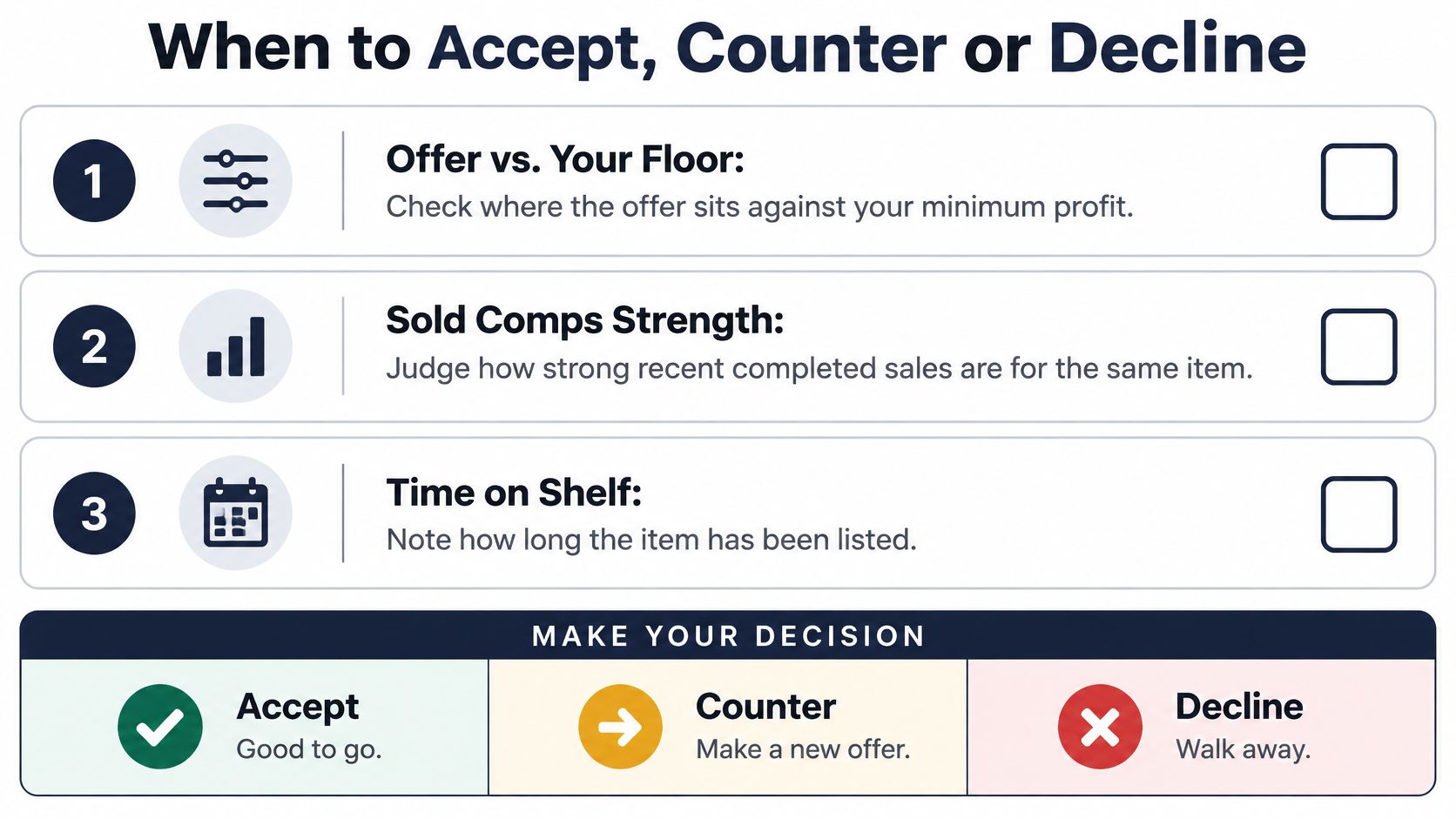
Accept, counter or decline by situation
| Situation | Action | Why |
|---|---|---|
| Offer at or above your floor | Accept | The sale locks in profit, and accepting makes it binding |
| Below floor, 10 or more sold comps in 30 days | Counter at your floor | Strong demand supports holding the price |
| Below floor, item 60 or more days in stock or thin comps | Accept if net stays positive | Cash beats a shelf that is costing you space |
| Below floor, under $15 net at list | Decline | Handling and listing time outweigh the profit |
| Offer arrives after you have left the store or the listing is ending | Let it expire | The window is 24 hours, and chasing it rarely pays |
Treat 10 or more sold comps in 30 days and 60 days in inventory as starting points, not laws. A seasonal item in its peak month deserves a firmer line. A bulky lamp you keep tripping over deserves a softer one.
Shelf rule: If you'd buy the item again today at the offer price minus your costs, accept. If you wouldn't pick it up at that math, counter or decline.
The thin comp case trips up new sellers. Two sales in 90 days doesn't prove demand, so holding out for list price can mean holding the item for another quarter. When the net is positive and the item is aging, I take the money and put it into a category with a better sell through rate.
Fees and Profit Thresholds Behind Your Floor
A $20 offer is not automatically good or bad. What matters is what remains after marketplace fees, shipping, and cost of goods, compared with the dollar profit you need from the sale.
The floor formula
Use this calculation: Floor = (cost of goods + shipping + target net profit) ÷ (1 − fee rate).
For an item that cost $6, with $4.50 shipping and a $10 profit target, the calculation is ($6 + $4.50 + $10) ÷ 0.867 = $23.65. An offer below $23.65 misses that target under these assumptions.
Lowest accepted price by cost and target profit
| Cost of goods | Target net profit | Lowest accepted price |
|---|---|---|
| $6 | $10 | $23.65 |
| $6 | $15 | $29.41 |
| $10 | $10 | $28.26 |
| $10 | $20 | $39.79 |
| $15 | $25 | $51.33 |
These examples use about 13.3% in fees and $4.50 shipping. If either changes, recalculate the floor with a break-even price calculation. A higher shipping cost raises the sale price needed to preserve the same target profit.
A fixed dollar target makes low-cost finds easier to judge. A 30% margin on a $6 item can leave only a few dollars for sourcing, photographing, listing, packing, and driving. Set the floor from the profit you want to keep, not a generic discount from list price.
Returns can erase part of that profit. Many online merchants charge return fees, so an accepted offer can still reverse. A $2 buffer on return-prone categories like electronics and fitted apparel can account for some of that risk, especially where size or condition disputes are common.
Higher-priced items call for care with the transaction as well as the math. Advice on how to avoid scams when selling a Rolex applies to luxury watches, and the same basic habit matters at lower price points: check the buyer, payment, and net proceeds before shipping the item.
Set Your Offer Floor Before the Next Sourcing Trip
The worst time to decide your floor is at 11 p.m. with an offer expiring. Decide it at the sourcing table, before money leaves your pocket, and the later decision takes ten seconds.
Say you're standing in a Goodwill aisle holding a $6 item you think comps at $42. You don't need certainty. You need a floor, a comp check and a yes or no before another picker reaches for the same rack.

A four step routine before you buy
- Set your minimum net per category before you leave. Use the floor table as a guide. If clothing needs $10 net and hard goods need $15, write it down and stop renegotiating with yourself in the aisle.
- Scan the item at the shelf. With ScanFlip AI you can use an AI photo scan with no barcode needed for untagged vintage and apparel, a barcode scan for books and boxed goods, or text search when you know the name but can't get a clean photo.
- Read sold comps against your floor. Check sold prices from eBay, Poshmark, Mercari, Depop, Amazon, Whatnot, ThredUp, Facebook Marketplace and TikTok Shop, then look at the net profit after fees instead of the gross comp. The app gives a red/green flip or pass verdict based on the minimum profit threshold you set, so a $42 comp that nets $8 after costs reads as a pass if your floor is $10.
- Reuse that floor when an offer lands. Run the offer through the same number and decide inside the response window. Above the floor, accept. Below it, counter once or let it go.
That routine keeps sourcing and selling connected. The BOLO you pass on because the net is $6 is the same item you would've regretted accepting a $21 offer on three weeks later.
If you crosslist after you buy, tools resellers already use like Vendoo or List Perfectly handle that side of the stack. The scan answers the earlier question, which is whether the item deserves your money and your shelf space at all.
New users get 10 free scans with no credit card required, and the app is available exclusively on the App Store for iPhone. Run your next ten thrift finds through your floor before you buy them. You'll pass on a few you would've bought last month, and that's the point.
Before your next offer expires, set a dollar floor and check the item against real sold comps and net profit after fees, not the list price you hoped for. Try it on your next sourcing trip with ScanFlip AI, scan by photo, barcode or text search, and let the red or green verdict tell you whether that find can survive a lower offer.