
Sports Card Value Scanner App: How to Pick the Right One
You're standing at a card show with a raw rookie in one hand and your phone in the other. The dealer wants an answer before the next buyer steps in. A sports card value scanner app can help, but only if it identifies the exact parallel, checks sold comps, and tells you what remains after fees, shipping, and grading. A big number pulled from an asking price isn't enough.
That's the test. The right app doesn't merely tell you what a card might be worth. It helps you decide whether the card belongs in your buy pile, your pass pile, or your growing death pile.
| Tool category | Best use | Where it falls down |
|---|---|---|
| Photo-ID scanner | Raw singles, vintage cards, oddballs, quick show decisions | Can confuse parallels, short prints, and autographs |
| Barcode scanner | Sealed wax, boxed products, modern items with UPCs | Useless for most individual raw cards |
| Text-search database | Difficult scans and confirmation | Slow at a crowded table |
| Portfolio tracker | Cards you already own | Doesn't help much before you buy |
| Sold-comp aggregator | Deep pricing research | Often requires manual identification and entry |
Table of Contents
- The Card You Almost Bought at the Wrong Price
- Detection Methods That Actually Matter for Cards
- Why Sold Comps Beat Asking Prices Every Time
- Comparing the Main Scanner App Categories
- Grading Economics and the Raw vs Graded Decision
- Where a Photo-ID App With Net Profit Fits
- Choosing the Right App for Your Card Workflow
The Card You Almost Bought at the Wrong Price
The card looked like an easy flip. At a card show, I spotted a raw 2018 Prizm Luka Doncic Silver in a discount bin. The tag said $90, and a recent eBay listing showed $140. At first glance, the spread looked attractive.
The scanner changed the decision. That $140 figure was an unsold asking price, not money another buyer had paid. Recent raw sold comps clustered around $75 to $85, as market reports on sports trading cards continue to emphasize the importance of active price discovery in a large secondary market (Grand View Research's sports trading cards market report).
At $90, the card wasn't a steal. It was overpriced before shipping, marketplace fees, or any grading risk entered the calculation.
The grading math made the deal worse
The app's grade-sensitive estimate showed why raw price alone can fool you. A PSA 9 outcome barely covered the grading expense under current PSA pricing, while a PSA 10 remained the kind of result you can't responsibly treat as the default. A surface scratch, print line, or weak centering could turn the entire plan into a raw-card sale or a PSA 8 return.
PSA's published centering standards help explain the danger. A Gem Mint 10 allows approximately 55/45 front centering and 75/25 back centering, while Mint 9 and NM-MT 8 permit looser front ratios of about 60/40 and 65/35 respectively (Edge Grading's centering guide). A scanner that ignores centering is leaving out one of the most important parts of the resale decision.
Practical rule: Don't compare your cost to the highest number on a chart. Compare your all-in cost to the realistic sold price for the grade you're most likely to receive.
The perceived $50 spread collapsed into roughly $20 after fees and shipping, and a PSA 9 could erase that cushion entirely. That near-miss is why I judge every sports card value scanner app by the buying moment, not by how polished its collection dashboard looks.
Detection Methods That Actually Matter for Cards
The best detection method depends on what's in front of you. A raw single on a dealer's table needs a different workflow from a sealed hobby box or a slab with a readable code.
Photo identification for raw singles
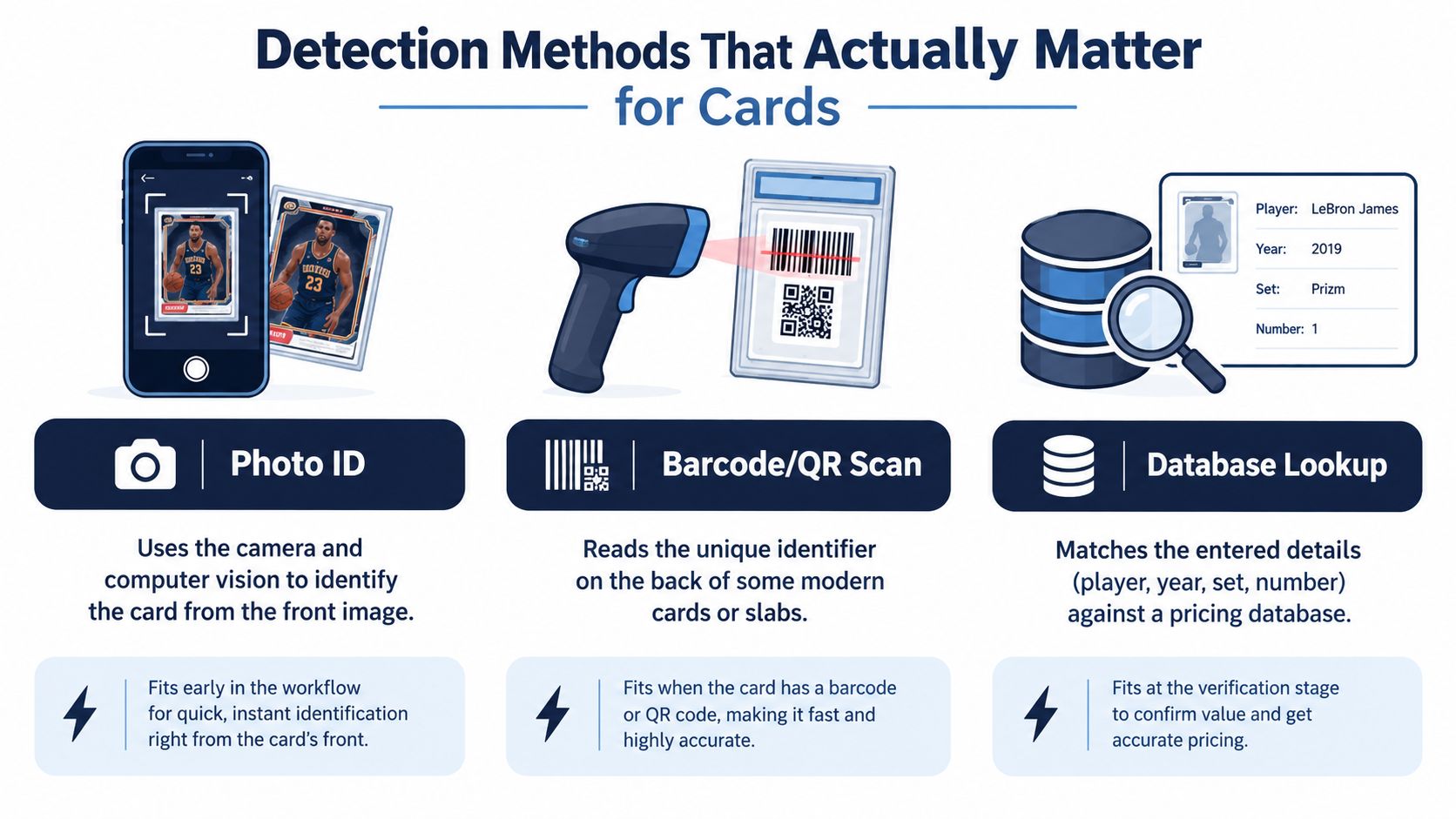
AI photo identification uses the camera and computer vision to match the front of a card with a database. It can identify the player, year, set, card number, and sometimes the parallel. This is the method that matters most when you're digging through a raw box at an estate sale or standing in a Goodwill aisle with no barcode to scan.
Take a straight photo in even light, keep the card fully inside the frame, and check the result against the card itself. Reflective finishes can confuse a scanner, especially when glare hides the color or pattern that separates a base card from a Silver Prizm, refractor, shimmer, or wave parallel.
Barcode scanning for sealed product
Barcode or UPC scanning reads a manufacturer identifier, usually from the back of a sealed product or slab. It's fast for unopened wax, repacks, boxed sets, and retail products. It's not a solution for most individual raw cards, particularly older issues and cards printed before modern barcode systems became common.
This method earns its place when you're deciding whether a retail lot or sealed box has enough resale room. It won't tell you whether a loose rookie in a bargain bin has a clean surface.
Text search as the fallback
Text search lets you enter the player, year, set, card number, and parallel manually. It's slower, but it's useful when the camera struggles with a tilted card, poor lighting, foil glare, or a damaged surface.
Use it to verify a photo result, not as your first choice when a dealer is waiting. The practical order is simple: photo scan for raw singles, barcode scan for sealed items, and text search when the first two methods can't produce a reliable match.
Why Sold Comps Beat Asking Prices Every Time
Asking prices show seller expectations. Sold prices show buyer behavior. That distinction decides whether a card is inventory or an expensive mistake.
A seller can leave a card listed at an ambitious number for months. Multiple listings can also come from one seller, creating the appearance of broad market support when there may be little actual demand. Sold comps remove most of that noise because they represent completed transactions.
A useful comp pool needs more than one attractive sale. I want the same grade tier, the same parallel or serial-number range, and a cluster of recent sales rather than one outlier. For a liquid card, I prefer a meaningful group of sales, often 10 to 15 recent transactions, while thinly traded cards require much more caution.
Read the cluster, not the headline average
A single high-grade sale can pull an average upward and hide the price floor. Low-pop cards, newly hyped rookies, and short-print parallels are especially vulnerable to this problem. One buyer may overpay during a hot week, while the next sale lands much lower.
Look at three things:
- The cluster: Where do most comparable cards sell?
- The outliers: Is one sale distorting the average?
- The direction: Are recent transactions moving up, down, or sideways?
A 60-day view can reveal whether the latest sale reflects a durable trend or a temporary spike. A 30-day sold-price signal with a meaningful depth floor is more useful than a sparse average built from asking prices, as pricing products focused on completed transactions illustrate (recent sold prices for resellers).
| Data source | What it shows | Trust level for buying decision |
|---|---|---|
| Unsold asking price | What a seller hopes to receive | Low |
| One completed sale | A single transaction | Limited |
| Recent same-grade sales | Actual buyer behavior for a defined card | Strong |
| Mixed grades and parallels | Broad market noise | Weak |
| Multi-market sold comps | Wider evidence across venues | Stronger, if the card ID is correct |
Never let a headline average make the buy decision for you. Confirm the exact card first, then judge the depth and consistency of the sold-comp pool.
Comparing the Main Scanner App Categories
A sports card value scanner app usually sits in one of four buckets. Each category solves a different part of the workflow, and none should be mistaken for a complete buying system.
Photo-ID scanning apps
These are the quickest option at shows, shops, estate sales, and garage sales. You point the camera at a raw card, receive a probable identification, and check recent sales. That speed matters when you're sorting a bargain box and don't have time to type every player and set manually.
The weakness is variant accuracy. A camera may identify the player and base set correctly while missing a Silver parallel, short print, autograph, or serial-numbered version. You still need to inspect the card and confirm the result before trusting the comp.
Barcode and UPC price checkers
Barcode tools work best for sealed wax, retail boxes, repacks, and other products with a readable code. They're useful for online lot flippers who are checking unopened inventory or comparing a boxed product against marketplace demand.
They break down on individual singles. A raw rookie, vintage Hall of Fame card, or oddball issue may have no barcode that connects it to a pricing record.
Portfolio trackers
Portfolio apps are designed for cards you already own. They can record raw and graded holdings, track collection value, and help a set collector organize a personal collection. That's useful after sourcing, but it doesn't answer the urgent question at the table: should you buy this card at this cost?
A portfolio value also isn't the same as liquid resale value. If the app doesn't show recent completed transactions, you may be tracking an estimate rather than a realistic exit.
Multi-source comp aggregators
These tools pull completed sales from more than one venue, including eBay, PWCC, Goldin, and 130point. The wider pool can improve research, especially for higher-end cards and items that don't sell often on one marketplace.
The trade-off is speed. Many require manual text entry and careful filtering. That's fine at home, but awkward when a seller expects a quick answer.
| Category | Detection method | Best for | Main weakness |
|---|---|---|---|
| Photo-ID scanner | Camera and image recognition | Raw singles and show sourcing | Variant mistakes |
| Barcode price checker | UPC or product code | Sealed wax and boxed products | No help with most singles |
| Portfolio tracker | Manual entry or collection scan | Personal collection records | Weak at pre-buy decisions |
| Multi-source aggregator | Text search and database lookup | Deep comp research | Slower at the point of purchase |
Serious flippers often pair a fast scanner with a deeper research tool. For broader resale sourcing, the same scan-first workflow is described in this guide to the best scanning app for retail arbitrage.
Grading Economics and the Raw vs Graded Decision
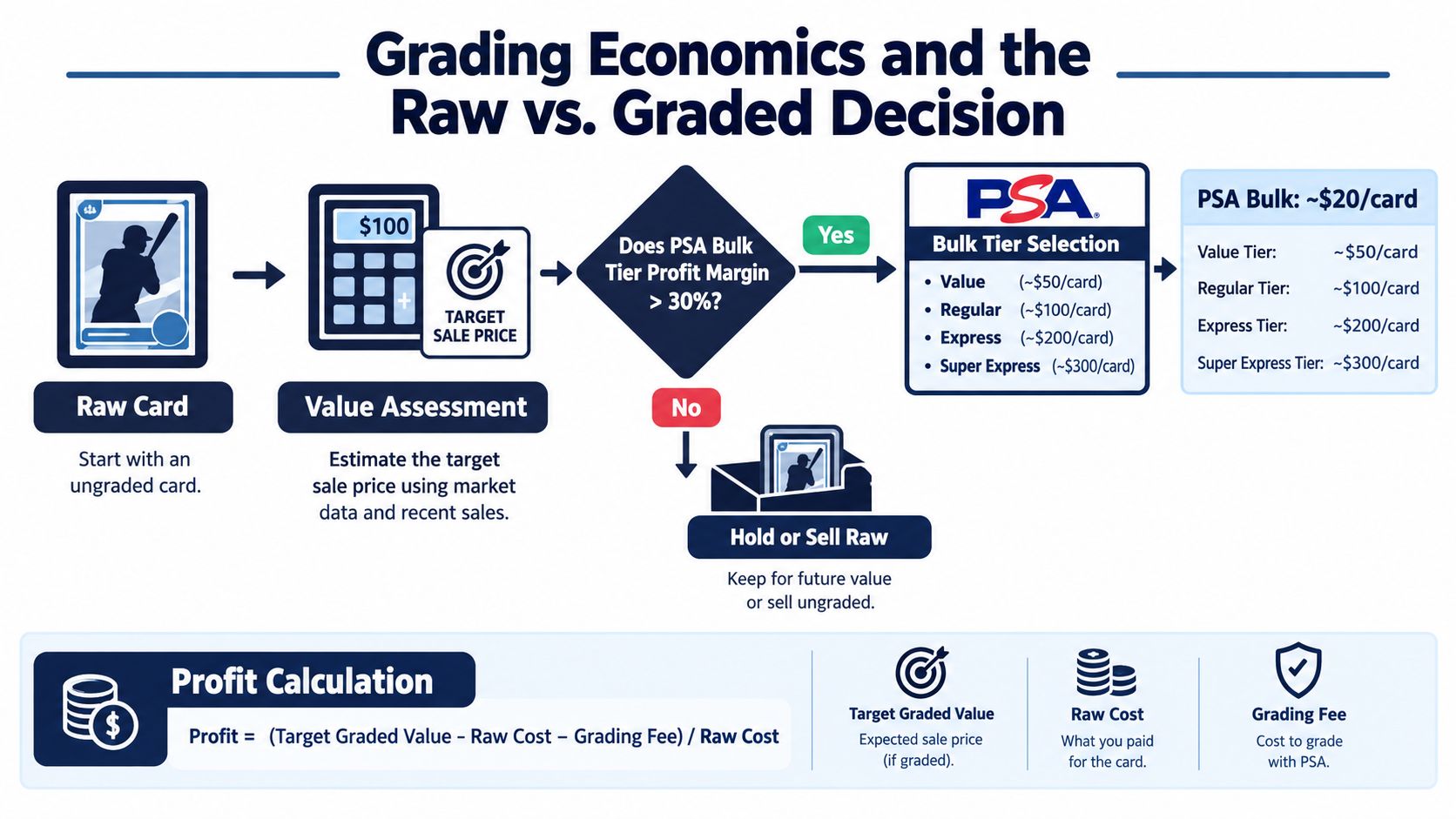
Grading only makes sense when the expected increase in sale value exceeds the complete cost of the process. The raw card's possible PSA 10 price is not the right starting point. Start with the grade you can realistically earn, usually after inspecting centering, corners, edges, surface, and print quality.
PSA's pricing creates a hard floor for low-end submissions. The Value Bulk tier is $24.99 per card, with an estimated 140 to 160 business-day turnaround, while the Value tier is $32.99 per card, with an estimated 100 to 120 business-day turnaround (The Athletic's report on PSA's 2026 pricing update). PSA says the completion clock begins after the order is received and scanned into its facility, not when you mail the cards (PSA's trading card grading services).
The break-even test
A raw card deserves grading only when the realistic PSA 9 sold comp covers:
- Your raw purchase price
- The grading fee
- Shipping to and from the grading service
- Marketplace fees
- Your required margin cushion
- The possibility of a PSA 8 or a lower result
That last item is where many flippers lie to themselves. If the deal works only at PSA 10, it isn't a grading opportunity. It's a gamble.
A mid-tier modern rookie can have a raw-to-graded spread under $30, which leaves little room after the grading bill and selling costs. A scarce vintage Hall of Fame card can absorb a $50 to $100 grading bill when the graded population is limited and the grade ladder is wide. Those amounts are not automatic profit. They're only useful when the sold comps support the expected grade.
Turnaround is part of cost
A slow submission ties up cash and delays the exit. Higher PSA tiers shorten the wait but raise the fee, so a low-margin flip can lose its advantage before the card returns. Autographs may use a separate workflow, with a single-signature item around a 30-business-day path and fees tied to autograph value bands, including $15 for $10 to $49, $25 for $50 to $99, and $50 for $100 or more (PSA autograph pricing).
Your scanner should show the raw value, graded value, and grading cost together. If you have to do the math later at the kitchen table, you're likely to remember the upside and forget the carrying cost.
Where a Photo-ID App With Net Profit Fits
At a card show, you may have seconds to decide whether a card is worth buying. The workflow must identify the exact issue, locate credible sold comps, account for the likely grade, subtract selling costs, and produce a clear buy or pass decision before another buyer takes it.
A camera-first tool fits that moment better than a basic price checker. Barcode lookup works for packaged products and cards with readable labels, but loose cards often require photo identification. The phone must return more than a broad market value.
Four inputs determine a useful verdict
First, the card ID must be correct. The app needs to separate the base issue from a parallel, insert, short print, or autograph. A wrong identification corrupts every later calculation.
Second, the comp pool needs depth. One marketplace may provide thin evidence, especially for low-pop cards or cards with limited recent activity. Card Ladder's sales database tracks 100M+ historical sales across sports, TCG, and non-sports cards from eBay, Goldin, Heritage, Fanatics, and other platforms. That depth helps with research, but the result still needs filters for the exact card, sale date, and condition.
Third, the grade assumption must be honest. A raw card cannot automatically inherit a graded card's value. Centering, surface, corners, and edges decide whether the premium is realistic. Treat the graded figure as a scenario, not a promise.
Fourth, the output must be net. Marketplace fees, shipping, and cost of goods belong in the decision before you buy. Gross sale price is not profit.
The practical ScanFlip workflow
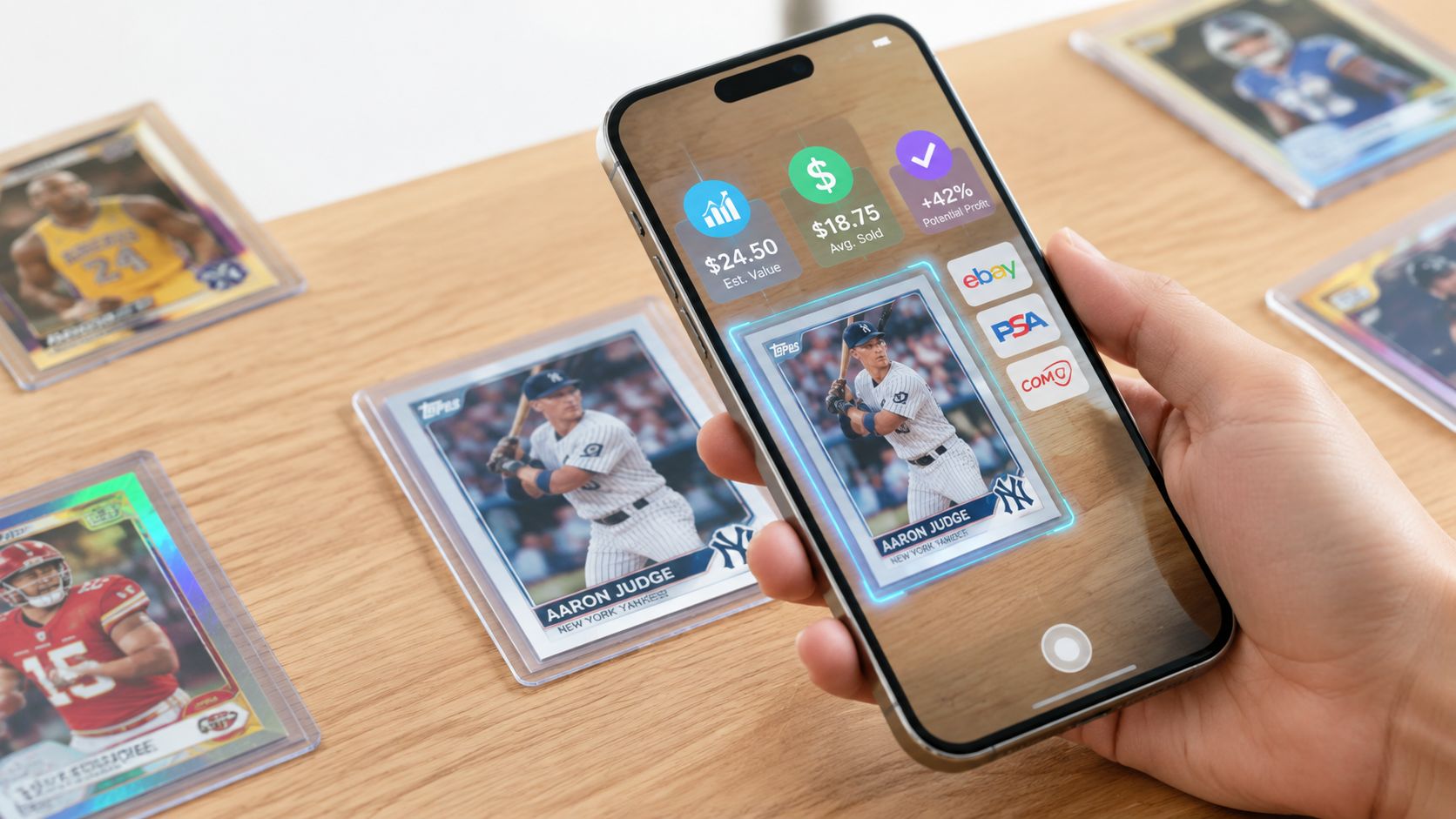
ScanFlip AI offers three scan methods: AI photo identification without a barcode, barcode scanning, and text search. It aggregates sold comps across eBay, Poshmark, Mercari, Depop, Amazon, Whatnot, ThredUp, Facebook Marketplace, and TikTok Shop, then factors fees and shipping into a net-profit figure with a red or green flip-or-pass verdict.
The photo-first approach is covered in this guide to an app to identify items by photo. For card sourcing, its value is speed. You can identify a loose card at an estate sale, check comps, and judge the exit without switching between an identifier, a sales database, and a calculator.
Use that verdict as a filter, not a substitute for inspection. Verify the parallel, examine the surface, and reject any result that does not match the physical card in your hand.
Choosing the Right App for Your Card Workflow
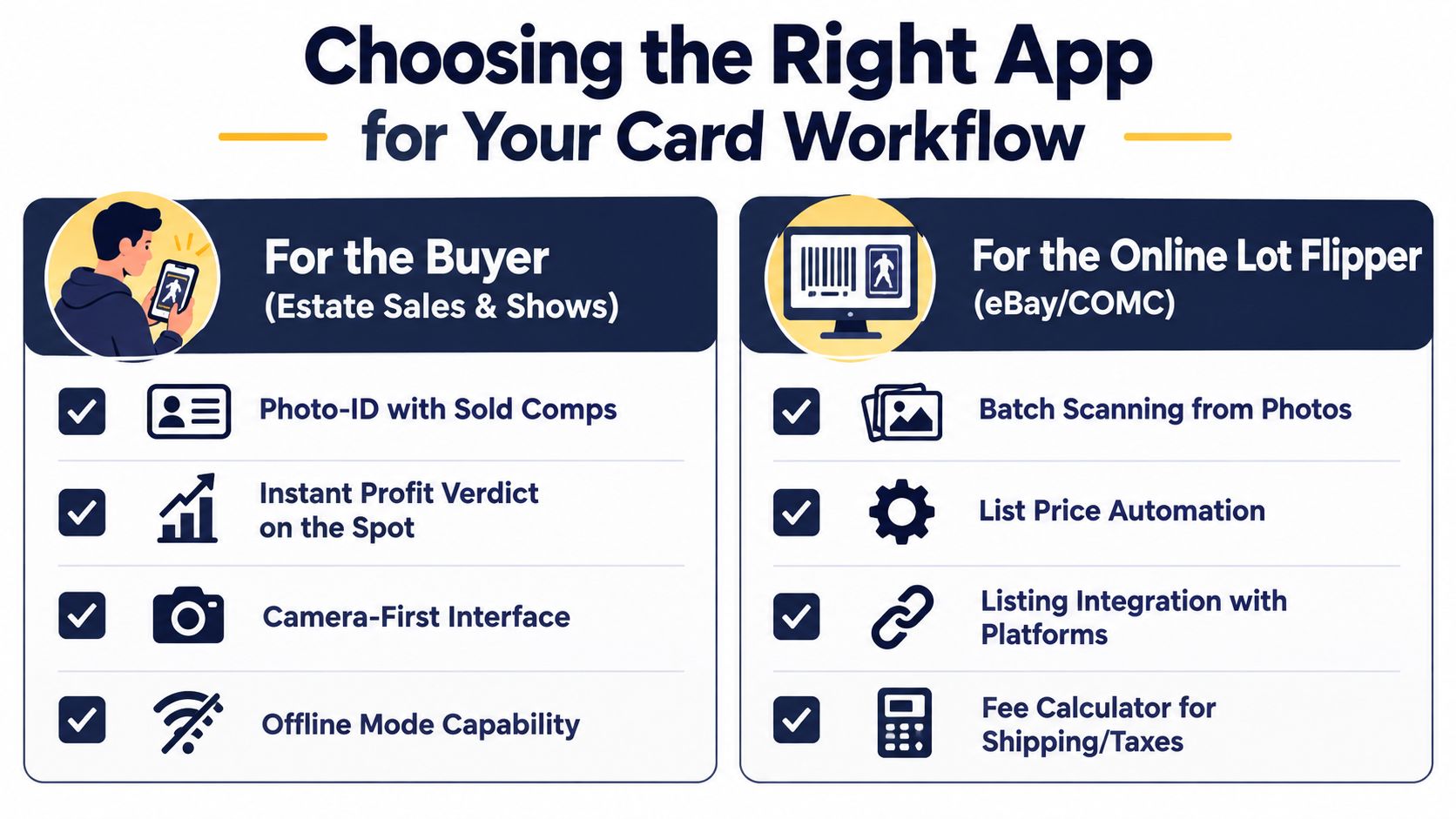
Match the app to the place where you source. A buyer working estate sales and card shows needs photo identification, sold comps, and a profit verdict before money leaves their pocket. An online lot flipper may get more use from barcode lookup and batch research. A set collector needs organization, raw-versus-graded tracking, and population context.
Avoid apps that hide the age of their pricing data. A feed older than 30 days can miss a sharp move in a hyped rookie or a newly discovered parallel. Be cautious with any tool that relies on one marketplace, doesn't model grading fees, or shows a raw number without explaining the comp depth.
Before you buy, run this short check:
- Confirm the identity: Match player, year, set, card number, parallel, and serial numbering.
- Review recent sales: Check at least three sales within the last 60 days when the card has enough activity.
- Separate grades: Don't mix raw, PSA 9, PSA 10, and other slabs into one average.
- Calculate the exit: Subtract platform fees, shipping, grading, and your cost of goods.
- Stress-test the grade: Ask whether the deal still works at PSA 9 or lower.
- Check liquidity: Sparse comps mean a slower sale and a less certain exit.
- Set your verdict: If the margin only works with a perfect grade or an optimistic sale, pass.
For most show and estate-sale sourcing, choose photo-first detection with sold-comp depth and net-profit math. For sealed product, add barcode capability. For a personal collection, use a portfolio tool alongside your buying scanner, not instead of it.
ScanFlip AI gives resellers photo, barcode, and text scanning, then compares sold comps across major marketplaces and calculates net profit after fees and shipping. Visit ScanFlip AI before your next card show or estate-sale run, and use it to make the flip-or-pass decision while the card is still in your hand.