
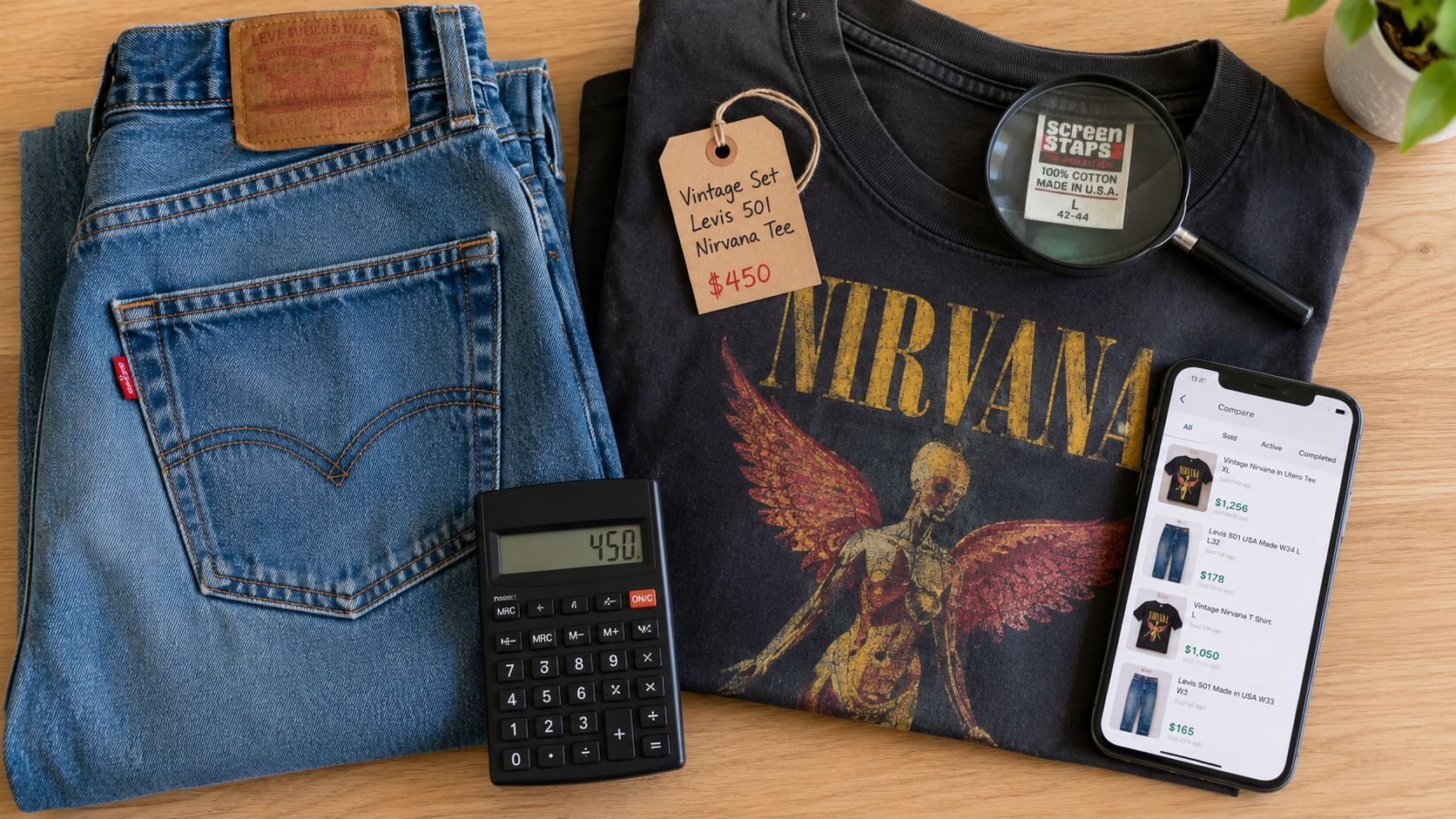

Vintage Clothing Price Guide for Resellers (2026)
You're standing in a thrift aisle with a jacket over one arm and your phone in the other. The tag says one price. Your gut says it's better than average. The label looks old. The stitching looks right. Maybe it's a strong buy.
But the central question isn't “What could this sell for?”
It's “What will I keep after fees, shipping, and cost of goods?”
That gap is where a lot of resellers leak money. A piece can look like a win at first glance and still turn into a weak flip once the deductions hit. That matters even more now because high-quality vintage fashion has skyrocketed by 50% to 300% over the last five years, with many pieces now matching or exceeding the cost of new clothing, according to WWD's reporting on vintage price increases. When buy costs rise, sloppy pricing hurts faster.
A solid vintage clothing price guide shouldn't stop at gross sale ranges. It should help you source with confidence, price with discipline, and protect margin before you ever hit checkout. That's the difference between hobby-level flipping and a repeatable resale business.
Table of Contents
- Introduction From Guesswork to Guaranteed Profit
- The Six Pillars of Vintage Clothing Value
- Typical Price Ranges for Popular Vintage Finds
- Why Most Resellers Miscalculate Profit
- A Modern Workflow for Pricing Vintage Clothing
- Calculating Your True Net Profit on Any Platform
- Advanced Strategies to Maximize Resale Value
Introduction From Guesswork to Guaranteed Profit
Every reseller has had the same moment. You find something that feels right. The fabric is heavier than modern stuff. The label looks older. The cut is specific enough that it probably isn't mall-brand imitation. You can see the listing in your head before you even leave the store.
Then the doubt starts.
Was that sale price you remember from eBay sold, or just listed? Was it pristine, while the one in your hand has a flaw under the cuff? Did that buyer pay shipping? And after the platform takes its cut, are you looking at a healthy return or just a lot of work for a thin payout?
That's where most vintage buying decisions go off track. New resellers often chase headline prices. Experienced resellers chase net profit.
Practical rule: If you can't estimate take-home profit in the aisle, you're still guessing.
The old way is slow. Search one marketplace. Open another app. Compare vague matches. Mentally subtract some fee you half remember. Hope the item sells near the top of the range. That process doesn't break because people are careless. It breaks because vintage pricing is messy by nature.
A good vintage clothing price guide has to deal with that mess directly. It has to account for era, construction, condition, buyer demand, and platform fit. Above all, it has to lead you to the only number worth trusting: what lands in your account after the sale is complete.
If you build that habit, sourcing gets calmer. You stop buying “interesting” pieces with weak margins. You stop overpaying because an item looks rare. And you start seeing racks the way strong resellers do, not as piles of clothing, but as filtered opportunities.
The Six Pillars of Vintage Clothing Value
Before you price anything, you need a framework. I think of vintage value like a six-part recipe. If one ingredient is missing, the item can still sell. But when several line up, value moves fast.
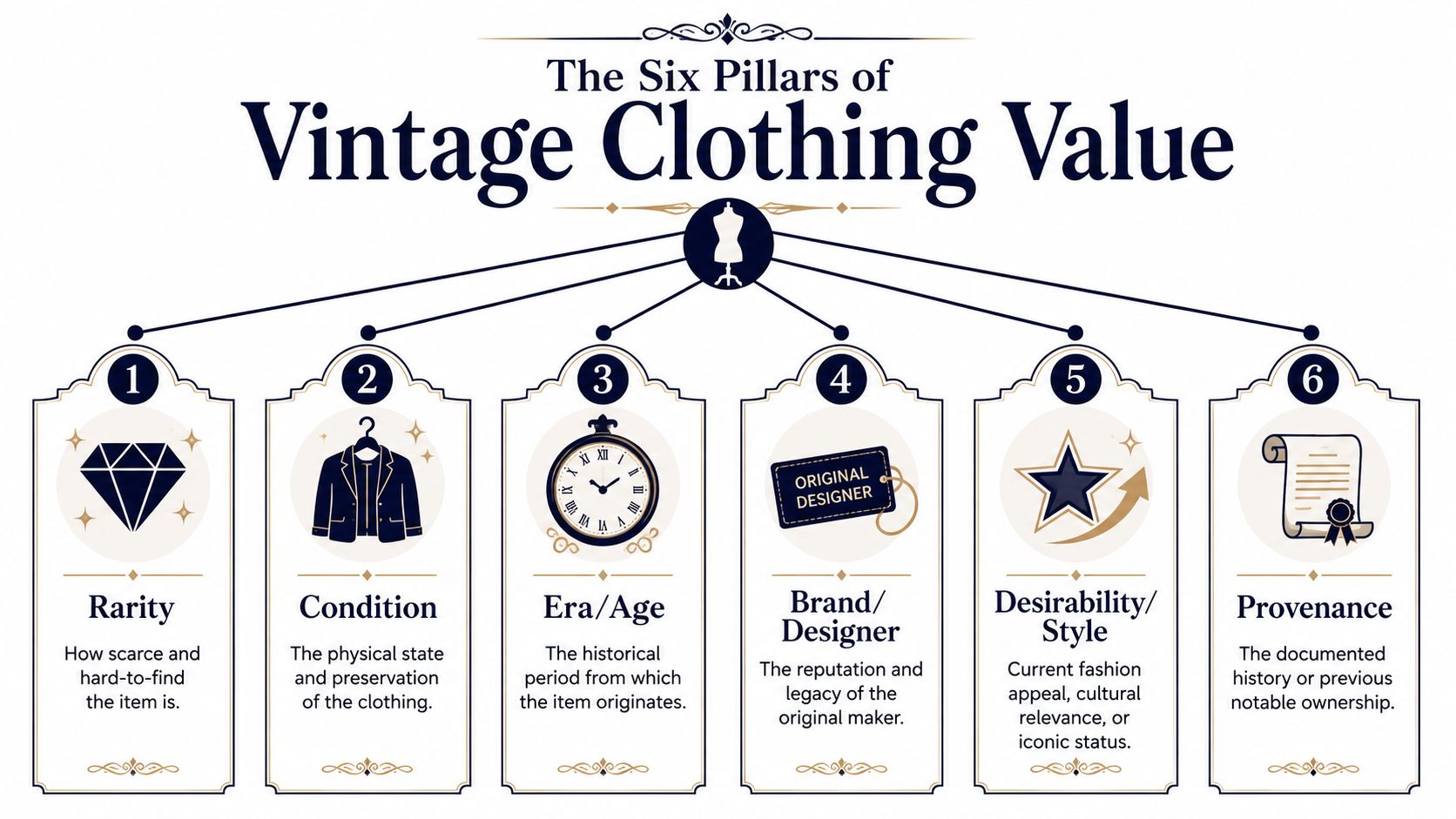
Brand and era
Brand does more than decorate the tag. It tells buyers what level of construction, heritage, and desirability they can expect. Heritage names and recognized designers usually give you a stronger floor price than anonymous labels.
Era narrows the market further. It affects silhouette, materials, production methods, and collector appeal. That's why the same category can swing wildly based on decade. A buyer looking for Y2K isn't shopping the same way a buyer hunting 1970s tailoring is.
If you're still sharpening your eye, this guide on how to identify vintage clothing is useful because it trains you to read labels, construction, and age signals before you even get to pricing.
Condition and materials
Condition isn't just “good” or “bad.” In resale, condition changes both sale price and sale speed. Vintage clothing in good condition typically sells for 25% to 35% of its original retail value, while quality heritage brands like Levi's and Patagonia often command $10 to $60, and rare pieces such as Big E Levi's or original band tees can reach $60 to $400 or higher, depending on markers like era-specific tags and single-stitch construction, according to this used clothing pricing reference.
Materials matter because buyers can feel the difference, even online. Older garments often show stronger fabric weight, cleaner seam finishing, and construction details that are rare in newer mass-market production.
Watch for signals like:
- Single-stitch construction that helps date certain tees and supports stronger resale value.
- French seams or bound buttonholes that point to better make quality.
- Label edge details such as pre-1980s pinked or zigzag edges that can support age assessment.
- Fabric integrity because dry rot, thinning, and hidden seam stress can kill a deal even when the item photographs well.
A vintage piece doesn't need to be perfect. But every flaw needs to earn its place in your buy price.
Rarity and provenance
Rarity is simple in theory and slippery in practice. Scarcity alone doesn't guarantee profit. It has to be scarcity that buyers recognize and pay for. An obscure garment can be old and hard to find, yet still move slowly because demand is thin.
Provenance is the final pillar. Most thrift finds won't come with glamorous backstories, but documented history still matters. Original tags, identifiable production details, deadstock presentation, or a clearly collectible designer line all strengthen trust and justify pricing.
Here's the practical takeaway. Don't treat these six pillars as equal checkboxes. Treat them like stacked evidence. When brand, era, condition, materials, rarity, and provenance line up together, the item becomes easier to price and safer to buy.
Typical Price Ranges for Popular Vintage Finds
A reseller pulls a 1990s tee, a 1970s western shirt, and a Y2K mini skirt from the same rack. All three are vintage. Only one is likely to produce a clean net profit after fees, shipping, returns risk, and time spent listing. That is why broad price ranges help, but only if you treat them as buying filters instead of promises.
Decade matters, but category matters more. In actual resale, “90s vintage” is too wide to price as one bucket. A plain mall-brand 90s knit and a documented 90s band tee do not belong anywhere near the same range. The same problem shows up with 70s and 80s pieces. Era can raise buyer interest, but profit usually comes from the intersection of era, category, brand, and condition.
Use ranges that match what resellers source most often.
What the decade tells you
Y2K tends to sit at the lower end unless the piece hits a very specific trend, brand, or silhouette. Many common Y2K tops, skirts, and casual dresses land in the modest range seen on peer-to-peer platforms. Older decades can sell higher, but usually only when the item also has a strong category pull, such as denim, leather, westernwear, sportswear, or collectible tees.
The safer approach is to price by item type first, then use the decade as a multiplier. That keeps you from paying up for age alone.
There are also category-level anchors worth remembering from the verified data already covered in this article's opening source set. Vintage denim like original Levi's 501 from the 1970s to 1980s can command $300 to $800, and vintage designer handbags can trade in the $1,000 to $5,000 range. Band and concert T-shirts can sell from $100 to over $1,000 depending on artist and rarity, as noted in the earlier market data discussion.
Quick range table for common finds
| Item Category | Typical Price Range (Good Condition) | Notes |
|---|---|---|
| Y2K vintage pieces | $25 to $45 | Common fashion pieces. Trend alignment and brand decide whether they move fast enough to be worth listing. |
| 90s basics and casualwear | $30 to $80 | Tees, shirts, fleece, and everyday separates usually live here unless a collectible angle is present. |
| 80s to 90s jackets and outerwear | $60 to $180 | Leather, varsity, workwear, and standout graphics usually outperform basics. |
| 70s shirts, westernwear, and tailoring | $50 to $150 | Fit, fabric, and wear matter more than age by itself. |
| Designer vintage | $250 to $2,500+ | The low end covers less collectible labels or slower styles. The high end is reserved for known houses and proven demand. |
| Vintage denim | $300 to $800 | Era, brand, fit, and wear pattern can move the result sharply. |
| Band and concert T-shirts | $100 to over $1,000 | Artist, originality, date, and graphic demand drive the spread. |
These ranges do two jobs.
They stop you from pricing an average piece like an outlier comp.
They also stop you from missing profit on categories where buyers reliably pay up.
A practical rule helps here. If the range is wide, buy against the low end and list toward the middle unless your piece has a clear reason to reach higher. That protects margin. It also keeps stale inventory from eating your time.
The range is only the top line. Your actual decision starts with what you can keep after costs.
Why Most Resellers Miscalculate Profit
The biggest pricing mistake in vintage resale is simple. People confuse a sale price with a payout.
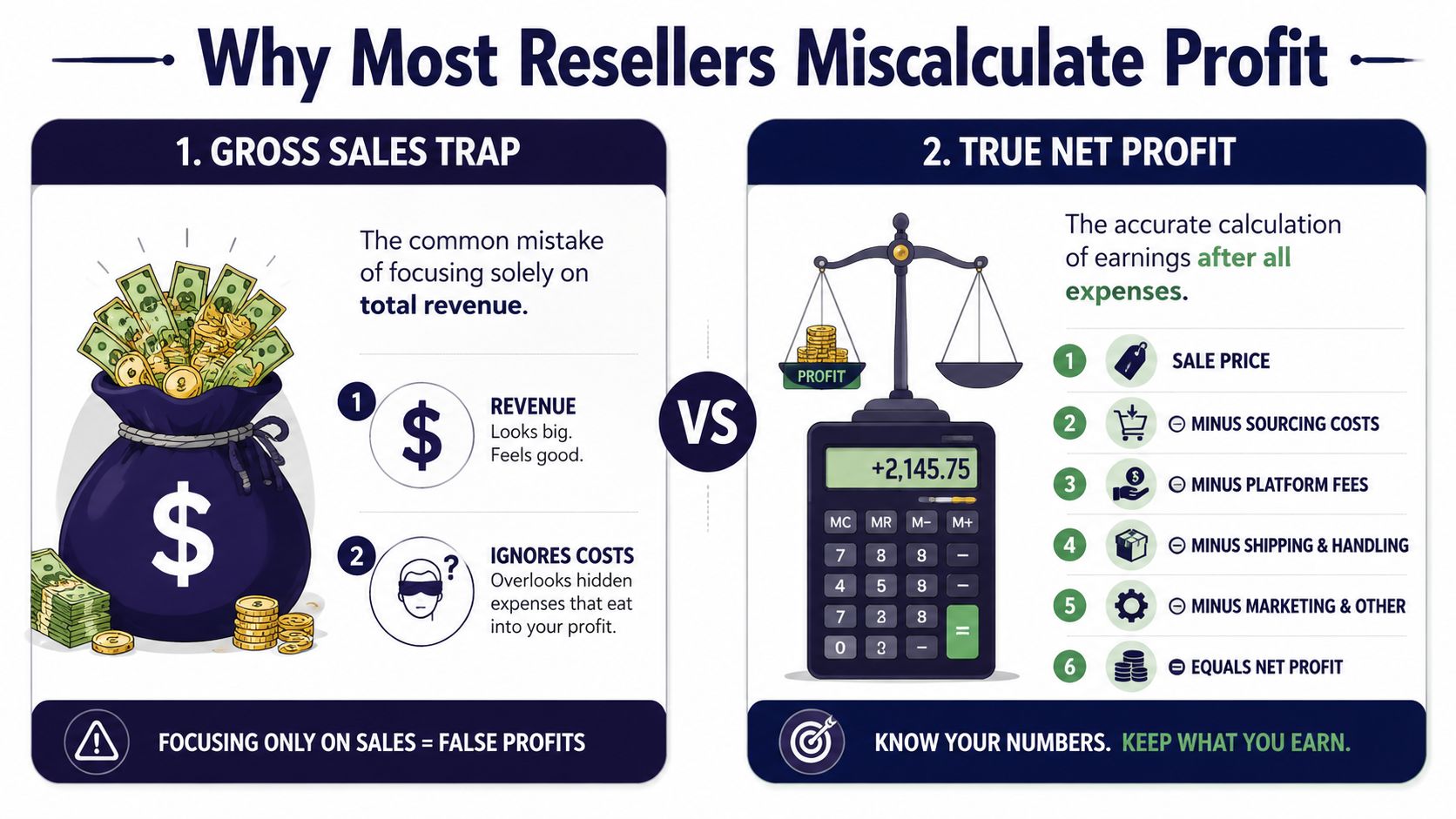
Gross price is not the payout
Most guides tell you what an item sold for. That's useful, but incomplete. A sold comp can anchor the top line, yet it says nothing about what the seller kept once costs were removed.
One of the clearest critiques of existing guides is that they focus on gross sale prices while missing the central question of resale economics. Hidden costs can erase 30% to 40% of apparent margins, according to this analysis of vintage clothing value and net profit blind spots.
That's why a piece that looks like a clean flip on paper can disappoint in practice. The gross number flatters you. Net profit tells the truth.
Most bad buys don't look bad until you subtract everything.
What the manual method gets wrong
Manual pricing creates three problems at once.
- It slows you down. You lose time jumping between marketplace apps, checking sold comps, and trying to normalize different results.
- It distorts your confidence. If you only remember the best recent comp, you'll price the item as if your piece is also the best example.
- It hides deductions. Fees, shipping, cleaning, packaging, and discounting don't show up in a quick mental estimate.
The worst part is that these errors stack. You overestimate sale price, underestimate costs, and ignore the time required to move the item. That combination leads to shelves full of “valuable” inventory with weak cash flow.
Here's what usually doesn't work:
- Buying on brand name alone when condition is only average.
- Trusting active listings instead of sold comps.
- Using one marketplace as the whole market for a cross-platform item.
- Pricing from memory when fees and offer behavior change.
Strong resellers don't avoid mistakes because they know every label by heart. They avoid mistakes because they force every candidate through the same profit filter.
A Modern Workflow for Pricing Vintage Clothing
The fastest pricing system is the one you can repeat in the aisle without talking yourself into a bad buy.

Start with identification
Vintage doesn't come with a barcode safety net. That means identification is step one, not step three. You need to know what you're holding before any comp search means anything.
Look at the tag, then the construction, then the cut. If the label is missing or unreadable, shift to manufacturing clues. Stitch type, seam finishing, fabric feel, pocket shape, and hardware details all help narrow the era and category.
A lot of newer resellers skip this and search vague terms like “old jacket” or “vintage tee.” That creates noisy comps and false confidence. Better input leads to better pricing.
If you want a practical walkthrough for building that process, this article on how to price items for resale is a good companion because it focuses on turning recognition into a buy-or-pass decision.
Check comps, then adjust for reality
Once the item is identified, compare sold listings across the marketplaces where that type of item performs. Don't use one platform by default. Some vintage moves better with collector buyers. Some moves better with trend-driven buyers.
Then adjust the comp set down to reality:
- Accurately assess condition. A pristine comp is not your comp if your item has repairs, fade, or staining.
- Match the exact era when possible. “Similar style” is weaker than “same era, same line, same construction.”
- Match the category buyer. A designer archive buyer and a casual thrift shopper don't pay the same way.
The quality of your comp set matters more than the size of your comp set.
A short list of strong matches beats a long list of loose ones.
Make the flip or pass call fast
At this point, a lot of sourcing becomes emotional. You've already invested time. The item is in your hands. You can imagine the listing title. It's easy to upgrade a maybe into a yes.
Don't.
Use a quick decision filter instead:
- Buy it if the adjusted sold range leaves enough room after buy cost, fees, shipping, and a likely offer.
- Pass if the item only works at the high end of the comp range.
- Pass if flaws are hard to photograph or explain.
- Buy carefully if the item is niche but unusually strong on multiple value pillars.
This workflow works because it removes drama. You identify, compare, adjust, decide. No storytelling. No wishcasting. Just disciplined sourcing.
Calculating Your True Net Profit on Any Platform
If you remember one formula from this entire vintage clothing price guide, make it this one:
Net profit = sale price – cost of goods – platform fees – shipping – packaging – cleaning or prep – any other direct selling cost
The only formula that matters
Gross price is what the buyer pays. Net profit is what the business keeps. Those are not close enough to blur together.
Expert pricing models for vintage resale recommend a 40% to 60% subjective markup over acquisition cost, with many strong resellers treating 2 to 2.5x purchase price as a practical ceiling, and they often start prices 15% to 20% above target to leave room for offers and fees, according to this guide on how to price vintage clothing for resale.
That guidance is useful because it forces restraint. A markup target gives you structure. A cap keeps you from choking sell-through with fantasy pricing. Room for offers protects your actual target payout.
For a deeper breakdown of the math itself, this resource on how to calculate net profit is worth bookmarking.
How to build room for offers and fees
Here's the practical sequence I use mentally when evaluating an item:
- Start with a realistic sold price, not the best one you found.
- Subtract your buy cost immediately so you're not anchoring on gross.
- Subtract platform fees next because they change the payout more than most beginners expect.
- Subtract shipping and packing costs even if the buyer covers part of shipping, because your handling costs don't disappear.
- Subtract prep costs if the item needs cleaning, steaming, buttons, or minor repair.
That final number serves as the buy signal.
Field note: If a deal only works when everything goes right, it usually isn't a deal.
This is also why net profit beats raw margin talk. Net profit makes different categories easier to compare. A jacket with a higher sale price may still be worse than a simpler tee if the heavier item costs more to ship, takes longer to sell, and attracts more negotiation.
Once you start sourcing this way, your inventory gets cleaner. Fewer sentimental buys. More items that convert into cash.
Advanced Strategies to Maximize Resale Value
A good vintage buy can still turn into a weak business decision. You list it high, sit on it for 90 days, accept an offer, and realize the extra wait added almost nothing to your actual payout.
That is why resale value has to be managed in net terms, not vanity terms. The goal is not the highest possible listing price. The goal is the best cash kept after fees, shipping, storage time, returns risk, and labor.
Price for the net you want to keep
Start with your minimum acceptable net, then work backward into the list price. That sounds simple, but it changes how you handle offers.
If a jacket needs stronger photos, weighs more to ship, and attracts repeated low offers, it needs more buffer than a fast-moving single-stitch tee. Broad-demand items usually do better with sharper pricing because they convert quickly and tie up less capital. Niche pieces can support a longer hold, but only when the expected extra payout beats the cost of waiting.
I use a simple filter here. If holding an item longer only adds a small amount to net profit, I would rather sell through faster and reinvest the cash into the next batch of inventory.
Use hold time as part of the pricing decision
Resellers often treat time like it is free. It is not.
An item sitting for four months has a carrying cost, even if you never write it down in a spreadsheet. It takes storage space, attention, relisting time, and mental bandwidth. In many closets and stock rooms, stale inventory also hides better opportunities because money is stuck in pieces that looked exciting at purchase but do not clear profitably.
As noted earlier, the resale market for vintage has grown well beyond a niche category. That growth helps disciplined sellers, but it does not guarantee that every old piece deserves a long hold. The right question is narrower. Will waiting increase expected net profit enough to justify the delay?
Sometimes the answer is yes. A rare band tee before tour season, heavyweight outerwear before fall, or a category with thin current supply may deserve patience. More often, the smarter move is to price cleanly, sell efficiently, and recycle capital.
Track patterns that improve future buys
The best resale strategy is not squeezing another few dollars out of one listing. It is building a repeatable buying system based on what pays you.
Keep notes on source, category, brand, condition issues, days to sell, accepted offer level, and final net. After enough volume, patterns get obvious. One thrift may produce strong vintage denim but weak sportswear. One label may get a lot of likes but soft offers. Another may sell for less on paper yet leave you with more cash because it ships cheaply and moves in a week.
That is the edge newer sellers miss. Gross price creates excitement. Net profit builds a business.
If you want a faster way to make buy-or-pass decisions on vintage without relying on rough mental math, ScanFlip AI helps resellers identify items, pull sold comps across marketplaces, and estimate expected net profit after fees, shipping, and buy cost. For vintage sourcing, that is the difference between hoping a piece works and knowing what you are likely to keep.