
What Does NWOT Mean? a Flipper’s Guide to Condition Labels
NWOT means new without tags: the item is represented as brand new and never worn, with its original retail hangtags missing. Nothing about the garment has to be wrong for that label to apply, and nothing about the label proves the garment was never worn either.
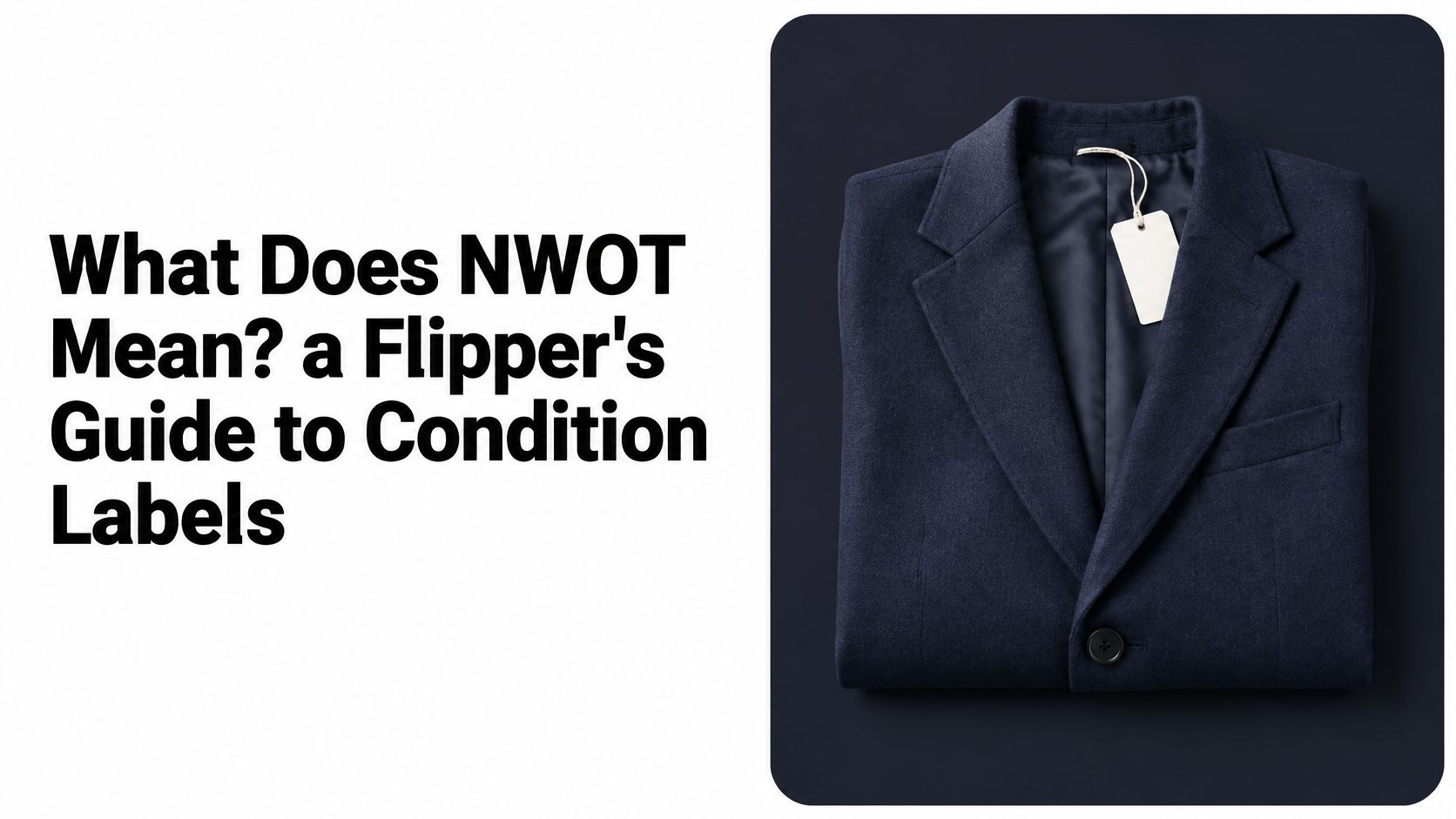
You're standing in a Goodwill aisle with a navy blazer in your hand. The cut is current, the buttons match, the underarms are clean, and the original price tag is long gone. Is it NWOT, or is it a used blazer you're about to overpromise on?
That question comes up more often now. In 2024, U.S. secondhand apparel sales grew 14%, five times faster than the overall apparel market, according to ThredUp's 2025 Resale Report as covered by the U.S. Chamber of Commerce. More inventory on the rack means more tagless items, and more buyers judging condition from photos instead of from the garment in their hands.
Table of Contents
- What NWOT Means in Resale
- How to Verify NWOT Before You Pay
- Shoes, Packaging and Other Gray-Area Cases
- Why Missing Tags Lower the Sold Price
- How to Write an NWOT Listing Buyers Trust
- Check Sold Comps and Net Profit Before You Buy
What NWOT Means in Resale
Take the blazer. The claim built into NWOT is narrow: brand new, never worn, no flaws, original retail hangtag missing. The NWOT meaning breakdown at Nifty frames it the same way, as an item represented as never worn or used while its hangtags or price tags are gone.
What surprises newer flippers is what stays. Sewn-in brand, size, fabric, and care labels normally remain. Missing hangtags remove the easy proof of size and provenance, not the identification itself, which is why a tagless piece with intact interior labels sells far more easily than one with the neck label cut out.
Practical rule: if the neck label and care tag are gone too, don't call it NWOT. You've destroyed the evidence a buyer needs to believe the claim.
That's the core of what does NWOT mean in practice. It's a statement about use history, not a laboratory grade, so the seller carries the burden of proof. Close-up photos of cuffs, collars, soles, hardware, stains, odors, and packaging do that work. A disclosed try-on is fine. Actual wear, a wash, an alteration, or a visible defect makes the label misleading, and buyers open cases over exactly that gap.
Here's how the terms sit next to each other:
| Term | What the seller claims | Original tags | Packaging |
|---|---|---|---|
| NWT (New With Tags) | Brand new, never worn, tags attached | Attached | Original box or bag included where the item ships in one |
| NWOT (New Without Tags) | Brand new, never worn, no flaws, tags missing | Missing | May be missing |
| New with imperfections | Brand new, never worn, has a defect | Can be attached or missing; the defect sets the grade | Can be present or missing |
| New other | Unused, may have opened packaging, a factory second or defects | Can be attached or missing | May be missing or already opened |
The label tells a buyer one thing only: this item wasn't worn. It says nothing about how the fabric drapes, whether the fit runs small, or whether the thing is authentic. That's what the photos and the interior labels are for.
How to Verify NWOT Before You Pay
Verification happens in the aisle, not after the package lands. A tagless garment is guilty until proven new, and the checks below take a couple of minutes per piece once you've done them a hundred times.
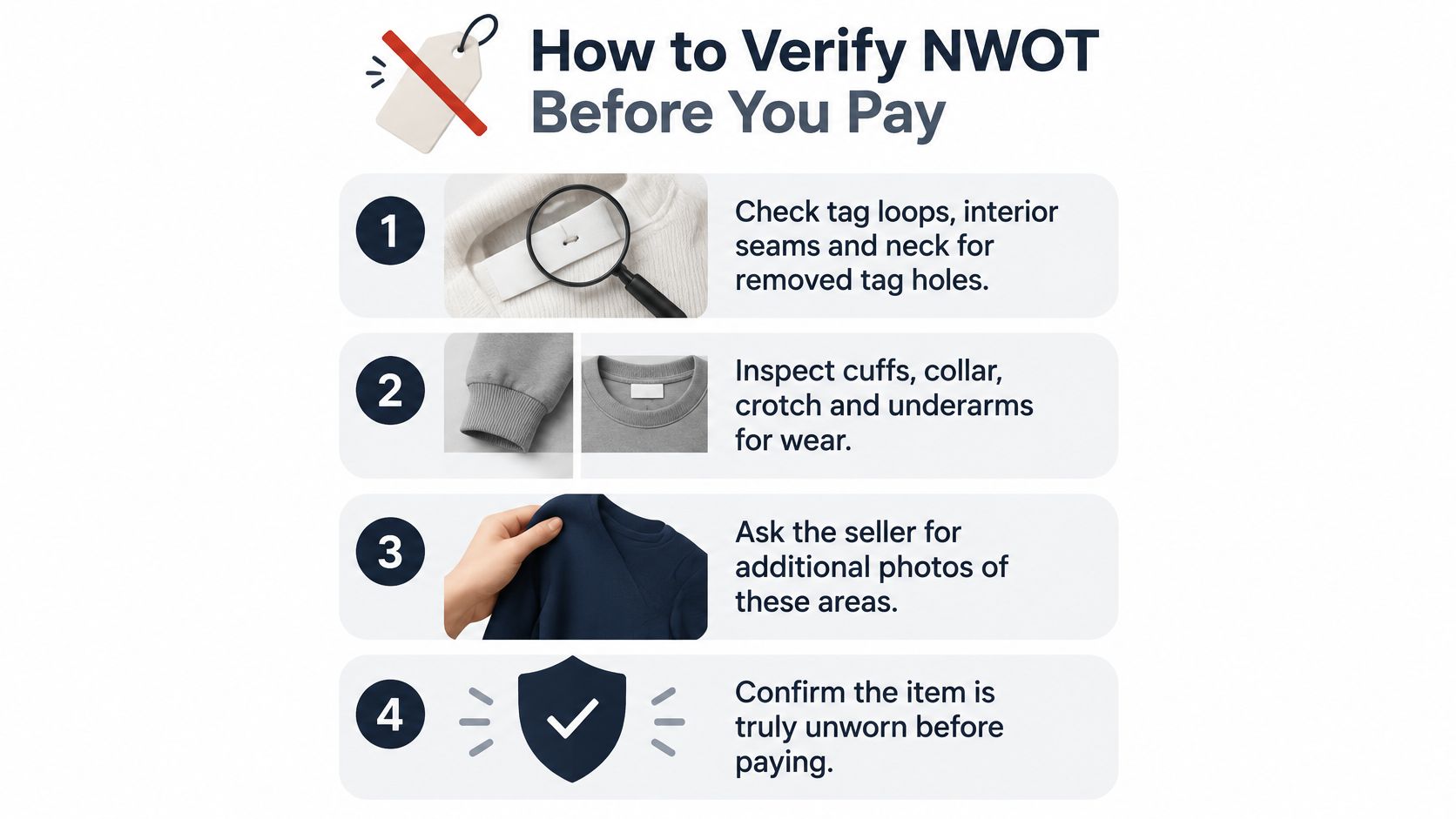
- Confirm the tags are gone. Look at the tag loop and the interior seam where a hangtag was attached. Removed tags often leave a small hole, a loose thread, or a faint rectangle of unfaded fabric. A tag still pinned inside the garment means you're looking at NWT, not NWOT, and you should price it accordingly.
- Check the high-wear zones. Cuffs, collar, crotch, and underarms tell you the truth faster than any other part of a garment. Deodorant staining, pilling, and stretched ribbing are the three signals that a piece has been worn and washed.
- Inspect hardware and surface. Zippers that stick, buttons with thread wear, faded dye along the shoulder line, and a slightly napped fabric face all point to wash wear. Compare the inside of a cuff to the outside if you want to see how much dye has moved.
- Smell it. Hold the armpit and collar to your face. Perfume, fabric softener, mothballs, smoke, or that sour closet smell won't wash out reliably, and a buyer will smell it the moment they open the mailer.
- Match the interior labels. Brand, size, and care tags should agree with each other and with the item. A size tag that contradicts the measurements is a red flag for a swapped or reworked garment.
- Do shoes separately. Left and right, sole and insole, heel wear and toe creasing. One scuffed sole disqualifies the pair from clean NWOT.
- Photograph it now. Shoot the tag loop, the collar, the cuffs, the underarms, and anything missing. If you photograph it in the aisle, you'll never have to argue about it later.
Poshmark's condition guidance sets the bar at three checks: the item is new, the original tags are absent, and there are no flaws or wear, as laid out in the platform's product condition definitions. Fail any one of the three and the honest description is used, not NWOT. A clean-looking dress pulled off a Goodwill rack is not automatically new just because nobody spilled coffee on it.
No proof, no NWOT label. If you can't show the buyer why you believe the item is unworn, you don't have a condition claim, you have a guess.
Bags need their own pass. Hardware scratches, corner rub, and lining discoloration show up under a phone flashlight in ways they never do under store lighting, and a missing dust bag or authenticity card changes the comp set you should be pricing against. If you source in the mid-tier range, this Cedar & Lily Clothier guide to luxury handbags under 500 is a useful reference for which construction details separate an unworn bag from a carried one, and what the tags and dust bags are worth in the listing. When you're ready to write the description, this walkthrough on how to describe item condition covers the phrasing that keeps returns down.
Shoes, Packaging and Other Gray-Area Cases
An estate sale, a closet being emptied, and a pair of unworn loafers with no box. The shoes were clearly never worn outdoors, but the box, the tissue, and the spare laces are gone. That pair still qualifies, because eBay's clothing and shoe definition allows the item to be missing tags and/or original packaging as long as it's brand new, never worn, and free of flaws, per the platform's item condition guidelines for sellers.
The gray areas are where flippers get sloppy. Scuffed soles, creased uppers, a damaged lining, or missing accessories move an item out of clean NWOT and into a different category, which means a different comp set and a lower sold price. Here's how the common cases should be labeled:
| Case | Usual label | What to disclose |
|---|---|---|
| Unworn shoes, no box | NWOT, since eBay allows missing packaging | Box missing; inspect and photograph soles and insoles |
| Unworn shoes with scuffed soles | New with imperfections or used | Describe the scuff and price to that condition |
| Fitting-room try-on, no wear | NWOT if clean | Disclose the try-on |
| Gift never worn, tags removed | NWOT if flawless | State it was a gift and that it was not worn |
| Returned item with wear or odor | Used or New other | Describe the wear and the odor |
| Long-stored garment with yellowing | Used | Disclose storage conditions and visible yellowing |
Each label points you to a different set of completed sales and a different price ceiling. Calling a yellowed, stored blouse NWOT because it was never worn sends you into comps that don't apply to what you're holding.
For the loafers, write it out instead of typing NWOT and hoping. Something like: no box, no dust bag, one spare lace, insoles unmarked, soles show no outdoor wear. Then check whether the insoles, laces, belts, dust bags, or replacement buttons that should be there are present. Buyers will accept a missing box. They won't accept discovering it after the fact.
Why Missing Tags Lower the Sold Price
Back to the blazer. It passed the wear checks: seams clean, no deodorant, buttons original. Comparable NWOT sold prices sit at $42. A 13% marketplace fee takes about $5.46, shipping runs $8, and you paid $6 at Goodwill. That leaves $22.54 net before supplies and your time, and that math is the whole reason condition labels matter.
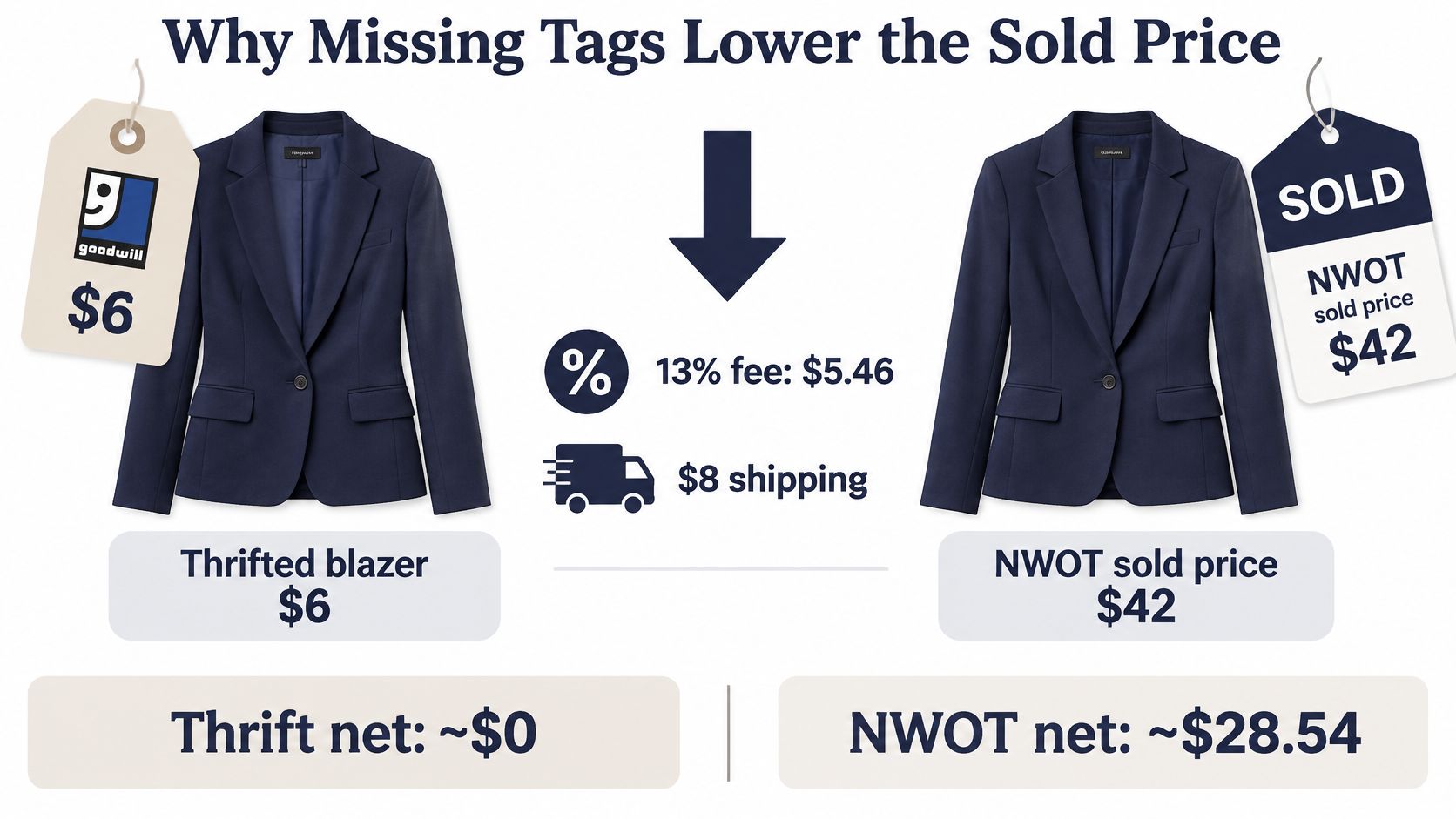
Treat that number as a model, not a chart. The next blazer needs fresh comps, because the $42 comes from a specific brand, size, and platform.
What you can't do is borrow an NWT sold price. Attached retail tags are easy proof of size and provenance, and buyers pay for that confidence. There's no fixed dollar gap between the two labels, though.
A missing hangtag might cost you a few dollars on ordinary mall apparel and hundreds on a luxury bag or a pair of unworn sneakers, where the box, dust bag, and hangtag are part of what's being sold.
If your blazer turns out to have a pulled thread or a mismatched replacement button, throw out the clean NWOT comps entirely. eBay's item condition lookup treats a brand new, never-worn item with a defect as New with imperfections, and New other covers opened packaging, a factory second, or a new item with defects. Reprice against sold comps for that condition, rerun sold price minus fees, shipping, and your $6 cost of goods, and if the net misses your floor, hang it back on the rack.
How to Write an NWOT Listing Buyers Trust
The listing that generates returns reads like this: "NWOT dress, flawless," plus one photo of it on a plastic hanger. The seller meant well. The buyer got a dress with a faint deodorant line and opened a not-as-described case.
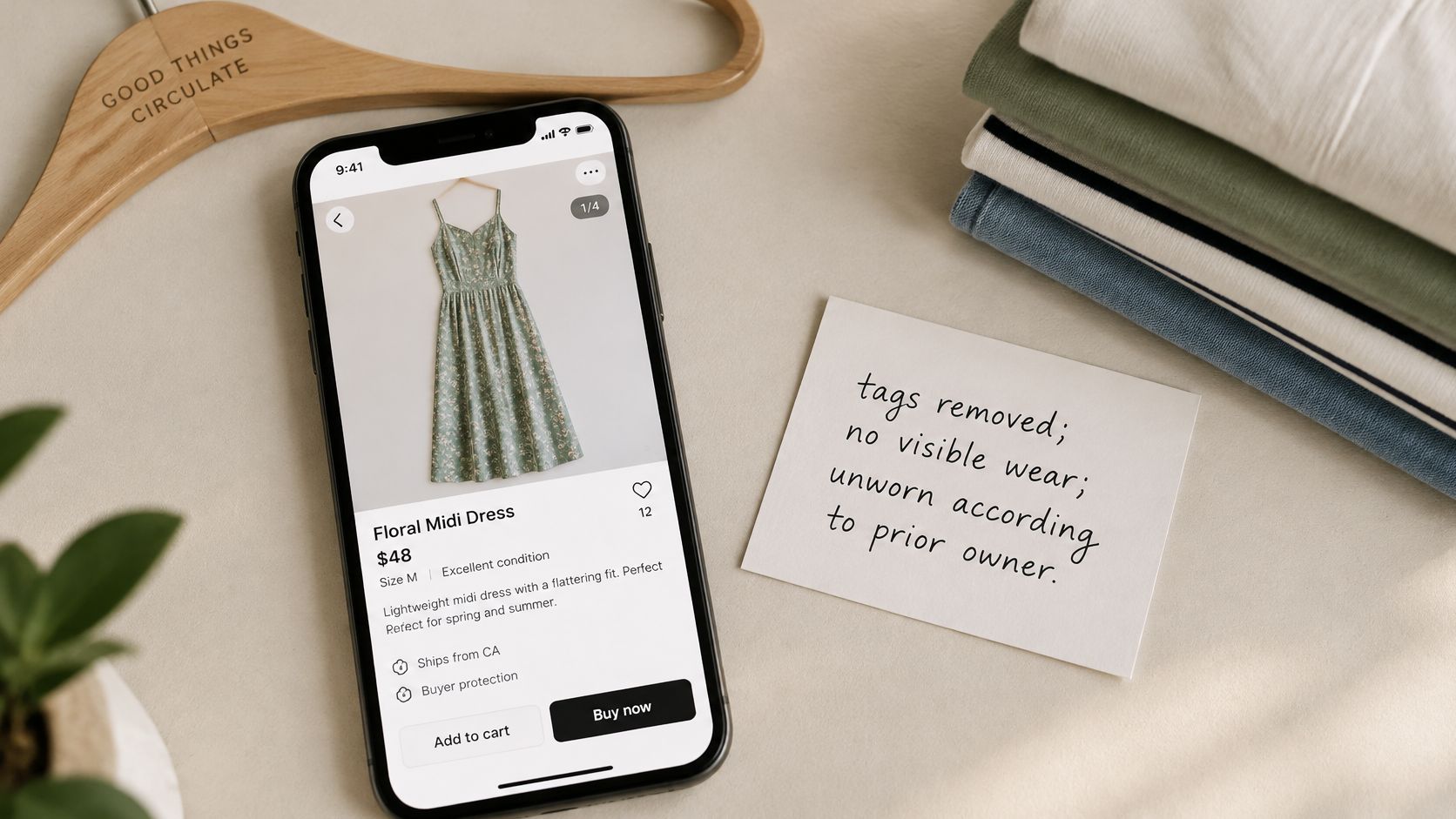
Rewrite it as observable facts instead of a verdict. The Gradethread explanation of NWOT makes the useful point that NWOT is a seller's condition claim, not independently verified proof of factory-new condition, and that the same shorthand covers a returned item, an unwanted gift, a try-on, a sample, or a long-stored garment.
So say which one it is. Lines that hold up:
- Tags removed, no visible wear, then show the empty tag loop.
- Unworn according to the seller I bought it from, if that's the provenance.
- No stains or odor, only after you've checked both.
- Box not included, or belt, dust bag, or spare laces missing, named specifically.
- Measurements in the photos, so fit disputes don't become condition disputes.
Lead with what's missing. Buyers forgive a missing hangtag. They don't forgive finding out it was missing after they paid an NWT-like price.
Then set the condition field to match the platform. On eBay, New without tags applies when the piece is brand new, never worn, and free of flaws, including when the packaging is gone. On Poshmark, NWOT applies when it's new, the original tags are absent, and there's no wear. If you disclosed a try-on or a gift with the tags cut off, keep that sentence in the description and leave the condition field alone. Don't upgrade to NWT because the item feels new.
Price it from NWOT sold comps on the platform where you're listing. Not NWT sold prices, and never active asking prices. The photos that back the claim are the interior brand and size label, the care tag, the collar, cuffs, underarms, zipper or hardware, and for shoes both soles plus both insoles. If you don't have a receipt and you're unsure about authenticity, say so rather than pricing it like tagged new. For a full model of how these descriptions should read, this guide on how to list items walks through the structure field by field.
Check Sold Comps and Net Profit Before You Buy
You've got the label right and the blemish disclosed. Now decide whether the item is worth buying at all, because the condition call is only half the decision.
Run the tagless piece through ScanFlip AI before you commit. With no barcode to hit, the AI photo scan identifies the item from the garment itself, and barcode scan or text search covers the boxed and tagged stuff. It pulls sold comps across eBay, Poshmark, Mercari, Depop, Amazon, Whatnot, ThredUp, Facebook Marketplace, and TikTok Shop, then shows net profit after fees with a red or green flip-or-pass verdict against your minimum.
Filter the comps to NWOT or "new without tags" specifically. If the only strong sales you can find are NWT, you don't have a comp, you have a hope. This piece on reading recent sold prices explains why the distinction changes the number you're chasing, and if you sell across platforms, an Etsy fee calculator for sellers from Pumo is a quick way to sanity-check fee math on the side.
The pass rule: no matching NWOT sold comp, no buy. Red verdict, put it back.
If the NWOT comps clear your net threshold, buy it and photograph the interior labels, the high-wear spots, and everything that's missing before you leave the aisle. After that, the item goes into whatever you already list with, Vendoo or List Perfectly or your own spreadsheet. The condition call took two minutes. The comp check took thirty seconds. Both happen while you're still standing at the rack, which is the only place they're worth anything.
ScanFlip AI is built for the moment before you pay, when a tagless blazer is in your hand and the answer isn't obvious. Point the camera at it, and you'll see sold comps across every major marketplace and your net profit after fees, with a clear flip-or-pass verdict against the number you need to make. Next time you're holding something with the hangtag missing, run it through ScanFlip AI and let the comps decide instead of the price tag that isn't there.