
Pokemon Card Price Scanner for Sold-Comp Buys
The number a scanner shows you is not the number you keep. A raw single that scans at $12 and sells at $12 leaves roughly $3.51 after a final value fee, tracked postage, and the $2 you paid for it, which is a pass unless you can bundle it or move it locally for cash.
A pokemon card price scanner earns its place in your pocket by doing one narrow job well. It names the exact printing, pulls recent sold comps for that printing, and runs the subtraction before money leaves your hand. Everything past that is character recognition wearing a price tag.
Get any one of those steps wrong and you're not buying a card. You're buying a story about a card, and the story is usually priced off someone else's slab.
Table of Contents
- Why Binder Guesses Lose Money
- Photo Scan Versus Barcode Versus Typing
- Features That Decide a Pokemon Buy
- Real Buy Math at Sales and Thrift
- When a Raw Card Is Not a Slab
- Fakes and Comps Too Thin to Trust
- Scanner Apps, Manual Lookups, and Their Trade-offs
- Pick a Minimum Net Before You Buy
Why Binder Guesses Lose Money
Three-ring binders on a folding table, sleeves gone cloudy, a handwritten sign that reads $5 each. Two other pickers are already turning pages, and the seller keeps repeating that Charizard sells itself. That line is not a sold comp. It's a feeling with a price tag on it, and it's how a raw holo with edge whitening becomes a $40 mistake before you've backed out of the driveway.
Pokemon pricing stopped being a binder-and-guess market years ago. OpenTheMagazine's explainer on why Pokémon cards are booming reports that eBay sales of Pokémon trading cards climbed 547% from 2019 to 2020, and that PSA graded more than 2 million cards in 2020 and over 19 million in 2025. Volume like that is why sold comps exist in the first place, and why two copies that look identical on a phone screen can sit hundreds of dollars apart.
Realized price moves with set, language, edition, condition, centering, rarity, and professional grade. The character name carries none of that information. Search "Charizard" and you'll pull Base Set unlimited, 1st Edition, Japanese printings, the Evolutions reprint, promo stamps, reverse holos, and slabs at four different grades into one useless average.
Active listings sit above what buyers paid. Sellers ask, buyers pay, and only the second number is evidence you can spend.
Where the Money Actually Leaks
- Character-only matching. You comp the Pokémon instead of the printing. Your card is the cheap one, the comp is the expensive one, and the spread is your loss.
- Raw priced off a slab headline. A PSA 10 number tells you nothing about a raw copy with a soft corner and a print line. Grade mix is the most common reason a card looks profitable in the aisle and isn't.
- Sold price treated as profit. A $12 sale is gross. Fees, postage, and cost of goods come out before anything is real.
All three happen before you open an app. So the first question at the table isn't what the card is worth. It's which scan method can name the exact printing fast enough to matter while two other pickers work the same binder.
Photo Scan Versus Barcode Versus Typing
At a sale, the wrong lookup can turn a promising card into a bad buy. Use a photo scan for a loose single, a barcode scan for sealed product, and text search when you know the set and collector number. Each method finds a different kind of match.
| Method | Use it on | Aisle speed | Typical miss |
|---|---|---|---|
| AI photo scan | Loose singles and holos with no UPC | A few seconds if the full card is in frame | A reprint with the same art if the set symbol or number is missed |
| Barcode scan | ETBs, tins, blisters, and other sealed products with a UPC | Fastest on boxed product | Loose singles, which do not use that product barcode |
| Manual text search | A card you can identify by set and number | Slowest while someone waits | The wrong printing, language, or promo if you search only the character name |
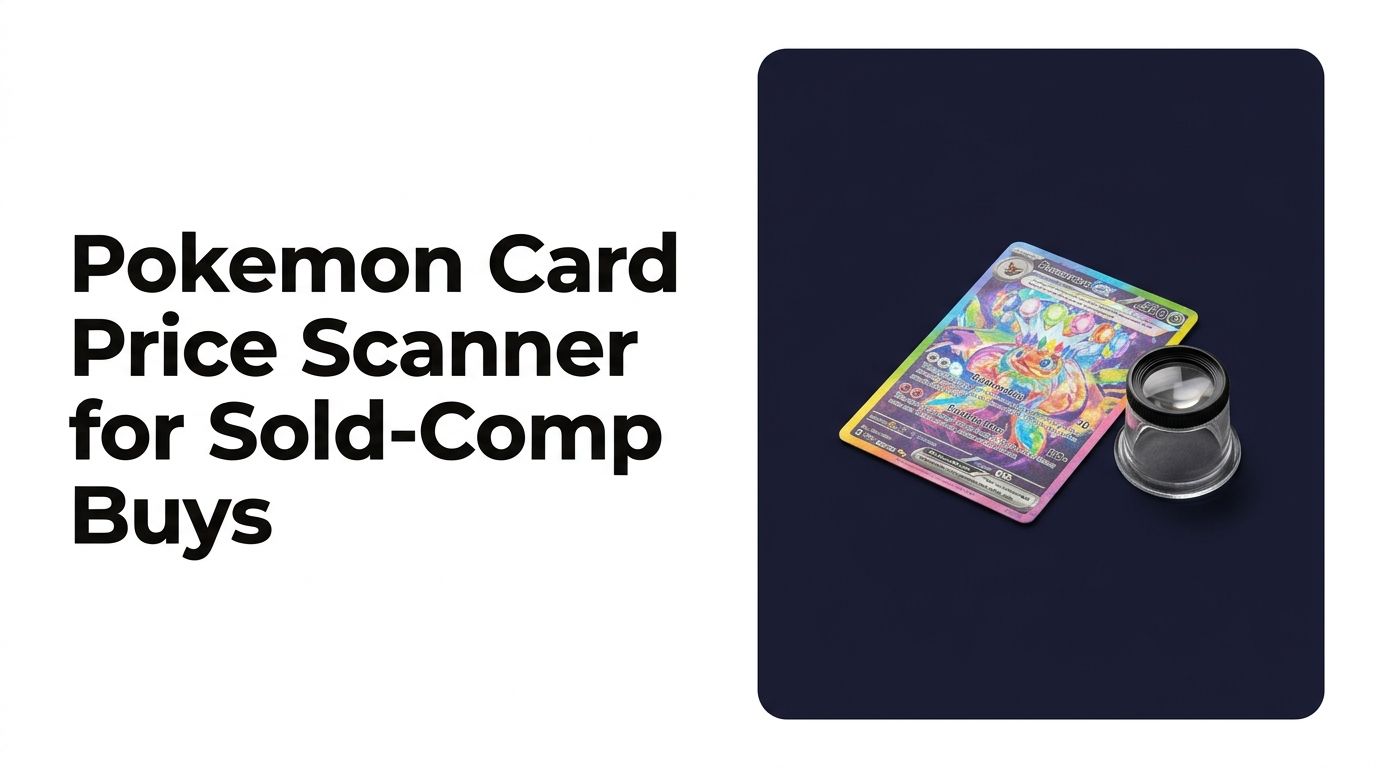
For a loose card, photograph the full card rather than just the artwork. Then check the set symbol, collector number, language, and holo pattern against the match. A character name alone can pull up a different printing, and its sold price may have little to do with the card in your hand.
A barcode is useful for an Elite Trainer Box, tin, or blister that still has its UPC. It identifies the sealed product, not the condition of the box or the contents inside. For a single, switch to a photo or a precise text search.
Text search is the fallback when you already know the set and number. Search those details together; typing “Charizard” alone can mix unrelated printings. If you're copying card numbers from a printed checklist or set-list image, compare the best OCR tools to move the text into your search.
Features That Decide a Pokemon Buy
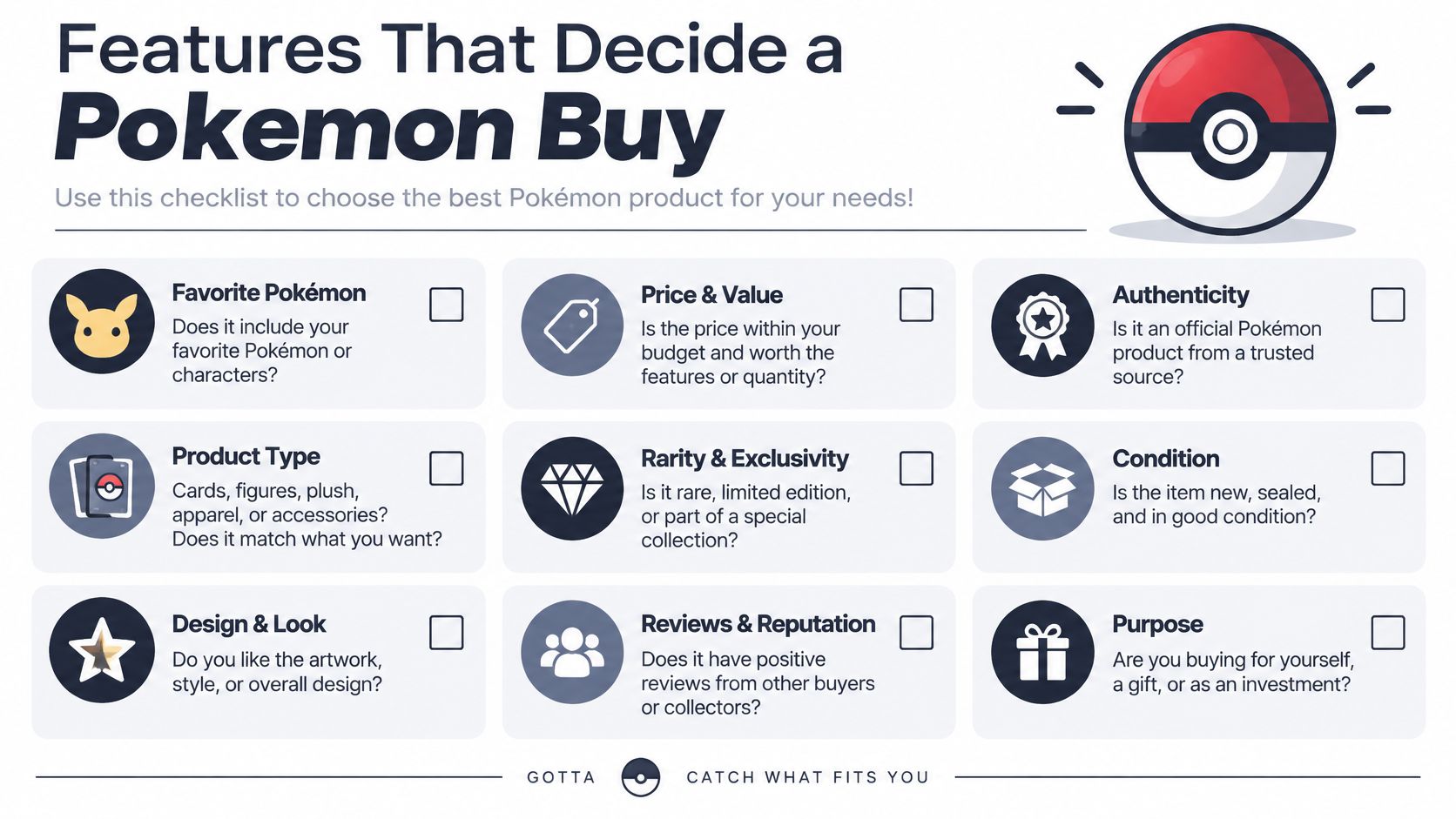
Identification is table stakes now. Almost every app on the App Store can name the card in front of you. What separates a tool worth opening in a Goodwill aisle from a novelty camera is what it prints after the identification: a comp set you can trust and a net number you can act on.
The checklist below is what I'd apply to any scanner before trusting it with a buy decision.
| Check | Pass looks like | Fail looks like |
|---|---|---|
| Sold comps | Recent completed sales, not active asks | One asking price or an old price-guide number |
| Comp count and median | Several sales and a middle price | The single highest auction |
| Marketplace spread | eBay plus at least one other sold venue | One app, one platform |
| Raw versus graded | Separate rows for raw, PSA, BGS, and CGC | A PSA 10 mixed into a raw average |
| Fees and shipping | Net after current fees, postage, and your cost | Gross sold price called profit |
| Speed | A read you can finish before the next picker | A search that needs a desk |
| Identity cues | Set, number, language, and edition confirmed | Character name only |
The Two Rows That Decide Everything
Sold comps and net profit. Everything else is comfort.
Sold comps. Completed sales are the only evidence that a buyer paid. An asking price tells you what a seller hopes for, and asks run high on exactly the cards you're chasing. If a tool shows you "market value" with no sold history behind it, you're looking at a wish.
Marketplace spread. A card that looks dead on eBay can still move on Whatnot or Mercari, and graded slabs behave very differently from raw on every venue. One-platform pricing is a partial answer dressed as a full one.
Raw versus graded rows. PSA, BGS, and CGC results have to sit apart from ungraded comps, and they have to be grade-specific. Any average that blends a PSA 10 with your raw copy is fiction, and it's fiction in the direction that costs you money.
Fees and shipping out the door. The number that matters is what lands in your account after the final value fee, the postage, and the cash you put down. Gross is not a decision.
Speed. A ten-second miss in the aisle is the same as a pass, because the next picker doesn't wait for your app to load. A clean interface beats a feature list every time.
Identity cues on the result screen. Set, collector number, language, and edition should be visible before the verdict. If the app buries them, you're trusting a match you can't check, and you'll find out at the mailbox.
Scan history. Photos with location and time help on a return trip to the same bins. History is a memory aid, never a substitute for a fresh comp.
A scanner that shows no sold comps and no fee deduction isn't a pricing tool. It's a lookup with a camera, and you can get that free.
One more habit worth building: check the range, not the point. If you want a baseline for what singles clear before you set expectations at a sale, this breakdown of how much Pokémon cards sell for is the right place to start.
Real Buy Math at Sales and Thrift
Three buys, same fee logic, one rule: $10 minimum net after fees and shipping. Run the subtraction in the order it happens. Sale price, marketplace fee, per-order fee, postage, cost of goods. Whatever's left is the only number you should care about.
| Spot | You pay | Sold comp used | Call |
|---|---|---|---|
| Garage-sale raw single | $2 | $12 raw median | Pass, under the $10 minimum |
| Clearance sealed ETB | $6 | $42 recent solds | Buy if the solds are recent |
| Estate binder, mixed raw and slabs | $80 | Raw-only comps, slabs excluded | Pass until raw-only comps clear the $10 minimum |
eBay charges one final value fee based on the total sale amount and adds a per-order charge: $0.40 for orders over $10 and $0.30 for orders of $10 or less, per eBay's seller fee and payout page. Run the math with a hypothetical 13.25% rate and see what survives.
The $2 Garage-Sale Single
Recent raw sold comps cluster at $12. A 13.25% fee takes about $1.59, the per-order charge adds $0.40, so roughly $1.99 is gone before you've printed a label. Tracked shipping runs about $4.50, and the card cost $2.
$12 minus $1.99 minus $4.50 minus $2 leaves $3.51. That's under the minimum, so it's a pass. Bundle five of them into one lot, sell it locally for cash, or leave it in the box. Don't talk yourself into it because the percentage looks decent.
The Clearance Endcap ETB
A Ross or Walmart clearance endcap has a sealed ETB for $6 with recent sold comps at $42. The same 13.25% takes about $5.57, plus the $0.40 order fee, roughly $5.97. Shipping a box is about $6.
$42 minus $5.97 minus $6 minus $6 is $24.03. That clears the minimum comfortably, so buy it, but only if the solds are the same SKU and recent. An ETB from a different set, or comps from six months ago, is a different trade.
The Estate Binder Quote
An $80 binder quote is a trap when three of the sales in the average are slabs and yours are raw. Recompute on raw-only comps before you negotiate. If the raw math lands you under $10 net, counter lower or walk, and be ready to walk. There's always another binder.
If the net after fees and shipping can't clear your minimum, the card goes back in the box. Say it out loud at the table. It gets easier.
Every figure above uses a hypothetical 13.25% rate on the sale price. Check the current eBay fee schedule before you buy, because rates change and your category may not match.
When a Raw Card Is Not a Slab
A $40 raw card with a $180 PSA 10 sold comp for the same card is the most expensive mirage in the hobby. Before you send anything to a grader, price the grade you expect, not the one in the headline.
Say the card grades a PSA 8, and 8s sell at a hypothetical $70. Grading, shipping both ways, and turnaround come to $60 all in. A 13.25% fee on $70 is about $8.90, plus the $0.40 per-order charge, so fees take $9.30. $70 minus $9.30 minus $60 leaves $0.70, and you haven't paid for the card yet.
Sell it raw this week instead. At $40, the fee is about $5.30 plus $0.40, and tracked shipping is $4.50, so you net roughly $29.80 with no wait.
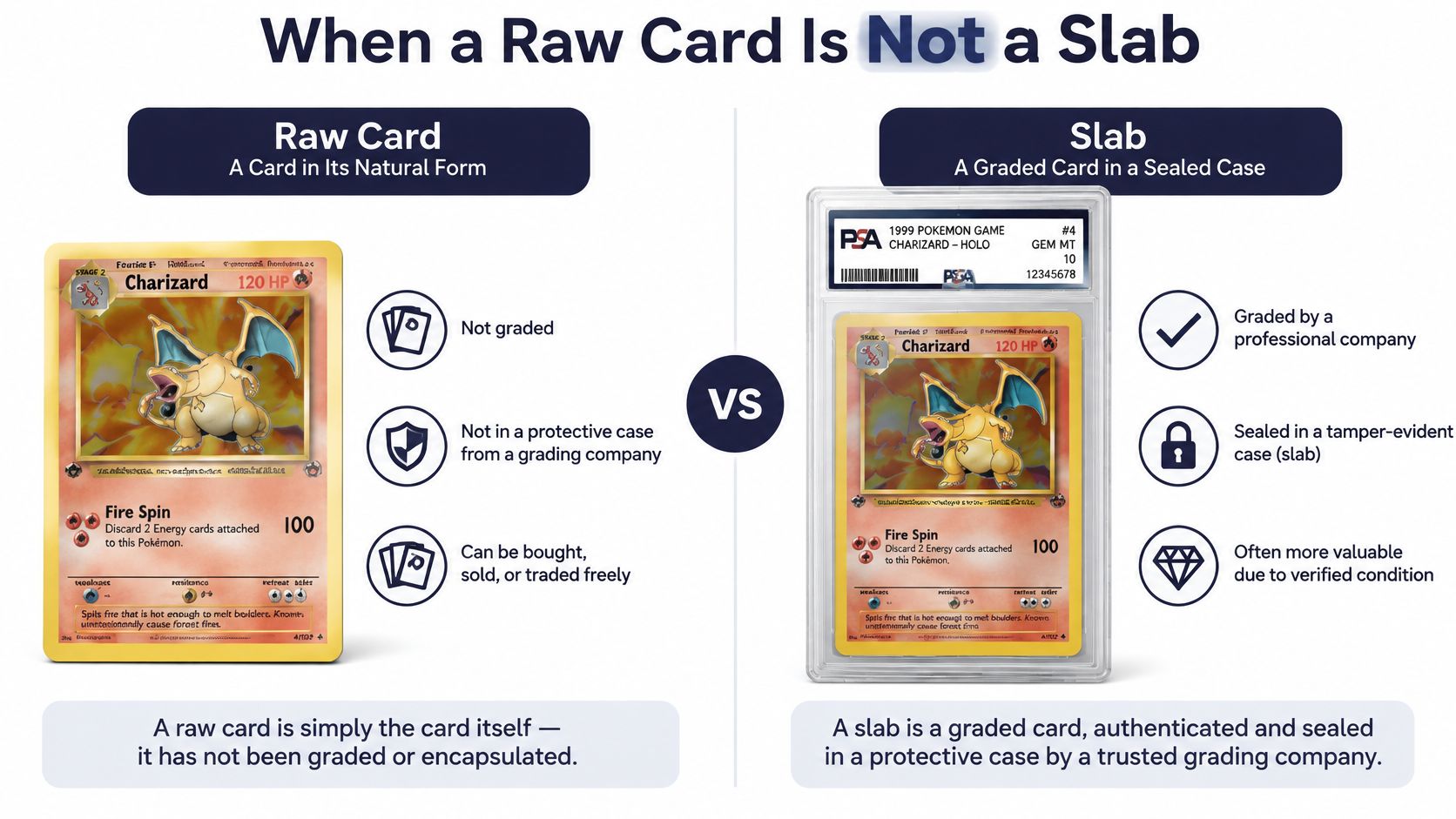
EBay's Price Guide matches cards to completed sales and, when available, the same grade, but it warns that prices vary with condition, timing, and demand, and that its data may not be enough for less-liquid cards. That warning is the whole game on raw cards, where centering, whitening, surface scratches, dents, print lines, language, and edition swing the number hard.
Photograph the front and the back. Keep raw comps out of any slab average. A good scan separates raw from graded by grade and shows you the spread of likely outcomes. Only you can judge whitening in hand, so when the photos leave condition uncertain, the honest answer is a range and a pass on the grade bet.
Submit only when the raw card already looks like the grade the higher comps require, and treat the submission as a second buy with its own minimum net.
Fakes and Comps Too Thin to Trust
A matched sold price is not proof of anything. The scan can name the card perfectly and still be looking at a counterfeit, because identifying artwork and verifying authenticity are different jobs. Demand is exactly why Pokémon gets targeted: PSA-related reporting estimated more than $200 million in counterfeit or altered trading cards identified in 2025, with Pokémon representing six of the ten most-counterfeited cards, and counterfeit activity reportedly up 45.3% that year, according to Yahoo Finance's coverage of the fake-card surge.
In a thrift bin or a sale pile, check texture, holo pattern, font, set symbol, card number, copyright line, and anything that feels off in weight or finish. Treat those as screening signals, not authentication. If they fail, lower the offer or walk.
Liquidity is the second haircut. Say a holo has five recent sold comps with a $48 median, all on one platform, and you can't verify the print. Cut the comp 30% for fake risk and thin demand, down to $33.60. Fees take $4.85, shipping is $4.50, and your cost is $15. That leaves $9.25, under a $10 floor.
Pass, even though the headline sale looked strong. Before you trust a thin set of comps, check whether a second venue clears, and read up on how to find sold prices on eBay so you're pulling completed sales and not asks.
Scanner Apps, Manual Lookups, and Their Trade-offs
A dedicated scanner app gives you an identification and a comp set in one pass, which is what you need when someone is standing behind you. The weakness is the number it prints. Check whether it separates raw from graded, shows comp count and sale dates, and deducts fees and shipping before handing down a verdict. A fast camera on top of a bad comp set just gets you to the wrong answer quicker.
The eBay Price Guide is a solid check for eBay-only buys. It lives inside one marketplace, though, and it says itself that thin data can make the number unreliable on cards that don't trade often. If your card moves on Whatnot or Mercari, that guide can't see it.
A manual sold search on each marketplace costs the most time and rewards patience. It's the best check on a card you already know by set and number, and the worst choice when a bin of 40 cards is waiting and the seller wants to close up.
Pick the tool by the buy in front of you. A scanner for the aisle. The eBay Price Guide or a manual sold search for the expensive single you want to verify on the kitchen table that night, with good light and no one waiting.
Pick a Minimum Net Before You Buy
Set your minimum net before you walk in. For a single, that might mean $10 after fees and shipping; use a higher floor for cards likely to sit unsold. With the threshold set, the decision comes down to the numbers rather than how much you want the card.
At the table, verify the set symbol and collector number, and compare raw cards with raw sold comps. A low comp count or a card that looks wrong in hand is a reason to pass. If you want to set a clear floor, this guide to how to price items for resale explains how fees affect your take-home.
ScanFlip AI offers photo identification without a barcode, barcode scanning, and text search. It compares sold comps across eBay, Poshmark, Mercari, Depop, Amazon, and Whatnot, then calculates profit after fees and shipping. Set your minimum profit margin to get a red or green Flip or Pass verdict. New users get 10 free scans with no credit card required.
Before your next sourcing trip, choose the minimum net you'll accept. If the card falls short, leave it in the box.
ScanFlip AI is designed for the buy decision: identify the card, check sold comps across six marketplaces, and see the expected profit after fees and shipping. Use its verdict against your own threshold, then buy only when the numbers work. ScanFlip AI is available exclusively on the App Store for iPhone.