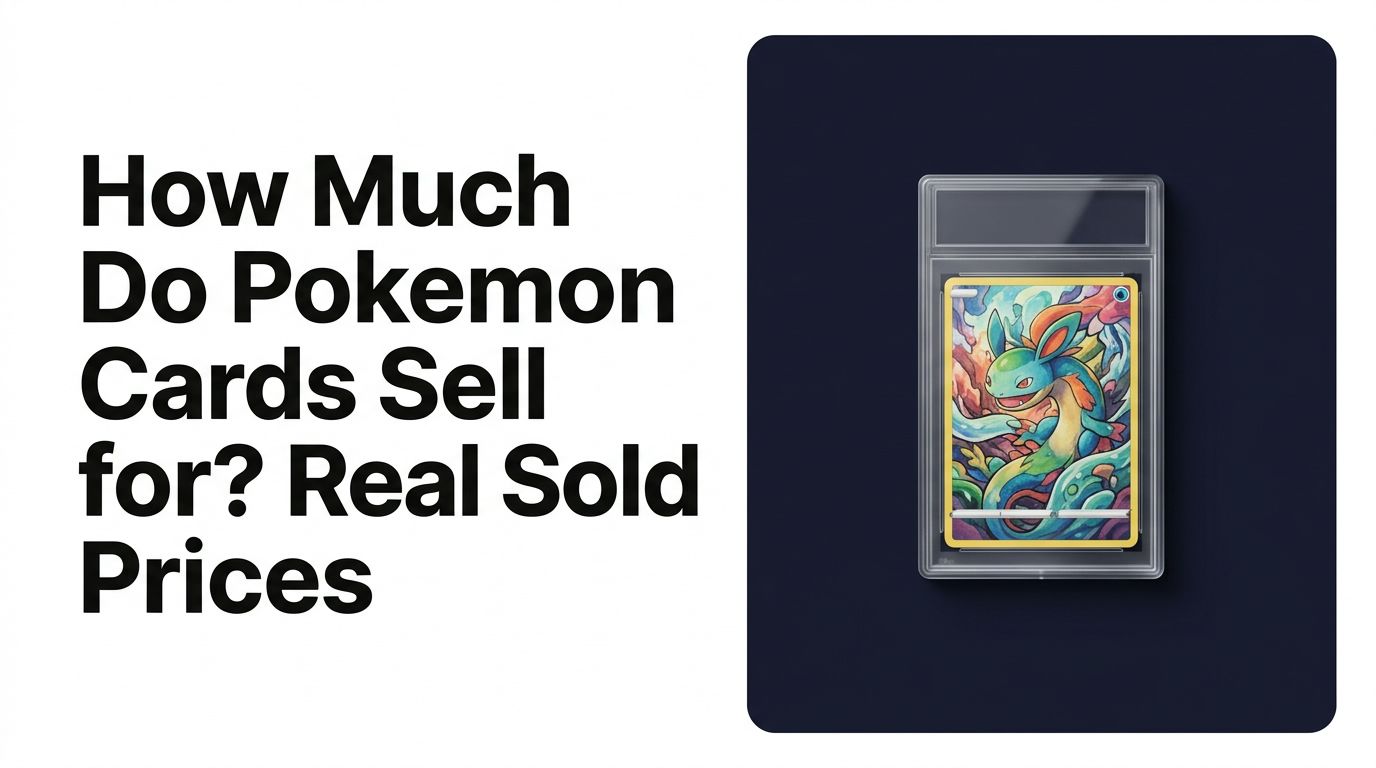

How Much Do Pokemon Cards Sell for? Real Sold Prices
You're standing over a Goodwill bin with a stack of Pokémon cards priced at 25 cents each, wondering whether to grab the lot before another picker does. In this sourcing scenario, the mistake is treating every shiny card as inventory. Most ordinary bin cards belong in the bulk category until exact sold comps prove otherwise.
So, how much do Pokémon cards sell for? Some aren't worth selling individually. Others justify a careful condition check, and a small group belongs in a completely different collector market. Your job is to identify the tier, then decide whether the net profit pays for the work.
Table of Contents
- Pokemon Card Price Bands You Can Expect Today
- What Actually Moves a Pokemon Card's Price
- Pull Sold Comps and Net Profit Before You Buy
- Grading Math and When a PSA 10 Is Not Profit
- Worked Example From a Thrift Store Bin
- Cards Not Worth Picking Up at the Bin
Pokemon Card Price Bands You Can Expect Today
A single average is almost useless for sourcing. The What the Slab Pokémon auction report recorded 1,560 Goldin lots totaling $33.69 million, with a median sale of $895, but those were auction-selected cards, including graded and scarce inventory, not a random stack of binder commons.
That distinction matters when a seller has priced an entire box using a headline auction result. You're buying the actual cards in front of you, not the possibility that something valuable might be underneath them.
Typical Pokemon card sold prices by tier
Use these as rough sorting bands, not measured market averages or guaranteed sold prices. The exact card's completed sales override the band every time.
| Card tier | Typical raw sold price | Usual resale call | What puts it here |
|---|---|---|---|
| Bulk commons and uncommons | Under $0.50 | Sell in lots or pass | Common print and heavy supply |
| Modern playable singles | $0.50 to $5 | Sell raw, skip grading | Ordinary bin finds with actual player demand |
| Modern chase cards | $5 to $50 | Compare exact card and grade | Full art, popular characters, clean condition |
| Vintage and scarce holos | $50 to $1,000 | Check raw and graded sold comps | Age combined with rarity, demand, and condition |
| Elite graded trophies | $10,000 and up, graded rather than raw | Treat as a separate market | Top grades and auction-driven sales |
Bulk commons and uncommons need a resale plan before you buy them. A familiar character doesn't automatically make a common worth photographing, storing, and shipping individually. Look at the card number and rarity symbol rather than sorting by artwork alone.
Modern playable singles can have demand without looking impressive. Search the exact printing, because a different set, language, or holo treatment can lead you to the wrong comp. Don't assume every card found in a bin is playable or desirable.
Where a closer inspection pays
Modern chase cards deserve more attention, but full art isn't a buy signal by itself. Match the set and card number, then inspect the surface. A clean-looking front can hide whitening, dents, or scratches that change the appropriate comparison.
Vintage and scarce holos require the same discipline. Age gets your attention; edition, condition, and demonstrated demand decide whether you spend money. A worn vintage holo doesn't belong beside a pristine graded copy in your valuation.
Elite trophies aren't a useful BOLO for ordinary thrift-store sourcing. They require authentication, specialist comparisons, and a buyer pool that has little in common with someone filling a modern binder.
For your next unidentified bin find, assume bulk until the identification and sold comps establish something better. That starting assumption keeps cheap cards from becoming an expensive death pile.
What Actually Moves a Pokemon Card's Price
Say a garage sale has matching copies of the same holo. One has sharp corners and clean edges; the other has whitening across the back and a soft top corner. If their condition-matched sold comps sit far apart, that's not an inconsistency. They're different resale propositions.
Don't negotiate until you've inspected both sides outside the sleeve, with the seller's permission. A sleeve can hide scratches, and a cloudy top loader can make a clean card look worse than it is.
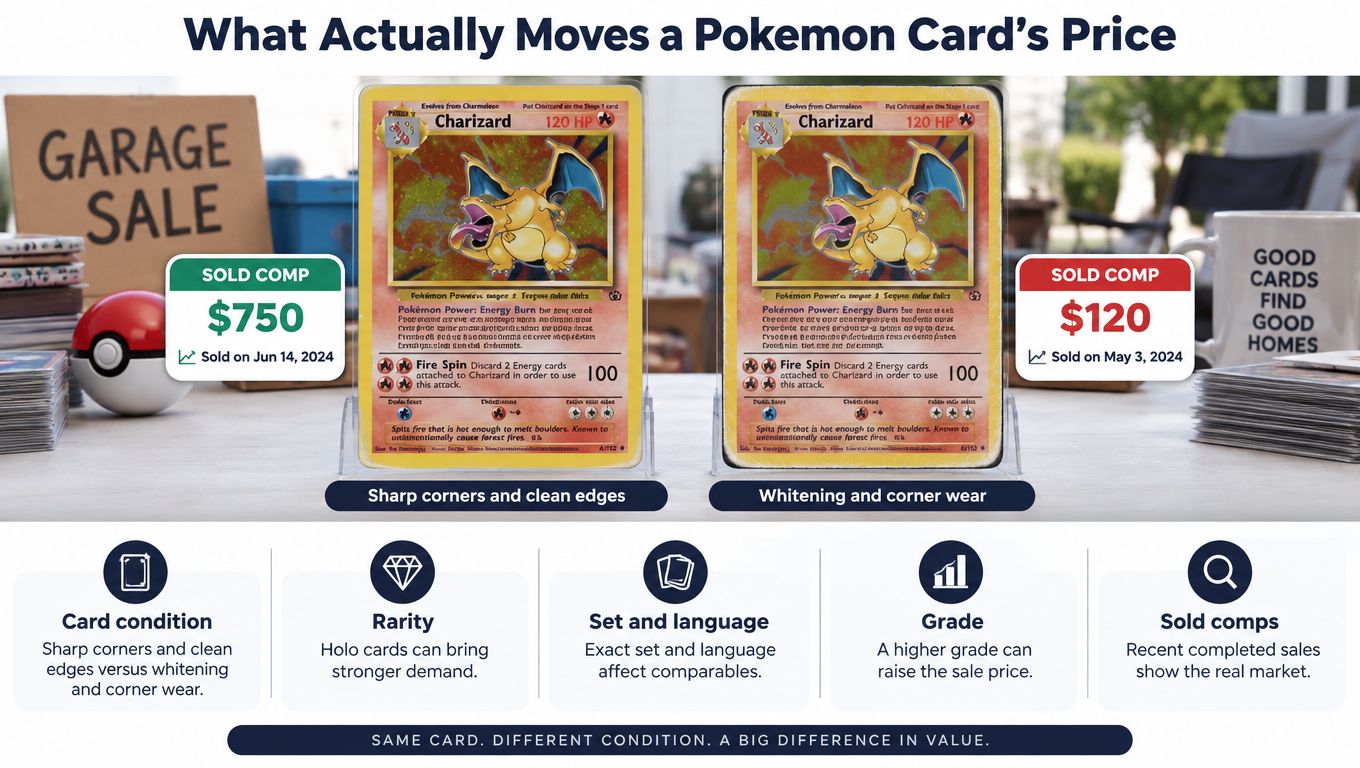
Check the drivers in a useful order
- Grade and grade population. For PSA, BGS, or CGC slabs, read the actual label and verify the certification through the grading company. Compare the same company and grade, then check how many comparable examples exist.
- Raw condition. Tilt the card under direct light. Check surface scratches, corners, edge whitening, dents, and front-to-back centering. Don't assign a perfect grade from an aisle glance.
- Edition and print run. Look for the edition stamp and identify the printing. A 1st Edition comp isn't interchangeable with an Unlimited comp.
- Set and era. Read the set symbol or identifying set information. Similar artwork can appear on different releases.
- Rarity and set symbol. Inspect the printed identifiers rather than relying on how unusual the card looks. Confirm them against the exact release.
- Holo treatment. Move the card under light to distinguish holo, reverse holo, and other treatments. Photograph the effect if you can't confidently identify it.
- Language. Read the card itself. Japanese and English versions need their own comparisons, even when the illustration matches.
- Character demand. Search the exact card rather than assuming a popular character makes every printing valuable.
Popularity isn't a valuation method
For character context, the gaming blog ranking legendary Pokemon can help you recognize names collectors discuss. It isn't a pricing guide, and a character's place in a ranking doesn't establish demand for a particular printing.
At the extreme, CNN's account describes Logan Paul's July 2021 purchase of the only known PSA Gem Mint 10 Pikachu Illustrator for $5,275,000, a record private transaction involving an exceptional top-grade trophy, not a comp for ordinary cards.
A card's name gets you into the search results. The card number, edition, language, treatment, and condition determine which results you can use.
Pull Sold Comps and Net Profit Before You Buy
You've got a card in one hand, your phone in the other, and a garage sale seller who wants an answer in five minutes. Don't spend that time scrolling through unrelated Charizard results. Capture the identifiers first.
A repeatable search beats an optimistic guess. It also makes it easier to walk away when the seller's number only works if you achieve the highest sale you can find.
Run the same comp check every time
- Record the exact identity. Note the card number, set, language, holo treatment, and slab grade if applicable. This prevents similar-looking cards from contaminating your estimate.
- Search eBay completed sales. Enter the name and number, then enable sold items. This guide to finding sold prices on eBay explains the filter workflow.
- Check Poshmark and Mercari. Look for the same card and condition. Another marketplace can help you spot whether an eBay result is an outlier.
- Check Whatnot and TikTok Shop. Use identifiable completed sales when available. Live-selling interest alone doesn't establish what your card will realize.
- Use Depop and Amazon selectively. These checks are more relevant when you're evaluating newer products or boxed items. Don't substitute sealed-product results for a loose single.
- Reject mismatches. Remove different languages, editions, grades, treatments, and bundled sales. Keep shipping treatment consistent when comparing totals.
- Use a recent median. As a working rule, aim for the last 10 comparable sales, preferably within 30 to 90 days. Three sales are a weak basis for a confident buy, especially if their conditions differ.
Facebook Marketplace asking prices can indicate local interest, but they aren't proof of completed sales. Sell-through rate, or STR, needs a consistent marketplace and time window too. Don't compare recent sold volume with an unrelated pool of active inventory.
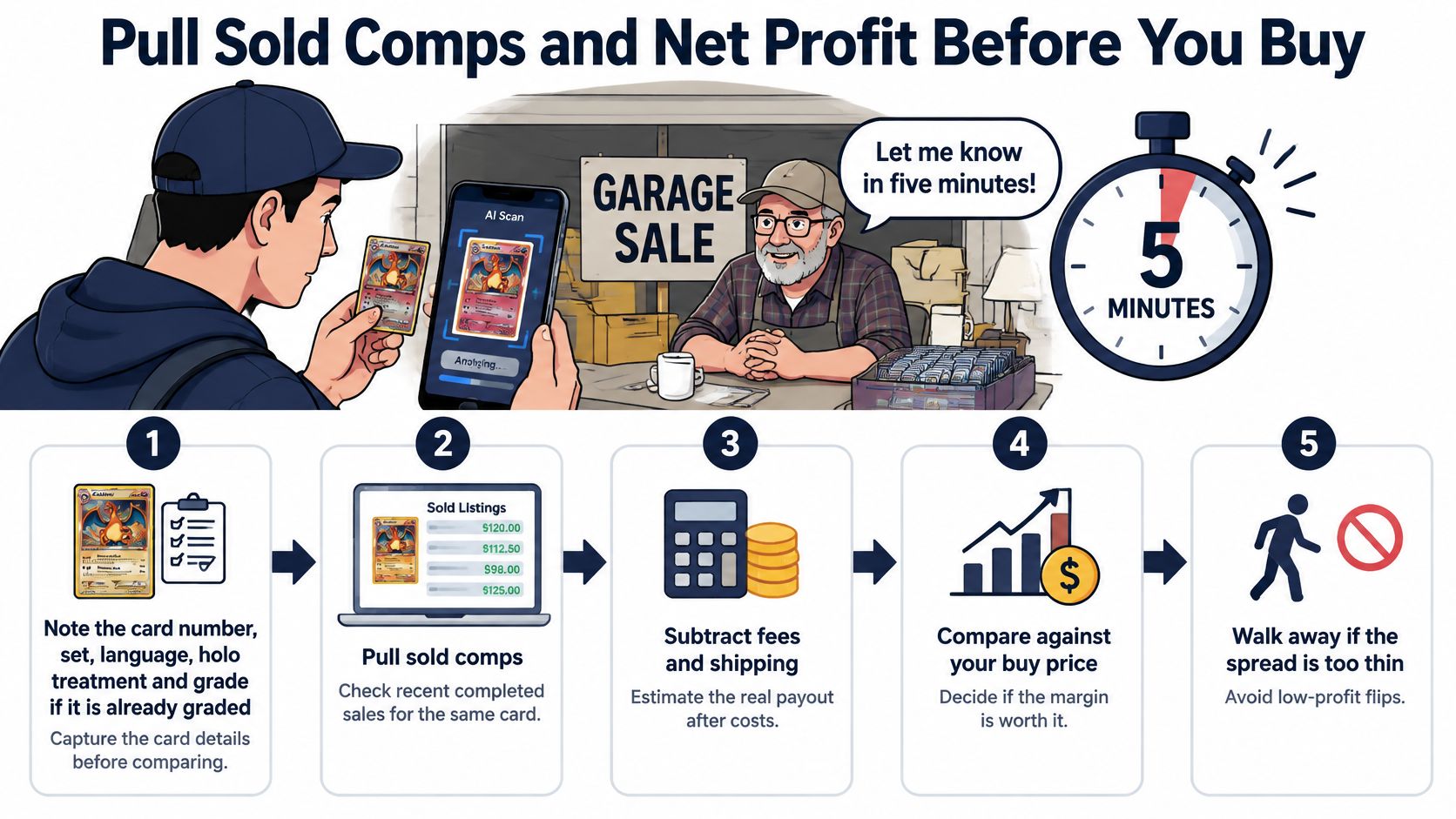
Convert the comp into a buying limit
Net profit = sale proceeds minus cost of goods, selling fees, shipping, supplies, and any additional acquisition costs. If you need help setting the floor, calculate your break even price before adding the profit you require.
Auction totals need extra care. Antique Trader's auction coverage distinguishes the hammer price from the total including a buyer's premium; neither represents the seller's net proceeds.
When identification is the bottleneck, ScanFlip AI offers AI photo scan without a barcode, barcode scan, and text search. Our app compares real-time sold comps across six major platforms, eBay, Poshmark, Mercari, Depop, Amazon, and Whatnot, with broader marketplace coverage including ThredUp, Facebook Marketplace, and TikTok Shop, and calculates net profit after fees with a red/green flip-or-pass verdict. Our sample result shows a $145 average, $15 cost, $102 estimated profit, and 14 sold comps; that's an illustration, not a Pokémon-card forecast.
Set your minimum acceptable profit before this weekend's garage sales, and write it in your phone. Don't lower it just because you've already spent time researching a card.
Grading Math and When a PSA 10 Is Not Profit
Expected graded value = the sum of each possible grade's probability multiplied by its sold price, minus grading, shipping, insurance, selling fees, and capital cost. For a buying decision, subtract your acquisition cost as well.
That's the model to use, not the highest PSA 10 result. If you can't make a defensible estimate of the lower-grade outcomes, you don't have a grading plan yet.
Raw and graded sold prices by raw value
The Folio grading-cost discussion reports the modern-card PSA 10 figures and approximate entry-level fees below. These are category-level observations, not promises for the card in your hand.
| Raw card value | Typical graded sold price | PSA entry fee | Likely net outcome |
|---|---|---|---|
| Modern, under $5 raw | About $48.61 at a PSA 10 | $39.99 to $59.99 | Little or no profit after fees and shipping |
| Modern, $5 to $10 raw | About $84.45 at a PSA 10 | $39.99 to $59.99 | May clear costs at a 10; verify every expense |
| Modern card graded PSA 9 | Hypothetical example: $30 to $40 | $39.99 to $59.99 | Usually weaker than a 10; often under the grading bill |
The under-$5 row is where sellers confuse revenue with profit. A $48.61 slabbed sale means little once the grading bill and selling costs take their share.
The $5 to $10 row offers more room, but landing a 10 still doesn't guarantee a worthwhile return. Acquisition cost, submission shipping, selling costs, and the wait for payment all stay in the math. And a 9 on that same card can sink the deal entirely, which is why the third row's probability matters as much as its price. If your copy has a whitening spot or off-centering you noticed at the bin, weight the PSA 9 outcome heavily before you submit.
Multipliers are context, not targets
Cardtrack's market report reported a median 11.8x PSA 10-to-raw multiplier for gradeable cards worth at least $20 raw, compared with 9.3x earlier. Treat that as a description of selected groups, not a target for your copy.
A multiplier says nothing about how likely your card is to hit the grade, how quickly it will sell, or whether the raw and slabbed buyers are equally active. Population reports add context too, but a small population doesn't prove future appreciation. You still need buyers completing purchases at prices that justify the submission.
Bin-side rule: Grade only when the probability-weighted proceeds after every cost beat selling the card raw.
The same split between raw condition and certified condition applies when checking baseball card values. Don't carry a grading assumption from one collectible category into another without checking that item's actual sold comps.
Worked Example From a Thrift Store Bin
Say I'm evaluating a hypothetical $6 raw card in a Goodwill aisle. It has sharp corners and apparently clean centering, and the condition-matched raw comps in this scenario run from $38 to $42. I'd use the lower end as the buying baseline rather than build the deal around the best result.
The seller doesn't charge extra because you intend to grade it, but the grading company does. That additional cost has to earn its place in the flip.
Compare the cash paths
PSA's submission updates list Value at $39.99 per card with an estimated 90–100 business-day turnaround, versus Standard at $59.99 and 70–80 business days; a 10-card Value submission costs $399.90 before shipping.
For this hypothetical comparison, assume a $75 PSA 10 sale, with the following illustrative shipping and selling costs. They're inputs for the example, not a universal marketplace fee schedule.
- Sell raw. $38 sale minus $6 cost of goods, $5 assumed marketplace fees, and $4 shipping leaves $23 before supplies and taxes.
- Grade and receive a PSA 10. $75 sale minus $6 cost, $39.99 grading, $9.75 assumed selling fees at 13%, and $4.50 buyer shipping leaves $14.76 before submission shipping, insurance, supplies, and taxes.
Use an eBay fee calculator with your actual category, account, and shipping inputs before treating an estimate as money you'll keep. A rounded fee allowance is useful for rejecting a marginal buy, not for final bookkeeping.
Choose the route, not the prettier sale total
I'd choose the raw route under these assumptions. It produces more money before the additional submission expenses, avoids the grading wait, and doesn't require a perfect-grade outcome.
The graded route is weaker even in its favorable outcome. If the card comes back below the target grade, the economics can deteriorate further. You can't fix that by pointing to a PSA 10 comp after paying the submission bill.
Also consider capital allocation. A batch submission requires payment before the eventual sales, and that money isn't available for the next estate sale or clearance opportunity while you wait.
Decision check: If grading makes the best plausible outcome worse than the raw sale, there's no reason to submit the card for this flip.
A card can be a sensible raw purchase and a poor grading candidate. If your business only works by grading it, this otherwise appealing find can still be a pass.
Cards Not Worth Picking Up at the Bin
Most ordinary bin commons are a pass as individual online listings. Cheap acquisition cost doesn't solve weak demand, small sale totals, or the time required to photograph and fulfill each order.
Take a hypothetical common from a $0.25 bin with a $0.99 sold comp. Assume $0.13 in selling fees and a $0.73 shipping label for this illustration, not as a quoted current shipping rate.
Run the loss before buying
$0.99 sale − $0.25 cost − $0.13 fees − $0.73 shipping = a $0.12 loss.
That's before a sleeve, protective packaging, or your labor. The card isn't cheap inventory. It's a transaction you're paying to complete.
Bulk lots can work, but only after you compare complete lots with similar contents. Don't add up optimistic individual-card values and call that the lot's likely sale total.
Recognize the other pass signals
- Heavy whitening, dents, or damaged corners. Buy only if condition-matched raw demand supports the purchase. A grading plan doesn't remove physical damage.
- Chase cards with crowded supply. A desirable-looking card can still have flat sold comps and too much competing inventory. Check STR before committing shelf space.
- A median below your profit floor. If realistic proceeds fail your minimum after expenses, pass. The highest outlier doesn't rescue the deal.
- An unidentified or questionable card. If you can't resolve the printing or authenticity before paying, don't value it as the expensive version.
Keep a short digital pass pile with photos and identifiers if you want to recheck cards when demand changes. You don't need to buy the physical pile to monitor it.
For bulk you already own, test a clearly described lot rather than creating endless low-value singles. Count the cards, disclose condition, show representative contents, and calculate shipping for the packed order.
At the next bin, separate identification from buying excitement. Run the sold comps, calculate the net, and leave anything that fails your minimum.
ScanFlip AI offers photo identification, barcode scanning, and text search to check sold comps and estimate net profit before you buy. Visit ScanFlip AI before your next sourcing trip, set your profit threshold, and use the flip-or-pass verdict to check whether that Pokémon card deserves space in your buy pile.