
Are Amazon Return Pallets Worth It? a Resale Math Guide
Yes, Amazon return pallets can be worth it for experienced resellers with inspection space, testing time, and a resale channel for the categories they buy, even when freight adds $150 to $400 per pallet. No, they aren't worth it if you're bidding on the manifest's retail total instead of the units you can sell.
You're looking at an auction on your phone, trying to decide whether this is smarter sourcing than another Saturday at Goodwill or the Ross clearance rack. The shrink-wrapped pallet looks manageable. The problem is that you're committing to the broken appliances, incomplete sets, and slow movers along with whatever caught your eye.
Buy the recoverable inventory, not the unboxing experience. That means putting a dollar value on the work before you put money into the lot.
Table of Contents
- Why Retail Value Is a Bad Guide to Pallet Profit
- What a Return Pallet Really Costs You
- Reading a Manifest Without Trusting Its Retail Total
- Sorting a Pallet Into Condition Buckets
- How to Calculate Net Profit Before You Bid
- Why Some Pallets Drain Money Even With Good Units
- Go or Pass Checklist and Your First Pallet Test
Why Retail Value Is a Bad Guide to Pallet Profit
A buyer paid $575 for an Amazon-return pallet advertised as containing nearly $10,000 in merchandise in a CNBC example summarized by the WISEPIM ecommerce returns report. The same account describes returned goods moving through resale, donation, recycling, or liquidation channels, and quotes a liquidation executive estimating that a retailer may recover only about 5% of the original sale price through liquidation.
That's a long way from the number printed beside retail value. It's also a different measure from what you, the reseller, can earn after processing and selling the contents.
A boxed appliance might look like the item on your BOLO list. Until you confirm the model, accessories, operation, and resale eligibility, though, you've got a potential sale, not money.
Retail value isn't your exit price
A manufacturer's original price doesn't account for an opened package, a missing charger, obsolete specifications, or buyer demand. Nor does it account for the seller who must clean, test, photograph, pack, and answer questions about that item.
The retailer's recovery figures underline that distinction. Direct Liquidation puts 2025 liquidation recovery at approximately 5% to 20% of an item's original sale price, placing that earlier estimate at the low end of its range.
Those are retailer recovery figures, not a promise about your acquisition cost or ROI. Don't turn them into a shortcut for calculating a bid.
Practical rule: A recognizable brand earns a comp check. It doesn't earn an automatic place in your profit forecast.
Buy for your operation
Are Amazon return pallets worth it when you already sell the categories, know how to test them, and can handle the leftovers? They can be. A reseller with appliance-testing equipment and local buyers has a different opportunity from someone selling clothing out of a spare bedroom.
The reverse is just as important. If you don't know the category, can't verify condition, or need immediate cash recovery, a cheap pallet can be an expensive distraction.
Set your bid against expected net proceeds from sellable units. Let sold comps establish the potential revenue, then make the acquisition price fit the work and uncertainty.
What a Return Pallet Really Costs You
Typical hidden costs on a mixed return pallet
The ranges below come from MDS's guide to buying Amazon pallets, which describes bids around 10% to 30% of listed retail value, freight around $150 to $400, and a representative mixed-return processing model.
| Cost line | Typical range | How it changes your number |
|---|---|---|
| Winning bid | About 10% to 30% of listed retail value | Your starting number before add-ons |
| Buyer premium and acquisition fees | Commonly a percentage of the winning bid, sometimes with flat lot, listing, or payment fees | Raises the real basis in every unit |
| Freight | About $150 to $400 per pallet | Can outweigh the bid on a small lot |
| Unloading and sorting labor | Scales with unit count, testing depth, cleaning, and photo standards | Value your hour before bidding |
| Non-sellable or damaged write-off | 15% to 30% of units in the representative model | Fewer sellable units must cover the whole lot |
| Marketplace fees | About 13% to 20% of gross resale revenue | Deducted before you calculate profit |
| Outbound shipping to customers | Packed weight, dimensions, destination, and service determine the charge | Multiply your estimated label cost by expected sales |
Treat those ranges as planning inputs, not guarantees. The condition mix and your selling channels decide whether the lot performs anywhere near that model.
Separate acquisition costs from selling costs
Your landed acquisition cost includes getting the inventory into your workspace. Include the premium, applicable taxes, freight, delivery access charges, and unloading arrangements rather than stopping at the winning bid.
Before paying, ask whether delivery assumes a loading dock, forklift, or liftgate. A freight quote built for commercial receiving does not answer what it costs to drop that pallet at a garage, storage unit, or basement workspace.
Then price the work. Sorting and photography are only part of the job. Testing, cleaning, researching replacement parts, packing, answering questions, and handling returns all burn hours against the same pool of sellable units.
Write-offs do not reduce your invoice
A damaged unit may produce no revenue, but you still paid to buy it, move it, unload it, and store it. That is why cost per recoverable unit beats dividing the bid by every box on the pallet. A $900 bid for 100 listed units is not $9 per unit if only 70 are sellable and the rest need disposal.
Do not bury disposal in a vague miscellaneous category either. Separate batteries, damaged electronics, packaging, and other material that needs an appropriate disposal route.
For another acquisition-focused reference, Million Dollar Sellers explains how to evaluate returned inventory for Amazon sellers. Use that context to check the lot's sourcing and receiving requirements, not to substitute a general pallet price for your actual quote.
Copy the table into a spreadsheet before bidding. Replace each range with the fee schedule, freight quote, packed shipping estimate, labor allowance, and realistic write-off rate for the lot in front of you. The break-even number is simple: expected net proceeds from sellable units must cover every cost above, with margin left for the units that looked fine until you plugged them in. A blank cell is not free.
Reading a Manifest Without Trusting Its Retail Total
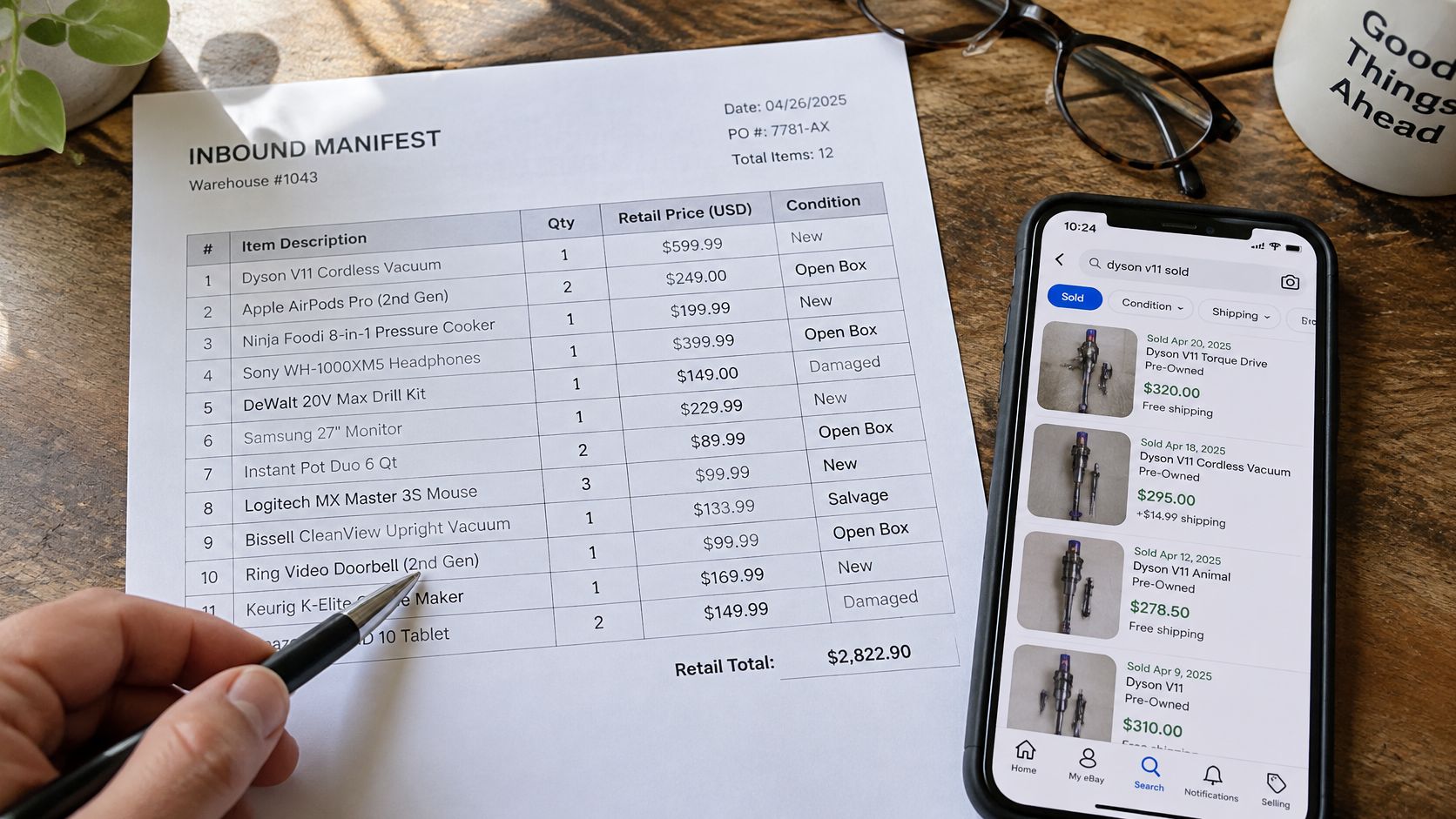
A manifest gives you an item list to investigate, not an appraisal. Wired describes liquidation marketplaces such as B-Stock showing registered buyers manifests and recommended retail prices before bidding; those references don't establish completeness, authenticity, or working condition.
Read the condition legend supplied by the seller. New, open box, damaged, and salvage should never receive the same recovery assumption, and a condition label isn't a substitute for understanding what the seller tested.
Start where the money appears to be
For a practical sample, pull the top five to ten highest-value lines. Search the exact ASIN or model, then verify that the sold item matches the configuration, accessories, and condition you expect to receive.
An expensive replacement component isn't the complete machine pictured on the manufacturer's product page. A matching brand name isn't enough.
Check sell-through rate, too. A strong sold price is less useful if your STR check suggests a long wait and you need the money back quickly. Use a consistent marketplace, category, and date window when comparing sold and available inventory.
Our guide to market value research explains how to make those comparisons without treating unrelated variants as equivalent stock.
Turn the sample into a conservative forecast
Say a manifest claims $2,000 in retail value, but matching the contents to realistic sold prices produces $900 in potential gross sales. In that hypothetical, the smaller figure is your starting revenue estimate, not your bid ceiling.
You still need to deduct processing, selling expenses, missing accessories, and uncertainty. Don't increase the estimate because the original retail total feels more impressive.
Before bidding, resolve these questions:
- Completeness: Are chargers, remotes, mounting hardware, and proprietary attachments included?
- Testing: Does tested mean powered on, or were the main functions checked?
- Resale eligibility: Are any items restricted, recalled, or counterfeit-prone?
- Disputes: What remedy, if any, applies to manifest discrepancies or shipment problems?
Read the actual purchase terms. Amazon's B-Stock terms describe mixed-condition merchandise and final purchases without a right to reject or return the shipment.
For a first purchase, I'd want the conservative recovery from the sampled top lines to justify the bid. Treat unsampled contents as uncertainty, not a hidden profit reserve.
Sorting a Pallet Into Condition Buckets
Say a 40-unit pallet arrives in your two-car garage. Before you start opening boxes, clear a testing surface, create labeled staging areas, and start a timer.
Match each package to the manifest and read its condition code. Then inspect the actual contents, because the label describes what you bought, not necessarily what you can promise a buyer.
Give every unit a destination
In this hypothetical lot, you finish with 25 working or open-box units, eight damaged or incomplete units, and seven salvage units. Keep those groups physically separate so an unchecked return doesn't drift into your ready-to-list stock.
Condition buckets for the 40-unit example lot
| Condition bucket | Units in example | Recovery value |
|---|---|---|
| Working or open box | 25 | Sold comps less fees and shipping |
| Damaged or incomplete | 8 | A fraction of sold comps, after parts or accessory cost |
| Salvage or parts | 7 | Zero, or disposal cost |
Power electronics on, then test their main functions with compatible equipment. A screen lighting up doesn't establish that a device charges, connects, records, or operates correctly.
For apparel, inspect under bright light for stains, repairs, odors, missing tags, and altered sizing. Set anything recalled, restricted, or suspicious aside for review rather than putting it into the listing queue.
Incomplete isn't automatically economical to repair
The damaged bucket needs its own decision. Check replacement-part availability, delivered cost, and the work required before ordering anything.
A missing proprietary attachment can make an otherwise functional item uneconomical. Don't buy parts merely to avoid admitting that a unit belongs in salvage.
Use specific defect descriptions and photographs when you sell incomplete goods. The guide to describing item condition can help you separate tested functions from assumptions.
Keep a unit out of the sellable count until you can defend its condition description.
In this scenario, 15 of 40 units, or 37.5%, aren't immediately ready for ordinary resale. That includes repair candidates, so it isn't necessarily the final write-off rate, but it is worse than the initial processing-ready forecast.
For conservative underwriting, count only the working group as dependable revenue. Write the bucket counts on the manifest before reaching for the calculator, and add repair or parts proceeds only when you have a defensible recovery plan.
How to Calculate Net Profit Before You Bid
Amazon's European liquidation purchase terms describe lots containing new merchandise, customer returns, unsellable goods, and products in varying physical condition. Your calculation has to reflect that mix. Only the units that will realistically sell earn back the bid.
Build the forecast in order
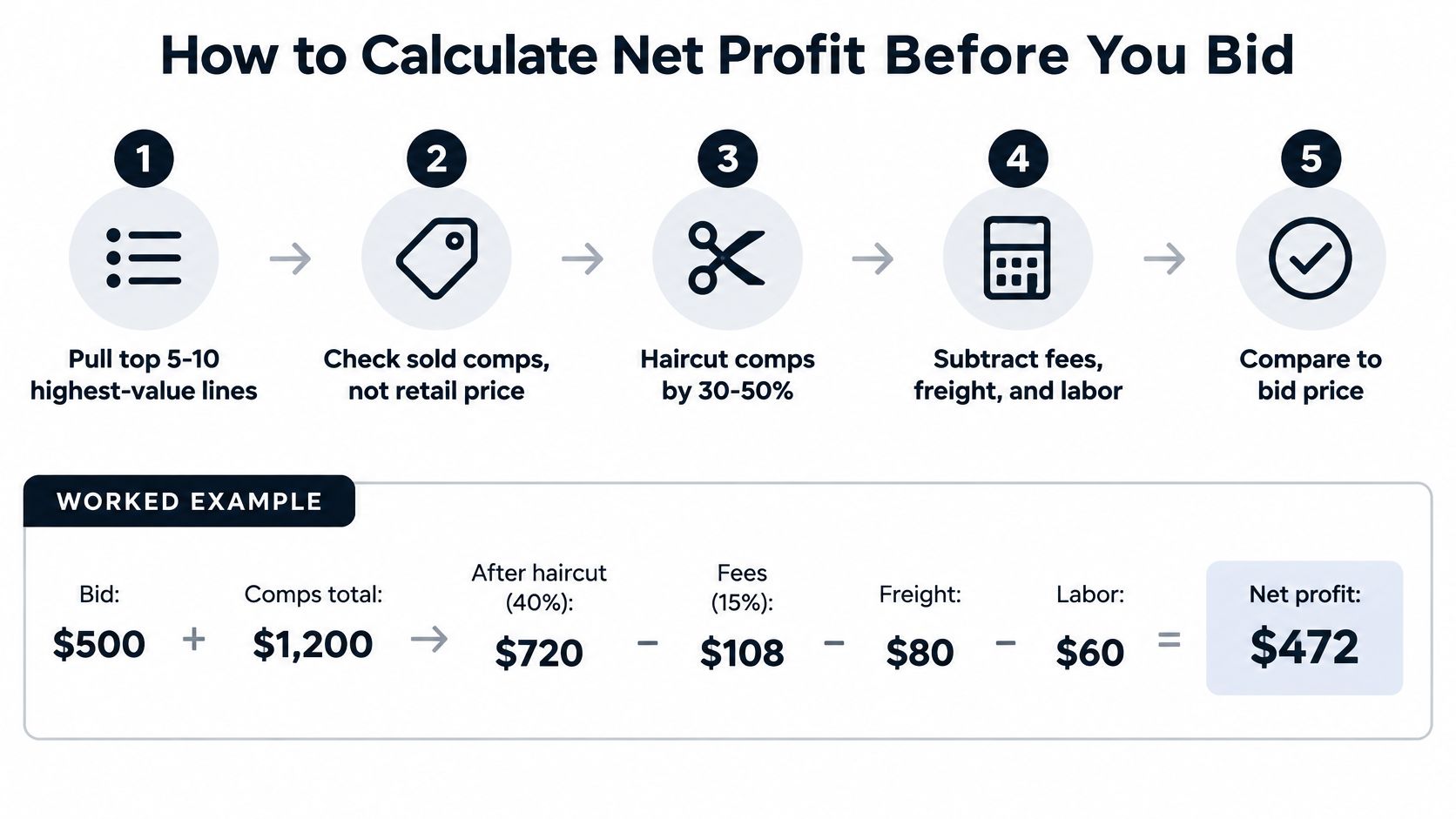
- Sample the valuable lines. Check the top five to ten manifest lines against matching sold prices.
- Adjust for the actual goods. Reduce expected recovery for condition and missing accessories, and record testing time as labor.
- Value each condition bucket. Use defensible sold comps for working stock, lower recovery for damaged items, and zero or disposal cost for unsellable goods.
- Count recoverable units. Divide the all-in cost by the units expected to earn revenue, not the shipped quantity.
- Deduct selling expenses. Subtract marketplace fees, seller-paid shipping, and supplies from forecast gross sales.
- Deduct acquisition and processing costs. Include the bid, freight, labor, applicable acquisition fees, and a defect reserve, with each expense counted once.
- Check the hourly return. Divide forecast profit by all expected working hours, and keep cash earnings before owner labor separate from profit after that allowance.
A pallet with good units can still fail
For this hypothetical, assume a $600 bid, $200 freight, and a $160 labor allowance. You expect 25 sellable units averaging $35, with a 15% marketplace fee assumption and $6 outbound shipping per sale.
Worked net profit example for a $600 pallet
| Line item | How it is counted |
|---|---|
| Winning bid | $600 starting cost |
| Freight | $200, quoted before bidding |
| Labor | $160 processing allowance |
| Total landed cost | $960 all-in acquisition and processing cost before sales |
| Gross sales | 25 × $35 = $875 |
| Marketplace fees | $875 × 15% = $131.25 |
| Outbound shipping | $150, or $6 per sold unit |
| Net result | $875 − $131.25 − $150 − $960 = −$366.25 |
Strictly speaking, landed inventory cost and labor are separate accounting lines. The all-in figure combines them here to make the buying decision clear.
The warning shows up before a single fee gets deducted. $960 ÷ 25 = $38.40 per sellable unit, already above the assumed $35 average sold price. Run the break-even the other way and it gets uglier: after the 15% fee and $6 shipping, each $35 sale returns $23.75, so 25 units return $593.75. With freight and labor fixed at $360, the bid that keeps this lot alive is roughly $234. Paying $600 means you need an average sold price near $52 per unit to break even, and the comps say $35.
The net profit calculation guide walks through separating these deductions. For percentage-based comparisons between sourcing options, Next Point Digital explains how to work out your ecommerce profit margins.
Pulling comps one app at a time is where the hours go. ScanFlip AI handles the lookup: AI photo scan works with no barcode on shoes, apparel, vintage, and electronics, the barcode scanner covers books and boxed retail, and text search prices anything by name. It pulls sold comps from eBay, Poshmark, Mercari, Depop, Amazon, and Whatnot, deducts marketplace fees and shipping, and returns a red/green flip-or-pass verdict against the minimum profit margin you set.
That prices individual units. Allocating pallet freight, processing labor, and defect losses to your cost of goods is still on you.
Why Some Pallets Drain Money Even With Good Units
Amazon says it helped sellers resell or donate nearly 391 million returned items in the United States and Europe in 2024, according to its sustainability reporting. That describes the scale of returns handling, not the quality of inventory available to your business.
For broader context, Amazon Web Services reports that U.S. online return rates averaged 15.2% in 2024, approximately three times the in-store rate. Plenty of incoming merchandise doesn't mean plenty of worthwhile individual listings.
Some categories consume the working day
Apparel can require measurements, cleaning, authentication, steaming, and detailed photography. A garment with an acceptable sold comp can still be a pass when stains or alterations make the work disproportionate.
Electronics need functional testing, compatible accessories, appropriate data wiping, and safe handling. Don't let a recognizable model distract you from battery damage, missing components, or functions you can't verify.
AMZ Prep's liquidation guide discusses claims of salvage lots being 60% to 80% unsellable, untested returns carrying 30% to 40% defects, and some pallets having only 20% to 30% immediately sellable units. Those are warnings from liquidation guidance, not universal benchmarks you should apply to every lot.
The practical issue is processing capacity. If you're already behind on photographing your estate sale finds, adding unfamiliar electronics won't fix the death pile.
An item can have resale value and still not deserve your listing time.
Plan recovery beyond individual listings
Give the remainder a route before the pallet arrives:
- Premium items: Sell individually with complete testing, condition photographs, and comps for the exact variant.
- Low-value goods: Bundle compatible items when a combined sale makes packing and customer service worthwhile.
- Bulky products: Check local demand before committing to parcel shipping.
- Repairable stock: Sell as repair inventory or parts when that produces a better return than refurbishment.
- Nonrecoverable material: Arrange appropriate recycling, disposal, or donation of usable goods rather than repeatedly moving it around the garage.
Don't assume that Whatnot, Facebook Marketplace, or TikTok Shop will absorb everything your main channel won't. Each route still needs a buyer, an accurate description, and enough proceeds to justify handling.
Make the decision at the unit level: Does the realistic sold comp justify the processing time after fees and shipping? If not, choose a lower-effort recovery route instead of forcing another marginal item into your queue.
Go or Pass Checklist and Your First Pallet Test
Before opening the bid screen, confirm the following:
- Manifest quality: The lot is itemized, with condition grades you understand.
- Comp support: Your top-line sample supports the purchase without optimistic assumptions.
- Freight certainty: You have a delivery quote that matches your receiving setup.
- Channel fit: You already have a workable sales route for each major category.
- Resale eligibility: You can legally and safely sell the intended inventory.
- Processing capacity: You have room and available hours to inspect, prepare, and dispatch it.
Set the ceiling before the auction starts
Use maximum bid = expected net sales proceeds − freight − acquisition charges − supplies − labor − defect reserve − required profit. Here, net sales proceeds means revenue after marketplace fees and outbound customer shipping, so don't subtract those expenses again.
Apply that formula to the hypothetical worked example. After fees and outbound shipping, expected proceeds are $593.75; subtracting $200 freight and $160 labor leaves only $233.75 for the bid before acquisition charges, supplies, a reserve, or required profit.
That's a break-even ceiling under those assumptions, not an attractive offer. A reserve and your profit requirement push the acceptable bid lower.
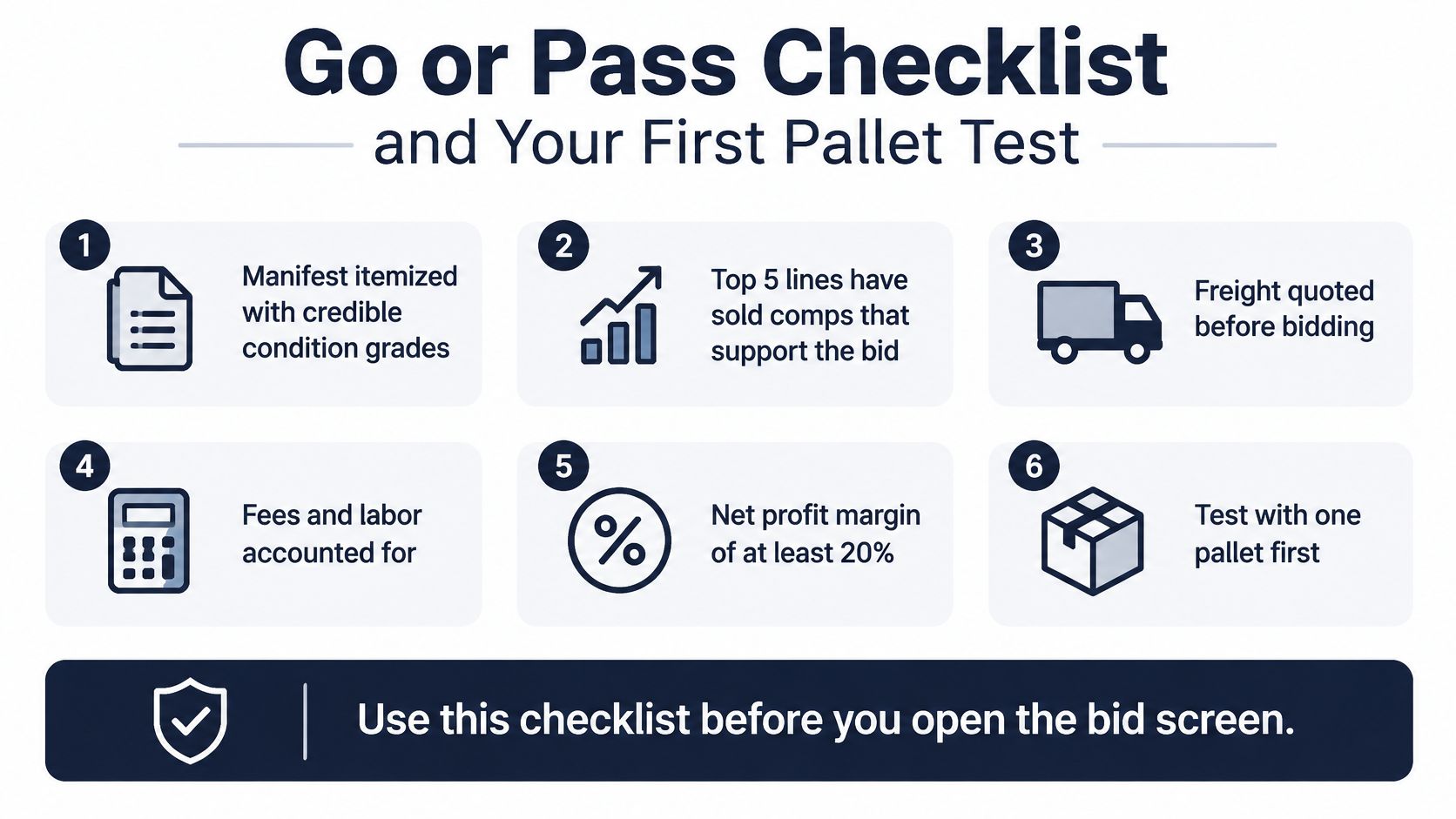
Test your forecast without chasing a win
Choose one live pallet listing this week. Save the manifest, sample the valuable lines, get freight quoted, and write down a maximum bid and pass-or-fail decision before the auction closes.
You don't have to purchase it to practice underwriting. If someone bids beyond your ceiling, let them.
If you do buy, record the actual sellable count, realized proceeds, total expenses, and working hours as the stock sells. Compare those results with your forecast so the next bid reflects evidence rather than your memory of the best item.
Pass on any pallet that doesn't clear your hourly threshold on conservative sold comps, however impressive the manifest looks.
Use ScanFlip AI to check individual pallet items through photo scan, barcode scan, or text search before you commit to the lot. Compare sold comps and net profit after fees, set your minimum margin for the red/green Flip or Pass Verdict, then put those item-level estimates into your full pallet calculation.