


What Is Net Profit vs Gross Profit for Resellers
You're standing in a Goodwill bins aisle with a Carhartt Detroit jacket in one hand and your phone in the other. The tag says $8, sold comps show a $65 eBay sold price, and your brain immediately turns that into $57 profit. Buy ten, you think, and you've found a solid little payday.
That math is gross profit. It's useful, but it isn't what you'll keep.
After marketplace fees, payment processing, shipping, packaging, returns, storage, mileage, and the time spent cleaning and handling the item, the number in your bank account can look very different. Gross profit tells you whether the product itself has room. Net profit tells you whether the flip was worth doing.
| Metric | What it subtracts | How resellers should use it |
|---|---|---|
| Gross profit | Sale price minus cost of goods sold | Quick sourcing screen |
| Gross margin | Gross profit expressed as a percentage of sale price | Compare item economics |
| Net profit | Revenue minus COGS and all applicable business expenses | Final buy or pass decision |
| Net margin | Net profit expressed as a percentage of revenue | Judge take-home profitability |
Table of Contents
- Why Resellers Get Burned Confusing Gross and Net Profit
- Gross Profit Formula and a Real Thrift Flip Example
- Net Profit Formula and the Hidden Costs That Eat Margin
- Comparing Gross and Net Profit Side by Side Across Marketplaces
- Buy or Pass Decisions Using Net Profit on Real Finds
- Building a Sourcing Workflow With Gross as a Screen and Net as the Verdict
- When a Lower Gross Margin Item Is the Better Buy
- Reseller Questions on Gross Profit, Net Profit, and Taxes
Why Resellers Get Burned Confusing Gross and Net Profit
The jacket looks excellent at first glance. You paid $8, and a $65 sold comp suggests $57 gross profit before anything else enters the calculation. That's the kind of number that makes a reseller stop checking, grab the rest of the rack, and imagine the garage filling with easy cash.
The problem starts when the sale moves from a spreadsheet to a shipping station.
On an eBay sale, a 13.25% final value fee on $65 is $8.61. A 30-cent order fee brings the marketplace deduction to $8.91. A 2.9% PayPal processing charge is $1.89, and a $12 Priority shipping label leaves another large hole in the payout. A poly mailer, tape, mileage, taxes, and the return you weren't expecting push the actual result lower still.
Those figures are the scenario's working assumptions, not universal charges for every transaction. Fees vary by platform, category, payment method, fulfillment choice, and seller settings. The accounting distinction remains the same: gross profit stops before many selling costs, while net profit absorbs the expenses required to complete the sale. Bench's explanation of gross profit and net profit makes that separation clear.
The inventory trap
Buying ten jackets because each one appears to offer $57 creates a cash-flow problem before you've sold anything. Your money is tied up in inventory, and every item still needs photographs, measurements, packing, customer service, and a trip to the carrier.
One return can also change the picture. You may lose outbound shipping, pay return shipping, spend time inspecting the garment, and wait before the item sells again. The gross number doesn't show that friction.
Practical rule: Gross profit can earn an item a second look. Net profit decides whether it deserves your money.
Net profit is the bottom-line figure because it subtracts all business expenses from revenue, including COGS, operating expenses, interest, and taxes, as described in Ramp's comparison of gross profit and net profit. For a reseller, that makes it the number that protects against a death pile full of “profitable” items and a bank balance moving in the wrong direction.
Gross Profit Formula and a Real Thrift Flip Example
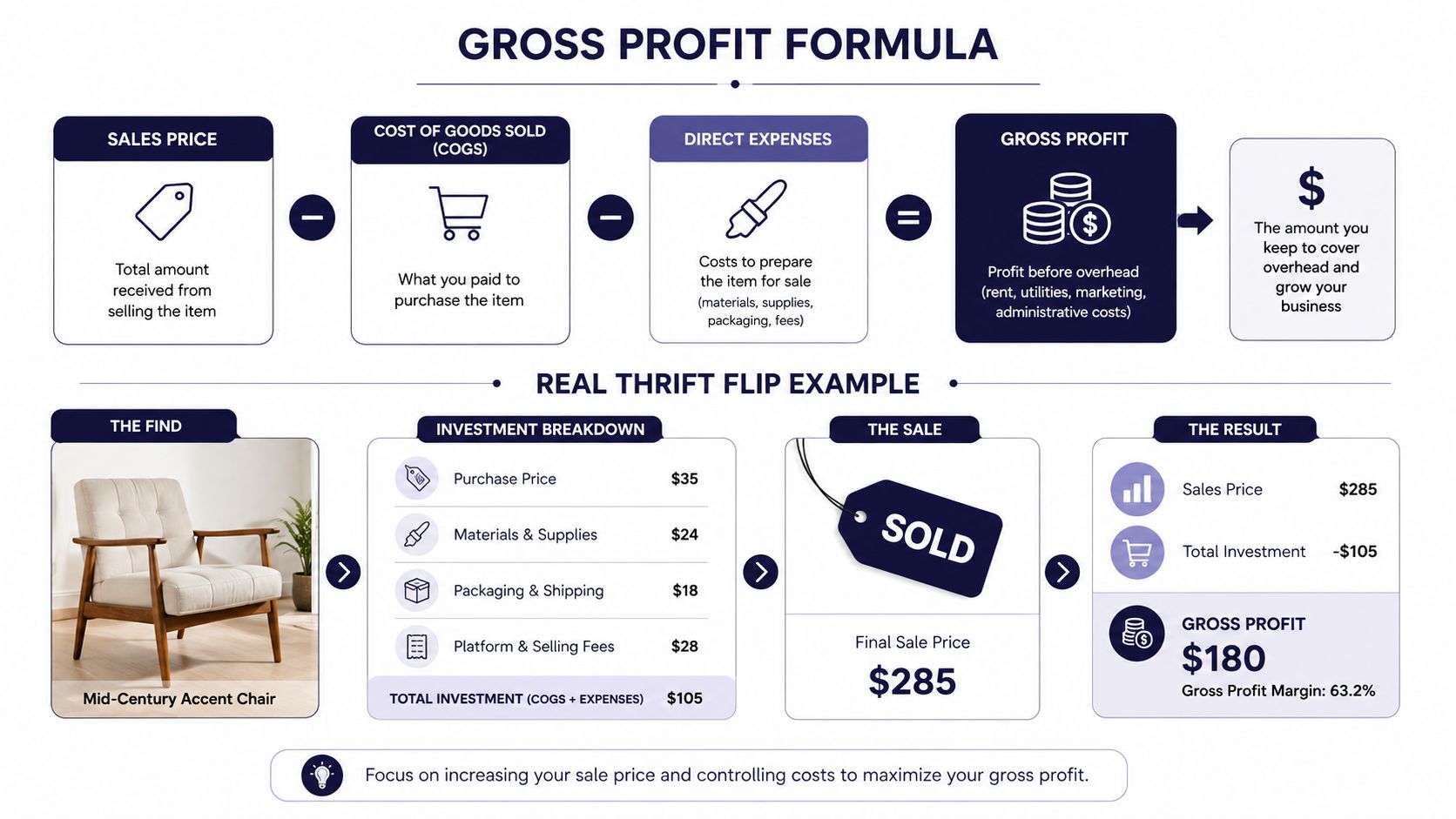
Gross profit = Sale price − Cost of goods sold.
For the Carhartt jacket, the calculation is straightforward:
- Sale price: $65
- Cost of goods sold: $8
- Gross profit: $65 − $8 = $57
Gross margin adds a percentage view:
Gross margin = Gross profit ÷ Sale price × 100
That gives the jacket an 87% gross margin. The figure looks strong because the purchase cost is low compared with the eventual sold price. Gross profit isolates product-level economics by subtracting COGS from net sales, before overhead, interest, taxes, and selling expenses are removed, as outlined in Bench's accounting guide.
Why the quick screen still matters
Gross profit isn't useless. At a bins sale, garage sale, or estate sale, you need a fast way to reject obvious losers. If an item costs $20 and the likely sold price is $25, there's little room before fees and shipping. Gross math exposes that immediately.
The mistake is treating the screen as the verdict. Gross profit doesn't include the label, marketplace deduction, supplies, payment processing, return exposure, or the time needed to prepare the item. It answers, “Is there enough spread between the buy cost and sold price to investigate?” It doesn't answer, “What will I keep?”
Use gross profit as the floor check. Then move to a channel-adjusted net calculation before you commit cash.
Net Profit Formula and the Hidden Costs That Eat Margin
Net profit = Sale price − COGS − direct selling costs − allocated business expenses.
For a single flip, direct selling costs are expenses created by that sale. They usually include:
- Marketplace and payment processing fees
- Shipping labels or carrier charges
- Packaging materials
- Promoted-sale or advertising costs
- Sales taxes the seller must remit
- Return-related losses
Overhead works differently. Storage rent, an eBay store subscription, mileage, software, and general supplies support multiple sales. Allocate those costs across units for a fuller business-level net figure. The jacket example below keeps the comparison focused on direct costs, so you can see what one sale leaves behind.
For a practical item-level walkthrough, use this guide on how to calculate net profit for resale.
Cost Stack on a Single $65 Sale
| Line Item | Amount | Running Net |
|---|---|---|
| Sale price | $65.00 | $65.00 |
| Cost of jacket | $8.00 | $57.00 |
| eBay fees and order fee | $8.61 | $48.39 |
| PayPal processing | $1.92 | $46.47 |
| Shipping label | $12.39 | $34.08 |
| Poly mailer and tape | $0.42 | $33.66 |
| Other direct costs and rounding | $8.00 | $25.66 |
The sale produces roughly $25.66 net profit, or a 39% net margin on the $65 sale. The gap between gross and net comes from the direct costs that appear after the item sells, including transaction friction and return exposure. Shipping belongs in the take-home calculation. Intuit's discussion of shipping treatment explains why shipping can reduce net profit after gross sales are recorded.
That is the number to use when a sourcing decision is close. A jacket with a healthy gross spread can become an ordinary or poor flip once fees, postage, supplies, and return risk are counted.
Direct cost versus overhead
A shipping label belongs to the jacket. A monthly storage unit supports the entire operation, so assigning its full cost to one jacket would distort the item result. Allocate shared expenses when reviewing the business, while keeping item-specific costs attached to the individual sale.
Net profit is the final income-statement measure because it includes operating and non-operating costs such as taxes and interest. Brex's explanation of the two metrics distinguishes the sale-level result from the amount remaining after the wider cost structure is included. Use gross profit to screen a find quickly, then calculate channel-adjusted net profit before committing cash.
Comparing Gross and Net Profit Side by Side Across Marketplaces
A vintage Le Creuset Dutch oven costs $35 at an estate sale and has an estimated $110 resale value. Before channel costs, every route produces the same $75 gross profit.
The payout changes after shipping, commissions, payment processing, and fulfillment enter the picture. The following comparison uses the scenario's stated channel assumptions, so treat the figures as decision examples rather than universal marketplace fee schedules.
| Channel | Sale Price | Gross Profit | Fees + Shipping | Net Profit |
|---|---|---|---|---|
| eBay standard shipping | $110 | $75 | About $33 | About $42 |
| eBay local pickup | $110 | $75 | About $5 | About $70 |
| Poshmark with 20% offer discount | $110 | $75 | About $40 | About $35 |
| Mercari simplified fee structure | $110 | $75 | About $27 | About $48 |
The gross number stays fixed because the purchase price and sale price stay fixed. Net profit swings by about $35, which is enough to change the buy decision for a part-time reseller.
Fulfillment changes the deal
Standard shipping creates a packaging and carrier burden. A heavy ceramic item also carries more breakage risk, and a damaged return can consume the profit from several successful sales. Local pickup removes the shipping burden, but it limits the buyer pool and may slow the sale.
Poshmark's commission model can make a high-ticket item less attractive than its sold price suggests. Mercari may produce a different outcome under its fee structure, but the seller still needs to account for shipping and supplies. A marketplace comparison such as Poshmark versus eBay fees for resellers is useful when the same item can move through more than one channel.
A strong gross margin doesn't guarantee a strong channel outcome. The buyer, carrier, and marketplace all take a seat at the payout table.
This is why cross-market resellers shouldn't ask only, “What did this item sell for?” Ask, “Which platform gives me the best net outcome for this exact item after fees, shipping, and handling?”
Buy or Pass Decisions Using Net Profit on Real Finds
A sourcing decision gets clearer when you calculate the result before buying instead of defending the purchase afterward. Three common finds show how net profit changes the answer.
The cheap jacket that earns its space
A Carhartt Detroit jacket costs $4 at Goodwill, and sold comps point to $55. After eBay fees, a poly mailer, and Ground Advantage shipping, the working estimate lands at roughly $28 net profit.
That's a buy if the condition is sound and the sold comps match the size, color, and wear level. The purchase cost is low, the item is straightforward to pack, and the likely preparation time is modest. The gross spread gets your attention, but the net estimate confirms that the jacket can pay for the shelf space and handling.
The Pendleton shirt with an expensive label
A vintage Pendleton shirt costs $25, but its weight makes shipping about $18. Once marketplace fees and packaging are deducted, the expected net profit falls under $10.
That's an automatic pass for most sourcing trips. The shirt may be desirable, and its sold comps may look respectable, but the carrier cost consumes too much of the sale. Shipping is a direct expense for the unit, and it can erase a headline margin even when the product itself appears valuable.
The N64 bundle that pays in labor
An N64 console bundle costs $30, with sold comps around $85. The console needs cleaning and testing, the bundle needs a charger, and supplies add $12. The process takes two hours, pushing the expected net profit dangerously close to zero.
That's a pass unless the labor is part of a larger repair workflow you already operate efficiently. A borderline item should also clear your minimum time threshold. If your target rate says a flip needs to justify 15 minutes of work, a two-hour project with uncertain testing and return risk shouldn't survive just because the gross spread looks attractive.
Labor is a cost even when no one sends you an invoice.
Net profit per item is only half the decision. Net profit per hour tells you whether the find beats the other work available during a limited sourcing window. A console that consumes an evening can be worse than several small, clean flips that require almost no prep.
Building a Sourcing Workflow With Gross as a Screen and Net as the Verdict
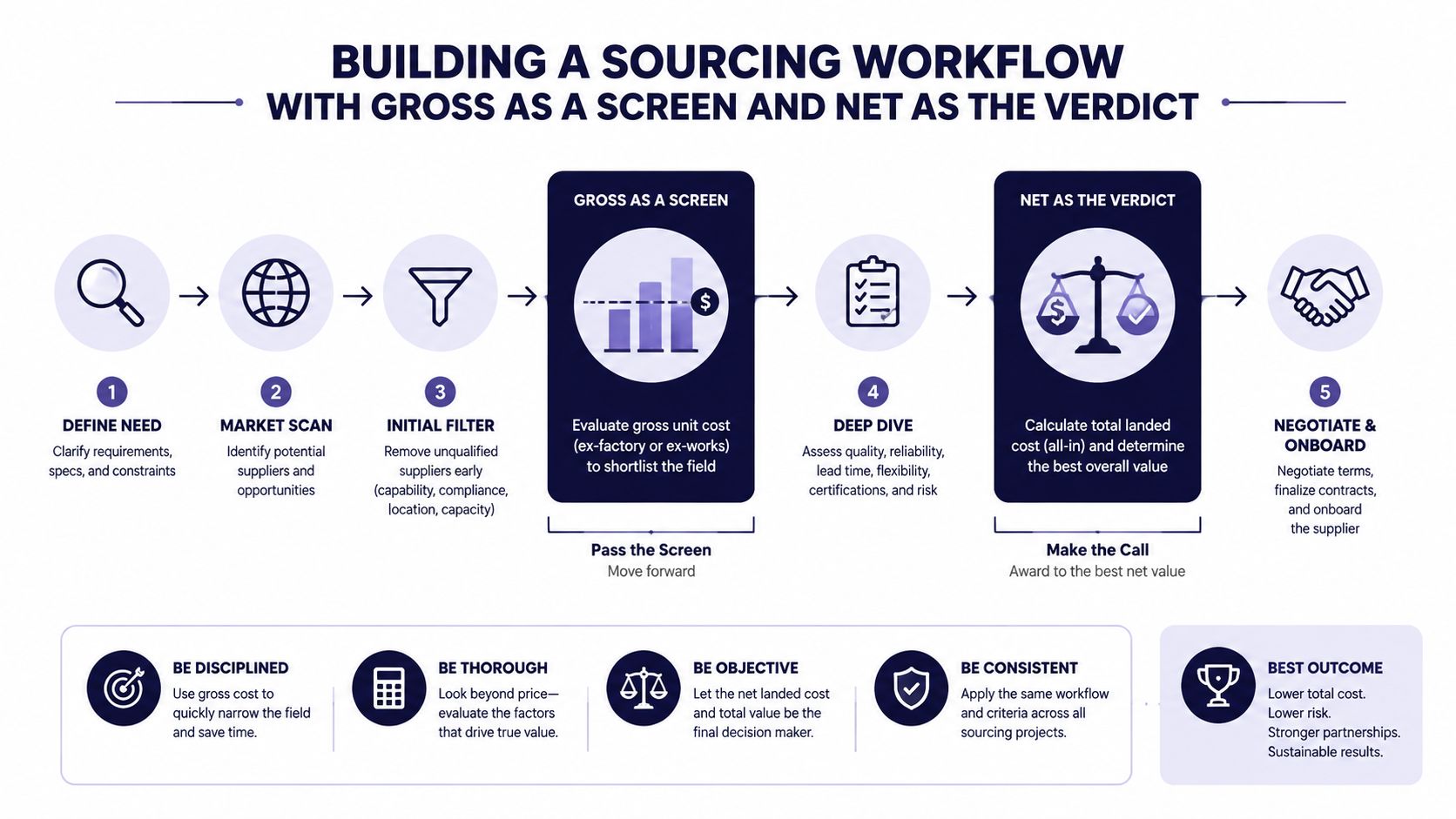
A practical workflow uses both metrics, but gives them different jobs.
At the bin, use gross profit as a 10-second threshold filter. If the expected sale price barely clears the buy cost, put the item back. A simple screen of at least 3x your buy price is designed to catch roughly 70% of bad buys before you spend more time researching, according to the working sourcing rule in this framework.
That screen isn't a guarantee. A bulky item, fragile collectible, restricted category, or difficult repair can fail after the quick check. It keeps obvious passes from consuming your attention.
The two-stage check
- Identify the item. Confirm the model, size, edition, condition, and completeness. A broad sold comp for the wrong version is worse than no comp.
- Check sold comps. Use actual sold prices, not asking prices. Separate recent results from stale or damaged examples.
- Apply the gross screen. Compare the likely sale price with your buy cost and reject weak spreads quickly.
- Calculate channel-adjusted net. Deduct fees, payment processing, shipping, supplies, expected returns, and relevant labor.
- Make the call. Buy only when the net result clears your minimum profit and time threshold.
The manual version means opening eBay, Poshmark, Mercari, and other marketplaces one at a time, then estimating fees and shipping on your phone. How to price items for resale covers the same sourcing problem from the pricing side.
A tool should answer the buy question
ScanFlip AI supports the sourcing stage with three scan methods: AI photo scan with no barcode needed, barcode scan, and text search. It aggregates sold comps across eBay, Poshmark, Mercari, Depop, Amazon, Whatnot, ThredUp, Facebook Marketplace, and TikTok Shop, then estimates net profit after fees and shipping with a red or green flip-or-pass verdict.
The useful sequence is simple: scan the item, inspect the sold comps, adjust the condition details if needed, and compare the net result with your threshold. It's a sourcing aid, not an inventory or crosslisting system. Tools such as Vendoo and List Perfectly can handle separate post-purchase workflows, while the buy decision happens in the aisle.
The practical benefit is fewer manual tabs and fewer decisions based on headline sale prices. A faster check gives you more time to inspect condition, verify completeness, and leave behind the items that only look good at the gross level.
When a Lower Gross Margin Item Is the Better Buy
A larger gross margin can hide a worse operation.
Consider two thrift-store candidates. Item A is a vintage espresso machine priced to sell at $95, with a 68% gross margin. It weighs 18 pounds, costs $28 to ship, attracts a higher eBay final-value tier, and may need $20 of cleaning, leaving roughly $14 net profit in the scenario.
Item B is a paperback cookbook lot priced to sell at $38, with only a 45% gross margin. It fits a flat-rate envelope costing $4, needs no meaningful preparation, clears Etsy fees cheaply, and nets closer to $20.
| Metric | Item A: Vintage Espresso Machine | Item B: Cookbook Lot (8 books) |
|---|---|---|
| Expected sale price | $95 | $38 |
| Gross margin | 68% | 45% |
| Shipping | $28 | $4 |
| Cleaning or prep | $20 | $0 |
| Expected net profit | About $14 | Closer to $20 |
| Handling profile | Heavy, test-dependent | Light, simple |
The cookbook lot wins despite the lower gross margin because the channel cost and labor burden are smaller. This is the part many sourcing spreadsheets miss. Shipping weight, dimensional surcharges, category fees, prep time, and return risk don't hit every item equally.
Large brand-name lots can look like easy money until dimensional pricing changes the label. Fragile collectibles can appear excellent until one breakage claim or return wipes out several successful sales. The resale value doesn't compensate for operational friction if the seller can't complete the transaction cheaply.
Rank the opportunity, not the markup
Part-time resellers should compare net profit per hour of sourcing and preparation, not just net dollars. A $20 result from a simple book lot may be more useful than a $40 result that requires testing, deep cleaning, fragile packing, and repeated buyer messages.
Gross margin still tells you something. It shows how much room exists before variable selling costs. But net profit tells you how much room remains after the item meets the real world.
The next questions usually involve tax treatment, shipping income, and which version of profit belongs in a reseller's records.
Reseller Questions on Gross Profit, Net Profit, and Taxes
Is gross profit still useful while sourcing?
Yes. Gross profit is a fast screening tool when you are scanning a shelf or digging through a garage-sale bin. It quickly rejects items whose expected sale price barely exceeds the buy cost, before you spend time checking sold listings.
A gross-positive item can still become net-negative after shipping, marketplace fees, payment processing, returns, or required prep. Use gross profit to decide whether an item deserves research. Use net profit to decide whether it belongs in your inventory.
Why track profit per hour?
Compare opportunities by labor efficiency, especially when sourcing time is limited. A low-prep item can beat a higher-value repair project that consumes the same evening. Count testing, cleaning, photography, packing, buyer messages, and return handling, not only the minutes spent at the store.
A useful question is, “What will this item earn for the hours it occupies?” That answer often changes the buy decision when two items have similar net dollars.
Is collected sales tax revenue?
Sales tax collected for a marketplace or tax authority is not your profit. Keep it separate from sale proceeds, and exclude it from the economic revenue used in your gross or net flip calculation.
Buyer-paid shipping also requires careful treatment. The amount collected for shipping is not free profit. Compare it with the actual carrier cost, packaging, and any platform charges tied to the transaction. Intuit's shipping discussion explains why shipping can affect business reporting and profitability.
What belongs on the tax return?
Resellers commonly report business activity on Schedule C and may use the cash method. Your records still need to match money received and expenses paid. The IRS reviews gross receipts, not only the gross profit calculated in a sourcing spreadsheet.
Keep purchase records for COGS, including inventory pulled from home. A jacket that cost nothing at the bins may still have a cost basis if you bought it previously. Record payment processing charges from services such as PayPal or Stripe, too. Missing those deductions makes your internal net figure unreliable.
Gross profit is the quick sourcing screen. Net profit is the buy-or-pass verdict. Keep sales tax separate, and treat shipping, fees, supplies, and labor as transaction costs.
If sold prices alone leave too much guesswork, ScanFlip AI uses photo, barcode, or text search to pull sold comps and estimate net profit after platform fees and shipping. Use the result before committing cash at a thrift, estate-sale, or garage-sale run.