
Barcode Scanner for Inventory: Sourcing Math
You're standing in a Goodwill aisle with a sealed board game in one hand and your phone in the other. The barcode scanner shows a $45 sold comp, and for a second it looks like an easy pickup. Then you notice the box is oversized, the recent sales are slower than the headline result suggests, and the fees and shipping leave far less than the gross price promised.
That's the problem with using a barcode scanner for inventory as an identification tool only. A UPC can tell you what the product is, but it can't tell you whether the item belongs in your cart. The useful question is whether the flip still works after cost of goods, marketplace fees, postage, condition, and expected sell-through.
Table of Contents
- The Aisle Test That Saves You From the Death Pile
- Hardware Scanners Versus Mobile Scanning Apps
- Doing the Real Math on Your Scanned Finds
- Building a Sourcing Workflow That Actually Works
- Common Scanning Mistakes That Kill Your Margins
- Fitting Your Scanner Into Your Reselling Stack
The Aisle Test That Saves You From the Death Pile
A barcode scan is the beginning of the decision, not the decision itself. The code may return a catalog match and a high sold price, but the matched item can still be the wrong edition, incomplete, damaged, or packed in a way that turns shipping into the margin killer.
At the shelf, I check the physical product against the scan before I trust the result. For a board game, that means confirming the edition, checking the seal, looking for crushed corners, and estimating the packed dimensions. A barcode decode confirms the characters encoded on the label. It doesn't confirm completeness, condition, authenticity, or whether the marketplace record matches the exact item in your hand.
Practical rule: A green scan is permission to do the math, not permission to buy.
The history behind the technology is solid. Major U.S. grocery-industry participants selected the Universal Product Code as a common standard on April 3, 1973, and a 10-pack of Wrigley's chewing gum became the first retail product scanned with a UPC on June 26, 1974, at a Marsh Supermarket in Troy, Ohio. GS1 says more than 1 billion products now carry GS1 barcodes worldwide, and the standard evolved into identifiers such as the GTIN across international supply chains. You can read the GS1 account of the barcode's development and reach.
That interoperability is useful for books, media, games, electronics, and boxed retail goods. It replaces repeated manual product entry with a consistent identifier that can connect to product records, pricing databases, sales history, and stock records.
But gross sold price is not net profit. If the item costs $12, needs special packing, attracts platform fees, and takes months to sell, the headline comp can be actively misleading. The best barcode scanner for inventory helps you move quickly, but the buying decision still belongs to the complete calculation.
Hardware Scanners Versus Mobile Scanning Apps
Dedicated laser or area-imaging scanners make sense at a receiving desk, checkout counter, or warehouse station where someone scans the same type of label repeatedly. They're durable, quick, and designed to send decoded characters into inventory software. A Bluetooth handheld can also help when a team counts stock across shelves instead of bringing every item to a fixed workstation.
That isn't the usual reseller workflow. A thrift picker moves between clothing racks, bookshelves, bins, garage-sale tables, and retail clearance aisles. The phone is already needed for photos, sold comps, messages, notes, and shipping estimates, so adding a separate scanner often creates another device to charge, pair, carry, and troubleshoot.
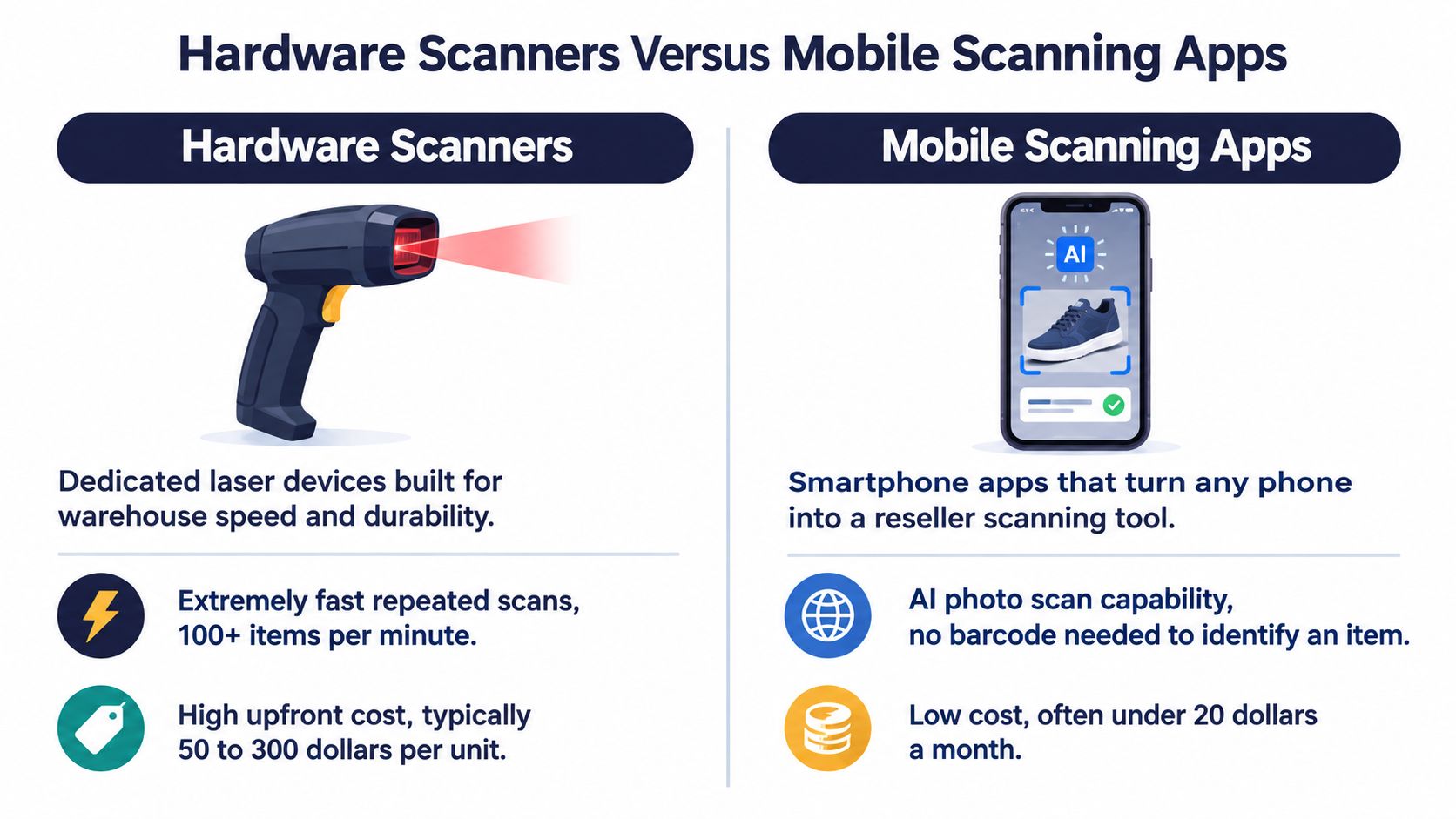
The bigger distinction isn't scan speed. It's what happens after the barcode is decoded.
| Dedicated hardware | Mobile scanning app |
|---|---|
| Sends an identifier into a connected system | Can identify and research the item in the aisle |
| Useful for repeated stock movements | Useful for sourcing decisions |
| Usually depends on configured inventory software | Can combine scans with sold comps and fee math |
| Strong fit for controlled warehouse workflows | Strong fit for thrift, arbitrage, and garage-sale sourcing |
A phone-based tool can compare sold prices across marketplaces instead of returning a static catalog record from one database. That matters for sellers working across eBay, Poshmark, Mercari, Amazon, Whatnot, and other channels, because the same item can have different fees, shipping expectations, and buyer demand on each platform.
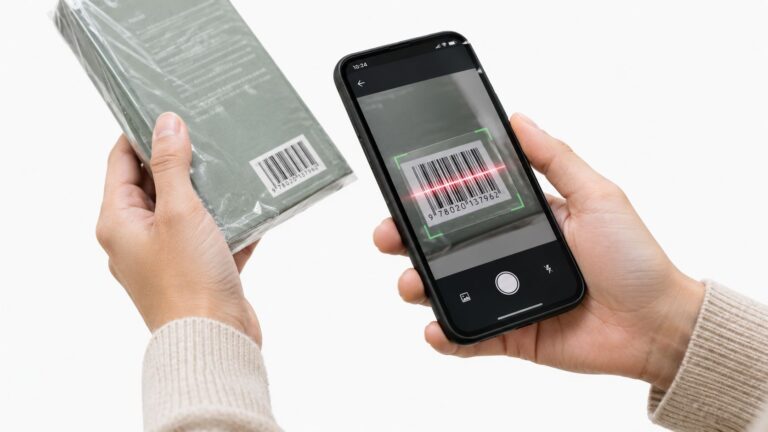
For resellers who need identification plus the buy decision, a mobile barcode scanner for inventory fits the workflow better than a warehouse gun. ScanFlip AI offers AI photo identification when there's no barcode, barcode scanning for tagged products, and text search when the item can't be photographed or decoded. The practical advantage is keeping the research and sourcing decision on the phone already in your hand.
Doing the Real Math on Your Scanned Finds
A scanner that shows the highest sold price without subtracting costs is a fast way to buy a slow-moving death-pile item. I want the calculation to answer one question before I spend money: what will I keep?
The book scanner calculation
Amazon lists Books, DVD, Music, Software, and Video at a 15% referral fee, and media items carry a $1.80 closing fee per sale, according to Amazon's seller pricing. Individual-plan sellers also pay $0.99 per item sold, while Professional sellers avoid that per-item charge.
Take a book with a $24.99 sale price. If the book costs $3 and postage is $4.63, the Individual-plan calculation is:
- Sale price: $24.99
- Referral fee at 15%: $3.75
- Media closing fee: $1.80
- Individual-plan fee: $0.99
- Postage: $4.63
- Cost of goods: $3.00
- Approximate amount left before supplies: $15.61
That result is useful because it separates a real buy from a tempting gross comp. Amazon also calculates the referral fee from total sales price, including buyer-paid delivery charges, so shipping can affect the fee base rather than sitting outside the calculation.
For a lower-dollar clearance book bought for $2.50, sold for $14.99, with the buyer paying $4.63 shipping, the 15% referral fee applies to $19.62, producing about $2.94 in referral fees. After the closing fee, Individual-plan fee, postage, and cost of goods, roughly $6.76 remains before supplies. That's why a $15 sold comp isn't automatically a buy.
The eBay electronics calculation
eBay calculates its final value fee on the total sale amount, including the item price and shipping. The percentage can range from 2.5% to 15.3% by category, and orders over $10 receive a $0.40 per-order fee, as explained in eBay's seller-fee guidance.
Suppose a household electronic shows a $42 sold comp. The buyer pays $5.50 shipping, and the category fee is 13.6%. The fee base is $47.50, so the percentage fee is $6.46, followed by the $0.40 per-order fee. If the item cost $6 and postage costs $5.50, the rough calculation is:
- Sale and shipping collected: $47.50
- eBay fees: $6.86
- Shipping: $5.50
- Cost of goods: $6.00
- Rough amount left before packing materials: $29.14
If you're treating the $42 as the entire sale amount and subtracting shipping again from a different base, your result will differ. The point is to use the actual fee structure and shipping setup, not a generic percentage.
Use a net-profit calculation method for scanned inventory that includes the platform, sale price, shipping, fees, and buy cost. The barcode identifies the item. The calculator decides whether the item deserves shelf space.
Building a Sourcing Workflow That Actually Works
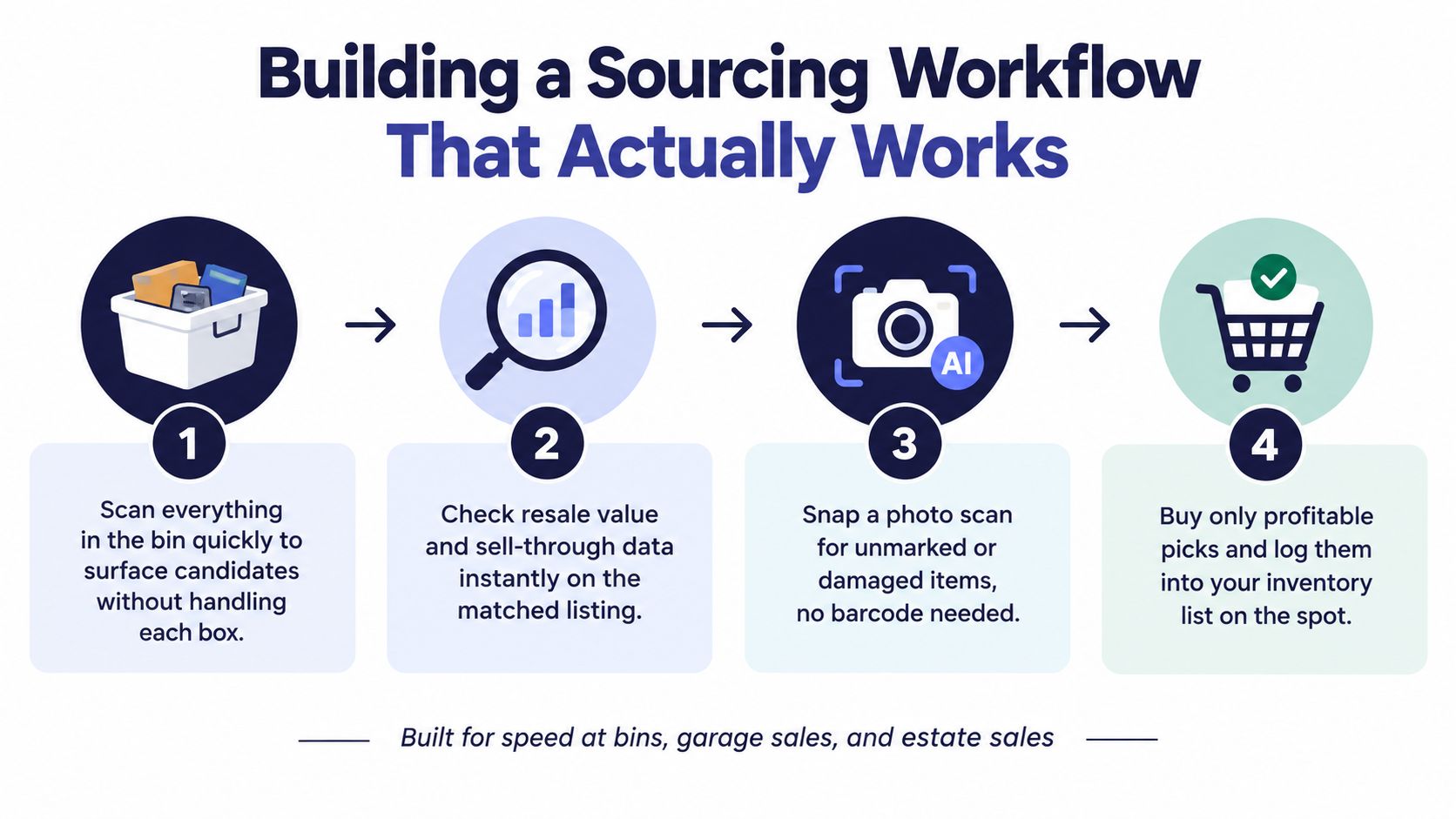
Speed matters when you're digging through bins or working an estate sale before another picker reaches the same table. A repeatable process keeps you from spending five minutes researching an item that was never going to meet your minimum profit.
Start with a quick pull test
Pick up the item only if it has a plausible resale path. A sealed game, recognizable electronics model, media item, or branded boxed product gets a quick scan. A damaged generic item with no clear demand usually doesn't deserve the same attention.
Scan the UPC, compare the returned record to the item, and look at recent sold comps rather than active listings. Check the condition and variant before entering your cost of goods. If the likely net profit is already below your minimum, put it back immediately.
Use the right fallback
Barcodes disappear on thrift inventory. Vintage clothing may never have had a useful UPC, shoes can have missing or unreadable labels, and collectibles often depend on visual details that a code doesn't capture.
A practical fallback order is:
- Barcode scan: Use it for books, media, games, electronics, and boxed retail goods with readable labels.
- Photo identification: Use the camera for untagged apparel, shoes, collectibles, and damaged packaging.
- Text search: Search the brand, model, title, or visible identifying details when the item can't be photographed or scanned.
ScanFlip AI supports those three methods, AI photo identification, barcode scanning, and text search, then returns a flip-or-pass decision based on the user's required profit or margin. For a reseller, that means the workflow can continue when a barcode-only app stops.
Set the buy rule before the aisle gets crowded
Choose a minimum net-profit or margin requirement before sourcing. Don't change it because a high gross comp makes an item feel exciting. If shipping is uncertain, estimate the packed size and use a realistic postage figure before committing.
At a garage sale, record the buy cost while the seller is still in front of you. At Ross or another clearance rack, include sales tax if it affects your actual cost. At the bins, keep moving when an item fails the threshold. A fast pass protects more profit than a slow maybe.
For eBay-specific sourcing decisions, this barcode scanning workflow for eBay sellers is most useful when it keeps the scan tied to the exact marketplace fee and shipping assumptions you'll use after purchase.
Common Scanning Mistakes That Kill Your Margins
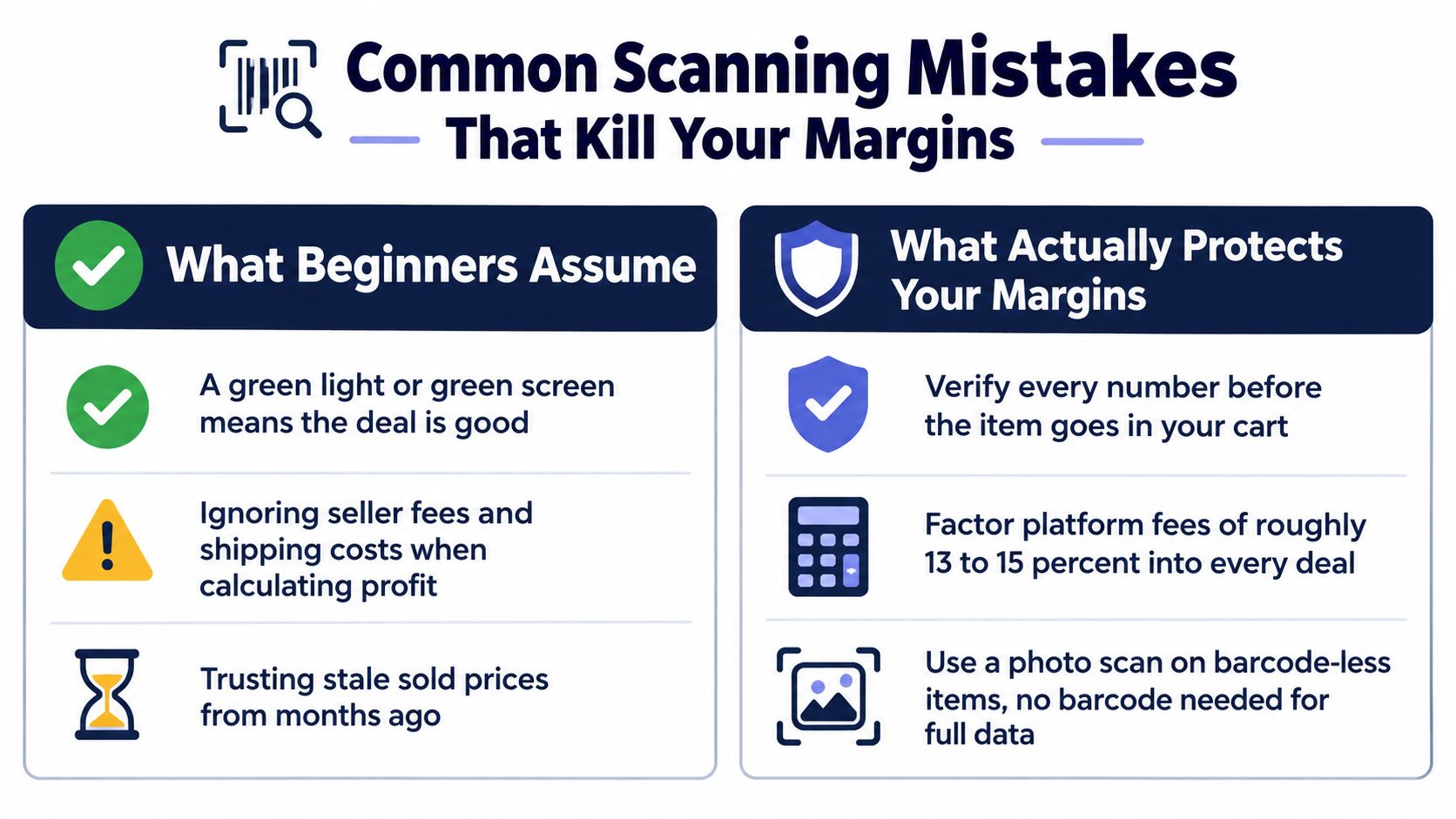
The most dangerous scan is the one that gives you confidence without giving you context. A green result can still represent the wrong edition, an old sale, a damaged unit, or a product with shipping costs that destroy the spread.
Mistake one is trusting the wrong market signal
Active listings show what sellers hope to get. Sold comps show what buyers paid. Even sold data needs context, because an unusually high result may reflect a rare condition, a complete bundle, an international sale, or a variant that your item doesn't share.
Match the title, edition, model number, accessories, and condition. A look-alike product can share a barcode family while having a different bundle or regional version. Don't let the scanner's matched image replace your own inspection.
Mistake two is forgetting dimensional shipping
USPS Ground Advantage pricing depends on package weight and zone. For parcels exceeding one cubic foot, USPS charges using whichever is greater, actual weight or dimensional weight, as described in the USPS Ground Advantage pricing guidance.
That matters at a Ross clearance rack when a bulky boxed household item has the same sold comp as a compact one. A lightweight console, appliance, or oversized toy can cost more to ship than the scale suggests once it's packed. Estimate the box, not just the object.
Mistake three is buying low-dollar inventory because the scan looks green
Fixed fees punish cheap flips. Amazon's $1.80 media closing fee and the $0.99 Individual-plan fee take the same dollar amount from a low-priced book as from a higher-priced book. On eBay, the $0.40 per-order fee for orders over $10 also belongs in the calculation.
A cheap item isn't automatically low risk. It may have the least room for fees, postage, returns, and your time.
Finally, don't treat a successful decode as proof that the record is correct. Preserve the raw scan, matched identifier, condition, variant, and exception status if you're building a repeatable inventory process. For a reseller, the practical exception queue includes unreadable labels, duplicate identifiers, stale catalog matches, incomplete products, and anything where the physical item doesn't match the database record.
Fitting Your Scanner Into Your Reselling Stack
A barcode scanner answers the sourcing question, should I buy this item? It doesn't replace the tools you use later for listing, crosslisting, inventory management, or bookkeeping.
Keep the roles separate. Scan in the Goodwill aisle, at the garage sale, or on the Ross clearance rack. Capture the product identity, sold comps, buy cost, estimated shipping, fees, and your flip-or-pass result. Once the item comes home, use your normal listing and crosslisting workflow.
Tools such as Vendoo or List Perfectly can sit downstream from the sourcing decision. They help resellers manage marketplace listings, while the scanner and profit calculator help decide which items deserve to enter the business at all. That separation keeps a bad buy from becoming a listing project, storage problem, and eventual markdown.
The same principle applies to inventory records. A scan can create useful sourcing history, but it shouldn't encourage you to buy every item that has a catalog match. Your system should preserve enough detail to explain why the item was purchased, which platform was used for the estimate, and whether the final sale matched the original assumptions.
The practical setup is simple: use mobile scanning for speed in the field, use sold comps instead of hopeful prices, calculate net profit with the actual fee and shipping structure, and pass on anything that misses your threshold. A barcode scanner for inventory earns its place in your stack when it prevents bad inventory from reaching the death pile.
ScanFlip AI combines AI photo scan with no barcode needed, barcode scan, and text search, then pulls sold comps across eBay, Poshmark, Mercari, Depop, Amazon, Whatnot, ThredUp, Facebook Marketplace, and TikTok Shop. Visit ScanFlip AI to check net profit after fees and shipping and get a red or green flip-or-pass verdict before you spend your sourcing money.