

8 Garage Sale Sign Examples: Tips to Attract Buyers
Why do some garage sale signs pull drivers off the road while others vanish in plain sight, even when they're advertising the same sale? Most sellers think the message is the hard part. In practice, the sign's size, contrast, route logic, and placement do most of the work, especially when buyers are already moving and deciding fast.
The best garage sale sign examples do more than announce a date. They help resellers, estate-sale shoppers, and bargain hunters find the sale quickly, understand whether it's worth the detour, and follow a clean path from the main road to the driveway. For physical signage, the clearest guidance points to a 22 x 28 inch poster-board format because it gives enough room for large lettering that drivers can read from a moving car, even on a two-lane road, and experts also recommend big bold lettering with strong color contrast such as black on hot pink or bright green for visibility (Sunshine and Rainy Days, Eilee George).
That matters even more for professional resellers who use tools like ScanFlip AI. A sign that gets the right buyer to the right curb is part of the sourcing funnel, not just decoration. The most useful signs work like a route system, a pre-qualifier, and a brand signal all at once.
Table of Contents
- 1. High-Contrast Bold Typography Signs
- 2. Directional Arrow Stake Signs
- 3. Detailed Category Inventory Signs
- 4. Multi-Day Weekend Event Banners
- 5. Digital QR Code Integration Signs
- 6. Time-Sensitive Urgency Signs
- 7. Online Social Media Cross-Promotion Signs
- 8. Professional Premium Signage Printed Yard Signs
- 8-Point Garage Sale Sign Comparison
- Strategic Takeaways for Reseller Success
1. High-Contrast Bold Typography Signs
The fastest-moving cars need the simplest possible read. A high-contrast sign with a short headline, oversized lettering, and a bright background is still one of the strongest garage sale sign examples because it cuts down the reader's effort at the exact moment they decide whether to turn in. For a reseller using physical signage with ScanFlip AI support, the sign should do more than announce a sale, it should also hint at a serious buying opportunity. Add SAT-SUN 8AM-2PM when that is the actual window, and if the mix includes strong resale inventory, refer buyers to what sells at garage sales so the sign feels deliberate rather than generic.
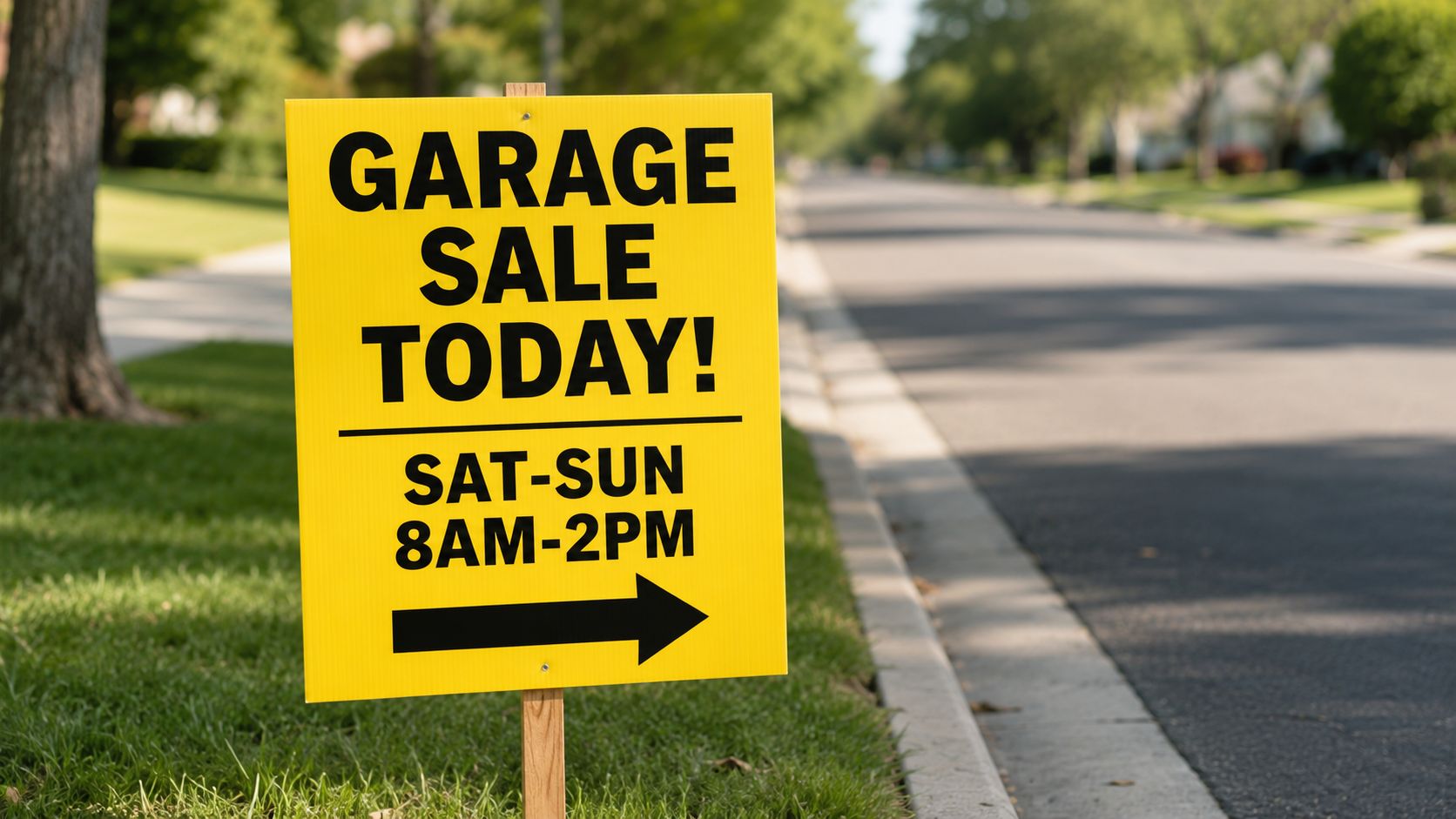
A practical layout is easy to read from a distance. Put GARAGE SALE TODAY first, then the day, then the time. Keep the copy tight, because legibility depends on clean spacing and a layout that does not crowd the words together. That matters more than decorative fonts ever will.
What works and what doesn't
The strongest version uses bold sans-serif lettering, a bright field like yellow, neon pink, or white, and very few words. A sign that says GARAGE SALE TODAY on yellow board in black marker will usually beat a pretty sign packed with clip art.
Practical rule: if a driver has to slow down to decode the sign, the design is already too busy.
The trade-off is simple. A plain sign is less branded, but it is easier to scan from a moving car and easier to replicate across multiple stops. That is why professional resellers usually get more value from clarity than from decoration.
Keep the finish clean. Laminated paper, a plastic sleeve, or a weather-resistant board helps the sign look intentional after sun or rain. Weathered signs read like leftovers, and buyers tend to treat them that way.
2. Directional Arrow Stake Signs
A sign at the curb only solves part of the job. If the sale is tucked inside a neighborhood, directional stakes are key, carrying shoppers from the main road to the driveway without guesswork. One yard-sale guidance source recommends placing a sign at each entrance to a neighborhood and then using smaller, same-color directional signs with arrows inside the neighborhood to keep traffic moving to the sale, while keeping the color and message consistent so drivers do not hesitate.
That route logic is why arrow stakes remain one of the most practical garage sale sign examples for resellers. Buyers who already plan to stop will follow a clear trail, but they will not spend extra time hunting for the driveway. One bad arrow at a turn breaks the whole path.
Build the route before the crowd arrives
Use arrows at every major turn toward the sale location. Put them where drivers make decisions, corner by corner, instead of relying on a single sign near the house. Keep the same visual system on every stake, because once the first sign sets the tone, the rest need to match it.
A strong arrow sign is small, portable, and direct. It should point first, then identify the sale second. A small house number or street name can still help, especially in larger neighborhoods where buyers want a quick check that they are on the right route.
- Place arrows at major turns: That keeps cars moving instead of circling.
- Use the same color system: Consistency cuts down on hesitation.
- Confirm the street or house number: A little reassurance reduces wrong turns.
- Set signs out shortly before opening: Late placement helps avoid confusion and weather damage.
You're trading the speed of homemade stakes for the credibility of professional ones. Homemade signs are fast and cheap, but cleaner stakes usually read better from the road and feel more trustworthy to buyers who are deciding whether the stop is worth it. If you run sales often, that credibility matters more than saving a little setup time. Retrieve every sign right after the sale ends, because abandoned arrows make the next neighborhood event harder to manage and weaken local goodwill.
3. Detailed Category Inventory Signs
Some shoppers want a sale. Resellers want a category. That's why signs naming the inventory can outperform generic GARAGE SALE boards when the goal is to attract buyers with a specific sourcing intent. If your sale includes VINTAGE JEWELRY, ELECTRONICS, FURNITURE, or DESIGNER CLOTHING, spell that out clearly and keep the categories large enough to read from the car.
For pricing and product positioning, ScanFlip AI's own garage-sale pricing guidance is the more useful lens than a vague “cheap stuff” promise, because serious buyers are trying to decide whether the trip can produce margin, not just whether the items are interesting, and the relevant internal guide is ScanFlip AI's garage sale pricing guide.
Use the buyer's language
The wording matters. Vintage sounds curated. Old sounds disposable. Designer signals potential upside. A sign that says VINTAGE FURNITURE, COLLECTIBLE GLASSWARE, MID-CENTURY ITEMS tells a reseller far more than a generic banner ever could.
If you know the inventory early, build category signs from a quick pre-sale walkthrough. Unusual items deserve their own wording because they separate your sale from the neighborhood competition. A tech-heavy sale can call out ELECTRONICS or VINTAGE COMPUTERS. A clothing-heavy sale can say DESIGNER BRANDS or VINTAGE LEVI'S.
Specific categories bring better traffic than broad promises, because they help the right buyer self-select before they park.
When the sale structure supports it, add qualitative price language rather than crowded detail. A phrase like ALL CLOTHING $0.50-$5.00 can attract qualified buyers faster than a long list of items. If the inventory changes during the day, update or remove the category signs once the key sections are gone. Nothing damages trust faster than driving up for ELECTRONICS and finding one box of adapters.
For ScanFlip-style sourcing, category signs do another job too. They reduce scan time by attracting people who already know what they're looking for. That makes the sale feel less random and more efficient, which is exactly what professional resellers want.
4. Multi-Day Weekend Event Banners
A banner is more than a larger sign. For a multi-day or weekend sale, it works as a durable brand marker that keeps the event visible after the first drive-by. That matters when shoppers pass the property more than once before they stop, which is common for serious buyers and other resellers using tools like ScanFlip AI to compare stops before they commit time. A vinyl or canvas banner makes the most sense when the sale runs long enough to justify a format that can handle repeated exposure across a driveway or fence.
Local rules still shape the plan. Some neighborhoods limit when garage sale and estate sale signs can go up and require them to come down by the end of the sale, so timing and retrieval need to be part of the setup from the start. In one Ladera Ranch community guidelines set, community property signs are allowed only shortly before the sale begins and must be removed when the event ends.
Make the banner work harder
Keep the wording tight. A banner should carry the sale name, the dates, and one value cue if it helps, such as BULK DEALS AVAILABLE or WHOLESALE PRICING. For recurring sales, that banner becomes more than a one-off promo piece. It is a brand asset that tells repeat buyers and other pros that the operation is organized, durable, and worth checking again. The longer the event runs, the more the banner helps as a memory marker for people who noticed the first sign but did not stop.
Placement matters as much as the print. Put the banner where passing traffic can see it first, not where it only looks good in photos. A side-street location can miss the cars that matter most, while a banner facing the main route gives the sale a better chance of being remembered. Use it to support the directional signs, not to replace them.
- Use bold, minimal text: The banner has to read quickly from the road.
- Match the sale window: A multi-day event justifies repeated visibility.
- Reuse the template: That cuts setup time for future sales.
- Check local rules first: Some neighborhoods are stricter than sellers expect.
For professional resellers, the trade-off is simple. A cheap printed sheet may work for one weekend, but a durable banner supports repeated events and builds recognition over time. That matters for sellers who want each sale to feel consistent, because a consistent look signals a serious operation and can attract other professionals sourcing inventory with ScanFlip AI.
5. Digital QR Code Integration Signs
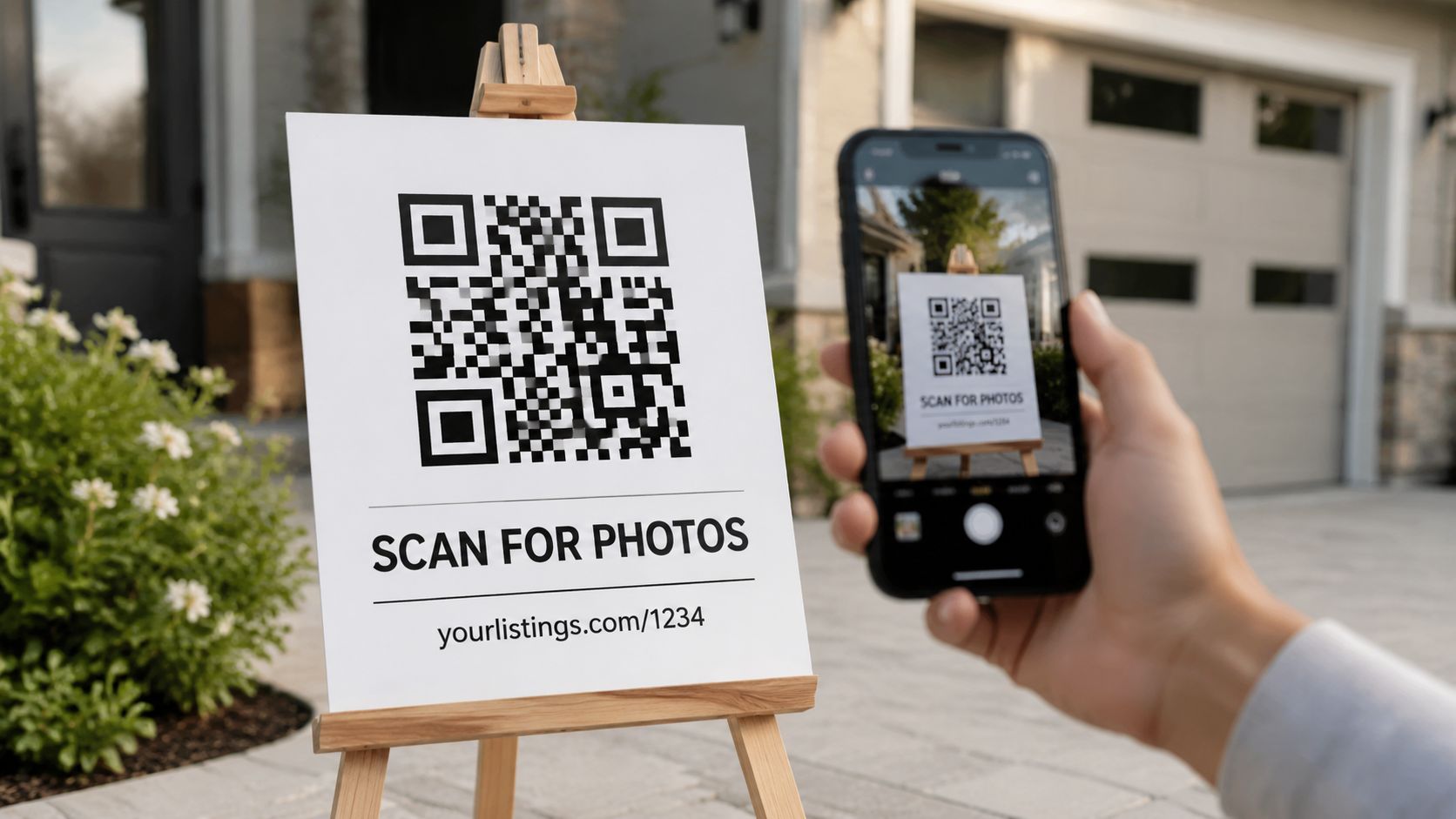
QR-integrated signs solve a problem that paper signs can't. They let buyers preview the sale before they leave home or before they decide to turn around and come in. That's useful for casual shoppers, but it's especially useful for resellers who want to inspect categories, condition, or item density before committing time to the stop.
Modern template tools already make this easy enough to use in print and social formats, and the best practice is still simple, keep the sign readable first, then use the QR code as a layer of support. For digital promotion, ScanFlip AI's scan-to-buy approach fits well here because it aligns a physical sign with a phone-first buyer journey.
Make scanning effortless
Use a high-contrast QR code on a light background and test it from multiple phones before printing the final run. Put a plain-text backup on the sign, something like VISIT OUR SITE FOR PHOTOS, because not every shopper will want to scan on the spot. The code should support the sign, not replace the headline.
A good linked page does a few things well. It loads fast on mobile, shows a small photo set, and gives enough context for a buyer to decide whether the trip is worth it. For resellers, that page should also include item condition, dimensions, and category labels, because those details help separate true flips from filler.
QR codes work best when they confirm what the sign already promised.
If you're integrating ScanFlip AI, use the QR link to support a sourcing workflow, not just a marketing one. A reseller can scan the code, preview the lots, and decide whether the sale fits a buy-pass threshold before driving across town. The trade-off is obvious, the more digital detail you share, the more prep time you need before opening, but the better you qualify the traffic that does show up.
Keep the on-sign messaging short and practical. A clean PREVIEW THE ITEMS cue plus the code is usually better than trying to explain everything on the board itself.
6. Time-Sensitive Urgency Signs
Urgency signs work because they compress the decision window. A shopper who sees ENDS TODAY or LAST DAY understands immediately that waiting means missing the deal. Those signs are especially useful for sales that change by day, because the message can pull in people who were undecided earlier in the weekend.
The underlying rule is simple, the sign has to match the actual sale structure. False urgency burns trust fast, and repeat customers remember. If you say EARLY BIRDS WELCOME, be ready to open accordingly. If you say SUN 50% OFF, the offer should be real.
Keep the timing honest
Use separate signs for separate messages. One can announce the early window, another can call out the final day, and a third can support an afternoon markdown. The cleaner the wording, the easier it is for buyers to act without checking multiple sources.
Bright colors help here because urgency should look urgent. Red, orange, or neon accents fit the message better than muted tones. For reseller traffic, a phrase like BULK PRICING AVAILABLE 7AM-9AM can align the sale with sourcing habits without sounding theatrical.
A time-sensitive sign only works when the deadline is real.
That honesty matters more than clever wording. People who show up for a true final-day sale often buy faster, while shoppers who know the hours are real tend to trust the seller on price as well. The trade-off is that urgency can increase traffic peaks, but it can also create pressure at the table, so the sale setup has to keep checkout simple.
Update or replace these signs each morning before customers arrive. A stale LAST DAY sign left up on Monday looks sloppy and weakens the next event. In resale terms, that's wasted trust, and trust is part of your conversion rate even if nobody writes it down.
7. Online Social Media Cross-Promotion Signs
A physical sign can carry a digital identity if you let it. Adding an Instagram handle, Facebook page, TikTok account, or website URL extends the sale beyond the curb and gives interested shoppers a way to follow, share, or preview what's available. That's useful for professional sellers who run recurring events, and it's useful for local resellers who want buyers to recognize a consistent brand.
Edit.org's sign template guidance also points out that garage sale images can be adapted for Facebook and Instagram formats, which reinforces the value of making the sale visible in both print and social spaces (Edit.org). The sign itself still has to be readable from the street, but the handle gives the sale a second life online.
Keep the social layer simple
Use a short, memorable handle and a hashtag that's easy to repeat. Long strings of characters are hard to remember and harder to type on a phone at a driveway. A clean social tag helps shoppers find the same sale later and gives you a place to post new photos if inventory changes.
Post a few quality images before the sale starts, especially if you're showing categories that matter to resellers. If the best items are in a corner, a quick social preview can save people a bad trip or bring the right buyer in sooner. That helps with professional presentation too, because buyers often trust a sale more when they've seen it online first.
- Use one consistent handle: Mixed accounts create friction.
- Show the location clearly online: Buyers need the same basics they'd get on the sign.
- Keep the photos current: Old photos create bad expectations.
- Reference bulk lots when relevant: Resellers care about lot size and category mix.
The trade-off is focus. If you crowd the sign with too many social details, you weaken the road-read. Keep the physical sign minimal, then let the online layer do the detailed work. For ScanFlip-style sourcing, that's the smart split, the curb attracts the buyer, and the feed qualifies the stop.
8. Professional Premium Signage Printed Yard Signs
Professionally printed signs make a sale look organized before anyone even gets out of the car. They work especially well for estate clearances, higher-value inventory, or repeat reseller events where consistency matters from one stop to the next. A clean printed sign also avoids the uneven lettering, fading, and weather wear that can make a handwritten board look temporary.
For reseller operations that run often, a key advantage is repeatability. A printed sign system lets you reuse the same core design, swap in the date, address, or category notes, and keep setup fast each time. That matters if you're using ScanFlip AI to build a recognizable sourcing route, because the curbside impression stays consistent even as the inventory changes.
Treat the sign like a brand asset
Use the same colors, fonts, and layout across multiple events. Repeat shoppers pick up on that quickly, and it makes the operation look planned instead of improvised. If you run several sales a year, a reusable template with updated date stickers or replaceable copy saves time and keeps the design cleaner.
Professional printing also gives you room for useful contact details without crowding the main message. A phone number, site name, or social handle can sit along the bottom edge while the headline stays easy to read from the road. That works best when the sign is already sized for quick street reading and the extra information supports follow-up instead of distracting from the stop.
A polished sign doesn't just attract shoppers, it signals that the seller has real inventory worth sorting through.
For professional resellers, that signal has practical value. Buyers often expect better organization, better pricing discipline, and better follow-through when the signage looks consistent. The trade-off is upfront cost, but the return shows up in reuse, faster setup, and fewer weak impressions at the curb.
Use quality materials if the signs are going to be reused. UV coating, lamination, or durable vinyl helps preserve the look across multiple events. That makes this format a better fit for a reseller business that wants a repeatable system, not a one-off yard cleanup, and it keeps the brand looking steady across regular sale days.
8-Point Garage Sale Sign Comparison
| Sign Type | Implementation Complexity | Resource Requirements | Expected Outcomes | Ideal Use Cases | Key Advantages |
|---|---|---|---|---|---|
| High-Contrast Bold Typography Signs | Low, simple layout and large type | Low-cost poster board, markers, optional lamination | Maximum long-distance visibility and quick comprehension | Short one-day garage sales; drive-by traffic areas | Very visible, inexpensive, fast to deploy |
| Directional Arrow Stake Signs | Low–Moderate, planning optimal placement | Multiple stake signs, arrows, stakes/frames | Improved navigation and higher arrival rates | Multi-turn routes, large neighborhood/estate sales | Guides traffic effectively; easy to deploy |
| Detailed Category/Inventory Signs | Moderate, requires inventory assessment | Time for categorization, printed boards or posters, icons | Attracts specialist resellers and pre-qualified visitors | Sales with notable categories (vintage, electronics) | Targets knowledgeable buyers; increases perceived professionalism |
| Multi-Day/Weekend Event Banners | Moderate–High, design and secure mounting | Vinyl/canvas banners, grommets, mounting hardware, budget | Persistent awareness and landmark visibility over event duration | Multi-day events, community sale weekends, estate liquidations | Durable, professional appearance, reusable over events |
| Digital/QR Code Integration Signs | Moderate–High, digital setup and testing | QR code service, photos, mobile-optimized landing page, internet | Pre-visit evaluation, higher-quality foot traffic, measurable interest | Tech-forward urban sales and reseller-targeted events | Bridges physical and digital; provides detailed previews and analytics |
| Time-Sensitive Urgency Signs | Low, simple messages, frequent updates | Basic signs, markers or prints, daily updates | Traffic surges during specified windows; faster purchases | Final-day sales, early-bird promotions, clearance events | Creates urgency at low cost; drives early/reseller attendance |
| Online/Social Media Cross-Promotion Signs | Moderate, content creation and moderation | Social accounts, photos/videos, posting schedule, optional QR | Extended digital reach and user-generated promotion | Building event following; younger demographics; community events | Amplifies reach; encourages sharing and ongoing engagement |
| Professional/Premium Signage (Printed Yard Signs) | High, design, printing lead time, branding | Professional printing, design services, coroplast/vinyl, stakes | Increased credibility and attraction of higher-end buyers | High-value estate sales, recurring professional events | Premium look, durable materials, consistent branding |
Strategic Takeaways for Reseller Success
The best garage sale signs do three jobs at once. They get seen, they direct traffic, and they qualify the right buyer. For resellers using ScanFlip AI, that means the sign system should work like a funnel, a bold anchor sign at the street, clear directional signs along the route, and a layer of detail that helps serious buyers decide whether the stop is worth making.
A good setup starts with visibility, then adds structure. Large lettering, strong color contrast, and clean spacing help drivers read the message quickly, especially from the road. From there, route control matters just as much as the headline. Signs placed at the neighborhood edge and repeated with matching arrows inside the area reduce hesitation, which matters when buyers are deciding between your sale and the next one on the map.
For a reseller, the primary value is fit. If the inventory is broad, the sign should stay simple and fast to read. If the sale has a clear niche, naming categories on the sign helps attract buyers who already want those items. If you are using ScanFlip AI to spot profit opportunities early, the signage should support that same filter, drawing in people who are more likely to convert instead of just passing by.
Digital detail is useful only when it earns its place. A QR code, preview page, or social handle can help pre-qualify traffic, but it should not crowd out the main message on the physical sign. The physical sign still has to do the first job. Digital layers work best after the driver has already understood where to turn and why the stop is worth making.
Local rules can change the whole plan. Some communities limit where signs can be placed, how long they can stay up, and when they must come down, so the layout has to respect both visibility and neighborhood expectations. A sale that gets attention but breaks the rules creates extra work and can hurt repeat use of the same route.
The practical test is simple. Stand at the curb and read the sign the way a driver would. If the sale is not obvious fast, the design needs more contrast, fewer words, or better placement. Build a repeatable system from there, keep the strongest layout, and tie it to your sourcing workflow so every sale becomes easier to find, easier to trust, and easier to convert into profit.