
Scan to Buy: Profitable Reselling with ScanFlip AI
You're in a thrift aisle with a full cart, a phone in one hand, and an item that might be great or might be dead inventory. The tag looks cheap. The brand looks promising. Another reseller is two racks away. Under such conditions, most sourcing mistakes occur.
Not because people can't find interesting items, but because they can't turn a fast hunch into a reliable decision. A scan to buy workflow fixes that. Instead of asking, “Could this sell?” you ask better questions: What is it, what has it sold for, what will it cost to sell, and does the net profit clear my threshold?
That shift fits a much bigger retail habit change. The global digital transformation market reached $1.85 trillion in worldwide spending in 2022, according to Scandit's report on future data capture trends. For resellers, that matters because visual identification and real-time price aggregation aren't niche anymore. They're becoming normal parts of sourcing.
Table of Contents
- From Hunch to Certainty with Scan to Buy
- Prepare for Profit Before You Source
- Mastering the In-Aisle Scan Workflow
- Interpreting Comps and Calculating Net Profit
- Leverage Scan History for Smarter Sourcing
- Conclusion Your New Sourcing Mindset
From Hunch to Certainty with Scan to Buy
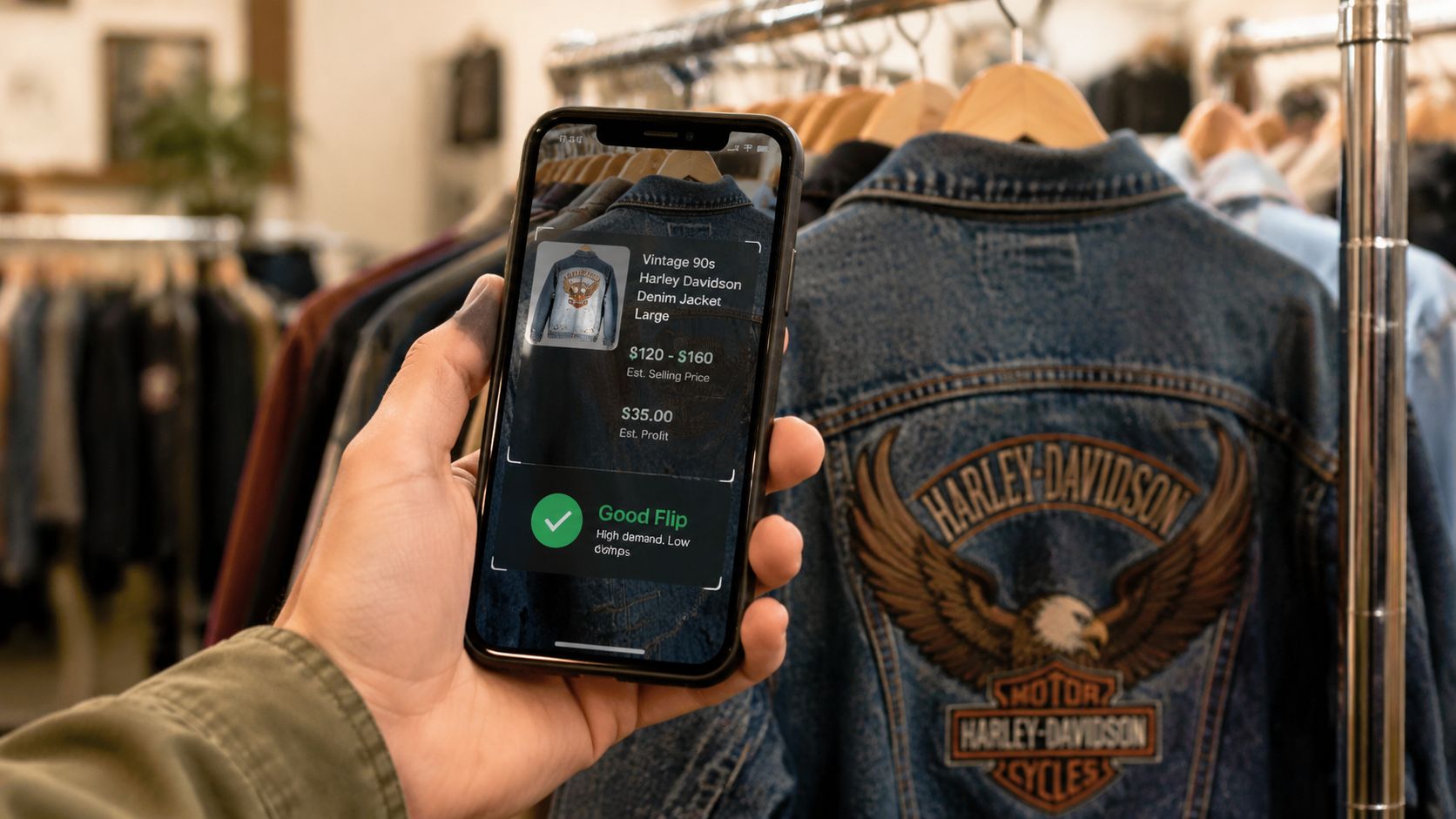
A good scan to buy workflow starts in a messy moment. You spot a vintage jacket buried between basic mall brands. The fabric feels right. The logo looks older. The price tag is low enough to gamble on, but not low enough to shrug off if you're wrong.
That's the trap. New flippers often think the job is finding hidden gems. The actual job is making repeatable decisions under time pressure.
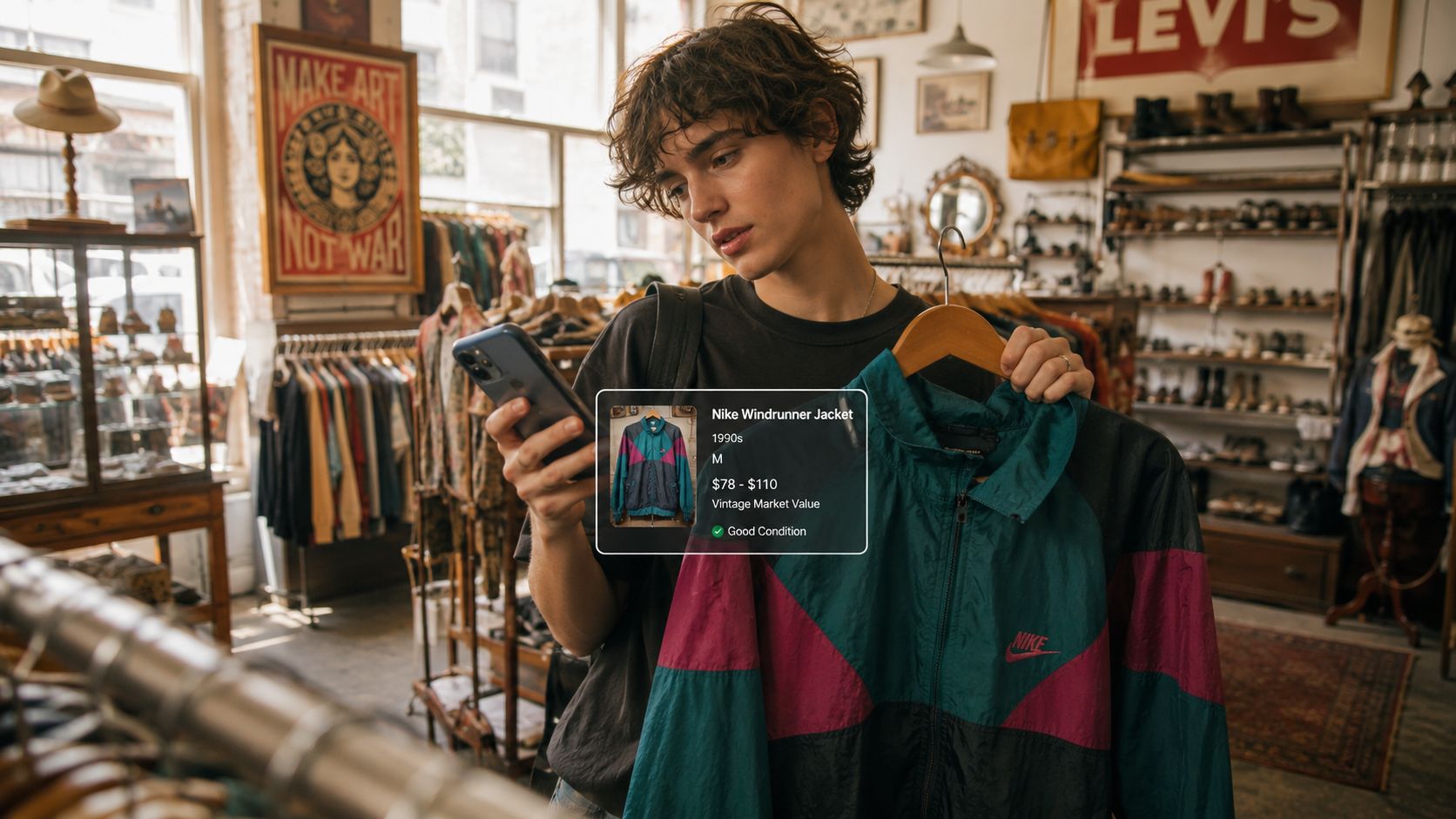
A loose process creates two expensive habits:
- You leave money behind because you hesitate on good items.
- You buy on gross price alone and discover later that the actual take-home doesn't justify the trip.
- You waste attention jumping between marketplace apps, notes, and mental math.
Practical rule: In a crowded store, speed only helps if your process stays accurate.
The fix is a single scan-to-decision routine. Identify the item from a photo or barcode. Check sold comps across marketplaces. Add your buy cost. Let your profit rule decide whether the item deserves cart space.
That sounds simple, but the benefit is bigger than convenience. It changes your behavior. You stop treating every item like a one-off mystery and start treating each scan like an investment screen.
A lot of resellers stall at the price lookup step. That's only part of the picture. A sold comp can tell you what a buyer paid. It doesn't tell you what you keep, how often that item moves, or whether that one high sale was an outlier.
Once you work from net profit instead of excitement, sourcing gets calmer. You still hunt. You just stop guessing.
Prepare for Profit Before You Source
Most bad buys don't start in the store. They start at home, when you head out without clear buying rules. If your standards change rack by rack, every item turns into a debate.
The better move is to define your pass or buy logic before the first scan. That means deciding what counts as enough profit for your business, not for someone else's YouTube haul.
Set your floor before the first scan
You need a minimum standard. I prefer thinking in two filters:
| Filter | What it protects | When it matters most |
|---|---|---|
| Minimum dollar profit | Your time | Low-cost thrift and garage sale items |
| Minimum margin or ROI | Your cash | Higher-cost buys and riskier categories |
If you only use a dollar threshold, you can still tie up too much money in a mediocre flip. If you only use a margin threshold, you can spend all day sourcing tiny wins that aren't worth listing.
A practical setup usually includes:
- A minimum take-home target so small wins don't clog your inventory.
- A margin requirement for categories with more condition risk, returns, or shipping headaches.
- A default buy cost assumption that matches where you're sourcing that day.
If your sourcing rules live only in your head, you'll bend them the second an item looks exciting.
Use different rules for different sourcing environments
A garage sale, thrift chain, estate sale, and clearance aisle don't behave the same way. Your thresholds shouldn't either.
- Garage sales: Prices are often low, but condition can be rough and item data can be thin. Keep a stricter standard for anything incomplete or untested.
- Thrift stores: Branded apparel, shoes, and media often reward speed. Your buy cost defaults can be more predictable.
- Estate sales: Better quality shows up, but so do optimistic prices. You need margin discipline.
- Retail arbitrage: Condition is cleaner, but competition is sharper. A decent spread can disappear fast.
One reason people like all-in-one reseller tools is that they can preload this logic instead of rebuilding it on every item. If you want a broader look at apps built for this kind of field decision-making, ScanFlip AI has a useful roundup of best reseller apps for sourcing and pricing.
The point isn't to automate judgment. The point is to protect it. When your thresholds are set in advance, the app becomes a filter, not a temptation machine.
Mastering the In-Aisle Scan Workflow
In-store scanning is physical. That matters more than most guides admit. Your results depend on where you stand, how fast you frame the item, and whether your photo gives the app enough to work with.
People blame the tool when the problem is usually the input. A blurry logo, shiny plastic glare, or a cluttered background can turn an easy identification into a miss.
What to capture first
Start with the feature that best identifies the item.
For different categories, that usually means:
- Shoes: The size tag, model tag, side profile, and outsole pattern.
- Apparel: Front graphic, brand tag, care tag, and any stitched logo.
- Electronics: Model label, ports, remote compartment, and included accessories.
- Collectibles: Front art, copyright line, edition detail, and any maker marks.
Your first shot should answer “what is this?” before it answers “what condition is this in?” If the app can't identify the item quickly, sales data won't matter.
A simple way to improve consistency is to use your hand, cart, or a blank section of shelf as a neutral background. That cuts visual noise and helps logos, labels, and shapes stand out.
When one photo is not enough
Single-photo scans work well when the item is obvious. A lot of profitable flips aren't obvious.
Take more than one image when:
- The item has variants like colorways, editions, or regional labels.
- The valuable detail is on the tag rather than the front.
- Condition changes value such as shoes with heel drag, chipped mugs, or game boxes with crushing.
- There's glare from plastic wrap, laminated covers, or polished metal.
Fast scanning doesn't mean rushed scanning. It means knowing which second photo saves you from a bad buy.
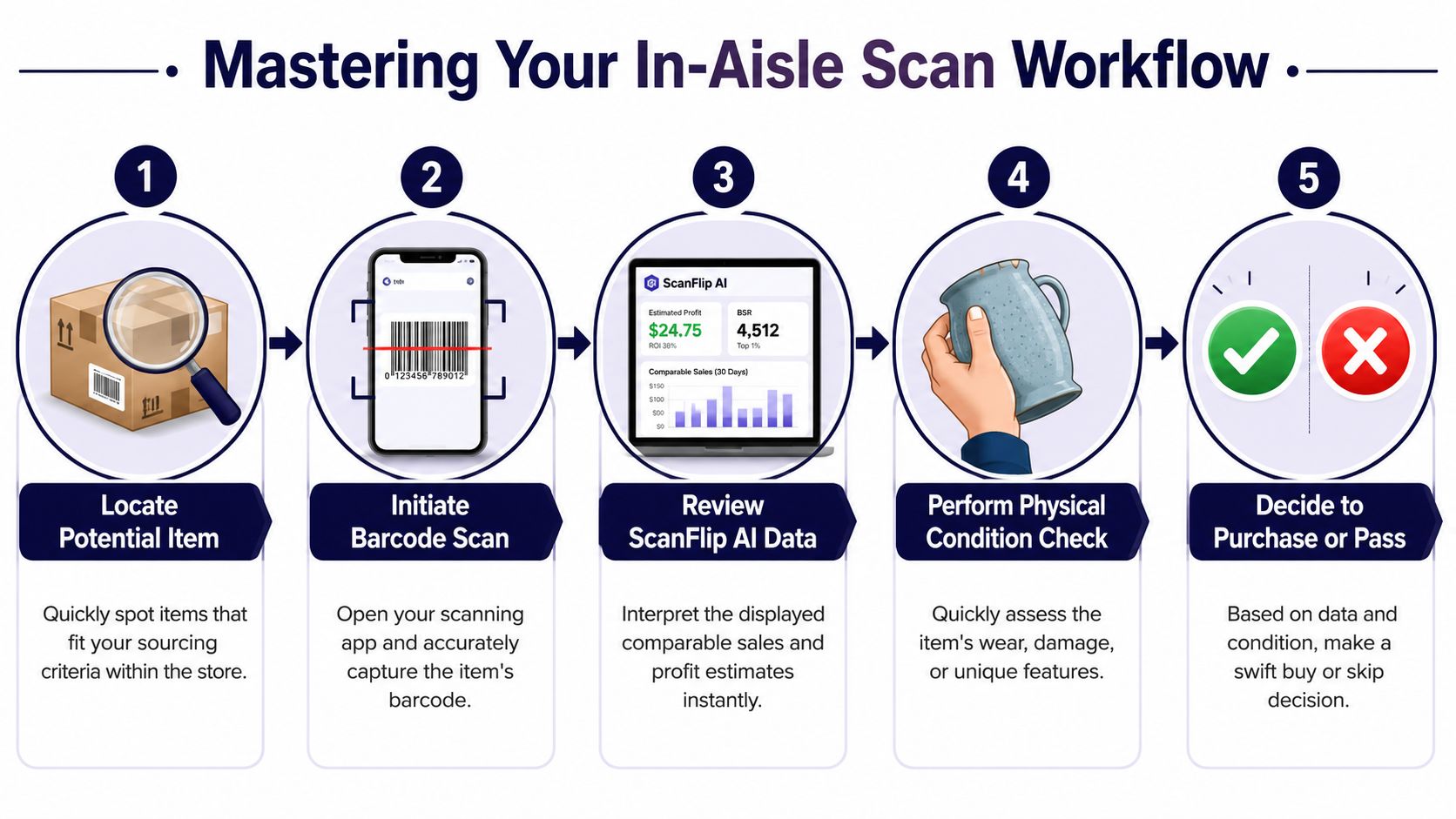
I also like a fixed rhythm in the aisle:
- Pick up the item.
- Grab the clearest identifying image.
- Add a detail shot if needed.
- Check physical condition before trusting the comp.
- Decide and move.
That rhythm keeps you from doing deep research on mediocre inventory. It also stops the opposite mistake, which is buying from a promising first impression without checking the flaw that kills value.
If you're relying on visual item recognition rather than barcode-only lookup, it helps to understand how dedicated identification tools are built for these fast scenarios. ScanFlip AI explains the category in its guide to using an item identifier app for resellers.
In practice, muscle memory matters more than speed hacks. The best in-aisle scanners aren't frantic. They're clean.
Interpreting Comps and Calculating Net Profit
A comp screen can either sharpen your buying or trick you. Most mistakes happen when sellers see one attractive sold price and stop reading.
You need to read the data as a pattern, not a headline.
Read the comps like a reseller
First, check whether the sold items match yours. Brand alone isn't enough. Model, era, condition, color, bundle completeness, and size all change value.
Then look at the spread.
If you see a wide range, ask why. One high sale may reflect better condition, a rare variant, or a complete set. One low sale may be damaged, poorly listed, or auctioned at the wrong time. The useful signal is the cluster in the middle and how recent those sales feel.
I usually weigh comps this way:
- Tight range and repeat sales: Easier decision. Demand is clearer.
- Wide range with obvious item differences: Slower decision. Match your item carefully.
- One standout sale and weak surrounding comps: Usually a pass.
- Good prices but shabby local condition: Lower your expected outcome.
A comp only matters if your item can realistically achieve it.
Gross price is not your profit
Many new resellers struggle. They've learned to search sold listings, but they haven't learned to price the deal after fees, shipping, and all the little drains that sit between sale price and payout.
According to Studio Qual's discussion of overlooked profitability mistakes in shopping and resale behavior, 68% of new resellers fail due to misjudging profitability from overlooked platform costs. That same source notes that recent marketplace fee changes make manual net-profit estimates unreliable.
A sold comp is evidence of revenue. Net profit is the reason to buy.
That's why the calculator matters more than the price lookup. Once you enter your buy cost, the useful question becomes simple: after platform fees and shipping, does this item still beat your threshold?
For quick decisions, I like this comparison:
| Screen element | Bad interpretation | Better interpretation |
|---|---|---|
| Highest sold price | “Mine will sell for that” | “That's the ceiling, not the expectation” |
| Average sold price | “That's guaranteed” | “That's a reference point if my item matches” |
| Recent sales activity | “Someone sold one” | “How likely is a timely sale?” |
| Net profit output | “Nice extra detail” | “The actual buy/pass signal” |
If you want a deeper framework for turning comps into list prices after you source the item, ScanFlip AI also has a practical guide on how to price items for resale.
Good sourcing gets easier when you stop celebrating gross sales numbers. Those don't pay for your inventory mistakes.
Leverage Scan History for Smarter Sourcing
A single scan helps with one decision. Your scan history helps with the next hundred.
Most resellers ignore this because they treat history as a receipt log. That's too small. It's really a sourcing database made from your own behavior. Every pass, every buy, every location, every timestamp becomes a clue about where your edge is.
Your pass pile is research
Review the items you passed on, especially after a long thrift run or estate sale day. Not to second-guess every choice, but to spot patterns.
Maybe you pass too quickly on certain categories because the labels look unfamiliar. Maybe you keep scanning slow-moving household goods when your real edge is vintage sportswear or small electronics. Maybe your “good deal” instinct keeps pulling you toward bulky items with annoying shipping profiles.
When you revisit old scans, ask:
- Which items matched my model best and still got ignored?
- Which categories waste my time even when they look promising?
- What details did I miss in the aisle that are obvious in saved photos?
- Where do I need better condition discipline before buying again?
That kind of review turns past hesitation into training.
Location changes what a good scan means
Where you scan matters. So does when you scan. According to this spatiotemporal analysis on scan context and metadata, sold-price accuracy was 42% higher when scans included geo-context and timestamp metadata.
That lines up with what many experienced resellers already feel in practice. The same item type doesn't perform the same way across every source. One thrift store may be strong for shoes. Another may be picked over on apparel but still weakly priced on media. An estate sale company may overprice branded kitchenware but miss niche electronics.
The item matters. The location pattern matters more over time.
Persistent history with location and time stamps lets you audit your route instead of trusting memory. You can start noticing things like:
- One store is better on weekday mornings because racks are less disturbed.
- Another location rarely yields margin unless you find overlooked accessories or off-season apparel.
- Certain estate sale companies price by brand recognition and miss model-specific value.
- Your best buys cluster in a few repeatable stops, not across your whole city.
That changes your calendar as much as your cart. Strong sourcing isn't only about recognizing profitable items. It's about going where those items still appear at workable prices.
Conclusion Your New Sourcing Mindset
A scan to buy workflow changes sourcing from reactive to deliberate. You stop relying on vague memory, lucky guesses, and gross sale screenshots. You start working from evidence, thresholds, and repeatable decisions.
That's what makes the process scalable. You can source faster without getting sloppier. You can review your own decisions instead of wondering why profit feels thinner than your sold prices suggested. And you can keep the fun part of reselling, which is spotting what other people miss, while removing a lot of the avoidable mistakes.
The biggest difference is mental. Casual sellers ask whether an item is worth something. Working resellers ask whether the item is worth buying now, at this cost, with this likely payout, in this location.
That's a better question. It leads to better inventory.
If you want one app built around that full scan-to-decision workflow, ScanFlip AI is designed for exactly this job. It helps resellers identify items from photos, pull sold comps across marketplaces, calculate expected take-home after fees and shipping, and save scan history for future sourcing decisions. For thrift stores, estate sales, garage sales, and retail arbitrage, it's a practical way to make faster buy-or-pass calls with less guesswork.