
How Much Is This Worth: A Reseller’s In-Aisle Pricing Guide
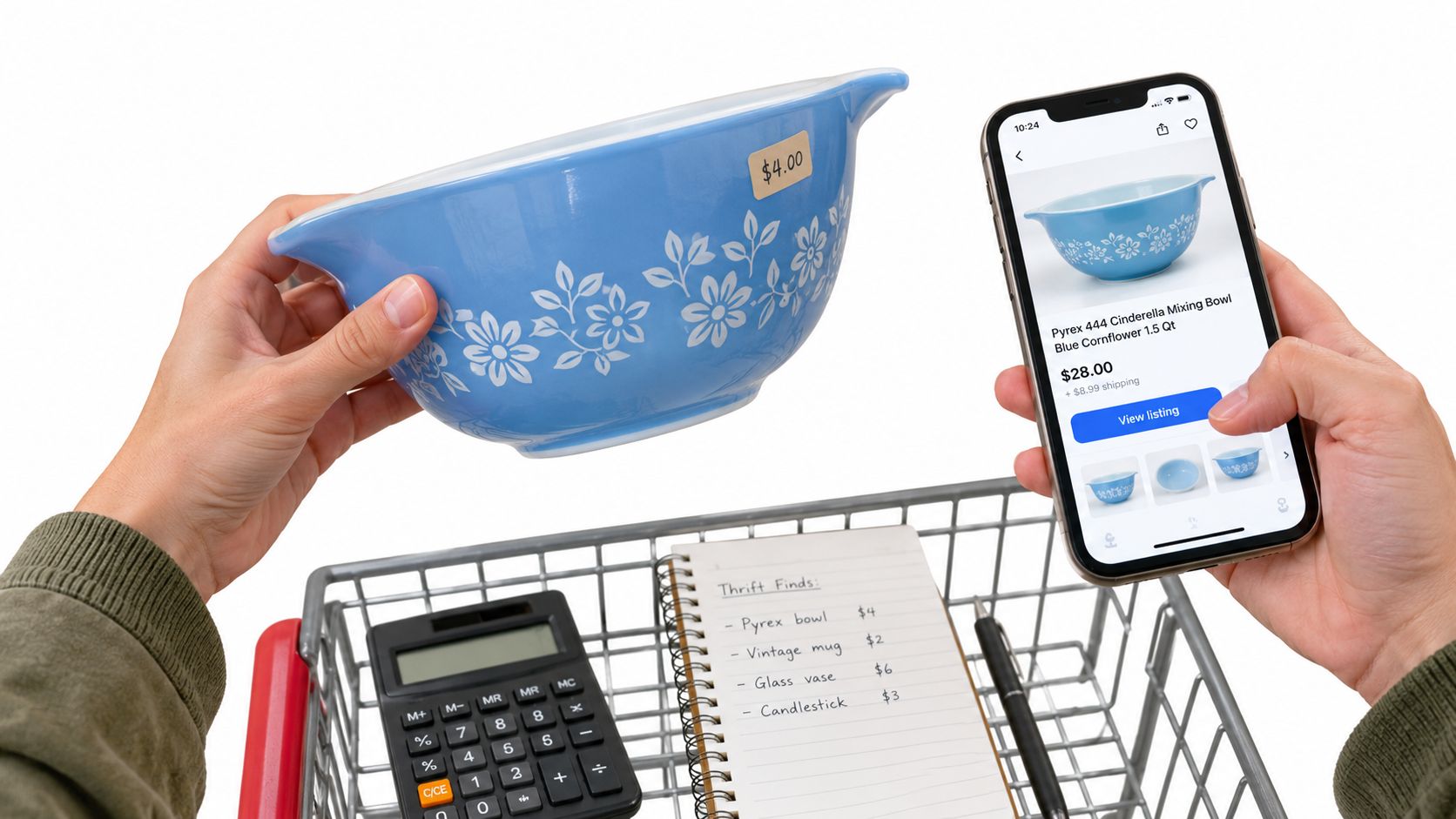
You're standing in a Goodwill aisle with a $4 Pyrex mixing bowl in your hand. It has the blue cornflower pattern, dust around the rim, and just enough of a vintage look to make you wonder, “How much is this worth?” Before it goes in the cart, there's a more useful question: how much will I keep after fees, shipping, cost of goods, and the time required to sell it?
That distinction separates a promising find from a slow-moving piece in the death pile. A $35 sold comp can look excellent beside a $4 thrift tag, but the gross sale price isn't your profit. The working decision is simple: identify the item, verify recent sold comps, then calculate net profit before buying.
Table of Contents
- The $4 Puzzle in the Aisle
- Three Ways to Identify What You're Holding
- Reading Sold Comps the Right Way
- Net Profit After Fees Math
- Local Pickup Versus Shipped Listings
- Buy Price Rules by Category
- Your 60-Second In-Aisle Routine and Common Questions
The $4 Puzzle in the Aisle
The beginner's mistake is easy to make. You search the pattern, see several $35 sold prices, mentally subtract the $4 purchase cost, and place the bowl in your cart. The number feels obvious because the gap between $4 and $35 looks large.
But that $35 isn't automatically what reaches your bank account. You may still have marketplace fees, packing materials, shipping, breakage risk, returns, and the time spent cleaning, photographing, listing, answering questions, and packing the sale. If the bowl sells for less than the strongest comp, or shipping costs more than expected, the original calculation changes again.
Practical rule: The number that earns a place in your basket is net profit after fees, not the highest sold price you can find.
The secondhand apparel market shows why resale deserves a more disciplined buying process. The global secondhand apparel market reached an estimated $257 billion in 2025, was projected to reach $289 billion in 2026, and had a longer-term forecast of $393 billion by 2030, according to Circular's coverage of the 2026 ThredUp Resale Report. The category represented about 10% of total global apparel spend, and the same report said it grew 13% year over year in 2025. Resale is a major consumer channel, but a large market doesn't make every thrift-store item profitable.
Standing in the aisle, I want three answers before buying:
- What is it? The exact brand, model, pattern, size, variant, and condition.
- What does it sell for? Recent sold comps, not active asking prices.
- What will I keep? Gross sale price minus platform fees, shipping, cost of goods, and obvious risk.
The Pyrex bowl might still be a buy. It might also have a damaged pattern, a less desirable size, or a shipping cost that makes the margin too thin. The point isn't to reject every uncertain item. It's to turn “how much is this” into a calculated bet instead of a hopeful guess.
Three Ways to Identify What You're Holding
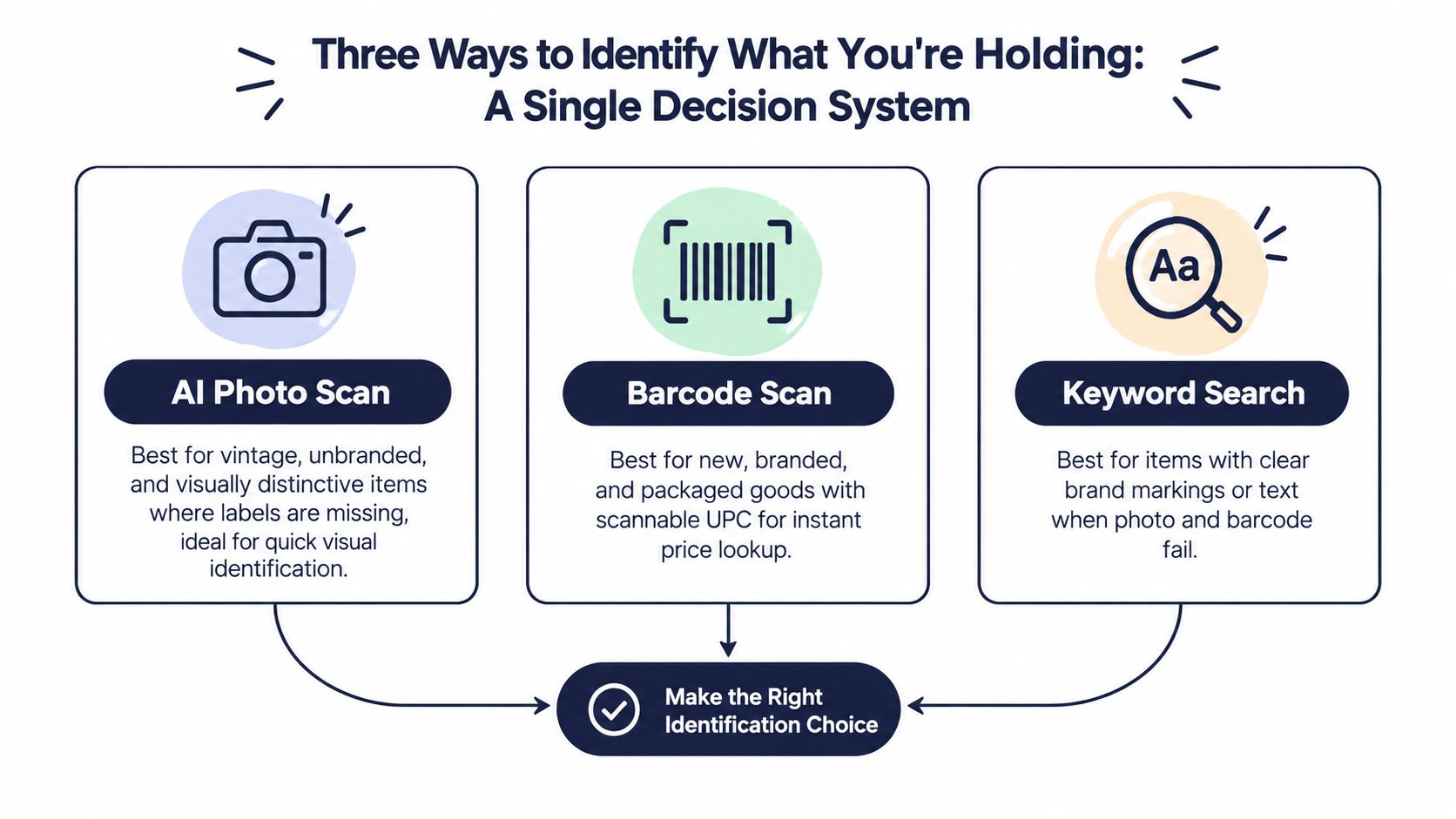
The price check starts with the right identity. A wrong model can produce clean-looking sold comps and still lead you to a bad buy, so choose the scan method that fits the item in front of you.
Start with the visual scan
AI photo scan is usually the fastest first check for vintage, unbranded, handmade, or visually distinctive goods. It works for the Pyrex bowl, an untagged leather bag, unusual shoes, or a collectible missing its box.
Photograph the whole item clearly. If the result is broad, take closer images of the maker's mark, pattern, hardware, sole, control panel, or back stamp. Those details can separate a valuable variant from a common one. Treat the result as a likely match, not confirmation. A low-confidence result means you should switch methods or inspect the item again.
Use the barcode when the product has one
Barcode scanning is quickest for books, sealed media, video games, boxed retail goods, and products with a printed retail sticker. A UPC or ISBN can point to an exact product match, giving you a better starting point than broad keywords.
The method becomes unreliable with handmade goods, vintage items, missing packaging, and products sold in several variants under one product family. A sealed book may scan correctly, while an older edition with a different cover can return a misleading match.
Search the text when the label gives you a lead
Text search works when the item shows a readable brand, model number, style code, or specific product phrase. Copy the wording from the tag or plate, then add size, color, generation, or material. It also helps when a crowded bin makes a clear photo difficult.
Generic text produces generic results. “Ceramic bowl” will not identify a valuable pattern, while “All-Clad D5 10-inch skillet” gives you a much narrower starting point. Worn or incomplete markings may require combining text with a photo.
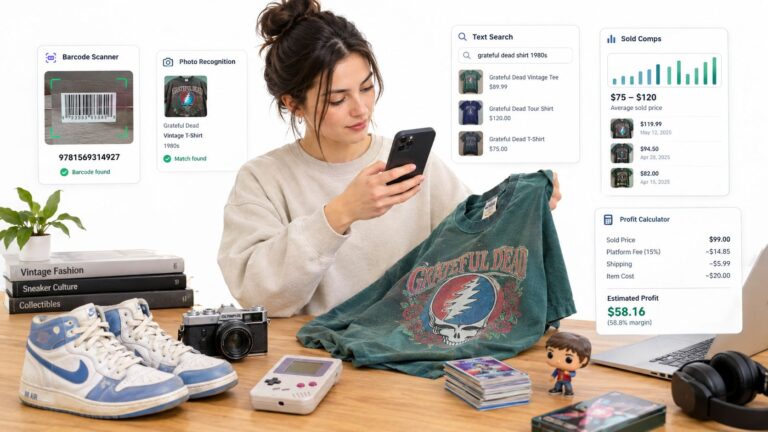
Use the methods as one aisle decision system. Start with a photo for unfamiliar goods, scan a barcode when available, then use text to confirm the model or variant. If the result could change your buy decision, verify it with at least two methods. A practical item identifier workflow for resellers can help reduce the risk of pricing from one incorrect match. Identification only earns its keep when it leads to the correct sold comps and a realistic net-profit calculation.
Reading Sold Comps the Right Way
A sold comp is evidence of a completed transaction. An active listing is only evidence that a seller wants a certain price.
That difference matters in the Goodwill aisle. A seller can list an identical bowl at $65 and leave it unsold for months. If the last five comparable bowls sold around $22, the $65 listing tells you almost nothing about your likely outcome.
Build a usable comp set
Pull five to ten comparable sold transactions from the past 30 to 90 days, following the resale pricing workflow for recent sold transactions. Match the details that buyers pay for:
- Exact identity: Brand, model, pattern, edition, or style.
- Condition: New, used, tested, flawed, incomplete, or damaged.
- Variant: Size, color, generation, bundle, region, or included accessories.
- Fulfillment path: Shipped sales and local-pickup sales aren't interchangeable.
- Sale date: A recent transaction usually reflects the current market better than an old one.
Sort the results and use the median as your center point. Keep a low and high range beside it, because the median gives you a practical expectation while the range shows how much condition and presentation can move the outcome.
Check more than one marketplace when the category supports it. eBay can show shipped demand across a broad buyer pool. Mercari and Poshmark can add useful apparel and accessory comparisons. Facebook Marketplace can reveal local pricing for furniture, appliances, and bulky goods.
Seasonality can change the answer. A Lodge Dutch oven that sells for $80 in November may sell for $45 by March, so a holiday-season comp shouldn't automatically set your year-round buy price.
Discard misleading evidence
Don't count an auction that has bids but hasn't converted into a completed sale. Don't build a decision around one unusually high transaction. Don't let international results set your United States shipping assumptions, especially for heavy or fragile goods.
If the item hasn't sold, recheck the comps every 14 days, as recommended in this resale pricing guidance. Comps older than 90 days should carry less weight in your mental average because demand and platform behavior can shift before a picker revisits the category.
| Step | Action | Why It Matters |
|---|---|---|
| Identify | Confirm brand, model, variant, and condition | Prevents matching the wrong item |
| Filter | Use completed sold transactions | Removes unsold seller expectations |
| Compare | Pull five to ten close matches | Reduces dependence on one outlier |
| Center | Use the median with a low and high range | Produces a realistic price target |
| Segment | Separate shipped and local sales | Keeps fulfillment economics honest |
| Recheck | Review comps again if unsold after 14 days | Catches fast pricing changes |
Net Profit After Fees Math
The gross sold price is only the top line. Your buy decision should use a deduction stack that includes the marketplace fee, order fee, payment cost where applicable, shipping, and cost of goods.
Use a $58 sold comp as the starting point. On eBay, the verified 2026 standard seller fee for many United States categories is 13.6% of the total sale amount, plus a $0.40 per-order fee when the order is over $10, as detailed in eBay seller fee calculations. The fee applies to the total transaction amount, not only the item price, so shipping can affect the fee calculation too.
USPS Ground Advantage pricing in the 2026 Postal Explorer draft price table starts at $5.09, and USPS announced a temporary holiday increase of $0.75 for Zones 5–9 on packages up to 3 pounds, according to the USPS January 2026 price-change notice. A heavier package or a cross-country shipment can remove the margin you thought you had.
Use route-specific calculations
The same $58 sale can produce different results across platforms because each marketplace charges differently. For this worked example, the estimated net figures below use the fee and shipping assumptions supplied for the scenario, followed by a $4 cost of goods.
| Platform | Fees Taken | Shipping Cost | Cost of Goods | Net to Seller |
|---|---|---|---|---|
| eBay | 13.25% final value fee, $0.30 order fee, payment processing near 3% | $8.50 USPS Ground for 2 lb | $4 | Roughly $38 |
| Poshmark | 20% commission above $15 | Included in the scenario | $4 | Roughly $39 |
| Mercari | 10% commission, payment fee, and $0.50 | Included in the scenario | $4 | Roughly $43 |
| Facebook Marketplace local | $0 selling fee | $0 local pickup | $4 | Roughly $54 |
The table is a decision model, not a universal payout promise. Fees, shipping arrangements, taxes, returns, promoted-sale costs, and category rules can change the final amount. The operational lesson remains stable: platform selection is part of pricing.
A $58 sale may look identical in a sold-comp search, but it isn't identical to the seller. A local cash pickup can preserve more of the gross amount. A shipped eBay sale can reach more buyers but carries postage and transaction deductions. Poshmark may suit an item with an established apparel audience, while Mercari may produce a different net after its fee structure.
For a repeatable formula, use expected sale price minus marketplace fees, payment costs, shipping, supplies, cost of goods, and a realistic risk allowance. A reseller net-profit calculation guide is useful when you're checking the math under aisle pressure.
Local Pickup Versus Shipped Listings
A 2-pound electronic item can create two completely different businesses depending on how it reaches the buyer. Suppose the local Facebook Marketplace path produces a $45 pickup sale, while an eBay shipped sale reaches $65. The higher gross price looks better until you subtract the costs attached to national fulfillment.
Local pickup avoids shipping, packing, in-transit damage, and platform selling fees. It also gives you a smaller buyer pool, more scheduling friction, and less room to reach a buyer who specifically wants that model. Shipped sales provide national exposure and may command a higher gross price, but they bring packaging work, carrier risk, return disputes, and item-not-as-described claims.
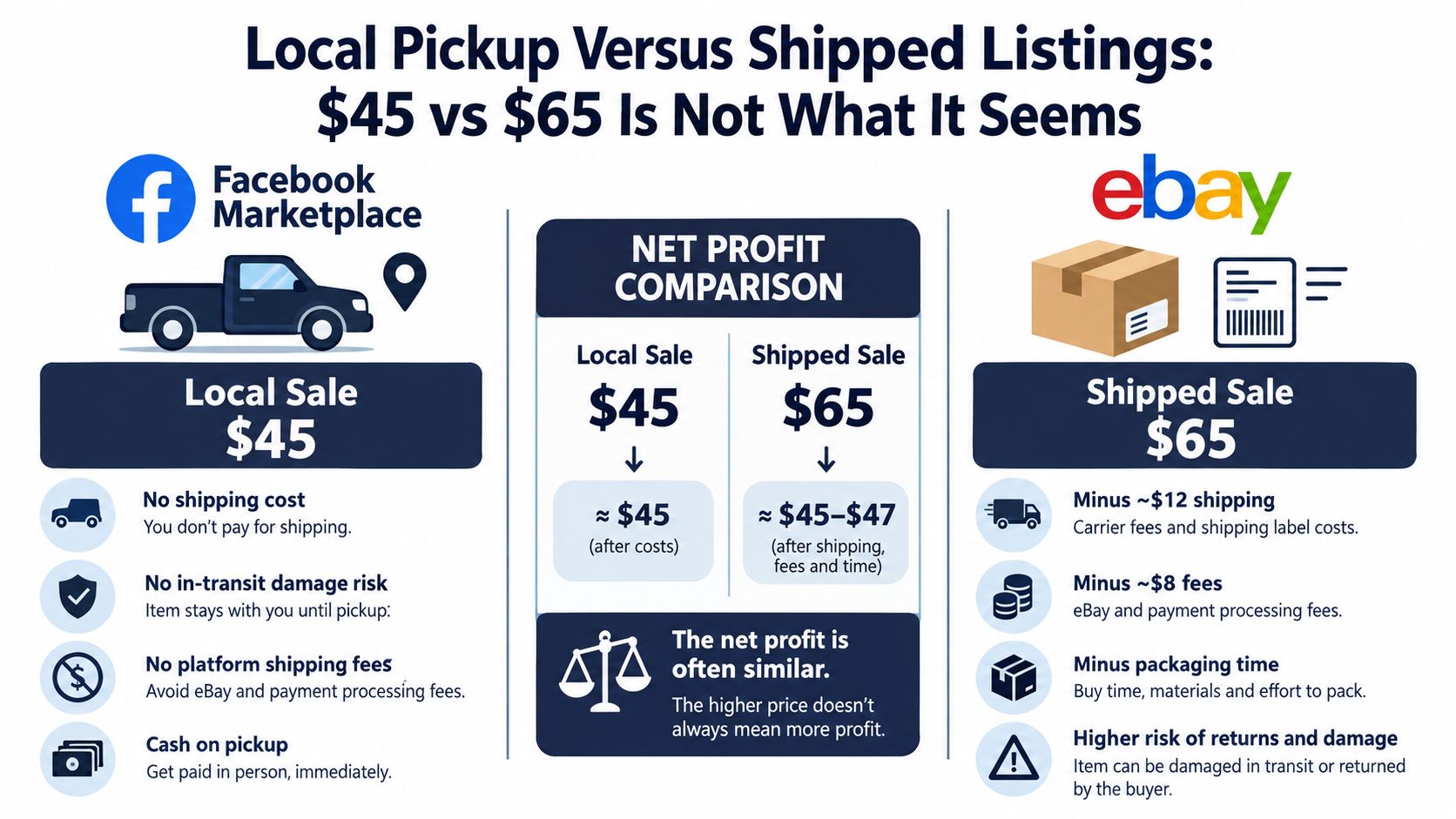
The $20 gross gap between those example sales can disappear quickly. Add $12 shipping and a $4 box, then account for a 1-in-15 return rate, and the shipped route may leave little advantage over the simpler local transaction. Those figures belong to the example scenario, so use your own actual postage, packaging, and return history when making the call.
Price by fulfillment path
Fee comparisons show that Facebook Marketplace local pickup has no selling fee, while shipped orders can carry about a 10% fee with a minimum charge, as described in this 2026 resale profitability comparison. Some marketplaces calculate fees from the total buyer-paid amount, which makes shipping-heavy items less attractive than their headline sale price suggests.
Use these operating bands as a starting judgment:
- Under $30 sold value: Default to local pickup unless the item is exceptionally easy and cheap to ship.
- $30 to $80: Compare both routes using net profit, buyer pool, damage risk, and expected time.
- Over $80: National shipping often makes sense because reach can justify the fees and handling.
A low-ticket item that loses money online may work locally. A bulky item with strong local demand may be a pass if you must store it for weeks. “How much is this?” needs a location and fulfillment answer before it has practical meaning.
Buy Price Rules by Category
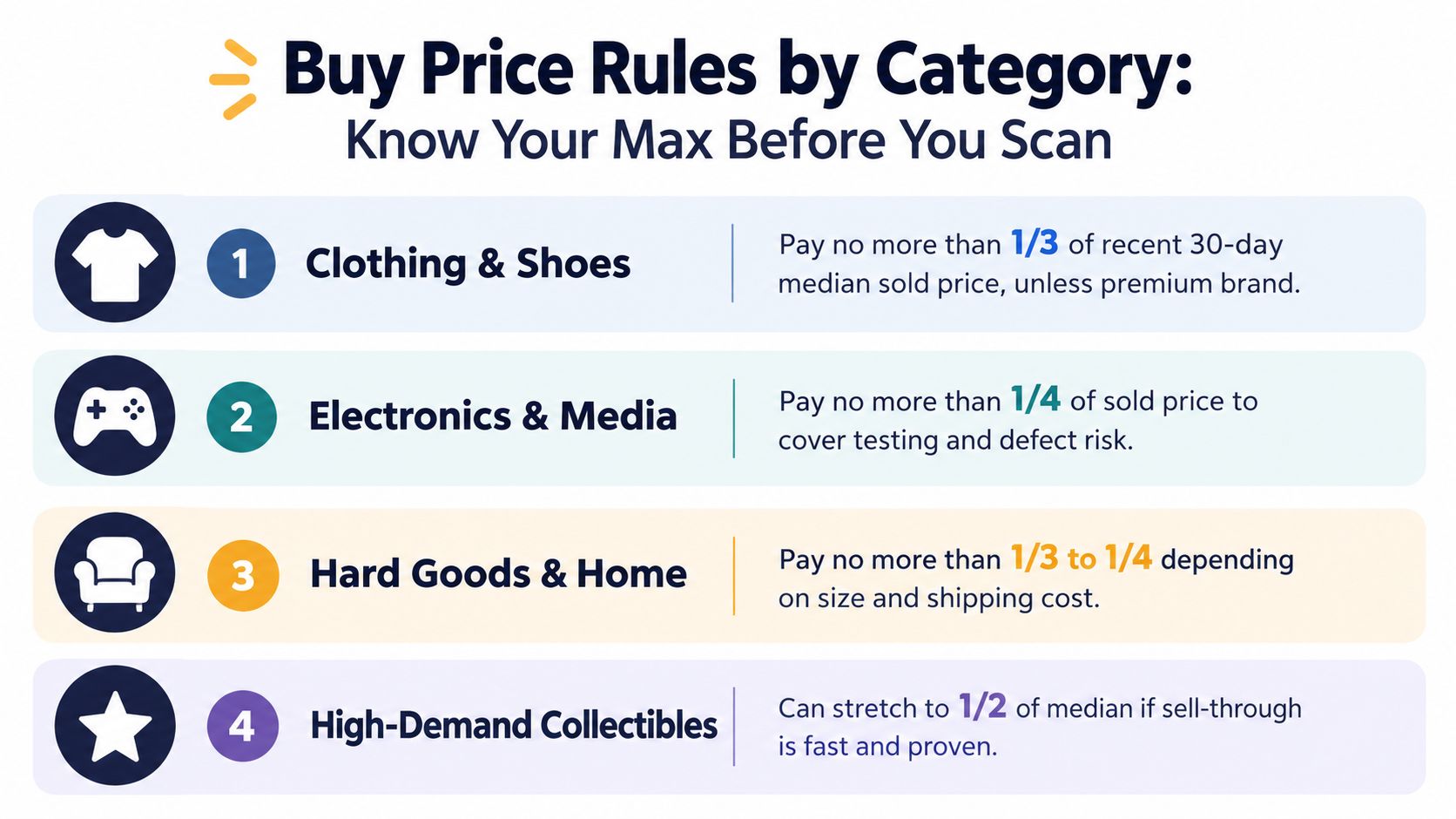
A good buy price leaves room for fees, shipping, mistakes, and the possibility that the item takes longer to sell than expected. The exact percentage varies by category, but the working habit is consistent: set your maximum cost before emotion gets involved.
Clothing and shoes
For ordinary clothing and shoes, pay no more than one-third of the recent 30-day median sold price. That's the practical 3x rule. If a jacket's median sold price is $30, a $10 purchase leaves more room than a $20 purchase once fees and shipping arrive.
A brand outlier such as Patagonia or Lululemon can justify stretching to 40%, but only when the exact style, size, and condition have strong sold evidence. Brand recognition alone isn't enough.
Books and media
Trade paperbacks usually need a low buy cost, often in the $0.50 to $3 range. ISBN-scan everything priced above $3 because a familiar title can still have weak demand, a common edition, or a low net after fees.
For small electronics, target 20% to 25% of resale value and walk away when expected profit falls below $15 after considering parts and defect risk. Untested electronics are not automatically bargains.
Kitchen goods and home items
Name-brand kitchen goods such as Le Creuset, All-Clad, and KitchenAid can support a buy cost around 30% of comparable sold prices, assuming the exact model and condition are verified. Furniture needs a different rule. Never pay more than you can realistically recover through local resale within 14 days, and account for movers, storage, cleaning, and the space it occupies.
Automatically pass when:
- Evidence is missing: There are no sold comps within 90 days.
- Shipping overwhelms value: The item weighs more than 5 pounds and sells for under $30.
- Authentication is uncertain: You can't verify authenticity in the aisle.
A high-demand collectible can sometimes justify paying up to half of the median sold price, but only when sell-through is proven and the item is easy to authenticate. A rare-looking item with no reliable market evidence is speculation, not a safe buy.
Your 60-Second In-Aisle Routine and Common Questions
You have ten seconds to decide whether the item deserves attention before another picker reaches it. The goal is not to find a promising sold price. It is to estimate whether the item can produce acceptable net profit after fees, shipping, and your buy cost.
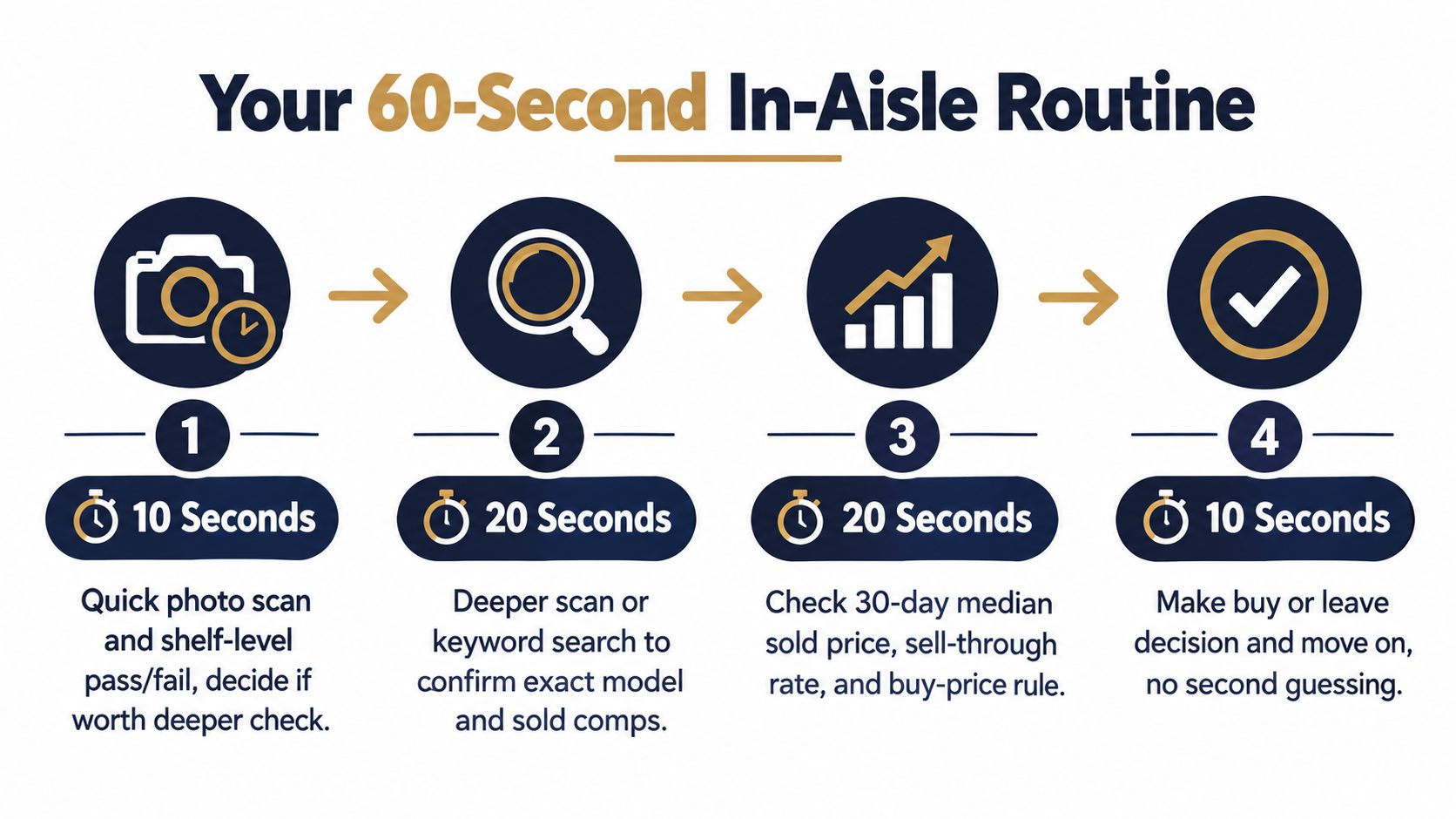
- First 10 seconds: Take a photo scan, inspect condition at shelf level, and decide whether to pass or investigate.
- Next 20 seconds: If the item still looks viable, scan the barcode or search visible text to confirm the exact model, edition, or variant.
- Following 20 seconds: Check relevant sold comps on eBay, Mercari, and Poshmark. Note the recent median, sell-through signal, and category buy-price rule.
- Final 10 seconds: Subtract marketplace fees, shipping, and cost of goods. Buy only when the projected net profit clears your personal threshold.
ScanFlip AI combines photo identification when no barcode is available with barcode scanning and text search. Its results include sold comps from marketplaces such as eBay, Poshmark, Mercari, Depop, Amazon, Whatnot, ThredUp, Facebook Marketplace, and TikTok Shop. It also estimates net profit after fees and shipping and gives a red or green flip-or-pass result. Use the tool as a fast check, not as permission to ignore condition, missing parts, or authentication risk.
Questions the routine can't settle
What about regional pricing? Local demand may differ from national sold comps, especially for furniture, appliances, and seasonal goods. Use local results when the item will be picked up.
What about hyped items with no history? Without comp history, you have no reliable price anchor. Set a conservative buy price or pass.
What if it's broken or incomplete? Count missing parts and repairs as separate costs. If you cannot estimate the repair or test the item, put the risk in the pass column.
What about rare items the AI can't identify? Check marks, measurements, construction details, and specialist references. Do not pay a premium because an image result sounds confident.
The routine does not remove uncertainty. It gives you a consistent way to decide whether the likely net profit justifies the risk, which leaves many bad buys on the shelf.