
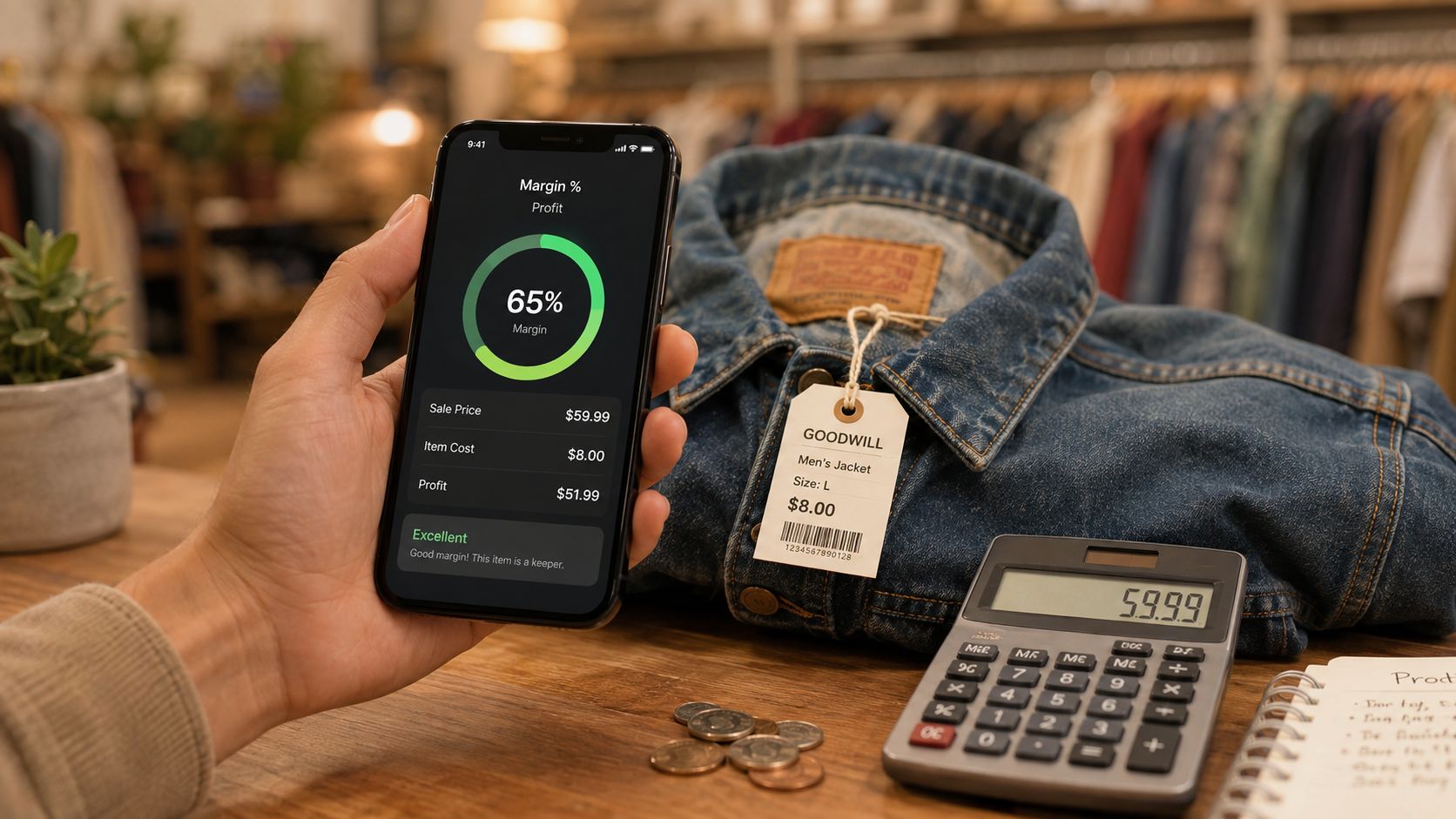

How to Calculate Margin Percentage for Reselling
You're standing in a Goodwill aisle with a $4 jacket in your hand, and the last sold comp you saw was $28. That's the exact moment margin math either saves you or burns you, because the buy decision isn't about what the tag says, it's about what's left after cost, fees, and shipping. If you're flipping on eBay, Poshmark, Mercari, or anywhere else, how to calculate margin percentage is the difference between a clean pickup and another item that sinks into the death pile.
Table of Contents
- The Margin Formula in Plain English
- Worked Examples From Real Sourcing Situations
- Margin vs Markup and Why the Wrong One Burns You
- Where Fees and Shipping Eat Into Your Margin
- Common Margin Mistakes Resellers Make at the Buy Decision
- Fast Margin Checks in the Aisle With ScanFlip
- Margin Percentage Quick Reference for Resellers
The Margin Formula in Plain English
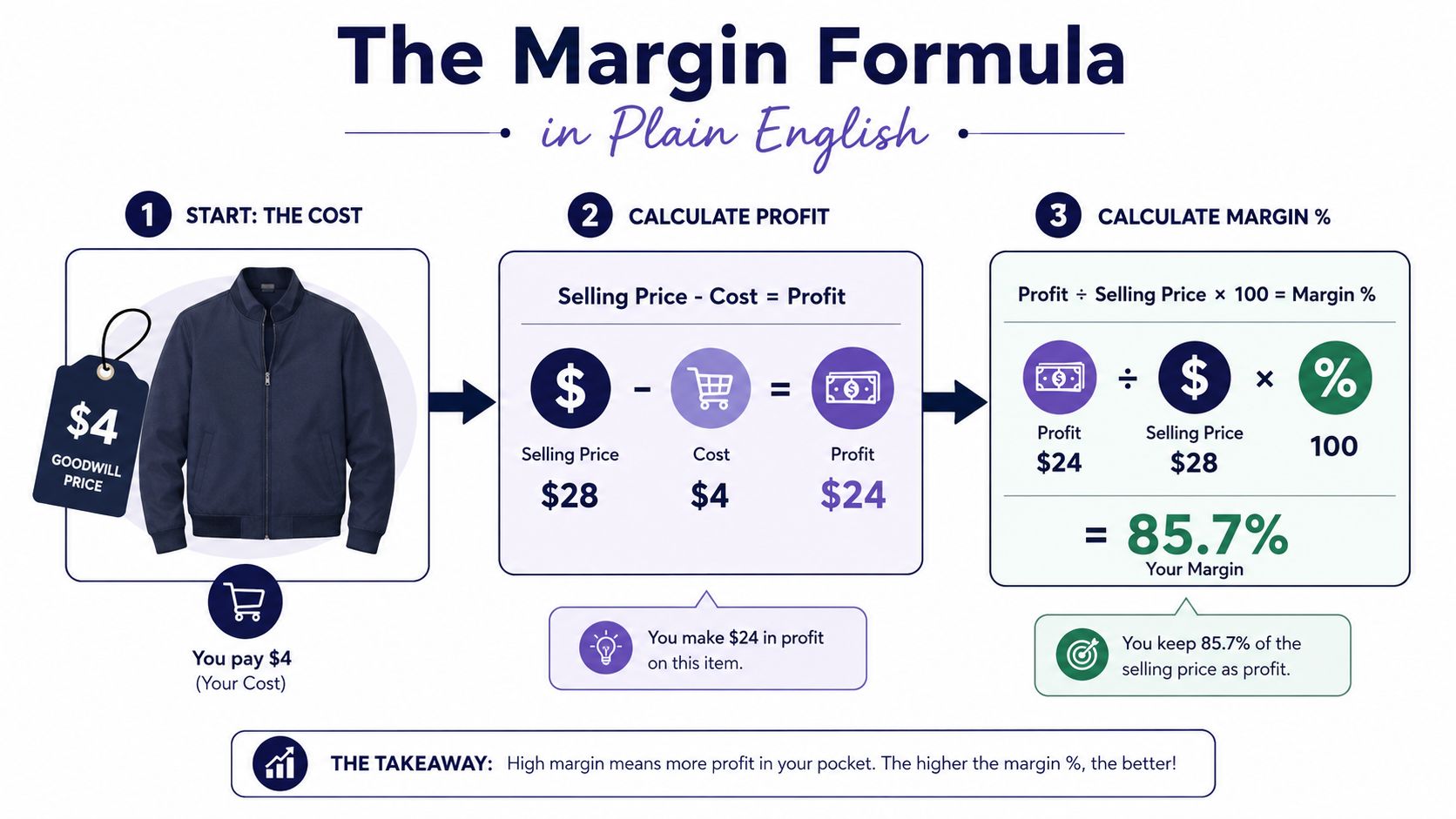
You've got that $4 jacket in your cart, and a sold comp says it can move for $28. The question isn't whether $24 looks like good money, it's whether that profit survives the math once you measure it against the sale price. The standard gross margin method is simple, identify revenue and COGS, compute gross profit as revenue minus cost, then divide by revenue and multiply by 100, which is the same as profit ÷ revenue according to OmniCalculator.
Start with the three numbers that matter
For resale, the aisle-side version of the formula needs three inputs. You need your buy cost, your expected sold price, and the fees plus shipping that will come off the top before you see cash in hand.
Practical rule: if you can't name those three numbers fast, you're not ready to buy.
That's why margin works so well for resellers. It keeps the focus on what you keep from the sale, not just what the item “goes for” in a vacuum. A jacket that looks cheap on the rack can still be a pass if the fees and shipping eat too much of the spread.
The formula in aisle language
Here's the clean version:
Margin % = ((Selling Price – Cost) ÷ Selling Price) × 100
Using the jacket example, the math is:
- Selling price: $28
- Cost: $4
- Profit: $24
- Margin: $24 ÷ $28 × 100 = 85.7%
That number tells you what fraction of the sale stays above cost before platform fees and shipping get involved. The denominator matters. Margin uses selling price, not cost, and that's why the result is different from markup as finance sources stress. For a reseller, that denominator choice changes whether a flip looks merely fine or worth the trip to the register.
How net profit changes the buy decision
Worked Examples From Real Sourcing Situations
The math gets real when you're staring at a shelf, not a spreadsheet. A thrift find, a book flip, and a shoe pair all use the same formula, but the margins feel different once fees and shipping hit the deal.
| Item | Buy Cost | Sold Comp | Fees + Shipping | Net Profit | Margin % |
|---|---|---|---|---|---|
| Vintage Levi's jacket | $6 | $28 | $9 | $13 | 46.4% |
| Sealed paperback | $1.50 | $12 | $4.50 | $6 | 50% |
| Nike shoes | $18 | $50 | $15 | $17 | 34% |
Thrift jacket math
A vintage Levi's jacket at a Goodwill half-off day often looks cheap enough to grab without thinking. But if the sold comp is $28, the buy cost is $6, and the total fees plus shipping run $9, the net profit is $13.
The margin on the sold price is 46.4%, because profit is $13 and sold price is $28. That's a decent flip if the jacket is clean, size-friendly, and likely to move without a long wait. If it needs cleaning, has damage, or sits in your death pile for weeks, that margin gets less attractive fast.
Book scanner find
A sealed paperback at an estate sale can be a tiny buy that still makes sense. If you pay $1.50, see a sold comp at $12, and estimate $4.50 for fees and shipping, your net profit lands at $6.
That's a 50% margin on the sold price. Books are where quick math matters most, because one bad assumption about shipping can wipe out the whole flip.
Shoes in the bin
A pair of Nikes dug from a thrift shoe bin can look like a stronger score than it really is. If you're in for $18, the sold comp is $50, and fees plus shipping total $15, your net profit is $17.
That works out to a 34% margin. Not terrible, but it's the kind of pickup that only makes sense if the pair is clean, size is strong, and your sell-through is moving. The number tells you when to keep digging.
Margin vs Markup and Why the Wrong One Burns You
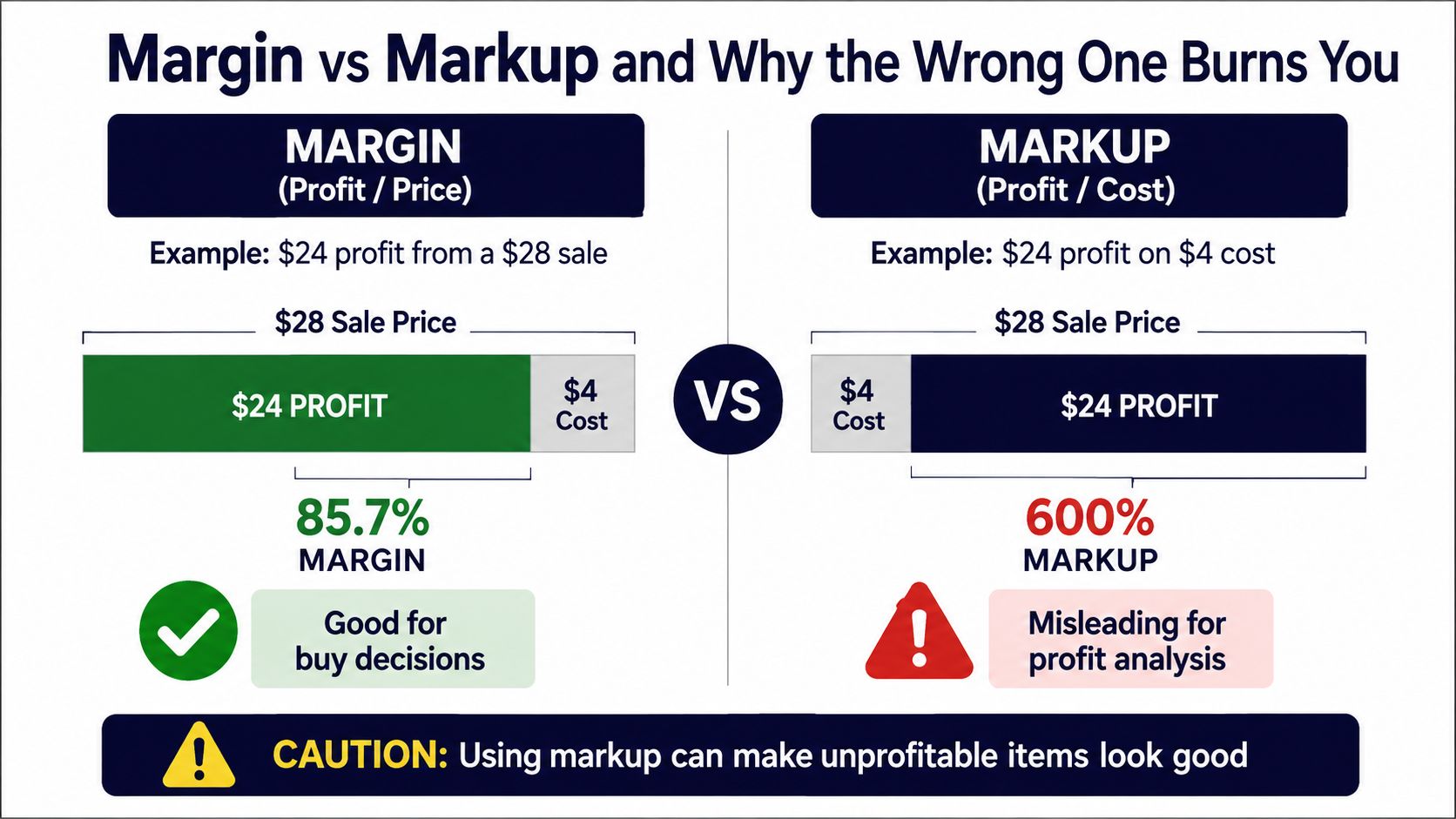
Most resellers mix these up at some point, then wonder why a flip that looked strong doesn't cash out the way they expected. Margin measures profit against selling price, while markup measures profit against cost as Pearson puts it. That denominator swap is why the same item can look sensible in one metric and wildly exaggerated in the other.
Same flip, two very different readings
Take the clean $20-to-$50 example. The profit is $30.
- Margin: $30 ÷ $50 = 60%
- Markup: $30 ÷ $20 = 150%
That's not a small difference. A seller who thinks in markup can talk themselves into a buy that doesn't leave enough real profit after fees and shipping. Margin tells you what share of the sale stays above cost, which is the number that matters when you're judging a flip.
Using the wrong denominator can make a weak item look like a home run.
When each one matters
Markup is useful when you're building a price from cost. If you know your purchase price and want to add a consistent cushion, markup gives you a quick way to set a tag.
Margin is what you want when you're asking a buying question. Should this jacket, shoe pair, or book leave enough money after the marketplace takes its cut? That's a margin question, not a markup question.
For sold-comps-driven resellers, margin is the cleaner lens. It keeps the focus on actual take-home potential instead of a padded percentage that sounds better than it is. If you're at a garage sale and the item only works when you frame it as markup, that's usually a sign to walk.
Where Fees and Shipping Eat Into Your Margin
A headline margin only matters if it holds up after the sale. A comp can look strong on the screen, then fees, the shipping label, and packing materials take a real bite out of it.
Gross margin is not net profit
If a flip sells for $40, the gross margin math can look fine at first glance. The item still has to pay platform fees and shipping before you know what stays in your pocket. That is why resellers should work backward from net profit, not stop at the sold comp.
On eBay, the net-profit breakdown matters because fees and shipping change the take-home. Poshmark has its own fee structure, Mercari handles fees differently, and each marketplace changes the margin on the same item. The gap between gross and net is where a lot of bad buys get missed.
A practical way to think about it
If a sale leaves you with a nice-looking gross spread, ask three questions before you buy:
- What are the platform fees? Use the fee structure that applies instead of guessing.
- What will shipping cost? Shoes, jackets, and books do not ship the same way.
- What is left after both? That is the number that matters.
A lot of resellers price around a target net margin instead of a target sale price. That is the right instinct. It forces you to work backward from the amount you want to keep, then decide whether the buy price still leaves room.
Why this matters on the floor
A seller can get excited about a comp and still make a bad purchase. I have seen plenty of items look fine at the rack, then fall apart once fees and shipping get pulled into the math. The clean move is simple. If the net does not clear your floor, leave it.
That discipline keeps you out of the “looks profitable” trap. It also keeps your cash available for the next better flip that comes through the door.
Common Margin Mistakes Resellers Make at the Buy Decision
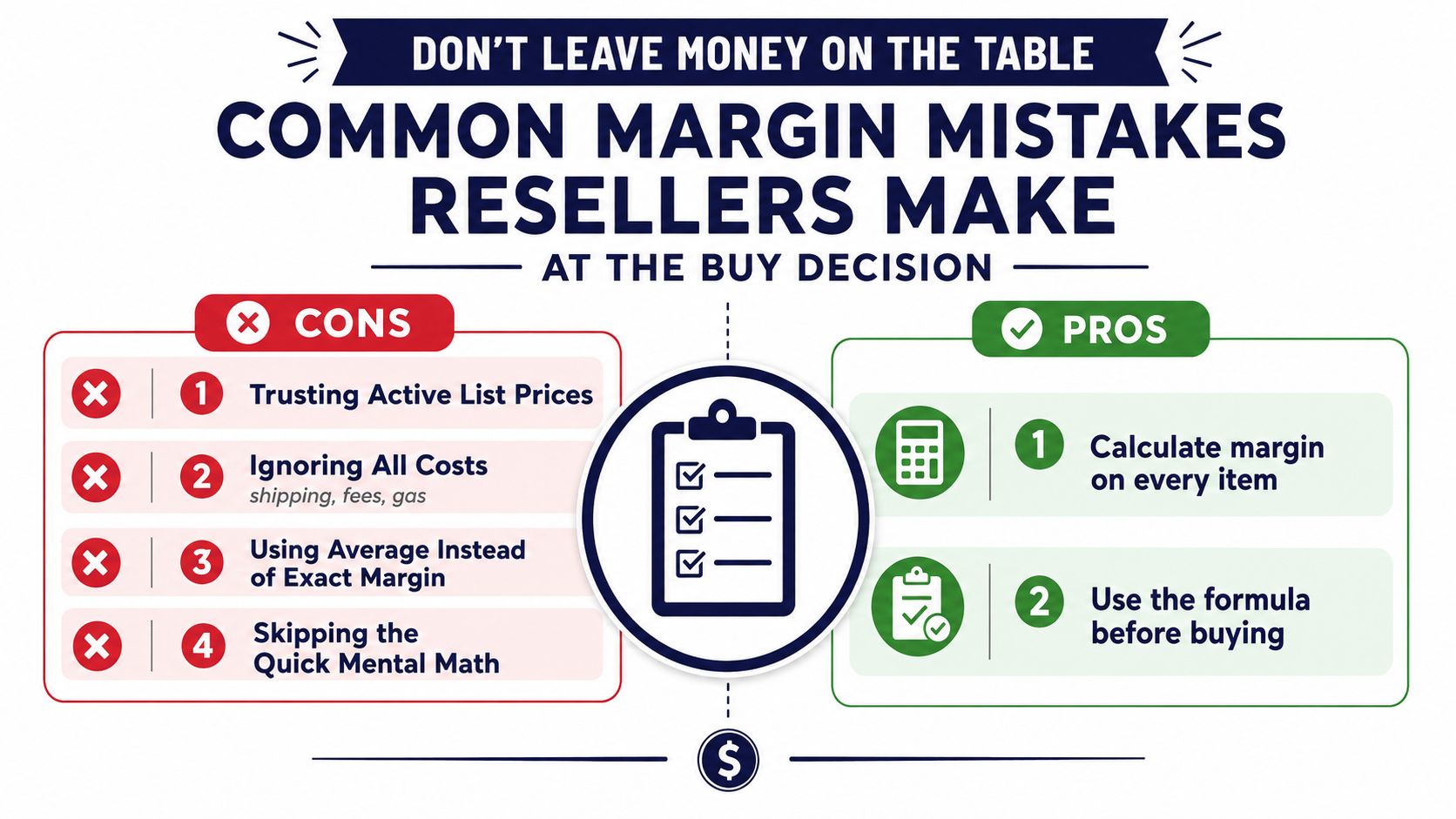
Bad margin math usually starts with hurry. The line is backing up, another picker is hovering, and the brain wants a fast yes. That's when resellers reach for the wrong price, the wrong denominator, or the wrong assumption about what will happen later.
The usual mistakes
- Trusting active listing prices: Active asks are not sold comps. A jacket listed at a high number doesn't mean anybody paid it.
- Ignoring all costs: Shipping supplies, labels, and platform fees still come out of the flip.
- Using averages instead of exact math: A rough estimate can be fine for a first look, but the buy decision needs the actual spread.
- Skipping the quick check: If the item only works after a long mental debate, it probably doesn't work.
Buy decision rule: if the math needs a story to make sense, pass.
How the correction looks
A sold comp from last week beats a hopeful listing every time. If a pair of shoes has one strong sold price and four weak ones, don't anchor on the outlier. Use the spread that makes sense for the condition, size, and category.
Shipping supplies are easy to forget because each one feels small. Mailers, poly bags, and padding add up on lower-priced flips, especially books and light clothing. If your buy only works before those costs, it doesn't really work.
The discipline that saves cash
The flippers who last usually have one simple floor. They won't buy unless the item clears a preset margin target after fees and shipping. That rule keeps the death pile smaller and the cash flow cleaner.
Walking away is part of the job. Some items are close but not close enough, and the right call is still no.
Fast Margin Checks in the Aisle With ScanFlip
A slow spreadsheet check doesn't fit a crowded thrift line or a garage sale where the host is already pricing faster than you can think. A faster workflow is easier to use when the item is still in your hand, and that's where tools built for sourcing help.
A quick aisle workflow
- Scan the item three ways. Use AI photo scan with no barcode needed, barcode scan, or text search depending on what's in front of you.
- Check sold comps. Pull real sold prices across eBay, Poshmark, Mercari, Depop, Amazon, Whatnot, ThredUp, Facebook Marketplace, and TikTok Shop.
- Read the net profit. Let the fees and shipping come off the top before you decide.
That's exactly the kind of sourcing-phase check ScanFlip AI is built to handle. It shows sold comps, estimates net profit after fees, and gives a red or green flip-or-pass verdict based on your threshold. That doesn't replace your judgment, but it gets the math out of the way fast.
Why speed matters
At a thrift store bin, the difference between a five-minute analysis and a five-second decision can be the difference between buying the item and missing it. Fast checks also cut down on impulse buys, because the app forces the math before the cash leaves your pocket.
The best aisle check is the one you'll actually do every time.
If you already use tools like Vendoo, List Perfectly, or Crosslist, this kind of scanner fits alongside them rather than replacing them. It's for the sourcing moment, when you're deciding whether the item deserves a spot in the cart.
How a margin calculator app fits reseller math
Margin Percentage Quick Reference for Resellers
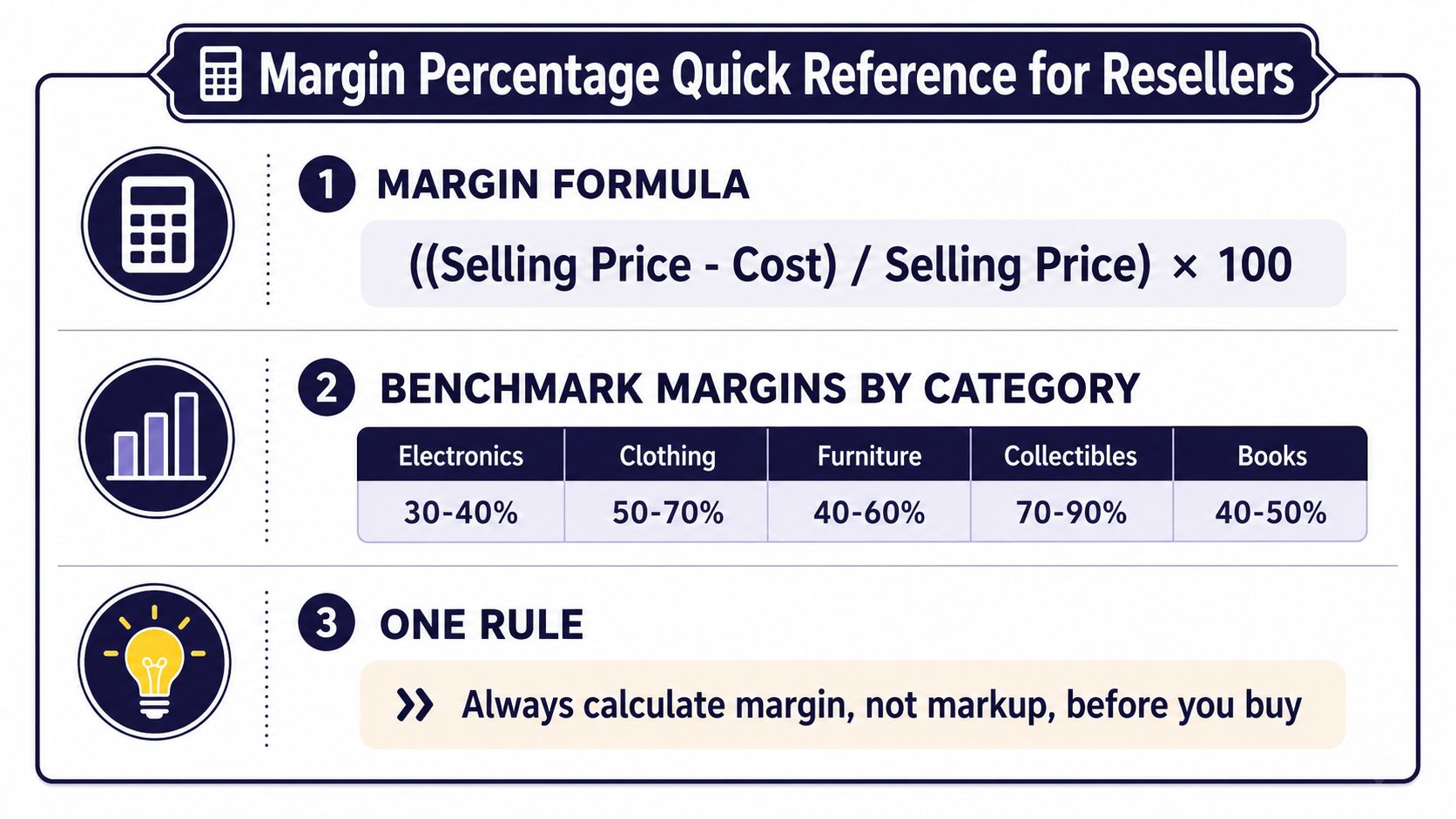
Margin formula: ((Selling Price – Cost) ÷ Selling Price) × 100. That's the one-liner to remember when you're checking a flip in the aisle, at a garage sale, or during an estate sale run.
The rule that matters most: always use net profit and selling price in the denominator. If you use cost instead, you're calculating markup, and that number will flatter weak flips.
Quick reseller benchmark ranges: clothing often lives in a wider middle band, books can work on slimmer spreads, and collectibles usually need stronger upside because sell-through can be slower. Category, condition, and fees change the target, so use the formula first and the category second.
A fast checklist helps when you're tired and the line is moving:
- Confirm the sold comp: Make sure you're looking at sold prices, not asking prices.
- Subtract everything: Buy cost, fees, shipping, and supplies all count.
- Check the margin, not the hype: A big markup can still hide a weak sale.
- Use your floor: If it doesn't clear your minimum, leave it.
That's the part resellers come back to. Margin isn't about making every item look good, it's about filtering bad buys before they turn into inventory clutter. The cleaner your math, the less you rely on hope.
If you want faster aisle math, use ScanFlip AI to check sold comps, fees, shipping, and net profit before you buy. It's built for the moment you're holding the item and need a red or green answer, not after it's already in the death pile.