
How to Identify Vintage Clothing a Reseller’s Field Guide
You're in a thrift aisle with a cart in one hand and a hanger in the other. The print looks right. The cut looks right. The tag looks old enough to be interesting. But that doesn't answer the only question that matters when you're sourcing to flip: is it vintage, and is it worth buying right now?
That gap is where a lot of resellers lose money. They learn just enough to spot “old-looking” clothes, then they overpay for pieces with weak demand, modern reproductions, or condition issues that kill resale. Knowing how to identify vintage clothing is useful. Knowing how to identify profitable vintage is what keeps your cash moving.
Table of Contents
- More Than a Hunch Identifying True Vintage
- The 30-Second Scan Quick Visual Checks in the Field
- Decoding the Details Dating Clothes with Forensic Clues
- Spotting Fakes and Red Flags That Kill Profit
- The Sourcing Workflow From ID to Profit Verification
- Documenting Finds to Build Your Sourcing IQ
More Than a Hunch Identifying True Vintage
A strong print and a dated silhouette can fool you fast. I've watched resellers grab a dress because it “felt 70s,” only to find a modern care tag, a web address, and fabric that was never going to bring real money. The opposite happens too. A plain wool skirt or a boring union-made blouse gets skipped because it doesn't scream vintage from six feet away.
That's why gut instinct is only the first filter.
When people ask how to identify vintage clothing, they usually want a dating trick. They want one clue that settles it. There isn't one. Real identification comes from stacking evidence: label, fabric, construction, hardware, care information, and then market demand. If those pieces line up, you've got something. If only one piece lines up, you've got a maybe.
Practical rule: Don't buy a garment because it looks old. Buy it because multiple clues agree, and the resale market agrees with them.
The business side matters just as much as the history side. A garment can be vintage and still be a bad buy. That happens every day. Plenty of dated pieces have weak brand recognition, oversupply, niche sizing, or too much damage to justify the time. Vintage is a category, not a guarantee.
The best thrift-store decisions happen in two stages:
| Stage | What you're checking | Why it matters |
|---|---|---|
| Identification | Age, authenticity, construction, era clues | Stops you from buying modern retro |
| Verification | Sold demand, likely net, condition-adjusted value | Stops you from buying dead inventory |
That's the difference between a collector's mindset and a reseller's mindset. Collectors can afford a sentimental yes. Flippers need an evidence-based yes.
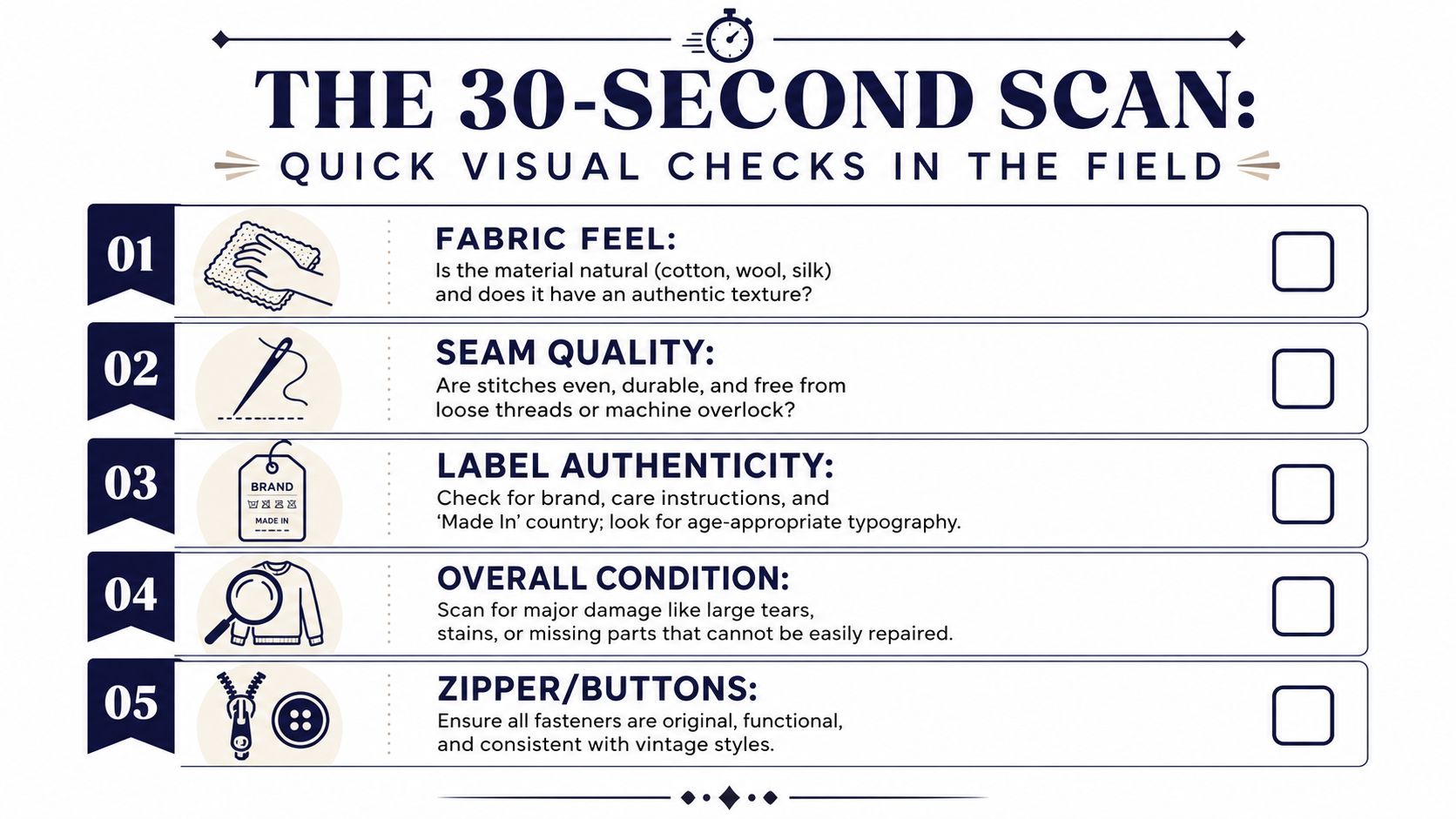
The 30-Second Scan Quick Visual Checks in the Field
Speed wins in crowded stores. If you need five minutes per hanger, someone else is walking out with the best pieces. Your first pass should be fast, physical, and ruthless.
A useful shortcut is pairing your eye test with tools built for resale speed. If you source across mixed categories, a barcode-free item identifier app for resellers can help confirm what you're holding when the label is vague or missing.
Start with touch and shape
Before you read anything, touch the fabric. Older pieces often telegraph themselves through feel. Wool, silk, linen, sturdy cotton, and older synthetic blends usually have a different hand than thin modern fast-fashion fabric.
Then look at the shape. Don't overcomplicate this. You're not writing a museum catalog. You're checking whether the cut feels era-consistent or just trend-recycled.
Use this quick field list:
- Fabric first: Natural fibers often deserve a second look. If the garment feels slick, flimsy, or cheaply blended, slow down before assuming it's old.
- Silhouette check: The cut should make sense with the rest of the garment. A supposed vintage piece with a modern cropped proportion, modern stretch behavior, and trendy distressing often isn't what it appears to be.
- Seam glance: Clean finishing helps. Sloppy overlock-heavy construction can be a warning sign, especially if the garment is pretending to be older and better made than it is.
Read the tag like a reseller
The tag is your fastest yes-or-no tool in the aisle. Brand matters, but tag typography, country wording, and label style matter more than logo recognition by itself.
Scan for these cues:
- Made-in language: “Made in USA” alone doesn't prove age. Domestic production still exists. Treat it as neutral until other clues support it.
- Country names that date the piece: Obsolete country names like West Germany or USSR, or city-state style tags, can be stronger period clues than patriotic wording.
- Tag design: Old tags usually look era-specific. If the typography feels too polished, too modern, or too deliberately retro, be skeptical.
A good reseller reads the whole tag, not just the brand name.
Use damage as a filter not a challenge
Beginners treat every flaw like a repair project. That burns time and margin. The faster move is to reject hard problems immediately and spend your attention on cleaner inventory.
In the first half-minute, look for:
- Big obvious issues: Large stains, tears, broken zippers, missing buttons, or stretched-out elastic.
- Hidden damage zones: Underarms, crotch seams, cuffs, collars, and hems.
- Mismatch problems: A garment that looks old but has replacement parts that don't fit the era or the style.
A thrift aisle isn't the place to fall in love with potential. It's the place to sort fast. The 30-second scan isn't supposed to prove authenticity. It's supposed to decide whether the item has earned a closer inspection.
Decoding the Details Dating Clothes with Forensic Clues
A piece makes it past the rack test. Now it has to survive the money test.
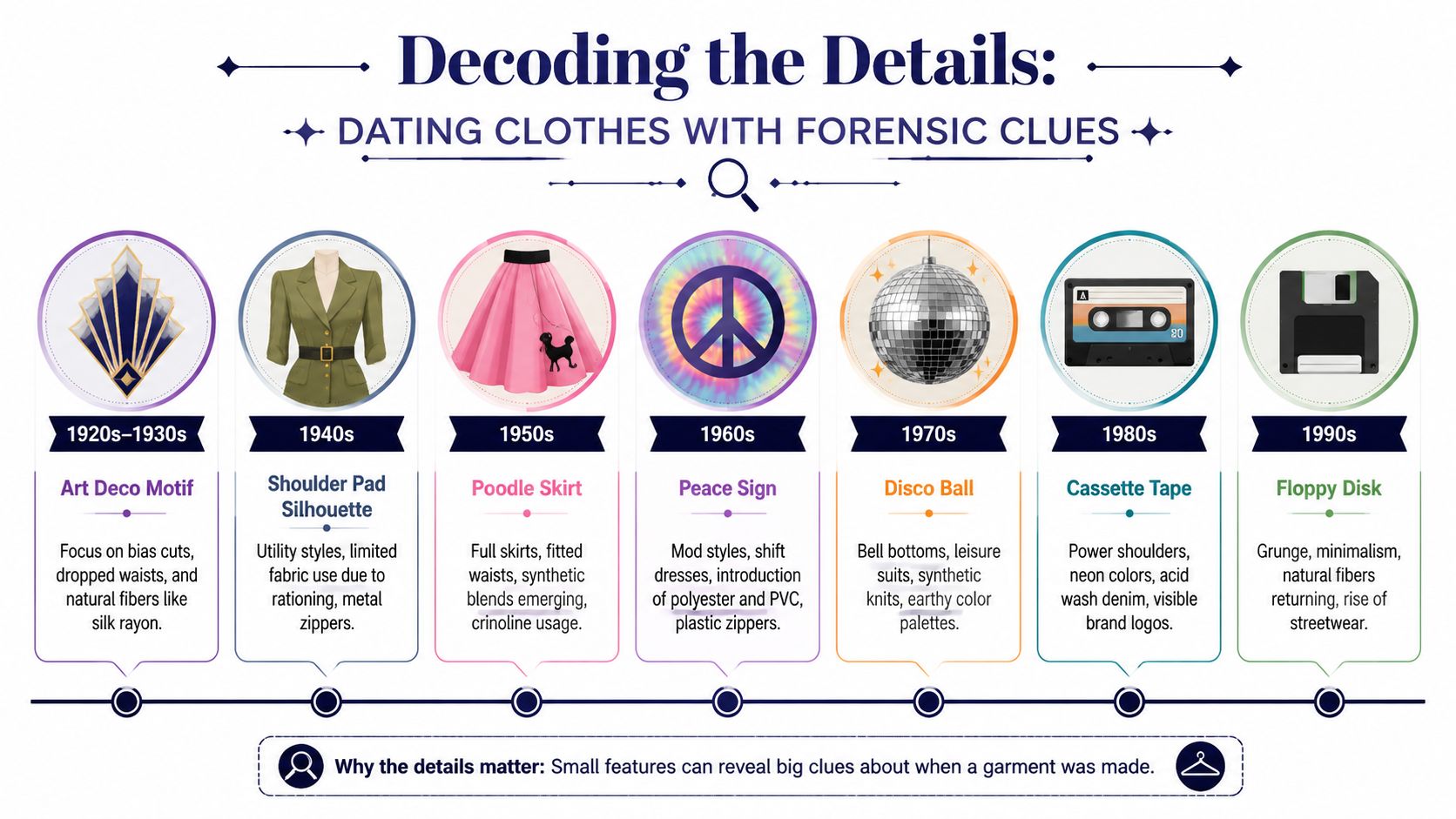
This is the stage where a $12 buy turns into a strong flip, or into dead stock with a good story. Fast sellers stop reading clothes like fans and start reading them like evidence. The goal is not to pin down an exact year for fun. The goal is to get close enough to decide whether the date range supports the asking price, the demand, and the likely sell-through.
RN numbers and labels that matter
If the garment has an RN number, read it before you read the hype. According to this guide on dating vintage clothing with RN numbers and construction clues, RN numbers from 00101 to 04086 indicate issuance between 1952–1959, and an RN like 13670 confirms the garment post-dates 1959. The trade-off is simple. An RN dates the company registration, not the exact production year of the garment.
That still gives you a hard boundary, and boundaries protect margin.
Union labels matter for the same reason. A real ILGWU or similar union tag can support an older US-made piece, especially when the fabric, construction, and wear all line up. On its own, though, a union label is supporting evidence. It is not a permission slip to overpay.
Use label evidence in layers:
| Label clue | What it tells you |
|---|---|
| Early RN range | The brand registration points back to the 1950s |
| Union label present | Supports authentic US-made production from the period |
| Era-consistent typography | Makes the tag more believable |
| Brand name alone | Adds very little without matching construction |
When I am sourcing fast, I want the tag to answer one question: does it narrow the date range enough to justify checking comps right now? If yes, keep going. If no, the piece needs stronger evidence somewhere else.
Hardware and stitching tell the truth
Tags can be swapped. Construction is harder to fake well.
Zippers are one of the quickest tells. The same dating guide notes that metal zippers are a marker for many pre-1960s garments. Nylon teeth with a metal pull usually point later, often into the 1960s or 1970s. Hook-and-eye closures, snaps, and older seam finishes can push the date earlier, especially on women's garments. None of these clues should work alone. In practice, the date gets stronger when zipper type, label style, and fabric all agree.
T-shirts need a different read. Single-stitch hems and sleeves can support an older tee, often pre-mid-1990s, while double-stitch construction usually points later. That clue has real resale value because buyers search for it, but the market also overweights it. A single-stitch tee with a weak graphic, bad fade, or no demand is still a slow mover. A double-stitch tee with a killer graphic can still make money.
That is the business angle many guides miss. Dating clues matter because they affect buyer demand, not because every old detail creates value.
If the graphic looks expensive but the construction looks wrong, trust the construction and check sold comps before you buy.
Care tags and origin details
Care tags settle a lot of arguments. Standardized care instructions and washing symbols became common only in the 1970s, so their absence can suggest an older garment, as noted earlier. That clue narrows the window. It does not prove a decade by itself.
Country wording can sharpen the call. “Made in USA” is weak on its own because domestic production spans too many years. Older or obsolete country names, unusual regional wording, and city-state style labels usually carry more dating weight. I trust the details that limit the timeline, not the ones that sound patriotic.
Here is the field order that saves the most time and bad buys:
- Construction clues such as zipper type, seam finish, and stitch pattern.
- Label evidence including RN numbers and union tags.
- Care tag information or the lack of it.
- Fiber content that fits the claimed era.
- Style and silhouette as support, never primary proof.
If three clues point to the same era, pull out your phone and verify sold prices. If the date range is fuzzy, the comps are soft, and the condition is only decent, put it back. Dating a garment is useful. Dating it fast enough to protect profit is what pays.
Spotting Fakes and Red Flags That Kill Profit
The easiest money to save in vintage resale is the money you don't spend on bad inventory. A lot of “vintage” on the rack is just modern clothing borrowing old ideas.
Why old-looking is not enough
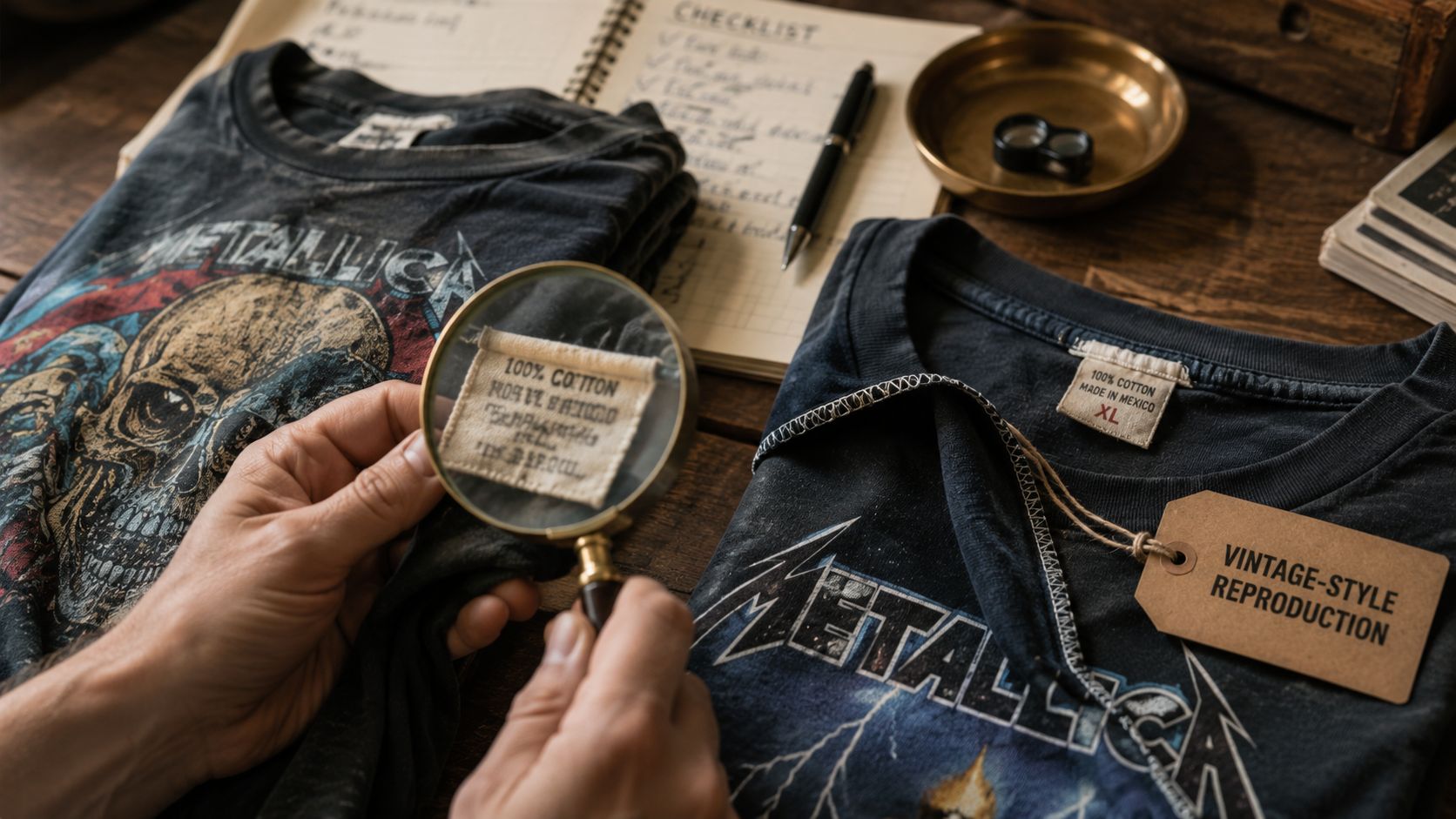
Logos fool people. Faded prints fool people. Band tees fool people most of all.
The strongest warning from the verified data is simple: 30–40% of items labeled “vintage” by sellers are modern retro-style reproductions using synthetic blends rather than the natural fibers typical of true vintage, according to the cited Clothing Warehouse reference. That's a huge chunk of false confidence in the market.
The same source gives one of the fastest disqualifiers you'll ever use: if a URL appears on the care tag, especially “http://,” the item is almost certainly post-2000. That doesn't tell you what it is, but it tells you what it isn't.
Red flags that deserve an instant pause:
- A modern web address on the tag: Fast elimination.
- Generic synthetic feel with a fake aged look: Often a reproduction trying too hard.
- Brand hype with no matching construction clues: Usually where buyers overpay.
- A suspiciously “perfect” vintage graphic tee: Popular designs get reproduced constantly.
Don't let nostalgia talk you into a modern fake.
Condition problems that ruin the flip
Even real vintage can be dead inventory if the damage is wrong. Some flaws are manageable. Others eat your profit before you've listed the item.
Walk away more often when you find:
- Dry rot: If the fabric feels weak, shreds under light stress, or breaks too easily, skip it.
- Permanent odor problems: Smoke, mildew, and storage smell can be stubborn enough to sink the sale.
- Severe moth damage: One hole can be survivable. Repeated damage across wool usually isn't.
- Structural failure: Elastic shot, lining disintegrating, seam stress everywhere, or hardware failure that isn't worth fixing.
Condition is where resellers start bargaining with themselves. That's dangerous. An unusual piece with bad damage can still sit forever. Buyers forgive minor flaws faster than they forgive instability, odor, or wear that makes the garment hard to use.
If you want cleaner flips, treat red flags as final. Not as a challenge.
The Sourcing Workflow From ID to Profit Verification
You're at the rack holding a real 80s jacket. The tag checks out. The construction looks right. The store wants $24. If you can't tell in under a minute whether it sells for enough after fees, shipping, returns risk, and your time, the vintage ID barely matters.

A fast buy or pass sequence
Use a tight workflow:
- Confirm it deserves research. Start with the basics. Era clues, category, brand, and overall condition.
- Name the item accurately. “Vintage dress” is too vague. “90s wool varsity jacket” or “70s western pearl snap shirt” gets you closer to real comps fast.
- Check sold comps, not active listings. Asking prices waste time. Sold results show what buyers paid.
- Match comp quality to your item. Same era, similar condition, similar size appeal, similar graphics or materials.
- Run the net number. Subtract platform fees, shipping, cleaning, repair, and a margin for returns or slow sell-through.
- Decide at the rack. Buy, pass, or set it down and keep moving.
That order matters. New resellers often identify first and celebrate second. Good sourcers identify, comp, and price in one motion.
A phone camera and image-based search speed this up. Typing loose descriptions by hand usually leads to bad comps, especially with niche workwear, denim, old union-made basics, or obscure department store labels. If you want a cleaner framework for the math, this guide on how to price items for resale using sold comps and net profit lays it out clearly.
Profit sits in the gap between “real vintage” and “real demand”
Plenty of authentic vintage is still a bad buy.
That's the part beginners miss. Age helps with identification. It does not guarantee sell-through, and it definitely does not guarantee margin. A clean 90s mall-brand sweater can be genuinely vintage and still sit for months at a low price. A less romantic piece, like a plain chore jacket or single stitch tee with the right fit and demand, can sell faster and leave better profit.
Use a simple rack-side filter:
| If this is true | Then do this |
|---|---|
| It's vintage, but sold comps are weak or inconsistent | Pass |
| It's vintage, clean, and sold comps are steady | Buy if the net margin is there |
| The ID is uncertain and the pricing spread is wide | Pass unless cost is very low |
| The item has strong comps and fast sell-through | Buy, even if the piece feels less exciting |
The trade-off is simple. The more uncertainty you accept on age, condition, or demand, the cheaper your buy cost needs to be. If the store price leaves no room for mistakes, leave it behind.
I treat every find like inventory, not a trophy. That keeps emotion out of the cart and cash in the business.
Documenting Finds to Build Your Sourcing IQ
The resellers who improve fastest don't rely on memory. They build their own reference library from actual store trips, actual passes, and actual sales.
Your notes become your edge
Every item you inspect teaches you something, including the ones you leave behind. If you only document purchases, you miss half the lesson. Passed items often teach better sourcing discipline than bought ones.
A saved photo plus notes on label, fabric, condition, and pricing can help you review patterns later. Over time, you start noticing what you keep misreading. Maybe you overvalue certain tags. Maybe you underestimate plain wool pieces. Maybe you grab novelty and skip basics that sell faster.
The fastest sourcers aren't guessing less because they were born with better taste. They've seen the same clues enough times to stop hesitating.
A practical habit is keeping a history of scans, photos, and comps tied to each sourcing trip. If you also review how to find sold prices on eBay for resale decisions, your notes stop being random and start becoming training data for your own business.
What to log after every trip
Keep it simple. You don't need a giant spreadsheet to get smarter.
Track these points consistently:
- What you found: Brand, garment type, era clues, and standout construction details.
- Why you bought or passed: Demand, condition, price, or uncertainty.
- What the comps looked like: Not just the highest sale. The pattern.
- What happened later: Sold fast, sat too long, got returned, or outperformed expectations.
That review loop sharpens your eye. After enough repetition, you won't just know how to identify vintage clothing. You'll know which vintage clothing deserves your money.
If you want faster buy-or-pass decisions while sourcing, ScanFlip AI helps you identify items from photos, pull sold comps across major marketplaces, and calculate expected net profit before you buy. That's useful when you're staring at a rack full of “maybe” and need an answer in seconds.