

Inventory Valuation Methods: A 2026 Reseller Guide
Standing in a Goodwill aisle with a chipped Le Creuset lid in one hand and a cart full of maybe-finds in the other, the core question isn't just whether the item will sell. It's whether the numbers will still make sense after fees, shipping, taxes, and the dead weight of the stuff that never moves. That's where inventory valuation methods stop being accountant language and start affecting your actual flip math, your tax bill, and whether a $4 buy is a real win or just a busy-looking mistake.
Table of Contents
- Why Inventory Valuation Matters for Resellers
- The Four Core Inventory Valuation Methods Explained
- Worked Examples Showing How Each Method Changes Your Numbers
- How Inventory Valuation Methods Affect Taxes and Profits
- The Reseller Gap Most Valuation Guides Miss
- How to Apply Inventory Valuation to Your Resale Business
- Best Practices and Reporting Considerations for Resellers
Why Inventory Valuation Matters for Resellers
The thrift-store version of inventory valuation is simple enough. You spot a stack of vintage Le Creuset, the bin is $4, and the sold comps tell you the market still wants it. If your sourcing tool shows real sold comps and a solid net profit after fees, that's a green light. If you want to sanity-check how market value research fits into that kind of buy, the practical angle is laid out in this note on market value research.
The bookkeeping version is where a lot of small sellers get tripped up. Inventory valuation methods decide how much of what you bought becomes cost of goods sold, how much stays on the books as inventory, and how much profit is left showing on paper. That changes taxable income, reported margins, and the number that ends up on your return, even when the box on your shelf hasn't changed at all.
The book value and the buy decision are different problems
At sourcing time, you're really asking, “Will this thing clear after fees?” At tax time, you're asking, “How much of my inventory cost should be matched against the sales I made?” Those are related, but they're not the same question. The first one is a buy-or-pass call. The second one is an accounting method.
Practical rule: use sold comps to decide whether to buy, then use a consistent valuation method to keep the books honest later.
That distinction matters because resale inventory is usually a pile of one-offs, mixed-condition goods, and random replenishment. Textbooks talk like everything comes in neat layers. Real life looks more like a cart full of mugs, shoes, books, and one weird sealed item you found behind a lamp box.
For resellers, that means valuation isn't just about compliance. It affects whether your quarter looks healthy, whether your tax prep is clean, and whether you can tell which categories are pulling weight. The method itself won't change your cash in the bank, but it will change how much of that cash shows up as profit after COGS is matched to sales.
The Four Core Inventory Valuation Methods Explained
A reseller can buy the same three pieces of stock and end up with different profit numbers depending on the method used to assign cost. Under GAAP, the main methods are FIFO, LIFO, weighted-average cost, and specific identification. In plain terms, each one answers the same question a little differently, which cost gets attached to the item you sold? Under common inventory systems, these methods are the core ways to assign cost to stock, and in a perpetual setup, FIFO and LIFO pull from distinct batches while weighted average keeps recalculating a running mean after each receipt, as described in IBM's inventory valuation guidance.
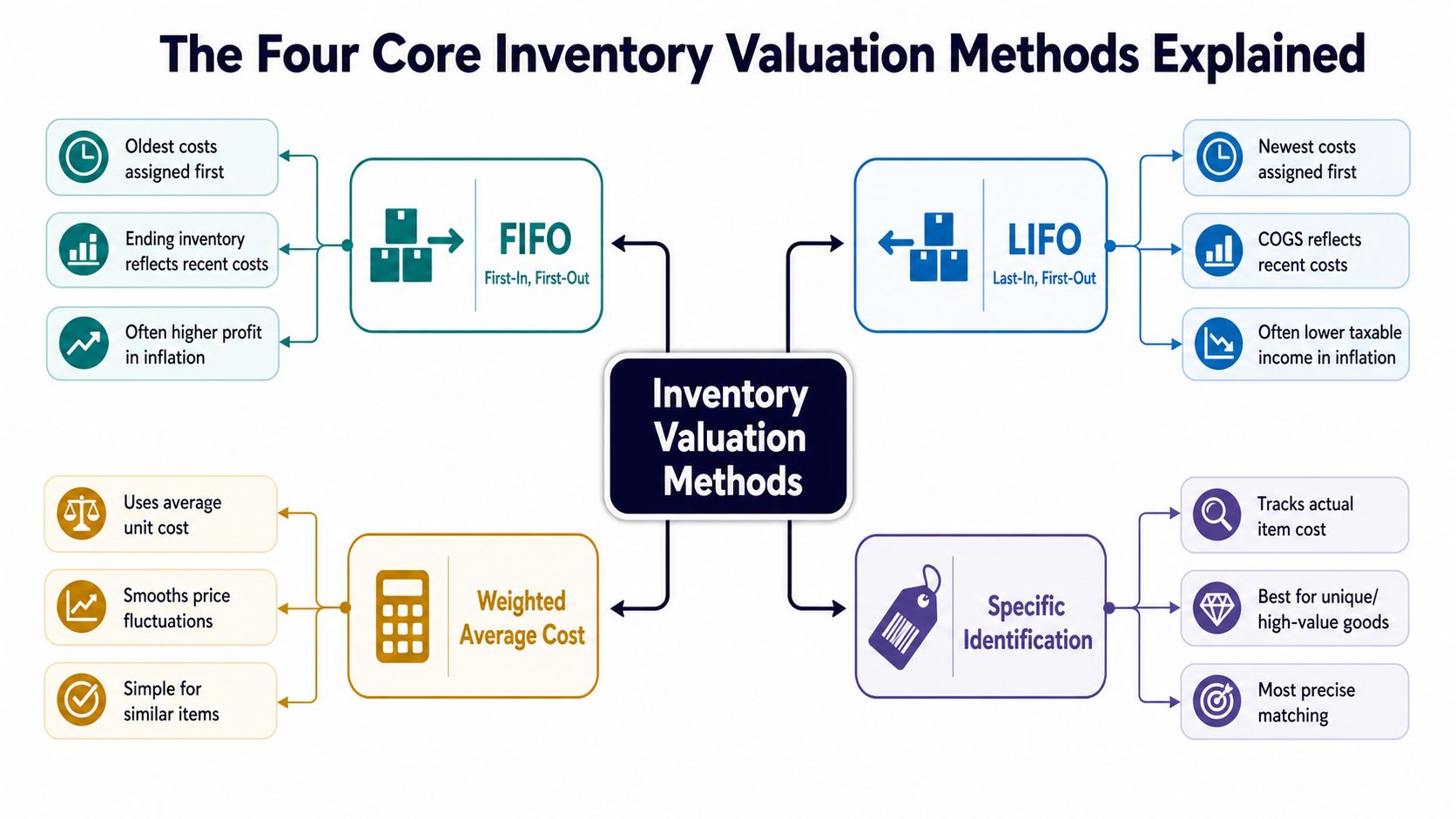
FIFO, LIFO, weighted average, and specific identification in reseller terms
FIFO means first in, first out. The oldest cost leaves first, so the earliest items you bought are treated as sold first. If you picked up a mug at an estate sale two months ago and another one last week, FIFO matches the older cost to the sale first.
LIFO means last in, first out. The newest cost gets matched to sales first, and older costs stay in ending inventory. In inflationary conditions, LIFO produces the highest cost of goods sold and the lowest net income among the three main approaches, which can change reported earnings even when the shelf looks the same.
Weighted average cost smooths everything together. Each unit gets the running average of the costs you have paid so far. That works well when your stock is similar, like books, sealed retail, or commodity-style items, where the individual unit cost does not matter much from one sale to the next.
Specific identification tracks the exact cost of each unit. For a reseller, that is the most intuitive option when you deal in unique finds, like signed collectibles, antique glass, or a specific pair of sneakers with a known buy price. It also gives the cleanest answer when you are looking at one-off goods and already know the cost tied to that exact item.
A simple buy example
Say you buy three items at different sales. Item A costs $10, Item B costs $25, and Item C costs $5. If you sell Item B, FIFO might assign an earlier cost, LIFO might assign the newest cost, weighted average would spread the costs across the batch, and specific identification would keep Item B tied to its actual $25 cost because you tracked it directly.
That difference is the whole point. The sale price can stay identical, but the cost attached to the sale changes your profit, and that changes the tax line too. For resellers, the right method is the one that matches how the stock is handled, not the one that sounds neat in a textbook.
Worked Examples Showing How Each Method Changes Your Numbers
Three trips, ten mugs, and one quarter of sales tells the story better than any accounting definition. At an estate sale, you buy five mugs at $5 each. Two weeks later at a garage sale, you grab three more at $8 each. After that, a thrift run turns up two at $12 each. Your total cost is $79 for ten mugs.
Now say you sell seven of them. The cash you bring in doesn't care which valuation method you use. Your books do.
The same seven sales, four different answers
| Method | COGS (7 sold) | Ending Inventory (3 remaining) | Gross Profit on 7 sold |
|---|---|---|---|
| FIFO | $41 | $38 | Depends on sale price minus $41 |
| LIFO | $56 | $23 | Depends on sale price minus $56 |
| Weighted Average | $55.30 | $23.70 | Depends on sale price minus $55.30 |
| Specific Identification | Varies by actual items sold | Varies by actual items remaining | Depends on the exact costs tracked |
Under FIFO, the first five mugs at $5 are treated as sold first, then two mugs at $8, so your COGS is $41 and ending inventory is $38. Under LIFO, the last two mugs at $12 go out first, then five at $8, so COGS rises to $56 and ending inventory drops to $23.
Under weighted average, the batch cost spreads evenly. Your average is $7.90 per mug, so seven sold comes to $55.30 and the remaining three sit at $23.70. Specific identification depends on which exact mugs sold, so the answer changes only if the actual sold items change.
What that looks like in a real notebook
If you know what you bought, you can make the numbers tell the truth. If you don't, the numbers just look tidy.
That's the point a lot of side hustlers miss. You can have the exact same sell-through, the same marketplace fees, and the same payout, but your reported profit still shifts because the cost side shifts. That's why the method matters even for small resellers who think of books as “just bookkeeping.”
How Inventory Valuation Methods Affect Taxes and Profits
The choice stops being theoretical once inventory valuation changes taxable income. In practice, that affects how much profit you report, how much cash you keep back for tax time, and how confidently you can judge whether a flip worked. A cited industry summary says FIFO is used by 60% of U.S. companies, while weighted-average cost is used by 22% of retail firms. The same dataset says LIFO reduces taxable income by about 8% on average for manufacturing firms industry inventory statistics.
Why the method changes the tax line
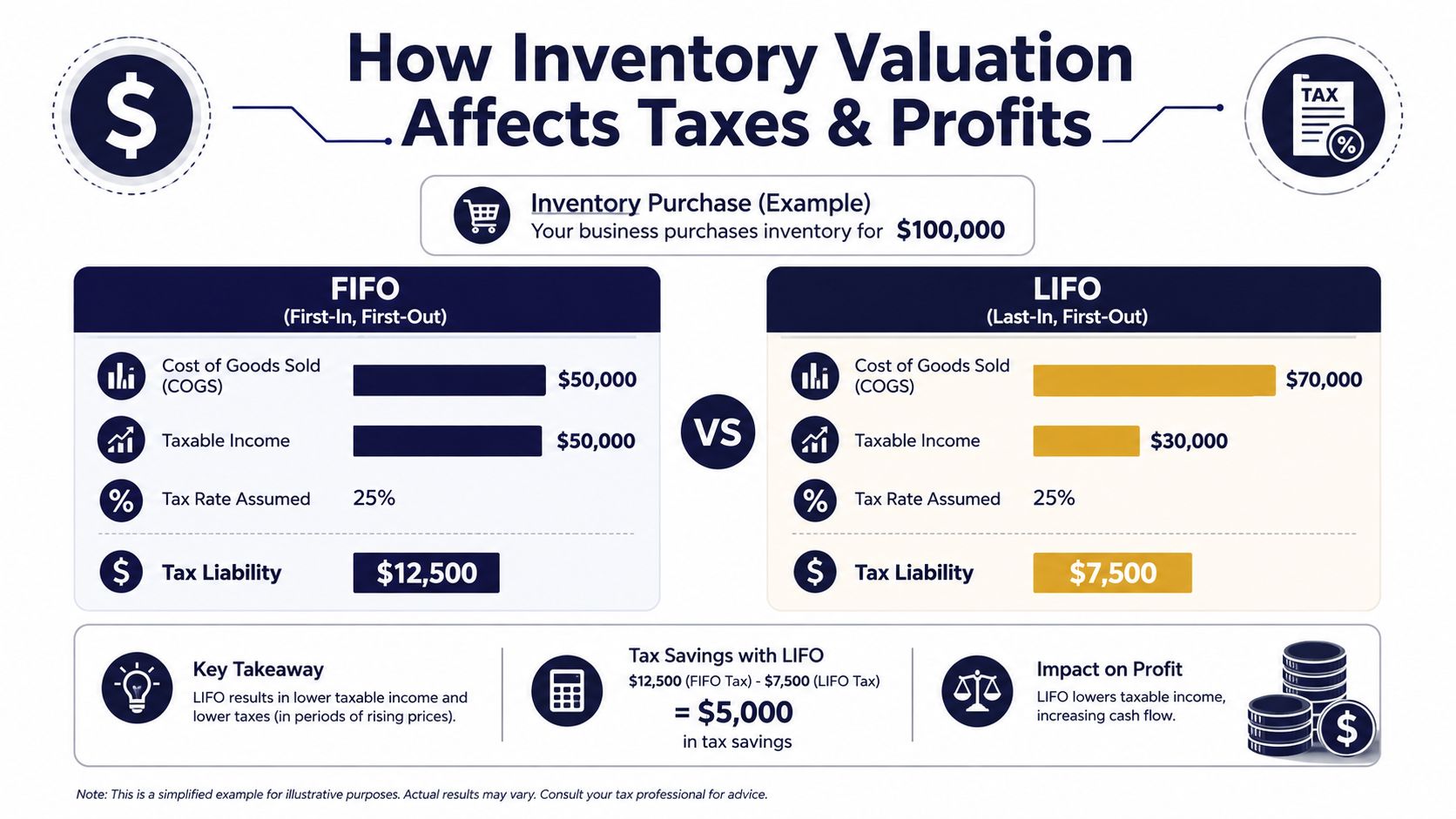
When prices are rising, LIFO pushes newer, higher costs into COGS first, so profit on paper goes down. FIFO does the opposite, because older, cheaper costs get matched to sales first, which makes profit look higher. NYU Stern's primer says LIFO produces the highest COGS and the lowest net income among the main approaches in inflationary periods, so the method can change reported earnings even when the physical inventory has not changed NYU Stern inventory primer.
For a reseller, that means rising replacement cost can make FIFO look stronger than the business really is, at least on paper. LIFO may soften the reported profit, but it does not create extra margin. It shifts the timing of profit recognition, which is why the method choice needs to be deliberate and consistent.
The reporting risk is bigger than many resellers realize
Inventory valuation errors can cost companies 5% to 10% of reported profits industry inventory statistics. That is not a minor cleanup issue. If your cost tracking is loose, the profit number you show can drift far enough to distort the decisions you make about pricing, restocking, and cash reserve.
Practical rule: if your cost tracking is sloppy, the valuation method will not save you.
For high-turnover sellers, weighted average can behave a lot like FIFO because stock moves fast and replenishment is frequent. For unique or high-value goods, specific identification is usually more useful because each item has its own buy price and its own story. The right method will not make taxes disappear, but it can keep your profit reporting from drifting away from reality.
If you already calculate your take-home from sales, it helps to match the cost method to the same profit logic you use in your own math. A practical breakdown is in this guide to calculating net profit.
The Reseller Gap Most Valuation Guides Miss
Most inventory guides are written for people who buy pallets, run warehouses, or close month-end books. Resellers live in a messier world. You're buying one-off items, mixed-condition lots, partial bundles, and things with no clean cost basis, then deciding in thirty seconds whether an item is worth carrying to the checkout line.
Specific items need a different lens
That's where specific identification matters most. Accounting references already treat it as a method for unique items, which is exactly why it fits vintage furniture, jewelry, watches, sports cards, and other pieces where each unit stands on its own. The problem is that standard explainers often stop at FIFO, LIFO, and weighted average, then leave resellers to guess how to price an oddball item with incomplete information.
A better sourcing mindset starts with realized net proceeds, not just textbook valuation. In fast-moving resale, what matters is the amount left after platform fees, shipping, and markdown pressure. A bin find may look strong at first glance, but if the sell-through is weak or the category is flooded, the book value doesn't matter much.
Market-linked valuation can be more honest than cost alone
Some inventory valuation approaches also use sales-based logic when cost data is incomplete. The comparative sales method starts from expected selling price and subtracts process profit and disposal allowances, which shows that market-linked valuation isn't some fringe idea. It's a workable framework when you don't have a reliable cost trail, or when you're assessing goods that have to move quickly.
Reseller math gets ugly when cost is known but sell-through is not. It gets worse when both are fuzzy.
That's why a lot of guidebook advice misses the question. The question isn't only which method is allowed. It's which method gives you the clearest answer before you buy, while still holding up after the sale. In a resale business, those aren't the same thing, and pretending they are usually leads to dead inventory.
How to Apply Inventory Valuation to Your Resale Business
Start with the kind of stock you move. If your business is built around unique, high-value, or one-of-a-kind goods, specific identification usually fits best because it preserves the actual cost of each unit. If you're pushing large volumes of similar items, weighted average can be a workable middle ground. For a lot of small resellers, though, specific identification wins because the inventory is too uneven for averaging to feel honest.
Make the sourcing decision before the bookkeeping decision
The best place to improve your books is the aisle, not the spreadsheet. If you can estimate sold comps before you buy, you'll avoid filling your death pile with things that only look good at sticker price. That's where a sourcing tool matters more than a later accounting cleanup.
ScanFlip AI is one option for that buy-or-pass step. It uses AI photo scan with no barcode needed, barcode scan, or text search, and it pulls sold comps across eBay, Poshmark, Mercari, Depop, Amazon, Whatnot, ThredUp, Facebook Marketplace, and TikTok Shop. It also calculates net profit after fees and shipping and returns a red or green flip-or-pass verdict in seconds.
That kind of sourcing check doesn't replace your valuation method. It supports it. You still record the actual buy cost when the item gets home, but you're making the purchase with better odds because you've already checked the resale math.
Use your method to support the way you already work
If you're scanning books, sealed media, or retail arbitrage items, the cost pattern often stays close enough that weighted average can make sense. If you're flipping antiques, collectibles, or mixed-condition one-offs, averaging can hide too much. That's why many sellers eventually default to tracking each item separately, even if they never call it “specific identification” out loud.
The key is consistency. Pick a method that matches your inventory, then keep the records clean enough to defend it later. If you need extra help deciding what the buy should be worth, compare your comps in one place, then let your own books handle the back end.

If you want a practical way to compare profit before you buy, a focused pricing check helps. A useful companion note on that topic is this break-even price calculation guide.
Best Practices and Reporting Considerations for Resellers
The cleanest books usually come from boring habits. Track your cost per item from day one, whether that lives in a spreadsheet, a simple app, or accounting software. If you're using specific identification, you can't fake your way through the purchase record later.
Keep your valuation grounded in reality
Don't value inventory off active listings. Those are asking prices, not sold prices. Sold comps are the number that matter, which is why tools that pull actual sold market data are more useful than anything that just shows what people hope to get.
Revisit your method once a year and stick with it. Switching in the middle of a tax year creates messy records and makes it harder to explain what changed. If an item gets damaged, obsolete, or clearly downgraded in condition, the lower of cost or market rule matters, because inventory shouldn't keep sitting on the books at full cost if the market value has fallen below it lower of cost or market guidance.
What to do when the shelf and the books disagree
- Track cost per item from day one. That makes specific identification possible and keeps the sale side tied to the buy side.
- Do regular physical counts. If the shelf and the spreadsheet don't match, the valuation method won't save you.
- Stay consistent with one method. Changing methods because the quarter looks bad only makes the reporting mess worse.
- Talk to a tax professional when your inventory mix changes. A reseller with a few mugs and a reseller with piles of varied stock don't need the same treatment forever.
Practical rule: inventory valuation methods are built to turn physical stock into accounting value with consistent cost-flow assumptions, not to guess what the market feels like today.
That's the balance to keep in mind. Use cost-based accounting to keep your records defensible, but use sold comps and actual realized margins to decide what's worth buying in the first place. If your system can do both, your numbers start matching the business instead of fighting it.
If you want a faster way to judge a flip before you spend the money, ScanFlip AI gives you sold comps, fee-aware net profit, and a red or green buy signal while you're still in the aisle. It fits the sourcing side of resale, where good decisions start with actual sold prices and not listing guesses.