
Poshmark vs Depop: Which Platform Pays More for Resellers
Standing in a Goodwill aisle, it's easy to think a desirable jacket will make the same money anywhere. It won't. The marketplace you choose changes the fee stack, the buyer's expectations, the shipping decision, and the price you can defend with sold comps.
That's the core Poshmark vs Depop decision. Don't send every piece to both apps by habit. Split your inventory by category, target price, buyer fit, and net profit, then give each item the platform where it has the best chance of selling without wasting your time.
Table of Contents
- The Same Item, Two Very Different Payouts
- What Poshmark and Depop Are
- Fees, Shipping, and Net Profit by Price Band
- Who Is Buying and What Sells Fast
- Where Specific Inventory Types Belong
- The Decision Matrix for Listing Choice
- When Multi-Listing Pays and When It Hurts
The Same Item, Two Very Different Payouts
A reseller pulls a Carhartt Detroit Jacket from a Goodwill Bins rack, photographs it that night, and prepares the same item for Poshmark and Depop. The photos are similar. The description identifies the size, condition, fading, and measurements. The sold price target is the same.
The payout still diverges.
On a $50 sale, Poshmark's commission is $10, because Poshmark takes 20% on sales of $15 or more. Depop's U.S. payment processing on the item price alone is approximately $1.95, calculated at 3.3% plus $0.45, before any processing tied to shipping or taxes. That leaves roughly $40 on Poshmark versus $48.05 on Depop before shipping and cost of goods. The fee difference is about $8.05 on the same item, based on the published fee structures from Poshmark and Depop.
If the jacket cost only a modest amount to source, that gap can decide whether the flip feels worthwhile. If the item needs cleaning, measurements, buyer messages, packaging, and a trip to the carrier, giving away an avoidable slice of the payout makes little sense.
Practical rule: The same inventory is not the same business on Poshmark and Depop.
Shipping can change the final result. Poshmark's simple shipping structure makes the checkout and fulfillment process predictable, while Depop gives sellers more control over shipping choices. That flexibility can protect margin when the buyer pays shipping, but it also means you must account for the shipping method instead of treating the sale price as your take-home.
The other mistake is ignoring demand. A vintage workwear jacket may attract style-focused buyers on Depop, while a recognizable contemporary brand may receive stronger engagement on Poshmark. A lower commission can't rescue an item that gets weak exposure, poor saves, or no serious offers.
Before you buy from the bins, calculate sale price minus platform fees, shipping, and cost of goods. This net profit calculation guide lays out the basic formula. Use sold comps, not asking prices, and decide where the item belongs before it joins your death pile.
What Poshmark and Depop Are
Poshmark runs on a social closet model. You create a listing with photos, brand, size, condition, description, and price, then buyers find it through search, feeds, shared listings, seller closets, and Posh Parties. Offers to likers and bundle discounts encourage shoppers to buy several pieces from one closet instead of treating every listing as a separate purchase.
The daily workflow is structured. Share listings, answer questions, send offers, and keep the closet active. That system fits repeatable branded inventory, coordinated outfits, shoes, bags, and categories where buyers already recognize the product and know what they want. If your inventory is broad but lacks brand or category demand, the routine creates activity without fixing weak sell-through.
Depop works as a visual fashion feed with marketplace checkout attached. The cover photo has to stop the scroll, while styling, title, description, tags, measurements, and seller profile help convert attention into a purchase. Buyers discover items through search, their feed, aesthetic terms, and the seller's wider profile. A consistent grid of related pieces can increase the value of each listing because shoppers may continue browsing the shop.
Depop also gives sellers more control over shipping. You choose an available shipping approach and decide whether the buyer pays shipping or you absorb it. That flexibility suits light clothing, carefully packed vintage pieces, and sellers who know their shipping costs. It adds a decision to every listing, so the platform rewards sellers who calculate fulfillment rather than guessing.
| Feature | Poshmark | Depop |
|---|---|---|
| Core shopping experience | Social closet, feeds, sharing, offers, bundles, and Posh Parties | Visual feed, search, profile curation, and style-led discovery |
| Listing emphasis | Brand, size, condition, measurements, price, and closet activity | Photography, styling, keywords, measurements, condition, and aesthetic |
| Shipping experience | Predictable seller workflow with a platform shipping label | Flexible shipping choices that require seller judgment |
| Buyer behavior | Often shops recognizable brands, categories, closets, and bundles | Often searches by style, era, aesthetic, brand, and distinctive details |
| Best operational fit | Structured routines and repeatable apparel inventory | Strong styling, photography, and descriptions for distinctive fashion |
| Main margin question | Does the convenience justify the commission? | Do lower U.S. seller costs justify the shipping decisions and effort? |
Neither marketplace is passive. Poshmark rewards consistent closet activity. Depop demands stronger visual presentation and sharper item positioning. A flat-lay photo with a weak title can underperform on Depop, while an unshared Poshmark closet can lose buyer attention.
Split inventory by platform fit. Put recognizable, bundle-friendly items into a Poshmark workflow. Give distinctive vintage, aesthetic, or visually styled pieces the Depop treatment. Poshmark packages convenience and social selling differently from Depop, so your workflow and item selection should match the item, not your habit.
Fees, Shipping, and Net Profit by Price Band
The key question is what remains after the platform fee, payment processing, shipping responsibility, and cost of goods. A $12 basic top, a $50 vintage piece, and a premium designer jacket need different listing decisions because the fee gap changes with the selling price.
For U.S. Poshmark sellers, the structure is straightforward. Poshmark takes $2.95 on sales under $15 and 20% on sales of $15 or more, with no separate listing fees or monthly costs, according to its seller updates. Depop's U.S. help documentation lists 0% platform selling fee and payment processing of 3.3% plus $0.45. Depop applies that processing to the item sale price plus shipping and applicable taxes, so the item-only examples below do not represent the complete payout.
| Item Price | Poshmark Fees | Depop Fees | Poshmark Net Before COGS and Shipping | Depop Net Before COGS and Shipping | Winner |
|---|---|---|---|---|---|
| Under $15 | $2.95 commission | 3.3% plus $0.45 processing, with shipping and tax inputs affecting the final amount | Sale price minus $2.95 | Sale price minus processing | Depop on seller fee, but shipping and checkout cost still matter |
| $15 or more | 20% commission | 3.3% plus $0.45 processing, with shipping and tax inputs affecting the final amount | Sale price minus 20% | Sale price minus processing | Depop on fee math |
| $50 example | $10 | Approximately $1.95 on the item price before shipping and tax processing | Approximately $40 | Approximately $48.05 before shipping and tax processing | Depop before shipping and COGS |
Low-ticket items need a separate decision
Poshmark's flat $2.95 commission takes a large share of a low-priced sale. On an item under $15, the fee comes out before sourcing, storage, photography, packing, customer service, and any shipping cost you absorb.
Depop's processing fee also stands out on cheap items because the $0.45 fixed portion remains the same regardless of sale price. On a low-ticket top, that fixed amount can take a larger share of the gross payout than expected.
For a basic item priced below $15, Depop usually gives you the cleaner fee result. Keep it there only when the buyer pays shipping, the listing takes little time to create, and the item does not require paid promotion or a deep offer. A styled, distinctive piece can justify the extra work. A common top with thin demand usually cannot.
Shipping can erase the advantage quickly. Absorbing shipping, accepting a deep offer, or spending too long producing a polished listing changes the actual margin. The practical break-even question is which app leaves enough after every cost for this item to justify your time.
Mid-ticket and premium items expose the gap
The difference grows as the selling price rises. Poshmark's 20% commission scales with the item price, while Depop's U.S. structure uses payment processing instead of a platform selling fee. A $50 vintage piece therefore shows a materially different payout before shipping.
A premium jacket or designer item can create a larger dollar gap, but buyer confidence still determines the better channel. If Poshmark buyers recognize the brand, trust the transaction, or make an offer that closes the sale, Depop's lower fee does not automatically produce the better flip.
Use the Poshmark profit calculator as a starting point, then enter the actual shipping assumption and your cost of goods. Assign low-ticket basics and visually distinctive pieces according to their real margin, rather than multi-listing every item by habit. Never treat a gross sold price as profit.
Who Is Buying and What Sells Fast
Poshmark and Depop don't reward the same kind of presentation.
Poshmark is the stronger default for recognizable mainstream and contemporary brands, coordinated outfits, athleisure, handbags, shoes, and practical wardrobe pieces. Buyers often arrive with a brand or category in mind. A clean listing for a known label can work without a dramatic editorial concept, provided the photos, measurements, condition notes, and price are credible.
Depop is more style-led. Its active buyer base is heavily youth-oriented, with nearly 90% of active buyers under age 34, according to reporting on Depop's audience and marketplace growth. Depop also reported roughly 7 million active buyers, more than 3 million active sellers, and approximately $1 billion in annual gross merchandise sales by late 2025, with nearly 60% year-over-year growth in the U.S. The market history and reported Depop figures are covered by MediaPost.
That doesn't mean every young buyer wants vintage, or that every older buyer avoids Depop. It means the platform's strongest commercial signal is often a clear aesthetic: Y2K, vintage workwear, streetwear, handmade pieces, remade clothing, distinctive denim, and items with a story beyond the brand name.
| Attribute | Poshmark | Depop |
|---|---|---|
| Strongest buyer signal | Recognizable brand, category, size, condition, and practical wardrobe use | Distinctive style, era, silhouette, texture, styling, and subculture relevance |
| Good listing approach | Clear photos, measurements, brand information, and a realistic offer strategy | Strong cover image, cohesive styling, useful keywords, and detailed condition notes |
| Typical demand advantage | Contemporary clothing, athleisure, accessories, shoes, and brand-led shopping | Vintage, Y2K, streetwear, handmade, remade, and aesthetic-driven inventory |
| Price conversation | Buyers may negotiate through offers, bundles, and closet shopping | Buyers may respond to uniqueness, styling, rarity, and profile curation |
| Common failure | Generic photos or an inactive closet | Weak photography, vague measurements, or a listing that lacks a clear style identity |
A $45 Aritzia sweater is a natural Poshmark test because brand recognition and wearable styling can carry the listing. On Depop, it may need a stronger visual angle or a sharper trend connection to stand out.
A 90s Carhartt Detroit Jacket has the opposite problem. On Poshmark, buyers may treat it as ordinary outerwear unless the condition, fit, wash, and measurements are exceptional. On Depop, the same jacket can speak directly to buyers searching for vintage workwear, oversized silhouettes, and streetwear-adjacent pieces.
Trend fit also changes over time. Recent Depop reporting has highlighted rising searches for “minimal” by more than 800%, alongside increased interest in brands including COS, The Row, Gap basics, Ralph Lauren, J.Crew, Champion, Adidas, and Onitsuka Tiger. Those signals show why a seller shouldn't reduce Depop to loud Y2K pieces only. Clean basics and contemporary classics can work when presented in the right visual context, as discussed in this comparison of selling clothes on both platforms.
Where Specific Inventory Types Belong
Stop using “vintage goes to Depop, everything else goes to Poshmark” as your whole strategy. That shortcut misses price, brand recognition, buyer intent, and how much explanation an item needs before someone understands its value.
Poshmark gets the brand-led wardrobe
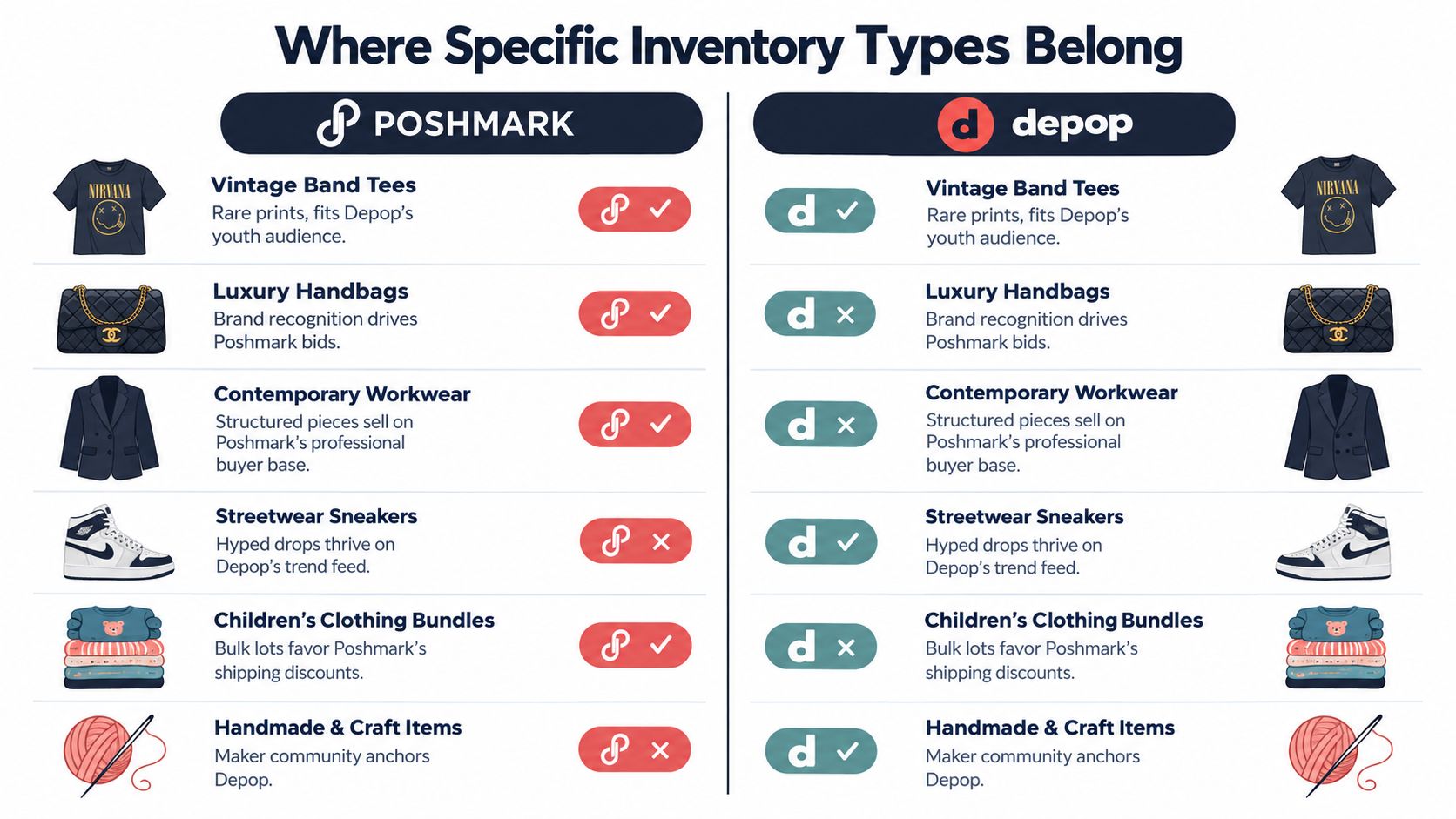
Mid-range contemporary pieces from brands such as Aritzia, Madewell, and J.Crew usually deserve a Poshmark-first approach. Buyers can search directly for the brand, compare sizes, and add related pieces to a bundle. That matters for a clean sweater, office-friendly blazer, modern denim, or a lightly worn dress that doesn't need a subculture story.
Luxury and authenticated designer inventory also leans Poshmark. Louis Vuitton, Coach, and higher-end vintage Chanel need buyer trust, brand recognition, and a price environment where detailed condition information matters. Keep your authentication records, close-up photos, serial or date-code details where appropriate, and honest flaw notes.
Children's clothing bundles belong on Poshmark when the lot is practical and the pieces share a size, season, or brand theme. The buyer is shopping for convenience, not necessarily for one standout garment.
Depop gets the identity-led pieces
Y2K, vintage denim, 80s and 90s graphic tees, Carhartt workwear, streetwear, and unusual silhouettes fit Depop more naturally. The buyer is often responding to the complete look, not just the label. Photograph the jacket on-body, show the fade and wear, include measurements, and describe the fit in useful terms.
Handmade and curated vintage also belong on Depop regardless of era. A hand-painted jacket, reconstructed skirt, one-off accessory, or tightly edited vintage piece benefits from a seller profile that feels like a point of view rather than a random closet.
Contemporary classics can go either way. A neutral COS-style top, Ralph Lauren polo, or clean Adidas piece may perform on Depop if the photos, styling, and keywords connect it to the current aesthetic. The platform's trend signals include interest in minimal clothing and several mainstream brands, so don't reject a piece just because it isn't loud or obviously vintage.
Sourcing rule: Put brand-led basics where buyers search by brand. Put identity-led pieces where buyers search by look, era, or subculture.
The Decision Matrix for Listing Choice
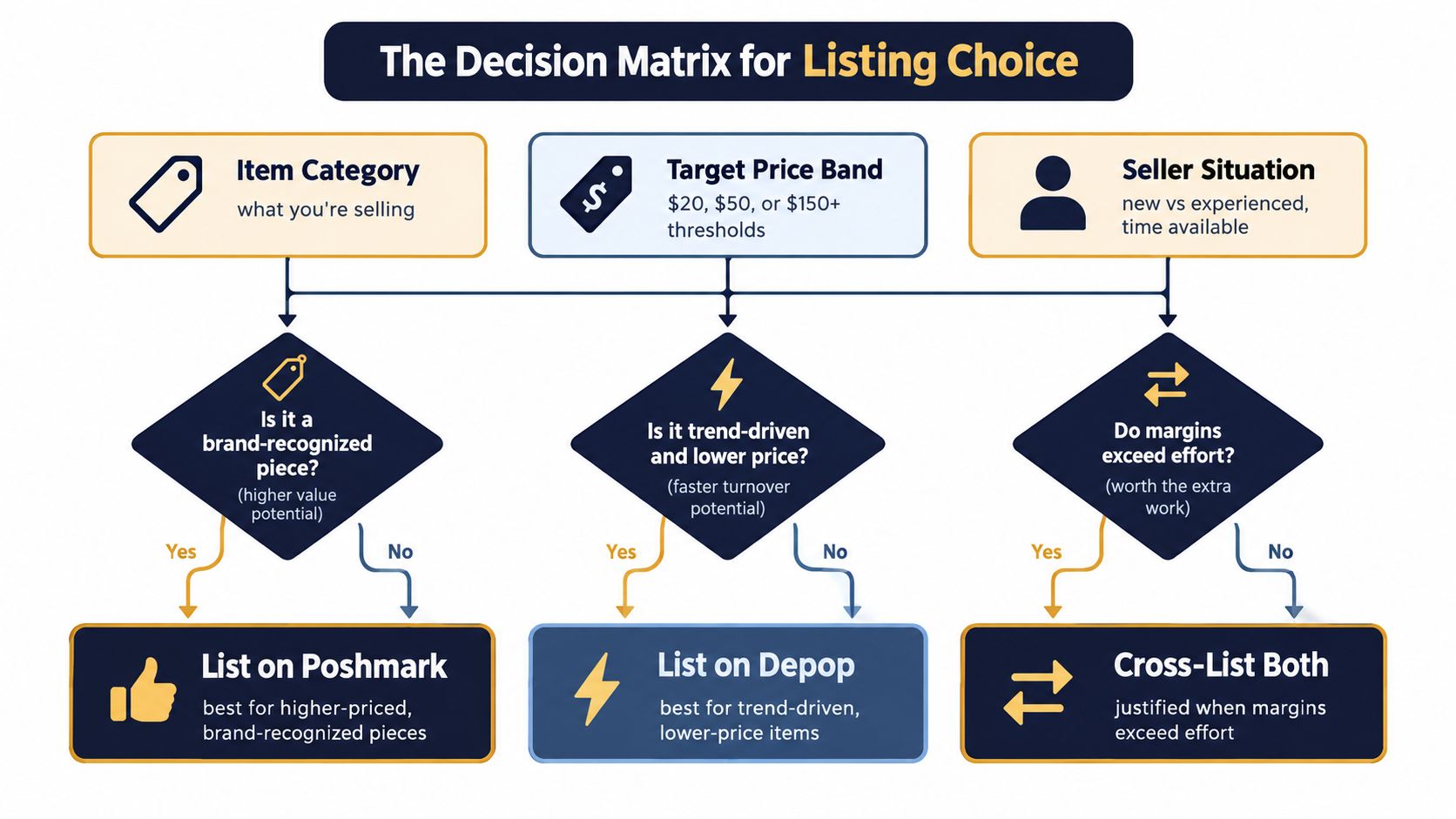
Use three questions before you photograph an item:
- What is it? Identify the category, brand, era, condition, and buyer use.
- What can it realistically sell for? Use sold comps and account for the fee structure, not the highest asking price you can find.
- What kind of selling work does it need? Decide whether it needs styling, daily sharing, buyer education, authentication, or careful shipping.
| Inventory situation | Primary platform | Secondary option | Why |
|---|---|---|---|
| Contemporary brand with a practical wardrobe use | Poshmark | Depop if the styling has a clear aesthetic | Brand search, closet shopping, offers, and bundles make the buyer path easier |
| Vintage, streetwear, workwear, or Y2K | Depop | Poshmark for recognizable brands or broader exposure | The item's identity and visual style carry more weight |
| Luxury or authenticated designer | Poshmark | Depop only when the piece has strong archive or editorial appeal | Brand trust, authentication expectations, and price support matter |
| Handmade, remade, or one-of-one | Depop | Poshmark if the item is easy to classify by brand or category | Depop gives the item's design and story more room |
| Low-priced item under $15 | Depop as the fee-first test | Poshmark only if it can sell in a bundle | Poshmark's flat commission can take a larger share at the low end |
| Mid-priced item from $15 upward | Compare net payout and demand | Cross-list only when the effort is justified | Depop's U.S. fee structure usually leaves more before shipping, while Poshmark may convert better for brand-led goods |
A vintage Ralph Lauren polo is an edge case. If it has an unusual color, oversized fit, older tag, or strong texture, Depop may be the better home. If it's a clean, conventional polo with a searchable size and color, Poshmark is the safer first choice.
Seller situation matters too. A new seller who hates shipping decisions may prefer Poshmark's more structured process. An experienced seller who already measures packages and photographs clothing well can take advantage of Depop's flexibility. A seller with a small death pile shouldn't create double the work for every item.
For a deeper workflow around choosing more than one marketplace, use this guide to selling on multiple platforms. The point isn't to put every item everywhere. The point is to justify the extra work when the likely net payout or sell-through opportunity supports it.
When Multi-Listing Pays and When It Hurts
Multi-listing pays when the item has enough margin, enough demand, or enough uniqueness to justify a second set of photos, descriptions, messages, and sale checks.
A $35 vintage Carhartt jacket is a sensible cross-listing candidate when Depop is the obvious style fit but Poshmark can reach buyers searching the brand. A $120 designer handbag should usually stay Poshmark-first, especially when authentication and buyer trust are central. An $18 Y2K top can work on either platform, but the extra maintenance may not be worth much if both audiences produce similar offers.
Use Vendoo, List Perfectly, or another cross-listing tool if it fits your workflow. These tools can help duplicate and manage marketplace listings, but you still need to deactivate the other copy immediately after a sale. Manual selling works too, provided you maintain a simple sold-item check before accepting offers elsewhere.
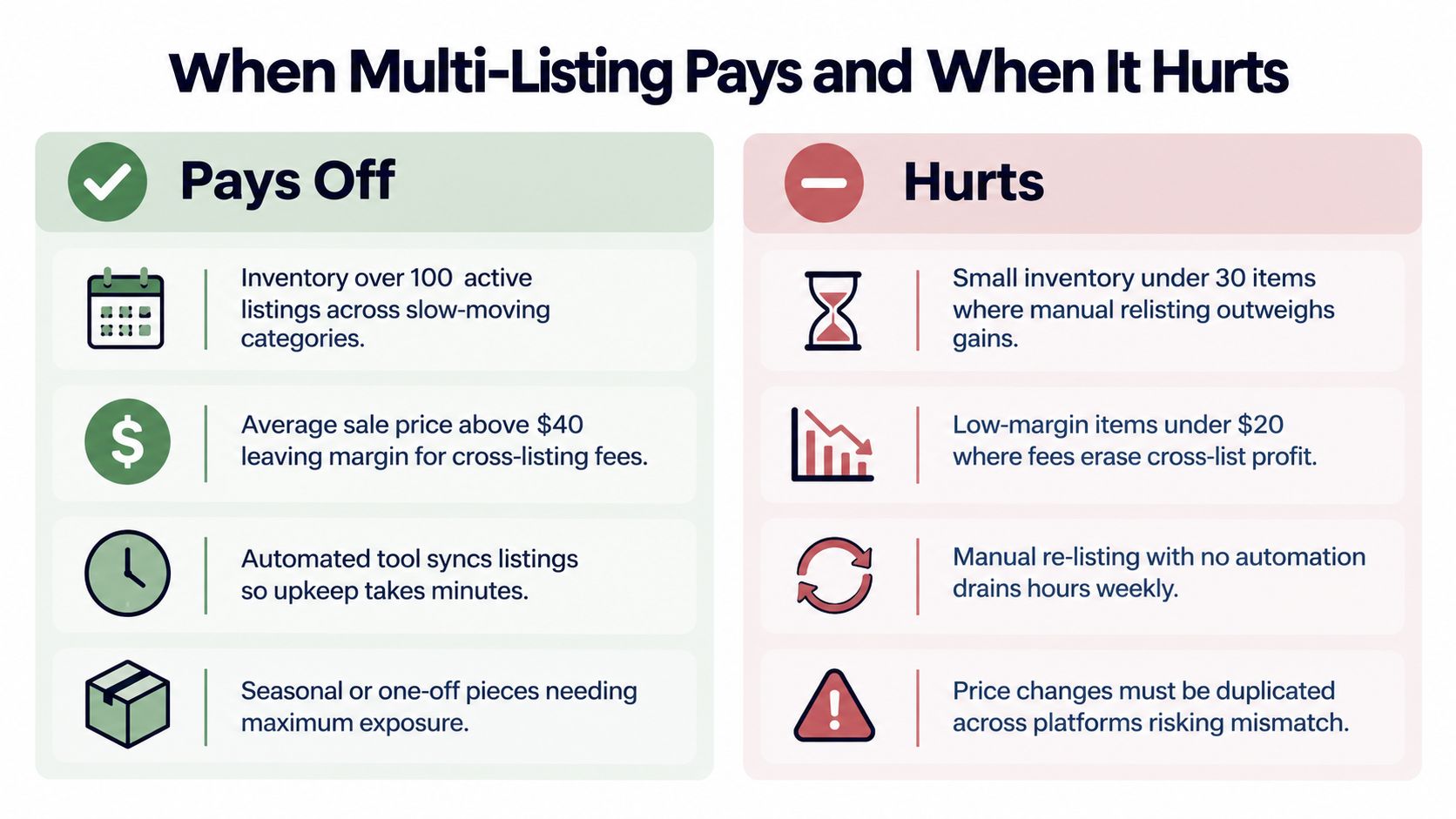
Cross-list when the item earns the effort
Use both platforms when:
- The item has a clear audience on each app: A recognizable brand can fit Poshmark, while its vintage cut or unusual styling gives Depop a reason to surface it.
- The margin leaves room for maintenance: A larger payout gap can justify duplicate work, packaging checks, and prompt deactivation.
- The item is seasonal or one of a kind: More exposure can help when the piece has a narrow selling window.
- Your process is controlled: Keep one source of truth for price, measurements, condition, and location so the same item doesn't drift into conflicting versions.
Single-platform listings protect your time
Keep low-margin inventory focused. Items under $20 can lose their advantage once you add payment processing, shipping decisions, offers, and the time spent maintaining two listings. Premium items above $100 also don't automatically need both apps. If one marketplace has the stronger buyer trust and category fit, duplicate exposure may create more work than sales.
Set a 14-day relist window for items that receive views or likes but no serious offer. Before moving the listing, change the cover photo, tighten the title, verify measurements, and check fresh sold comps. Don't keep expanding the death pile by repeatedly copying weak listings without diagnosing the problem.
The simple rule is clear: cross-list items priced between $20 and $60 when the category fits both audiences, keep sub-$20 and premium $100-plus inventory focused, and review underperformers after 14 days.
ScanFlip AI lets you check an item before you buy it with an AI photo scan that needs no barcode, a barcode scan, or text search. It aggregates sold comps across eBay, Poshmark, Mercari, Depop, Amazon, Whatnot, ThredUp, Facebook Marketplace, and TikTok Shop, then estimates net profit after fees and returns a red or green flip-or-pass verdict. Visit ScanFlip AI before your next thrift-store, estate-sale, or garage-sale buy and compare the actual payout before money leaves your pocket.