
Best Profit Calculator App for Resellers in 2026
You're in a thrift store aisle holding a bread maker, a pair of vintage boots, and a sealed board game. All three look promising. All three could also be dead inventory.
That's the core sourcing problem. Not finding items. Deciding fast enough, with enough confidence, to buy the right one and leave the wrong one behind.
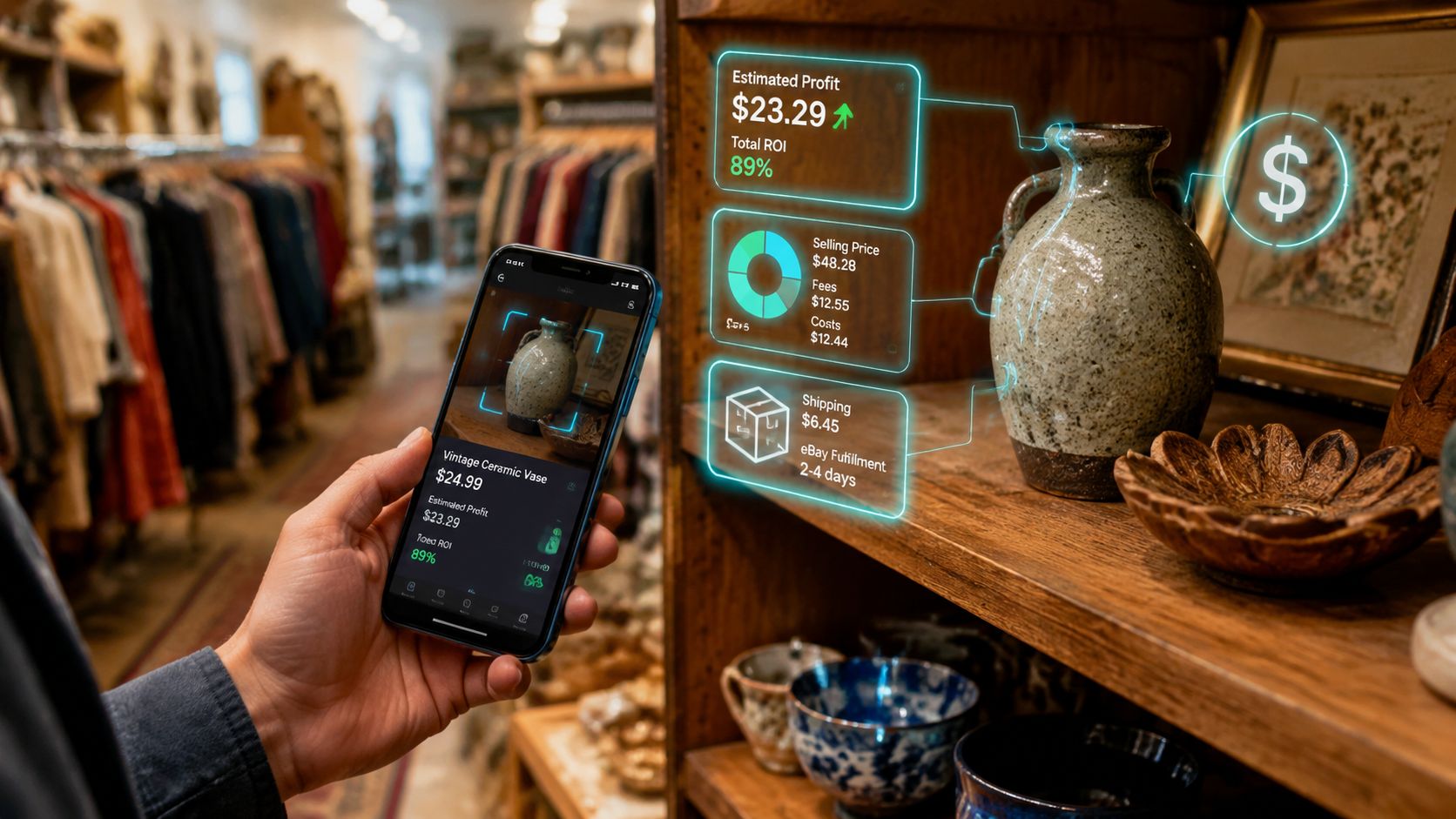
A good profit calculator app changes that moment. It turns a sticker price into a real answer. Not “maybe this sells for more online,” but “after fees, shipping, and platform costs, this is what's left.” In crowded thrift stores, estate sales, and garage sales, that shift matters more than any feature checklist.
Table of Contents
- The Reseller's Dilemma Sourcing in the Wild
- What a Profit Calculator App Actually Does
- Core Features Every Reseller's App Needs
- Your In-Aisle Workflow with a Profit Calculator App
- Evaluating Apps and Avoiding Common Sourcing Pitfalls
- How ScanFlip AI Is Built for Modern Resellers
The Reseller's Dilemma Sourcing in the Wild
A lot of bad buys happen for the same reason. The item looks valuable, the price feels low enough, and there's just enough uncertainty to make you guess.
That guess gets expensive. You miss a hidden defect. You assume the item will ship cheaply. You remember one strong sold comp and ignore the slower ones. Then you get home, run the numbers carefully, and realize the margin was never there.
In the wild, sourcing rarely gives you the luxury of slow thinking. Someone else is already reaching for the same shelf. The store is closing soon. Your cart is filling up. If you stop to open three marketplace apps and do math in your notes app, you lose momentum and often lose the buy.
The aisle test is simple
Most items come down to four questions:
- What is it really? Brand, model, variation, and condition matter more than broad category.
- What has it sold for? Not the optimistic listing price. The sold price.
- What will the platform take? Fees erase a lot of “looks good” flips.
- What's left after shipping and prep? That's your real number.
This is why experienced sellers stop chasing “cheap” and start chasing clear margin.
When sourcing is fast, clarity beats optimism.
A profit calculator app earns its keep in that exact moment. It shortens the path from shelf to decision. If you're still building your sourcing instincts, it also teaches pattern recognition over time. You start seeing which categories survive fees, which ones only look good on paper, and which finds belong on a list of best items to resell for profit.
What hesitation usually means
Hesitation often isn't lack of knowledge. It's too many moving parts at once.
You're trying to price the item, remember platform fees, estimate shipping, judge demand, and compare that against your buy cost in your head. Even seasoned resellers make mistakes when they compress all of that into a few seconds.
That's the dilemma. Not whether an item can sell, but whether it can sell well enough to justify your cash, your time, and your shelf space.
What a Profit Calculator App Actually Does
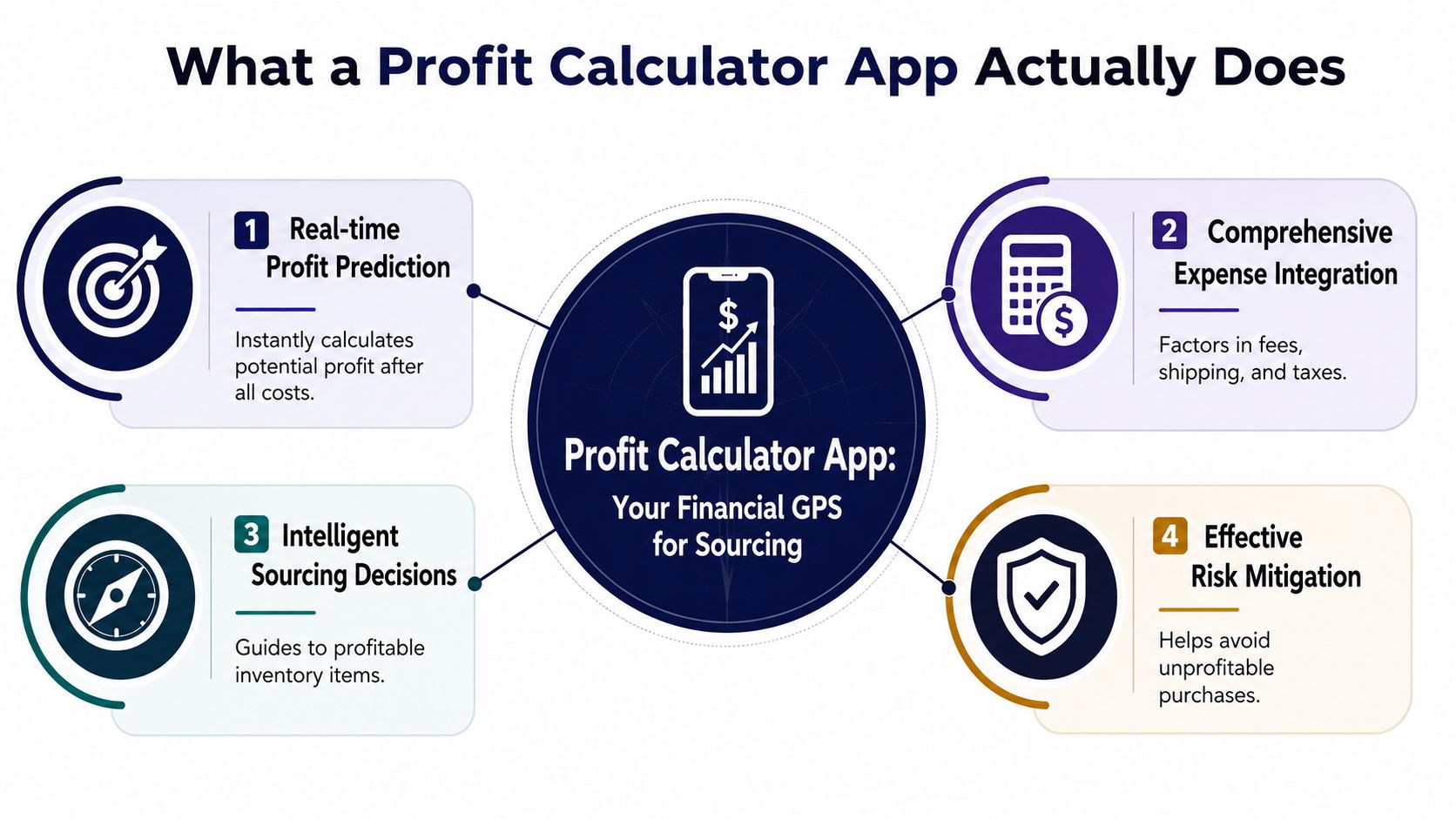
A profit calculator app is a reseller's financial GPS. It doesn't just tell you where a price might go. It tells you whether the route from buy cost to take-home profit is worth taking.
At a basic level, these tools combine item lookup with cost analysis. In retail arbitrage, that workflow matters because the market sits inside a massive online selling ecosystem. In 2023, the global e-commerce market was valued at approximately $6.3 trillion, with the United States contributing over $1.5 trillion, creating the environment where resellers use software to spot low-cost items offline and resell them online for a profit, as described in this overview of retail arbitrage apps and market size.
Gross price is not profit
Newer sellers usually ask, “What can this sell for?”
Better sellers ask, “What do I keep?”
That difference is the whole point. A listing price is only the top line. A profit calculator app works backward from likely selling price and subtracts the costs that hit your payout.
Those costs usually include:
- Marketplace fees for the platform where you sell
- Shipping expense based on the item's size, weight, or likely service
- Buy cost from the store, sale, or flea market
- Prep or handling costs when the item needs cleanup, packing, or extra materials
A useful walkthrough of the numbers behind that process is this guide on how to calculate net profit.
Why manual math breaks down in the aisle
Manual calculation sounds fine until you try to do it ten times in a row while standing next to a cart.
The practical job of the app is to automate the workflow that sellers used to split across multiple tools. Barcode scanning, live price pulling, fee calculation, ROI checks, and estimated per-unit profit all land in one place. That speed matters because sourcing environments don't wait for perfect spreadsheets.
Practical rule: If you need more than a minute to understand the economics of a basic item, your process is too slow for live sourcing.
The best versions also keep you focused on net, not hype. That means fewer emotional buys, fewer “I'll figure it out later” purchases, and fewer items that looked great until the platform invoice arrived.
A weak app behaves like a calculator with a prettier screen. A strong one behaves like a decision engine.
Core Features Every Reseller's App Needs
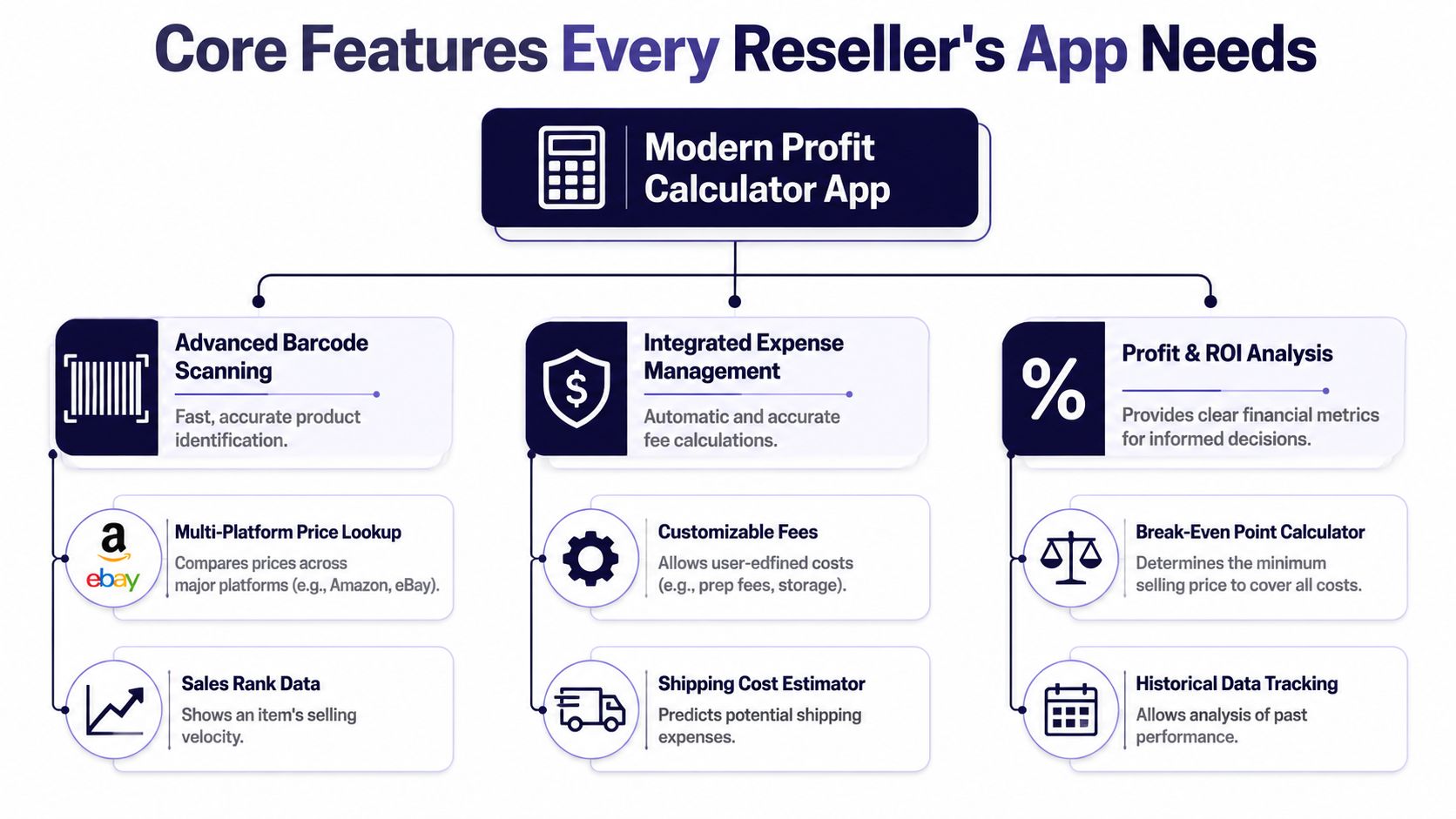
Shelf decisions live or die on speed, but speed without accuracy gets expensive. The right app shortens the time between scan and decision while keeping the numbers honest.
Identification has to work beyond barcodes
Barcode scanning helps on new retail inventory. It breaks down fast once you move into used goods, missing tags, multipacks, bundles, or products with several lookalike variants.
That is where weak apps waste your time. You scan, get no match, start typing, and lose the pace that makes in-store sourcing work.
Look for an app that can handle:
- Camera-based item recognition for products without a usable UPC
- Variant matching so size, color, model number, and edition stay separate
- Quick manual fallback with minimal typing when the camera misses
- A tight scan-to-decision flow similar to a practical scan-to-buy sourcing workflow
A reseller does not need more inputs. A reseller needs fewer dead ends.
Comps need market shape, not cherry-picked wins
One high sold comp can talk you into a bad buy. What matters in the aisle is whether the item sells often enough, at a price range wide enough, to leave room after fees and shipping.
Good apps show the market in a way you can use quickly. Recent solds matter more than active listings. A spread of sale prices matters more than the top result. Demand signals matter because a profitable item that sits for months still ties up cash and shelf space.
The strongest tools usually give you:
- Sold comparables across marketplaces so you are not relying on one channel's pricing
- Recency cues that show whether the demand is current or stale
- Price range visibility so you can buy against the middle of the market, not the best case
- Sell-through or velocity hints that help separate fast flips from long holds
The practical test is simple. If the comp screen makes it easy to justify almost any item, the app is feeding optimism instead of discipline.
The calculator has to reflect real costs
Profit math is simple on paper. The hard part is catching the costs that affect your payout before you buy the item.
A usable app should calculate net profit from expected sale price after subtracting buy cost, marketplace fees, shipping, and any prep expense. It should also let you change assumptions quickly, because the same item can work at one shipping method and fail at another.
That matters most on borderline buys. A small fee difference, a heavier-than-expected package, or a $4 replacement part can turn a decent pickup into a pass.
Here is what the calculator needs to account for:
| Need | Why it matters in practice |
|---|---|
| Custom cost inputs | Used and salvage inventory often needs cleaning, batteries, parts, or packaging |
| Shipping estimates | Size and weight can erase margin faster than most new sellers expect |
| Marketplace-specific fees | The same item produces different payouts on eBay, Amazon, Poshmark, and Mercari |
| ROI and margin views | Dollar profit alone does not show whether the cash outlay makes sense |
| Editable sale price assumptions | You need to test realistic, conservative, and fast-sale pricing on the spot |
A calculator that only shows upside is not a sourcing tool. It is a way to overbuy.
Your In-Aisle Workflow with a Profit Calculator App
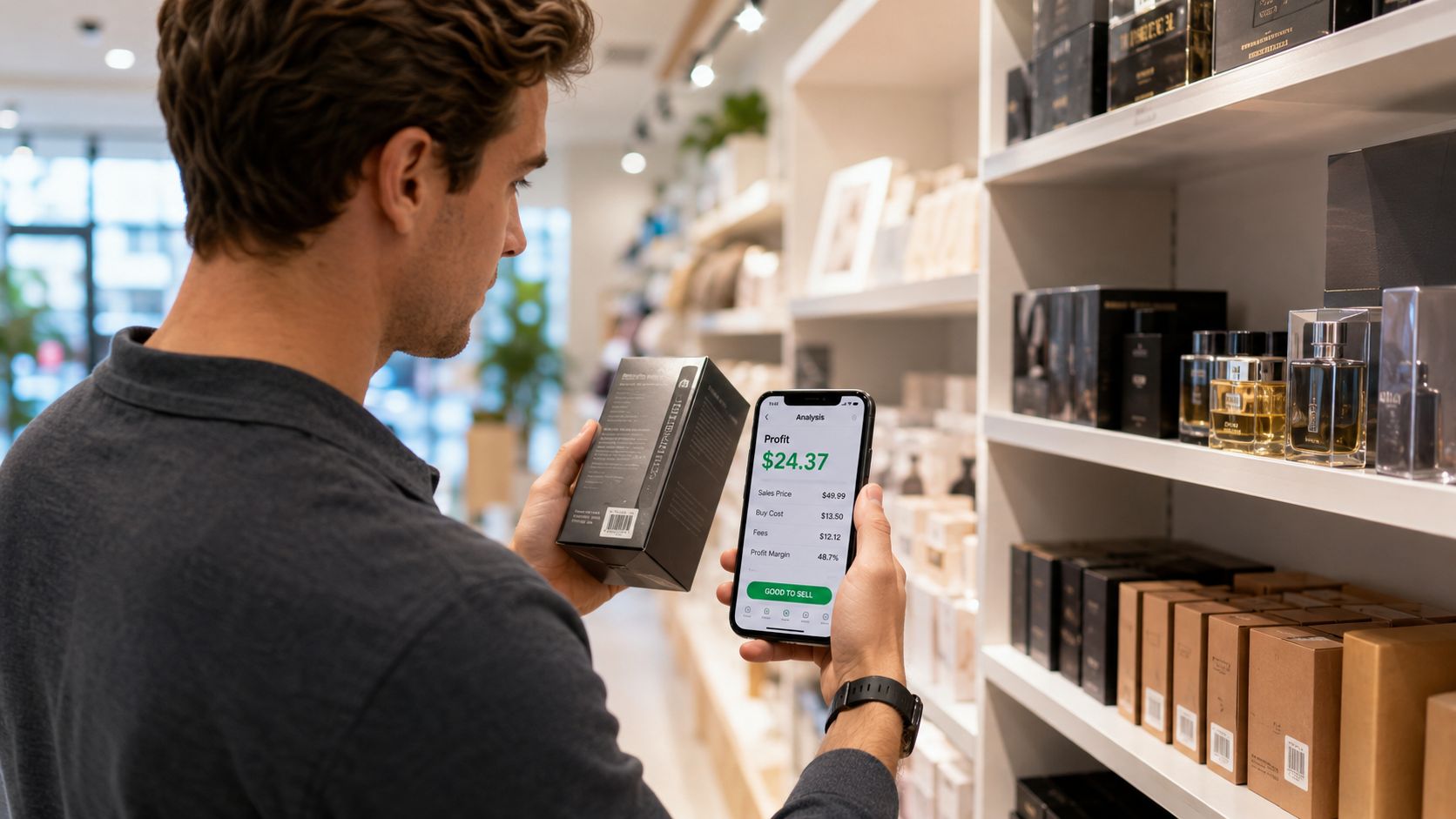
You're standing in a thrift aisle with a cart in one hand and your phone in the other. Two other sellers are already working the same shelf. You do not have ten minutes to research one item. You need a fast read on whether it belongs in the cart or back on the rack.
That is where a profit calculator app earns its keep. In the store, speed matters, but bad speed gets expensive. The job is to get to a grounded buy or pass decision before hesitation, bad assumptions, or another reseller beats you to it.
Step one is identify the item fast
Start with the fastest input that is likely to be right. Scan the barcode if the item has one and the packaging is clear. If it is used goods, apparel, shoes, or something with no useful barcode, switch to camera search or a short manual search built around brand, model, size, and one distinctive detail.
The goal at this stage is not complete research. It is a reliable match.
A pair of used boots is a good example. In the aisle, the app should help you answer three questions fast:
- What is the exact item or the closest likely match?
- What do sold comps look like at its current condition?
- Is there enough demand to justify spending more time on it?
If your process still means bouncing between marketplace tabs and mental math, a tighter scan-to-buy workflow for reseller sourcing will usually improve your trip more than another sourcing rule or bolted-on spreadsheet.
Step two is pressure test the numbers
Once you have likely comps, plug in your cost and try to disprove the buy.
That mindset matters. In a store, the easiest mistake is building the case for an item you already want to buy. A useful workflow does the opposite. It checks whether the flip still works after you lower the expected sale price, account for real condition, and use a shipping method you would choose.
Use a quick filter:
- Check condition before price. Scuffs, missing parts, stains, dead batteries, and worn soles all push the actual sale price down.
- Use a normal sold comp. Ignore the outlier at the top unless your item clearly matches it.
- Estimate shipping accurately. Boots, blenders, framed art, and anything oversized can wipe out what looked like easy profit.
- Read net profit, not gross spread. The number that matters is what is left after fees, shipping, and prep.
If the deal only works under best-case assumptions, leave it.
Step three is make the call while you still have context
Good sourcing apps reduce debate with yourself. After the scan and the math, the next move should be obvious enough to act on in a few seconds.
There are usually only three outcomes:
- Buy now if the expected net clears your threshold and the item should sell in a reasonable time
- Pass if profit is thin, demand looks soft, or the condition risk is too high
- Research later if the item is unusual enough to justify a second look outside the aisle
That last category should stay small. If too many items fall into “maybe,” the workflow is too slow or your buy criteria are too loose.
The primary gain is not perfect accuracy on every item. It is cleaner decision-making during a live sourcing trip. You spend less time carrying marginal inventory around the store, less time talking yourself into weak buys, and more time picking up inventory that still looks good after the numbers take a hit.
Evaluating Apps and Avoiding Common Sourcing Pitfalls
Most reseller apps look better on a landing page than they do in a thrift store. The difference shows up when you need answers on oddball inventory, weak cell service, messy packaging, and fast decisions.
There's also a bigger market gap here. Many calculator tools were built for e-commerce operators managing inventory and marketing, not for secondhand resellers making live buy decisions. One summary of that gap notes that 68% of resellers waste 15+ minutes per item researching prices across multiple platforms, which explains why single-scan workflows matter so much for thrift and arbitrage sellers in practice, as described in this discussion of reseller research time and app limitations.
What to compare before you commit
Use the app the way you typically source, not the way the demo wants you to source.
| Feature | Why It Matters | Look For |
|---|---|---|
| Cross-platform comps | One marketplace can give a distorted picture | Sold data from multiple resale platforms in one view |
| Visual identification | Many profitable items don't have useful barcodes | Camera-based recognition for apparel, shoes, collectibles, and used goods |
| Fee handling | Old fee assumptions create fake margin | Centrally updated marketplace fee schedules |
| Shipping input | Shipping mistakes wreck profit | Easy cost estimation with room for manual adjustment |
| Saved history | Good sourcing gets better with review | Stored scans, photos, and prior lookups |
| Simple verdict | Too much complexity slows decisions | Clear net profit, margin, and buy/pass cues |
What the app still can't do for you
No app can fix bad judgment on condition.
If the jacket has a broken zipper, the coffee maker is missing a carafe, or the board game has taped corners, the software can't fully price that risk for you. You still need to inspect items like a seller, not just like a scanner operator.
Common mistakes worth watching:
- Ignoring condition gaps when comparing your item to cleaner sold comps
- Underestimating bulk on shoes, appliances, and awkward home goods
- Falling for high asking prices instead of checking what sold
- Buying slow inventory because the top-end price looked attractive
The app should make you faster. It shouldn't make you careless.
The best setup is simple: trust the calculator for math, trust your eyes for condition, and trust sold evidence over hope.
How ScanFlip AI Is Built for Modern Resellers
Most reseller tools were not built around the aisle. They were adapted to it.
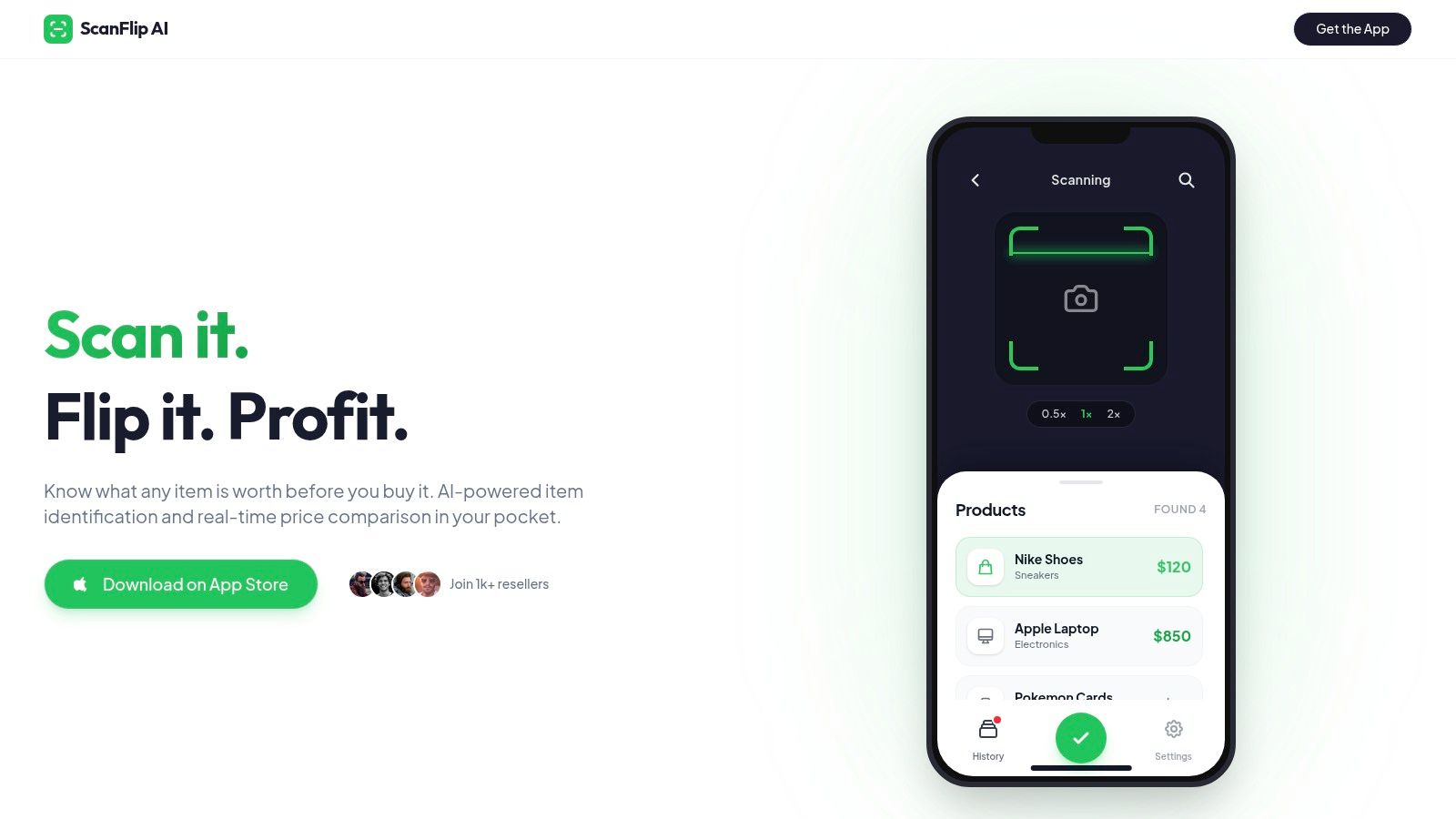
That's the main difference with ScanFlip AI. The product is built around the sourcing moment itself. You scan an item, identify it from a photo even when there's no barcode, review sold comps across major marketplaces, and get an expected net result after fees and shipping.
Why it fits the real sourcing workflow
The strongest part of the product is that it combines the pieces resellers usually split across several tools:
- Visual item identification from camera photos
- Cross-platform sold comparables across marketplaces used by secondhand sellers
- Automatic profit calculation with platform fees and shipping estimates
- Configurable flip-or-pass thresholds so the verdict matches your model
That matters most on inventory that breaks normal lookup habits. Shoes without boxes. Vintage apparel. Collectibles. Accessories. Used electronics. All the categories where barcode-first tools start to wobble.
Where it solves the usual friction
A lot of sourcing time gets wasted on toggling. One app for price checks. Another for comps. A calculator for fees. Notes for history. Then a mental debate.
ScanFlip AI reduces that friction by keeping the workflow in one place and saving scan history with photos, timestamps, and location context for later review. That makes it useful not only for live decisions, but for improving your sourcing pattern over time.
If your goal is to make cleaner buy or pass calls without bouncing between apps, ScanFlip AI is built for that job. It gives modern resellers a faster way to identify items, compare sold comps, calculate real take-home profit, and move through a sourcing trip with less hesitation and better math.